No “Gold Standard,” No Israel Clause: What the Saudi Nuclear Deal Actually Says (MBN)

August 7, 2026 , https://npolicy.org/no-gold-standard-no-israel-clause-what-the-saudi-nuclear-deal-actually-says-mbn/
Two weeks ago, President Trump was about to send the Hill a U.S.-Saudi nuclear cooperative agreement. After a torrent of criticism from Fox News, The Wall Street Journal, and The New York Times, though, he changed his mind and insisted that the United States would not help Saudi Arabia make nuclear fuel and that the deal would not come into force until Saudi Arabia recognized Israel.
The question now is what’s next. Below is an interview I granted to the U.S. government’s Middle East Broadcasting Network that takes a stab at where we’re headed.
First, if the deal proceeds as the U.S. Energy Department and the press have described it will provide the Saudis with a pathway to make nuclear fuel—the most difficult and essential step to making nuclear weapons. The problem here is that Israel and the United States have been bombing a variety of nuclear sites to throttle this very same activity in Iran.
In an attempt to avoid this contradiction, the Energy Department insists there will be no enrichment unless a two-year study concludes that Saudi nuclear fuel-making is economically sound and can be rendered safe. Yet, as I note below, the premise of conducting such a study—that the answer could be yes—is disingenuous. We already know the honest answer is no.
The second problem with the agreement is that it does not require Riyadh to adopt international nuclear inspections (known as Protocol I visits) that would allow the International Atomic Energy Agency (IAEA) to go anywhere, anytime outside declared nuclear sites. One hundred and forty four nations have already granted authority to the IAEA to conduct such inspections on their soil. Saudi Arabia has refused.
This suggests that Riyadh has something it wants to hide, possibly including a covert nuclear weapons program. Saudi officials are already on record that the Kingdom must get nuclear weapons if it believes Iran is acquiring them. Saudi Arabia also has tight connections to Pakistan, which has mastered both enrichment and nuclear weapons design.
Finally, by creating a pathway to dangerous nuclear weapons-related activities, it will set a precedent for Riyadh’s neighbors, including the United Arab Emirates, Turkey, and Egypt—nations pursuing large nuclear power programs.
The Energy Department’s rejoinder is that if the United States doesn’t help Saudi Arabia make nuclear fuel, Russia and China will with fewer controls. That gets things backwards. In fact, no country—not the United States, not China or Russia—during the last half-century has offered to transfer nuclear fuel-making technology to states lacking nuclear weapons. The last country to do that was the United States in the 1960s with India, which used the assistance to set off a “peaceful” nuclear explosion.
If, as proposed, the United States violates this sound standard by helping Saudi Arabia enrich uranium, the very thing our Energy Department says it is worried China and Russia might do, is what our violation of this standard will ensure.
The President has yet to send the Saudi nuclear agreement to Hill for review. As I argue in the attached interview, it would be best if it never left his inbox or, at least, our government renegotiated to include the very things President Trump now insists are necessary—no enrichment and Saudi Arabia’s recognition of Israel.
August 4, 2026
Henry Sokolski Interview with Middle East Broadcasting Networks
No “Gold Standard,” No Israel Clause: What the Saudi Nuclear Deal Actually Says
The Trump administration has yet to formally send to Congress the nuclear cooperation agreement it signed with Saudi Arabia last month.
Energy Secretary Chris Wright and Saudi Energy Minister Prince Abdulaziz bin Salman signed a Section 123 agreement – the legal step that allows American companies to share nuclear technology with another country – in Riyadh on July 22. The Department of Energy said at the time that the agreement would “now be transmitted to Congress for review.”
Until it is, the review clock cannot start. Once transmitted, the agreement takes effect “after 90 consecutive legislative days of sitting before Congress” – days Congress is actually in session, not calendar days – “which could be sometime before the end of this year,” said Henry Sokolski, who runs the Nonproliferation Policy Education Center and served as the Pentagon’s deputy for nonproliferation policy in the George H.W. Bush administration.
The administration has also complicated its own deal. A day after the signing, President Trump posted on Truth Social that Saudi Arabia would not be allowed to enrich uranium, and that the entire arrangement depended on Riyadh joining the Abraham Accords and establishing relations with Israel.
Those conditions do not appear in what the two governments actually signed, Sokolski told MBN.
“I’m with the Saudis on this. I think they’ve got it right, which is: you’ve got to be kidding. We signed documents. They didn’t have anything in it about these other conditions,” Sokolski said. “It is not part of the deal.”
Saudi Arabia has said repeatedly that it will not normalize relations with Israel unless Israel agrees to Palestinian statehood — a condition Prime Minister Benjamin Netanyahu has refused.
Sokolski noted that the president retains one lever regardless: even after the agreement takes effect, he can decline to approve nuclear exports to Saudi Arabia. “He has that power. But it’s not something that he’s legally bound to do. It’s something that’s executive discretion,” he said.
What the deal actually allows
A full assessment is still impossible. The text of the agreement has not been published, nor have two side letters that accompany it. “We haven’t seen them,” Sokolski said. “Of course, we haven’t even seen the 123 agreement yet.” Most of what is known comes from briefings the Energy Department has given reporters.
What is known is this: once in force, the deal defers the central question to a study. “There’ll be a two-year study on, well, is the making of nuclear fuel by enriching uranium really all that economical for Saudi Arabia,” Sokolski said.
If the study says yes, American firms would build an enrichment plant on Saudi soil, operating under U.S. oversight.
“If the conclusion of that is yes, then the United States would actually build a plant, an enrichment plant, that would bring the most sensitive technologies that we’re now currently bombing in Iran to Saudi Arabian soil,” Sokolski said, referring to the U.S. military campaign aimed at preventing Iran from obtaining nuclear weapons.
If the study says no, “the agreement somehow will bind the Saudis to not get enrichment from anyone else for 10 years,” Sokolski said, citing reporting on two side letters that have not been made public. A separate side agreement, he added, would limit Saudi reactor purchases to Westinghouse — a company headquartered in Pennsylvania but owned by two Canadian firms.
A departure from the “gold standard”
The agreement breaks with the terms Washington set for the United Arab Emirates in 2009 – an arrangement so strict it became known as the “gold standard.” Abu Dhabi made a legal commitment to forgo both uranium enrichment and the reprocessing of spent fuel, the two most direct pathways to a nuclear weapon. It also accepted the International Atomic Energy Agency’s Additional Protocol, an inspection regime that lets IAEA monitors examine nuclear-related sites a country has not formally declared.
Saudi Arabia has agreed to neither.
“In the case of Saudi Arabia, the forswearing did not occur at all,” Sokolski said. “Worse, they did not agree to the Additional Protocol — which raises the question: do they have something to hide, or do they think they will?”
“144 countries – almost all the countries in the world – have agreed to the Additional Protocol,” he added. “Not Saudi Arabia.”
Supporters of the deal argue that American oversight of a Saudi facility is better than pushing Riyadh toward Russia or China, which might offer looser terms. Sokolski is skeptical that American control would survive contact with reality.
“We have this expression in the United States: possession is 90 percent of the law. If you have something on your soil, you can always tell the Americans to leave. And there you go – you have it,” he said.
A declared facility, he added, does nothing to rule out a covert program – especially without the Additional Protocol, which exists precisely to let inspectors chase undeclared activity.
A history of finding out too late
Sokolski pointed to Saudi Arabia’s record of acquiring missile capabilities without Washington managing to stop it in advance. “The track record there is 100 percent consistent. Every time they’ve gotten a missile, it was too late for us to do anything to block it,” he said. The Washington Post has reported that Riyadh secretly bought Chinese ballistic missiles in the 1980s, and that Washington learned of the deal only after the missiles had arrived and construction of their bases had begun inside the kingdom.
The stakes are raised by the Saudi crown prince’s own words. In 2018, Mohammed bin Salman told CBS’s “60 Minutes” that if Iran builds a nuclear weapon, Saudi Arabia would “follow suit as soon as possible.”
“In the case of Saudi Arabia, they’ve been pretty clear that if they think Iran’s getting a bomb, they have to get one too,” Sokolski said.
The fight in Congress
The deal “hasn’t sat well with a lot of people on the Hill,” Sokolski said, including some staunch Trump supporters – among them Sen. John Kennedy of Louisiana, who has been “quite emphatic saying there’s no way he’s going to support this.”
Blocking it is hard, but not impossible. “You don’t need many Republican senators to join a whole lot of Democrats to pass a piece of legislation,” Sokolski said, especially if Democrats take the House next year. The president could veto such a bill – but, he added, “you do not, as a president, want to see that coming to your desk.”
He suggested two narrower options for Congress: bar the use of American funds to implement any part of the agreement that permits nuclear fuel production inside Saudi Arabia, or write in an explicit condition that cooperation cannot lead to an enrichment facility.
The regional echo
The consequences do not stop at Saudi Arabia’s borders. The U.S.-UAE agreement contains a consultation clause triggered if Washington gives another country in the region more generous terms – and granting Riyadh a future path to enrichment, Sokolski said, could prompt Abu Dhabi to demand a renegotiation of its own deal. Egypt and Turkey could invoke the Saudi precedent to press their own claims to a full nuclear fuel cycle on their territory.
“Folks assume the worst when someone says they’re going to do something and they have the means to do it,” he said.
Sokolski worries the agreement could unravel a policy Washington has held since India’s nuclear test in the 1970s: refusing to help non-nuclear-weapon states produce nuclear fuel. Russia and China have largely taken the same public position, he said — but an American exception for Saudi Arabia could invite others to make their own.
The argument that the United States must cooperate because someone else will anyway is, he said, “a self-fulfilling fallacy.”
“People say, well, if you’re going to do that, then we got to do that,” he said.
Not settled yet
For all his criticism, Sokolski stressed that nothing is final. The economic study has not begun, Congress has not reviewed the agreement, and the administration could still tighten its terms or attach conditions to implementation. The deal, he said, looked like “a trial balloon” whose drafters “may have been a little too clever by half, not knowing exactly what they were locking into.”
“I just don’t know how the story ends,” he said, “and it could end very badly.”
To read the full piece, click here.
Walt Zlotow – After 164 years it’s America facing ‘Unconditional Surrender’

Walt Zlotow West Suburban Peace Coalition Glen Ellyn IL, 10 Aug 26, https://theaimn.net/after-164-years-its-america-facing-unconditional-surrender/
America is famous for declaring its foes capitulate to unconditional surrender. It was first uttered in 1862 by Ulysses S. Grant who demanded the “unconditional and immediate surrender” of Confederate forces at Fort Donelson, Tennessee. U.S. Grant forever became known as Unconditional Surrender Grant.
US war presidents loved unconditional surrender. FDR employed it on Germany before he died and it worked well. Didn’t go so easily for Truman on Japan. Burning down Toyko on March 10 with Napalm, killing a hundred thousand innocents didn’t. A bombing Hiroshima.
August 6 didn’t. Even the second A bomb on Nagasaki did not definitively make Japan bow to the US demand. Most likely it was the million man Russian invasion the day before the Nagasaki bomb that convinced Japan to surrender unconditionally.
Unconditional surrender lay dormant for the next 81 years. It was AWOL thru Korea, Vietnam, Iraq, Afghanistan as the US failed to achieve anything close to an unconditional surrender from opponents that stymied, even defeated the vaunted world’s strongest military.
But on March 6, President Trump, unaware he’d already lost his delusional war to bring down the Iranian regime at the behest of Israel, declared Iran must submit to Unconditional Surrender.
Trump posted on Truth Social a week into his lost war demanding “unconditional surrender” from Tehran. Then he trotted out his clueless Press Secretary Karoline Leavitt to describe what would constitute unconditional surrender.
“What the president means is that when he, as commander in chief of the U.S. Armed Forces, determines that Iran no longer poses a threat to the United States of America and the goals of Operation Epic Fury has been fully realized, then Iran will essentially be in a place of unconditional surrender.”
One hundred sixty-three days into his lost war, President Trump finds America facing unconditional surrender. Unless he capitulates on all of Iran’s reasonable and non-negotiable terms, Iran will not fully reopen the Strait of Hormuz, placing the world’s economy in jeopardy of collapse.
What are those reasonable terms of surrender?
1. End all military action against Iran including bombing and blockade
2. Promise never again to attack Iran
3. End all economic sanctions on Iran
4. Return all frozen Iranian assets
6. Provide reparations for damage inflicted in Trump’s illegal criminal war launched February 28
Of course, facing unconditional surrender does not mean Trump will surrender unconditionally to Iran’s reasonable demands. He may simply adhere to the counsel of his former evil mentor Roy Cohn… ‘Never give up, never give in’ and mutter “After me, the deluge.”ww
What Does It Take to Reopen a Nuclear Power Plant?

By Felicity Bradstock – Oil Price 9th Aug 2026
- The Trump administration wants to expand U.S. nuclear capacity through new reactors, power uprates, and the return of previously shuttered plants.
- Holtec’s Palisades restart has encountered corrosion, equipment repairs, supply-chain problems, and other unexpected challenges that illustrate the difficulty of reviving an aging reactor.
- Other projects, particularly Constellation’s Crane Clean Energy Center, could prove easier to restart and demonstrate that the viability of reactor recommissioning varies significantly by plant.
In the United States, President Trump aims to expand the country’s nuclear power capacity by developing new projects and restoring old reactors. However, restarting disused reactors is not as simple as just turning them back on, as rigorous safety standards must be considered.
In May 2025, President Trump published an executive order entitled “Reinvigorating the Nuclear Industrial Base”, in which he outlined plans to start construction of 10 new large reactors and add 5 GW of power to existing nuclear reactors by 2030.
Several U.S. reactors were shut down in previous decades as confidence in nuclear power fell to an all-time low following three prominent nuclear disasters – Chornobyl, Fukushima, and Three Mile Island. However, the public perception of nuclear power has significantly improved in recent years.
Last year, Trump announced plans to recommence operations at the Palisades Nuclear Plant in Michigan, a 789-MWe plant owned by Holtec International that shut down in 2022; the Constellation Energy 835-MWe Crane Clean Energy Centre on the Three Mile Island site in Pennsylvania; and NextEra’s 615-MWe Duane Arnold in Iowa. This supports Trump’s aim for a U.S. nuclear renaissance…………………………………………………………………………………………………
https://oilprice.com/Alternative-Energy/Nuclear-Power/What-Does-It-Take-to-Reopen-a-Nuclear-Power-Plant.html
America places huge order for 14 more nuclear submarines
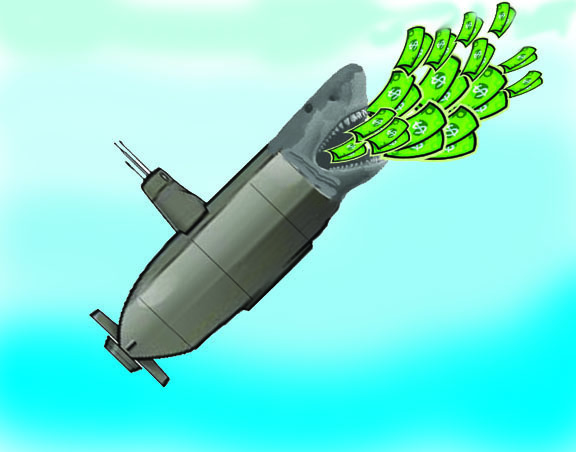
The United States Navy has placed contract modifications worth around $76.6 billion with the two yards that build its
nuclear submarines, covering nine further Virginia-class boats, five more Columbia-class ballistic missile submarines and funding for shipyard infrastructure, HII stated.
ukdj , UK Defence Journal 9th Aug 2026
The award covers Block VI of the Virginia programme and Build II of the Columbia programme, and is split between HII’s Newport News Shipbuilding division in Virginia and General Dynamics Electric Boat in Connecticut and Rhode Island. Newport News will act as delivery yard for six of the nine Virginias, and on the Columbia programme will construct and deliver six module sections for each boat. The two yards have handed over 26 Virginia-class submarines to date.
Kari Wilkinson, president of Newport News Shipbuilding, said in the release that the company is “committed to building the nuclear-powered submarines that protect our nation”, adding that the contracts give the American shipbuilding industrial base an opportunity to demonstrate that commitment.
The two programmes represent the largest naval construction effort under way anywhere. The Columbia class will replace the fourteen Ohio-class boats that carry the sea-based leg of the US nuclear deterrent, with twelve planned in total. Each displaces around 20,800 tonnes submerged, making them the largest submarines the United States has built, and each carries sixteen Trident II D5 missiles in a common missile compartment developed jointly with the United Kingdom, which uses the same section in its Dreadnought class. The lead boat, USS District of Columbia, has been under construction since 2020 and has run behind schedule, with the Navy and the Government Accountability Office both reporting delays measured in years.
The Virginia class is the U.S. Navy’s attack submarine, displacing roughly 7,800 tonnes and built in successive blocks with incremental changes. Block V introduced the Virginia Payload Module, an additional hull section carrying four large vertical tubes that raises the boat’s Tomahawk capacity substantially, and later blocks continue that configuration. Delivery rates have been the persistent problem: the U.S. Navy has sought two boats a year for some time, while the yards have been running closer to one and a third, a shortfall attributed to supply chain fragility, workforce attrition and the competing demand of the Columbia programme, which holds priority.
Newport News Shipbuilding is the only yard in the United States capable of building aircraft carriers and one of only two able to build nuclear submarines. The company marked 140 years of operation at the Virginia site earlier this month, and has been expanding automation across its facilities, including agreements with robotics firms announced in early August covering welding and surface finishing work
Trump’s nuclear deal: a disaster for the Middle East?
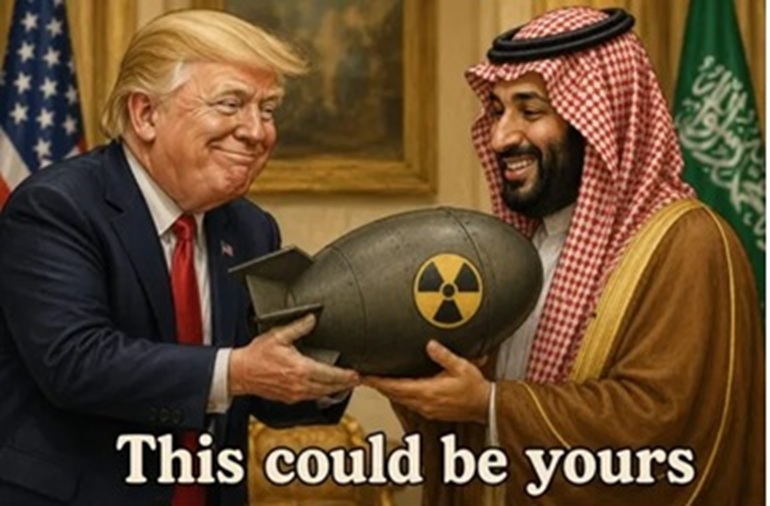
No, the real reason is to gain atomic weapons to protect itself against its main foe: Iran. MbS has made no secret of his desire to build a bomb, and the deal would be a concrete step in that direction. Despite Trump’s claims to the contrary, it appears to permit nuclear enrichment on Saudi soil, thus enabling Riyadh to follow the likes of India, Israel and Pakistan in covertly enriching uranium to weapons-grade level
The hard truth is that the “era of non-proliferation is coming to an end”
Well, is it on or is it off? No one’s quite sure, said Al Jazeera (Doha). Two weeks ago, the United States and Saudi Arabia signed a multibillion-dollar deal allowing US companies to build and operate nuclear power plants on Saudi soil over the next 30 years.
But a day later, President Trump added a new condition, via social media: Saudi Arabia must fall in line with the UAE and other Arab nations that have signed the Abraham Accords, and recognise the state of Israel.
‘Reckless’ agreement
And that may prove a deal breaker, said David Frum in The Atlantic. Riyadh had been working towards this landmark pact for almost two decades. Thanks to the savvy of its de facto leader Crown Prince Mohammed bin Salman (MbS), who ensured the private equity firm of Trump’s son-in-law, Jared Kushner, would get its share of the billion-dollar nuclear licensing deals at stake, he almost got it over the line.
But now it must surely be in doubt, said Mohamad Elmasry on Middle East Eye. Riyadh has vowed it won’t normalise relations until Israel guarantees Palestinian statehood. And MbS has reportedly told US officials that hostility towards Israel is so great among Saudis in the wake of Israel’s devastating war in Gaza, that to sign a normalisation treaty would probably get him assassinated.
It’s obvious why the Saudis still badly want this nuclear deal, said Joseph Cirincione on MS Now (New York). It’s not, as they claim, to diversify their energy profile: that makes no sense for a nation sitting on an ocean of oil and blessed with the ideal wind and solar conditions for generating renewable energy – a far cheaper option.
No, the real reason is to gain atomic weapons to protect itself against its main foe: Iran. MbS has made no secret of his desire to build a bomb, and the deal would be a concrete step in that direction. Despite Trump’s claims to the contrary, it appears to permit nuclear enrichment on Saudi soil, thus enabling Riyadh to follow the likes of India, Israel and Pakistan in covertly enriching uranium to weapons-grade levels.
‘Guiding hand’
Who knows what’ll happen if this “reckless” deal goes ahead, said Mitchell Plitnick on Mondoweiss (New York). The “gold standard” nuclear-power pact that the US signed with the United Arab Emirates in 2009 required the UAE to forego the ability to enrich uranium, and obliged it to submit to International Atomic Energy Agency inspections: this Saudi deal has no such restrictions.
Which is why it would inevitably trigger a Middle East arms race, said Azriel Bermant in Foreign Policy. If the deal proceeds, Iran would openly seek its own nuclear deterrent, something it has so far officially forsworn. “It beggars belief that the US went to war against Iran to prevent it from acquiring a nuclear weapon yet now acts in a way that is an open invitation for Tehran to weaponise.” And in a way that would also pour “proliferation kerosene” on Turkey and Egypt’s “smouldering nuclear ambitions”, said Matthew Kroenig and Henry Sokolski in The Wall Street Journal. Trump’s deal invites disaster.
Actually, the US is doing the right thing, said the Washington Examiner. The hard truth is that the “era of non-proliferation is coming to an end”: Pakistan and North Korea are both testing nuclear weapons. Given that sobering reality, better the US offer “a guiding hand” to the Saudis and oversee their nuclear agenda than let China or Russia fill the void.
Good or bad, the deal matters a lot to the US president, said Sharon Squassoni in The Bulletin of the Atomic Scientists (Chicago), so rumours of its death “are premature”. After all, it’s not some “spur-of-the-moment fantasy” cooked up by Trump. The same deal was also being considered under Joe Biden, and then too enrichment was a quid pro quo for recognising Israel.
The Saudis won’t do so, of course, given recent history, but they won’t have to. Although Congress can disapprove the deal once it’s submitted, the present Congress – due to adjourn on 18 December – is much less likely to do so than any freshly elected one. So the Saudis can “call Trump’s bluff by simply sitting back” and waiting for him to succumb to the pressure of the December deadline.
US War on ICC Isn’t New, Isn’t Just Coming From GOP, and Isn’t Just About Israel

SCHEERPOST, August 8, 2026, By Stephen Zunes
This is a disingenuous bipartisan effort to discredit the ICC and international humanitarian law as a whole.
The United States has launched an all-out assault on the International Criminal Court (ICC). In the past few weeks alone, the Trump administration has vowed to eradicate the top court, pressured countries to withdraw from it, and has attacked progressive political leaders like New York City Mayor Zohran Mamdani who seek to carry out its mandates.
These attacks are jarring, but they are not new, are not only about Israel, and are not just coming from Republicans.
The renewed chorus of attacks began on July 13, when Secretary of State Marco Rubio renewed a U.S. attack on the court by announcing a plan to “dismantle” the ICC “brick by brick, if necessary.” Rubio claimed that, without such action, U.S. police officers or border patrol agents “could be dragged before an international court, tried by judges from random countries across the globe, found guilty under international laws we neither consent to nor control, and then imprisoned thousands of miles from America.”
This claim is utter nonsense. The ICC has no jurisdiction over crimes committed by law enforcement officers in the United States. And while Rubio claims that the U.S. has not consented to the international humanitarian law that the ICC seeks to uphold, such law is actually drawn directly from binding treaties — including the Genocide Convention as well as the Geneva Conventions and related protocols, which the U.S. government has signed, ratified, and in many cases, incorporated into its own military manuals.
More revealing is Rubio’s complaint that the United States can’t “control” international law. No country can do that, nor should they be able to. The law is the law. As Kenneth Roth, the former longtime director of Human Rights Watch, put it: “Law is meant to bind people, not be controlled by them.”
In an op-ed for the Wall Street Journal accompanying his official announcement from the State Department, Rubio claimed that the court is “run” by “hostile Third World governments united by their enmity toward the U.S.” This is also untrue. Virtually every European government is a member of the ICC. None of its 18 justices are from countries with hostile state relations with the U.S., and all but three of those countries are inarguably democracies. Of the 73 people indicted by the ICC, none of them have been Americans and only six of them have been associated with governments allied with the United States.
Rubio’s attack was followed by continued attention on the court, this time from Mamdani, who called on federal authorities to act on an ICC warrant for Israeli Prime Minister Benjamin Netanyahu and arrest him during a planned trip to New York later this year. In response, Mamdani was falsely accused of unfairly singling out Israel, even though he explicitly stated that his position would apply to “any other war criminals.” His focus on Netanyahu was simply because no other indicted war criminal was scheduled to visit his city.
Only two Israelis have ever been indicted by the ICC. This hasn’t stopped prominent U.S. politicians like Democratic Senate leader Chuck Schumer (D-New York) to insist that the court has an “anti-Israel bias.” Similarly, Rep. Josh Gottheimer (D-New Jersey) has accused the ICC of a “continued, longstanding bias against the Jewish state,” and former Rep. Kathy Manning (D-North Carolina) has criticized what she referred to as its “efforts to single out and undermine Israel.”
What actually appears to bother these lawmakers is not the baseless claim that the ICC has an anti-Israel, anti-American, or anti-Western bias, but that it refuses to make exceptions for the United States and its allies. These demonstrably false statements from lawmakers reveal a disingenuous bipartisan effort to discredit the ICC and, by extension, international humanitarian law as a whole, in the eyes of the American public…………………………………………………………………………………………………………………………………..
The post-World War II international legal system upon which the International Criminal Court is based was crafted by Western nations, particularly the idealists of the Roosevelt and Truman administrations. While there are some reasonable critiques of the limitations of this “rules-based international order,” it at least sent a message — however unevenly these principles may have been enforced — that the killing of civilians, torture, territorial conquest, maltreatment of prisoners of war, apartheid, and genocide are illegal, and that perpetrators of these crimes should be held accountable.
This is what Trump administration officials, members of Congress, and critics of Mamdani’s statement oppose. They are essentially rejecting the liberal international order in favor of a new system in which governments — at least the United States and its allies — are no longer bound by such principles. https://scheerpost.com/2026/08/08/us-war-on-icc-isnt-new-isnt-just-coming-from-gop-and-isnt-just-about-israel/
Nuclear waste delivers a political haymaker. Five states say it can be done.

By Francisco “A.J.” Camacho, Hannah Northey | 08/05/2026, https://www.eenews.net/articles/nuclear-waste-delivers-a-political-haymaker-five-states-say-it-can-be-done/
From proposals to bury waste under the Gulf of Mexico to shooting canisters deep underground, GOP-led states mainly see economic opportunity.
Five Republican-led states are now jockeying to host nuclear technology hubs — and possibly spent nuclear fuel — in a show of heightened political interest in breaking through chronic barriers to new U.S. reactors.
Oklahoma, Louisiana, Idaho, Tennessee and Utah are in the running to host Nuclear Lifecycle Innovation Campuses — Energy Department-backed facilities that would support the full nuclear fuel cycle, from enriching uranium and fabricating fuel to reprocessing and disposing of waste.
But even as states raise their hands, and by and large view fuel enrichment and disposal as an economic opportunity, the thorny politics and financing of new long-term nuclear projects and waste disposal also remain challenges as they negotiate terms with the Trump administration.
All five finalists called for reprocessing nuclear waste into new reactor fuel, but they varied in tone and technique for ultimate disposal of nonrecycled waste.
“Oklahoma proposes to become the first U.S. state to establish a permanent disposal solution before it begins commercial nuclear deployment. No country in the world has done this,” Oklahoma officials said in the state’s proposal.
Idaho, in contrast, seems hesitant to handle waste long term, although it, alongside Utah and Oklahoma, expressed interest in drilling deep boreholes and dropping the waste hundreds of meters underground. Louisiana is eyeing underwater disposal underneath salt domes in the Gulf of Mexico. Tennessee seeks the more conventional route by mining a repository in the eastern part of the state.
“There have been some states that have been more open to this at times, and it sort of goes back and forth,” said Allison Macfarlane, a geologist and former Nuclear Regulatory Commission chair during the Obama administration, adding that New Mexico, Texas and Wyoming were all previously interested in hosting a repository before plans fizzled out. “It’s really important that you have an implementer that knows what it’s doing and does this carefully, because otherwise you’re looking at this going sideways yet again.”
A decade and a half ago, Congress slashed project funding and halted construction of a sole waste repository at Nevada’s Yucca Mountain, in line with opposition from state residents and its elected leaders. Then-Senate Majority Leader Harry Reid (D-Nev.) was a powerful critic of the Yucca solution. That left the United States with no effective long-term solution for the country’s most radioactive waste as it collected across America’s 57 nuclear power plants.
Nevada’s Democratic senators returned to the question Tuesday, introducing legislation that would change a legal framework put in place by Congress directing the federal government to identify a sole waste depository. The Jobs, Not Waste Act sponsored by Sens. Jacky Rosen and Catherine Cortez Masto would prohibit future consideration of Yucca Mountain as the nation’s permanent repository.
Getting state buy-in to host a voluntary disposal site is seen as crucial to avoid Yucca’s pitfalls, and DOE has offered some carrots with the new innovation campus program. The department says it may offer technical expertise, cost-sharing or loan guarantees to develop a campus, and it claims each campus could attract up to $50 billion in capital investment, $25 billion in state and local tax revenue, and 25,000 jobs.
With midterms looming in November, POLITICO spoke with elected officials and technical experts about each state’s disposal proposal for tackling the generational scientific, regulatory and political challenge.
Oklahoma
Oklahoma proposes working with a startup company to drill boreholes in the Anadarko sedimentary basin in western Oklahoma for permanent waste disposal.
“Oklahoma does not have a nuclear background, but knows energy well,” Lake Barrett, a former DOE nuclear staffer through several administrations, told POLITICO. “Their proposal is light on specifics, but seems serious.”
While partnering with Santa Clara, California-based Oklo for fuel reprocessing, Oklahoma would also work with Berkeley, California-based Deep Isolation on borehole disposal. Deep Isolation plans to drill 18-inch-wide boreholes “hundreds of meters” underground. Once drilled, canisters of waste can be slotted down until the given hole is full.
A 2020 paper co-authored by Macfarlane found few areas of the U.S. have optimal conditions for borehole waste disposal. The Anadarko Basin has shale gas reservoirs and heightened earthquake risks poorly suited for borehole waste, according to the article.
Barrett further notes that the Anadarko Basin partially overlaps with the Ogallala Aquifer, an underground freshwater supply.
Deep Isolation agrees that the concerns identified by Macfarlane and her co-authors must be evaluated through site-specific characterization and modeling, but it argues that their article overstates the technology’s hurdles.
“Oklahoma meets all preliminary site-screening criteria in Deep Isolation’s published site evaluation framework,” Oklahoma officials said in their pitch to DOE.
Louisiana
Among the potential hubs put forth by Louisiana Gov. Jeff Landry (R), one envisions storing waste in salt domes under the Gulf of Mexico.
Here again, there’s a long history. In 1987, then-Louisiana Sen. J. Bennett Johnston (D) successfully scuttled plans to dispose of waste in his state by diverting it to Nevada and Yucca Mountain. Some liberal groups are contrasting that with Landry’s willingness to entertain disposal more than 3 miles into the Gulf of Mexico.
“Even as Louisiana was at its economic nadir, fighting for solvency, [Johnston] realized that a nuclear waste dump was not the answer; that whatever short-term economic gains and temporary construction jobs would come into the state would not be worth the long-term damage to the state’s environment and reputation,” Jan Moller, CEO of the Louisiana Budget Project, wrote in a Substack post.
Republican Sen. John Kennedy of Louisiana, who also chairs the Energy and Water Appropriations Subcommittee, voiced caution about the state’s proposal. “I need to learn a lot more about it before I’m going to be supportive of the rest of the country dumping its nuclear waste on Louisiana,” Kennedy said.
“It seems to me a nonstarter,” said Macfarlane, the former NRC chair. “I say it’s the least serious in terms of disposal of spent fuel.”
While Macfarlane noted that an underwater repository can be done safely, as Sweden plans to do one near its coast, going so far offshore is likely to raise costs dramatically.
Barrett, the former DOE nuclear expert, noted regulators have long been wary of site problems such as volcanic activity or water pathways that might be discovered after a repository is filled. That’s why they required waste to be recoverable from Yucca Mountain, a rule that might be renewed with a new site.
“Salt’s difficult because the canisters will sink in the salt. Now you say I’m going to put the canister in the salt, and I’m going to put it more than 3 miles offshore. That’s a little more challenging [to recover],” Barrett said. “Can you do it? Yeah, with money you could.”
Idaho
Idaho’s proposal would build on expertise at the Idaho National Laboratory and include everything from fuel enrichment to recycling and waste storage. What the proposal does not call for is a permanent repository, which Utah is better suited to host, according to the proposal.
“While Idaho will not consider the establishment of a deep geologic repository below the [Idaho National Laboratory] site or above the Snake River Plain Aquifer, Idaho is willing to consider additional long-term monitored storage solutions for the DOE, possibly including deep borehole storage, in exchange for significant financial consideration,” the state’s 113-page report says.
While Republicans in Idaho are embracing the proposal as an extension of the state’s long history of developing nuclear power — it’s home to the Idaho National Laboratory — Democrats voiced concerns about a lack of details.
“This is an opportunity to build on that legacy, bringing new investment, new jobs, and new technology to Idaho while helping restore America’s leadership in the full nuclear fuel cycle,” Lt. Gov. Scott Bedke (R) said in a statement.
But state Senate Minority Leader Melissa Wintrow, a Democrat, said that while she supports exploring a federal program, she’s concerned about the state “taking on as much as one-third of the nation’s spent nuclear fuel, especially while major questions about long-term storage, safety and responsibility remain unanswered.”
“I cannot support a proposal without clear answers, binding protections, and full accountability,” said Wintrow. “No promise of federal funding or economic development is worth risking the health and safety of Idahoans or the future of our land and water.”
Tennessee
Tennessee’s proposal is centered on Oak Ridge, a major hub of nuclear military, energy and medical technologies for eight decades. The state says a repository could be mined somewhere between 25 and 75 miles west of the city on the Cumberland Plateau.
Barrett says Tennessee’s existing ecosystem of nuclear fuel cycle companies makes it an especially strong contender for the campus program and a repository.
“One thing Oak Ridge has done is they have made deals with Radiant Nuclear for microreactor manufacturing and Oklo for fuel recycling,” Barrett noted. “They’ve made deals on enrichment.”
An Orano uranium enrichment facility planned for Oak Ridge would be a major new nuclear investment if the French company commits to the plan.
DOE had planned a fuel storage facility at Oak Ridge in the 1980s, but it was rejected by state officials. Yet political support for the nuclear industry writ-large seems on the rise in the state.
“Tennessee leads the nation in nuclear energy, which is why our state was selected as a finalist to host [DOE’s] Nuclear Lifecycle Innovation Campus,” Republican Sen. Marsha Blackburn wrote on X.
“There is no better place to innovate,” she wrote.
Utah
Utah identifies Tooele County just west of Salt Lake City for possible deep boreholes and, as a secondary preference, a mined repository.
Republican Sen. Mike Lee of Utah, chair of the Energy and Natural Resources Committee, did not comment on whether he supported the state’s disposal options as presented in Gov. Spencer Cox’s (R) proposal for the program, but he expressed interest in formally taking Nevada’s Yucca Mountain off the table as the nation’s sole repository.
The top Republican and Democrat in the Utah Senate also weighed in.
If selected, the campus would strengthen America’s domestic nuclear supply chain, create thousands of high-paying jobs and help secure our nation’s energy future,” said state Senate President J. Stuart Adams, a Republican.
State Senate Minority Leader Luz Escamilla chastised the Trump administration for failing to address the uncertain future of the Great Salt Lake. “The federal government should help protect the Great Salt Lake because it is in the national interest to do so, not because Utah agrees to take on additional nuclear waste,” Escamilla said.
Macfarlane’s research suggests the earthquake risk in western Utah makes it inappropriate for the borehole approach, but she said Utah could be a good location for a deep geologic repository.
The state’s submission lists salt domes in Millard County as a possible location for a repository, which Barrett considers a good option at face value.
“Salt is a good geologic medium for high-activity nuclear waste disposal,” he said.
Walt Zlotow – No Attaboy for Uncle Sam…he just ran out of ATACMS ( Army Tactical Missile System).

Walt Zlotow West Suburban Peace Coalition Glemn Ellyn IL,6 Aug 26
Back in 2022 the US was all in throwing tens of billions in US weapons to Ukraine to fuel the US proxy war against Russia.
At the time the US had plenty of tactical surface to surface missiles known as ATACMS to lavish on Ukraine to clobber the hated Russians. The US was just fine using Ukraine as a Trojan horse to weaken if not destroy Russia as long as Ukraine did all the dying while Americans shed not a drop of blood.
Four had a half years on Ukraine is a shattered land on life support. Millions dead, fled, injured. A fifth of its land gone forever. It’s access to the Black Sea port kaput. It’s military near collapse.
And the US not faring so well either. Just a week after the four year anniversary of the proxy war President Biden provoked, his successor Trump launched a deranged, criminal ear on Iran at the behest of Israel that was lost on day one. Trump bombed Iran furiously for 39 days then stopped abruptly.
Why? He was informed that the missile cupboard of offensive ATACMS and the newer Precision Strike Missiles (PrSM) were nearly depleted, in part from squandering them on the lost cause of the Ukraine proxy war.
Adding to America’s offensive missile woes, it has depleted over 60 % of Patriot defensive interceptors and half of its THAAD interceptors. No wonder Iran has decimated every one of America’s 18 Gulf State bases. No wonder Trump dare not attack Iran again in force least Iran wipe out Gulf State oil infrastructure sending the world economy into collapse.
America under the Clinton, Bush, Obama, Trump, Biden, Trump again war machine does well against small powerless states like Serbia, Libya, Somalia and Venezuela. But try to defeat formidable foes like Russia and Iran? America’s trillion dollar war machine collapses into chaos. No attaboy for the murderous American military bombing 7 or more countries worldwide for no reason at all.
The Nuclear Regulatory Commission ignores climate danger
Climate impacts on nuclear power reliability, safety
August 5, 2026, https://beyondnuclear.org/climate-impacts-on-nuclear-power-reliability-safety/
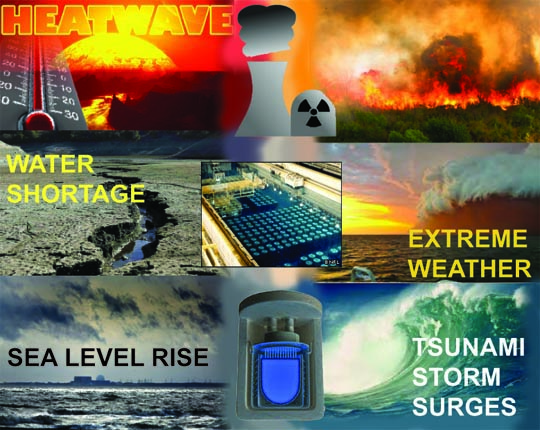
The US Government Accountability Office (GAO) published its congressional report on April 2, 2024 titled as a warning, “Nuclear Power Plants: NRC Should Take Actions to Fully Consider the Potential Effects of Climate Change.” Their report to Congress points to increasingly severe and more frequent climate hazards including extreme heat, drought, wildfires, severe storms, atmospheric rivers, floods, hurricanes and sea level rise. Congress’ investigative arm further determined that the U.S. Nuclear Regulatory Commission (NRC) does not adequately consider these climate change risks nor project the hazardous consequences on reactor safety in its licensing and relicensing processes.
Instead, the entrenched federal nuclear agency focuses on the projected climate benefits from nuclear power’s reduced carbon emissions. However, the GAO found that the NRC refuses to analyze and focus on climates’ worsening adverse impacts on future safe and reliable reactor operations by focusing only on historical meteorological data. This unheeded recklessness by the NRC and the nuclear industry is not unlike driving a car through its rear view mirror, unaware of the oncoming hazards that can result in severe radiological accidents.
Current news accounts confirm an accelerating climate crisis while exposing nuclear power’s unsustainability and vulnerability across Europe today as yet another example.
The Canadian (CANDU) heavy water pressurized water reactors at Romania’s two-unit Cernavoda nuclear power station is struggling to maintain reactor cooling water and remain operational. Current actions include raising the Danube River level if even by only centimeters. Romania’s only nuclear power station is on the verge of complete shutdown due to the falling river levels and warming water temperatures. Romania’s Navy has been dynamiting along the Danube to redirect the river flow to keep the reactors’ cooling systems and electricity generation operational.
The four-unit Paks nuclear power station (Soviet Union-era VVER-440 pressurized water reactors) also on the Danube River in Hungary is reported to be on the verge of emergency shutdown of all units. Similarly, the record low water levels in the Danube River are falling and receding away from the reactors’ once through coolant system intake suction pipes. The shallower river is also heating up, dramatically contributing to the loss of reactor cooling efficiency. The Danube is the only source of cooling water for the reactor cores which are now only “a few millimeters away from completely shutting down the Paks Power Plant.”
The American Nuclear Society’s publication Nuclear Newswire reports, “The 1,916-MWe, four-unit Paks is Hungary’s only nuclear power plant and, according to the International Energy Agency, generates about 42% percent of the country’s electricity. But as of Sunday, it was only producing 240 MW of power.”
Europe’s climate-driven heat wave is critically undercutting France’s electrical energy demand given the nation’s unsustainable and over reliance upon nuclear power (now reduced to 70%). The French state-owned nuclear operator, EDF, is also powering down and taking nuclear reactors off line to compensate for the loss of adequate and warming reactor cooling water sources. Bugey unit 3, Chooz unit 2 and Golfech 2 – operating on the Rhône, Meuse and Garonne rivers- have been taken offline to comply with operational technical specifications and regulations on reactor cooling water discharges. At least eight other reactors are operating and transitioning between reduced power and shutdown. Those affected reactors include: Saint Alban units 1 and 2; Bugey units 4 and 5; Blayais units 1 and 3; and Tricastin. These measures are environmental and aquatic protection requirements to avoid discharging too much hot water into rivers already impacted by the heatwave and drought.
At present, in Switzerland, the two-unit Westinghouse Electric pressurized water reactors at Beznau nuclear power station are temporarily shut down, or operated at lower power due to loss of adequate reactor cooling efficiency because of high temperatures in the River Aare.
In a warming climate, nuclear power is not sustainable while its operational safety margins are also narrowing. Inevitably, economic and political pressure on regulatory bodies threaten to relax and exempt nuclear operators from environmental protection standards for hotter cooling water discharges associated with increasing environmental damage and jeopardizing aquatic life while destroying habitat.
Nuclear Security Is A Hidden Public Cost Of Nuclear Power
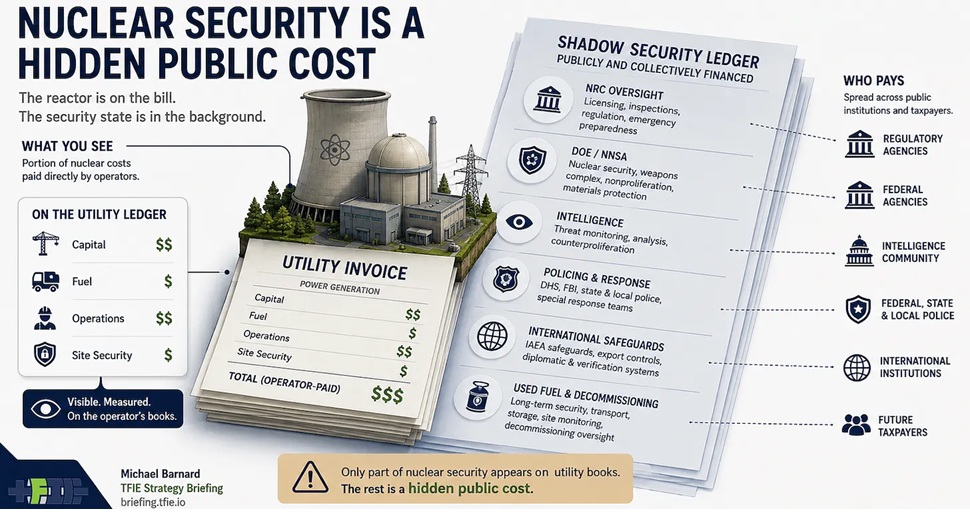
Security costs stretch across regulators, weapons-adjacent agencies, intelligence, policing, international safeguards and plant sites, but only part appears on utility books.
Michael Barnard, Aug 05, 2026
Nuclear security is not a single line item. It is a layered public and private cost structure spread across international safeguards, federal agencies, local policing and plant sites.
Nuclear power has an accounting problem that rarely appears in clean-energy comparisons. The industry requires overlapping layers of security across fuel supply chains, international safeguards, generation sites, used fuel, waste management and long decommissioning periods. Operators pay some of those costs directly. Much of the rest is spread across public agencies, regulatory systems, policing, intelligence and security institutions.
That was the core argument of my original CleanTechnica analysis in 2021. The article estimated that nuclear security costs in the United States were on the order of $50 million per reactor per year, with roughly half or less paid directly by operators. The resulting screening estimate was about $4 billion per year in uncounted public support for the U.S. nuclear fleet, in addition to direct tax preferences. That number should not be treated as a consolidated federal invoice. It was, and remains, an attempt to size a cost category that is otherwise scattered across too many budget lines to see clearly.
The need for that framing has not gone away. The numbers have moved, but the structure remains. As of March 2026, the United States had 96 operating commercial reactors at 57 nuclear power plants in 28 states. The NRC’s FY2027 budget request was $892 million with 2,606 full-time-equivalent staff. NRC fee recovery rules have also shifted: the Nuclear Energy Innovation and Modernization Act now requires the NRC to recover, to the maximum extent practicable, approximately 100% of its annual budget authority, excluding specific categories. The National Nuclear Security Administration, a semiautonomous DOE agency responsible for nuclear warheads, naval reactors and nonproliferation, has also grown materially, with an FY2026 request of about $30 billion…………….. (subscribers only)
https://briefing.tfie.io/p/nuclear-security-is-a-hidden-public
The Next Weapons Frontier: New Mexico’s Expanding Military Industrial Ecosystem
How New Mexico Is Becoming the Nation’s Directed-Energy Weapons Hub
Elaine Cimino, Aug 05, 2026
What This Could Mean for Weapons Development in New Mexico
For more than eighty years, New Mexico has served as America’s proving ground for weapons that would change warfare. The atomic bomb was born at Los Alamos. Nuclear weapons engineering became a permanent mission at Sandia National Laboratories. White Sands Missile Range evolved into one of the world’s premier test ranges for rockets, missiles, electronic warfare, and advanced military systems. What was once an isolated military landscape has become something far larger: an integrated weapons-development ecosystem where research laboratories, military installations, private corporations, venture capital, and public subsidies increasingly operate as parts of the same machine.
The Army’s decision to move high-energy laser weapons from experimental technology into a permanent “program of record” marks another turning point. It is not simply the purchase of a new weapon. It signals the beginning of sustained production, expanded testing, new supply chains, and decades of future research. Once a weapons system enters the Pentagon’s permanent budget, the question is no longer whether it works. The question becomes how rapidly it can be improved, manufactured, and deployed.
New Mexico is uniquely positioned to become one of the principal beneficiaries—and one of the principal hosts—of that expansion.
Sandia National Laboratories has spent decades advancing the science that underlies directed-energy systems: high-power lasers, pulsed power, optics, sensors, target acquisition, beam control, advanced materials, and weapons-system analysis. White Sands Missile Range provides vast restricted airspace and testing infrastructure. The Air Force Research Laboratory, Space Force operations, and nearby military installations contribute additional capabilities. Universities train engineers and scientists who feed directly into the defense workforce. Together they form an infrastructure that few places in the world can match.
The private sector is following that infrastructure. Companies developing hypersonic weapons, solid rocket motors, autonomous systems, drones, electronic warfare, and advanced manufacturing are increasingly locating in New Mexico. Public investment is helping accelerate that process. Through the State Investment Council’s Strategic Venture Capital Program, New Mexico has invested in venture-capital firms backing defense technology companies, while state and local governments simultaneously provide LEDA incentives, industrial revenue bonds, infrastructure improvements, and public land to attract those same industries.
Project Ranger illustrates this transformation. The public agreements describe the facility as a hypersonic systems test and manufacturing facility supported through state and local economic-development incentives and infrastructure improvements. It is one component of a much broader defense-industrial network that now stretches across the state.
The implications extend well beyond one factory.
Modern warfare is no longer organized around individual weapons. Directed-energy weapons, autonomous drones, hypersonic missiles, artificial intelligence, electronic warfare, cyber operations, satellite systems, and advanced sensors are designed to operate together. A laser cannot function without radar, electro-optical tracking, machine vision, software, communications, and power generation. Hypersonic missiles require advanced propulsion, guidance systems, manufacturing technologies, and testing infrastructure. Every new capability strengthens the others.
New Mexico increasingly contains every link in that chain.
As directed-energy weapons become operational, testing will inevitably expand. White Sands already hosts demonstrations of laser systems designed to defeat drone swarms. Future testing will involve increasingly complex scenarios: autonomous targeting, moving aircraft, electronic warfare, coordinated drone attacks, integrated missile defenses, and artificial intelligence controlling engagement decisions. Each successful demonstration creates demand for more facilities, more contractors, more specialized suppliers, and more federal investment.
What begins as research becomes production. Production becomes permanent infrastructure.
That transformation carries consequences extending far beyond economics.
The military describes lasers as inexpensive defenses because they require electricity rather than missiles costing millions of dollars each. But the public costs are measured differently. High-energy lasers introduce new questions about airspace management, satellite safety, wildfire risk, emergency response, occupational exposure, and civilian oversight. Destroyed drones do not simply disappear; they fall. Burning batteries, fuel, debris, and fragments fall somewhere. In a drought-stricken state increasingly defined by catastrophic wildfire, those risks deserve independent analysis rather than assumptions that new technology is inherently safer because it carries no explosive warhead…………………………………………………………………………………………………………………………………….
Directed-energy weapons represent the next chapter in military technology. Their arrival also marks the next chapter in New Mexico’s identity. The state is no longer simply a place where weapons are tested. It is becoming a place where the future architecture of warfare is researched, financed, manufactured, integrated, and normalized. Whether the public has an equal role in shaping that future remains the most important question of all. https://elainecimino652909.substack.com/p/the-next-weapons-frontier-new-mexicos?r=281p2&utm_medium=ios&triedRedirect=true
𝗪𝗛𝗢 𝗜𝗦 𝗥𝗘𝗔𝗟𝗟𝗬 𝗜𝗡 𝗖𝗛𝗔𝗥𝗚𝗘: 𝗔𝗠𝗘𝗥𝗜𝗖𝗔 𝗢𝗥 𝗜𝗦𝗥𝗔𝗘𝗟?

Israel is experiencing a golden era of influence, but its recent moves have not produced the results it expected.
more Americans and government officials are arguing that the United States must prioritize its own interests and avoid being pulled into endless foreign conflicts.
The political relationship between the United States and Israel comes down to a fundamental question: who is actually in charge?
Ibrahim Majed, Aug 06, 2026, https://ddgeopolitics.substack.com/p/9bb?utm_source=post-email-title&publication_id=1769298&post_id=209955647&utm_campaign=email-post-title&isFreemail=true&r=1ise1&triedRedirect=true&utm_medium=email
When you look at the region today, the United States does not want a full-scale regional war. However, it also cannot afford to completely back down. Washington continues to support military pressure on Iran because a sudden retreat would undermine American deterrence, weaken its credibility among allies and adversaries alike, and erode the global perception of U.S. hegemony.
Israel, meanwhile, has pushed for even more aggressive action, creating growing tensions over how far the conflict should go.
The reality is that Israel cannot afford to keep taking endless losses, because running a nonstop military campaign with no real political achievements will eventually exhaust and destabilize any state
The balance of power between the two countries is not as simple as military strength alone.
The United States is clearly the stronger country, with far greater economic resources and military capabilities.
However, Israeli leaders have often been highly effective at navigating the political system in Washington, allowing them to build significant influence over American decision-making.
Benjamin Netanyahu has been in power for a very long time, and he understands how the American government works better than almost anyone.
In the United States, politics runs on money, lobbies, and deals made behind closed doors in Congress.
Ever since the 1960s, Israel has built a massive network of support inside Washington.
This does not mean Israel completely owns America, but it does mean Israeli leaders know exactly which politicians to talk to, which donors to use, and how to push the U.S. government to do what they want.
This influence works best when Israel’s goals match what the American President personally wants.
But there is a limit.
If a U.S. President ever feels that Israel is hurting his own political career or messing up America’s bigger plans, he has the power to tell Israel to stop, and Israel would have no choice but to listen.
The main reason America rarely puts its foot down is because the pro-Israel lobby has spent decades building power in Washington.
Israel is experiencing a golden era of influence, but its recent moves have not produced the results it expected.
The war on Lebanon in 2024 did not bring a clear victory, while the 2026 war on Iran caused massive destruction but failed to achieve its intended objectives. On the contrary, Iran emerged with a stronger regional position, greater influence, and increased leverage over key strategic waterways such as the Strait of Hormuz, giving it the ability to impact global energy markets and the world economy.
As a result, many governments and populations around the world are increasingly blaming Israel’s actions for escalating tensions and threatening the stability of critical global trade routes, including the Strait of Hormuz.
The way Israel keeps its hold on U.S. politics is through a mix of favors and political pressure, making it very risky for American politicians to speak out against Israeli decisions.
Even so, people inside the U.S. government are getting frustrated.
A leader with a big ego, like Donald Trump, hates feeling like a smaller country is bossing him around.
On top of that, when an American leader builds his entire image around being tough on Iran, he gets trapped into a corner where he cannot back down without looking weak.
Meanwhile, Iran is playing the exact same game, making unpredictable moves to counter American pressure.
This conflict has also disrupted major economic and diplomatic plans in the Middle East.
Before the recent escalations, countries like Saudi Arabia, Turkey, Egypt, Jordan, and Qatar were moving toward closer business and security partnerships with Israel, heavily pushed by figures like Jared Kushner.
However, the events of October 7 and the war that followed dramatically changed the regional and global environment.
Israel’s actions during the conflict, along with statements by some Israeli officials regarding territorial ambitions and visions of a “Greater Israel,” have increased concerns across the region and contributed to a major shift in public and political attitudes.
As a result, previous normalization and partnership efforts have been slowed or put on hold, forcing Washington to reconsider whether its regional strategy is still achievable.
At the same time, more Americans and government officials are arguing that the United States must prioritize its own interests and avoid being pulled into endless foreign conflicts.
Inside the U.S. national security system, major disagreements are emerging over how Washington should handle Israel and the wider regional conflict. Some officials and policymakers have grown increasingly concerned about Netanyahu’s government, the direction of the war, and the consequences for broader American interests.
Major American media figures and influential commentators have openly criticized these policies, showing that even within conservative circles in the United States there is growing division over the approach toward Israel and the wider conflict.
After the long, painful wars in Iraq and Afghanistan, many people in Washington no longer believe that constant military action works.
That is why you see political figures like Marco Rubio and J.D. Vance taking different approaches, it is a calculated way for political leaders to appeal to different groups of voters without losing control.
If you look back at history, America is the strongest empire the world has ever seen, but taking endless risks for a smaller ally is a dangerous strategy.
History shows that ancient superpowers, like the Roman Empire, would eventually put their foot down and crush any regional partner that caused too much trouble for the empire as a whole.
If America wants to remain the top global power, its leaders have to put American interests first instead of constantly backing another country’s moves.
Washington gave Israel a chance to handle the region on its own, but since that failed, smart decision-makers in the U.S. government are starting to think it is time to cut their losses before things get worse.
You can already see signs that both the United States and Israel are facing growing pressure and are looking for ways to manage the situation behind the scenes.
Washington’s priority is to avoid being dragged into a wider war, but it also cannot afford to appear weak or defeated.
The United States wants to preserve its image as the dominant global power and maintain its credibility and deterrence in the region.
Meanwhile, Netanyahu’s political position has become increasingly difficult, forcing his government to balance domestic pressure with the risks of further escalation.
Netanyahu is dealing with major political trouble at home and is looking for ways to protect himself if new elections happen.
On the ground, Israel is quietly trying to limit the intensity of the fighting.
Operations in Lebanon have shifted into smaller-scale actions, while direct confrontations with Iran have slowed down.
At the same time, Israeli forces in southern Lebanon continue to face attacks from the resistance, but many of these incidents are kept away from public attention to avoid highlighting vulnerabilities or creating pressure for a wider escalation.
Israel keeps quiet about these hits because it does not want the public to see its weakness or get pulled into a bigger war it cannot win.
At the same time, the resistance is keeping quiet so they can keep chipping away at Israeli forces without starting a massive new conflict.
In the end, even though Israel has been highly effective at influencing U.S. politics, the United States remains the far stronger power and will ultimately prioritize its own strategic interests.
History shows that great powers place their national interests above any individual alliance when they believe a partnership has become too costly or threatens their broader objectives.
The United States could lose its alliance with Israel and still remain a global power, but Israel’s strategic position is far more dependent on continued American military, political, and diplomatic support.
This is why Israeli leaders have repeatedly emphasized the need to develop greater independence in areas such as defense production, while pro-Israel political networks in the United States continue to push for maintaining strong American support. Their concern is that if Washington begins prioritizing its own interests over Israel’s regional objectives, Israel’s ability to sustain its current position and policies in the region would be significantly weakened.
Ultimately, the choice facing the United States is whether it continues to bear the costs of policies that primarily serve another country’s objectives, or whether it puts American interests first.
A great power maintains its strength by protecting its own security, economy, and global position, not by allowing any ally to influence the direction of its foreign policy.
Pentagon Plans AI Data Centers at Military Bases Across Multiple Branches
One site is near the military’s main chemical and biological weapons testing range. Another parcel is a half-mile from civilian housing.
Jul 27, 2026, By Adam Gramegna, Military.com
At Dugway Proving Ground in Utah, on ground the Army’s own contracting documents describe as previously used for grazing, a company owned by two of the largest investment firms in the world is preparing to build a data center.
That site sits about an hour’s drive from the nearest community, on the installation where the U.S. military conducts its primary chemical and biological weapons testing. Three parcels there total roughly 3,466 acres. One of them, about 1,201 acres, is already spoken for.
It is one of at least a dozen military installations the Army and the Department of the Air Force have opened to commercial data center developers over the past year and a half. Two of those deals are real; the rest are still proposals.
Land-for-Computing
In late March, the Army conditionally selected two companies to enter exclusive negotiations to build and operate commercial hyperscale data centers on Army land.
Carlyle, the global investment firm, was picked for roughly 1,384 acres at Fort Bliss, Texas. CyrusOne, a data center operator jointly held by funds managed by KKR and BlackRock, was picked for the parcel at Dugway. Each project is estimated to cost about $2 billion, according to the Financial Times.
The companies will be responsible for financing, building, operating, maintaining and eventually decommissioning the facilities, the Army said, on what it called “underutilized but non-excess Army land at no upfront cost to taxpayers.” In exchange for the land, the service gets access to computing power.
It all runs through the Army’s Enhanced Use Lease program, driven by a Trump executive order directing agencies to open non-excess federal land to data center development. The U.S. Army Corps of Engineers is handling lease negotiations and environmental review.
“AI is a strategic asset for the Army,” Army Secretary Dan Driscoll said in the March announcement. “It is a force multiplier, supports future transformation and requirements, keeps the Army ahead of our adversaries, and generates resiliency across the force.” Driscoll told the Wall Street Journal that the Fort Bliss facility would be “the first hyper-scale data center that the Pentagon has ever done.”…………………………..
Which Bases and How Close to Housing?
Only Fort Bliss and Dugway have been awarded so far, and even those remain conditional, pending negotiation. Beyond them, federal contracting documents show the Army considering data centers at Fort Hood, Texas, and Fort Bragg, N.C.
The Department of the Air Force put out its own call in 2025 for private AI data center projects on unused land at Arnold Air Force Base, Tenn., Edwards Air Force Base, Calif., Joint Base McGuire-Dix-Lakehurst, N.J., Davis-Monthan Air Force Base, Ariz., and Robins Air Force Base, Ga.
More recently, it sought bidders for facilities at Joint Base Elmendorf-Richardson, Eielson Air Force Base and Clear Space Force Station in Alaska. Acreage varies enormously; for example, Fort Hood has 207 acres on offer. Fort Bliss has nearly seven times that.
Dugway is remote by design, although not every site is. Contracting documents show the Army weighing a parcel at Fort Hood within a half-mile of residential and commercial property, and several potential locations at Fort Bragg within one mile of civilian areas and a half-mile of civilian housing.
Proximity to the population is what has made data centers a heated topic in the civilian world. Nearly $156 billion in projects nationwide have been delayed or canceled after local opposition, according to Data Center Watch.
In Virginia, which holds the world’s highest concentration of the facilities, a state-funded study found residents’ monthly energy bills could rise by $14 to $37 by 2040………..
Two requirements attached to these projects do not apply to commercial builds off base. Proposals must include net-zero water usage and a power plan that does not draw on the local electrical grid. Bidders were also required to describe plans for “local outreach and engagement” and to assess “any risks or opposition” to the project.
The Defense Department’s own procurement documents, obtained by the trade publication Data Center Dynamics, rate the water risk for the El Paso area as “Extremely High.” Data centers consume water to cool their servers. Fort Bliss is where the Army wants its flagship…………..
Proximity to the population is what has made data centers a heated topic in the civilian world. Nearly $156 billion in projects nationwide have been delayed or canceled after local opposition, according to Data Center Watch.
In Virginia, which holds the world’s highest concentration of the facilities, a state-funded study found residents’ monthly energy bills could rise by $14 to $37 by 2040.
Army Officials Say They’re Ready
“So I think the difference between us, the Army, doing a data center, and say Meta or Google, is we’re part of the communities that are there, and we are going to engage with them on a routine and regular basis to look for solutions that work for everyone, right?” Col. John Oliver, executive officer for Deputy Army Under Secretary Dave Fitzgerald, told Defense One. “Because, yes, we understand that there’s been consternation with data centers.”
Two requirements attached to these projects do not apply to commercial builds off base. Proposals must include net-zero water usage and a power plan that does not draw on the local electrical grid. Bidders were also required to describe plans for “local outreach and engagement” and to assess “any risks or opposition” to the project.
The Defense Department’s own procurement documents, obtained by the trade publication Data Center Dynamics, rate the water risk for the El Paso area as “Extremely High.” Data centers consume water to cool their servers. Fort Bliss is where the Army wants its flagship.
Army officials want the project to be a net contributor rather than a net drain. In the spring, Fitzgerald traveled to Fort Bliss for a listening session with the commander of the 1st Armored Division, community members, El Paso Water, El Paso Electric and Carlyle. One idea on the table is having the developer drill a new well to feed the city’s desalination plant, offsetting what the data center uses.
“We are encouraging Carlyle to do that, so actually make it net-positive,” Oliver told Defense One. “We don’t know if that’s an engineering solution that we can actually get to yet, but we’re actively working toward that as a part of the process.”
Darrell M. West, a senior fellow at the Brookings Institution who studies data center development, said the approach is sound, and that communities which have accepted the facilities tend to be the ones told the full details in advance.
“People want to know up-front, you know, where the energy is coming from, how much water is being used, how much the overall cost is going to be, and what the noise levels are,” West said.
Congress Not Settled
Rep. Cory Mills, a Florida Republican, secured a provision in the House version of the fiscal 2027 defense authorization bill. This bill bars the Defense Department from leasing land for data centers unless developers agree not to install equipment containing components made in China, Russia, Iran or North Korea. The restriction covers certain printed circuit boards, advanced semiconductors and chipsets the department considers a security risk.
“Honored to pass this amendment to protect our military installations from Chinese components being used in data centers on our installations,” Mills wrote on X.
The Army objected. The measure would create a “federal land penalty,” a service official told Federal News Network, imposing rules on companies building on installations that would not apply to identical projects built anywhere else. “We want Congress to incentivize companies to build on secure federal land, rather than creating barriers that drive them away,” the official said.
Rep. John Garamendi, a California Democrat, proposed requiring the Pentagon to evaluate a data center’s energy and water consumption, noise and light pollution, and effects on security and supply chains before finalizing any deal. House Armed Services Republicans rejected it………………… https://www.military.com/pentagon-plans-ai-data-centers-at-military-bases-across-multiple-branches
CIA Assessment Details Israel’s Race to Make the U.S.-Israel Alliance Irreversible
The intelligence assessment says Israeli officials are pursuing a long-term strategy to make the alliance harder for future administrations to scale back.
Aída Chávez, Jul 30, 2026, https://capitalandempire.com/p/exclusive-cia-assessment-israel-us-support
Israeli officials know they’re losing the American public. Panicked that America’s political consensus on Israel is collapsing, they’re pursuing a long-term strategy to permanently enmesh Israel within America’s military, intelligence, and defense establishment – in ways future administrations would struggle to unwind – according to a new confidential U.S. intelligence assessment.
Israeli officials believe the political fight over Israel in the United States is becoming harder to win, and that the era of indefinitely securing billions of dollars in annual military aid is coming to an end, according to the assessment, which was described to Capital & Empire by several U.S. officials. Instead of relying on direct U.S. military aid – an increasingly visible and politically contentious form of support – Israel is racing to embed itself more deeply in America’s military, intelligence, and national security apparatus in ways designed to outlast future administrations.
The assessment, written primarily by the CIA and circulated this week, describes discussions about expanding intelligence cooperation and the possibility of hosting a permanent U.S. military base on Israeli territory. It also says Israeli officials have been cultivating prominent figures in the American technology sector to build long-term political and financial support for the strategy. The assessment does not identify those individuals by name.
Congress has already begun advancing elements of Israel’s strategy. Last week, the House quietly approved Section 219 of the National Defense Authorization Act, establishing a permanent U.S.-Israel Defense Technology Cooperation Initiative within the Pentagon. The House version establishes a Pentagon executive agent charged with coordinating bilateral defense research, development, industrial cooperation, and technology integration.
Six Democrats – Reps. Henry Cuellar, Don Davis, Jared Golden, Vicente Gonzalez, Adam Gray, and Marie Gluesenkamp Perez – joined Republicans in voting to pass the defense authorization bill. The measure now heads to the Senate, which is expected to consider its own version of the NDAA before lawmakers from both chambers negotiate a final compromise bill for President Donald Trump’s signature.
Rep. Thomas Massie, R-Ky., who led an effort to strip Section 219 from the $1.15 trillion Pentagon budget, called the provision “a betrayal of our sovereignty.” Rep. Alexandria Ocasio-Cortez, D-N.Y., similarly described the proposal as “an existential threat to American sovereignty and democracy.”
Earlier this year, Israeli Prime Minister Benjamin Netanyahu floated phasing out direct U.S. military aid altogether. Most mainstream news coverage framed the proposed shift as a reflection of Israel’s growing economic and military strength, or self-sufficiency. But according to the assessment, the CIA views the strategy differently. The spy agency believes that Israel is seeking to insulate the U.S.-Israel alliance from America’s changing political landscape by replacing highly visible foreign aid with deeper, longer-lasting forms of military and industrial integration.
From Israel’s perspective, embedding the alliance more deeply within the U.S. national security apparatus would make it far more difficult for future administrations to pressure Israel by slowing or withholding arms transfers.
The strategy goes beyond intelligence sharing and military aid. Israeli officials also want Israeli technology, intelligence capabilities, and jointly developed weapons systems embedded in the U.S. military itself, making American defense increasingly reliant on Israeli systems. The assessment says Israeli officials have discussed positioning Israel in Washington as a uniquely indispensable technological and intelligence partner, pointing to language in the 2026 National Defense Strategy describing Israel as a “model ally” whose relationship with the United States is mutually beneficial.
Since the start of Israel’s genocide in Gaza, American public opinion toward Israel has deteriorated sharply. About 60 percent of U.S. adults now hold an unfavorable view of Israel, up from 53 percent a year ago, according to an April Pew Research Center survey. Among both Democrats and Republicans under 50, majorities now view both Israel and Netanyahu negatively.
As Gaza has become a defining issue in Democratic politics, the Democratic Socialists of America has surged in membership and electoral success behind campaigns centered on opposition to Israel. A generation ago, public support for Palestine could end a career. Today, a Canary Mission profile may be a stepping stone to Congress. The CIA knows Israel is nervous.
‘Defend Israel or the Homeland’: Top US general issues stark warning to Pentagon brass
Washington has greatly reduced its interceptor missile stocks, jeopardizing its ability to fight China, while prioritizing the protection of Israel
News Desk, AUG 1, 2026, https://thecradle.co/articles/defend-israel-or-the-homeland-top-us-general-issues-stark-warning-to-pentagon-brass
The highest-ranking US general in Europe informed the Pentagon this week that he does not have enough naval units to protect Israel against potential Iranian missile strikes, according to a report by the Washington Post on August 1.
General Alexus Grynkewich, the head of US European Command (EUCOM), notified senior Pentagon officials in writing that without another navy destroyer, he will be forced to choose between defending the US “homeland” and defending Israel.
Grynkewich’s warning comes as US President Donald Trump continues to escalate the war on Iran.
The US Navy has shouldered a significant burden in waging the war, including responsibility for blockading Iranian ports in response to the Islamic Republic’s closure of the Strait of Hormuz.
US naval destroyers in the eastern Mediterranean have long been part of Israel’s defense strategy. They are equipped with radar systems and missile interceptors capable of countering Iranian ballistic missiles and drones.
EUCOM is responsible for protecting Israel from the Mediterranean and deterring any Russian ground incursion into NATO member states.
The US Navy has five destroyers deploying from Rota, Spain, with a sixth expected later this year. They face maintenance issues due to lengthy missions.
The US is also experiencing a shortage of missile interceptors, which are costly to manufacture and hard to restock.
Pentagon assessments conducted earlier in the war showed that US forces have “shouldered the brunt of defending Israel from Iranian ballistic missiles.”
Washington has used more of its defensive weapons, including the Terminal High Altitude Area Defense (THAAD) and naval interceptors, to defend Israel from Iranian missile and drone attacks than Israel has used of its own interceptor stocks.
US inventories of Patriot missiles have now fallen below 1,000 and THAAD inventories to about 250, according to the Center for Strategic and International Studies (CSIS).
Israel has not participated in the war on Iran since Washington and Tehran signed a memorandum of understanding (MoU) and ceasefire in mid-June.
Trump resumed attacks on Iran three weeks ago.
Last week, Israeli Finance Minister Bezalel Smotrich said Israel was content to remain out of the fighting and allow the US and its Gulf allies to fight the war on Tel Aviv’s behalf.
“Israel has no interest in joining the campaign – the current situation is the best for us,” Smotrich said on Tuesday.
Meanwhile, Israeli Prime Minister Benjamin Netanyahu visited the White House last week and lobbied Trump to escalate the war by imposing a land blockade on Iran.
According to a CBS News report on Friday, Washington and Tel Aviv are planning to significantly escalate the war of aggression by targeting Iran’s vital energy infrastructure.
1 This Month





PLEASE OPPOSE HR 8255 AND S.3639 – bills would accelerate satellite deployment, with no environmental review or safeguards – https://ncstd5li.quorum.us/campaign/169331/
To see nuclear-related stories in greater depth and intensity – go to https://nuclearinformation.wordpress.com
-
Archives
- October 2026 (74)
- September 2026 (339)
- August 2026 (330)
- July 2026 (355)
- June 2026 (287)
- May 2026 (306)
- April 2026 (356)
- March 2026 (251)
- February 2026 (267)
- January 2026 (308)
- December 2025 (358)
- November 2025 (359)
-
Categories
- 1
- 1 NUCLEAR ISSUES
- business and costs
- climate change
- culture and arts
- ENERGY
- environment
- health
- history
- indigenous issues
- Legal
- marketing of nuclear
- media
- opposition to nuclear
- PERSONAL STORIES
- politics
- politics international
- Religion and ethics
- safety
- secrets,lies and civil liberties
- spinbuster
- technology
- Uranium
- wastes
- weapons and war
- Women
- 2 WORLD
- ACTION
- AFRICA
- Atrocities
- AUSTRALIA
- Christina's notes
- Christina's themes
- culture and arts
- Events
- Fuk 2022
- Fuk 2023
- Fukushima 2017
- Fukushima 2018
- fukushima 2019
- Fukushima 2020
- Fukushima 2021
- general
- global warming
- Humour (God we need it)
- Nuclear
- RARE EARTHS
- Reference
- resources – print
- Resources -audiovicual
- Weekly Newsletter
- World
- World Nuclear
- YouTube
-
RSS
Entries RSS
Comments RSS

