For the first time, most Americans now against nuclear power
Most Americans now oppose nuclear energy, poll finds http://thehill.com/blogs/blog-briefing-room/news/273558-poll-majority-of-americans-oppose-nuclear-energy-for-first-time By Mark Hensch, 18 Mar 16 A majority of Americans oppose using nuclear energy for the first time, according to a new poll.
Fifty-four percent dislike nuclear energy in the Gallup survey released Friday, with 44 percent who support using it.Pollsters found that opposition toward nuclear energy is up 11 points since last year, when 43 percent rejected using it as an energy source.
Support for nuclear power is down 7 points during the same period, with 51 percent backing the resource in 2015.
The poll has tracked public opinion on nuclear power since 1994. The high point in support for nuclear energy was in 2010 at 62 percent.
In 2011, support was at 57 percent just before the disaster at Japan’s Fukushima nuclear plant. Support for nuclear energy in the U.S. remained relatively unchanged the following year, but has slipped since.
The Fukushima plant suffered nuclear meltdowns after it was damaged in an earthquake and tsunami. It’s considered the largest nuclear disaster since Chernobyl in 1986.
Gallup polled 1,019 Americans via cell and landline telephones from March 2-6. The poll has a 4 percent margin of error.
Union of Concerned Scientists Annual Review of U.S. Nuclear Plant, Near Misses
A near miss incident is an event or condition that could increase the chance of reactor core damage by a factor of 10 or more, prompting the NRC to send an inspection team to investigate. The number of near miss incidents has declined since UCS initiated its annual review in 2010. In 2010, there were 19; last year there were nine. All told, from 2010 through 2015 there were 91 near misses………
NASA and Rosatom want nuclear rockets to take astronauts to Mars
Nasa wants to use nuclear rockets to get to Mars: Space agency claims the technique is ‘most effective way’ of reaching red planet
- Nuclear propulsion weighs almost half as much as a chemical rocket
- Nasa is also are planning to build rockets powered by nuclear fission
- They hope it could be used to carry astronauts to the red planet in 2033
- Follows news this week that Russia plans to test a nuclear engine in 2018
By ELLIE ZOLFAGHARIFARD FOR DAILYMAIL.COM
Nuclear thermal propulsion is ‘the most effective’ way of sending humans to Mars.
That’s according to Nasa administrator and former astronaut, Charles Bolden, who made the statement when speaking to Congress this week.
‘We are on a journey to Mars and most people believe that, in the end, nuclear thermal propulsion will be the most effective form of propulsion to get there,’ he said.
 He didn’t, however, expand on details on how quickly Nasa hoped the technology could get astronauts to Mars. ……..’A nuclear power unit makes it possible to reach Mars in a matter of one to one and a half months, providing capability for manoeuvring and acceleration,’ Sergey Kirienko, head of Rosatom told RT . http://www.dailymail.co.uk/sciencetech/article-3499441/Nasa-wants-use-nuclear-rockets-Mars-Space-agency-claims-technique-effective-way-reaching-red-planet.html
USA worried about weapons proliferation risks in China’s Nuclear Recycling plan
China’s Plans to Recycle Nuclear Fuel Raise Concerns U.S. energy secretary airs worries about proliferation risks ahead of nuclear-security summit WSJ, By BRIAN SPEGELE, 17 MAR 16, BEIJING—China’s plans to process spent nuclear fuel into plutonium that could be used in weapons is drawing concern from the U.S. that Beijing is heightening the risk of nuclear proliferation.
U.S. Energy Secretary Ernest Moniz, in Beijing for talks, said Thursday that China’s plans to build a nuclear-recycling facility present challenges to global efforts to control the spread of potentially dangerous materials……..
Mr. Moniz’s comments marked a rare public expression by the Obama administration of concern over China’s reprocessing plans. The differences, which the governments have discussed privately, are being aired ahead of a visit by President Xi Jinping to Washington this month for a summit with President Barack Obama and other world leaders on nuclear security.
The issue comes down to the different choices countries make over how to handle potentially dangerous waste created by commercial nuclear reactors. In the U.S., spent fuel is treated as sensitive material and is stored, and reprocessing is banned out of proliferation concerns.
Elsewhere, including in France and Japan, spent fuel is recycled to extract plutonium to be used in nuclear reactors. The U.S.’s concern is that the bigger the stockpiles of plutonium, the higher the risk that some of it could be refined for use in nuclear weapons or taken by terrorists……
U.S. concerns about nuclear reprocessing and proliferation are particularly acute in the Asia-Pacific region, “where the perception is there is less international cooperation, less transparency,” said Mark Hibbs, a nuclear expert at the Carnegie Endowment for International Peace………
larger Chinese stockpiles of isolated plutonium could prompt Japan, especially, to build up its caches.
Civilian plutonium stockpiles reached 271 metric tons by the end of 2014, up from around 150 metric tons in the 1990s, the International Panel on Fissile Materials, an independent group looking at nonproliferation policy, said in its latest annual report.
The official Xinhua News Agency reported in September that construction of China’s reprocessing facility may start in 2020 and take a decade to complete. The project is expected to have a processing capacity of 800 metric tons of spent fuel a year…..
Previously, the U.S. has questioned the economic viability of such projects, which are expensive to build and operate, as well as proliferation issues, Ernest Moniz said……
Mr. Hibbs from the Carnegie center said China’s decision to pursue reprocessing couldn’t be justified on economic or commercial grounds, given the billions of dollars needed to construct one large-scale facility. But China may be acting strategically, guaranteeing future fuel supply by recycling, he added.
Last June, state-owned China National Nuclear Corp. and France’sAreva SA agreed to speed up negotiations on building the facility. Areva didn’t respond to a request for comment on Mr. Moniz’s remarks and CNNC said its press officers weren’t available.
Write to Brian Spegele at brian.spegele@wsj.com http://www.wsj.com/articles/chinas-plans-to-recycle-nuclear-fuel-raise-concerns-1458228504
The radioactive heaps at Paducah, USA
Voice of Paducah Plant Worker #1: And then later on, they took the Geiger counters out, and they told us, “That stuff won’t hurt you. It’s harmless. It won’t hurt you if you ate it, it wouldn’t hurt you.” I think they ought to be held accountable. And I’d like to see them be put on trial, and I hope they put them in prison, because a lot of my friends I know died from what they did.”
Bill Gates’ Nuclear Pipe Dream: Convert Depleted Uranium to Plutonium to Power Earth for Centuries, Truth Out Tuesday, 15 March 2016By Josh Cunnings and Emerson Urry, EnviroNews | Video Report Editor’s Note: The following news piece represents the second in a 15-part mini-series titled, Nuclear Power in Our World Today, featuring nuclear authority, engineer and whistleblower Arnie Gundersen. The EnviroNews USA special encompasses a wide span of topics, ranging from Manhattan-era madness to the continuously-unfolding crisis on the ground at Fukushima Daiichi in eastern Japan.
TRANSCRIPT:
Josh Cunnings (Narrator): Welcome to the EnviroNews USA news desk. I’m Josh Cunnings. Thank you for tuning in for the second episode in our 15-part mini-series, Nuclear Power in Our World Today.
Last time, in our kickoff episode, we focused on the widespread devastation wreaked by 15,000 abandoned uranium mines. These toxic and festering open sores are sprawled all across the entire western U.S. landscape, posing a direct threat to humans and all life.
In episode two, we pick up where we left off with the dirty frontend of the nuclear power industry — which becomes in turn, the nuclear bomb fuel industry. Following the 1940s and 50s uranium rush to make bombs, over 80 sites were contaminated so badly that they received a special “legacy” site designation on the EPA’s superfund list — a special commitment from the U.S. government to clean up those places because weapons of war were manufactured there. Amongst those legacy sites is the gaseous diffusion uranium processing facility at Paducah, Kentucky………..
Voice of 2000 Paducah Plant Documentary Narrator: Even up through the 1980s, Department of Energy investigators say that protection against radiation at the site was very inconsistent. Men walked through uranium dust on the floors, and brushed it off the tables where they ate. Respirators weren’t required. At one point the company stopped providing work coveralls.
Voice of Paducah Plant Worker #1: And when they took those [coveralls] away from us, well we’d have to bring work clothes from home, and we’d work in that stuff, and we would get it all over us, and then we’d bring it home and it’d be washed in the laundry. I told them I didn’t like bringing that stuff home to be washed in the laundry with my kids’ clothes and my wife’s clothes. And the public relations people said, “Well, if you were really concerned, you’d wash your clothes here at the washroom.”…………
Voice of 2000 Paducah Plant Documentary Narrator: No one knew until this document was released last year that plant officials were also tracking worker cancers and deaths, while denying there was any reason to worry.
Cunnings: Due to poor market conditions, the company running the site went belly-up [in 2014]. The city once labeled as our nation’s premier atomic boomtown, now left in the wasteland of its own nuclear demise.
The radioactive heaps at Paducah are mostly depleted uranium — a byproduct of uranium enrichment, and a substance that used to be considered unusable for nuclear fission, rendering it useless for both nuclear power generation and bomb making.
But science is always advancing, and one technology kingpin has an idea for Paducah — an idea that not everyone thinks is a good one………. http://www.truth-out.org/news/item/35229-bill-gates-nuclear-pipe-dream-convert-mountains-of-depleted-uranium-to-plutonium-to-power-earth-for-centuries
Nuclear Disaster by Design – Nuclear Safety inFLEXibility
For the NRC’s Fukushima fixes to reach their target destination, the NRC must determine why Pilgrim procured an inadequate FLEX air compressor, why River Bend thought it had 24 hours to handle a one-hour problem, and how dozens of flood protection problems remaining invisible during the NRC-mandated walkdowns at Arkansas Nuclear One.

 Nuclear Safety inFLEXibility http://allthingsnuclear.org/dlochbaum/nuclear-safety-inflexibility Dave Lochbaum, director, Nuclear Safety Project | March 15, 2016, Disaster by Design/Safety by Intent #23
Disaster by Design
Among the actions taken by the Nuclear Regulatory Commission (NRC) in response to the March 11, 2011, accident at Fukushima was to issue an order on March 12, 2012, to all U.S. nuclear plant owners requiring them to procure equipment and implement measures to enable their facilities to cope with an extended loss of normal and backup power supplies to emergency equipment.
The NRC required that owners develop a phased response capability (Fig. 1). The initial response is by permanently installed equipment. Recognizing that this equipment may become unavailable (as happened at Fukushima), the NRC required a followup response capability by portable equipment stored in places not likely to be affected by the accident. Recognizing that portable equipment provides an interim response, the NRC required a longer term response capability to be provided by the “nuclear cavalry” (equipment and staffing resources arriving from offsite locations). The Nuclear Energy Institute developed the Diverse and Flexible Coping Strategies (FLEX) Implementation Guide for use by plant owners in complying with the NRC’s order.
Safety Detour?
There can be a big difference between the course plotted and the road taken. For example, a family heading out by car from their home in Atlanta, Georgia for a relaxing vacation on Sanibel Island in Florida should become a little troubled upon seeing the Washington Monument through the windshield.
If the following examples are any indication, the road to the Fukushima fixes ordered by the NRC might have taken a detour or three. Continue reading
Bill Gates enjoys spruiking his plutonium dream
Bill Gates’ Nuclear Pipe Dream: Convert Depleted Uranium to Plutonium to Power Earth for Centuries, Truth Out Tuesday, 15 March 2016 By Josh Cunnings and Emerson Urry, EnviroNews | Video Report Voice of Bill Gates –-“……… Excerpt #1: There was a concept a long time ago that you would do a different type of reactor called a “fast reactor,” that would make a bunch of another element called plutonium, and then you would pull that out, and then you would burn that. That’s called “breeding” in a fast reactor. That is bad because plutonium is nuclear weapons material. It’s messy. The processing you have to get through is not only environmentally difficultly, it’s extremely expensive.
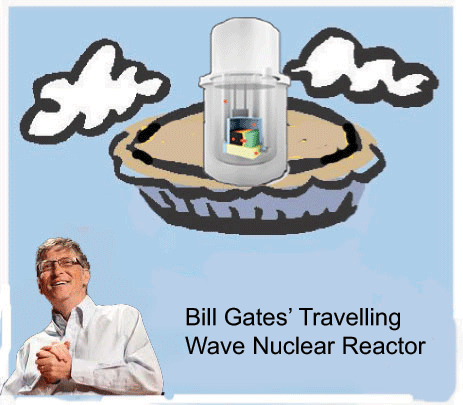 Cunnings: The man considered by many to be supposedly a humanitarian trailblazer when it comes to combatting disease, has a plan to fast-breed the mountainous heaps of depleted uranium at Paducah into plutonium — one of the most dangerous and disease-causing substance on the face of the planet. Then in turn, this plutonium would be used to power what would be the so-called new fourth-generation nuclear power plants. Let’s listen to Gates articulate his plutonium scheme.
Voice of Bill Gates — Excerpt #2: The concept of this so-called “TerraPower reactor” is that you, in the same reactor, you both burn and breed. So, instead of making plutonium and then extracting it, we take uranium — the 99.3 percent that you normally don’t do anything with — we convert that, and we burn it.
[Editor’s Note: Bill Gates is the current Chairman of the Board of TerraPower — a Washington-based nuclear power technology company.]
Cunnings: Now get this, only 60 seconds after Gates acknowledges the tremendous problem of bringing more plutonium into this world, he turns around and makes a joke about it to a crowd filled with university students from nuclear programs — all this, only a few months after the catastrophic triple melt-through at Fukushima Daiichi.
Bill Gates — Excerpt #3: Our flame is taking the normal depleted uranium — the 99.3 percent that’s cheap as heck, and there’s a pile of it sitting in Paducah, Kentucky that’s enough to power the United States for hundreds and hundreds of years. You’re taking that and you are converting it to plutonium (humorously under his breath) — and then you’re burning that.
Cunnings: Oh yes, Mr. Gates seems to have a little love affair going on with plutonium — and the notion is that we need nuclear power to save ourselves from climate change.
Bill Gates — Excerpt #4: You could go nuts!
Wall Street Journal Interviewer Alan Murray: If everything goes perfectly?
Gates: Absolutely.
Murray: How often does everything go perfectly?
Gates: In nuclear? Ah, well, ya’ know… If you ignore… (laughter) No, no. Come on. If you ignore 1979 [Three Mile Island], and 1986 [Chernobyl], and 2011 [Fukushima], come on — we’ve had a good century (laughter). No seriously. I mean, in terms of raw figures, you know, coal mining, natural gas … More people die, I mean … It wasn’t far from here a natural gas pipe blew up and incinerated people.
Bill Gates Excerpt #5: So we can simulate Richter-10 earthquakes. We simulate 70-foot waves coming into these things. Very cool. We basically say no human should ever be required to do anything, because if you judge by Chernobyl and Fukushima, the human element is not on your side.
Bill Gates Excerpt #6: We have, you know, total fail-safe … Any reactor that a human has to do something … that’s a little scary.
Bill Gates Excerpt #7: So, you’ve got to design something that humans just don’t have to be involved in.
Bill Gates Excerpt #8: I love nuclear. It does this radiation thing that’s tricky (laughter). But they’re good solutions. You know, it was interesting; recently, in Connecticut this natural gas plant blew up 11 guys. It just blew them up.
Murray: But you are personally investing in nuclear?
Gates: Right………” http://www.truth-out.org/news/item/35229-bill-gates-nuclear-pipe-dream-convert-mountains-of-depleted-uranium-to-plutonium-to-power-earth-for-centuries
Plutonium and ” fourth generation nuclear power”
Bill Gates’ Nuclear Pipe Dream: Convert Depleted Uranium to Plutonium to Power Earth for Centuries, Truth Out Tuesday, 15 March 2016 By Josh Cunnings and Emerson Urry, EnviroNews | Video Report Cunnings: “………..EnviroNews Editor-in-Chief Emerson Urry chatted with the esteemed nuclear industry expert and whistleblower Arnie Gundersen to explore whether Gates’ plan is a good idea or not.
 Emerson Urry: Let’s go back to Bill Gates again, [and] the fourth generation nuclear power. I’ve heard him out there speaking about this, and essentially his ambition to, let’s say, convert Paducah, Kentucky [to plutonium]. What can you tell us about Paducah, Kentucky? We understand it went bankrupt a couple years back, and I think there is quite a bit of radioactive material still there. We’ve heard at one point in time it was also one of the world’s largest greenhouse gas emitters from the Freon — not to mention having four allocated coal-fired power plants. What can you tell us about Paducah, Kentucky? What does the situation on the ground look like there, and how do you think they will deal with all that?
Arnie Gundersen: Paducah didn’t have centrifuges, it had gaseous diffusion, and there’s no need for the plant anymore, so the plant has to be decommissioned and destroyed. What’s happened is, the way they shut the plant down was, to be nice, sub-optimal. And what they allowed it to do was for all that uranium to cake inside the pipes. So, had they done it in a more orderly fashion, the plant could have been much cleaner when they went to shut it down — but they didn’t. So, the Paducah site is a very expensive cleanup that is going to take 20 or 30 years to decontaminate. You know, it’s like all of these bomb legacy sites — Hanford in Washington State…
Urry: … that has the plutonium leak in AY-102 correct? Which has that been ratcheted down? Have they been able to ratchet down AY-102?
Gundersen: No. Hanford is going to take 70 years and cost 110 billion dollars to clean up. So, here we are paying over half of a century for the legacy of building bombs for five years in 1940. And so, Paducah is another one of those sites. It was built to enrich uranium. Why did we do that? Because we had a bomb program. And now we’re stuck with these huge costs that are underfunded or unfunded by Congress. That plant is going to sit there for 30 years. It will create a lot of employment for a lot of people knocking it down, but it also is highly radioactive, and it’s got to be done so cautiously, and it’s a really difficult problem.
Cunnings: There’s no known disintegration of plutonium small enough that doesn’t possess the ability to cause cancer. To be clear, there is no safe amount to be exposed to whatsoever.
Plutonium, though a naturally occurring element was virtually non-existent on planet earth before the dawn of the nuclear age. Now, each of the roughly 400 uranium-powered nuclear reactors in the world create approximately 500 pounds of plutonium each year — or enough to create about 100 nuclear warheads each.
Coming from a “humanitarian” concerned with curing diseases, the notion that plutonium is the way to save ourselves from a runaway climate catastrophe seems the epitome of oxymoronic — utterly and woefully contradictory. But stay tuned for more on that topic, as in episode 14 of this series we examine whether or not we really need nuclear to solve the climate quandary.
But, in the meanwhile, let’s just say that Bill Gates’ nuclear ambitions go beyond mere ideas. He actually possesses financial holdings in one very dangerous situation indeed — a situation that is presently causing residents around St. Louis, Missouri to live under an all-out nuclear nightmare. And that scenario will be the topic of discussion in the next episode of our short series.
So please, tune in tomorrow for part three, where we explore the scary situation at hand in the Westlake Landfill in St. Louis, Missouri. Signing off for now, this is Josh Cunnings…… http://www.truth-out.org/news/item/35229-bill-gates-nuclear-pipe-dream-convert-mountains-of-depleted-uranium-to-plutonium-to-power-earth-for-centuries
Climate action a winner for USA with clean energy and transport policies
Clean energy is win-win for the US, Climate News Network, March 13, 2016, by Tim Radford Simply implementing its Paris climate conference commitments on reducing greenhouse gas emissions could save the US billions of dollars – and save hundreds of thousands of lives.
LONDON, 13 March, 2015 − Scientists have worked out how the US could save as many as 300,000 lives by 2030, and get a tenfold return on its investments at the same time.
It’s simple. All the nation has to do is what it promised to do at the Paris climate conference last December − launch clean energy and transport policies, reduce greenhouse gas emissions by two-thirds or more, and pursue the international goal of keeping global warming to below 2°C.
Drew Shindell, professor of climate sciences at Duke University, North Carolina, and colleagues report in Nature Climate Change that the climate policies agreed by 195 nations at the latest UN summit on climate change deliver a winning scenario for the most powerful nation on Earth.
If the US pursued the switch to electric cars and renewable energy, hundreds of thousands of premature deaths could be prevented − not just by containing global warming and limiting the extent of climate change, but by the consequent reduction in soot, aerosols and ozone, all of which are pollutants with consequences for health.
Implementation costs
And although such policies would cost considerable sums to implement, the money saved in the long run would exceed expenditure by between fivefold and tenfold. Even in the short term, benefits of up to $250 billion a year are likely to exceed implementation costs.
“Achieving the benefits, however, would require both larger and broader emissions reductions than those in current legislation or regulations,” the scientists warn………..
The clean energy policies would prevent 175,000 premature deaths by 2030, with 22,000 fewer annually thereafter. Clean transport policies could prevent 120,000 premature deaths by the same year, and about 14,000 annually thereafter.
Calculations like these are based on a wide range of assumptions, and so are the potential rewards. Near-term national benefits could be anything from $140 billion a year to $1,050bn by 2030, but the Duke scientists settle on a likely figure of $250bn. Altogether, by 2030, the US would have saved $1,200bn under their proposals.
But if other countries do the same thing, the benefits would begin to multiply with the decades. Those benefits, the scientists say, would roughly quintuple, and could be 10 times larger than implementation costs.
“The US has pledged to markedly reduce emissions that cause warming, but has left many details to be determined later,” the scientists say − which is why they constructed their own emissions scenarios………
The proposals sound like a win-win offer. But the Duke scientists are aware of the problems. Their suggestions go twice as far as policies yet to be implemented in the US Clean Power Plan, and the costs of implementation would not be fairly spread.
They end on a note of realism: “Most benefits would accrue to society at large, whereas businesses that could face economic losses would not directly benefit from decreased emissions.
“These misaligned economic incentives between the welfare of individual companies and that of society at large create substantial implementation barriers.” − Climate News Network http://climatenewsnetwork.net/clean-energy-is-win-win-for-the-us/
$Billions for US nuclear submarines
 ‘Top priority’: Next-generation US nuclear submarines head Navy’s budget Rt.com 15 Mar, 2016 The US Navy is requesting over $1.8 billion from Congress for the upcoming fiscal year to begin developing and building new nuclear ballistic missile submarines, a top priority for the military branch, according to a Congressional Research Service report.
Should the request for $773.1 million in advance procurement funding and $1.0911 billion for research and development be met, the Navy would be ready begin work on replacing 14 Ohio-class SSBNs, or nuclear ballistic missile submarines, with 12 new subs of a whole new class.
The total cost of the program, known as SSBN(X) or the Ohio Replacement Program, is currently estimated to be $95.8 billion. The small fraction of $1.8 billion would be spent from the Navy’s fiscal year 2017 budget, which runs October 1, 2016 to September 30, 2017. The first new-generation submarine would be acquired in 2021, according to the Congressional Research Service report.
Known as the nuclear triad, land, air and sea nuclear capabilities are reemerging as areas of priority for rearmament and modernization. Submarines, which can remain underwater for months on end, are more likely to survive nuclear attacks than their land and air nuclear counterparts, although they may not be as accurate when it comes to attacks.
According to Popular Mechanics, the nuclear-armed subs “tend to be assigned retaliatory missions against ‘countervalue’ targets – civilian targets such as cities, factories, oil refineries, and transportation infrastructure.”………https://www.rt.com/usa/335612-new-navy-nuclear-submarines/
Tax-payer money proposed in Senate, to keep uneconomic Fitzpatrick nuclear plant going
 Senate proposal includes $100M to keep Fitzpatrick nuclear plant online, North Country Public Radio, by Payne Horning (WRVO) , in Oswego, NY Mar 15, 2016 — The New York Senate Republican budget proposal includes money for Oswego County’s Fitzpatrick nuclear power plant. It would give $100 million to try to extend the life of the financially struggling plant.
The money would provide the immediate support Fitzpatrick needs to pay for the costs of refueling the plant, a lengthy and expensive process that has to take place this year. The ultimate goal is to keep Fitzpatrick open until 2017 when lucrative tax credits from the state could become available……..
Entergy is planning to close the facility next January because they said Fitzpatrick is losing $60 million annually. Since the decision to close the plant was announced last fall, lawmakers have been working to find a quick financial fix. If approved, the $100 million could be available as soon as April, but lawmakers in Albany are just starting the budget process and the proposal could be removed or changed. http://www.northcountrypublicradio.org/news/story/31295/20160315/senate-proposal-includes-100m-to-keep-fitzpatrick-nuclear-plant-online
USA’s nuclear regulator ineffective, as radiation leaks continue
 Nuclear Plants Leak Radiation, and Regulator Faces Scrutiny Five years after one of the worst nuclear disasters in history, America’s nuclear plants still face safety issues. Indian Point nuclear power plant sits on the Hudson River outside New York City.USA News, By Alan Neuhauser March 15, 2016
Yet it’s radioactive, and in the past two months, two nuclear power plants outside New York City and Miami were found to be leaking tritium: the former into groundwater within the facility’s confines, the second straight into Biscayne Bay.
The leaks, revealed in news reports, apparently haven’t contaminated drinking water and don’t pose a threat to human health. But tritium, while less potent than other substances like cesium or strontium or radium, can still be harmful in high enough concentrations, even lethal. And that’s before taking the public reaction into account: The New York incident made headlines across the region, anti-nuclear groups warned the state was “flirting with catastrophe,” and Gov. Andrew Cuomo ordered an investigation.
The incidents came just a few weeks before the fifth anniversary of the meltdown at Japan’s Fukushima Daiichi nuclear plant, which was sparked by a tsunami and earthquake and became the world’s worst nuclear disaster since Chernobyl. They also occurred as the industry was working to burnish its image on safety: All of the nation’s 61 nuclear plants are at least 20 years old, many are over 40, and at least one plant operator has announced it hopes to extend its reactors’ licenses to 80 years.
Yet more than three-quarters of the country’s commercial nuclear power sites have reported some kind of radioactive leak in their life spans, an investigation by the Associated Press found in June 2011 – three months after Fukushima. At the same time, the U.S. Nuclear Regulatory Commission has repeatedly weakened federal regulations to allow plants to keep operating, despite thousands of problems ranging from corroded pipes to cracked concrete and radioactive leaks.
Late last month, seven NRC engineers went public with a petition urging the agency to fix a critical design flaw in the electrical systems of all but one of the nation’s nuclear plants – a highly unusual move for federal employees.
“We have a very ineffective regulator that will not impose any costs that will jeopardize the economics of these plants,” says Paul Blanch, a longtime engineer and industry worker turned watchdog. While a tritium leak may not imperil human health, “it indicates a very sloppy operational environment of aging management and fixing obvious sources of leaks.”………
since finalizing the new standards, the agency has reportedly inspected and approved just two of the country’s 61 plants for compliance: one in Tennessee, the other in Virginia, Bloomberg BNA found. It’s also unclear whether new equipment for maintaining power at the plant during a prolonged outage will even work, experts say: while the NRC’s mandate called for buying the new equipment, it apparently lacked minimum performance standards.
Meanwhile, last fall, Indian Point in New York – the plant leaking tritium – suffered four unplanned outages in two months………http://www.usnews.com/news/articles/2016-03-15/nuclear-plants-leak-radiation-and-regulator-faces-scrutiny
Arkansas Nuclear Reactors found by regulator to need more oversight
Feds Say Entergy’s Arkansas Nuclear Reactors Need More Oversight, NPR By WESLEY BROWN/ TALK BUSINESS & POLITICS 14 Mar 16 In an annual evaluation of the nation’s commercial nuclear plants, the federal Nuclear Regulatory Commission said Entergy Arkansas’ Nuclear One and Two units in Russellville were among three reactors that require increased oversight because of two safety findings of “substantial significance” in 2015…….
Eleven reactors need to resolve one or two items of low safety significance. For this performance level, regulatory oversight includes additional inspections and follow-up of corrective actions. Plants in this level are: Clinton (Illinois); Davis Besse (Ohio); Dresden 2 (Illinois); Duane Arnold (Iowa); Indian Point 3 (New York); Millstone 3 (Connecticut); Prairie Island 2 (Minnesota); River Bend (Louisiana); Sequoyah 1 (Tennessee); and Susquehanna 1 and 2 (Pennsylvania). Duane Arnold, Millstone 3, and Susquehanna 1 and 2 have resolved their issues since the reporting period ended and have transitioned to the highest performing level, NRC officials.
There were three reactors in the fourth performance category, or Column 4, including Entergy’s Arkansas Nuclear One and Two units in Russellville, and Entergy Corp.’s Pilgrim Nuclear Power Station in Plymouth, Mass. Pilgrim is in the fourth performance Column 4 category because of long-standing issues of low-to-moderate safety significance, NRC officials said.
Nuclear reactors in Column 4 receive additional inspections and increased NRC management attention to confirm performance issues are being addressed. Later this year, the NRC will host a public meeting in the vicinity of each plant to discuss the details of the annual assessment results………
ISSUES ARISE FROM 2013 ACCIDENT
The issues relating to the Entergy nuclear reactors in Russellville stem back to the events surrounding the industrial accident that occurred at the plant on March 31, 2013, which resulted in one fatality and eight injured personnel. At the time of the event, Unit 1 was shut down in a refueling outage with the reactor vessel head off and fuel in the vessel. Beginning in 2013, Entergy Operations officials and the NRC began extensive inspections of the flood protection program at ANO.
All told, more than 100 previously unknown flood barrier deficiencies creating flooding pathways into the site’s two auxiliary buildings were found. These included defective floor seals, flooding barriers that were designed, but never installed, and seals that had deteriorated over time. In one case, a special hatch that was supposed to close a ventilation duct in the Unit 1 auxiliary building in the event of flooding had never been installed.
In June 2014, ANO Units 1 and 2 received yellow violations because electrical equipment damaged during an industrial incident increased risk to the plant. Workers were moving a 525-ton component out of the plant’s turbine building when a temporary lifting rig collapsed on March 13, 2013, damaging plant equipment. Those violations moved both units from Column 1 to Column 3 of the NRC’s Action Matrix, which the agency increases its oversight of plants as performance declines.
Bowling said the NRC placed Arkansas Nuclear One in Column 4 in March 2015 after issuing the two “yellow findings” for each nuclear unit related to the 2013 heavy equipment handling incident in which a lift operated by a contractor failed. Two subsequent yellow findings for Arkansas Nuclear One and Two related to flood barrier effectiveness had the cumulative effect of moving the plant to Column 4………http://ualrpublicradio.org/post/feds-say-entergy-s-arkansas-nuclear-reactors-need-more-oversight#stream/0
Call to New York Governor to stop supporting nuclear power
Environmentalists call on Cuomo to end support of nuclear power, NCPR, by Tom Magnarelli (WRVO) , in Syracuse, NY Mar 15, 2016 — Five years after the Fukushima nuclear disaster in Japan, protesters in Syracuse called on Governor Andrew Cuomo to stop supporting nuclear and invest in renewable energy instead. The protest was organized by the Alliance for a Green Economy.
Critics of nuclear said it is dangerous and expensive. Joe Heath, an attorney for the Onondaga Nation, grew up in Oswego County and said he understands how important jobs such as the ones at the Fitzpatrick nuclear plant are to the region. But Heath said the governor should be investing in green jobs in Oswego County, the way he did with the solar panel manufacturing plant, SolarCity in Buffalo. “If we invest in the renewable future, then we will have jobs for generations yet to come,” Heath said…….
Heath said nuclear power produces spent fuel rods which are radioactive and require constant maintenance. “Like so many other environmental mistakes that we’re making, we’re kicking the can down the road to future generations,” Heath said. Heath said nuclear is not cheap. The reason Entergy said it is closing Fitzpatrick is because it is losing tens of millions of dollars. Although renewable power sources such as solar can also be expensive, environmentalists argue the more people that use it, the cheaper it will be in the future.
There is one nuclear plant Cuomo wants to close: Indian Point over safety concerns because of its proximity to New York City. http://www.northcountrypublicradio.org/news/story/31297/20160315/environmentalists-call-on-cuomo-to-end-support-of-nuclear-power
South Carolina nuclear whistleblower workers punished for speaking out on safety concerns
 Nuclear workers say they were retaliated against for exposing wrongdoing BY LINDSAY WISE AND SAMMY FRETWELL, The State, 13 Mar 16 lwise@mcclatchydc.com, sfretwell@thestate.com WASHINGTON, DC
In her job at the Savannah River Site nuclear weapons plant in South Carolina, Sandra Black was responsible for looking into concerns raised by employees about everything from health and safety to fraud, abuse, harassment and retaliation.
But in fall 2014, when federal investigators with the Government Accountability Office asked her whether she had the necessary independence to do her job, Black says she answered truthfully: She told them her supervisors had interfered with her work and had tried to intimidate her into changing her findings if they validated employees’ complaints.
Black disclosed her conversation with the GAO investigators to her bosses. A few weeks later, on Jan. 7, 2015, she was fired.
“It is so humiliating and embarrassing,’’ Black said. “It’s hard to come home and tell your family you’ve been terminated after 35 years. It was for no reason other than retaliation for doing my job correctly with integrity.’ ’’
The investigators who questioned Black had been conducting a probe into whistleblower retaliation by the Department of Energy and its contractors at the nation’s nuclear facilities. The GAO is expected to release a report this spring.
Three U.S. senators — Democrats Claire McCaskill of Missouri, Ron Wyden of Oregon and Edward Markey of Massachusetts — had asked the GAO in March 2014 to get to the bottom of persistent incidents of retaliation against whistleblowers reported at the Hanford nuclear reservation in Washington state.
The probe broadened to review other DOE sites, including SRS near Aiken, S.C.
“It defies belief that an Energy Department contractor would fire an employee who cooperated with a Government Accountability Office investigation into whistleblower retaliation,” said Wyden, a former chairman of the Senate Committee on Energy and Natural Resources.
“I’m awaiting the GAO’s full report,” Wyden said, “but the firing of Sandra Black under these circumstances demonstrates to me that the culture of retaliation against whistleblowers is regrettably alive and well at DOE.”
Markey said Black’s termination is evidence of a “dangerous culture of disregard for the law” among DOE contractors, including Savannah River Nuclear Solutions, the company Black says let her go.
“Rather than rewarding whistleblowers who bravely put their careers on the line to protect public safety, SRNS and other contractors have acted to retaliate against them, sending a chilling message to all employees who bear witness to wasteful, unsafe, or illegal activity,” Markey said. “DOE has historically done nothing to curb this wholly unacceptable behavior.”……….
Carolina Dust Up
Similar concerns are found nearly 3,000 miles from Hanford at the Savannah River Site, along the South Carolina-Georgia border.
Black, a 59-year-old Martinez, Ga., resident, said she’s worried workers at the 310-square-mile complex won’t come forward with safety complaints now that she has been let go………http://www.thestate.com/news/local/article65707887.html
-
Archives
- October 2026 (129)
- September 2026 (339)
- August 2026 (330)
- July 2026 (355)
- June 2026 (287)
- May 2026 (306)
- April 2026 (356)
- March 2026 (251)
- February 2026 (267)
- January 2026 (308)
- December 2025 (358)
- November 2025 (359)
-
Categories
- 1
- 1 NUCLEAR ISSUES
- business and costs
- climate change
- culture and arts
- ENERGY
- environment
- health
- history
- indigenous issues
- Legal
- marketing of nuclear
- media
- opposition to nuclear
- PERSONAL STORIES
- politics
- politics international
- Religion and ethics
- safety
- secrets,lies and civil liberties
- spinbuster
- technology
- Uranium
- wastes
- weapons and war
- Women
- 2 WORLD
- ACTION
- AFRICA
- Atrocities
- AUSTRALIA
- Christina's notes
- Christina's themes
- culture and arts
- Events
- Fuk 2022
- Fuk 2023
- Fukushima 2017
- Fukushima 2018
- fukushima 2019
- Fukushima 2020
- Fukushima 2021
- general
- global warming
- Humour (God we need it)
- Nuclear
- RARE EARTHS
- Reference
- resources – print
- Resources -audiovicual
- Weekly Newsletter
- World
- World Nuclear
- YouTube
-
RSS
Entries RSS
Comments RSS

