A conflict of attrition: Iran’s bet on asymmetric warfare
Destabilizing the global economy is perhaps Iran’s most visible and salient use of asymmetric warfare. Tehran has used artillery strikes, sea mines, and electronic warfare to impede transit through the Strait of Hormuz, dominating a vital maritime chokepoint through which a significant portion of the world’s fossil fuels and fertilizers transit.
By Spenser A. Warren | Analysis | April 7, 2026, https://thebulletin.org/2026/04/a-conflict-of-attrition-irans-bet-on-asymmetric-warfare/?utm_source=ActiveCampaign&utm_medium=email&utm_content=Iran%20s%20bet%20on%20asymmetric%20warfare&utm_campaign=20260409%20Thursday%20Newsletter
Around midnight on March 30, crewmembers on the bridge of the oil tanker Al Salmi were rocked by a large explosion. Hours later, fires still raged on the ship’s deck. The explosion was caused by an Iranian drone strike. The Al Salmi is not an adversary warship; its crew are not enemy combatants—it is a civilian vessel owned by the Kuwait Petroleum Corporation.
Like others on civilian oil tankers, this attack was intended to disrupt energy supplies and threaten regional security. In short, it’s part of Iran’s asymmetric warfare effort—which includes the use of several types of disruptive technologies—over the course of its ongoing conflict with the United States and Israel.
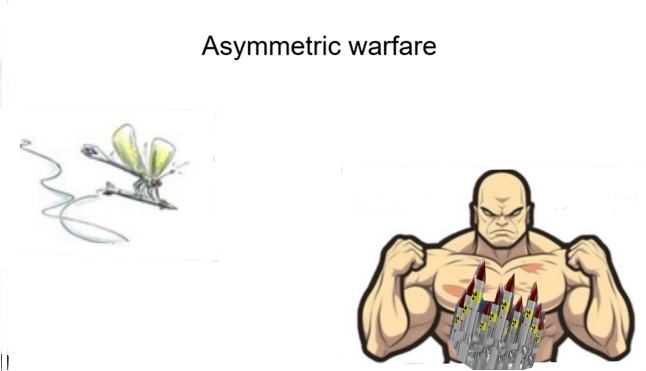
For Iran—in overall military terms far weaker than the United States—an asymmetry strategy attempts to counter expensive, often exquisite US capabilities with cheaper, lower-tech weapons and tactics designed to target critical American vulnerabilities. Most visibly, this strategy has included the use of mines, drone boats, and anti-ship missiles to close the Strait of Hormuz. Additionally, Iran has used drone strikes against US assets and those of its regional partners, cyberwarfare, and missile strikes against economic and civilian targets in Israel and the Gulf States. These drone attacks deplete the stockpiles of interceptor missiles defending US and allied bases and infrastructure, degrading air-defense capabilities and increasing political and economic pressure against continued American engagement.
The Trump administration appears to have been taken off guard by at least some of Iran’s tactics, including attempts to close the Strait of Hormuz. A degree of uncertainty is unsurprising given the nature of both asymmetric warfare and disruptive technologies. However, such tactics have been at the center of Iranian strategy for decades, and analysts have explicitly predicted the closure of the Strait of Hormuz in the event of a US-Iran war.
Thus far, Iran’s warfare has to some degree degraded American and Israeli capabilities, increased pressure on Washington, and hampered the global economy. While Iran has employed emerging or evolving technologies as part of its efforts, it is also using older technologies to significant effect. But Tehran’s strategy has serious limits, and the United States and Israel have exacted a significant toll on Iran’s military capabilities over the course of the war, now in its sixth week. Overall, this war has shown both the ways that weaker opponents can leverage asymmetric advantages to significant effect and how stronger opponents may still be able to limit the ultimate impact of asymmetric tactics.
Use of asymmetric warfare and disruptive tech. Recognizing its marked conventional imbalance against countries such as the United States and Israel, Tehran has been preparing to fight such a war for years and thus developing a range of technologies and strategies. Iran’s war effort has one overarching goal: survival. To try to achieve it, Iran has pursued tactics that appear to be aimed at three instrumental sub-goals: it has sought to degrade American and Israeli offensive capabilities; attempted to increase political pressures to end the war quickly; and sought to disrupt the global economy to increase economic pressure on Washington.
To target American, Israeli, and partner assets, Iran has used both ballistic missiles and drones. Coming into the war, Iran had a large and diverse missile force that included short- and intermediate-range ballistic missiles. Some estimates placed the number of the Iranian ballistic missile arsenal at around 3,000. Recently, Iran showcased a possibly extended range for some of its ballistic missiles, firing two at a joint US-UK base at Diego Garcia, well beyond the stated maximum range of their capabilities. At this range, Iranians could strike parts of Europe, Africa, and Asia, as well as naval targets in the Indian Ocean and Mediterranean, previously thought safe. To conduct the attempted strike, it’s possible that Iran modified space-launch assets. However, the reliability of such strikes is questionable: One of the two missiles broke up during flight, while the second proved vulnerable to air and missile defenses from Diego Garcia.
Iran’s drone arsenal, which dates to the 1980s, has yielded significant innovations despite producing mostly cheap and expendable, drones. The low cost of these systems, combined with their accuracy and reliability, has allowed Iran to deploy large numbers of them against specific targets, overwhelming defenses. This means Iran can launch enough drones to make a survival rate of only 10 to 20 percent acceptable.
Israel, the United States, and other American partners in the Persian Gulf have succeeded in intercepting many Iranian missiles and drones, limiting the effectiveness of Iran’s strikes. But the interceptions have taken a significant toll on American and partner forces. The United States reports a Terminal High Altitude Area Defense (THAAD) intercept success rate of 90 percent. But this level of effectiveness comes at a high burn rate, potentially using more than 30 percent of its total stockpile of THAAD interceptors in the first 96 hours of Operation Epic Fury alone.
The financial burden of interception alone is staggering. Iran’s Shahed-136 and several other of its variants are estimated to cost between $20,000 and $50,000 per unit. Interceptor costs vary significantly depending on which system a defender is using but can involve multimillion-dollar assets. Beyond the financial bottom line, the depletion of interceptor stockpiles will take many years to rectify, substantially weakening the United States regionally and globally. A reportspecifically on Terminal High Altitude Area Defense depletion suggests that just replacing these assets could take three to eight years.
Iran initially used its improving missile force and drone capabilities to strike American bases in the region but pivoted towards softer civilian targets. Among Iran’s nonmilitary targets is water infrastructure in the Gulf. On March 8, it struck a critical desalination plant in Bahrain. This strike exhibited a level of symmetry instead of asymmetry, with the attack occurring after Iran accused the United States of striking an Iranian desalination plant. Iran’s other targets have included airports and hotels, disrupting travel, tourism, and the domestic economies of several Gulf Arab states, as well as global air travel and logistics networks.
Destabilizing the global economy is perhaps Iran’s most visible and salient use of asymmetric warfare. Tehran has used artillery strikes, sea mines, and electronic warfare to impede transit through the Strait of Hormuz, dominating a vital maritime chokepoint through which a significant portion of the world’s fossil fuels and fertilizers transit.
Civilian ships have reported strikes from unknown projectiles that are likely mobile or shore-based artillery. Iranian forces have also rammed vessels with explosive-laden uncrewed “kamikaze boats.”
As of March 24th, Iran has also laid approximately a dozen Maham 3 and Maham 7 limpet mines in the Strait. Further, Tehran has made extensive use of electronic warfare targeted at military and civilian assets in and around the Gulf. While the broader use of electronic warfare has had limited effects, it has proven significantly successful in targeting shipping in the Strait of Hormuz. Maritime data and intelligence company Lloyd’s List Intelligence has tracked Iranian’s global navigation satellite systems in and around the Strait, logging more than 1,700 jamming incidents affecting 655 vessels, usually lasting around three to four hours each.
The Strait of Hormuz is not completely shut. Iran is allowing shipping from some friendly or neutral states to transit the waterway, so long as vessels comply with IRGC requirements and acquiesce to their inspections. Previous Iranian strikes on neutral shipping, however, has limited the credibility of this claim. As such, the threat of Iranian strikes, concern for seafarer safety, and exorbitant insurance costs have resulted in transit grinding to a near halt.
New and old technologies. Much has been written about the impacts of emerging and novel technologies on strategic outcomes, escalation dynamics, stability, and warfighting. Some of the technologies that Iran has used, such as uncrewed speedboats, are emerging—or at least evolutionary. However, Tehran has proven that many of its old, dated technologies, such as artillery, can still be effective tools of asymmetric warfare.
Both drones and cyber capabilities figure heavily in past literature on emerging disruptive technologies. It may be difficult to describe either, as well as electronic warfare systems, as emerging or novel today. But Iran’s capabilities are evolutionary, with its drone, cyber, and electronic warfare systems becoming increasingly advanced and effective over the past several decades. This is particularly true for Iran’s drone forces, with the country being among the pioneers of drone warfare.
Ballistic missiles, which Iran has used for strikes against US bases and softer, nonmilitary targets, are fundamentally a mid-20th century technology, even if Iran took longer to develop them. Short-range ballistic missiles and intermediate-range ballistic missiles, in particular, emerged more than 70 years ago. Similarly, sea mines are an old technology, not an emerging one, and their impact on the US-Iran war has been limited not by their technological characteristics, but by intentional American strikes against minelaying vessels.
Global impact and wider implications. Iran’s asymmetric warfare has implications beyond the ongoing war and the greater Middle East. The closure of the Strait of Hormuz has led to an increase in global oil prices. And those prices are threatening to rise further if the war doesn’t end or the strait isn’t reopened. Additionally, food prices are likely to rise due to a shortage of fertilizer, as the region is one of the main producers of nitrates necessary for crops. Further, up to 20,000 seafarers and several ships are stranded in the Persian Gulf, complicating global shipping, while the inaccessibility of Middle Eastern airports has exacerbated supply chains around the world.
The conduct of the war also provides possible lessons for future conflicts. The use of cheap drones and relatively rudimentary ballistic missile capabilities to draw down interceptor stores is indicative of forthcoming issues that United States would have if fighting a larger conventional adversary unless the American defense industrial base can rapidly ramp up production. Even then, Iran’s successes with $35,000 Shahed drones against multimillion dollar interceptors indicates a balance that favors offensive capabilities in the missile-interceptor race. Conversely, the unwillingness of the United States Navy to traverse the Strait or attempt to clear it alone indicates a balance favoring defensive capabilities and Anti-Access/Area Denial (which restricts adversaries in an area by prohibiting or limiting their ability to operate at a level of acceptable risk) strategies in naval warfare. Iran has successfully limited the world’s most powerful navy’s freedom of navigation despite losing most of its own navy—as well as most of its air force—in the war’s opening days.
Iran’s asymmetric successes may provide lessons for a potential United States-China conflict, though experts should use caution when trying to understand the similarities between the current crisis and a hypothetical one in the Taiwan Strait. First, the United States is likely to bring more forces to bear on China than it has against Iran. Second, the Taiwan Strait is far wider than Hormuz, making certain capabilities that China may use less effective. Third, additional actors—including the Taiwanese and Japanese—would play a significant role, with Taiwan seeking to counter Chinese movements in the Strait and the Japanese Maritime Self Defense Force potentially joining the fight, one much larger than partner navies are currently playing in the Persian Gulf. Finally, the Chinese military, especially the Chinese Navy, is far more capable than their Iranian counterparts. Despite these important differences, the United States should draw lessons about the missile-interceptor balance and the effectiveness of adversary Anti-Access/Area Denial capabilities.
Analyzing Iran’s many tactical and operational successes and their implications for future conflicts may be conducive to overstating their broader military successes. Despite blocking off the strait, depleting United States’ and partner interceptor stocks, and hitting military, political, and economic targets with kinetic and cyberattacks, Iran has had several military and political setbacks and has faced stark losses.
The United States has attacked Iranian minelaying ships attempting to close the Strait of Hormuz, potentially destroying several dozen of such vessels, if the Defense Department estimates are accurate. The destruction of so much of Iran’s minelaying force has likely contributed to its inability to deploy more than maybe a dozen mines in the Strait. While Iran has continued missile strikes against American, Gulf Arab, and Israeli targets, American and Israeli precision strikes and sabotage have degraded Iran’s missile capabilities, placing a ceiling on their ultimate effectiveness.
Militarily, Iran is likely to be defeated in this war, facing mounting losses with mounting time. But the war is also taking a major strategic toll on the United States. The cost of achieving America’s shifting war aims—including the decapitation of Iran’s pre-war leadership, degrading Iran’s missile forces, and potentially weakening its ability to restart a nuclear program—has been steep. The United States has burned through a large portion of its interceptor stockpile. The war has placed a high level of stress on the U.S.S. Gerald Ford aircraft carrier and its crew, hampering its future readiness. And Iran has struck and destroyed some critical assets, most important an E-3 Sentry aircraft that is part of the airborne warning and control system. Each of these losses reduces American readiness to respond to crises or counter great power adversaries in the short to mid-term future.
No comments yet.
-
Archives
- October 2026 (129)
- September 2026 (339)
- August 2026 (330)
- July 2026 (355)
- June 2026 (287)
- May 2026 (306)
- April 2026 (356)
- March 2026 (251)
- February 2026 (267)
- January 2026 (308)
- December 2025 (358)
- November 2025 (359)
-
Categories
- 1
- 1 NUCLEAR ISSUES
- business and costs
- climate change
- culture and arts
- ENERGY
- environment
- health
- history
- indigenous issues
- Legal
- marketing of nuclear
- media
- opposition to nuclear
- PERSONAL STORIES
- politics
- politics international
- Religion and ethics
- safety
- secrets,lies and civil liberties
- spinbuster
- technology
- Uranium
- wastes
- weapons and war
- Women
- 2 WORLD
- ACTION
- AFRICA
- Atrocities
- AUSTRALIA
- Christina's notes
- Christina's themes
- culture and arts
- Events
- Fuk 2022
- Fuk 2023
- Fukushima 2017
- Fukushima 2018
- fukushima 2019
- Fukushima 2020
- Fukushima 2021
- general
- global warming
- Humour (God we need it)
- Nuclear
- RARE EARTHS
- Reference
- resources – print
- Resources -audiovicual
- Weekly Newsletter
- World
- World Nuclear
- YouTube
-
RSS
Entries RSS
Comments RSS


Leave a Reply