Reprocessing isn’t the solution
by Bart Ziegler, April 6, 2026, https://thecoastnews.com/opinion-reprocessing-san-onofres-nuclear-waste-a-risky-bet/
A decades-old conversation about what to do with the nuclear waste at the San Onofre Nuclear Generating Station is now getting the attention it deserves.
Last December, the San Diego County Board of Supervisors voted to explore sending spent fuel from San Onofre to a national laboratory for reprocessing. Our organization raised concerns at the time. Now, the county’s own staff has reached the same conclusion.
In a March 9, 2026, report, the county found that commercial-scale reprocessing “has historically been cost-prohibitive and presents security concerns related to plutonium separation” and that “deployment timelines remain uncertain and federal policy does not prioritize reprocessing as a near-term solution.” The report concluded that pursuing a reprocessing initiative “may not be a cost-effective or strategically viable project at this time.”
This comes as pressure to embrace reprocessing intensifies. An energy think tank and Oklo — a recycling company that recently announced a $1.68 billion facility in Tennessee — are pressing Congress to rewrite foundational laws governing nuclear energy to promote commercial recycling.

The Department of Energy is soliciting states to host “nuclear lifecycle innovation campuses” encompassing enrichment, fuel fabrication and waste disposal. Of 24 states that expressed interest, officials say 12 to 15 have “very serious proposals.”
The urgency driving these efforts is real. The 3.6 million pounds of spent fuel at San Onofre sit 100 feet from the Pacific Ocean, near a military base, above the water table and near multiple active fault lines. But handing the waste over to loosely regulated startups with unproven technology and limited oversight is equally a recipe for disaster.
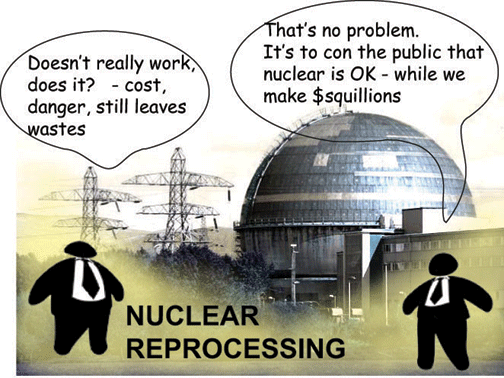
Reprocessing advocates call it “recycling,” which sounds beneficial or even harmless, but it carries its own risks. Reprocessing does not eliminate nuclear waste. It transforms solid spent fuel rods into more unstable forms, including liquid radioactive acid, which is harder to contain.
The only commercial reprocessing plant operated in the United States, in West Valley, New York, ran for six years before shutting down and accruing a cleanup bill that may ultimately cost taxpayers more than $5 billion.
The deeper problem is proliferation. Reprocessing separates plutonium — a key component of nuclear weapons — from spent fuel, creating material that is far easier to divert or steal. Presidents Gerald Ford and Jimmy Carter halted U.S. commercial reprocessing after India used plutonium from its civilian program to build a bomb in 1974.
The National Academies and Department of Energy laboratories have since concluded that newer reprocessing methods do not meaningfully reduce that risk.
This does not mean reprocessing research should be abandoned. But it does mean lawmakers should stop treating commercial reprocessing as an emergency off-ramp for San Onofre and other sites with stranded nuclear waste.
If federal policy is updated, it should prioritize approaches that avoid separated plutonium, favor low-enriched fuel strategies, minimize high-hazard secondary waste streams and meet rigorous safety requirements.
Reprocessing is not a substitute for the federal government’s obligation to deliver a permanent disposal solution, as required by federal law. Rep. Mike Levin, co-chair of the bipartisan Spent Nuclear Fuel Solutions Caucus, warned that treating reprocessing as a near-term fix for San Onofre “distracts from the work that experts agree is unavoidable.”
Instead, if lawmakers are serious about a nuclear renaissance, they should advance bipartisan legislation already under discussion to establish an independent nuclear waste authority that prioritizes removing waste from high-risk, high-population sites like San Onofre.
Bart Ziegler is the president of the Del Mar-based Samuel Lawrence Foundation.
No comments yet.
1 This Month
23-25 October – on Zoom – World BEYOND War’s annual global conferenc


Shut down the radiation-damaged Heysham nuclear reactors now
To see nuclear-related stories in greater depth and intensity – go to https://nuclearinformation.wordpress.com

Say No to NASA’s Reckless Nuclear Reactor on the Moon
Say No to NASA’s Reckless Nuclear Reactor on the Moon

-
Archives
- October 2026 (199)
- September 2026 (339)
- August 2026 (330)
- July 2026 (355)
- June 2026 (287)
- May 2026 (306)
- April 2026 (356)
- March 2026 (251)
- February 2026 (267)
- January 2026 (308)
- December 2025 (358)
- November 2025 (359)
-
Categories
- 1
- 1 NUCLEAR ISSUES
- business and costs
- climate change
- culture and arts
- ENERGY
- environment
- health
- history
- indigenous issues
- Legal
- marketing of nuclear
- media
- opposition to nuclear
- PERSONAL STORIES
- politics
- politics international
- Religion and ethics
- safety
- secrets,lies and civil liberties
- spinbuster
- technology
- Uranium
- wastes
- weapons and war
- Women
- 2 WORLD
- ACTION
- AFRICA
- Atrocities
- AUSTRALIA
- Christina's notes
- Christina's themes
- culture and arts
- Events
- Fuk 2022
- Fuk 2023
- Fukushima 2017
- Fukushima 2018
- fukushima 2019
- Fukushima 2020
- Fukushima 2021
- general
- global warming
- Humour (God we need it)
- Nuclear
- RARE EARTHS
- Reference
- resources – print
- Resources -audiovicual
- Weekly Newsletter
- World
- World Nuclear
- YouTube
-
RSS
Entries RSS
Comments RSS


Leave a Reply