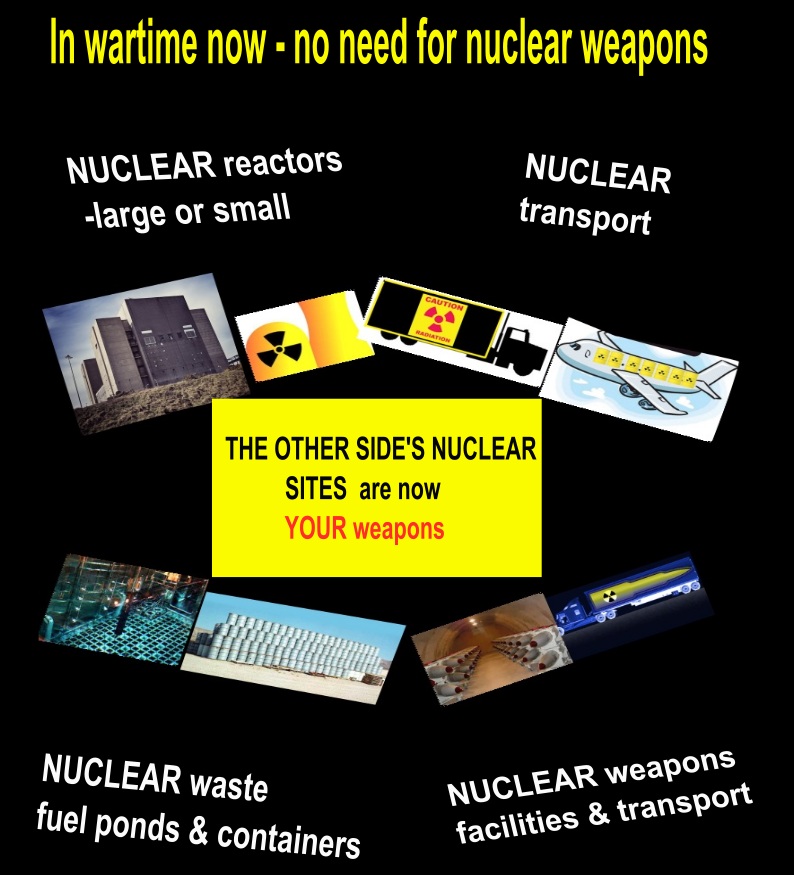
The new nuclear weapons are so much cheaper – they’re the enemy’s nuclear sites!
Noel Wauchope, 20 April 26, https://theaimn.net/the-new-nuclear-weapons-are-so-much-better-and-cheaper-theyre-the-enemys-nuclear-sites/#comment-24806
Yes, ain’t it grand! We, the God-fearing, God-loving West and Israel, don’t really need any longer to put our $billions of tax-payer money into those horribly expensive nuclear missiles, bombs, submarines. Good old new technology is proving us with much cheaper little drones
The beauty of it all is that our enemies, those bad people in Iran, Russia, China, have got readymade nuclear sites just sitting there, waiting to be gloriously exploded by our drones. If some sites, like nuclear reactors with strong containment covers are a bit too tough for drones, well non-nuclear missiles should do the job – still a lot cheaper than a nuclear weapon.
And of course, there’s an awful lot of other nuclear stuff that is just as vulnerable, even more vulnerable, than the actual nuclear reactor. Nuclear spent fuel pools are a beaut target, with their extremely high radiation levels, risk of cooling system failure, with ensuing fire. Nuclear canisters, even clad with concrete, are quite a good target, too. And so are the various forms of transport of nuclear materials. And that’s before we’ve even considered the nuclear submarines, (some in operation, many dead and awaiting burial) nuclear weapons sites, and the transport of nuclear weapons.
Nuclear facilities have strong safety protections, say the experts. But the trouble is, that was then, and this is now: in addition to material tools like drones and missiles, we have cyber digital tools – malaware and malicious computer code can be used to seriously disrupt, even destroy the other side’s nuclear systems – whether they be military, energy, or just research nuclear facilities.
So, it’s an exciting time for the war-makers.
Perhaps too exciting? The Bulletin of the Atomic Scientists discussed the Epic Fury threat by Donald Trump and Pete Hegseth, to obliterate Iran and its nuclear sites –
“signaling” near a live reactor is a high-stakes gamble with an unclear ultimate purpose. While the plant continues to feed the grid, a direct hit on its containment dome would trigger a radiological catastrophe far exceeding that of Chernobyl or Fukushima. With 70-80 tons of uranium dioxide in its core and a massive inventory of spent fuel lying in nearby cooling ponds, a breach would shroud the Persian Gulf with a lethal miasma of radioiodine and cesium-137. This wouldn’t just be a strike against a regime; it would be a death sentence for the region’s environment and its people.
And wait! What if the other side has the same idea ? And they do. In 2021, Hamas deliberately targeted Israel’s secretive Dimona nuclear reactor site. Iran has recently attacked Israeli areas close to that site. Russia drones have struck he Zaporizhzhia Nuclear Power Plant , and the defunct Chernobyl nuclear power plant in Ukraine, though these strikes could have been unintentional.
I don’t want to bore you with the gloomy details – but these are some countries that have already developed sophisticated drones and missiles capable of devastating “our side’s” nuclear facilities – Iran, Russia, China, North Korea.
And the other subject of gloom is the diminished safety policies of the United States. Karl Grossman – Harvey Wasserman report – Trump’s “flood of executive orders on nuclear power have weakened or eliminated nuclear safety regulations—making nuclear power plants more dangerous than ever—and has expedited their being built” .
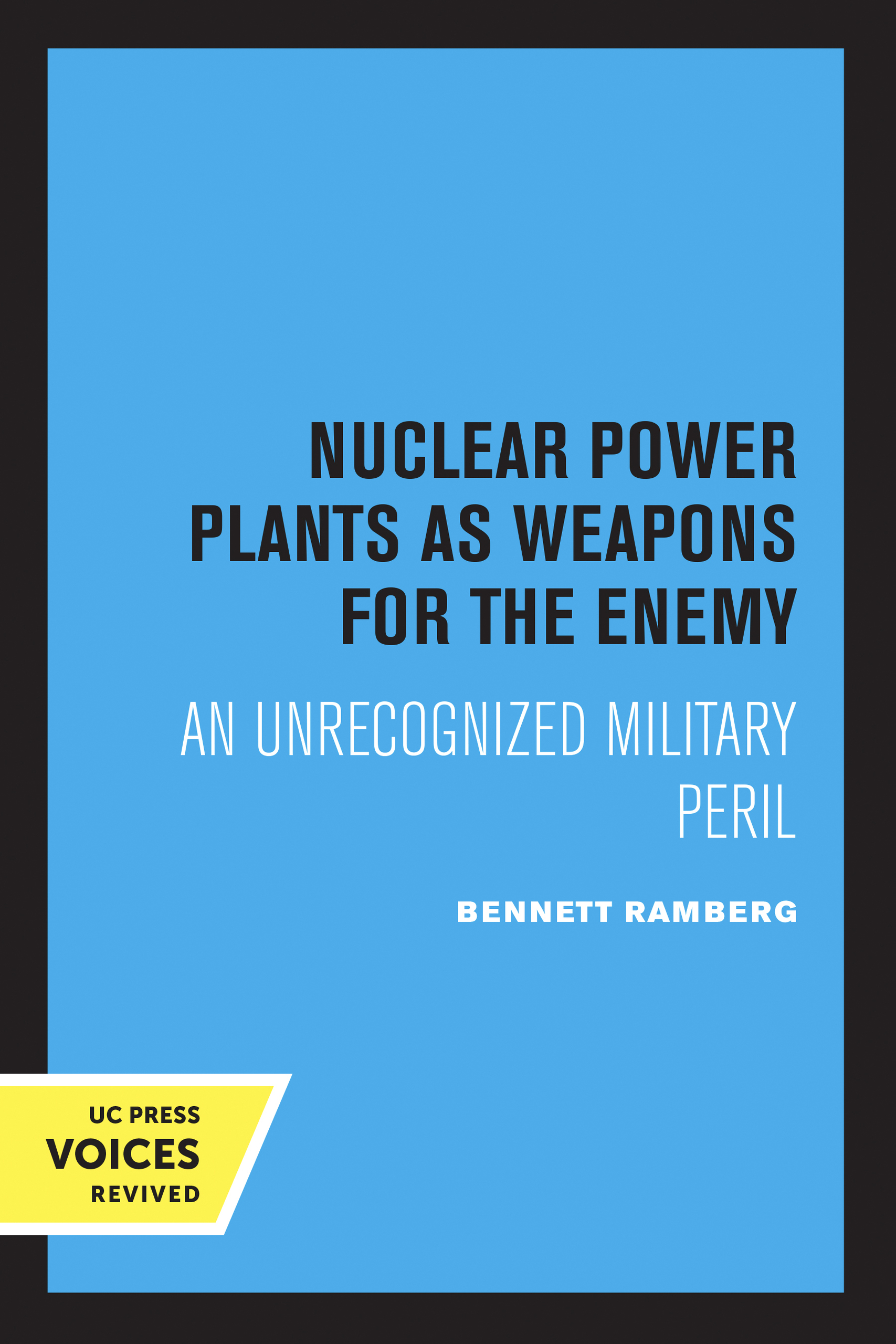
Bennet Ramberg in his 2024 book Nuclear Power Plants as Weapons for the Enemy outlined the dangers posed by nuclear sites.
The Trump administration has not merely weakened nuclear safety regulation, but virtually abdicated from it. Even the nuclear lobby itself has recognised this, and encouraged private industry to address safety questions.
BUT – Futurism points out -( https://futurism.com/science-energy/nuclear-startups-safety ) “new reporting by Politico‘s energy publication E&E News found that several baby nuclear companies are avoiding requests to join one of the industry’s main safety organizations. The regulatory body, called the Institute of Nuclear Power Operations (INPO), was formed in the fallout of the partial meltdown at Three Mile Island in 1979. While not a government body, the INPO is a nonprofit nuclear watchdog, responsible for conducting plant inspections, sharing operational guidance between nuclear companies, and helping companies train nuclear personnel.
For a nuclear energy company, joining the INPO is completely voluntary, though every operator has — until now”
Nuclear experts are well aware of these new dangers. On April 13th on a Bulletin of the Atomic Scientists panel eminent experts discussed them. Rachel Bronson, Lars van Dassen, Laura S. H. Holgate, all closely tied to the International Atomic Energy Agency, (IAEA)went into the subject in some detail. They all looked to the IAEA as the one body that might lead the world out of this perilous nuclear vulnerability mire. But they expressed anxiety, in view of the fact that that the IAEA is underfunded and under-resourced.
I am sorry – experts. But I can’t get out of my mind the fact that the IAEA has a dual mission. Its job is to ensure the safety of nuclear facilities, and to promote the peaceful nuclear industry.
Even these three very earnest experts acknowledge that the “peaceful” and the “military” nuclear industries are now irrevocably entwined. So, apart from the weakness and lack of funding for the IAEA, it is hopelessly caught up in its own conflict of interest. https://www.youtube.com/watch?v=CQGbJKEbzy8&t=63s
Nuclear-Powered Rockets — NASA Plans First Launch in 2028

In 2015 Gagnon said: “The nuclear industry views space as a new market for their deadly product. Nuclear generators on space missions, nuclear-powered mining colonies on Mars and other planetary bodies and even nuclear reactors on rockets to Mars are being sought. Thus, there are many opportunities for things to go wrong.”
by Karl H Grossman, April 17, 2026, https://www.dailykos.com/stories/2026/4/17/800021876/community/nuclear-powered-rockets-nasa-plans-for-launch-in-29/
NASA got through the Artemis II mission last week with a few minor “anomalies,” as NASA calls problems, but in 2028 it plans to launch a nuclear-powered rocket to Mars as an initial step to using nuclear-powered rockets in space.
An accident involving a nuclear-powered rocket could be no small anomaly.
The NASA plan was heralded in a section titled “America underway on nuclear power in space” in a NASA announcement on March 24th headed “NASA Unveils Initiatives to Achieve America’s National Space Policy.”
It said that “after decades of study and in response to the National Space Policy, NASA announced a major step forward in bringing nuclear power and propulsion from the lab to space. NASA will launch the Space Reactor‑1 Freedom, the first nuclear-powered interplanetary spacecraft, to Mars before the end of 2028, demonstrating advanced nuclear electric propulsion in deep space.”
Scientific American followed with an article the same day headlined: “NASA announces a nuclear-powered Mars mission by 2028.” The subhead: “The U.S. space agency will aim to send a nuclear-powered spacecraft to Mars—a first—in a bid to show that nuclear propulsion can be used to send missions into deep space.”
Pursuing use of nuclear propulsion in space has been a NASA aim for many years—indeed, going back to the 1960s.
This was highlighted by NBC News correspondent Tom Costello, who covers space issues, in 2023 going to NASA’s Marshall Space Flight Center in Alabama where work has been done and remains underway on developing nuclear rockets.
Costello reported: “NASA looks at going to the moon…and to Mars. And to get to Mars, they’re going nuclear….While science and exploration are the driving motivators, there’s also a competitive factor, China. The Chinese government is very secretive, and a lot of their plans involve their military preparations. And so, there’s a reason for us to get there first. And NASA wants to get there faster…So to cut travel time, America is going back to the future.”
“This project was called NERVA,” Costello continued, citing NERVA (which stands for Nuclear Engine for Rocket Vehicle Application), “the 1960s a government program that most Americans have never heard of to develop nuclear powered rockets. It turns out they made big progress back in the 60s, running expensive tests.”
In Huntsville, he said, “they’ve got an exact replica to scale of the Saturn V [rocket]…Future astronauts will need that kind of lift. But once they’re in space, they can use a much smaller engine, a nuclear engine, to go all the way to Mars and back…It’s happening now at the Marshall Space Flight Center…This is where they put [together] components of nuclear thermal rockets.”
Things did not go smoothly for NERVA.
“NASA: Lost its NERVA,” was the heading in an article in Ad Astra in 2005 by longtime space journalist Leonard David. He wrote about how, “For NASA, it has been a long time in coming—permission to use the ‘N’ word: for nuclear power in space. In many ways, it has been the political, financial and technological third rail of space exploration—too hot of an issue to handle easily—radioactive to boot.”
He wrote that NERVA’s “success was short-lived. In the late 1960s and early 1970s, U.S. President Richard Nixon nixed NASA and NERVA funding dramatically…Eventually, NERVA lost its funding and the project was scuttled in 1973.
It’s not just the U.S. that is intending to use nuclear-powered rockets in space. “Nuclear-powered rockets will win the new space race,” was the headline last year in The Washington Post. The sub-head: “Russia and China are working hard for a nuclear-powered advantage in space. The U.S. must up its game.
“Space nuclear propulsion and power are not hypotheticals,” said the article. “China is investing heavily in both terrestrial and space-based nuclear technologies, with plans to send a nuclear-powered spacecraft to Mars by 2033. Russia, too, has announced ambitious goals.”
The headline in a 2024 article in the South China Morning Post: “Starship rival: Chinese scientists build prototype engine for nuclear-powered spaceship to Mars.” Its subhead told of how a “1.5 megawatt-class…fission reactor passes initial ground tests as global race for space. The lithium-cooled system is designed to expand from a container-sized volume into a structure as large as a 20-story building in space.”
The article began by saying a “a collaboration of more than 10 research institutes and universities across China have made significant strides toward interplanetary travel with the development of a nuclear fission technology.”
The Russians are bullish on the speed a nuclear-powered rocket could, they believe, attain. “Mars in 30 days? Russia unveils prototype of plasma engine,” was the headline last year of an article put out by World Nuclear News.
It began: “A laboratory protype of a plasma electric rocket engine based on a magnetic plasma accelerator has been produced by Rosatom scientists, who say it could slash travel time to Mars to one or two months.” (Rosatom is the Russian State Atomic Energy Corporation.)
The Global Network Against Weapons and Nuclear Power in Space was formed in 1992 at a gathering in Washington, D.C. and now has membership throughout the world. It has organized protests at the Kennedy Space Center in Florida to NASA launches of spacecraft using radioisotope thermoelectric generators. Using the heat of plutonium-238, the RTG’s generate electricity to run instruments, not to propel spacecraft.
The largest protest organized by the Global Network involved the Cassini space probe mission to Saturn in 1997 with 73 pounds of plutonium in three RTGs, the largest amount of plutonium ever on a spacecraft.
The most dangerous portion of that mission was when NASA had the Cassini probe perform a “slingshot maneuver,” sending it back towards Earth to use Earth’s gravity to increase its velocity. If, as NASA said in an Environmental Impact Statement for Cassini, there was an “inadvertent reentry” into the Earth’s atmosphere in that maneuver causing it to disintegrate and release its plutonium, an estimated “5 billion billion…of the world population…could receive 99 percent of the radiation exposure.”
NASA insisted at the time that beyond the orbit of Mars, it was necessary to use plutonium-powered RTGs. However, in 2011 NASA launched its Juno space probe to Jupiter which instead of RTGs used three solar arrays to generate onboard electricity. Juno orbited and studied Jupiter, where sunlight is a hundredth of what it is on Earth.
In the U.S., in 2021 a report titled “Space Nuclear Propulsion for Human Mars Exploration” was issued by a committee of the National Academies of Sciences, Engineering and Medicine of the U.S.
The 104-page report also lays out “synergies” in space nuclear activities between the NASA and the U.S. military. It said: “The report stated: “Space nuclear propulsion and power systems have the potential to provide the United States with military advantages…NASA could benefit programmatically by working with a DoD [Department of Defense] program having national security objectives.”’
What might be an “anomaly” involving a nuclear-powered rocket.
“Is using nuclear materials for space travel dangerous, genius, or a little of both?” was the heading of a 2021 article in the Bulletin of the Atomic Scientists.
With the U.S. setting a goal of “a human mission to Mars,” said the articleby Susan D’Agostino, “the words ‘nuclear’ and ‘space’ are again popping up together….Nuclear propulsion systems for space exploration—should they materialize—are expected to offer significant advantages, including the possibility of sending spacecraft farther, in less time, and more efficiently than traditional chemical propulsion systems.”
“But,” the piece went on, “extreme physical conditions on the launchpad, in space, and during reentry raise questions about risk-mitigation measures, especially when nuclear materials are present. To realize the goal of nuclear-propelled, human mission to Mars, scientists must overcome significant challenges that include—but go beyond—the technical. That is, any discussion about such an uncommon journey must also consider relevant medical, environmental, economic, political, and ethical questions.”
The piece said that “attaching what amounts to a nuclear reactor to a human-occupied spaceship is not without risks.”
An article in 2023 by Bob McDonald of the Canadian Broadcasting System was headed: “Nuclear powered rockets could take us to Mars, but will the public accept them?”
“Nuclear rockets are not a new idea,” it noted. “Now, with the prospect of sending humans to Mars in the 2030s, the idea is being revived in an effort to shorten the roughly seven months it takes a conventional rocket to get to Mars. This might be a boon for future astronauts who face a seven-month, one-way journey using current technology.”
“The idea is to use a small fission reactor to heat up a liquid fuel to very high temperatures, turning it into a hot gas that would shoot out a rocket nozzle at high velocity, providing thrust,” it continued.
“The design of a nuclear rocket means they typically would produce less thrust than a chemical rocket, but nuclear engines could run continuously for weeks, constantly accelerating, ultimately reaching higher velocities in a tortoise-and-hare kind of way. Nuclear propulsion is expected to be twice as fuel-efficient as chemical rockets, largely because they can heat the gas they use for thrust to a higher temperature than chemical combustion, and hotter gas means more energy.”
“A quicker trip to Mars provides huge benefits. Astronauts would be exposed to less cosmic radiation during the journey. The psychological pressures of living in a confined space far from home would be reduced. Supplies and a rescue mission could be delivered more quickly. These rockets could also open up the outer solar system so trips to Jupiter and its large family of icy moons could eventually be within reach,” the piece went on.
“While the technology of nuclear propulsion is certainly feasible, it may not be readily embraced by the public. The accidents at Chernobyl, Three Mile Island and Fukushima have left many people skeptical about nuclear safety. And there will be risk,” said the piece.
“Technicians at the NASA Lewis Research Center in 1964 testing a nozzle design for a nuclear thermal rocket. A nuclear rocket wouldn’t be used to launch a spacecraft from the Earth’s surface — it would be designed to run in space only. It would have to launch into orbit on a large chemical rocket — so the public would have to accept the risk of launching a nuclear reactor on a standard rocket filled with explosive fuel.”
“And rockets have and will malfunction catastrophically, in what with black humor rocket scientists sometimes call RUD—’rapid unscheduled disassembly.’”
“No one wants to see nuclear debris raining down on the Florida coast or Disneyland, and that’s not the only possible scenario. An accident in orbit could potentially drop radioactive material into the atmosphere. These safety concerns need to be addressed before any nuclear rocket leaves the ground,” said the article.
Bruce Gagnon, coordinator of the Global Network since its formation, cites in the past NASA “postponing a test of a nuclear-powered spacecraft just above the Earth. They weren’t allowed to test it on Earth because of its potential for spreading contamination widely, so they intended to test it over our heads. There were concerns about the technology failing, and it falling, burning up on re-entry. At the present time there is no schedule to do those tests, but I’m sure they’re pushing ahead to do them as quickly as possible.”
“Besides the problem of an accident,” said Gagnon, “the production process for nuclear space devices leads to radioactive contamination in the laboratories where they takes place and in air and water.”
In 2015 Gagnon said: “The nuclear industry views space as a new market for their deadly product. Nuclear generators on space missions, nuclear-powered mining colonies on Mars and other planetary bodies and even nuclear reactors on rockets to Mars are being sought. Thus, there are many opportunities for things to go wrong.”
If things go wrong, these “anomalies” could be major.
NASA’s March 24 announcement also said: “When SR-1 Freedom reaches Mars, it will deploy the Skyfall payload of Ingenuity‑class helicopters to continue exploring the Red Planet. SR-1 Freedom will establish flight heritage nuclear hardware, set regulatory and launch precedent, and activate the industrial base for future fission power systems across propulsion, surface, and long‑duration missions. NASA and its U.S. Department of Energy partner will unlock the capabilities required for sustained exploration beyond the Moon and eventual journeys to Mars and the outer solar system.”
Big Tech Is Rushing Into Nuclear Energy, and Bypassing Safety Oversight

By Haley Zaremba – Apr 16, 2026, https://oilprice.com/Alternative-Energy/Nuclear-Power/Big-Tech-Is-Rushing-Into-Nuclear-Energy-and-Bypassing-Safety-Oversight.html
- A growing number of nuclear startups are opting out of the Institute of Nuclear Power Operations (INPO), the voluntary safety watchdog created after Three Mile Island — breaking a decades-long industry norm.
- The Trump administration is actively weakening existing nuclear safety regulations, including a May 2025 executive order directing the NRC to reconsider core radiation exposure standards, to accelerate domestic nuclear expansion.
- As the NRC has offloaded some regulatory responsibilities to the INPO, companies that decline membership now effectively operate outside both layers of oversight — raising serious public safety concerns.
While most countries manage their nuclear energy as a public sector, controlled and maintained by the state, the United States takes a uniquely American – which is to say, privatized – approach. As the tech sector becomes increasingly involved in nuclear energy and in the energy industry as a whole thanks to the insatiable energy needs of the AI boom, the nuclear energy landscape is changing. While there are some benefits to letting private interests compete in the nuclear energy sector in significant numbers, there are also considerable drawbacks, including the safety and oversight of these ventures. This is extremely concerning considering what can happen when nuclear energy goes wrong.
And the United States is no stranger to nuclear accidents. In 1979, a partial nuclear meltdown at the Three Mile Island plant in Pennsylvania released radioactive materials into the environment. While the accident was relatively minor, causing no detectable harm to the public or the plant’s workers, it was a wakeup call for the nation. In response, The Institute of Nuclear Power Operations, or INPO, was created as a sort of watchdog organization to ensure safety compliance in nuclear plants across the United States.
But the appetite for such compliance has flagged considerably in the intervening years. While joining the INPO has always been voluntary, every single nuclear power plant operator has always joined. Until recently, that is. A study released earlier this month by Politico’s E&E News found that a growing number of nuclear startups are declining to join the INPO.
These companies are balking at the invasivement of the organization, and the economic costs of compliance – but those hurdles are the whole point. When it comes to nuclear safety, rigor is key. And investigations have found that the INPO actually saves money for nuclear plants in the long run by diagnosing potential issues early, and thereby avoiding snags and shutdowns.
But Silicon Valley apparently doesn’t see it that way. “These entities are businesses, and they’re trying to make money,” Scott Morris, an industry consultant and former Nuclear Regulatory Commission (NRC) official, told E&E. “Any infrastructure that you put around that entity that is not directly contributing to its bottom line, it’s going to be questioned.”
But Big Tech is not solely to blame for a backslide in nuclear safety measures. In fact, their priorities are reflective of a larger sea change trickling down from the Oval Office. The Trump Administration is hell-bent on a domestic nuclear power revival, and is actively seeking to undermine existing safety regulations in order to fast-track the sector’s expansion
An executive order issued in May of last year mandates that the NRC “reconsider reliance on the linear no-threshold (LNT) model for radiation exposure and the ‘as low as reasonably achievable’ standard,” among other requirements, in order to “reestablish the United States as the global leader in nuclear energy.”
As a part of the reorganization of the NRC, the government has actually offloaded additional responsibilities to the INPO, making membership more important for public safety than ever before – and effectively making previous mandates under the NRC completely optional for nuclear energy startups that decline to join the INPO.
“The NRC has delegated some of its regulatory authority, so to speak, to INPO, specifically in the realm of operations and maintenance training programs,” Morris went on to explain. “The NRC and INPO are not duplicative; they’re complementary.”
While safety is the largest potential casualty of the privatization and Big Tech takeover of the domestic nuclear energy sector, it is not the only drawback. “If you don’t have a financial stake in the nuclear race,” Futurism recently wrote, “you might notice this arrangement comes with side effects like chronic understaffing and public subsidies of private profit.”
Critical Atlantic current significantly more likely to collapse than thought

The critical Atlantic current system appears significantly more likely to
collapse than previously thought after new research found that climate
models predicting the biggest slowdown are the most realistic.
Scientists called the new finding “very concerning” as a collapse would have
catastrophic consequences for Europe, Africa and the Americas. The Atlantic
meridional overturning circulation (Amoc) is a major part of the global
climate system and was already known to be at its weakest for 1,600 years
as a result of the climate crisis.
Scientists spotted warning signs of a
tipping point in 2021 and know that the Amoc has collapsed in the Earth’s
past. Climate scientists use dozens of different computer models to assess
the future climate. However, for the complex Amoc system, these produce
widely varying results, ranging from some that indicate no further slowdown
by 2100 to those suggesting a huge deceleration of about 65%, even when
carbon emissions from fossil fuel burning are gradually cut to net zero.
The research combined real-world ocean observations with the models to
determine the most reliable, and this hugely reduced the spread of
uncertainty. They found an estimated slowdown of 42% to 58% in 2100, a
level almost certain to end in collapse.
Guardian 15th April 2026, https://www.theguardian.com/environment/2026/apr/15/critical-atlantic-current-significantly-more-likely-to-collapse-than-thought
Trump prefers collapsing world economy to admitting defeat in his criminal Iran war

Trump is now a shell of the former war president who gloried in bombing 7 nations and snatching Venezuelan President Maduro to capture his oil. He’s trapped with no way out except admitting defeat by ending the war on Iran’s sensible terms.
Walt Zlotow West Suburban Peace Coalition Glen Ellyn IL, https://theaimn.net/trump-prefers-collapsing-world-economy-to-admitting-defeat-in-his-criminal-iran-war/
That was some phony 2 week ceasefire President Trump agreed to with Iran. When Iran refused Trump’s impossible demands presented by amateur US diplomats Vance, Witkoff and Kushner, Trump essentially resumed the war with his imaginary blockade of all Iranian shipping delivering the world’s oil.
Trump still hasn’t ruled out resuming his murderous but ineffective bombing campaign or launching a possible ground invasion to extract Iran’s enriched uranium or snatch its oil infrastructure on Kharg Island. He’s sending 10,000 more ground troops to bolster the 50,000 waiting around to either to nothing, or face major destruction if dropped into Iran.
To show the extent of US war failure, 6,000 troops aboard the aircraft carrier USS George H. W. Bush and accompanying warships had to skip the short route through the Mediterranean to go around the much longer southern Africa route, due to the Houthis’ threat to close the Bab el-Mandeb Strait. As a result Trump won’t have his 60,000 troop force in place till early May.
Trump must know he has no path to anything remotely resembling victory. No regime change. No end to nuclear enrichment. No end to Iran’s missile stockpile. Most importantly, no reopening to the Strait of Hormuz and renewed flow of Middle East oil.
He’s also likely still controlled by Israeli Prime Minister Benjamin Netanyahu who convinced Trump to launch the war on February 28 and has been sabotaging the ceasefire with his ghastly bombing of Lebanon. While Trump desperately wants out of the lost war, Netanyahu demands it continue till Iran is destroyed as an Israeli rival. Why Trump remains under Netanyahu’s control is both horrifying and may forever remain a mystery.
Trump is now a shell of the former war president who gloried in bombing 7 nations and snatching Venezuelan President Maduro to capture his oil. He’s trapped with no way out except admitting defeat by ending the war on Iran’s sensible terms.
But Trump’s lifelong delusion of his invincibility in anything he does prevents him from facing the reality of the unfolding world catastrophe he initiated.
At present, Trump resuming murderous war and precipitating worldwide economic collapse appear more likely than seeking peace, albeit certifying US defeat. Unless Congress acts to defund Trump’s $200 billion request to continue this catastrophe, or the Cabinet, led by Veep Vance, removes Trump via the 25th Amendment, things will only get dramatically, possibly infinitely worse.
Israel May Be Preparing to Permanently Reoccupy Southern Lebanon
Negotiations may end up stopping bombs on Beirut, but are unlikely to end Israel’s expanding south Lebanon occupation
.By Shireen Akram-Boshar , Truthout, April 16, 2026
n April 16, U.S. President Donald Trump announced a 10-day ceasefire in Lebanon, set to begin later that day. Although Lebanese President Joseph Aoun and Prime Minister Nawaf Salam welcomed this announcement, it is unlikely to put a stop to Israel’s expanding occupation of south Lebanon. In the hours before the announcement, Israel continued to bomb Lebanon’s south, bombing a school as well as the last main bridge connecting the south of the country to the rest of Lebanon.
The announcement came after a meeting on April 14, in which U.S. Secretary of State Marco Rubio hosted Lebanon and Israel’s ambassadors for the first diplomatic talks between the two countries since the early 1990s, a move that is likely to cause further turmoil in Lebanon. In a statement after the meeting, the U.S. explained that direct negotiations would be launched at a later date, and that objectives included the disarming of Hezbollah. Additionally, it asserted that mediation would be limited to the U.S., and that Lebanon’s reconstruction would be linked to negotiations with Israel.
A day after the envoys met in Washington, D.C., Israel launched another round of strikes on southern Lebanon, pushing forward with its invasion of the south even as it purportedly moves toward “peace.” Israel’s strikes reportedly killed 20; at the same time, Israel issued yet another forced displacement order for residents of the south. Days earlier, protesters in Beirut mobilized against the Lebanese government’s planned negotiations with Israel.
The push for direct negotiations between Israel and Lebanon came after Israel’s massive attacks on Lebanon on April 8. Hours after a fragile ceasefire took effect in the U.S.-Israeli war with Iran on April 7, Israel escalated its attacks on Lebanon, unleashing the most violent assault of its six-week war on the country. Iran and Pakistan — which mediated the U.S. ceasefire with Iran — insisted that a halt to attacks on Lebanon was part of the agreement, but Israeli Prime Minister Benjamin Netanyahu and Trump claimed otherwise. Israel’s military declared that “the battle in Lebanon is ongoing,” while renewing expanded evacuation orders for southern Lebanon.
Israel’s wave of attacks on April 8 clearly aimed to pressure the Lebanese government to further capitulate to Israel’s wishes. Throughout that morning, Israel bombed areas of southern Lebanon, attacking residential buildings as well as medical vehicles and a medical center. In the early afternoon, Israel escalated, unleashing more than 100 airstrikes in less than 10 minutes, bombing residential and commercial areas across Beirut as well as in southern Lebanon and the eastern Bekaa Valley. These airstrikes killed at least 357 people and wounded more than 1,200, marking the deadliest day of Israel’s current assault on the country. Airstrikes struck residential complexes, bridges, grocery stores, a funeral procession in a cemetery, and a university hospital………………………………………………………………………………………………………………………………………………………………………………………………………………………….
A Genocidal Aggression
Israel began its latest escalation in its war on Lebanon on March 2, when Hezbollah fired rockets at Israel after the U.S.-Israeli assassination of Iranian leader Ali Khamenei. In reality, Israel had already been waging a protracted war on southern Lebanon since 2024. The ceasefire that marked the end of Israel’s 2024 war on Lebanon did not see an end to Israel’s attacks on the south of the country. In a familiar pattern from Gaza, the agreement essentially became a one-way ceasefire, with Israel attacking south Lebanon on a regular basis and continuing to occupy areas of the south between November 2024 and March 2026. According to the UN, Israel violated the 2024 ceasefire more than 15,000 times.
Since March 2, Israel has carried out a campaign of collective punishment, particularly of the Shia-majority regions of Lebanon, and has expanded its occupation of the south of the country. Israel’s assaults, and in particular its occupation of the south, have forced 1.2 million people — 20 percent of the country’s population — to flee their homes, creating a severe displacement crisis. Israel is also working to exploit frustrations with Hezbollah and sectarian tensions within Lebanon to push the country toward civil strife or even civil war.
This current war adds to the prolonged list of catastrophes that Lebanon has already been facing:………………………………………………………………………………………………………………………………………………………………………………………….
Israel’s expansion of its war on Shia-majority areas of Lebanon uses methods from its genocidal war on Gaza. Israel has waged mass ethnic cleansing of the population of the south of Lebanon, as well as the southern suburbs of Beirut — both of which have largely been depopulated throughout the course of the war. The Israeli military has issued numerous expulsion orders as it invades and pushes towards the Litani River — some 20 miles north of Lebanon’s border with Israel — while destroying civilian infrastructure……………………………………………………………………………………………………………………………………………. https://truthout.org/articles/israel-may-be-preparing-to-permanently-reoccupy-southern-lebanon/?utm_source=Truthout&utm_campaign=8b318324c6-EMAIL_CAMPAIGN_2026_04_16_09_07&utm_medium=email&utm_term=0_bbb541a1db-8b318324c6-650192793
‘THIS IS NOT SELF-DEFENSE’: UN EXPERTS BLAST ISRAEL’S ASSAULT ON LEBANON AS WAR CRIME

April 16, 2026, ScheerPost Staff, https://scheerpost.com/2026/04/16/this-is-not-self-defense-un-experts-blast-israels-assault-on-lebanon-as-war-crime/
As Israel intensifies its bombardment of Lebanon, a group of United Nations experts is now saying plainly what much of the political class refuses to: this is not self-defense—it is a violation of international law.
In a sharply worded joint statement, two dozen UN special rapporteurs condemned the ongoing assault as “a blatant violation of the UN Charter” and “an affront to the international legal order,” warning that the scale and timing of the attacks—launched even as ceasefire talks were underway—represent a deliberate destruction of any remaining path to peace.
What’s unfolding is not just escalation—it’s acceleration.
According to reports, Israeli forces unleashed one of the largest coordinated strike campaigns in Lebanon in decades, leveling towns, hitting civilian infrastructure, and killing rescue workers in so-called “triple-tap” strikes—attacks that target first responders arriving at the scene.
The human toll is staggering. Over a million people—more than a fifth of Lebanon’s population—have been displaced since March. Thousands are dead. Hundreds of thousands of children have been forced from their homes, with UNICEF warning that “nowhere is safe.”
But beyond the numbers is the pattern.
The Israeli and Lebanese governments are once again attempting to come together for peace—at least on paper.
But even that fragile possibility comes wrapped in uncertainty. In a Truth Social post published just before midnight, Donald Trump said he was “trying to get a little breathing room between Israel and Lebanon.”
“It has been a long time since the two leaders have spoken—like 34 years,” he added, without specifying who would attend or where the talks would take place. As the death toll has now risen to 2,164, with 7,061 wounded as of today.
UN experts point to what they describe as “domicide”—the systematic destruction of homes and civilian infrastructure—combined with mass displacement orders that leave entire populations with nowhere to return. Under international law, they warn, this constitutes crimes against humanity and war crimes.
UN human rights experts are now sounding the alarm in unmistakable terms: Israel’s latest wave of strikes on Lebanon—launched within hours of a ceasefire announcement—constitutes not self-defense, but a “blatant violation of the UN Charter” and a direct assault on the international legal order. In a coordinated bombardment hitting more than 150 locations in minutes, hundreds were killed and injured, entire neighborhoods were reduced to rubble, and over a million people have been driven from their homes—an unprecedented displacement crisis that experts warn reflects a deliberate pattern of “domicide” and collective punishment. The scale, timing, and targeting of civilian areas, they argue, not only undermine any remaining prospects for peace but rise to the level of war crimes and crimes against humanity under international law, raising urgent questions not just about the attacks themselves—but about whether any system of global accountability still exists.
And yet, the bombs continue to fall.
The statement does not just call out Israel—it directly challenges the United States, Israel’s primary military backer, urging Washington to use its leverage to halt the assault. That pressure, so far, has not materialized in any meaningful way.
Instead, the gap widens—between what international law says and what global power allows.
It seems Washington needs to be reminded of the Nuclear Non-Proliferation Treaty
Bulletin, By Olamide Samuel | Analysis | April 16, 2026
After more than 40 days of US-Israeli strikes on Iran and Iranian retaliation across the Middle East, Pakistan helped broker a fragile two-week ceasefire announced on April 7, alongside a temporary re-opening of the Strait of Hormuz and a promise of direct talks in Pakistan the following week. The ceasefire created just enough diplomatic space for the highest-level direct negotiations between the United States and Iran in recent memory.
But when the Islamabad talks collapsed after 21 hours of diplomacy on April 12, Washington almost immediately went back to coercion, with President Donald Trump threatening a blockade of Iranian ports and more strikes.
The fact that both sides agreed to talk, even momentarily, demonstrates their recognition that military escalation and economic coercion could very well spiral out of control and result in severe and unforeseen consequences………………………..
It is quite perplexing that a significant part of what Washington demands of Tehran has already been written into a treaty Iran signed a long time ago—the Nuclear Non-Proliferation Treaty (NPT), to which Iran is a non-nuclear-weapon state party since 1970. Although Tehran is to blame for Washington’s undermined confidence in the NPT, bombing Iran and issuing blockade threats won’t lead to a better non-proliferation arrangement. As state parties to the NPT will convene this month in New York for the treaty’s review conference, it’s about time to remind the Trump administration of the non-proliferation obligations Tehran already agreed to.
Existing obligations. The NPT strictly constrains Iran’s nuclear activities: Article II bars the acquisition of nuclear weapons, and Article III requires safeguards, limiting a state’s ability to “quickly achieve a nuclear weapon.” And even if Article IV affirms the rights of states to pursue the peaceful use of nuclear energy, it allows so only if that activity remains within the treaty’s non-proliferation obligations.
Of course, Washington has other demands that go beyond the NPT’s obligations. ………………………………………………………………………………………………………………………………………………………………………………..
Washington’s actions have consistently narrowed the already fragile space for Iranian cooperation with IAEA inspections at the very moment when more visibility and more access are needed. But when Vance now says Iran must renounce not only the bomb but also the “tools” that would allow it to move quickly towards one—tools that reportedly include enrichment capacity, major nuclear facilities, and highly enriched uranium stockpiles—he is in effect describing the function the JCPOA once served, albeit in more maximalist form. That 2015 agreement was designed to lengthen breakout time, constrain enrichment, and make the restraint verifiable. The UN Security Council had endorsed that agreement, and Iran was complying with it until the first Trump administration unilaterally walked away from it in 2018…………………………………………………………………………………………………………………………………………………………………………………………………………………………….. https://thebulletin.org/2026/04/it-seems-washington-needs-to-be-reminded-of-the-nuclear-non-proliferation-treaty/?utm_source=ActiveCampaign&utm_medium=email&utm_content=Washington%20needs%20to%20be%20reminded%20of%20the%20Nuclear%20Non-Proliferation%20Treaty&utm_campaign=20260416%20Thursday%20Newsletter
Proposed Scottish nuclear study unlikely to be published before election
An assessment looking at the feasibility of building new nuclear power
plants at existing nuclear sites in Scotland, proposed by the UK
Government, is unlikely to be published before the Scottish Parliament
elections on 7 May.
New Civil Engineer 17th April 2026 https://www.newcivilengineer.com/latest/proposed-scottish-nuclear-study-unlikely-to-be-published-before-election-17-04-2026/
Bulgarian minister wants fixed price for Kozloduy 7 and 8 nuclear reactors
Bulgarian minister wants fixed price for Kozloduy 7 and 8. Minister of
Energy Traycho Traykov has said Bulgaria wants its proposed new nuclear
power units at the Kozloduy plant to be built at fixed prices.
World Nuclear News 16th April 2026, https://www.world-nuclear-news.org/articles/bulgarian-minister-wants-fixed-price-for-kozloduy-7-and-8
Not clear there is public appetite for nuclear energy in Ireland despite fuel crisis, junior minister says
It is “not clear” that public
opinion is in favour of removing a ban on the development of domestic
nuclear power plants for electricity in Ireland, the Dáil has been told.
Junior minister Timmy Dooley said there were no plans for the development
of nuclear power, including small modular reactors, as part of Ireland’s
electricity system. Two separate legislative bans prohibit the development
of nuclear fission for electricity generation and “would need to be
replaced as a first step,” he said.
Irish Independent 16th April 2026
https://www.independent.ie/irish-news/taoiseach-insists-his-position-not-under-threat-in-any-shape-or-form-as-fianna-fail-tds-sound-out-senior-ministers-to-lead-heave-against-him/a1221611234.html
1 This Month





PLEASE OPPOSE HR 8255 AND S.3639 – bills would accelerate satellite deployment, with no environmental review or safeguards – https://ncstd5li.quorum.us/campaign/169331/
To see nuclear-related stories in greater depth and intensity – go to https://nuclearinformation.wordpress.com
-
Archives
- October 2026 (49)
- September 2026 (339)
- August 2026 (330)
- July 2026 (355)
- June 2026 (287)
- May 2026 (306)
- April 2026 (356)
- March 2026 (251)
- February 2026 (267)
- January 2026 (308)
- December 2025 (358)
- November 2025 (359)
-
Categories
- 1
- 1 NUCLEAR ISSUES
- business and costs
- climate change
- culture and arts
- ENERGY
- environment
- health
- history
- indigenous issues
- Legal
- marketing of nuclear
- media
- opposition to nuclear
- PERSONAL STORIES
- politics
- politics international
- Religion and ethics
- safety
- secrets,lies and civil liberties
- spinbuster
- technology
- Uranium
- wastes
- weapons and war
- Women
- 2 WORLD
- ACTION
- AFRICA
- Atrocities
- AUSTRALIA
- Christina's notes
- Christina's themes
- culture and arts
- Events
- Fuk 2022
- Fuk 2023
- Fukushima 2017
- Fukushima 2018
- fukushima 2019
- Fukushima 2020
- Fukushima 2021
- general
- global warming
- Humour (God we need it)
- Nuclear
- RARE EARTHS
- Reference
- resources – print
- Resources -audiovicual
- Weekly Newsletter
- World
- World Nuclear
- YouTube
-
RSS
Entries RSS
Comments RSS

