Trump’s Genocidal Threats on Iran Are Enabled by a Vast Apparatus of Destruction
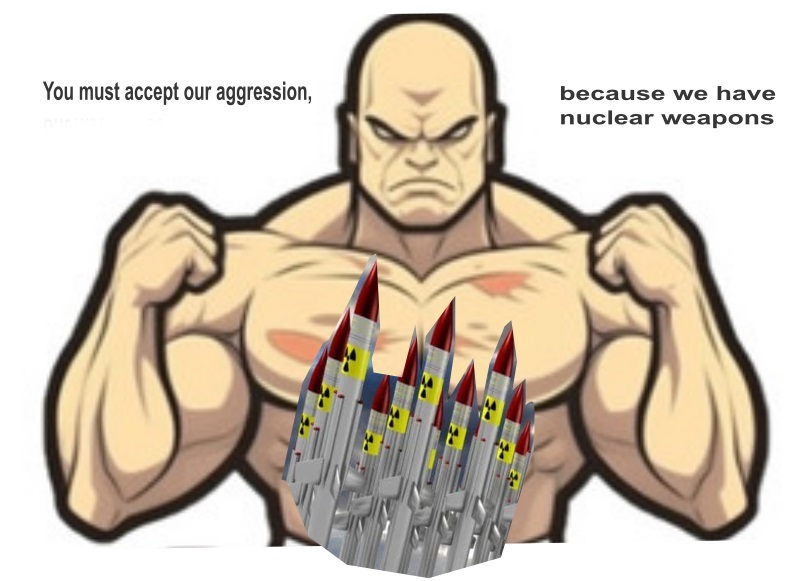
most people with common sense are speculating whether Trump will use one of the United States’ 3,700 nuclear weapons on Iran. Let us not forget that Israel — the only actually nuclear-armed state in the region, the one that’s spent nearly three years now committing genocide against Palestinians and is currently wiping out entire villages in Lebanon — also has an estimated 90 nuclear weapons.
“A whole civilization will die tonight, never to be brought back again,” Trump threatened.
By Negin Owliaei , Truthout, April 7, 2026
Somehow, in a war already bent on turning Iran into a failed state, Donald Trump’s threats against the country have become increasingly disturbing. For days now, Trump has threatened to bomb key civilian infrastructure in Iran, from bridges to power plants. On April 5, in a terrifying screed, he wrote: “Tuesday will be Power Plant Day, and Bridge Day, all wrapped in one, in Iran.” He went on to say, “Open the Fuckin’ Strait you crazy bastards, or you’ll be living in Hell — JUST WATCH! Praise be to Allah.”
He doubled down on that threat the next day, when a reporter asked how his threatened strikes would not amount to a war crime. “They’re animals and we have to stop them,” he said. He also attempted to justify himself by suggesting that he was calling for Iranian liberation. “They want to hear bombs because they want to be free.”
Finally, on the morning of April 7, he issued his most chilling threat yet: “A whole civilization will die tonight, never to be brought back again.”
These statements, from a man who directs the incomprehensibly lethal power of the U.S. military, should make the world stop. For me, personally, it does feel like the world has stopped: What do you do in the hours between the moment the president of the United States threatens to annihilate your homeland and the time he has vowed to conduct the actual act? Trump is holding an entire nation hostage. But, somehow, the rest of the world continues on. The markets chug along. Congress continues to be in recess, with dissent confined largely to social media posts. It is hard not to feel like we have failed some critical test of the bounds of our own humanity.
Now, as the entire world waits to see what kind of fate a single man will inflict upon an entire nation, we have entered new territory. As I type these words, most people with common sense are speculating whether Trump will use one of the United States’ 3,700 nuclear weapons on Iran. Let us not forget that Israel — the only actually nuclear-armed state in the region, the one that’s spent nearly three years now committing genocide against Palestinians and is currently wiping out entire villages in Lebanon — also has an estimated 90 nuclear weapons.
The nuclear threat is animating for its sheer terror, and for good reason. Some military experts have cast doubt on the U.S.’s ability to use a nuclear weapon against Iran. Other political pundits, meanwhile, suggest that this is a perfect example of Trump making a maximalist threat in order to seek a better negotiating position.
But to pretend that this is the limitation of the threat — that, if a nuclear weapon is not deployed, we have somehow won something crucial — is to miss the point. The U.S. and Israel have already inflicted mass death upon Iran in the form of conventional missiles. In terms of specifically nuclear threats, Iran’s nuclear power plant at Bushehr has come under repeated attack during this aggression. Mainstream U.S. media outlets have largely moved past the fact that Israel bombed fuel depots in Iran, causing oil to rain down from the skies — a chemical attack if there ever was one.
Trump’s threats to bomb power plants and bridges and civilian infrastructure more broadly are already terrifying enough as it is. And Trump’s language alone is monstrous. It is genocidal and should be treated as such; threatening genocide, legal experts are pointing out, is itself a war crime.
…………………………………………………………………………………………………………………………………………… On the first day of the war, we learned that the earliest reported casualties of U.S.-Israeli aggression were kids going to school, and eventually found they were killed while huddled together in a prayer room, their bodies hit with a U.S.-made and delivered missile. I wrote then that “we in the U.S. need to reckon with the fact that so much of our state wealth, capacity, and technology goes toward burying children in rubble.” We still need to do that, desperately.
We also need to address the dehumanization that persists in every single aspect of American life — from politics to culture to media — that has sent us down the path in which Trump can threaten to annihilate a civilization and we find ourselves with few answers about how to stop it. By calling for the death of a civilization, Trump is making the goal explicit. But decades of sanctions paved the way for his words. Politicians on both sides of the aisle who have and continue to frame Iran as a particular threat, even as a “cancer,” have made this possible. The media outlets that uncritically platform those racist tirades bear responsibility, too. Sadly, Iranians in the diaspora who insisted that their fellow country people were desperate for bombs — some of whom continue to call for further violence against their people — played a role here as well.
…………………………………………………………………………….. Trump might be able to threaten a civilization with mass death. But there is an entire apparatus that makes those threats credible — from the whole spectrum of the U.S. political establishment constantly voting to fuel the war machine, to the international organizations that shaped international law to favor the powerful, to the media that downplay and obfuscate the viciousness of U.S. empire. A civilization that allows these threats to repeat unabated should question whether, somewhere along the way, it was the one that actually died. https://truthout.org/articles/trumps-genocidal-threats-on-iran-are-enabled-by-a-vast-apparatus-of-destruction/?utm_source=Truthout&utm_campaign=ca3edbadaa-EMAIL_CAMPAIGN_2026_04_07_09_29&utm_medium=email&utm_term=0_bbb541a1db-ca3edbadaa-650192793
US Satellite Firm Blacks Out Iran War Images Per US Government Request

by Alan Mosley | April 5, 2026, https://news.antiwar.com/2026/04/05/us-satellite-firm-blacks-out-iran-war-images-per-us-government-request/
Planet Labs says it will “indefinitely withhold” satellite visuals of Iran and the wider Middle East war zone after a request from the US government and the Trump administration. In an email to customers, the firm said it is shifting to a “managed distribution” model, releasing imagery only case-by-case for “urgent, mission-critical requirements,” or when release is deemed “in the public interest.” Planet also said it will withhold imagery dating back to March 9, and it expects the policy to remain in effect until the conflict ends.
On March 6, Planet Labs announced a mandatory 96-hour delay on new imagery collected over the Gulf states, arguing that near-real-time pictures could be exploited to “endanger allied, NATO, and civilian personnel.” That measure later expanded into a 14-day delay, described by Planet as an extension of the earlier hold. By March 30, Al Jazeera’s Digital Investigations unit was reporting that independent verification had become harder as commercial providers restricted satellite imagery.
Satellite imagery matters because, unlike press briefings, it can corroborate damage, assess patterns of targeting, and check narratives that would otherwise be accepted on authority. Reporting by the Global Investigative Journalism Network describes how open-source teams used satellite imagery and videos to probe contested incidents during this war, quoting Bellingcat’s head of research warning that a “two-week delay” slows verification and reduces the certainty investigators can reach while events are still developing. It also quotes the Defense Secretary saying, “Open source is not the place to determine what did or did not happen.”
Despite the insinuation that open source investigative journalism is less credible, even mainstream news organizations utilize such tools in their reporting. For example, Reuters has also used satellite imagery in its war coverage, including sharing said imagery and post-strike visuals with a munitions researcher in reporting on the strike on a girls’ school in Minab which killed over 170 people, mostly children. While later reporting added that the strike may have involved outdated targeting intelligence, it is worth noting that the president claimed “without evidence” that Iran was responsible.
One can concede that operational security is real and still recognize that “trust us” is an unsafe substitute for public evidence. In mid-March, the White House claimed Iran’s ballistic-missile capacity was “functionally destroyed,” with “complete and total aerial dominance,” while reporting in the same period described continued missile incidents and interceptions. But the Trump administration’s claim of total control over Iranian airspace seems dubious when countered with reports of military losses, such as the downing of multiple aircraft just since the start of April.
The blackout of satellite imagery from the region is not a story about one firm’s products or customer service. It is a reminder that foreign intervention tends to produce domestic control, often without the drama of a formal censorship order. The same state that wages war can narrow the evidence available to judge that war. The predictable result is that the public is pushed to take the word of the administration’s spokesmen at face value, without timely means to verify or falsify their claims.
Alan Mosley is a historian, jazz musician, policy researcher for the Tenth Amendment Center, and host of It’s Too Late, “The #1 Late Night Show in America (NOT hosted by a Communist)!” New episodes debut every Wednesday night at 9ET across all major platforms; just search “AlanMosleyTV” or “It’s Too Late with Alan Mosley.”
How the neoconservative influence over U.S. war-making paved the way for Trump’s war crimes in Iran

Donald Trump’s naked threats to target Iran’s civilian infrastructure are the culmination of a strand of neoconservative thought that has defined U.S. war-making over three decades, from the Iraq war to Obama’s drone campaigns to the Gaza genocide.
By Abdaljawad Omar Mondoweiss, April 6, 2026
On Sunday morning, as Christians across Iran and the world marked Easter, Donald Trump posted a profanity-laced ultimatum on Truth Social. “Tuesday will be Power Plant Day, and Bridge Day, all wrapped up in one, in Iran,” he wrote. “Open the Fuckin’ Strait, you crazy bastards, or you’ll be living in Hell — JUST WATCH!”
The post was the latest in a week of escalating threats — to bomb Iran “back to the Stone Ages,” to destroy its power plants, bridges, and “possibly all desalinization plants” after a ten-day deadline issued on March 26 expires at 8 p.m. ET on Tuesday. Over a hundred international law experts have already warned that targeting civilian infrastructure constitutes a war crime under the Geneva Convention. Trump, characteristically, appears neither to have read their letter nor to care.
The language is Trump’s own: crude, performative, calibrated for the scroll. But the logic it serves is not his. It belongs to a longer and more deliberate tradition of strategic thought — one that was articulated, with far greater sophistication, more than three decades ago. It has been advancing, precedent by precedent, toward exactly this moment, and to understand how threats of destroying Iranian civilian infrastructure not only became thinkable but inevitable, one must return to the man who first laid the intellectual groundwork for it in the contemporary age: Eliot Cohen.
A professor of strategic studies at Johns Hopkins and later Counselor of the State Department under Condoleezza Rice, Cohen was one of the most consequential war intellectuals of his generation. One of his more memorable and deliberately irreverent lines, first appearing in an article in Foreign Affairs in the aftermath of the First Gulf War, compared airpower to modern courtship, because it appeared “to offer gratification without commitment.” The Gulf War had produced a euphoria among politicians, commentators, and generals due to the emergence of airpower as an instrument of surgical precision, coming at negligible cost and with minimal political consequence. Smart bombs had entered the popular imagination, and press briefings started to feature grainy cockpit footage of missiles threading through ventilation shafts. The message of it all was unmistakable: war had been technologically redeemed.
Cohen’s essay dispelled this fantasy, not to restrain the conduct of war, but to liberate it. His first and most fundamental argument was that war is cruelty, and no degree of technological sophistication changes that. But where a humanitarian critic might have drawn from this the conclusion that force should be constrained, Cohen drew the opposite: the pretense of constraint, far from a moral achievement, was a strategic weakness. ……………………………………………………….
When Trump threatens to destroy Iran’s power grid and water desalination plants, an infrastructure upon which millions of civilian lives depend, he is speaking, whether he knows it or not, in the language codified by Cohen.
There’s a second argument in Cohen’s essay that is relevant here, and it followed naturally from the first. Cohen endorsed, without apology, the killing of the enemy leadership as the logical endpoint of airpower doctrine,………………………………
How Israel refined the Cohen doctrine
These two ideas — that war must be waged with unflinching cruelty against the full depth of the enemy’s society, and that leadership decapitation is airpower’s natural culmination — did not remain academic propositions. They germinated over the course of three decades in the operational doctrines of the states most invested in aerial warfare……………………………………………………………………
And so we arrive at Trump’s deadline: “Power Plant Day, and Bridge Day, all wrapped up in one.” The threat to destroy civilian infrastructure that sustains millions of lives is not an aberration, but the next room in a long corridor of precedent, each section built to make the next step feel less dramatic than it is……………………………………………………………………….
Cohen’s courtship metaphor promised gratification without commitment; what it delivered, in the end, was cruelty without limit — and a world in which the consequences of that cruelty fall not on the men who authorized it, but on everyone else. https://mondoweiss.net/2026/04/how-the-neoconservative-influence-over-u-s-war-making-paved-the-way-for-trumps-war-crimes-in-iran/
They Reject American Israel Public Affairs Committee (AIPAC)—But Not the War Machine
what does it mean for a state to claim a right to exist if that existence is sustained through the death, displacement, and destruction of others?
April 7, 2026 Joshua Scheer, https://scheerpost.com/2026/04/07/they-reject-aipac-but-not-the-war-machine/
In Washington, a quiet rebrand is underway.
One by one, prominent Democrats positioning themselves for 2028 are announcing that they will no longer accept money from the American Israel Public Affairs Committee (AIPAC). On its face, this seems like a meaningful break from decades of bipartisan deference. For years, AIPAC has functioned as a gatekeeper of acceptable discourse on U.S. policy toward Israel—rewarding loyalty, punishing dissent.
But look closer, and the shift begins to feel less like a rupture—and more like a recalibration.
Because while the money may be refused, the machinery of war remains firmly intact.
A Political Adjustment, Not a Moral One
Recent polling shows a dramatic shift among Democratic voters, with overwhelming sympathy now leaning toward Palestinians rather than Israelis. Currently, 65 percent of Democrats say their sympathies lie more with the Palestinians, while 17 percent say they sympathise more with the Israelis. That reality has forced politicians to adapt. For the first time in a generation, the moral ground beneath U.S. support for Israel is cracking—driven not by politicians, but by a public no longer willing to ignore the scale of destruction in Gaza.
So candidates pivot.
They distance themselves from AIPAC. They speak in softer tones. Some even flirt with language once considered taboo—words like “apartheid,” quickly walked back when backlash arrives.
Yet beneath this rhetorical repositioning lies a stubborn continuity: unwavering support for military aid, strategic alliance, and the broader architecture of U.S. dominance in the Middle East.
This is not transformation. It is triangulation.
To demonstrate that most clearly, here is the front-runner for 2028 discussing his reversal of calling Israel an apartheid state and his reverence for the country. Newsom’s reversal—pairing regret over the word “apartheid” with an insistence that he “revere[s] the state of Israel”—captures where Democrats are now: distancing from Netanyahu without challenging the system itself.
However, Cory Booker defended the group—from which he has received significant funding—arguing that the intense focus on AIPAC is misplaced. He noted that many ethnic and interest groups raise and bundle political donations, often for causes he personally disagrees with, yet AIPAC has become a singular target of criticism. As he put it, “There are Iranian Americans that bundle money. There are Turkish Americans that bundle money. There are a lot of ethnic groups that bundle money… but somehow AIPAC seems to be drawing a lot of attention, and that’s problematic to me.” At the same time, Booker has said he would no longer accept PAC money in general. Still, at least he stands by his position.
The Illusion of Courage
Rejecting AIPAC donations is being framed as a bold stand. In reality, it is the lowest bar imaginable.
What would actual political courage look like?
It would mean voting to halt weapons transfers used in devastating campaigns across Gaza, Lebanon, and beyond. It would mean openly confronting the human cost of U.S. foreign policy—not just its public relations problem. It would require breaking not just with a lobbying group, but with a system that treats military force as the default instrument of policy.
Few are willing to go that far.
Instead, we see a familiar pattern: symbolic gestures paired with substantive silence.
Blaming Individuals, Protecting Systems
Another tactic has emerged in this moment of discomfort—one as old as politics itself.
Blame the leader, not the structure.
Criticism is carefully directed at Benjamin Netanyahu, portrayed as an outlier or aberration. The implication is that without him, the underlying policies would somehow be more humane, more restrained, more just.
But this framing obscures more than it reveals.
Netanyahu did not create the system—he operates within it. A system sustained by decades of U.S. military funding, diplomatic shielding, and bipartisan consensus. To isolate him as the problem is to avoid confronting the deeper reality: that the policies themselves, not just their most visible architect, are responsible for the devastation.
Here is that dynamic in clear focus with former Chicago mayor Rahm Emanuel. A longtime supporter of Israel—whose father was Israeli. At the same time, he has also vowed not to take AIPAC’s money.
Kentucky Gov. Andy Beshear underscored again what we have been saying: that the party cannot change its ways despite cutting off one group that has become politically problematic, further showing the disconnect between the people they represent and Israel.
Here, Beshear sticks to familiar pro-Israel talking points in a recent interview and resists labeling the devastation in Gaza as “genocide,” dismissing such language as an unwelcome party “litmus test.” Rep. Ro Khanna pushed back, arguing that defending human rights should be the most basic standard—and that the party must find a new moral direction.
The Money Isn’t the Whole Story
Even as AIPAC becomes politically radioactive in some circles, its influence persists—often through parallel organizations, aligned donors, and entrenched institutional relationships.
More importantly, AIPAC has never been the sole driver of U.S. policy. It is a symptom of a broader alignment between American power and Israeli military strategy—an alignment rooted in geopolitics, not just lobbying.
Which means that removing AIPAC from the equation, while leaving everything else intact, changes very little.
The pipeline of weapons continues.
The bombs keep falling.
The rhetoric adjusts.
And while AIPAC often dominates the conversation, it is far from the only force shaping pro-Israel advocacy in U.S. politics. A wide network of organizations operates across the political spectrum, each reinforcing the U.S.-Israel relationship in different ways. Christians United for Israel (CUFI), the largest pro-Israel group in the country with over seven million members, mobilizes grassroots evangelical support rooted in Christian Zionist beliefs. J Street, founded in 2008, presents itself as a more progressive alternative, advocating for a two-state solution and diplomacy over military approaches, even as it maintains a pro-Israel stance. Within party politics, the Democratic Majority for Israel (DMFI) works to ensure the Democratic Party remains firmly aligned with Israel, while the Republican Jewish Coalition (RJC) advances similar priorities within Republican circles. Other groups, such as Pro-Israel America PAC and the Israeli-American Coalition for Action, focus on supporting candidates and advancing legislation that strengthens bilateral ties, including efforts like anti-BDS laws at the state level. Additional organizations—including NORPAC, the Joint Action Committee for Political Affairs (JAC), and Americans for Good Government (AGG)—further reinforce this ecosystem by backing candidates who support a strong U.S.-Israel relationship. While these groups differ in strategy—ranging from grassroots mobilization to direct political funding and lobbying—they collectively demonstrate that AIPAC is not an isolated actor but part of a broader, deeply embedded network.
At the same time, opposition has begun to coalesce through the “Reject AIPAC” coalition, which includes groups like IfNotNow, Jewish Voice for Peace Action, and Justice Democrats, signaling a growing pushback against this entrenched influence.
The Bottom Line
The deeper problem is not rhetorical—it is structural. Israel is a settler-colonial state, and until that truth is spoken plainly—alongside the histories of the United States, South Africa, and others built on dispossession—we are not having an honest conversation. We are circling it, softening it, avoiding it. Because the real question cuts too deep: what does it mean for a state to claim a right to exist if that existence is sustained through the death, displacement, and destruction of others? That is the question buried beneath every speech, every careful statement, every political pivot.
Instead, we are handed villains. Netanyahu becomes the embodiment of the problem—like Trump, grotesque enough to absorb our outrage. But this is a sleight of hand. Systems do not begin or end with men like him; they outlive them, operate through them, and are protected by those who claim to oppose them. By narrowing the blame, we absolve the structure.
And so the language collapses. Even Gavin Newsom, for a fleeting moment, brushed against the truth—only to retreat, unable to hold the weight of the word “apartheid,” unable to let it stand. That retreat is not incidental; it is the boundary of acceptable politics. Because to name the system is to implicate ourselves—our history, our alliances, our silence.
Until that boundary is broken, until the words match the reality, there is no path forward—only repetition, only evasion, only the quiet normalization of what should be unthinkable.
Trump, Hegseth and the Language of War Crimes
9 April 2026 Dr Binoy Kampmark, https://theaimn.net/trump-hegseth-and-the-language-of-war-crimes/
He’s out of ideas, a mind running on empty. Increasingly, he is also short of reason, zapped by geopolitical addling and meddling. Now that US President Donald J. Trump has reached an uneasy understanding with Tehran that a two-week ceasefire should apply to the warring parties (Israel, as usual, has its own elastic interpretation as it continues attacking Lebanon), it is worth considering the warring language he has been using since February 28. Of note is the shrill wording of various ultimata he has directed at Iran.
On April 7, the President seemed to flirt with the notion of genocide in promising that “A whole civilization will die tonight, never to be brought back. I don’t want that to happen, but it probably will.” With biblical promise, he was certain that “one of the most important moments in the long and complex history of the World” was about to befall humanity. “47 years of extortion, corruption, and death, will finally end.”
On Easter Sunday, another message was posted bellowing that “Tuesday will be Power Plant Day, and Bridge Day, all wrapped up in one, in Iran. There will be nothing like it!!!” Strong language followed. “Open the Fuckin’ Strait, you crazy bastards,” he railed in making reference to Iran’s restrictive hold on the Strait of Hormuz, “or you’ll be living in Hell – JUST WATCH!” Showing a mind turned to slurry, America’s commander-in-chief then praised Allah.
A few days prior, the President issued another threatening note to his adversaries. “If there is no deal, we are going to hit each and every one of their electric generating plants, very hard and probably simultaneously.” This came after strained suggestions that Iran’s new leadership was seeking a ceasefire but could expect nothing without the reopening of the Strait of Hormuz. “Until then, we are blasting Iran into oblivion, or, as they say, back to the Stone Ages!!!”
No degree of lexical polishing, ducking and adjustment escapes the central tenet of such words. They show a lack of discrimination, a lack of proportion, and can only amount to war crimes, either in terms of promised or ongoing operations. Article 52 of the Geneva Convention Additional Protocol I, for instance, makes it abundantly clear that attacks shall only “be limited strictly to military objectives.” Targeted objects shall only be those that “make an effective contribution to military action and whose total or partial destruction, capture, or neutralization, in the circumstances ruling at the time, offers a definite military advantage.” Article 57 affirms that “constant care shall be taken to spare the civilian population, civilians and civilian objects.” A number of precautionary steps to ensure that aim are enumerated, including, for instance, verifying “that the objectives to be attacked are neither civilians nor civilian objects.”
In a measured assessment of Trump’s spray of promised annihilation published in Just Security, Margaret Donovan and Rachel VanLandingham, both former uniformed military lawyers, also consider the grave effects of such statements on serving personnel. “[W]e know the president’s words run counter to decades of legal training of military personnel and risk placing our warfighters [sic] on a path of no return.” Such rhetoric did not merely “undermine US legitimacy and global standing” but posed “a significant risk of moral and psychic injury for servicemembers.” They further imperilled soldiers by placing them at risk of future prosecutions for war crimes that would not fall within the statute of limitations.
To Trump’s chilling language can also be added various sinister remarks from Secretary of Defense (or War, as he prefers) Pete Hegseth, who has soiled the conventions of international humanitarian law by expressly declaring that “no quarter, no mercy for our enemies” will be shown. That’s the Lieber Code, the Hague Conventions, and the Rome Statute of the International Criminal Court out the door, perhaps unsurprising from a man who had claimed that US forces should pursue “maximum lethality, not tepid legality.”
Far from being unbecoming aberrations, these comments from Trump and Hegseth are not out of character in the history of American warfare. The no-quarter logic was habitually demonstrated during the Civil War, notably when it came to killing captured Black American soldiers. Historian George S. Burkhardt goes as far as to suggest that an unofficial policy existed among the Confederates that they could execute Black American soldiers and their white officers captured in combat fighting for the Union.
This pattern of no prisoners and no quarter would again assert itself in such theatres of conflict as the Philippines, when, in September 1901, Brigadier General Jacob H. Smith demanded of Major Littleton Waller that no prisoners were to be taken in the aftermath of a surprise attack on the island of Samar which left 54 American soldiers dead. “I wish you to kill and burn,” he growled, insisting that the island of Samar be turned into a “howling wilderness.” Ditto the ferocious combat shown in the Pacific during the Second World War, when merciless no-quarterism was manifest as US forces made their way towards Japan.
Having noted all three examples, Ali Sanaei of the University of Chicago observes that such instances are not only unlawful but diagnostic. “It appears when war is not imagined as reciprocal combat but as punitive domination over populations thought incapable of deserving the usual protections.” Whatever gilded rhetoric on notions of freedom issue from the Trump administration when it comes to the Iran War, it has become increasingly clear that distinctions between foe and non-combatant have fogged up and vanished, leaving the sort of stubborn resistance that demands punishment. Yet, even as statute books are blotted and conventions maligned, the stubborn continue to prevail.
Former presidents must call for end to Trump’ criminal Iran war destabilizing the world…but won’t.
Walt Zlotow West Suburban Peace Coalition Glen Ellyn IL 7 April 26
Former presidents Bill Clinton, George W. Bush, Barack Obama, Joe Biden, like all ex-presidents, tend to refrain from criticizing the current White House occupant. They view themselves as members of the most exclusive American club so are loathe to excoriate their next member joining them upon leaving office. Criticizing the current president is generally political in nature, best left to those still battling in the political arena.
But these are no ordinary times. Current President Trump has embarked on a catastrophic war on Iran that besides needlessly killing thousands, is destabilizing the world economy. Iran wins by not losing. The US loses by not winning.
All US bases in the region have suffered damage, forcing thousands of US military personnel to evacuate. Israel is being bombed relentlessly by Iran and its allies Hezbollah and the Houthis from Lebanon and Yemen respectively. Not only has Iran choked off a fifth of the world’s oil supply by closing the Strait of Hormuz, they are destroying Gulf States oil production facilities.
Iran, Israel, the Gulf States, even the US and the rest of the world may be facing an existential crisis brought on by morally and mentally degraded Trump.
Instead of acknowledging his monstrous crimes against Iran and cease hostilities, Trump is double, triple, quadrupling down, threatening Stone Age destruction of Iran with war crimes against civilian infrastructure. He’s clearly become unhinged facing likely the worst self-imposed military disaster in US history, one with calamitous worldwide aftereffects.
We need Clinton, Bush, Obama, Biden to jump into the national debate. They must call out Trump’s criminal war destabilizing the world economy in strongest words possible. They should request the International Criminal Court indict Trump for war crimes and issue a warrant for his arrest.
But instead of lending their status as former presidents to aid the desperate effort to end hostilities, the Former 4 are silent. And it’s not just their collegiality as former presidents preventing their speaking out. All four adhere to American Exceptualism which demands that US wars of choice are never wrong and never to be lost. All four promulgated US world dominance costing hundreds of thousands of lives having nothing whatsoever to do with US national security interests.
Clinton bombed Iraq after his cruel economic sanctions killed hundreds of thousands. When asked by CBS News if the half million Iraqi killed by Clinton’s sanctions were worth it, his Secretary of State Madeleine Albright said “I think that is a very hard choice, but the price we think is worth it.” Clinton bombed Serbia for 78 days, killing 2,000 to create a fractured Balkans still unsettled three decades later.
George W. Bush launched two criminal wars that killed over half a million Iraqis and Afghans along with 7,000 Americans. Both countries remain largely failed states a quarter century on. While the Afghan Taliban booted US troops out in 2021, we’re still defiling Iraq with US troops subject to attack by Iraqis trying to replicate the Taliban’s success.
Barack Obama may have succeeded Bush s president, but he couldn’t succeed in removing all US troops from those two sorrowful countries or stopping US servicepersons from being killed there. Inexplicably and senselessly, Obama jumped into the Libyan civil war to oust hated strongman Muammar Ghaddafi. Result? Over 30,000 Libyans dead and another failed state thanks to US meddling. His Secretary of State Hillary Clinton gloated regarding Ghaddafi “We came, was saw, he died.” Grotesque.
Joe Biden was the first US president to preside over genocide. He enabled Israel’s near complete destruction of Gaza with tens of billions in genocide weapons that killed over 70,000 while destroying nearly every school, hospital and home for the remaining 2,200,000 Palestinians now living in tents and still be slaughtered by Israeli invaders.
Biden also provoked the Russian invasion of Ukraine by supporting Ukraine’s war killing thousands of Russian leaning Ukrainians in Ukraine Donbas. He totally dismissed Russia’s security concerns regarding NATO membership for Ukraine that could place NATO nukes on Russia’s borders. Biden knew Russia would invade but lusted to see Russia destroy itself in the process. By following Biden’s astonishing stupidity it was Ukraine that is destroying itself with over a million casualties, a shattered economy and loss forever of a fifth of its most productive territory.
No wonder the Former 4 remain silent as Trump rains down death and destruction thruout the Middle East and possibly blows up the world economy. To Clinton, Bush, Obama and Biden, Trump is just following their blood soaked US presidential tradition.
Trump accelerates new nuclear warhead production, nearly doubles funding for plutonium “pit” bomb core production.
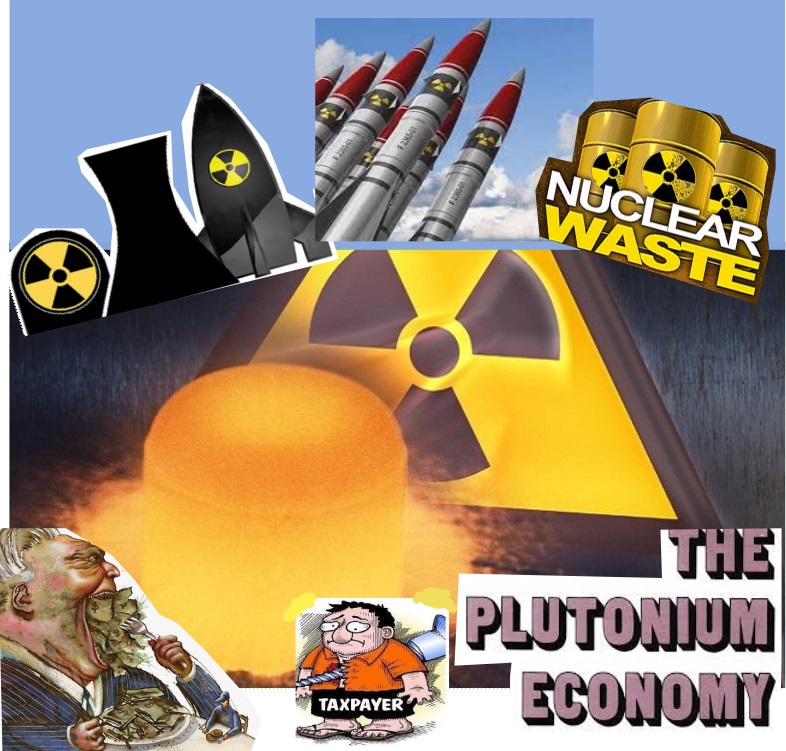
The Pentagon has always explicitly rejected “minimum-deterrence” in favor of keeping “counterforce” capabilities to wage nuclear war. This is why the U.S. has thousands of nuclear weapons and a $2 trillion “modernization” program to keep them forever. Indefinitely maintaining and expanding nuclear capabilities is contrary to the 1970 NonProliferation Treaty
None of this future pit production is to maintain the safety and reliability of the existing stockpile, but instead is entirely for new-design nuclear weapons
The Trump 2027 budget speeds up this backwards trend. For nuclear warhead production:
April 6, 2026, Jay Coghlan, Nuclear Watch, New Mexico, https://nukewatch.org/wp-content/uploads/2026/04/Trump-Accelerates-Nuclear-Warhead-Production-PR.pdf
Santa Fe, NM – The Trump Administration has released military budget numbers for the federal fiscal year 2027 (which begins October 1, 2026). This still current fiscal year 2026 is already a record breaker for military spending at one trillion dollars. Trump now proposes nearly $1.5 trillion in military spending in FY 2027, of which $1.1 trillion is base funding for the Department of War and an additional $350 million is through so-called budget reconciliation.
On top of all this, Trump will likely seek $200 billion in supplementary appropriations for the war in Iran, for a potential total of $1.7 trillion in military spending in FY 2027 (a 70% increase above FY 2026). At the same time, there is a 10% across-the-board cut to non-military spending. Much of the remaining discretionary funding for education, wildfire protection, environmental regulations, health care, etc., will be constrained by a focus on border control and immigration enforcement.
Trump proposes $53.9 billion for the Department of Energy (DOE) in FY 2027. Sixty-one per cent ($32.8 billion) is for its semi-autonomous nuclear weapons agency, the National Nuclear Security Administration (NNSA). DOE’s Office of Science is gutted by $1.1 billion which “eliminates funding for climate change and Green New Scam research.” DOE’s Office of Energy Efficiency and Renewable Energy is eliminated. Nationwide cleanup of legacy Cold War radioactive and toxic wastes at DOE sites is cut by $386 million to $8.2 billion ($3 billion of which is reserved for the Hanford Site; other site-specific cleanup budget numbers are still not yet available).
With respect to the Department of Energy’s nuclear weapons agency, the Trump FY 2027 budget:
“… focuses NNSA on its most important mission—producing a robust, credible, and modern nuclear deterrent that protects the American people. The United States must maintain and expand its set of nuclear capabilities that allow the President flexibility to protect the homeland and deter adversaries. Specifically, the Budget makes strong investments to develop new warheads that would bolster deterrence, modernize NNSA’s supporting infrastructure, and extend the life of existing warheads.”
The Pentagon has always explicitly rejected “minimum-deterrence” in favor of keeping “counterforce” capabilities to wage nuclear war. This is why the U.S. has thousands of nuclear weapons and a $2 trillion “modernization” program to keep them forever. Indefinitely maintaining and expanding nuclear capabilities is contrary to the 1970 NonProliferation Treaty, which required the nuclear weapons powers to “to pursue negotiations in good faith on effective measures relating to cessation of the nuclear arms race at an early date and to nuclear disarmament…” After more than a half-century that has never even begun. An NPT Review Conference, held every five years, is scheduled to begin April 27 at the United Nations. It is widely expected to fail for the third time over fifteen years to make any progress whatsoever toward nuclear disarmament.
The Trump 2027 budget speeds up this backwards trend. For nuclear warhead production:
• A feasibility study for a new B61-13 limited earth-penetrating bomb is funded at $46.4 million in FY 2027. A full budget request of $1 billion is expected for FY 2028 followed by an average of $870 million for each fiscal year 2029 – 2031.
• The W80-4 warhead for the Long-Range Stand-Off weapon (i.e., air-launched cruise missile) is funded at $1 billion in FY 2027. There is an average of $970 million in projected costs for each fiscal year 2028-2031.
• No funding is requested in FY 2027 for the W80-5 warhead for the Sea-Launched Cruise Missile. However, there is an average of $1.4 billion in projected costs for each fiscal year 2028-2031.
• The W87-1 nuclear warhead program is for the new Sentinel intercontinental ballistic missile, with likely multiple warheads for each missile (which is particularly dangerous and destabilizing). The Sentinel ICBM itself is already massively over budget. The W87-1 warhead program is increased 41% from $650 million in FY 2026 to $913 million in FY 2027, with an astounding average of $3.5 billion in projected costs for each fiscal year 2028-2031.
• The submarine-launched W93 nuclear warhead program, which the United Kingdom has actively lobbied for, is increased 37% from $807 million in FY 2026 to $1.1 billion in FY 2027. There is an average of $1.95 billion in projected costs for each fiscal year 2028-2031.
• There is a new “Future Programs” budget line item of $99.8 million in FY 2027 for feasibility studies for other new-design nuclear weapons, followed by an average of $92 million for each fiscal year 2028-2031.
Plutonium “pit” bomb core production: Plutonium pits are the essential “triggers” for modern nuclear weapons. Pit production has been the chokepoint for resumed industrial-scale nuclear weapons production by the U.S. ever since an FBI raid investigating environmental crimes stopped operations at the Rocky Flats Plant in 1989.
Trump’s FY 2027 budget proposes:
An 83% increase in funding for pit production at the Los Alamos National Laboratory from $1.3 billion in FY 2026 to $2.4 billion in FY 2027. There is an average of $2.3 billion in projected costs for each year FY 2028-2031. NNSA has directed LANL to double pit production to at least 60 pits per year because of increasing delays at the Savannah River Site (SRS).

• An 87% increase in funding for pit production at SRS from $1.2 billion in FY 2026 to $2.25 billion in FY 2027. There is an average of $2.5 billion in projected costs for each year FY 2028-2031. The Savannah River Plutonium Processing Facility’s upper range in estimated costs is now $25 billion, which would make it by far the most expensive building in U.S. history. Gloveboxes at SRS for canceled “dilute and dispose” of surplus plutonium are being diverted to “purification instead of disposition” to create feedstock for manufacturing new plutonium pits. There is only one glovebox left at SRS to process and remove excess plutonium, which could lead to resumed legal conflict with the State of South Carolina.
Total “Plutonium Modernization” for expanded plutonium pit production at both sites is increased 87% from $2.6 billion in FY 2026 to $4.9 billion in 2027. There is an average of $5.1 billion in projected costs for each year FY 2028-2031.
None of this future pit production is to maintain the safety and reliability of the existing stockpile, but instead is entirely for new-design nuclear weapons. This is despite the fact that in 2006 independent experts found that pits have serviceable lifetimes of at least 100 years. The average age of pits is now around 43 years. NNSA has avoided any full pit lifetime studies since 2006 (however, a new one is reportedly pending).
At least 15,000 pits are already stored at NNSA’s Pantex Plant. The independent Government Accountability Office has repeatedly reported that NNSA has no credible cost estimates for pit production, its most expensive and complex program ever. New pits cannot be tested because of the existing international testing moratorium, which could erode confidence in the stockpile. Or, conversely, new pits could prompt the U.S. to resume testing (which Trump has already threatened), after which other nuclear weapons powers would surely follow, thereby rapidly accelerating the new nuclear arms race.
Other nuclear weapons production programs:
• The “Tritium and Defense Fuels” program is increased by 79% from $520 million in FY 2026 to $881 million in 2027. There is an average of $1.8 billion in projected costs for each fiscal year 2028-2031.
“Non-Nuclear Capability Modernization” for non-nuclear components manufacturing, primarily at the Sandia National Laboratories, is increased 130% from $195.5 million in FY 2026 to $449 million in FY 2027. There is an average of $370 million in projected costs for each fiscal year 2028-2031.
• “Weapons Dismantlement and Disposition” is increased 10% from $82.3 million in FY 2026 to $90.7 million in FY 2027 (a mere 1.3% of total warhead funding). Rather than being a worthy step toward nuclear disarmament, the stated objective of weapons dismantlements is to “recover critical components and materials to support existing weapon programs, Naval Reactors, and other national priority missions.” There is an estimated backlog of up to 1,500 retired warheads to dismantle and dispose. However, NNSA’s Pantex Plant is so busy rebuilding existing nuclear warheads with new military capabilities that dismantlements have been at a historic low since the end of the Cold War.
In all, NNSA’s budget category of “Total Weapons Activities” is increased 35% from $20.4 billion in FY 2026 to $27.4 billion in FY 2027. There is an average of $29 billion in projected costs for each fiscal year 2028-2031.
Jay Coghlan, Director of Nuclear Watch, commented, “New nuclear weapons won’t give us more security as our nation is being hollowed out by tax cuts for the ultrarich, cuts to domestic programs, and the gutting of programs to address adverse climate change. It is way past time for the nuclear weapons powers to honor their obligations under the 1970 NonProliferation Treaty to negotiate verifiable nuclear disarmament instead of keeping nuclear weapons forever. We should be cleaning up, not building up new nuclear weapons.”
Sources:……………………………………………………………..
Ceasefire on the Brink — The Day Genocide Became a Negotiating Tactic

once a leader openly invokes the destruction of an entire civilization, the threshold has already been crossed. The unthinkable has been spoken—and therefore made thinkable.
April 7, 2026 , Joshua Scheer. https://scheerpost.com/2026/04/07/ceasefire-on-the-brink-the-day-genocide-became-a-negotiating-tactic/
In the span of a single day, the United States came terrifyingly close to crossing a line that cannot be uncrossed.
A president publicly threatened the destruction of “a whole civilization,” only to pivot hours later to a fragile, last-minute cease-fire brokered through frantic diplomacy.
That whiplash is not strategy. It is the normalization of annihilation as a negotiating tool.
And now, the world’s leading human rights bodies are saying exactly what Washington refuses to confront: this is not just reckless rhetoric—it may be criminal.
Amnesty International warned that such threats reflect a “staggering level of cruelty and disregard for human life,” and could constitute a threat of genocide under international law.
Not hyperbole. Not partisan outrage. Legal language.
Let’s be clear about what was on the table.
The deliberate targeting of power plants, water systems, bridges, and essential infrastructure is not some abstract military option. It is the dismantling of civilian life itself—the systems that make survival possible. As Amnesty and medical experts warned, such attacks would deprive millions of access to water, food, healthcare, and basic human dignity, while potentially triggering environmental and even nuclear catastrophe.
This is not war in the conventional sense. It is the engineering of societal collapse.
And yet, in today’s Washington, even genocidal rhetoric is spun as leverage.
This is the deeper crisis: not just the war itself, but the erosion of boundaries that once constrained power. The idea that you can threaten mass civilian death to force compliance—and then walk it back as part of a deal—is not diplomacy. It is coercion dressed up as statecraft, a performance of dominance in which human lives become bargaining chips.
The cease-fire, reportedly mediated by Pakistan under intense global pressure, buys two weeks.
Two weeks to negotiate.
Two weeks to pause the bombing.
Two weeks for markets to stabilize and headlines to cool.
But what does it not do?
It does not undo the more than 1,600 civilians already reported killed.
It does not rebuild the infrastructure already shattered.
It does not erase the terror inflicted on tens of millions of people suddenly forced to contemplate their own annihilation.
And it does not undo the precedent.
Because once a leader openly invokes the destruction of an entire civilization, the threshold has already been crossed. The unthinkable has been spoken—and therefore made thinkable.
Human rights experts are warning that the danger is not only what might happen next, but what has already been normalized. As Amnesty put it, the very act of making such threats “brazenly shreds core rules of international humanitarian law.”
That is the real story here.
Not just a war spiraling toward catastrophe—but a global order in which the rules meant to prevent catastrophe are being openly discarded.
We have seen this trajectory before. Iraq was justified with certainty that did not exist. Afghanistan became a forever war without a clear end. Now Iran sits at the edge of something even more dangerous—not just invasion or occupation, but the explicit threat of civilizational erasure.
Even some of the president’s allies have recoiled, recognizing that this is not strength but instability masquerading as resolve. When threats alienate allies, embolden adversaries, and horrify the world, they are not strategic—they are reckless.
Meanwhile, Congress drifts. Calls for oversight, war powers votes, even removal from office have surfaced—but only after the rhetoric crossed into territory that international law was designed to prevent.
This is the central failure of American governance in the age of permanent war: the abdication of responsibility until crisis becomes catastrophe.
The cease-fire should not be mistaken for success. It is a pause forced by global alarm and the sheer gravity of what was nearly unleashed. It is proof that diplomacy still exists—but only under the shadow of something far darker.
Because the question now is unavoidable:
If threatening to destroy a civilization is part of the negotiating playbook, what happens when threats stop working?
History offers a grim answer: escalation.
And next time, there may be no last-minute intervention.
No diplomatic scramble.
No two-week pause.
Only the consequences of a line already crossed.
Blocking Iran’s Other Option: A Plutonium Bomb

By Henry Sokolski, April 03, 2026, https://www.realcleardefense.com/articles/2026/04/03/blocking_irans_other_option_a_plutonium_bomb_1174454.html
America and Israel want to prevent Tehran from getting a bomb. That’s why the Pentagon and Israel Defense Forces continue to target Tehran’s ability to make weapons uranium. Washington and Jerusalem claim they have obliterated Tehran’s uranium enrichment capability. Perhaps. But, Iran has another pathway to a bomb.
U.S. and Israeli leaders have yet to fully consider Iran’s option to make nuclear weapons from plutonium, a material Iran can extract from spent fuel at its largest reactor at Bushehr. Washington should make sure that Iran doesn’t remove Bushehr’s spent fuel and strip out the plutonium. This can and should be done without bombing the plant.
ROSATOM, the Russian firm that built and has operated Bushehr since 2011, says there are 210 tons of spent reactor fuel at the plant. If you check the ROSATOM figure against International Atomic Energy Agency (IAEA) reactor performance logs, the 210 tons of waste contain enough plutonium to make more than 200 nuclear weapons – as many or more than SIPRI estimates Israel has.
It would not take Iran long to remove Bushehr’s spent fuel and chemically strip the plutonium out. In 1977, the U.S. General Accounting Office evaluated leading U.S. nuclear chemist Floyd Culler’s proposed quick and dirty method of plutonium chemical separation. The facility Culler described was 130 feet by 60 feet by 30 feet (approximately the size of a standard basketball court). It employed technology little more advanced than that required for the production of dairy and the pouring of concrete. Such a plant could fit within a large warehouse and would take no more than six months to build. Until the plant was operational, it would send off no signal and could separate a bomb’s worth of plutonium after only ten days of operation. After that, the plant could separate a bomb’s worth of plutonium in a day.
Two more steps are needed to convert separated plutonium into an insertable metallic core for a nuclear implosion device First, turn the plutonium solution into an oxide and another to convert this oxide into metal. Second, cast and machine this material into a hemisphere. Assuming Iran already had an (implosion) device on the ready, the completion of a bomb could take one to two weeks. This plutonium weapon production timeline is similar to what it would take to extract the uranium hexafluoride in the rubble at Isfahan and then to chemically convert that gas into insertable metal uranium bomb cores. For that reason, the Trump administration should pay as much attention to this back end of the fuel cycle as it is to the front-end, which features uranium enrichment.
What’s odd is that there’s been next to no public discussion of Iran exploiting the Bushehr plutonium option. This may be due to the popular myth that “reactor-grade plutonium” can’t be used to make workable bombs. Robert Selden and Bruce Goodwin, two of America’s top plutonium weapons designers, put this fable to rest, most recently in 2025. As the U.S. Department of Energy has explained, with Iran’s level of weapons sophistication it could use reactor-grade and produce Hiroshima or Nagasaki yields.
The U.S. government used to worry about this possibility. In 2004, the State Department spotlighted Bushehr as a worrisome nuclear weapons plutonium producer. Late in 2012, after Iran shut Bushehr down and withdrew all of the fuel – roughly 20 bombs-worth of near-weapons-grade plutonium – the Pentagon swung into action, launching surveillance drones over the reactor to make sure the plutonium-laden spent fuel didn’t leave the plant to be reprocessed elsewhere. The Iranians put the fuel back, but the concern that Iran was trying to pull a fast one remained.
Now, the Trump Administration is threatening to bomb the largest of Iran’s electrical generating plants, of which Bushehr is in the top ten. Bombing it, much less its spent fuel pond, however, would be a big mistake. The last thing the United States should risk is prompting a radiological release. NPEC-commissioned simulations indicate radiological releases from Bushehr’s reactor core could force the mandatory evacuation of tens of thousands to millions of Iranians. Attacking the spent fuel pond could result in even larger numbers. Of course, Bushehr would be a legitimate military target if it supported Iranian military operations. However, it doesn’t. Even before U.S. Israeli forces hit the site with two projectiles, the plant was on cold shutdown.
What, then, should our government do? First, the Pentagon should watch to make sure Iran does not remove any of the spent fuel at Bushehr. It could do this with space surveillance assets or, as it did in 2012, with drones. Second, any “peace” deal President Trump cuts with Tehran should include a requirement that there be near-real-time monitoring of the Bushehr reactor and spent fuel pond, much as the IAEA had in place with Iran’s fuel enrichment activities. The IAEA actually asked for this back in 2015. Iran refused. Unfortunately, President Obama didn’t push back. That was a mistake, one the Trump Administration should not continue to make.
Henry Sokolski is executive director of the Nonproliferation Policy Education Center. He was deputy for nonproliferation policy in the Department of Defense (1989–1993), and is the author of China, Russia, and the Coming Cool War (2024).
An Open Letter to Washington: The World Cannot Afford Silence
7 April 2026 Michael Taylor, https://theaimn.net/an-open-letter-to-washington-the-world-cannot-afford-silence/
To Members of the United States Congress and the Vice President,
I write to you as an observer from outside the United States, but not outside the reach of its power. What happens in Washington does not stay in Washington. It reverberates across the globe.
A recent public statement by President Donald Trump, circulated widely from his Truth Social account, contains language and threats relating to Iran that are alarming in both tone and substance. The message invokes destruction of infrastructure, uses inflammatory and profane language, and concludes with a phrase that appears to praise a religious figure in a context that is, at best, deeply incongruous and, at worst, dangerously provocative.
Taken together, this is not normal rhetoric for the holder of the most powerful office in the world.
Many across the world are beginning to ask a question that would once have seemed unthinkable: whether the behaviour being displayed is that of a rational leader, or something far more dangerous. In blunt terms – terms now increasingly heard in public discourse – there is a growing fear that the President is acting like a madman.
The concern here is not political disagreement. It is the apparent abandonment of restraint, clarity, and responsibility in matters that could have immediate and catastrophic international consequences. Words at this level are not symbolic – they can signal intent, trigger reactions, and escalate conflict.
If such rhetoric is not constrained by the institutions designed to provide oversight, the consequences could be severe. Miscalculation or escalation in relation to Iran risks drawing multiple nations into conflict, destabilising an already fragile region, and placing countless civilian lives in jeopardy. It risks disrupting global energy markets, triggering economic shocks far beyond the United States, and increasing the likelihood of direct military confrontation between major powers. In the worst case, it opens the door to a broader and more devastating war whose impacts would be felt worldwide.
The United States Constitution anticipates moments when the conduct of a President raises serious questions about their fitness to discharge the duties of the office. It provides lawful mechanisms to respond: the power of impeachment vested in Congress, and the provisions of the 25th Amendment, which empower the Vice President and Cabinet to act where incapacity or inability is evident.
These are not partisan tools. They are safeguards.
No one outside your system can invoke them. Only you can.
History will not judge this moment solely by what was said, but by what was done – or not done – in response. Silence or inaction in the face of credible concern carries its own consequences.
The world is watching the United States not for perfection, but for proof that its institutions still function as intended: that power is checked, that accountability exists, and that no individual is beyond the reach of the law.
I urge you to consider, with the utmost seriousness, whether this moment calls for the use of those constitutional safeguards.
Respectfully,
Michael Taylor
Audit cites DOE oversight failures on NuScle nuclear project

E&E News 1st April 2026
The Department of Energy mismanaged a landmark nuclear project to construct the country’s first small modular reactor, according to an audit by DOE’s Office of Inspector General released Tuesday.
The Carbon Free Power Project was a partnership between the federal government, NuScale Power and a coalition of Utah utilities that included $1.36 billion in DOE cost-share financial assistance. The government grant would help fund construction of the company’s first units at the Idaho National Laboratory.
The project that launched in 2015 was ultimately canceled in 2023 after NuScale and the Utah Associated Municipal Power Systems mutually agreed to terminate development of the plant. Cost estimates for the first-of-a-kind advanced reactors had climbed, giving the utilities that had agreed to purchase the power cold feet. NuScale’s stock price had collapsed. The canceled project left the U.S. government out $183 million………………………………..(Subscribers only) https://www.eenews.net/articles/ig-cites-doe-oversight-failures-on-nuscale-nuclear-project/
Secrets and Shortcuts: The US Uranium Enrichment Rush

LYNDA WILLIAMS, 6 April 2026, https://www.counterpunch.org/2026/04/06/secrets-and-shortcuts-the-us-uranium-enrichment-rush/
The United States keeps going to war over uranium enrichment.
We started a war in Iraq over it after Secretary of State Condoleezza Rice said, “We don’t want the smoking gun to be a mushroom cloud,” which later proved to be false. We bombed Iran’s enrichment facilities in June 2025, with Trump declaring he had “completely and totally obliterated” them.
Eight months later, we started another war with Iran over enrichment, even though the International Atomic Energy Agency (IAEA) found no evidence of a structured nuclear weapons program. Now, Trump is considering sending special forces into Iran to physically seize the enriched uranium — except nobody knows exactly where it is.
Now the US is actively pursuing its own domestic uranium enrichment after decades of dependence on foreign suppliers, including Russia, which, after it invaded Ukraine, the Biden administration cut off. The US currently has only one operating commercial enrichment facility, which cannot begin to supply the “nuclear renaissance” the Trump administration is promoting. Five companies are simultaneously seeking NRC licenses, backed by $2.7 billion in DOE contracts, under a regulatory framework being dismantled in real time — gutting environmental review, eliminating radiation safety standards, and compressing public participation timelines to get them built fast.
The first to apply is Global Laser Enrichment LLC — a Delaware shell company majority-owned by Silex Systems Limited of Australia and Cameco Corporation of Canada — and their application is shrouded in secrecy and regulatory shortcuts. The license application looks like a redacted Epstein file: 274 pages of black bars.
Why the Big Secrecy?
The problem with enrichment is proliferation. Natural uranium consists of two isotopes — uranium-238 and uranium-235 (U-235), the fissile isotope you need for both nuclear reactors and nuclear bombs. In its natural state, uranium contains only 0.7% U-235, so it must be enriched artificially.
Nuclear fuel for a nuclear power plant needs uranium enriched to about 5% U-235. A nuclear bomb needs it at 90% or above. Same basic process, same basic equipment — just keep enriching. Iran had enriched to 60% according to the IAEA before the June 2025 strikes — well past reactor fuel and closing in on weapons grade. That’s proliferation. North Korea had a proliferation problem the Clinton administration was successfully negotiating — until Bush came in, put North Korea on the “axis of evil,” and within months they turned off their IAEA monitoring cameras and expelled inspectors, testing their first nuclear bomb four years later.
On March 27, 2026, the NRC published a draft Environmental Impact Statement (EIS) for a proposed $1.76 billion uranium enrichment facility in Paducah, Kentucky — next to the former Paducah Gaseous Diffusion Plant (PGDP), a Cold War uranium enrichment site that operated from 1952 to 2013 and left behind a Superfund cleanup still running today. The federal government sold GLE over 200,000 metric tons of publicly owned depleted uranium to process from the PGDP — but the price is secret.
The secrecy traces to a single act. In June 2001, the Secretary of Energy classified the SILEX laser enrichment technology under the Atomic Energy Act of 1954. The entire public record of that decision is five sentences in the Federal Register — no technical justification, no public comment period, no congressional notification, no appeal process. The Federation of American Scientists called it “constitutionally questionable.” It has never been legally challenged. The PLEF would be licensed to enrich to a maximum of 6% U-235 — reactor fuel grade. The irony is that independent peer-reviewed research suggests SILEX cannot be efficiently cascaded to weapons grade, making the classification that drives all this secrecy scientifically questionable as well.
What’s in the EIS?
GLE proposes to build a $1.76 billion laser enrichment facility on 322 acres of former public wildlife land — until eighteen months ago part of the West Kentucky Wildlife Management Area, managed for hunting, fishing, and horseback riding, and home to bald eagles, golden eagles, monarch butterflies, and eastern box turtles. The site contains 38 wetlands, 20 streams, and 6 ponds — all of which would be destroyed to build the facility. GLE proposes to discharge 60,000 gallons of wastewater per day, some of it radioactive, into Little Bayou Creek, which flows to the Ohio River — drinking water for five million people downstream. Fish consumption in Little Bayou Creek is already not supported due to PCB contamination from the adjacent Cold War plant.
The facility would take in depleted uranium hexafluoride — the tails left over from Cold War enrichment — re-enrich it, and produce more uranium hexafluoride waste. Over 40 years the PLEF would generate 290,574 metric tons of new radioactive waste with nowhere to go. The EIS waste table lists the largest waste stream — 18,161 tons per year — with three words in the disposal column: “subject to availability.” The EIS also declines to quantify what fraction of the DOE stockpile contains reprocessed uranium — known as RepU — material that passed through a reactor and carries transuranic contaminants, including neptunium-237 and plutonium, with half-lives of thousands to millions of years. RepU cannot go to a standard low-level waste site and may require disposal at WIPP in New Mexico, which was never designed for it. GLE’s website says the PLEF will “reduce the legacy environmental footprint” of the former Paducah plant. Re-enriching depleted uranium hexafluoride produces more uranium hexafluoride. The chemical form never changes, and the volume increases. That’s not cleanup. That’s more radioactive waste with nowhere to go.
What We Don’t Know: Safety
The comment period for the EIS closes May 11, but the government’s Safety Evaluation Report (SER) – which is normally completed alongside the EIS -won’t be completed until January 2027. GLE received special NRC permission to submit the environmental and safety portions of its application separately, meaning the public must comment on the facility’s EIS without ever seeing the safety analysis. The safety analysis submitted with the license application is classified. The emergency plan is withheld as a corporate trade secret on the grounds that releasing it would, in the sworn, notarized words of GLE’s licensing manager Tim Knowles, “reduce or foreclose the availability of profit opportunities.” The Integrated Safety Analysis Summary — which NRC regulations require to be placed on the public docket — has been removed from the federal docket entirely. Not redacted. Removed. (NRC ADAMS accession ML25179A002 not publicly available) In case of emergency, the EIS says the facility relies on local volunteer fire departments – departments with no legal right to read the emergency plan for the facility in their jurisdiction.
Meanwhile, Kentucky approved nearly $100 million in public incentives to bring this facility to Paducah — some of it under a nondisclosure agreement so complete that the McCracken County judge told public radio he legally cannot tell you how much his county committed or what the terms are. The undisclosed county portion alone is nearly twice McCracken County’s entire annual operating budget.
The Regulatory Shortcut
For the EIS, the NRC borrowed conclusions from NUREG-2249, a draft Generic Environmental Impact Statement written for nuclear reactors — not enrichment facilities — that was published in September 2024, never finalized, and never applied to any proceeding before this one. Using this unfinished reactor document, the NRC pre-answered 34 environmental questions for the PLEF, declaring them all SMALL without site-specific analysis — including water use in the region, sedimentation impacts on aquatic species, and contaminated stormwater from outdoor uranium cylinder storage pads. SILEX laser enrichment appears nowhere in NUREG-2249. These 34 conclusions can still be challenged before May 11. Once NUREG-2249 is finalized, that window closes permanently.
What You Can Do
The most impactful comments challenge the application of NUREG-2249 — a draft reactor document — to pre-answer 34 environmental questions for a laser enrichment facility without legal authority; the waste disposal analysis for which no confirmed to put 290,574 metric tons of new radioactive waste; and the requirement to comment on facility safety before the Safety Evaluation Report exists.
Submit comments on the PLEF draft EIS by May 11, 2026 at: https://www.regulations.gov/docket/NRC-2025-1007
Lynda Williams is a physicist and environmental activist living in Hawaii. She can be found at scientainment.com and on Bluesky @lyndalovon.bsky.social
US Troops Need To Start Disobeying Orders In Iran, And Other Notes
Caitlin Johnstone, Apr 06, 2026, https://www.caitlinjohnst.one/p/us-troops-need-to-start-disobeying?utm_source=post-email-title&publication_id=82124&post_id=193307504&utm_campaign=email-post-title&isFreemail=true&r=1ise1&triedRedirect=true&utm_medium=email
The president of the United States has a bat shit crazy post on Truth Social once again threatening to blow up civilian infrastructure in Iran, saying, “Tuesday will be Power Plant Day, and Bridge Day, all wrapped up in one, in Iran. There will be nothing like it!!! Open the Fuckin’ Strait, you crazy bastards, or you’ll be living in Hell — JUST WATCH! Praise be to Allah. President DONALD J. TRUMP.”
At this point if you’re in the US military you have a moral obligation to start refusing orders. Desert. Become a conscientious objector. Ideally, get everyone together and launch a full-scale military coup. We’re in “Mad King” territory. Someone’s gotta do what needs to be done.
Promoters of this war told the world it was about liberating the Iranian people from tyranny to bring them freedom and democracy. Now that they got their war it’s about bombing them “back to the Stone Age”, stealing their oil, and blowing up their bridges and power plants.
The only people dumber than Americans who bought into Trump’s “ending the wars” shtick are the Iranians who believed the United States was going to bring freedom to their country.
The Jerusalem Post just ran an opinion piece on Zohran Mamdani which includes the sentence, “It is time for the mayor of New York City to stand in solidarity with Muslim leaders who eschew antisemitic tropes, such as ‘genocide’ and ‘occupation,’ and are committed to a new and broader regional alignment in the Middle East.”
It’s been fun watching Israel apologists invent “antisemitic tropes” in real time. The words “genocide” and “occupation” are antisemitic tropes now, apparently. According to pro-Israel groups like the Anti-Defamation League and B’nai Brith, the phrases “Epstein class” and “Operation Epstein Fury” are also recent additions to the no-no list.
In reality these so-called “antisemitic tropes” are just effective talking points used to highlight facts that are inconvenient to Israel and its allies. Every relevant human rights group on earth agrees that Israel is an occupying force in the Palestinian territories. Every relevant human rights group on earth has accused Israel of genocide in Gaza. The phrase “Epstein class” makes the rich and powerful people who rule our society look as creepy and suspicious as they should look. “Operation Epstein Fury” highlights President Trump’s place in the Epstein Files, which a majority of Americans believe played a role in his decision to attack Iran.
We see this all the time. Effective pro-Palestine political slogans like “Globalize the intifada” and “From the river to the sea, Palestine will be free” are labeled antisemitic not because they express hatred toward Jews but because they are effective.
That’s all it ever is. Israel apologists see a phrase or slogan hurting Israeli information interests and go “Uh, okay so you can’t say those words anymore. Those words make Jewish people feel unsafe.”
And then the phrases get banned. Here in Australia we just saw the state of Queensland ban the phrase “from the river to the sea” on penalty of two years in prison. For no other reason than because it’s something people chant at pro-Palestine protests.
Antisemitism isn’t the target of these laws; the protests themselves are the target. They’re designed to shut down pro-Palestine demonstrations by making so many speech suppression laws that nobody would attend one without a lawyer present to advise them on what they may and may not say.
The very first time someone told me “from the river to the sea Palestine will be free” was a hateful genocidal chant I thought it was the most ridiculous thing I’d ever heard, and to this day I still feel that way. It’s a completely counter-intuitive claim that makes no sense on first hearing it. It is only by the constant repetition of the assertion that it’s an antisemitic slogan that people began accepting this transparently absurd idea. They just said it over and over again in an authoritative tone until people started to buy it.
Nobody actually believes these words and phrases are hateful toward Jews, they’re just pretending to believe that to promote the information interests of a genocidal apartheid state. That’s all we’re ever looking at with this nonsense.
This fuel crisis really looks like it’s going to hurt. From a big-picture perspective it’s probably a good thing for westerners to feel some sting from their empire’s wars, and for US allies to start re-evaluating their relationship with Washington. But from a selfish perspective, damn this is gonna suck.
I’m done trying to convince people not to use generative AI. You want to kill your critical thinking faculties? You want to lose the ability to write and create art? You want to make people like me look special and amazing because we can create things with our minds? Be my guest.
Trump’s $1.5 Trillion Pentagon Budget Will Make US Weaker
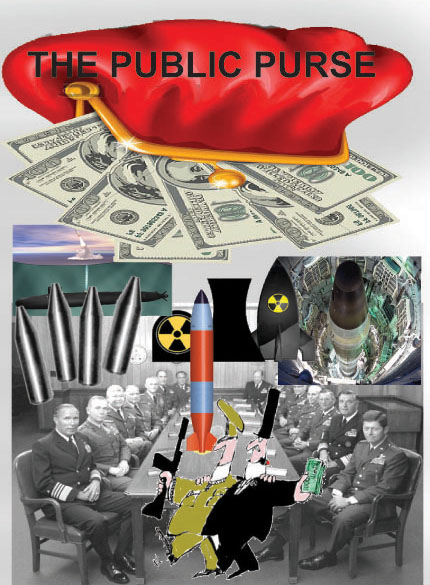
Passing this proposed budget would be a recipe for endless war, while undermining the nation’s ability to address the truly pressing problems at home that demand our urgent attention.
William Hartung, Apr 03, 2026, Common Dreams, https://www.commondreams.org/opinion/1-5-trillion-pentagon-budget
It has been reported that the Pentagon on Friday will release a proposed budget for Fiscal Year 2027 of almost $1.5 trillion, with approximately $1.15 trillion in discretionary spending contained in the department’s regular annual budget and an additional $350 billion dependent on Congress including it in a separate budget reconciliation bill.
Whatever vehicles the administration chooses to promote this huge increase, it will be doubling down on a failed budgetary and national security strategy. If passed as requested, $1.5 trillion in Pentagon spending—in a single year–will make America weaker by underwriting a misguided strategy, funding outmoded weapons programs, and crowding out other essential public investments.
The current war in the Middle East is a case study in the ineffectiveness of an overreliance on military force in seeking to make America or the world a safer place. In his first term, President Trump abandoned a multilateral agreement that was effectively blocking Iran’s path to a nuclear weapon. Six years later, in his second term, the president initially justified his disastrous intervention against Iran as being motivated by fears of that very same program.
Diplomacy worked. Reckless resort to force does not, as evidenced by the devastating human, budgetary, and global economic consequences of the current Middle East war. Passing a $1.5 trillion Pentagon budget would be a recipe for endless war.
Meanwhile, other, non-military investments needed to protect the lives and livelihoods of Americans are being sharply reduced. By one account, the first week of the war on Iran cost $11.6 billion. That’s more than the Trump administration proposed for the annual budgets of the Centers for Disease Control and the Environmental Protection Agency combined for this year. Yet addressing the climate crisis and the need to prevent future outbreaks of disease are essential to the safety and security of Americans.
The administration has also reduced our available tools of influence on the foreign policy front by decimating the Agency for International Development, laying off trained diplomats at the State Department, and withdrawing from major international agreements. This leaves force and the threat of force as virtually the last tools standing for promoting U.S. security interests.
The Pentagon doesn’t need more spending, it needs more spending discipline. Spending billions of dollars on a Golden Dome system that can never achieve the President’s dream of a leak proof missile defense system is sheer waste, as is continuing to lavish funds on overpriced, underperforming combat aircraft like the F-35, or multi-billion dollar aircraft carriers that are vulnerable to modern high speed missiles.
The truth is, there are not enough factories, or skilled workers, or materials to effectively spend such a huge increase. It will be a recipe for waste, fraud and abuse.
War front updates: America opposes war on Iran

Wednesday, April 01, 2026, Organizing Notes, Bruce Gagnon
Americans have little appetite for sending troops to Iran, polls show
Only 14% of Americans favor sending ground troops into Iran, while 62% oppose this. Almost all Democrats and 66% of Independents oppose sending in ground troops, while Republicans are divided, with 30% in favor and 37% opposed.
In the DC mental asylum, they dreamt up the concept of “Greater North America”. In addition to the USA, it includes Canada, Greenland, Mexico, and the Caribbean countries. US Defence Secretary and professional drunkard, Pete Hegseth, displayed a map on which these regions are unified. Hegseth did not explain how these countries are supposed to be united, but emphasized: “Trump has drawn a new strategic map”. ……………………………………………………. https://space4peace.blogspot.com/2026/04/war-front-updates-america-opposes-war.html
1 This Month





PLEASE OPPOSE HR 8255 AND S.3639 – bills would accelerate satellite deployment, with no environmental review or safeguards – https://ncstd5li.quorum.us/campaign/169331/
To see nuclear-related stories in greater depth and intensity – go to https://nuclearinformation.wordpress.com
-
Archives
- October 2026 (67)
- September 2026 (339)
- August 2026 (330)
- July 2026 (355)
- June 2026 (287)
- May 2026 (306)
- April 2026 (356)
- March 2026 (251)
- February 2026 (267)
- January 2026 (308)
- December 2025 (358)
- November 2025 (359)
-
Categories
- 1
- 1 NUCLEAR ISSUES
- business and costs
- climate change
- culture and arts
- ENERGY
- environment
- health
- history
- indigenous issues
- Legal
- marketing of nuclear
- media
- opposition to nuclear
- PERSONAL STORIES
- politics
- politics international
- Religion and ethics
- safety
- secrets,lies and civil liberties
- spinbuster
- technology
- Uranium
- wastes
- weapons and war
- Women
- 2 WORLD
- ACTION
- AFRICA
- Atrocities
- AUSTRALIA
- Christina's notes
- Christina's themes
- culture and arts
- Events
- Fuk 2022
- Fuk 2023
- Fukushima 2017
- Fukushima 2018
- fukushima 2019
- Fukushima 2020
- Fukushima 2021
- general
- global warming
- Humour (God we need it)
- Nuclear
- RARE EARTHS
- Reference
- resources – print
- Resources -audiovicual
- Weekly Newsletter
- World
- World Nuclear
- YouTube
-
RSS
Entries RSS
Comments RSS

