Nuclear Scaling Requires Discipline. SMRs Deliver Fragmentation.
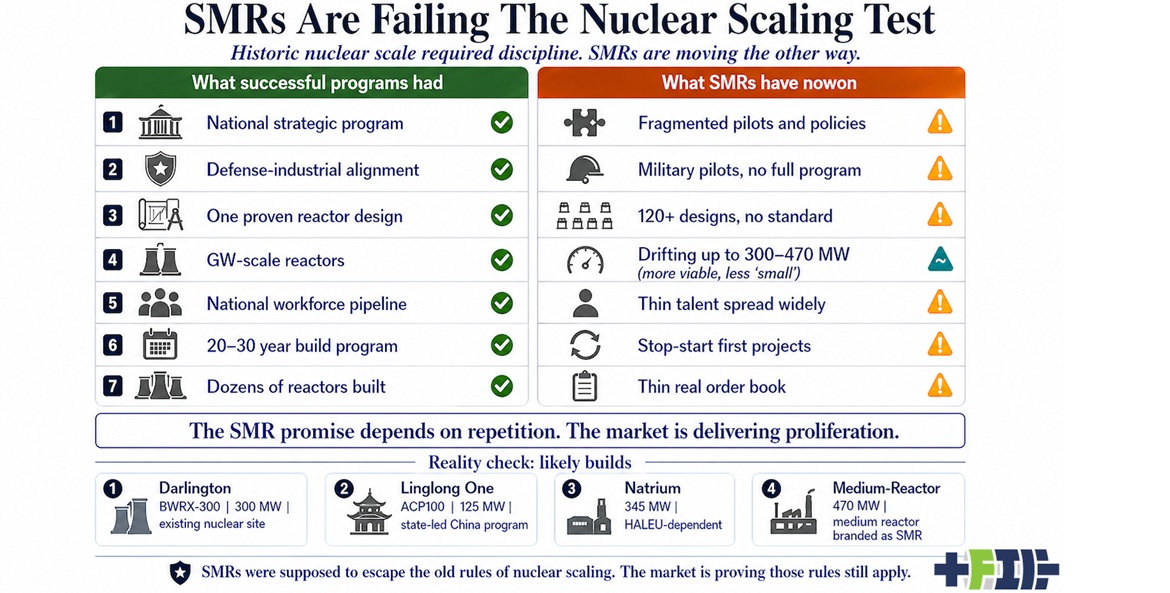
the evidence does not support treating SMRs as a broad, near-term, commercially validated solution
Michael Barnard, Clean Tecnica 28th April 2026, https://cleantechnica.com/2026/04/28/nuclear-scaling-requires-discipline-smrs-deliver-fragmentation/
When I wrote in 2021 that small modular reactors were mostly bad policy (peer reviewed version, CleanTechnica version), the argument was not that nuclear fission could not produce useful low-carbon electricity. It was already doing so every day. The United States had about 98 GW of operating nuclear capacity, and the global fleet was a major source of firm generation. The question was whether the SMR policy proposition matched the conditions under which nuclear power had scaled in the past. It did not then. The evidence since then has made the problem clearer.
The original SMR case rested on a simple promise. Make reactors smaller, build more of them in factories, reduce capital at risk, shorten construction schedules, serve more sites, and avoid the large-project failures that had damaged recent nuclear construction in liberalized electricity markets. It was an appealing story because it pointed at real nuclear problems. Large reactors are expensive to finance. They take a long time to build. A single failure can consume a utility’s balance sheet and a government’s political patience. A smaller unit sounds easier to manage.
But the promise depended on a condition that was often treated as background noise. SMRs only make economic sense if the sector converges on a few designs and builds them many times. Factory manufacturing does not create a learning curve because the word factory appears in a presentation. Learning curves come from repeated production of the same or similar products, with stable tooling, stable suppliers, stable inspections, stable quality assurance, stable training, and steady demand. Solar panels, batteries, and wind turbines became cheaper because the world made huge numbers of related products in shorter production cycles. Nuclear reactors are different. Each design carries a safety case, a fuel qualification pathway, licensing work, site work, security, emergency planning, operator training, waste arrangements, and decades of liability.
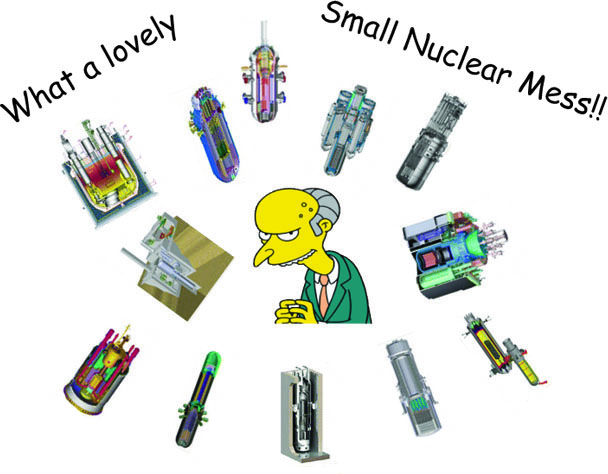
That was the central weakness in the SMR story in 2021. In that earlier assessment, I counted 57 SMR designs and concepts across 18 broad types, and none could be considered dominant. That was already far too fragmented for a credible manufacturing-learning argument. Since then, the OECD Nuclear Energy Agency’s SMR dashboard has tracked more than 120 SMR technologies worldwide, with roughly 70 to 80 included in recent dashboard editions after filtering out some paused, inactive, unfunded, or non-participating designs. The sector has not moved from many concepts to a few winners. It has become more crowded.
This matters because nuclear design proliferation is not cheap experimentation. In software, a hundred teams can try different approaches, fail fast, and leave lessons behind. In nuclear, each credible design requires scarce engineering, regulatory, fuel-cycle, owner, and supply-chain attention. A light-water SMR, a high-temperature gas reactor, a sodium fast reactor, a molten-salt reactor, and a microreactor are not minor variations around a shared product platform. They create different materials questions, fuel requirements, operating temperatures, inspection regimes, safety cases, and licensing pathways.
The EIA’s April 2026 Today in Energy article is useful because it lays out that diversity. It groups U.S.-relevant SMRs and microreactors into light-water reactors, high-temperature gas reactors, molten-salt reactors, sodium-cooled reactors, and other designs. It identifies applications such as AI loads, data centers, industrial sites, remote areas, microgrids, and military or federal facilities. It points to DOE programs, pilot pathways, and fuel-chain efforts. As a map of activity, it has value. As a test of whether the SMR proposition is becoming a real deployment class, it is much weaker.
The EIA article does not ask the questions that matter for scaling. It does not ask whether the order book is large enough to support factory learning. It does not ask whether design proliferation undermines standardization. It does not ask whether the credible projects are really small, or whether they are drifting back toward conventional power-station scale. It does not ask whether remote sites, mines, and islands are large enough markets to sustain a reactor manufacturing industry. It does not ask whether HALEU will be available at scale on the timelines implied by advanced reactor plans. It describes activity and optionality. It does not demonstrate convergence.
The historical conditions for nuclear scaling are not mysterious. Nuclear built at scale where it was treated as a national strategic program, where the state played a strong role, where designs were standardized or semi-standardized, where large reactors spread fixed costs over a lot of output, where experienced nuclear owner-operators existed, where training and safety culture were centralized, and where governments sustained programs for decades. France, South Korea, and China did not scale nuclear power by letting dozens of small reactor startups compete for scattered boutique sites. They scaled, to the extent they did, through alignment among state policy, utilities, vendors, regulators, finance, and workforce.
SMRs were sold as a way around these conditions. The actual market is rediscovering them. The projects that look most likely to be built are tied to existing nuclear sites, state-backed strategic sites, experienced utilities, military or laboratory settings, or large industrial anchors with public support. That does not mean they are worthless. It means they are not validating the broad SMR pitch. They are validating the old lesson that nuclear needs strong institutions.
The most credible projects are also getting bigger. Ontario’s Darlington project is the clearest Western example. Ontario Power Generation has a license to construct one GE Hitachi BWRX-300 at Darlington, with four units planned. Each unit is about 300 MW. This is a serious project, but it is not a small reactor scattered into a new class of sites. It is a 300 MW boiling water reactor at an existing nuclear site, backed by an experienced provincial nuclear operator with grid interconnection, cooling access, security culture, political support, and a long-term system need. If it succeeds, it will matter. But it will not prove that SMRs can escape nuclear’s institutional requirements.
China’s Linglong One, the ACP100 at Changjiang in Hainan, is another real project. At about 125 MW, it is closer to the traditional idea of a small reactor, and it has moved through construction and testing milestones. But it exists inside China’s state-led nuclear program. China can choose, license, finance, build, and integrate nuclear projects in ways that liberalized markets struggle to copy. That makes Linglong One important, but it does not make it proof that a global commercial SMR market has arrived.
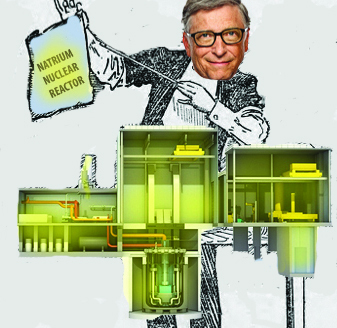
TerraPower’s Natrium project in Kemmerer, Wyoming, is serious as well, with a construction permit issued by the U.S. Nuclear Regulatory Commission and non-nuclear site work underway. But Natrium is 345 MW, with storage-boosted output advertised around 500 MW. It sits above the old 300 MW SMR threshold and depends on sodium cooling, HALEU fuel, major public support, and a coal-site transition narrative. It may become a useful advanced reactor demonstration. It is not evidence that small, repeatable, low-risk nuclear products are ready for broad deployment.
Rolls-Royce makes the size drift even more obvious. Its reactor is about 470 MW. Three units at Wylfa would total about 1.4 GW, which is a large power station by any normal electricity-system measure. The unit is small only compared with the largest conventional reactors. It may fit the United Kingdom’s industrial strategy if the government commits to a fleet. But at 470 MW, the project is better understood as a medium reactor with modular construction ambitions than as the small product implied by early SMR rhetoric.
Holtec’s design history points the same way. The SMR-160 became the SMR-300. NuScale’s module moved from 50 MW toward 77 MW, and the commercial plant concept became a multi-module station approaching conventional plant scale. X-energy’s Xe-100 is about 80 MW as a module, but Dow’s proposed Seadrift project packages four units into about 320 MW. The pattern is clear. The more serious the customer discussion becomes, the more the sector tries to put several hundred MW behind a single site, operating organization, licensing file, security plan, and grid connection.
That is not an accident. Nuclear has large fixed costs that do not shrink in proportion to reactor size. A 50 MW reactor does not need one-twentieth of the licensing effort, one-twentieth of the security analysis, one-twentieth of the operator training, one-twentieth of the emergency planning, one-twentieth of the quality assurance, or one-twentieth of the waste arrangements of a 1,000 MW reactor. Some hardware costs scale down. Many institutional costs do not. Smaller reactors start with a scale penalty. Factory repetition is supposed to overcome it. But repetition requires a narrow set of designs and a large order book. The current market offers neither.
After years of SMR hype, the likely-build list remains short: Darlington, Linglong One, Natrium in Wyoming, TVA’s Clinch River, Dow’s Seadrift project, Holtec’s proposed Palisades units, Rolls-Royce at Wylfa, and Russian RITM-based Arctic or floating projects. That is not nothing, but it is not a broad commercial market. It is a small order book of state-backed, utility-backed, or strategic projects, often tied to existing nuclear or heavy-industrial sites, often larger than the original SMR story implied, and often dependent on public risk absorption. By contrast, the press-release order book is filled with memoranda of understanding, technology selections, data-center announcements, export discussions, remote-site narratives, and vendor road maps. Those are not reactors. Nuclear projects have a long valley between interest and electrons.

HALEU sits near the center of the problem, not at the edge of it. Several advanced reactor designs require higher-assay low-enriched uranium, enriched above the 3% to 5% U-235 common in today’s light-water reactor fuel but below 20%. HALEU can support smaller cores, longer operating cycles, higher burnup, and reactor designs that standard low-enriched uranium cannot support. That is why developers want it. It is also why it is a bottleneck.
The United States does not yet have a mature, large, domestic HALEU supply chain. Russia has been the major commercial source, which is now a strategic and political problem. Rebuilding a domestic chain requires conversion, enrichment, deconversion, fuel fabrication, transport packages, licensing, inspections, safeguards, workforce, and customer commitments. Each link needs facilities, capital, permits, contracts, and time. This is not a paperwork problem. It is an industrial-base problem.
There is a circular dependency at the heart of it. Reactor developers need HALEU to make credible deployment commitments. Fuel suppliers need credible reactor demand to justify investment. Customers need confidence that both reactor and fuel will be available. Regulators need data on fuel behavior and safety. Government can break pieces of the loop by funding fuel production and demonstration quantities, but that confirms that the strategy is government-led. It does not show that advanced SMRs are market-ready.
HALEU also makes design proliferation more damaging. A narrow reactor program using a common fuel form creates a clearer demand signal. A market with many designs, fuel forms, enrichments, geometries, claddings, coolants, and operating conditions creates a harder investment problem. Fuel suppliers are not being asked to serve one standardized fleet. They are being asked to prepare for a moving set of possible reactor futures. If HALEU is a gating condition for deployment, then public policy should be narrowing the field, not celebrating breadth.
This is where U.S. energy policy becomes confused. The United States has a rational nuclear policy layer and a speculative nuclear policy layer. The rational layer is preserving safe existing reactors, extending licenses where appropriate, uprating existing units, restarting recently retired units where the equipment and economics support it, and strengthening the workforce and fuel system. Existing plants have grid connections, trained operators, known safety records, community relationships, cooling systems, and regulatory histories. Keeping a safe reactor operating can avoid large volumes of fossil generation with much less uncertainty than a first-of-a-kind new build.
The speculative layer is treating a fragmented SMR sector as if it were already a deployable answer to new load growth. DOE’s UPRISE initiative, which emphasizes uprates, restarts, license extensions, and improvements to existing reactors, belongs largely in the practical bucket. A $900 million Gen III+ SMR funding opportunity belongs in the option-value and industrial-policy bucket. It may help one or two designs move forward. It may produce learning. But it is not proof that the commercial case exists.
Read more: Nuclear Scaling Requires Discipline. SMRs Deliver Fragmentation.AI has become the new accelerant for this policy story. Data centers want large amounts of firm power, often on fast schedules. U.S. policymakers are concerned about electricity demand growth from AI, data centers, and advanced manufacturing. Nuclear advocates see an opening. The problem is timing. Data centers are being planned and built on two-year to five-year horizons. First-of-a-kind nuclear projects move through design completion, licensing, site work, supply-chain development, fuel procurement, construction, testing, and commissioning on longer timelines. Existing nuclear plants can serve some corporate procurement needs. Restarts and uprates may help in some places. SMRs are not close enough to be the main answer to near-term AI load.
Data centers are a shaky foundation for SMR strategy in any event because the AI electricity panic has already started to look familiar. As I argued in a January 2025 CleanTechnica piece, every wave of digital growth has produced claims that data centers were about to overwhelm the grid, from the dot-com boom to cloud computing, streaming, remote work, blockchain, and now AI. The pattern has been repeated concern, then hardware, software, architecture, and market optimization. U.S. data centers were about 1.5% of electricity consumption in the 2006 EPA report and only about 1.8% in 2014, despite the internet becoming central to daily life. Even with AI, the article noted data centers at about 4.4% of U.S. electricity demand in 2022, material but not world-ending.
Data centers are a shaky foundation for SMR strategy in any event because the AI electricity panic has already started to look familiar. As I argued in a January 2025 CleanTechnica piece, every wave of digital growth has produced claims that data centers were about to overwhelm the grid, from the dot-com boom to cloud computing, streaming, remote work, blockchain, and now AI. The pattern has been repeated concern, then hardware, software, architecture, and market optimization. U.S. data centers were about 1.5% of electricity consumption in the 2006 EPA report and only about 1.8% in 2014, despite the internet becoming central to daily life. Even with AI, the article noted data centers at about 4.4% of U.S. electricity demand in 2022, material but not world-ending.
That is the core policy failure. U.S. SMR policy is confusing aspiration, option value, and industrial strategy with deployment readiness. Policymakers want SMRs to support AI growth, military resilience, export competition, coal-site redevelopment, industrial heat, fuel-cycle rebuilding, and decarbonization before the sector has demonstrated cost, schedule, fuel readiness, repeat construction, or customer depth. That is misguided boosterism. It takes a category that should be treated as a narrow, risky, publicly supported technology option and presents it as if it were a near-term pillar of energy strategy.
Microreactors and remote-site claims should be separated from utility-scale SMRs. Military bases, national laboratories, and research campuses are credible early niches because they have strategic reasons to accept higher cost, unusual risk, and federal procurement structures. Project Pele at Idaho National Laboratory, a 1 MW to 5 MW transportable reactor demonstration for the Department of Defense, fits that category. It is strategic procurement. It is not evidence of normal commercial electricity competitiveness.
Remote communities, mines, and islands are weaker as broad markets. They have real energy problems, including high diesel costs, reliability challenges, fuel logistics, and limited grid access. But the alternatives are improving and being built now. Mines in Western Australia have deployed hybrid systems with solar, wind, batteries, controls, demand management, and gas or diesel backup. Gold Fields’ Agnew project has delivered roughly 50% to 60% renewable energy over the long term. Liontown’s Kathleen Valley project targets more than 60% renewable power from startup. Those systems are modular, financeable, serviceable by normal industrial contractors, and expandable in pieces. They do not require nuclear licensing, nuclear operators, HALEU supply, nuclear waste arrangements, or a nuclear security regime.
The same logic applies to islands and remote communities. Solar, wind where resources are good, batteries, thermal storage, demand response, efficiency, heat pumps, and retained backup can reduce fuel imports and improve resilience without importing the full institutional weight of a nuclear facility. A microreactor may make sense for a sovereign military site, a national laboratory, or a nuclear-capable jurisdiction with a strategic reason to pay for it. That is different from a scalable business model. When an energy technology retreats to remote sites as a leading commercial story, it is often no longer arguing that it is broadly competitive. It is arguing that unusual constraints may hide its disadvantages.
A rational policy would stop treating optionality as progress. If governments believe SMRs are strategically necessary, then they should fund discipline. Pick one or two designs for fleet deployment. Put them at nuclear-capable sites first. Require transparent cost and schedule reporting. Separate first-of-a-kind cost from claimed nth-of-a-kind cost. Tie public support to standardization, real orders, fuel readiness, and repeat construction. Do not count MOUs as demand. Do not pretend that every data-center press release is a reactor order.
Licensing reform can help, but it is not a substitute for a market. The ADVANCE Act and related U.S. efforts to make NRC processes more timely and predictable are reasonable in principle. Regulators should be efficient while maintaining safety and security. But if dozens of designs seek attention, faster licensing does not solve the deeper problem. The bottleneck moves to design maturity, fuel, supply chain, owner capability, financing, construction execution, and public acceptance.
The policy mistake is not supporting any SMR development. Governments often buy option value, and there can be reasons to maintain nuclear engineering capacity, preserve strategic fuel-cycle skills, support a few demonstrations, and keep an export option alive. The mistake is presenting a fragmented, fuel-constrained, thinly ordered technology class as if it were a central answer to near-term electricity demand, AI growth, or industrial decarbonization. That is boosterism, not rational energy policy.
The update to the 2021 conclusion is straightforward. The success conditions have not been met. The sector has not consolidated. The credible projects are getting larger. The real builds are mostly attached to existing nuclear sites, state-backed programs, or strategic industrial contexts. HALEU remains a hard constraint. Remote-site narratives remain niche claims. Small, modular, advanced, factory-built, flexible, and deployable are claims that have to survive contact with licensing, fuel, siting, security, staffing, waste, construction, financing, and repeat orders. Some reactors will likely be built. Some may be useful. But the evidence does not support treating SMRs as a broad, near-term, commercially validated solution. It supports the older and less exciting conclusion that nuclear scale requires focus, standardization, strong institutions, mature fuel supply, and a long program. The SMR sector is still moving in the opposite direction.
The Plague of Plastic: The other Petroleum Curse

Scientists have recently detected microplastics in human blood, breast milk, heart arteries, lungs, testicles, brains and placentas, foreboding serious human health consequences.
H. Patricia Hynes, 05/03/2026, https://www.juancole.com/2026/05/plague-plastic-petroleum.html
Greenfield, Mass. (Special to Informed Comment; Feature) – Microplastics, those miniscule particles smaller than 5 millimeters which plastics physically break down into, have now infiltrated every part of the planet – from the highest point of the Himalayas; to the deepest depths of the sea; to the snow of Antarctica. They penetrate all layers of ocean and are often mistaken for zooplankton and consumed by fish. Consequently, people of coastal countries and islands who are highly dependent on the sea for food are consuming microplastic contaminated fish.
Scientists have recently detected microplastics in human blood, breast milk, heart arteries, lungs, testicles, brains and placentas, foreboding serious human health consequences.
A 2024 study found that 99 percent of seafood samples in stores and West Coast fishing boats were contaminated with microplastics. Plastics, made from oil and gas and toxic chemicals and manufactured largely in poor, communities of color in Texas and Louisiana, are a major source of greenhouse emissions and air pollution. Plastic recycling is a master myth, given 5-6 percent are actually recycled in the U.S. as of 2021, despite a century of existence.
When I first learned that plastic flakes filled my lightweight winter jacket, I thought “great” – recycling plastic rather than throwing it away. But I have since learned what Judith Enck, author of The Problem with Plastics, and other critics prescribe: the best thing we can do is Reduce the use of plastic in our lives, if we are ever to bring our planet back from this runaway pollution. Yes, we can re-use as much as certain plastic allows, which is not back to itself like wood, paper, metal, and glass. It is “down-cycled” at best, like the filling in my jacket, before disposed in a landfill, or incinerated, or dumped unconscionably in a poor, developing country.
Invented a century ago, plastic is now ubiquitous, having increased from about 2 million tons annually in 1950 to one half billion tons a year today, and projected to triple by 2060. Plastics are derived from fossil fuels, which are converted into chemical components such as ethylene and propylene – the building blocks for plastics. They were first manufactured as nylon and PVC, then boosted by use in WWII and subsequently Increased by the middle-class love affair with single-use products, such as straws, coffee cups, and water bottles. Agricultural fields are polluted with plastic through the use of plastic-contaminated sewage sludge. irrigation water, and plastic films to suppress weeds. These then decompose into microplastic and enter streams, rivers and, ultimately, the ocean.
With the growth of renewable technologies replacing fossil fuels, oil and gas corporations are aggressively promoting plastics, such that greenhouse gases from plastics are poised to surpass those of coal. Because of the plethora of toxic chemicals added to it, plastics are now associated with the rise of non-communicable diseases such as diabetes, reproductive cancer and cardiodiseases.
The plastics industry aims to account for one-half of oil and gas demand by 2050, unless (and that is a questionable unless) the world’s countries can reverse the failed 2025 Plastics Convention.
What we can do
Stop using single-use plastics, which constitute some 40 percent of plastics today. This would immediately reduce throwaway plastic, greenhouse gas emissions, our exposure to hundreds of toxic chemicals in plastic, and diminish ocean pollution. Further, critics advocate never using plastic to package food because research shows that chemicals can migrate from plastic food packaging into food.
One thousand strategies with tens of thousands of people in the lead advocating for city, state and federal bans on single-use plastics are needed. Surveys indicate that the public (both Republicans and Democrats) support ‘a pause’ in new manufacturing facilities and legislation to protect oceans from further plastic pollution.
Beyond Plastics provides a guide for Meals on Wheels, restaurants and dry cleaners to reduce use of throwaway plastics and also invites organized groups to join them as an affiliate and to use the model legislation they provide.
Women lead the charge against plastics. Author Judith Enck recounts the story of nearly a dozen women, some from Cancer Alley and the Gulf Coast, whose unstinting activism has blocked plastic industries from their neighborhoods.
For decades the US and higher-income countries have exported much of their plastic waste to low-income countries – an environmental injustice on a massive scale. Researchers found that poor people living in more than 25 developing countries burn the flammable plastic waste to cook and heat their home, making plastic pollution a “daily health and survival issue.” Women in poor countries., responsible for all the household chores and childcare, inhale disproportionately these toxic plastic fumes. Additionally, smoke from chimneys in packed slum neighborhoods contaminates everything: people, water sources, soil and crops.
Plastics, “the terrible debris of progress,” is an immense environmental injustice. We must stop this juggernaut.
Starmer plan to relax nuclear regulation opposed by Holyrood

“The weakening of environmental protection is a slippery slope opening the way for increased radiation doses to members of the public and the workforce.” – Pete Roche, Scottish Campaign to Resist the Atomic Menace
UK Government plans which could “weaken” oversight of nuclear safety in Scotland have been rejected by the Scottish Government.
Rob Edwards, May 03 2026, https://www.theferret.scot/starmer-nuclear-regulation-holyrood/
The prime minister Sir Keir Starmer’s plans to reform the regulation of nuclear power and weapons to make new developments easier have provoked “serious concerns” within the Scottish Government, according to emails obtained by The Ferret.
The Scottish energy minister, Gillian Martin, wrote to the UK nuclear minister, Lord Vallance, in March, rejecting the suggestion that Scotland could “reap the benefits” of the reforms in helping to build new nuclear reactors.
She also expressed worries that proposals for a “lead regulator” system designed to simplify and speed up the handling of nuclear projects would threaten the independence of the Scottish Environment Protection Agency.
Campaigners warned that the “weakening” of nuclear safety regulation could lead to workers and the public being exposed to more radiation, which can cause cancer. They stressed that Scotland did not need nuclear power and its “toxic legacy”.
The UK Government said that Starmer would “like to see benefits delivered across the UK”. But it promised to work with the Scottish Government “in good faith without presuming an outcome”.
Nuclear power has become one of the most contentious issues in the run-up to the Scottish Parliament elections on 7 May.
Scottish Labour has repeatedly attacked the Scottish National Party (SNP) for “blocking” the building of new nuclear power stations, which it argued would bring jobs, investment and energy security.
The SNP has maintained the move would drive up electricity prices, create long-lived radioactive waste and undermine renewables, which offer Scotland a better energy future.
In February 2025, Starmer announced plans to “rip up rules to fire up nuclear power”, and set up a nuclear regulatory taskforce to “deliver new projects more quickly”. The Ferret reported in May 2025 that in doing so, he had ignored warnings from his nuclear safety watchdog that regulation was not to blame for delays.
The taskforce, headed by business expert John Fingleton, published its final report in November 2025. It recommended a “radical reset” introducing a “lead regulator” followed by a new regulatory commission to reduce “risk aversion” and “accelerate delivery”.
The report covered both nuclear power and nuclear weapons, and suggested that the civil safety watchdog, the Office for Nuclear Regulation, and the Ministry of Defence’s internal watchdog, the Defence Nuclear Safety Regulator, should be merged “to reduce duplication”.
Starmer published his full response to the taskforce in March 2026, accepting all its recommendations. The aim, he said, was to “build a Britain that reclaims its place as a leading nuclear nation”.
His response acknowledged that the taskforce had not made recommendations for the Scottish Government and other devolved administrations. But it promised to “work closely with them to ensure that they too can reap the benefits of these reforms”.
The UK Government was “committed to nuclear across the UK”, the response said. It highlighted government involvement in plans for a new fleet of so-called small modular reactors at Wylfa in Wales.
These statements were highlighted by Scottish minister Martin in an email on 13 March 2026 to UK minister Vallance, released in response to a freedom of information request from The Ferret.
Martin expressed “concerns” that the UK Government was making commitments to take forward the taskforce’s recommendations in Scotland, despite having promised not to. The Scottish Government was yet to be convinced that there was “any merit” in adopting Westminster’s proposals, she said.
“We need to ensure we are reaching our full renewables potential rather than ploughing billions of pounds into a nuclear industry that will leave a long and toxic legacy for future generations.” – Patrick Harvie, Scottish Greens.
Martin pointed out that Scottish ministers had “a longstanding position on new nuclear energy in Scotland and matters of environmental regulation remain devolved to Scottish ministers and the Scottish Parliament.”
She also said that the Scottish Environment Protection Agency (Sepa) had been invited to a meeting in London on 26 March 2026 to discuss the UK Government’s plans for a “lead regulator” for nuclear projects.
“We have serious concerns about a lead regulator model and the impact that would have on Sepa’s independence,” Martin warned. She sought clarification “on how the implementation of this will be done in a way which does not impact on areas of devolved competence.”
Another email released to The Ferret is from an unnamed Scottish Government official to the UK Department for Energy Security and Net Zero on 12 March. It complained that Starmer’s response to the taskforce “impinges on devolved issues without the agreement of Scottish ministers” and was “problematic”.
“Ministers will have to be robust on this with language and next steps,” the email said.
Other files disclosed that Martin had an online meeting with Vallance to discuss the nuclear regulatory taskforce on 25 February. According to Martin’s pre-meeting briefing from officials, there were “significant issues” with what the taskforce recommendations would mean for Sepa.
Another Scottish Government email to Westminster back in February 2025, when the nuclear regulatory taskforce was announced, said there had been “no engagement with, or agreement from, Scottish ministers”. It suggested that ministers “should not be part” of the taskforce’s work.
“The weakening of environmental protection is a slippery slope opening the way for increased radiation doses to members of the public and the workforce.” – Pete Roche, Scottish Campaign to Resist the Atomic Menace
Vallance responded to Martin’s email raising concerns on 18 March. Starmer would “like to see benefits delivered across the UK”, he said, but the “recommendations apply only to England”.
The UK Government’s intention was to work with the Scottish Government to “discuss what reforms they may wish to echo or engage with”, he added. “We want to do so in good faith and without presuming an outcome.”
Vallance pointed out that regulatory reform was not just about building new nuclear reactors, but also covered the dismantling of defunct reactors. Major nuclear decommissioning projects, expected to take decades, are under way at Hunterston in North Ayrshire and Dounreay in Caithness.
“We do not consider that it implies an intention for the development of new nuclear power in Scotland,” he stated. Vallance also insisted that he “respected” Sepa’s independence.
“None of the measures in the government’s response are intended to, or would, cut across Sepa’s statutory remit or independence of judgment,” he said.
The plan for a “lead regulator” did not give legal powers to that regulator, he maintained. “It simply seeks to facilitate collective, consensus-based decisions.”
The Scottish Campaign to Resist the Atomic Menace backed the Scottish Government’s concerns. The UK Government seemed to be following president Trump’s lead in relaxing nuclear safety regulation, warned the campaign’s spokesperson, Pete Roche.
The story of the cooks of Chernobyl, 40 years later
Vikram Doctor, ET BureauLast May 03, 2026,
https://economictimes.indiatimes.com/magazines/panache/the-story-of-the-cooks-of-chernobyl-40-years-later/articleshow/130728007.cms
Synopsis
Forty years ago, a nuclear disaster struck Chernobyl. Women from Rivne Nuclear Power Plant were sent to cook for clean-up crews. They faced radiation and health problems. Food meant for workers was often wasted or contaminated. Some food was smuggled out. Decades later, these women fight for promised pensions. Their experiences offer insight into the disaster’s lasting impact.
When Raya heard of a nuclear power plant accident, she turned to Ukraine’s Rivne Nuclear Power Plant close by: “We looked at our gherkin barrels — that’s what we call our power plant chimneys — and we could see there was nothing wrong with them.” But then the truth emerged: The accident was at their sister plant in Chernobyl, 180 miles east, and Raya had to go there to cook.
It has been 40 years since the world’s worst nuclear disaster and so much has been written and filmed about Chernobyl. But Polish writer Witold Szablowski found a little-known story for his book What’s Cooking in the Kremlin, a history of Russia through food. Szablowski knew how, even in the worst disasters, those working to save the situation had to eat, so someone had to cook for them. He found seven women alive, out of a group of 15 sent from Rivne after the disaster.
All the women suffered health issues, though not being in the actual plant spared them a bit. Dosimeters, to measure radiation, were placed at the entrance of the canteen, and when clean-up workers came from the plant, their buzzing became frantic and continuous. “It was a dreadful sound,” recalled Valentina, the head of the group.
Finally, the dosimeters were removed. Why remind people about radiation, when nothing could be done? The countryside around Chernobyl was abandoned. Raya recalled cows “mooing pitifully, because the people had been taken away and there was no one to milk them”. The canteen had also been abandoned. An earlier group of cooks were so terrified, they fled through the forest. That act had probably sealed their death warrants since Chernobyl’s forest was one of the worstaffected areas.
Food shortages were the norm in the latter days of the Soviet Union, but a guilty state ensured Chernobyl’s workers were given the best meats, dairy and fruit from across the country. “There was a whole sea of produce there,” Luba, another cook, recalled. “Little cubes of butter, full-fat cream — it sounds funny, but in those days, under Gorbachev, that was a real delicacy.” Workers had to drink glasses of cream, perhaps in the hope that its calcium would counter the depletion in their bones ..
Yet this food, which would normally have been the stuff of fantasies for people, was mostly wasted. Workers just wanted fruit juices and vodka. “They were burning up Witold. Burning up from inside,” Olga said. It was hard for the cooks to see such food disregarded. By habit, Luba would tell workers to take chocolate and give it to a kid, if they didn’t want it for themselves. Then she realised the food was contaminated by just being there, and no kid should have it.
Inevitably, some food was smuggled out. In Nobel Prize winner Svetlana Alexievich’s Voices from Chernobyl , one woman tells her how, in the months of fear afterwards, she only bought the most expensive meats to be safe: “Then we found out it was the expensive salami that they mixed contaminated meat into, thinking, well, since it was expensive, fewer people would buy it.” It is almost grimly comic how quickly the usual compromises and corruptions of life reasserted themselves.
Decades later, Valentina is fighting for the special pensions they were promised. An agent says she’ll arrange it for a thousand dollars — and tells an outraged Valentina that it’s a discount: “She charged those who hadn’t been in Chernobyl several thousand.”
Chernobyl’s 40th anniversary has been marked by articles lamenting how it set back nuclear power for decades. Sam Dumitriu, a British policy analyst, notes with some puzzlement that polls show women are far less likely to support nuc ..
Pentagon strikes deals with top AI companies

Anthropic, which the US Department of War designated a “supply-chain risk” earlier this year, was not part of the agreement
2 May, 2026, https://www.rt.com/news/639359-pentagon-ai-spacex-anthropic/
The Pentagon has said that it has reached deals with major artificial intelligence firms to integrate their advanced AI capabilities into the agency’s classified networks.
The US Department of War has been actively negotiating with the industry’s leaders since the start of the year as it is trying to expand the application of AI in military operations and diversify the range of companies that provide the technology.
It is going ahead with the push despite concerns among experts regarding the ability of the AI to reliably operate within the existing laws of war and its possible use to invade the privacy of civilians in peacetime.
Agreements have been struck with SpaceX, OpenAI, Google, NVIDIA, Reflection, Microsoft, Amazon Web Services and Oracle to deploy their AI systems for “lawful operational use,” the Pentagon said in a statement on Friday.
Artificial intelligence will be integrated into the Department of War’s Impact Level 6 and Impact Level 7 networks to “streamline data synthesis, elevate situational understanding, and augment warfighter decision-making in complex operational environments,” the statement read.
The US Department of War’s official AI platform, GenAI.mil, has been used by over 1.3 million personnel in the last five months, “generating tens of millions of prompts and deploying hundreds of thousands of agents,” it said. According to the Pentagon, the technology has allowed the execution of certain tasks to be sped up “from months to days.”
Separately, the US Navy has awarded San Francisco-based AI company Domino Data Lab a $100 million contract to aid in combating Iranian mines in the Strait of Hormuz, which has been effectively blocked since the early days of the US-Israeli war on Iran.
“The Navy is paying for the platform that lets it train, govern, and field that AI at a speed required for contested waters,” Domino CEO Thomas Robinson told Reuters in an interview on Friday. Washington is betting on the speed of AI in analyzing a wealth of data from multiple sensor types to rapidly improve mine detection in US underwater drones, the outlet said.
The Pentagon’s recent deals with AI companies conspicuously excluded Anthropic, which had a falling out with the Pentagon earlier this year after it refused to loosen safeguards for its technology. The company argued that its AI could be used for domestic surveillance or the deployment of automatic weapons without human oversight.
The Department of War responded by designated Anthropic a “supply-chain risk,” a rare label typically reserved for entities linked to Washington’s foreign adversaries, effectively sidelining the firm from any future contracts.
US Secretary of War Pete Hegseth branded Anthropic CEO Dario Amodei an “ideological lunatic” during a US Senate hearing earlier this week. Hegseth compared the company’s reluctance to agree to Pentagon’s terms to “Boeing giving us airplanes and telling us who we can shoot at.”
Anthropic is currently challenging the Pentagon in court to have the “supply-chain risk” label dropped.
Trump calls US seizure of Iranian ships ‘profitable’ amid Hormuz tensions

U.S. President Donald Trump described the U.S. Navy’s seizure of Iranian-linked vessels in the Strait of Hormuz as “a very profitable business,” saying Washington had taken control of cargo and oil as part of its maritime blockade.
“We took over the cargo. Took over the oil, a very profitable business,” Trump said during an event in Florida. “We’re sort of like pirates, but we’re not playing games.”
Defending the move, Trump accused Iran of using the Strait of Hormuz as a strategic pressure tool, saying the United States responded by imposing its own restrictions.
On diplomacy, Trump cast doubt on the prospects of a nuclear agreement with Tehran, saying “maybe we’re better off not making a deal,” while acknowledging the current situation cannot continue indefinitely.
The remarks come amid ongoing tensions following U.S. and Israeli strikes on Iran on Feb. 28, which triggered actions by Tehran and disruptions to shipping through the Strait of Hormuz.
A ceasefire was brokered on April 8 through mediation by Pakistan, followed by talks in Islamabad on April 11-12 that ended without agreement. Trump later extended the truce without setting a new deadline.
Since April 13, the United States has enforced a naval blockade targeting Iranian maritime traffic in the waterway.
Meanwhile, Iran’s Islamic Revolutionary Guard Corps (IRGC) said it has introduced new operational measures along its Gulf coastline and the Strait of Hormuz under directives from Supreme Leader Mojtaba Khamenei.
According to Press TV, the IRGC Navy said it would exercise control over nearly 2,000 kilometers of Iran’s coastline, describing the move as aimed at strengthening national security and economic resilience.
Reports also indicate that Washington is seeking to form an international coalition to restore maritime traffic in the Strait of Hormuz.
Comment: Two wrongs do not make a right…especially if they are both from the same source.
INTERVIEW: There are two crazy individuals here, Trump and Netanyahu.
105,329 views 5 May 2026 #MOATS#ProfJeffreySachs#GeorgeGallowayThey’re both nuts, they’re both pathological liars, says Prof Jeffrey Sachs. Psychopaths who kill and create harm without remorse. Everything points to a resumption of fighting because ‘we do not have rational leadership or a rational process’
PATRICK LAWRENCE: Trump’s Trap, Trump’s Sanity.
The U.S. president has lost the war he started with Iran — or at the very least he has no chance of winning it — but accepting defeat and repairing the damage of the error is simply beyond his reach.
By Patrick Lawrence, Consortium News, May 2, 2026, https://consortiumnews.com/2026/05/02/patrick-lawrence-trumps-trap-trumps-sanity/
You have to hand it to Sara Jacobs, the California Democrat and the youngest member of the Golden State’s House delegation.
She has an O.K.–plus voting record — at least by Capitol Hill standards — as a member of the Armed Services and Foreign Affairs Committees, but this is not why you have to hand it to Sara Jacobs.
You have to hand it to Sara Jacobs because she has just forced the question of Donald Trump’s lapsing sanity into an open debate in the U.S. Congress.
Jacobs accomplished this during the very heated grilling of Pete Hegseth during his testimony in Armed Services hearings on Wednesday.
The defense secretary was a belligerently incoherent mess, but we already knew he was a hopeless Dummkopf, and his appearance on the Hill — his first since the U.S.–Israeli attacks on Iran began Feb. 28 — is merely par for his course.
Jacobs stole the show with her opening question when her time came. Here is a video of her five minutes with the microphone, and here is the query that may find some small place in the annals of the Trump II regime when they are written:
“Mr. Secretary, you are with the president a lot, and it pains me even to have to ask this about our president, but my constituents’ lives are at stake: Do you believe the president is mentally stable enough to be the commander-in-chief?”
Sara Jacobs, you go girl.
Dissecting An “Antisemitism” Psyop
Caitlin Johnstone, May 03, 2026, https://www.caitlinjohnst.one/p/dissecting-an-antisemitism-psyop?utm_source=post-email-title&publication_id=82124&post_id=196309636&utm_campaign=email-post-title&isFreemail=true&r=1ise1&triedRedirect=true&utm_medium=email
I recently watched a Sky News segment on the need to ban pro-Palestine marches which nicely illustrates the way the mass media have been working to manipulate the public into believing these demonstrations are causing antisemitic attacks.
Reporting on British prime minister Keir Starmer’s recent assertion that the “repeat nature” and “cumulative effect” of pro-Palestine marches may necessitate a ban on some protests following the Golders Green stabbing, reporter Mollie Malone repeatedly told the audience of Sky News that the marches are happening in the “context” of antisemitic incidents and “against the backdrop” of attacks on Jewish people.
There is no evidence whatsoever for the claim that pro-Palestine marches have anything at all to do with antisemitic attacks. But watch how this Sky News propagandist marries the two in the minds of her viewers by repeatedly mentioning them in the same breath and connecting them with words like “context” and “backdrop”.
“The prime minister has gone somewhat further than he has previously in discussing and commenting on how to approach and manage these protests which we’ve seen for a long time now, but clearly they now come against the backdrop of increased attacks on our Jewish communities, most recently of course on Wednesday where two Jewish men were stabbed in Golders Green,” Malone said.
Malone made the obligatory appeal to emotion by talking about the feelings of British Jews by saying that antisemitic attacks are “adding to fears among Jewish people,” and then said “it’s in that context that these pro-Palestine marches are being discussed.”
I could make the exact same type of argument to suggest that the faint humming sound from my refrigerator is causing the pain in my ankle. I could say I’m experiencing ankle soreness and the soreness is making my feelings feel very upset, and it is in this context and against this backdrop that the buzzing from the refrigerator is happening. At no point am I actually presenting evidence that the soreness in my ankle has anything to do with the faint buzzing sound; I’m just using fallacious associations and appeals to emotion to get you to think of them as having a causal relationship.
Malone uncritically quoted the UK’s Independent Reviewer of Terrorism Legislation Jonathan Hall asserting on no basis whatsoever that pro-Palestine marches “incubate antisemitism,” then repeated the bogus hasbara talking point that the phrase “globalise the intifada” is “seen to incite violence towards Jewish people.”
“The context here is everything,” Malone concluded after a few moments of pro-Palestine activist rebuttals to provide the illusion of impartiality.
As the British political/media class have been doing for days when discussing the Golders Green stabbings, Malone neglects to mention that a third man who was not Jewish was also attacked in the same incident, and that the assailant had recently emerged from the care of a psychiatric hospital. You might think the perpetrator’s extensive history of mental health struggles combined with the fact that he did not solely target Jewish people would dissuade serious news reporters from framing this as an act motivated by hateful ideology, but British news media employees are not serious news reporters. They are propagandists.
This frenzied propaganda push to stomp out pro-Palestine protests across the western world has nothing to do with protecting Jewish people from antisemitic attacks. It’s about protecting the interests of Israel and the murderous western governments with whom it is aligned, and nothing else.
-
Archives
- October 2026 (129)
- September 2026 (339)
- August 2026 (330)
- July 2026 (355)
- June 2026 (287)
- May 2026 (306)
- April 2026 (356)
- March 2026 (251)
- February 2026 (267)
- January 2026 (308)
- December 2025 (358)
- November 2025 (359)
-
Categories
- 1
- 1 NUCLEAR ISSUES
- business and costs
- climate change
- culture and arts
- ENERGY
- environment
- health
- history
- indigenous issues
- Legal
- marketing of nuclear
- media
- opposition to nuclear
- PERSONAL STORIES
- politics
- politics international
- Religion and ethics
- safety
- secrets,lies and civil liberties
- spinbuster
- technology
- Uranium
- wastes
- weapons and war
- Women
- 2 WORLD
- ACTION
- AFRICA
- Atrocities
- AUSTRALIA
- Christina's notes
- Christina's themes
- culture and arts
- Events
- Fuk 2022
- Fuk 2023
- Fukushima 2017
- Fukushima 2018
- fukushima 2019
- Fukushima 2020
- Fukushima 2021
- general
- global warming
- Humour (God we need it)
- Nuclear
- RARE EARTHS
- Reference
- resources – print
- Resources -audiovicual
- Weekly Newsletter
- World
- World Nuclear
- YouTube
-
RSS
Entries RSS
Comments RSS

