No sane soldier would follow Hegseth into illegal, failed war.
Walt Zlotow West Suburban Peace Coalition Glen Ellyn IL 5 Apr 26
As Chicago Tribune letter writer Robert Geist’s comment ‘Defense Secretary Pete Hegseth is someone soldiers can follow’ reached print, Pete Hegseth unceremoniously fired revered Army Chief of Staff Gen. Randy George, Gen. David Hodne, director of Army training, and Gen. William Green Jr., Senior Army Chaplin. All this a month into a war of choice going terribly wrong.
The US Army has been senselessly thrown into chaos. US military morale is in freefall. Hegseth may just have made the biggest military leadership mistake in US history.
Robert Geist might view Pete Hegseth as a military leader he could follow. But if so, it’s doubtful a single active Army soldier would be following behind Geist.
Trump says Tuesday deadline for Iran to accept ceasefire ‘final, won’t change’; Israel takes out experienced IRGC intel chief.

SOTT Signs Of The Times, Tyler Durden, ZeroHedge, Mon, 06 Apr 2026
Summary:
A Sunday night Axios report on a US-proposed 45-day ceasefire has by Monday morning been rejected by Iran, which later on Monday issued a 10-point letter via Pakistan.- Israel strikes large petrochemical plant at South Pars, which is responsible for half of the country’s petrochemical production.
- Trump reaffirms Tuesday deadline before vital infrastructure gets attacked as ‘final’, calls Americans opposed to Iran war ‘foolish’ – saying it’s all about Tehran not getting a nuke.
- Israel kills experienced longtime head of IRGC intelligence; Iranian missile strike on Haifa residential complex kills 4.
With all that in mind, the odds of a ceasefire by April 30, 2026 are rising (but still low)…28%
IRGC Intel Chief Taken Out; Israel Suffers Heavy Casualties
The head of the Intelligence Organization of the Islamic Revolutionary Guard Corps (IRGC) was killed in a Monday airstrike, according to confirmation in Iranian media. IRGC-linked Tasnim News Agency reported that the IRGC Public Relations Department confirmed Monday that Major General Majid Khademi was killed earlier in the day during an attack by US and Israeli forces. However, Tasnim did not disclose the location of the strike.
The Israel Defense Forces (IDF) earlier stated on X that Khademi wasone of the IRGC’s most senior commanders with decades of experience. “Khademi worked to advance terrorist attacks worldwide, and was responsible for monitoring Iranian civilians as part of the regime’s suppression of internal protests,” it claimed.
RFE/RL reported that Khademi assumed the post last summer after Mohammad Kazemi was killed in Israeli strikes during the 12-day war. Before that, he led the Intelligence Protection Organization of the Ministry of Defense and Armed Forces Logistics.Iran is now vowing to enact vengeance on Israel for his death.
Meanwhile Sunday into Monday saw significant casualties in Israel, after the IRGC claimed in a statement carried by state media that Iranian forces had targeted an oil refinery in Haifa. But instead, it appears that the missile slammed directly into a residential building, killing at least four Israelis. Search and rescue teams have spent some 18 hours pouring through the ruins of the complex, recovering two bodies early Monday after an initial two had been found. The casualties could climb amid ongoing recovery efforts. Another regional source stated that “Over 160 Israelis have been transferred to hospitals over the past 24 hours, Israel’s Health Ministry said on Monday.”
Trump: Tuesday Deadline ‘Final, Won’t Change’; Americans Opposed to Iran War Are ‘Foolish’
At a White House annual Easter event, President Trump reaffirmed the Tuesday deadline is final, and further said he has seen every proposal. While he acknowledged the new 10-point Iran proposal as a “big step,” he still said it’s “not good enough; will see what happens.” According to more:
- War could end very quickly if they do the things they need to do.
- People talking for Iran are more reasonable now.
- War is about one thing, Iran cannot have nuclear weapons.
- “If I had my choice, I would take Iran’s oil”.
- If Iran does not yield, they will not have bridges or power plants.
- UK has a long way to go.
There were interesting remarks also claiming that “As of this morning 45,000 protesters have been killed” in Iran – though it’s entirely unclear and dubious as to where he got such a figure. He said that Iranians need guns and that he had sent some but a “certain group” decided to keep them.
“The Iranian people wanna hear bombs because they want to be free,” he also claimed, while First Lady Melania added that the US is fighting for the “future” of children in Iran. Another interesting moment as some corners of MAGA grow increasingly skeptical and angry over the war:
The US president is speaking to reporters at the White House. Asked what he would tell Americans who are opposed to the war, Trump replied: “They’re foolish. Because the war is about one thing – Iran cannot have a nuclear weapon,” he said.
Iran Issues 10-Point Rejection of ‘Simple Ceasefire’
Per PressTV:
“The ten-point plan rejects a simple ceasefire, stressing the need for a permanent resolution that safeguards Iran’s interests. Key demands include ending regional hostilities, ensuring safe passage through the Strait of Hormuz, lifting sanctions, and rebuilding affected areas.”
It’s no secret that Iran is seeking a permanent end to the war on terms that would ensure it is never attacked again.
- “According to IRNA’s foreign policy correspondent, in this response, which consists of ten paragraphs, Iran has emphasized the need for a permanent end to the war, taking into account Iran’s considerations, while rejecting a ceasefire.”
- “This answer includes a set of demands from Iran, including the end of conflicts in the region, a protocol for safe passage through the Strait of Hormuz, reconstruction and lifting of sanctions.”
Per PressTV:
“The ten-point plan rejects a simple ceasefire, stressing the need for a permanent resolution that safeguards Iran’s interests. Key demands include ending regional hostilities, ensuring safe passage through the Strait of Hormuz, lifting sanctions, and rebuilding affected areas.”
It’s no secret that Iran is seeking a permanent end to the war on terms that would ensure it is never attacked again.
- “According to IRNA’s foreign policy correspondent, in this response, which consists of ten paragraphs, Iran has emphasized the need for a permanent end to the war, taking into account Iran’s considerations, while rejecting a ceasefire.”
- “This answer includes a set of demands from Iran, including the end of conflicts in the region, a protocol for safe passage through the Strait of Hormuz, reconstruction and lifting of sanctions.”
It appears similar to the outline that Iran issued some two weeks ago. At every turn, Tehran has rejected that direct talks with Washington are even taking place. Tehran also keeps rejecting White House ceasefire overtures. And yet the same Monday little dance keeps repeating itself……………………………………………………………………………………………………………………………………………………………………………………………………………………………………… https://www.sott.net/article/505586-Trump-says-Tuesday-deadline-for-Iran-to-accept-ceasefire-final-wont-change-Israel-takes-out-experienced-IRGC-intel-chief
Two Faces of Peace: How Trump’s “Peacemaker” Presidency Waged War Across the Globe

March 31, 2026 , ScheerPost Staff, https://scheerpost.com/2026/03/31/two-faces-of-peace-how-trumps-peacemaker-presidency-waged-war-across-the-globe/
When the world hears “peace,” it rarely imagines schools leveled, civilians at risk, and covert armies deployed across continents. Yet, reporting from The Intercept reveals that under President Donald Trump, the promise of a “peace presidency” has coexisted with a sprawling network of global conflicts. Nick Turse’s investigation exposes the U.S.’s secretive military footprint in more than 20 countries, while Natasha Lennard documents the deliberate targeting of Iranian universities by U.S.–Israeli airstrikes—attacks designed to cripple a nation’s capacity to rebuild. Together, these Intercept reports reveal two faces of the same strategy: the veneer of peace masking the machinery of war, from classrooms to battlefields, and from boardrooms to drone command centers.
Nick Turse’s investigative report for The Intercept exposes the stark contrast between President Donald Trump’s public image as a “peacemaker” and the reality of his administration’s military actions. While Trump campaigned on promises to avoid foreign entanglements and even founded a so-called Board of Peace, Turse details how the U.S. under Trump has been drawn into more than 20 military interventions, armed conflicts, and covert operations worldwide.
From drone strikes and proxy wars to full-scale interventions, Trump’s military footprint spans Afghanistan, Iran, Iraq, Syria, Venezuela, and dozens of other countries. The report highlights the administration’s repeated bypassing of Congress, reliance on secretive programs like 127e, and the cloak of legal euphemisms—“advise, assist, and accompany” missions or “military actions”—to obscure combat operations.
Turse documents a disturbing pattern of clandestine operations, including regime-change efforts, attacks on civilian targets, and the deployment of thousands of Special Operations forces without clear oversight. As Sarah Harrison, former Pentagon counsel, notes, these actions not only flout constitutional and international law but also put Americans at greater risk while enriching the military-industrial apparatus.
“Under the U.S. Constitution, it’s Congress that has the authority to declare war, not the president,” pointed out Katherine Yon Ebright, counsel in the Brennan Center’s Liberty and National Security Program. “Congress has not authorized conflicts in this wide array of contexts, and indeed many lawmakers — to say nothing of members of the public — would be surprised to learn that hostilities have taken place in many of these countries. Congressional authorization isn’t just a box-checking exercise: it’s a means of ensuring that the solemn decision to go to war is made democratically and accountably, with a clear purpose and goal that the American people can support.”
“The 2001 Authorization for Use of Military Force, enacted after 9/11 and stretched by successive administrations, has been invoked to justify counterterrorism operations—including airstrikes, ground combat, and support for partner militaries—in at least 22 countries, according to a 2021 report by Brown University’s Costs of War Project. Under Trump, even this framework has been circumvented in favor of more secretive programs and broad interpretations of executive authority.”
While Trump projected an image of peace abroad, Natasha Lennard reports in The Intercept on the very real human consequences of his and Israel’s military campaigns in Iran. Over the weekend, U.S.–Israeli strikes targeted the Isfahan University of Technology and the Iran University of Science and Technology in Tehran. These attacks, part of a broader campaign that has hit hospitals, power plants, desalination facilities, and schools, left Iranian students and staff unprotected and at risk.
The official justification—that the universities were connected to Iran’s weapons programs—is deeply cynical, Lennard notes. By this rationale, any advanced U.S. or Israeli institution involved in military research could be deemed a legitimate target, from MIT to Technion or Johns Hopkins. The reporting underscores the double standard of asymmetric warfare: aggressors rationalize strikes while shielding their own infrastructure.
Experts cited by Lennard emphasize that the bombings are systematic, aimed at undermining Iran’s capacity for indigenous development and sovereignty. Drawing parallels to Gaza, the attacks on universities are part of a long-term strategy to foreclose reconstruction and maintain strategic dominance
By combining Turse’s exposé of Trump’s global “peace presidency” turned conflict presidency with Lennard’s documentation of targeted strikes on educational institutions, the picture is clear: a veneer of peace masks a sprawling, violent network of operations designed to project power, suppress knowledge, and reshape global dynamics on U.S. and Israeli terms.
Both reports highlight the human cost and the hypocrisy of modern warfare, where civilian infrastructure, education, and research are treated as expendable under the guise of national security, and where the appearance of peace serves to hide the orchestration of conflict at a global scale.
Sources: Nick Turse, “Trump’s Secret Wars on the World Keep Expanding,” The Intercept, March 30, 2026; Natasha Lennard, “What Would We All Say If Iran Razed MIT Because of Military-Related Research?” The Intercept, March 30, 2026.
The US has declared ‘space superiority’ over Iran. What does that mean?

Iran’s nascent space program was destroyed. It’s still using other nations’ space intel.
The U.S. military declared space superiority over Iran this week, but defense experts question what that means given the country’s inchoate military space program and heavy reliance on space-based intelligence from other nations.
Adm. Brad Cooper, the head of U.S. Central Command, said Tuesday that the U.S. had established control of the space domain during Operation Epic Fury. It was nearly a month after CENTCOM had announced “Iran’s equivalent of Space Command” was destroyed, which harmed the Islamic Revolutionary Guard Corps’ ability to coordinate retaliatory strikes.
“Our Space Force has given us the ultimate high ground, delivering space superiority, which has been a critical enabler to this fight,” Cooper said in a Tuesday video.
It’s not clear if the country is still actively jamming or spoofing U.S. assets, and it’s highly unlikely that the U.S. Space Force has physically destroyed the country’s handful of satellites. Navy Capt. Tim Hawkins, a CENTCOM spokesperson, said he could not discuss details about space operations “due to classification.” Given Iran’s rudimentary space capabilities, defense experts question what has changed to prompt the military to declare space superiority.
“It isn’t stopping them from using space assets,” Victoria Samson, the Secure World Foundation’s chief director of space security and stability, said of the U.S. declaring space superiority. “There’s just a lot of question marks … In regards to how they use space as a national security enabler, I don’t know that they’ve really stopped it, because they weren’t using it other than for imagery analysis.”
Iran is reportedly relying on China and Russia’s intelligence and commercial space-based imagery to target U.S. assets throughout the region. A U.S. official told Defense One that Iran’s use of another country’s space-based data doesn’t mean the service lacks control of the space domain.
“Just because the Iranians are receiving space-based intelligence doesn’t negate that we have space superiority,” the official said.
Since 2005, the country has launched a total of 26 satellites, only 13 of which were still operational, according to the American Enterprise Institute’s space data navigator tool. Three of those are registered to the IRGC. The U.S., by comparison, has upwards of 500 operational military and intelligence satellites.
Gen. Chance Saltzman, the Space Force’s top uniformed officer, acknowledged “it wasn’t really a fair fight,” but said destroying Iran’s space capabilities gave the military an upper hand in communications and air operations within CENTCOM.
“You have space superiority if you can use space the way you want, and the adversary cannot use space the way they want, and I think those are the conditions that we’ve met in this particular instance,” Saltzman said during a Mitchell Institute event Wednesday.
The term “space superiority” was first publicized in a 1980s Air Force manual. A 2004 service document likened the idea to air superiority and said the two are “crucial first steps in any military operation.” Last year, the Space Force published a warfighting doctrine that said the service’s “formative purpose” is to achieve space superiority.
“Space superiority is the degree of control that allows forces to operate at a time and place of their choosing without prohibitive interference from space or counterspace threats, while also denying the same to an adversary,” the Space Force’s doctrine reads.
Some defense experts see the recent declaration of space superiority as a way for the service to highlight its warfighting rebrand in recent years.
“It’s a weird thing to say. I think it’s more a matter of floating the ‘Space Force as a warfighting’ thing,” Samson said.
Kari Bingen, a senior fellow at the Center for Strategic and International Studies and director of the Aerospace Security Project, said it’s not surprising to see the Space Force becoming more integrated into operations, given adversaries’ desire to target command, control, communications, and intelligence capabilities.
“Between Venezuela and Operation Epic Fury, these have been opportunities for the Space Force to better integrate space effects into a joint military campaign,” Bingen said. “We’ve long treated space as this special and different capability set. The physics are different, but to make it truly useful to the joint force, it needs to be fully integrated into planning and operations.”
Saltzman said guardians had been forward deployed to support Operation Epic Fury and continue to launch space effects in combat zones “despite being under attack from an adversary.” He also said some guardians are supporting the operation stateside out of Shaw Air Force Base in South Carolina and CENTCOM headquarters in Florida.
“I won’t go into a lot of the operational details, as you might imagine, but you don’t have to think too hard to understand what it is the Guardians are bringing to the fight,” Saltzman said. “All of the missions that we always do—missile warning, satellite communications. The links are vital. Over-the-horizon communications is as important now as it ever has been. We create disruption for an adversary.”
NuScale’s ENTRA1 “Veterans” Had Zero Nuclear Projects — Investors Lost 70%: Levi & Korsinsky, LLP
Promise vs. Reality: The NuScale Power ENTRA1 Partnership Performance Gap
March 30, 2026 Source: Levi & Korsinsky, LLP
NEW YORK, March 30, 2026 (GLOBE NEWSWIRE) — “Companies that make specific promises to investors about future performance have an obligation to disclose known risks to those projections. The contrast between what NuScale told the market about ENTRA1 and what analysts independently confirmed raises substantial questions about the accuracy of those representations,” stated Joseph E. Levi, Esq., managing partner of Levi & Korsinsky, LLP.
A securities class action has been filed on behalf of purchasers of NuScale Power Corporation (NYSE: SMR) stock between May 13, 2025 and November 6, 2025. …..
NuScale shares fell from a Class Period high above $57 to just $17, a decline exceeding 70%, after the gap between defendants’ representations and reality came to light. The lead plaintiff deadline is April 20, 2026.
The Promise
Throughout the Class Period, the Company portrayed ENTRA1 Energy LLC as a formidable commercialization engine for its small modular reactor technology. Official press materials and SEC filings described ENTRA1 as:
- An “independent global energy production platform”
- A “one-stop-shop” and “single hub” for financing, development, execution, and management of nuclear power plants
- An entity “led by an executive team of energy, infrastructure, and finance sector veterans”
- A partner with “experience in delivering large-scale power infrastructure”
- A “developer” of power plants that would “own and operate” energy facilities
- An entity whose experience was “exactly what is required” to commercialize NuScale’s reactors
The Reality
After NuScale disclosed a $495 million payment to ENTRA1 and analysts pressed for details on the November 6, 2025 earnings call, a starkly different picture emerged, the lawsuit contends:
- ENTRA1 had never built, financed, or operated any significant project during its entire operating history
- Independent analyst research identified just 3 employees and 1 investor at ENTRA1
- The “experience” defendants referenced belonged to principals of a separate entity, not ENTRA1 itself
- ENTRA1 would not actually build power plants but instead “coordinate projects” and “bring in partners”
- Guggenheim Securities described ENTRA1 as “a 3-year old company that has never built, financed or operated anything”
- ENTRA1 appeared to be organized primarily to support a single individual
The Numbers: Promised vs. Actual
What Was Promised | What Was Revealed
- “Independent global energy production platform” | Entity with 3 employees, no completed projects
- “Experience in delivering large-scale power infrastructure” | Experience belonged to principals of a different entity
- ENTRA1 “develops, finances, owns and operates” plants | ENTRA1 would “coordinate projects” and “bring in partners”
A “differentiator” justifying exclusive global rights | Analysts found “no information regarding the company’s history, management team, size or capitalization”- $35M-$55M per NPM contribution payments to a proven partner | $495 million paid to an untested entity, with potential obligations exceeding $3 billion
What the Lawsuit Alleges About the Gap
The action asserts that defendants knew or recklessly disregarded that their representations about ENTRA1 were materially false and misleading. By attributing the experience of a separate entity’s principals to ENTRA1 itself, and by describing ENTRA1 as a developer and operator when it lacked any track record, defendants allegedly created an artificial perception of commercialization readiness that inflated NuScale’s stock price……………………………………………………………….. https://www.globenewswire.com/news-release/2026/03/30/3264986/0/en/NuScale-s-ENTRA1-Veterans-Had-Zero-Nuclear-Projects-Investors-Lost-70-Levi-Korsinsky-LLP.html
US scientists are escaping to Norway because of Trump’s anti-climate agenda, minister says.

.At least 23 research scientists have left the US for
Norway in the wake of Trump returning to office, including to six
pioneering climate programmes. In the first year of Trump’s second term,
the US government cut thousands of jobs at federal science agencies,
slashed grant money for universities and effectively ended
government-backed research into the climate crisis, notably with the
announcement last December that the Colorado-based National Center for
Atmospheric Research would close.
More than 10,000 doctorate-level experts
in science and other fields have now left federal government employment,
according to one analysis, leading to fears of a scientific brain drain
from the US. Research minister Sigrun Gjerløw Aasland told The Independent
that several American scientists had joined research institutes in her
country over the past year, many of which are prioritising pioneering
climate research in the Arctic.
Last summer, the centre-left Norwegian
government announced a 100m kroner (£7.8m) programme to attract
international researchers. So far, 27 scientists have come to Norway under
the programme, including 23 from the US.
Independent 1st April 2026, https://www.independent.co.uk/climate-change/trump-climate-arctic-norway-scientists-b2938958.html
What to Know About the ‘Massive’ Military Bunker Beneath Trump’s Ballroom

President Trump has been talking about the emergency facility beneath what was once the East Wing, details of which are usually kept secret, as he tries to justify his renovation.
By Luke Broadwater, https://www.nytimes.com/2026/04/02/us/politics/trump-ballroom-military-bunker.html?campaign_id=190&emc=edit_ufn_20260403&instance_id=173568&nl=from-the-times®i_id=60047519&segment_id=217713&user_id=432fc0d0ad6543e820e2dfcd39f76c35April 2, 2026
While most public attention has focused on the aboveground portion of President Trump’s planned $400 million ballroom, what is underneath could prove to be the more complex and expensive portion of the project.
Work crews have been digging in the earth for weeks, ripping out the Presidential Emergency Operations Center, or PEOC, to build something bigger, better and deeper underground.
The PEOC, which was built during World War II to protect the president and other top officials in the event of an emergency, was where Vice President Dick Cheney was hustled after the Sept. 11 terrorist attacks, later to be joined by President George W. Bush and his national security teams. Mr. Trump was rushed there, too, during protests over the death of George Floyd in 2020.
The bunker is beneath what was once the East Wing, which Mr. Trump tore down last year to make way for his ballroom.
Details of the underground facility are usually shrouded in secrecy. But as Mr. Trump’s ballroom faces legal challenges, he has been talking more openly about the bunker. He argues that the two are linked, which makes building the ballroom a matter of security.
Here is what we know about the PEOC.
A ‘Massive’ Military Complex
Speaking on Sunday to reporters on Air Force One, Mr. Trump said that he envisioned his 90,000-square-foot ballroom as a “shed” for the underground project.
“The military is building a massive complex under the ballroom, and that’s under construction, and we’re doing very well,” Mr. Trump said.
In Mr. Trump’s telling, the bunker will have bomb shelters and “very major medical facilities,” including a hospital. It will have the latest secure communication methods and defenses against bioweapons.
He said the ballroom would protect the underground facility from drones, bullets and other attacks. “It’s high-grade bulletproof glass. So all of the windows are bulletproof,” Mr. Trump said.
Last week, speaking about the ballroom project during a cabinet meeting, the president said that “the military wanted it more than anybody.”
Mr. Trump has said the security features make his project even more important — a point he made again this week after a judge halted the project, saying it required congressional approval.
“Unless and until Congress blesses this project through statutory authorization, construction has to stop!” wrote Judge Richard J. Leon of Federal District Court in Washington, a George W. Bush appointee.
Mr. Trump ordered an appeal, but he pointed to a section of Judge Leon’s order that allowed “construction necessary to ensure the safety and security of the White House” to continue
“We have biodefense all over,” Mr. Trump told reporters in the Oval Office this week. “We have secure telecommunications and communications all over. We have bomb shelters that we’re building. We have a hospital and very major medical facilities that we’re building. We have all of these things. So that’s called: I’m allowed to continue building.”
The Secret Service
The Secret Service has twice filed documents in court attesting to the necessity of finishing the ballroom project.
Matthew C. Quinn, deputy director of the Secret Service, wrote in December and again in January that any halt in the project could put lives in danger.
Mr. Quinn said that the agency was working with a contractor on security upgrades but that the underground work was not finished.
“Accordingly, any pause in construction, even temporarily, would leave the contractor’s obligation unfulfilled in this regard and consequently hamper the Secret Service’s ability to meet its statutory obligations and protective mission,” Mr. Quinn wrote.
He offered to brief the judge privately about the security upgrades underway. The Trump administration also filed some documents about the project under seal in federal court.
Judge Leon appeared to mostly reject those arguments.
“While I take seriously the government’s concerns regarding the safety and security of the White House grounds and the president himself, the existence of a ‘large hole’ beside the White House is, of course, a problem of the president’s own making!” he wrote.
Joshua Fisher, director for management and administration in the White House, told the National Capital Planning Commission in January that he could not share all the administration’s plans for the project.
“There are some things regarding this project that are, frankly, of top-secret nature that we are currently working on,” he said.
There are still many unanswered questions about the project, including which branch or branches of the military are involved, the costs of construction and maintenance, and many other details.
Asked about the underground portion of the project on Monday, Karoline Leavitt, the White House spokeswoman, was equally closemouthed.
“The military is making some upgrades to their facilities here at the White House, and I’m not privy to provide any more details on that,” she said.
Luke Broadwater covers the White House for The Times.
Trump’s Divine War: How Christian Nationalists Are Running U.S. Policy in Iran and at Home

April 3, 2026 , ScheerPost Staff, https://scheerpost.com/2026/04/03/trumps-divine-war-how-christian-nationalists-are-running-u-s-policy-in-iran-and-at-home/
As the Trump administration deepens U.S. military involvement in Iran alongside Israel, a new The Intercept briefing examines a dimension of the conflict often overlooked in mainstream war coverage: the growing influence of Christian nationalist ideology inside American foreign policy. In this episode, investigative journalist Sarah Posner joins host Jessica Washington to unpack how apocalyptic theology, evangelical political networks, and religious-right power structures are shaping decisions from the Pentagon to the campaign trail.
At the center of the discussion is Defense Secretary Pete Hegseth, whose public prayers for “overwhelming violence” and rhetoric about divine mission reveal how sections of the modern Christian right increasingly frame military conflict not simply as geopolitics, but as spiritual warfare. Posner argues that this worldview goes beyond symbolic religious language: it reflects a deeper ideological belief that biblical authority supersedes international law, civilian protections, and traditional diplomatic constraints.The conversation also traces the role of influential evangelical figures such as John Hagee, whose decades-long advocacy for confrontation with Iran ties directly into end-times prophecy and Christian Zionist doctrine. Far from fringe theology, these ideas continue to shape large sections of Trump’s political base, reinforcing a foreign policy culture where war, prophecy, and domestic nationalism increasingly intersect.
Beyond Iran, the episode links these religious currents to broader domestic agendas—from anti-LGBTQ legislation to voting restrictions and immigration policy—showing how the same ideological infrastructure behind foreign intervention is also driving a wider effort to redefine American law, citizenship, and family life. The result is a portrait of a political movement that sees no separation between spiritual destiny, military power, and state authority.
What began as another presidential justification for war has rapidly opened a broader debate about the forces driving American power abroad. In its latest briefing, The Intercept turns attention away from battlefield headlines and toward a political current that has long operated beneath the surface of U.S. foreign policy: the growing fusion of Christian nationalist ideology, apocalyptic belief, and state power inside the second Donald Trump administration.
The episode arrives as Washington’s military partnership with Israel in its confrontation with Iran enters a more dangerous phase, with rising oil instability, domestic political backlash, and widening fractures inside both major parties. Yet the discussion presented by host Jessica Washington and investigative journalist Sarah Posner argues that strategic calculations alone do not explain the intensity of current rhetoric coming from senior U.S. officials. Instead, they suggest that parts of the administration increasingly frame war through a theological lens—one in which military action is not only justified politically, but sanctified spiritually.
That argument becomes most visible in the conduct of Defense Secretary Pete Hegseth, whose recent public prayer at the Pentagon asking for “overwhelming violence” against enemies drew renewed scrutiny. For Posner, the significance lies not merely in religious language but in the specific worldview behind it. Hegseth’s association with the Communion of Reformed Evangelical Churches reflects a current of Christian Reconstructionism that views biblical authority as the supreme legal framework governing both personal and public life. Under that framework, war can become more than a strategic instrument—it becomes part of a divine obligation to defend and expand what adherents see as a Christian nation.
The discussion carefully distinguishes this ideological current from more familiar evangelical support for Israel. Figures such as John Hagee, founder of Christians United for Israel, have spent decades promoting confrontation with Iran through a different theological narrative: one rooted in end-times prophecy, biblical signs, and the expectation that conflict in the Middle East may accelerate events leading to the return of Jesus. While Hegseth’s rhetoric reflects dominionist ideas about establishing God’s authority through state power, Hagee’s message speaks to a broader evangelical audience that sees Israel’s wars through prophetic fulfillment.
What makes the moment politically significant is that these belief systems are no longer confined to pulpits, television ministries, or religious conferences. According to Posner, they now intersect directly with executive power, military messaging, and legislative agendas. Trump’s long alliance with white evangelical leadership has often been described by mainstream media as transactional—religious conservatives deliver votes, and Trump delivers judges. But the interview argues that the relationship has matured into something far deeper: an ideological partnership in which both sides reinforce one another’s vision of national restoration, civilizational conflict, and cultural authority.
That framework also helps explain why debates over Iran cannot be separated from domestic policy. The same religious infrastructure influencing foreign policy is also deeply involved in campaigns against abortion rights, transgender rights, immigration protections, and secular legal norms. Posner points to new policy blueprints emerging from The Heritage Foundation, where “natural family” doctrine and anti-LGBTQ language form part of a broader project to reorder public life according to conservative Christian definitions of family, gender, and citizenship.
The conversation also highlights an important tension emerging inside Trump’s own coalition. While evangelical support for Israel remains strong, some Catholic and nationalist figures on the populist right have begun openly questioning Israeli influence in American politics and criticizing the war with Iran. Yet even this fracture is unstable. Posner notes that some of the loudest anti-war voices on the far right often blend legitimate foreign policy criticism with conspiratorial or openly antisemitic narratives, creating a volatile ideological split rather than a coherent anti-interventionist bloc.
Underlying all of this is a warning about infrastructure. The Christian right’s political power, Posner argues, was not built overnight and does not operate election to election. Over decades, it developed legal institutions, media ecosystems, activist training networks, educational pipelines, and political organizations capable of shaping courts, legislation, and public discourse across generations. From judicial appointments to school boards to foreign policy framing, the movement works through a layered system designed for permanence rather than short-term victory.
In that sense, the Iran war becomes more than a foreign crisis. It becomes another window into how religious nationalism increasingly shapes the language of American power—where military force, prophecy, electoral politics, and cultural conflict are no longer separate debates but parts of a single ideological project.
For more from the Intercept Trump’s Holy War Abroad and at Home
Journalist Sarah Posner on how the Christian right’s end times views are shaping U.S. foreign and domestic policies.
or listen to the full interview
Kucinich Statement on President Trump’s Address on Iran

“The President’s address to the nation was a tone-deaf sale pitch for more war, delivered on the first night of Passover.” — Dennis J. Kucinich
Dennis Kucinich, Apr 02, 2026, https://kucinichreport.substack.com/p/kucinich-statement-on-president-trumps?utm_source=post-email-title&publication_id=1441588&post_id=192938298&utm_campaign=email-post-title&isFreemail=true&r=4ds0bd&triedRedirect=true&utm_medium=email
Former Congressman Dennis J. Kucinich (1997 to 2013) challenged three administrations, Clinton (Serbia), Bush (Iraq), and Obama (Libya), over unauthorized military action under the War Powers Resolution, led Congressional opposition to the Iraq War, and delivered 155 speeches in Congress warning against war with Iran.
“The President’s address to the nation was a tone-deaf sale pitch for more war, delivered on the first night of Passover.
Civilian and military casualties are mounting across the region. Lives are being extinguished while triumphalist and violent rhetoric is offered as justification. War is being escalated in the name of peace, a contradiction that demands moral clarity, not political acceptance.
Each life lost carries equal value. No nation’s suffering is expendable. No people exist as collateral.
Iran is not an abstraction, nor just a target on a map. It is one of the great cradles of civilization, a society whose cultural and intellectual contributions long predate the rise of the modern West. To speak casually of bombing such a nation ‘back to the Stone Age’ reveals a colonial mindset that dehumanizes others and diminishes our own humanity in the process.
The extensive bombing of Iran by the United States and Israel, along with Iran’s counterstrikes, is already taking innocent lives. The global economy is destabilizing as a result.
Energy markets are being disrupted. Oil and gas production is constrained. Fertilizer supply chains are impaired. Critical materials are being cut off.
These consequences will be felt worldwide. Yet the deeper crisis is not economic, it is moral.
We have seen this before. The repeated invocation of a nuclear threat echoes the false claims of ‘Weapons of Mass Destruction’ used to justify the invasion of Iraq. That war cost thousands of American lives, the lives of hundreds of thousands of Iraqis, and trillions of dollars, while leaving a legacy of instability and grief that endures to this day.
If the President truly sought to prevent a nuclear Iran, he would not have abandoned the JCPOA, an agreement that placed verifiable limits on Iran’s nuclear program. Instead, we are presented with a cycle of escalation that defies logic and invites catastrophe.
Political rhetoric is becoming increasingly radical and dangerous. This is not a question of partisan politics. It is a question of conscience with very real global and domestic consequences.
The American people are not called to accept this. They are called to stand against it.
Members of Congress must have the courage to exercise their constitutional authority and rein this in.
War framed as strength is destruction. Violence presented as necessity is gratuitous violence, with consequences already accelerating destabilizing shifts in the global order.
Congress must act. The Constitution vests in Congress the authority to bring this, and any war, to an end through the power of the purse.
The American people must immediately contact their representatives and demand a NO vote on any supplemental funding that would continue this war. Congress must VOTE NO.”
Ukraine actively involved in US-Israeli aggression against Iran: Envoy to UN
Monday, 30 March 2026, https://www.presstv.ir/Detail/2026/03/30/766089/Ukraine-actively-involved-in-US-Israeli-aggression-against-Iran–Envoy-to-UN-
A senior Iranian diplomat condemns Ukraine’s admission to the dispatch of “hundreds of experts” to the region to confront Iran, saying Kiev is actively participating in the military aggression launched by the United State and the Israeli regime against the Islamic Republic.
Iranian Ambassador and Permanent Representative to the United Nations Amir Saeid Iravani made the remark in a letter to Secretary General of the United Nations Antonio Guterres and president of the UN Security Council on Monday.
“Ukraine’s admission that it has dispatched ‘hundreds of experts’ to the region apparently to help some Persian Gulf governments to confront Iran is in its essence considered to be providing financial and operative support for an unlawful military aggression, led by the United States of America and the Israeli regime, against Iran, which began on February 28, 2026.”
He said Iran rejects all unfounded accusations leveled by the Ukrainian ambassador to the UN which are devoid of any credible evidence and have been made with the clear aim of diverting attention from the ongoing US-Israeli war of aggression against Iran’s sovereignty and territorial integrity.
Such allegations also intended to whitewash the horrific crimes committed by the US and Israel against civilians and non-military infrastructure, he said.
“Such interference is not accidental. It exposes active participation in and facilitation of the illegal use of force against a sovereign state and raises serious concerns within the framework of international law, including the principles governing state responsibility and the prohibition of aiding or abetting in the commission of internationally wrongful acts.”
“Ukraine’s illegal acts constitute participation in an act of aggression and violate the fundamental prohibition on the use of force enshrined in Article 2, paragraph 4, of the United Nations Charter,” he added.
Furthermore, the envoy reiterated, Ukraine’s attempt to justify or normalize the targeting of critical infrastructure is deeply concerning and inconsistent with fundamental principles of international humanitarian law.
Earlier on Monday, Iranian Foreign Ministry spokesman Esmaeil Baghaei told reporters that linking the conflict in Ukraine to the current developments in West Asia, particularly after the US-Israel military aggression against Iran, is a “very catastrophic miscalculation.”
In response to a question about Ukrainian President Volodymyr Zelenskyy’s offer to provide military assistance to the US allies in the region, Baghaei expressed hope that the countries in the region will be wise enough not to allow such a person, who exposed his country to a very destructive war over the past four years, to pursue his objectives.
New US war team needed to end Iran war on Iran’s sensible terms
Walt Zlotow West Suburban Peace Coalition, 4 April 26, https://theaimn.net/new-us-war-team-needed-to-end-iran-war-on-irans-sensible-terms/
At day 35 of America’s lost war on Iran choking the entire world economy of Middle East oil, it’s time for a change. No, not regime change in Iran. Regime change in America.
President Trump, Defense Secretary Pete Hegseth and Secretary of State Marco Rubio should resign. They are so committed to winning a war that cannot be won on their terms, their continued involvement will produce endless death in the Middle East and worldwide economic catastrophe.
They know the US has no chance of winning on any of their shifting war goals. But they are loathe to admit a single negative reality regarding the disaster they’ve unleashed upon the Middle East and world economy.
Their public statements are 100% US propaganda. They ignore the devastating damage to every US base in the region. They provide virtually no information regarding over 500 US casualties. They totally ignore the devastating Iran retaliation degrading every aspect of life in Israel. They pretend Iran has no offensive capability left when Iran is positioned for long term retaliation. They make up imaginary negotiations with Iranian leaders who will never negotiate with the most duplicitous negotiators on earth. They say they don’t care the Strait of Hormuz is closed when they know it is creating economic ruin worldwide. They’ve alienated every country on earth except Israel, the nation that goaded them into this military disaster.
J.D. Vance should replace Trump and appoint Defense and State Secretaries not wedded to catastrophe. The war must stop immediately. The US should prepare to leave the Middle East as no Gulf State being bombed from America’s perfidy, will ever allow America to rebuild its damaged bases. They should agree to reparations for the colossal damage they senselessly inflicted upon Iran. They should end all sanctions while reestablishing the Joint Comprehensive Plan of Action regarding Iran’s nuclear development.
Most importantly, Vance and his new team must make any further military aid to Israel contingent upon ending its wars on Gaza, West Bank Palestinians, Lebanon, Syria and Yemen. Israel must commit to creation of a Palestinian state, something Israel has vowed never to do.
Trump and his war council will never resign on their own. But if all 535 Congresspersons demand their resignation and refuse to govern till they do, they may face the music of their foul deeds fouling up the world.
If Congress takes up the challenge of forcing the war’s end thru peaceful regime change, they will not only be reclaiming their constitutional war powers duty, they may prevent impending worldwide catastrophe.
Ambassador Chas Freeman: Trump PUSHES ESCALATION — Israel’s Strategy COLLAPSES Overnight
3 April 26,
COMMENT by Robert Anderson
The US, and its administration are on the losing end of this war, there’s a coverup going on. The military hospitals in Germany are full, we have many more casualties from the war in the Gulf/Iran/Israel. Iran is essentially winning this war. We will quit the war while we are behind (losing in this case. Epstein will come back to the forefront at some point. If nothing else this will bring Trump down, he’s being blackmailed by Israel which forced him into this war,
Washington Post Promotes Nuclear Agenda Tied to Bezos’ Investments

The piece contains no disclosure about Bezos’ financial ties to the nuclear energy sector, continuing a trend previously identified by FAIR (11/20/25). Bezos is the largest individual shareholder of Amazon, which has invested $500 million in small modular reactor nuclear (SMR) startup X-Energy. X-Energy recently signed a letter of intent to explore deployment in areas that include Illinois. Amazon is a member of the Nuclear Energy Institute, which advocated to end the state’s moratorium.
Peter Castagno, 1 April 26, https://fair.org/home/washington-post-promotes-nuclear-agenda-tied-to-bezos-investments/
The Washington Post has devoted four editorials to supporting the expansion of nuclear energy in the past three months, relying on factual errors and distortions to make the case for the Trump administration’s unprecedented cuts to nuclear safety regulation. The Post‘s owner, Jeff Bezos, is the chair of Amazon, a company dependent on electricity-guzzling data centers that invested more than $1 billion in nuclear energy last year.
The first of the editorials (1/15/26) was headlined “The Facts About Nuclear Energy Are Sinking In. Even in Illinois.” It lauded Illinois Gov. JB Pritzker’s decision to end the state’s moratorium on building new nuclear plants.
The piece contains no disclosure about Bezos’ financial ties to the nuclear energy sector, continuing a trend previously identified by FAIR (11/20/25). Bezos is the largest individual shareholder of Amazon, which has invested $500 million in small modular reactor nuclear (SMR) startup X-Energy. X-Energy recently signed a letter of intent to explore deployment in areas that include Illinois. Amazon is a member of the Nuclear Energy Institute, which advocated to end the state’s moratorium.
‘Clean energy’ (except the toxic waste)
The Washington Post editorial said of Pritzker:
The 2028 presidential hopeful personified the Democratic Party’s gradual realization that the country cannot meet its electricity needs—let alone combat climate change—without embracing the world’s largest source of clean energy.
As FAIR has previously noted, leading experts dispute the claim that nuclear energy is essential to address climate change. Describing it as “clean” obscures unresolved problems such as radioactive waste. More than 100,000 tons of spent nuclear fuel are stored in pools requiring active cooling and dry casks throughout the country—over 11,000 tons in Illinois alone, the largest stockpile of any state.
An expert report published the same day as the Post‘s Illinois editorial, co-authored by former NRC chair Allison Macfarlane, described the situation as a national imperative: The federal government has collected more than $50 billion from ratepayers for a waste repository it has never built, paid more than $12 billion to reactor owners in damages for failing to take the waste, and is projected to pay an additional $40 billion more.
Illinois’ 1987 moratorium was a bipartisan measure signed into law by a Republican governor that prohibited construction of new nuclear plants until the federal government identified and approved a means of disposing of radioactive waste. That condition has never been fulfilled. The Post omits the reason for the moratorium, instead characterizing nearly four decades of policy as a “perplexing attitude” driven by ideological environmental activists:
Illinois has suffered for decades from serious cognitive dissonance on nuclear energy. The state boasts the nation’s largest fleet of nuclear reactors, generating more than half its electricity from those plants. Yet lawmakers in Springfield followed the lead of environmental activists who regard the industry with open disdain…. That perplexing attitude is finally changing.
The Post also did not consider how the state’s years-long criminal nuclear scandal might affect its residents’ views. Since 2020, Illinois utility Exelon and its subsidiary Commonwealth Edison have agreed to more than $200 million in fines with federal authorities for bribing political figures to pass legislation that included roughly $2.35 billion in nuclear subsidies—the same subsidies Exelon has repeatedly stated it requires to keep its Illinois plants operating. The scandal is part of a broader pattern of corruption in the industry that the Post elided in other editorials.
Celebrating safety rollbacks
A month later, under the headline “America’s Nuclear Future,” the Washington Post editorial board (2/14/26) championed the Trump administration’s nuclear safety rollbacks:
Sometimes, regulators have even forced changes to designs mid-construction, as happened in 2009, when they required containment buildings for reactor developments in Georgia and South Carolina to be able to withstand direct aircraft strikes, driving up costs and delaying construction.
The editorial board invoked the Vogtle project in Georgia and the VC Summer project in South Carolina as cautionary tales about regulatory overreach. The Post did not mention that VC Summer’s failure in South Carolina was primarily caused by executive fraud and mismanagement (Power, 10/15/21).

Further, a senior representative of Southern Nuclear, the operator of Georgia’s Vogtle reactors, recently attributed reactor construction delays to macroeconomic events and lead contractor Westinghouse’s bankruptcy rather than over-regulation. The new reactors cost $35 billion, more than twice the original estimate, and were completed seven years late in 2024.
The Post claimed the Nuclear Regulatory Commission forced changes while reactors were “mid-construction” in 2009, but physical construction for both projects did not begin until 2013, as noted by Edwin Lyman, director of nuclear power safety for the Union of Concerned Scientists, and the pro-nuclear source they cited.

The Post made other misleading claims in the article regarding the science of radiation dangers. The editorial board expressed support for the Trump administration’s efforts to drastically weaken the NRC’s radiation guidelines, which are based on the Linear No-Threshold (LNT) model. LNT maintains cancer risk as proportional to radiation dose, with even tiny amounts causing small but real risks, particularly for infants and vulnerable populations. The Post wrote:
The science underpinning the radiation rule is mushy, at best. It’s based on a theory that because radiation poses a serious cancer risk at high doses, it must also pose a low risk at lower doses.
It is irresponsible for a reputable news outlet to describe the science supporting LNT as “mushy.” As the Bulletin of the Atomic Scientists (10/15/25) recently explained, the use of LNT model for radiation has been repeatedly affirmed by authoritative scientific bodies, including “the National Academies of Sciences, Engineering and Medicine, virtually all international scientific bodies, the Environmental Protection Agency (EPA) and the NRC itself.”

The Post did disclose Amazon’s nuclear energy investments in the February 14 piece, and in two following editorials. But those disclosures don’t convey the scope of their efforts to influence nuclear policy.

Amazon spent nearly $19 million on lobbying last year, including on nuclear energy–related issues. Amazon Data Services is a member of the Nuclear Energy Institute (NEI), the nation’s biggest trade group pushing to cut safety regulations—the same NEI that recently celebrated the Post’s inclusion of nuclear energy in its “25 Good Things That Happened in 2025.” In January, the Bezos Earth Fund donated $3.5 million to the Nuclear Scaling Initiative to help coordinate bulk purchases of standard reactor designs. Shannon Kellogg, vice president of public policy at Amazon, chairs the Data Center Coalition, another prominent lobby group that has pushed nuclear safety regulatory rollbacks.
Don’t mention the P-word

The Washington Post’s next pro-nuclear editorial (2/22/26)—headlined “Fixing America’s Broken Nuclear Supply”—advocated the practice of nuclear reprocessing, which refers to the separation of uranium and plutonium from spent fuel. The extracted materials are then repurposed for use as reactor fuel, but also can be used to create nuclear weapons.
The Post editorial did not contain the word “plutonium.” It glossed over the proliferation risk, the foremost historical concern with reprocessing, only mentioning it once:
President Jimmy Carter banned the practice out of fears of weapons proliferation. President Ronald Reagan later reversed that decision, but reprocessing never rebounded, mostly because nuclear companies decided that sourcing new uranium was more cost-effective.
Reprocessing was originally invented to develop plutonium for nuclear weapons. India used it to create a nuclear bomb from its atomic energy program in 1974, which Carter explicitly cited as the impetus for the ban. Presidents George H.W. Bush and Bill Clinton also did not encourage reprocessing due to proliferation concerns.
‘Crucial to power AI’
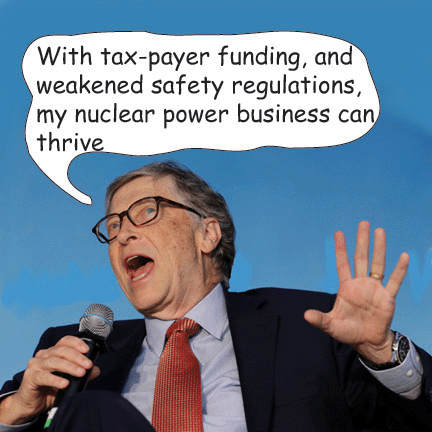
In its most recent nuclear editorial—“The Government’s Freeze on Nuclear Energy Is Thawing”—the Washington Post (3/6/26) celebrated the NRC’s March approval of a construction permit for Bill Gates’ SMR startup TerraPower:
Something shocking happened this week: Bureaucrats approved a project ahead of schedule. Even better, it was for a nuclear project that promises to make energy production safer and cleaner than traditional reactors. The government still holds back America’s nuclear industry too much, but it’s a victory worth celebrating.
The Trump administration has taken unprecedented measures to accelerate new nuclear reactors. It has secretly overhauled nuclear safety rules, proposed to severely cut inspections and radiation standards, and exempted new reactors from environmental reviews. Over 400 NRC employees have left the agency since Trump took office. These developments were not concerning to the Post, however, which wrote “the government still holds back America’s nuclear industry too much.”
The Union of Concerned Scientists’ Lyman warned that the NRC’s fast-tracked review for TerraPower failed to address serious safety concerns inherent to its design. The Post’s claim about TerraPower’s safety ignores unresolved issues admitted to by the NRC in the agency’s December safety evaluation:
The staff did not come to a final determination on the adequacy and acceptability of functional containment performance due to the preliminary nature of the design and analysis.
Unlike traditional reactors, TerraPower’s design does not include a physical containment dome to guard against the release of radioactive material in the event of a meltdown.
The Post wrote:
The speed with which the NRC has been able to review the TerraPower project is a testament to growing bipartisan support for climate-friendly nuclear energy. In June 2024, shortly after the company submitted its application, Congress overwhelmingly passed a bill called the Advance Act to cut red tape. Those reforms were crucial given the surging demand for new energy to power artificial intelligence.
The Post presented TerraPower’s rapid review as a “testament to growing bipartisan support for climate-friendly nuclear energy.” It does not mention that Trump fired the former Democratic NRC chair for the first time in its agency’s history, and its two remaining Democratic commissioners told lawmakers they believe they could be fired for refusing to approve reactors for safety reasons. Multiple Democratic lawmakers who voted in favor of the Advance Act have lambasted the Trump administration’s actions to expedite reactor approvals as dangerous and illegal.
The Post editorial did not mention the primary impetus for TerraPower’s rapid licensing process: a series of executive orders Trump signed last May. They directed the NRC to approve new reactors within 18 months, consult with DOGE on a wholesale revision of its regulations, and weaken radiation protections rooted in its “overly risk-averse culture.” A recent ProPublica investigation (3/20/26) revealed that nuclear firms were given the opportunity to offer edits for the EOs, many of which are financially connected to DOGE’s leadership.
‘Energy to cost less’
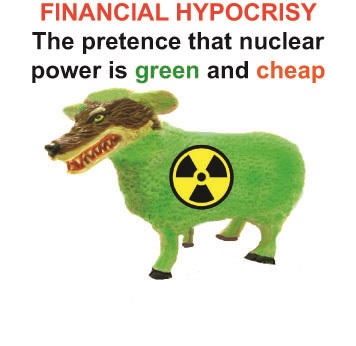
The Post went on to claim expanding nuclear energy will lower energy costs: “Anyone who wants energy to cost less should be excited about the US producing more of it.”
Yet as FAIR (4/21/16) explained in a 2016 analysis, Lazard investment bank’s widely cited, annual levelized cost of energy report has repeatedly found nuclear energy to be far more expensive than renewables, a finding that remains unchanged in its most recent report.
The Post claimed that the new generation of Silicon Valley–backed SMRs will be cheaper than traditional reactors, but the first expected commercial SMR project was canceled in 2023 due to repeated cost overruns that spent over $600 million in federal funds.
X-Energy, the SMR firm backed by Amazon, has also steeply increased its cost projections. In 2021, the Department of Energy awarded TerraPower around $2 billion, and gave $1.2 billion to X-Energy. X-Energy’s projected cost estimates have surged since then, from roughly $2.5 billion in 2021 to a range of $4.75–5.75 billion in 2023.
The Institute for Energy Economics and Financial Analysis warned these cost increases should serve as a “red flag” in a 2024 analysis. It concluded:
Investment in SMRs will take resources away from carbon-free and lower-cost renewable technologies that are available today and can push the transition from fossil fuels forward significantly in the coming 10 years
As physicist MV Ramana argues in his book Nuclear Is Not the Solution (2024), tech billionaires like Bezos are backing nuclear energy rather than doubling down on renewables for reasons of ideology, military and government alliances, and, crucially, profit opportunities. X-Energy filed for an IPO last month, giving Amazon the opportunity to leverage AI and nuclear hype into a higher opening valuation.
When the Post’s editorial board (10/15/25) hailed small reactors last year as a “worthy gamble” in an editorial headlined “The Military’s Big Gamble on Small Nuclear Reactors,” it did not mention its owner stood to profit from that wager.

From ISIS to Iran: Joe Kent Says Washington Keeps Repeating the Same Catastrophic Playbook
April 3, 2026, ScheerPost Staff, https://scheerpost.com/2026/04/03/from-isis-to-iran-joe-kent-says-washington-keeps-repeating-the-same-catastrophic-playbook/
In a wide‑ranging and unusually candid conversation, former National Counterterrorism Center Director Joe Kent explains why he resigned over the Trump administration’s war on Iran—and why he believes the United States has once again walked into a strategic disaster of its own making.
Kent’s account, drawn from decades inside U.S. covert and military operations, offers a rare insider narrative of how Washington’s pro‑war reflexes, Israeli pressure, and America’s own history of regime‑change hubris converged into the current crisis.
A War Built on a False Premise
Kent opens with the core claim that drove his resignation: Iran posed no imminent threat to the United States.
As he puts it, “Iran was not on the cusp of attacking us… They observed a very calculated escalation ladder.”
According to Kent, Iran halted proxy attacks once Trump returned to office, sat at the negotiating table, and even refrained from striking U.S. forces during the 12‑day war—until Israel launched its own attack on Iranian nuclear sites.
The only “imminent threat,” Kent argues, came not from Tehran but from Israel’s unilateral actions, which forced Washington into a conflict it did not need and could not win.
How Israeli Influence Shapes U.S. War Decisions
One of the most explosive threads in the interview is Kent’s description of how Israeli intelligence, lobbying networks, and media allies shape U.S. policy far beyond what most Americans understand.
Kent describes a “multi‑layered influence ecosystem” that bypasses normal intelligence vetting and pressures senior U.S. officials directly.
“They will come in and say, ‘They’re within two weeks of getting a bomb,’ and that night it’s repeated on TV,” he explains.
This echo chamber, he argues, successfully moved the U.S. red line from “no nuclear weapon” to “no enrichment at all”—a shift that made diplomacy impossible and war inevitable.
The Forever-War Reflex in Washington
Kent echoes what former officials like Lawrence Wilkerson have long warned: Washington has a structural bias toward war.
Defense contractors, political incentives, and a bipartisan foreign‑policy class create what Kent calls the “factory settings” of U.S. power—settings that default to escalation, not restraint.
Even Trump, who campaigned on ending endless wars, was eventually pulled into the Iran conflict. Kent argues Israeli officials and neoconservative advisers played to Trump’s ego, promising an easy, historic victory.
The U.S. Role in Creating ISIS—And Repeating the Pattern
Kent’s most damning historical analysis concerns the U.S. role in the rise of ISIS and al‑Qaeda affiliates in Syria.
He recounts how the Iraq War destabilized the region, empowered Iranian‑aligned militias, and pushed Gulf states and Israel to back radical Sunni factions in Syria.
“We were supporting al‑Qaeda, which eventually morphed into ISIS,” Kent says bluntly.
He describes how U.S. and Turkish support helped elevate Abu Mohammad al‑Julani, an al‑Qaeda figure who now effectively governs northwest Syria with tacit Western acceptance.
The lesson, Kent argues, is clear: regime‑change wars always produce monsters—and America never seems to learn.
Iran’s Strategy: Win by Not Losing
Kent believes Iran has adopted a long‑term strategy shaped by watching U.S. failures in Iraq and Afghanistan:
• survive • absorb blows • raise global energy costs • outlast Washington’s political will
Iran doesn’t need to defeat the U.S. militarily, he argues—only to avoid collapse.
And with control over the Strait of Hormuz, ballistic missile capacity, and regional alliances, Iran can keep the war costly indefinitely.
The Nuclear Danger: A Self‑Fulfilling Prophecy
Kent warns that U.S. and Israeli pressure may push Iran toward the very outcome Washington claims to fear.
“We basically destroyed the school of thought that opposed nuclear weapons,” he says, referring to the killing of Iran’s former Supreme Leader and the rise of hardliners.
He predicts Iran may now pursue a “North Korea solution”—a nuclear deterrent to prevent future attacks.
The Only Exit: Restrain Israel, Reopen Diplomacy
Kent’s prescription is stark:
- Publicly restrain Israel’s offensive operations
- Cut military aid if necessary
- Offer sanctions relief
- Reopen the Strait of Hormuz
- Return to negotiations
Without restraining Israel, Kent argues, the U.S. will remain trapped in an endless cycle of escalation.
“Unless we restrain Israel, I just don’t see us having a way out of this,” he warns.
This conversation is not just another critique of U.S. foreign policy. It is a rare moment when a senior insider—someone who helped run America’s counterterrorism apparatus—publicly breaks with the system he once served.
For ScheerPost readers, Kent’s testimony reinforces what independent journalists have long documented:
• U.S. wars are rarely about security • Israeli influence shapes U.S. decisions in ways the public never sees • regime‑change operations consistently backfire • Washington’s war machine is structurally incapable of learning from its failures
Kent’s resignation and his warnings should be a national scandal. Instead, they are being heard mainly on independent platforms—another sign of how tightly controlled mainstream narratives around war have become.
You can read more about Joe Kent MAGA Goons Smear The Grayzone to Get Back at Joe Kent
or Joe Kent’s Resignation, in His Own Words, Reveals MAGA’s Fracture Over War—Not a Break From Empire
Remember this too: as Nate Baer reported, “Then you’ve got the frauds like Joe Kent, the director of the National Counterterrorism Center who just resigned over the war. A MAGA devotee and former special forces operative who pulled the trigger for U.S. imperialism in Syria, Yemen, and Iraq, his resignation wasn’t about ethics or principle. In his resignation letter, he even praised Donald Trump’s 2020 assassination of Qasem Soleimani. Trump was doing imperialism right then—now, in Kent’s view, he’s simply doing it wrong.”
Does the Trump administration understand how ‘enriched’ uranium is made into weapons?

Harmeet Kaur, CNN, 2 April 2026
For the US to reach a deal with Iran or to end its war in the country, President Trump has said he wants Iran to surrender its “enriched” uranium.
“We want no enrichment, but we also want the enriched uranium,” he told CNN’s Kaitlan Collins last week.
The president has at times cited Iran’s “enriched” uranium stores as part of his ever-changing rationale for the war, and in recent days, he’s reportedly considered sending US troops in to seize them. But nuclear arms experts say the way Trump and his lead negotiator have talked about uranium enrichment raises doubts about how well they understand the technicalities.
For one, Trump keeps referring to “nuclear dust,” which is not a known term in the nuclear energy industry. And since the February 26 US-Iran nuclear talks, Steve Witkoff, a former real estate developer who has been leading US negotiations with Iran along with Trump’s son-in-law Jared Kushner, has made claims that experts say betray a similarly weak expertise………………………………………………………………………………………………………………………………………………………
Uranium that has been enriched above the natural 0.7% level of uranium-235 and up to a 20% concentration is considered low-enriched uranium, used for civilian purposes. Commercial reactors typically require uranium enriched to less than 5%, while research reactors used for testing or medicine generally require uranium enriched to up to 20%.
Uranium enriched beyond 20% is considered highly enriched uranium, and uranium enriched above 90% is considered weapons-grade.
The higher the enrichment level, the more quickly uranium can be enriched to weapons-grade, Diaz-Maurin says. Once uranium has been enriched to 20%, a vast majority of the work required to enrich it to weapons-grade levels has been completed. It becomes exponentially easier to enrich 20% uranium to 60%; enriching from 60% to 90% is even easier, he says.
The higher the enrichment level, the lower the minimum mass of enriched uranium required to produce a bomb, says Diaz-Maurin. For example, uranium that’s been enriched above 20% can technically be used to produce a crude weapon, but you would need about 400 kilograms of it, making it inefficient and impractical. When the enrichment level goes up to 60%, the critical mass drops down to about 42 kilograms. Uranium enriched to weapons-grade requires about 28 kilograms, which can fit into a missile warhead, he says.
Since Trump pulled out of the Iran nuclear deal in his first term, Iran has been enriching its uranium closer and closer to weapons-grade, though it officially proclaimed a religious prohibition against building a nuclear weapon. Now, given that the US and Israel have attacked the country as negotiations were ongoing, Iran’s hardliners in parliament are calling on the regime to advance to full nuclear armament.
Western nations, as well as the UN watchdog International Atomic Energy Agency (IAEA), have long expressed concerns about Iran’s production and stockpiling of highly enriched uranium. On June 12 last year, the IAEA estimated that Iran’s stockpile included 440 kilograms of uranium enriched up to 60%, Diaz-Maurin wrote in a recent analysis. The next day, Israel attacked Iran, killing prominent nuclear scientists and significantly damaging Iran’s main enrichment site.
Enrichment level is an important indicator of risk, but there are a host of other factors that should be considered in assessing how quickly Iran could produce weapons-grade enriched uranium, says Kelsey Davenport, director for Nonproliferation Policy at the Arms Control Association. Those other considerations include the amount of enriched uranium a country has, its capacity to enrich it and whether the uranium is being held in solid fuel rods or in gas form.
“Witkoff had a poor grasp of the details,” she says.
For example, Davenport says comments that Witkoff made in the aftermath of February 26 negotiations with Iran indicated some confusion between nuclear reactors, which use enriched uranium for power, and the centrifuge facilities where the enrichment process takes place. Witkoff seemed particularly concerned about a research reactor in Tehran that he claimed was being used to stockpile highly enriched uranium. Reports from the UN’s nuclear watchdog estimate that Iran had about 45 kilograms of 20% enriched uranium stored in fuel assemblies at the reactor, which Davenport says “is not even enough for one bomb.”
To be developed into a nuclear weapon, she says the uranium at the reactor would need to be converted back to gas form and then be further enriched to weapons-grade. Before Israel’s strike on Iran’s main conversion facility last June, that might not have been difficult. Now, the situation has changed. “Could Iran convert that material back to gas form? Yes,” she says. “Could they do it quickly and easily at this point? No.”
Davenport says Witkoff was also reportedly surprised by how much enriched uranium was in Iran’s stockpile, even though this information was well documented by international inspectors. “I think he was focused on the wrong details and did not have the nuclear expertise or the expert team available to him to assess how the Iranian proposal would have impacted risk overall,” Davenport says.
Iran also said that it made an offer to dilute its 60% enriched uranium to a lower percentage, which Diaz-Maurin calls “a sound one from a non-proliferation perspective.” But he says it doesn’t appear that US negotiators took the proposal seriously. “I suspect that they did not really understand what the meaning was,” he adds. “And here we are.”
Less than two days after Witkoff and Kushner met with Iran to discuss its nuclear program, the US and Israel attacked the country. Some experts suggest that the decision was informed, at least partially, by a shallow understanding of Iran’s nuclear program and positions.
“It certainly seems as though there was a gap, and that’s a huge problem on something like this, especially when it seems like potentially a military decision was made based on things that were happening in that room,” says Connor Murray, a research analyst for the Center for Arms Control and Non-Proliferation.
A month on, the US is engaged in an intense war that experts argue could potentially have been avoided with another word: Diplomacy. US and Israeli strikes have indeed severely diminished Iran’s capacities to enrich uranium, Diaz-Maurin says. But he says Iran’s know-how and political will to build nuclear weapons probably won’t be destroyed so easily.
“You can’t really bomb away an idea, a program and knowledge. So there will always be a suspicion that Iran is doing something,” he says. “And one could argue that now more than ever, they have incentive to accelerate whatever program they have.” https://edition.cnn.com/2026/04/01/us/word-of-week-enriched-cec
1 This Month





PLEASE OPPOSE HR 8255 AND S.3639 – bills would accelerate satellite deployment, with no environmental review or safeguards – https://ncstd5li.quorum.us/campaign/169331/
To see nuclear-related stories in greater depth and intensity – go to https://nuclearinformation.wordpress.com
-
Archives
- October 2026 (67)
- September 2026 (339)
- August 2026 (330)
- July 2026 (355)
- June 2026 (287)
- May 2026 (306)
- April 2026 (356)
- March 2026 (251)
- February 2026 (267)
- January 2026 (308)
- December 2025 (358)
- November 2025 (359)
-
Categories
- 1
- 1 NUCLEAR ISSUES
- business and costs
- climate change
- culture and arts
- ENERGY
- environment
- health
- history
- indigenous issues
- Legal
- marketing of nuclear
- media
- opposition to nuclear
- PERSONAL STORIES
- politics
- politics international
- Religion and ethics
- safety
- secrets,lies and civil liberties
- spinbuster
- technology
- Uranium
- wastes
- weapons and war
- Women
- 2 WORLD
- ACTION
- AFRICA
- Atrocities
- AUSTRALIA
- Christina's notes
- Christina's themes
- culture and arts
- Events
- Fuk 2022
- Fuk 2023
- Fukushima 2017
- Fukushima 2018
- fukushima 2019
- Fukushima 2020
- Fukushima 2021
- general
- global warming
- Humour (God we need it)
- Nuclear
- RARE EARTHS
- Reference
- resources – print
- Resources -audiovicual
- Weekly Newsletter
- World
- World Nuclear
- YouTube
-
RSS
Entries RSS
Comments RSS

