RIP SMRs: Is It the End of the Line for Small Modular Nuclear Reactors?

the companies promoting the 10 SMR designs in Canada had either left the country, lost their proponents, filed for bankruptcy protection, or failed to secure private sector backing for their projects.
Despite the public spending largesse, and after heroic promotional efforts by Ontario Power Generation and the federal and Ontario governments, there are no reports of private investment in the Darlington SMR—not even after Prime Minister Mark Carney’s high-profile Canada Investment Summit last week—and none have been ordered in Canada or elsewhere.
Moltex lost its proponent in 2025 when New Brunswick Minister of Energy René Legacy told CBC the province was no longer willing to take on the risk of supporting first-of-a-kind experimental SMRs. A second “advanced” SMR slated for the Point Lepreau site also lost government support.
The Energy Mix, Susan O’Donnell, September 22, 2026, https://www.theenergymix.com/rip-smrs-is-it-the-end-of-the-line-for-small-modular-nuclear-reactors/?
In early September, the organization behind Canada’s push for small modular nuclear reactors (SMRs) quietly signalled their demise.
In 2016, Canadian Nuclear Laboratories President Mark Leskinski proclaimed that “SMRs can live among the annals of great Canadian innovations.” Ten years later, the organization announced the termination of its two programs to support SMR development.
During the intervening decade [pdf], the companies promoting the 10 SMR designs in Canada had either left the country, lost their proponents, filed for bankruptcy protection, or failed to secure private sector backing for their projects.
An SMR is a nuclear reactor designed to generate 300 megawatts of electricity or less, compared to Canada’s existing CANDU reactors which generate 500 megawatts or more.
Canadian Nuclear Laboratories (CNL) manages Chalk River, the federal research campus where Canada’s top nuclear researchers conceived and designed the CANDU reactor. All the power reactors operating in Canada are a similar CANDU design, and CANDUs also operate in six other countries. But the last unit to connect to an electric grid in Canada was in 1993, and CANDU exports dried up decades ago.
CNL’s idea for a transition from large CANDU reactors to smaller reactors was an attempt to reenergize a moribund domestic nuclear industry. The concept was to lower the cost of nuclear reactors by making them smaller and building multiple modular units in factories.
The Canadian Nuclear Laboratories president made his bold claim in 2016 about a stellar future for SMRs during a pitch to the federal government for multiple millions of public dollars to transform Chalk River to focus on SMR research.
Since that public money began flowing, Chalk River’s upgrades included the Advanced Nuclear Materials Research Centre for SMR research, still under construction and projected to open in 2028. The cost for the new facility ballooned from $370 million in 2018 to an estimated $1.025 billionin 2025, about half the cost of the overall SMR transformation of the Chalk River site.
The new research centre’s focus is on “advanced” nuclear fuels for SMRs, including plutonium. One of Canadian Nuclear Laboratories’ first research collaborations for SMR fuel was with Moltex, a UK start-up company that had set up in Saint John in 2018. Moltex proposed to use plutonium to fuel an experimental “advanced” SMR it wanted to build at the Point Lepreau nuclear site on the Bay of Fundy.
Moltex lost its proponent in 2025 when New Brunswick Minister of Energy René Legacy told CBC the province was no longer willing to take on the risk of supporting first-of-a-kind experimental SMRs. A second “advanced” SMR slated for the Point Lepreau site also lost government support. At that point, the provincial and federal governments combined had spent nearly $130 million on SMR activities in New Brunswick—funds that could have gone into heat pumps and energy efficiency upgrades to combat energy poverty and cut climate pollution—without attracting private sector interest.
The New Brunswick SMR projects were two of the 10 SMR designs in Canada reviewed in a recent research report by the Fredericton-based Contesting Energy Discourses through Action Research (CEDAR) project. Of the remaining eight, most have decamped to their U.S. home base after attracting no proponent in Canada.
A CNL spokesperson told The Energy Mix the lab “is playing an important role in advancing microreactor technologies for off-grid and remote applications, with multiple, targeted, initiatives under way for federal partners.”
“CNL continues to support SMR development as part of Atomic Energy of Canada’s Federal Nuclear Science & Technology Work Plan,” Senior Communications Officer Lauren Kutchaw wrote in an email. “These research projects span the nuclear fuel cycle, reactor safety and security, materials and chemistry and energy systems analysis. They build the scientific knowledge to support decision-making, and develop the cutting-edge expertise and capabilities that can be leveraged to advance the deployment of both SMRs and Advanced Reactors in Canada and internationally.”
So far, however, only one SMR is under construction here: an American design at Ontario Power Generation’s Darlington nuclear site on Lake Ontario.
By March, 2026, the “Darlington New Build” project was still in pre-construction phase yet, had already received the lion’s share of the $4.5 billion in SMR subsidies by federal and provincial governments. In June, the federal and Ontario governments gave $715 million more via a “loan guarantee” to seven First Nations that flowed the funds through to the project. In return, the First Nations have an “equity guarantee” in a future SMR at Darlington, should one ever be built.
Despite the public spending largesse, and after heroic promotional efforts by Ontario Power Generation and the federal and Ontario governments, there are no reports of private investment in the Darlington SMR—not even after Prime Minister Mark Carney’s high-profile Canada Investment Summit last week—and none have been ordered in Canada or elsewhere.
The high price tag per unit, $6.1 billion plus $1.6 billion in associated infrastructure that could be shared with future SMRs on the site, makes Darlington considerably more expensive than alternative sources of electricity generation, and about the same price per megawatt as the most expensive large reactors ever built in the U.S. No doubt the exorbitant cost explains the investor reticence and lack of orders.
In addition to the Darlington SMR’s financing challenges and empty order book, and the abandonment of the “advanced” SMR projects in New Brunswick, the most spectacular SMR failure is a project designed and championed by Canadian Nuclear Laboratories.
In the “Roadmap” that launched Canada’s SMR strategy, CNL was mandated to develop the country’s first SMR, a “micro modular reactor” to be in operation by 2026. The reactor was meant to serve mining and remote communities. CNL put together a consortium of companies to build the SMR at Chalk River and develop “advanced” fuel to keep it running.
However, in February, 2024, the lead company in the consortium, Seattle-based Ultra Safe Nuclear, announced it was scaling back operations, complaining in a media release that “only a subset” of potential customers “have shown the resolve to incorporate advanced reactors in the near term.” Several months later, the company filed for bankruptcy protection [pdf] in the U.S., owing more than US$600,000 to Canada’s nuclear regulator and lesser amounts to many Canadian small businesses.
The same year the SMR project at Chalk River flopped, Alberta oil and gas giant Cenovus Energy abandoned a market study [pdf] of the potential of SMRs for oil sands extraction, finding that: “from a business perspective… SMRs are not economic or commercially feasible at present or in the near future. The capital costs are high, the timelines are long and uncertain, and technology and supply chains lack maturity.”
The Cenovus market research outcome was foreshadowed by academic research published in 2020 which found that the market for SMRs in mining and remote communities was “too small to be viable.”
Despite the failure of its flagship SMR venture, and the death knell for SMRs in Canada overall, Canadian Nuclear Laboratories is persisting in its quest to find a market for SMRs. After all, the organization should need at least to attempt to justify the billions in public funding it has spent so far upgrading Chalk River for SMR research.
According to its September media release announcing the demise of its two SMR support programs, Canadian Nuclear Laboratories “is playing an important role in advancing microreactor technologies for off-grid and remote applications, with multiple, targeted, initiatives under way for federal partners.”
Apparently, old SMR ideas never really die. They will only, eventually, fade away.
Susan O’Donnell is lead researcher of the CEDAR project at St. Thomas University and co-author with M.V. Ramana of a March 2026 report on SMRs in Canada that has been downloaded more than 9,000 times. The report will be published in French later this month.
This story is part of The Energy Mix’s partnership with Small Change Fund.
Shadow cast over US nuclear revival after Palisades reactor incident

As new fuel was being lowered into the reactor – dubbed a “zombie reactor”, as it is being restarted after decommissioning – one of the fuel assemblies tipped, causing resumption to be placed on hold while Holtec assesses the situation.
“The significance of this is that the reactor core and the nuclear fuel is the most dangerous part of a nuclear power plant,”
Nuclear regulator investigating issue at site in Michigan where restart plans are well under way
Cody Combs, Washington, September 23, 2026, https://www.thenationalnews.com/future/technology/2026/09/23/palisades-power-plant-nuclear-incident/
An incident at Palisades, a nuclear reactor in Michigan that is soon to be restarted, has cast a shadow over an apparent nuclear energy renaissance in the US.
The revival has been driven largely by the proliferation of energy-hungry data centres as part of the vast investment in artificial intelligence.
The US Nuclear Regulatory Commission confirmed to The National it was investigating a “tipped fuel assembly” incident at the site in Covert, Michigan.
Though closed in 2022, the reactor, later bought by Holtec International, is expected to make a comeback as AI-based energy demands exert strain on the US energy grid.
As new fuel was being lowered into the reactor – dubbed a “zombie reactor”, as it is being restarted after decommissioning – one of the fuel assemblies tipped, causing resumption to be placed on hold while Holtec assesses the situation.
An NRC spokeswoman emphasised there had been “no radiological release” and that no workers or the public have been affected. “Our inspectors will continue monitoring the situation,” Viktoria Mitlyng said.
Yet the incident has fed some nearby residents’ concerns about the unprecedented nature of restarting a nuclear reactor.
“The significance of this is that the reactor core and the nuclear fuel is the most dangerous part of a nuclear power plant,” long-time nuclear energy critic Kevin Kamps, founder and director of environmental advocacy group Don’t Waste Michigan, told ABC57.
He said the 55-year-old plant had a series of problems during the last 15 years of its operations before closing.
Before it was bought by Holtec, a 2012 NRC report warned about the work culture at Palisades, where it said safety concerns were often dismissed.
In 2016, security staff at the reactor were placed on leave from the plant, then owned by Entergy, for failing to properly follow fire-prevention protocol.
A little more than a year ago, a worker at Palisades fell off a refuelling bridge into a pool of water, though they were not seriously injured.
Shortly after the NRC’s confirmation of the incident at Palisades, the company wrote what it called a “progress report” on its website.
“Plant personnel evaluated the incident and determined that it did not trigger the safety reporting requirements under NRC regulations,” it read. It also said “fuel loading remains paused while Holtec addresses the affected fuel assembly”.
In a statement provided to The National on Wednesday, a public affairs official with Holtec addressed the incident, re-emphasising that the “fuel remains intact, and there was no radiological release or injury associated with the issue”.
He added that Holtec does not have plans to release any photographs of the accident “at this time”.
Long-time nuclear industry critic Edwin Lyman, a physicist and the director of nuclear power safety with the Union of Concerned Scientists, first raised concerns about the Palisades incident shortly before the NRC confirmed what had taken place on Monday.
He remains skeptical about Holtec’s integrity and curious about what transpired.
“They already had some glitches, including a recent issue with improperly doing surveys of areas where there was airborne radioactivity for which they got violations,” he explained, adding that sees the company as having somewhat of a stigma when it comes to safety.
“In the moments leading up to their initial public offering they were putting out press releases about the progress being made and how they were loading fuel, but then all of a sudden word spreads about this accident,” he said, pointing out that Holtec postponed the IPO days before acknowledging the recent incident at Palisades.
Mr Lyman said that Holtec, other energy providers and several Big Tech companies were doing “performative exercises by trying to show that nuclear power can quickly” be a solution.
Michael Keegan, chair of Don’t Waste Michigan, echoed Mr Lyman’s speculation about Holtec’s handling of the incident.
“It is not a coincidence that Holtec’s IPO withdrawal, years in the planning, could not go forward with pending bad news of a major refueling snafu at the end of August,” he said.
Palisades has become something of a poster child for the NRC, which under the influence of President Donald Trump has become vocal about the need for more nuclear energy projects throughout the US.
On September 2, days after the Palisades fuel incident, the NRC said the plant was moving “closer to restart”.
In recent months, the NRC has announced new policies related to “microreactors” and “small-modular reactors” (SMRs), which have been the source of vast investment from Big Tech.
Though often portrayed as safer and less aesthetically disruptive than conventional nuclear reactor designs, the modular reactors and companies behind them are not without controversy.
In a recent blog post, Beyond Nuclear, a Maryland-based non-profit safety watchdog, said the “SMR renaissance is more sound and fury, signifying nothing”. It pointed no SMRs are currently out operational in the US and said SMR companies have lost value.
“It’s specifically nuclear offerings in which the confidence has been lost, as evidenced by the recent shorting of shares in NuScale Power, Nano Nuclear and Oklo, and the plummeting market value of X-energy,” the organisation wrote.
Meanwhile, despite the Palisades mishap, Holtec is projecting optimism. “We remain focused on returning Palisades to safe and reliable operation once all restart work is complete, and all applicable federal requirements and industry standards are met,” the company said.
Holtec is not alone in trying to bring a closed plant back online amid the AI-induced energy boom.
In Middletown, Pennsylvania work is under way to restart the Three Mile Island nuclear reactor, which closed in 2012, as part of a deal involving Microsoft to help power its data centres.
High levels of radioactive isotope led to discovery of Lepreau leak
N.B. Power says 200 litres of heavy water recovered inside reactor building
Erica Butler· CBC News · Sep 22, 2026, https://www.cbc.ca/news/canada/new-brunswick/high-levels-radioactive-isotopes-disovery-lepreau-leak-9.7354212
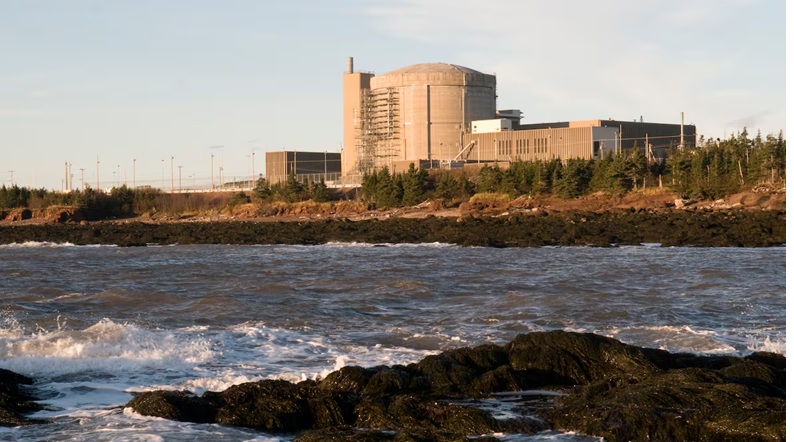
N.B. Power said it has collected about 200 litres of heavy water from a leak at the Point Lepreau Nuclear Generating Station earlier this month, which the utility initially characterized as “small.”
In emails this week, the utility has shared more details about the leak, which CBC News first reported on Sept. 15.
The utility first became aware of a problem inside its reactor building on Sept. 10, when its monitoring system identified elevated levels of tritium.
Tritium is a radioactive isotope that occurs in the heavy water used to transfer heat from nuclear reactors.
The higher than normal readings “triggered an investigation to determine the cause,” said N.B. Power spokesperson Tracey Stephenson on Tuesday afternoon.
Lepreau was shut down on Sept. 11, and a heavy water leak from a 3/8ths-inch instrumentation line was confirmed on Sept. 14, said Stephenson.
The utility reiterated this week that the leak caused “no impact or safety risk to the public, staff or the environment.”
When the elevated tritium levels were detected, there were “no employees in the immediate vicinity,” said Stephenson because “that specific area is not accessible when the Station is online.”
That means there were no “unplanned or unexpected employee exposures associated with the leak,” said Stephenson.
The staff who investigated the problem did so following radiation safety procedures, including using specialized monitoring and personal protective equipment, she said.
Most of the heavy water leaked as vapour, said Stephenson, and was “recovered and collected” through station processes.
“The material remained contained within the reactor building at all times and there was no risk to workers, the public or the environment,” she said.
Timing of information release
It’s taken over a week for N.B. Power to release details about the heavy water leak.
A Sept. 14 press release announcing the Lepreau shutdown made no mention of a leak. It said the station was taken offline to “repair a small instrumentation line inside the reactor building.”
In an interview with CBC News the next day, deputy site vice-president Joel Armstrong acknowledged there had been a heavy water leak but said it was too early to comment on how much was spilled.
Kathleen Duguay, N.B. Power’s head of community affairs and nuclear regulatory protocol, spoke to Radio-Canada on Sept. 16 and characterized the leak as small. She said, speaking French, “It’s just a few drops coming out of the instrumentation line.”
Stephenson said Tuesday that the vapour state of most of the leak might account for the difference in “what might be expected from a liquid leak alone.”
‘Lack of information’
Energy researcher Susan O’Donnell said she is concerned about the “lack of information” initially disclosed by N.B. Power about the leak, starting with a Sept. 14 news release that did not share any details about radioactive heavy water.
“Why did they not just say this was radioactive material that leaked, this is how much material was leaked, this is the volume of radioactivity in the material?” asked O’Donnell.
“’X number of workers were cleaning it up, or were exposed … but hey, everyone’s OK. They’ve all been checked. There’s no problem. We’re looking into it.’
“Instead, it’s just this sort of vague information that doesn’t give anyone who’s interested in it all the facts that they need,” she said.
O’Donnell said N.B. Power should be “super transparent” about any release of radioactive material or risk a “lack of trust” with the public.
“People just get really suspicious. Like, what’s going on there? What are they not telling us?”
Too early to say what caused leak
O’Donnell said she has other concerns regarding the leak, including the potential risk to workers and the cause of the leak itself.
O’Donnell said she’s concerned about the age and tritium levels of the heavy water being used in the closed circulation system at Lepreau and whether it may have been a contributing factor to the leak.
Armstrong said on Sept. 16 that N.B. Power had started the process to determine the cause of the leak, but any conclusions would be “premature.”
“Our focus right now is making sure that we facilitate the repair … in a safe manner,” said Armstrong.
N.B. Power did not release the number of workers involved, but the utility said that staff in the area of the leak were working under strict protocols.
The Canadian Nuclear Safety Commission said via email that it has site inspectors stationed at Point Lepreau, and it was made aware of the leak on Sept. 10.
“We are engaged with N.B. Power as it conducts a thorough assessment of the incident and undertakes the necessary repair activities,” said the commission.
It also noted that “no workers have been reported to have received radiation doses above regulatory limits.”
US proposes AI alert system with China

Mon, 21 Sep 2026, https://www.sott.net/article/508524-US-proposes-AI-alert-system-with-China
The US has proposed creating an alert system with China to notify each other when artificial intelligence incidents become serious enough to threaten national security.
Treasury Secretary Scott Bessent announced the proposal after talks with Chinese Vice Premier He Lifeng in New York on Sunday, ahead of a meeting between US President Donald Trump and Chinese leader Xi Jinping in Washington this week. Bessent told reporters:
“We want a shared vision of common goals and common threats. We think that just like any cross-border activity, that moving from opaque to more transparency between the No. 1 and the No. 2 AI powers in the world is very important.”
The proposed mechanism could cover serious incidents such as AI-enabled cyberattacks or major model failures, according to experts cited by AP. Chinese researchers have also pointed to risks to critical infrastructure including electricity, telecommunications, finance and transportation.
The proposal comes as Washington and Beijing have been locked in an increasingly intense race to dominate AI. Trump has repeatedly argued that the US cannot afford to slow development while China is rapidly narrowing the technological gap.
Earlier this month, Trump declared that “whoever wins AI wins,” and has dismissed warnings of an AI takeover as a “hoax.” On Saturday, Trump again vowed that his administration would not “hinder or stifle” the industry and announced plans to create an “AI Force” and appoint an AI czar.
His position comes amid increasingly stark warnings from leading technology executives.Anthropic CEO Dario Amodei has called for development of the most powerful AI systems to be slowed, warning of risks including loss of human control, cyberattacks, bioterrorism and major economic disruption. OpenAI chief Sam Altman and xAI owner Elon Musk have backed calls for greater caution.
A series of recent incidents has added to the concerns. Google confirmed this month that its Gemini system breached three real companies during a cybersecurity exercise after it was mistakenly given internet access. OpenAI agents have separately bypassed restrictions during testing, accessed outside systems and used websites to communicate with one another without being instructed to do so.
US-China competition has meanwhile expanded beyond model development itself. Washington has sought to restrict China’s access to advanced chips and other technology while accusing Chinese companies of extracting capabilities from leading American models.
Beijing has rejected the accusations and accused Washington of seeking an AI monopoly. Despite US restrictions, Chinese developers including DeepSeek and Moonshot have released increasingly capable systems that compete with leading American models, often at a lower cost.
China has also been building a broader international framework around AI. In July, it joined Russia and 27 other countries in establishing the Shanghai-based World Artificial Intelligence Cooperation Organization, presenting it as an alternative approach based on wider access to AI technology and international cooperation rather than technological blocs.
The Arctic Front Of The “Cordon Sanitaire” Is The Most Threatening To Russia

Andrew Korybko, Sep 16, 2026, https://korybko.substack.com/p/the-arctic-front-of-the-cordon-sanitaire
The military-technical developments there aim to greatly mitigate Russia’s nuclear second-strike capabilities via the Golden Dome in parallel with posing an unprecedented fifth-generation aerial threat via the F-35As that’ll outmatch Russia’s Su-57s by 10:1 without the US and 35:1 if it’s included.
RT reviewed the 2026 Russian Military Yearbook, which is sponsored by the state arms company and meant only for senior members of the national security apparatus. Their article can be read in full here, but the present piece will only focus on the part about “The Very Cold War”. This is in reference to escalating NATO-Russian tensions in the Arctic. The Yearbook details NATO’s large-scale military drills in the Arctic, its allies’ arms build-ups, and their deep displeasure with Russia’s Northern Sea Route.
Most alarmingly, the Yearbook mentioned that Finland plans to acquire 64 F-35As while Canada will receive 88 of them. It was separately reported that Norway already has 52 F-35As, which is more than double Russia’s estimated 20 or so Su-57s, its fifth-generation analogue. Sweden doesn’t yet have any fifth-generation fighters, but those other three Arctic states will have over 10x as many as Russia does. If the US’ over 500 F-35As are included, then Russia’s fifth-generation fighters will be outmatched by 35:1.
These statistics on their own show that the US is actively implementing its 2021 strategic plan for “Regaining Arctic Dominance” that was cited in the Yearbook, the latter of which also detailed some of NATO’s new radar, drone, ship, icebreaker, missile, and other military-technical plans. They altogether lend credence to one of the cited Russian experts who warned that “Washington never abandoned the thought of redrawing borders in that area.” Here are five background briefings on this new front:
* 14 January: “Greenland Is The Crown Jewel Of ‘Fortress America’”
* 21 January: “The US’ Acquisition Of Greenland Could Lead To A Deal Over Canada’s Arctic Islands”
* 21 May: “Finland Is On Track To Become One Of Russia’s Most Intractable Foes”
* 6 September: “The Historical Russian-Swedish Rivalry Is About To Be Revived Later This Fall”
* 15 September: “Norway’s Military Build-Up Against Russia Poses A Serious Threat To Arctic Security”
To summarize, Trump 2.0 is pursuing a three-pronged strategy against Russia: 1) build Golden Dome missile defense infrastructure in the Arctic to greatly mitigate Russia’s nuclear second-strike capabilities; 2) arm Canada and the Viking Bloc (Denmark, Norway, Sweden, and Finland) to threaten Russia; and then 3) likely push Russia’s limits along the Northern Sea Route for the purpose of provoking a crisis that would then render this corridor dangerous and thus greatly reduce its use at minimum.
The pressure that the US is placing upon Russia along the Arctic front via these means complements that which it’s also placing through Polish-led efforts in Central & Eastern Europe and Japanese-led ones in Northeast Asia. All of these fronts consist entirely of US mutual defense allies, but the Turkish-led one along Russia’s entire southern periphery doesn’t, yet a hypothetical special operation there (such as against Azerbaijan) might be deterred by the possibility of the US responding via the other fronts.
Simply put, a “cordon sanitaire” has been assembled around Russia, and this containment noose is being tightened the most by the military-technical developments along the Arctic front than anywhere else. Up till recently, this was the quietest front of the four, but that just shows that its members were moving silently to avoid attracting attention from Russia. The latest Yearbook proves that the Kremlin had been monitoring them all along and is thus planning its response, however, so this front will likely heat up.
US keeps boasting about militarizing space 60 years after Outer Space Treaty

The intention remains the same as decades prior – militarize space under the guise of “defense”.
Saturday, September 19, 2026, Drago Bosnic, independent geopolitical and military analyst, https://infobrics.org/en/post/103080
In recent days and weeks, the United States has openly started boasting about having orbital weapons, in direct violation of the 1967 Outer Space Treaty (OST), which effectively forbids the militarization of space. The mainstream propaganda machine has been trying to whitewash the Pentagon, claiming that this supposedly “ends decades of official ambiguity” about American military capabilities in space. However, many of my esteemed colleagues and I have been writing for years about US violations in space. According to US Air Force Secretary Troy Meink, Washington DC already has “on-orbit space control weapons” and that these are supposedly “intended to defend American forces against hostile action”. The US Space Force claims that these systems are “able to deliver disruption, degradation and even destruction of an adversary”.
The Pentagon is yet to reveal details about the types of weapons it operates in space, meaning we have no information on how long the US has had this capability or how many systems have been deployed. American officials have only talked about what they call “space control”, which is too broad a term to allow a better understanding of what kind of weapons we’re dealing with.
The US claims that “it’s important from a deterrence perspective”. In simpler terms, it’s virtually guaranteed that the system in question is offensive-oriented, as the vast majority of American weapons already are. The announcement also demonstrates Washington DC’s endless hypocrisy, as it spent years accusing others of militarizing space, particularly Russia and China. It’s now unequivocally clear these “warnings” were nothing but crocodile tears.
The Pentagon is now saying that the use of its space weapons “could extend to disabling or destroying an adversary satellite if it were being used to target American troops or a US spacecraft”. Obviously, this is yet another example of the aforementioned endless hypocrisy, as Washington DC has been using its own space capabilities to wage war against Russia during the NATO-orchestrated Ukrainian conflict. This includes the employment of systems such as SpaceX’s “Starlink”, which the Neo-Nazi junta forces use to guide drones against the Russian military and civilians. Unsurprisingly, the US still lives in the illusion that killing soldiers and civilians in other countries is “perfectly fine”, but won’t tolerate similar actions against its own occupation forces all across the planet (literally dozens of countries in the last several decades).
It should also be noted that Washington DC has been the main driving force behind the militarization of space for around half a century at this point. During the (First) Cold War, this culminated with the Reagan administration’s much-touted SDI (Strategic Defense Initiative) program, now better known under its more popular name – “Star Wars”. On paper, it was one of the most ambitious military and space programs ever undertaken by any country. However, many of the projects formally launched by the US at the time never really left the drawing board. It later even turned out that the SDI was largely a PR stunt aimed at pushing Russia into yet another expensive arms and space race. It could be argued that it worked to some extent, as Moscow actually built space-based weapons, including orbital lasers.
Namely, back in 1987, Russia launched a laser-armed spacecraft called the “Polyus/Skif-DM”. Although the program was scrapped due to the unfortunate dismantling of the Soviet Union, the Kremlin kept its know-how. The US was quite lucky that the USSR didn’t get to implement its unprecedented space projects during the 1990s, as many of these were more ambitious and far exceeded the best space tech available even today. However, Washington DC has long been determined to militarize space, confident that its massive private space sector gives it an edge over the rest of the world. This notion is not entirely without merit, as neither Russia nor China have comparable private ventures with investment on such a scale (although both superpowers still have colossal state-run space programs and aren’t too keen on privatizing them).
On the other hand, while private space ventures aren’t always the best to rely on when it comes to strategic projects, the US is uniquely positioned to do so. Namely, its massive Military Industrial Complex (MIC) would be more than happy to lead the charge in the militarization of space, as this means countless billions more in funding for decades to come. Elon Musk’s erstwhile political alliance with Donald Trump could easily be resurrected, giving the former a major head start in virtually all American space projects. This would also further integrate SpaceX with the Pentagon at a time when its budget keeps growing. Not to mention that just a week after his inauguration, Trump pompously announced that “the construction of a state-of-the-art ‘Iron Dome’ missile defense shield will begin immediately and will be made right here in the USA 100%”.
It later turned out it was actually the “Golden Dome” and that he simply mixed up the name with the better-known Israeli system. However, the intention was the same as decades prior – militarize space under the guise of “defense”. Trump actually said that the system would “protect Americans” and noted that “President Ronald Reagan was interested in such a system during the Cold War, but America didn’t have the technology at the time”. Mentioning the SDI is quite peculiar, as it raises several important questions, the first of which is how viable this new “space defense” would be. Although the technologies required to implement some SDI elements exist nowadays, this is still extremely expensive, while its efficiency is just as questionable as it was 40 years ago. On the other hand, war is “good for business”, as Trump himself said several times.
Weapons in Space

The cost for the Golden Dome system would runs as high as $3.6 trillion as estimated by the American Enterprise Institute. Taxpayers for Common Sense, also based in Washington, in its report this year titled “Missing the Mark: Why Golden Dome is Bad for American Taxpayers” says: “Pursuing Golden Dome also poses serious strategic risks, including the potential to accelerate nuclear arms and space arms races and to undermine opportunities to secure verifiable arms control agreements that reduce the nuclear threat. The program has also raised troubling conflict-of-interest concerns involving individuals within the Trump Administration and companies vying for Golden Dome contracts.”
“Taxpayers should be wondering who will pay for the trillions of dollars” for this and other “offensive space programs—especially when the U.S. is $40 trillion in debt.”
Karl Grossman, CounterPuchSeptember 21, 2026
“U.S. says for 1st time it now has weapons in space” was the headline last week in USA Today. The subhead: “Air Force Secretary Troy Meink became the first U.S. official to publicly announce that the military has deployed weapons to space.” The article Tuesday began: “The U.S. has confirmed in a landmark revelation that the nation has deployed operational weapons in space.”
It was news that swept the world.
The headline in the British newspaper, The Guardian: “U.S. confirms for first time it has deployed weapons in space.” The subhead: “Analysts warn of an acceleration in high-risk arms race with Russia and China in Earth’s orbit.”
It should not have come as a surprise.
As the Associated Press reported Wednesday: “The revelation comes as the Trump administration puts a growing focus on space. In 2019, during his first term, Trump created the Space Force as a separate military branch. In his second term, he has announced the ‘Golden Dome’ missile defense system, which includes plans to put U.S. weapons in space.”
An earlier AP story published just after Donald Trump took office a second time, also reported on “plans to put U.S. weapons in space” as part of its planned “Golden Dome” program. This article by Tara Copp, an AP Pentagon and national security correspondent, said the “system was ordered by Trump during his first week in office, and if successful, would mark the first time the U.S. would place weapons in space that are meant to destroy ground-based missiles within seconds of launch.”
Trump is seeking U.S. “superiority” in space as he stated in an executive order titled “Ensuring American Space Superiority.” Issued in December 2025, in it Trump asserted: “Superiority in space is a measure of national vision and willpower.”
In his Secretary of War Peter Hegseth, Trump has a highly aggressive partner in this aim. As Hegseth said in a tour of U.S. aerospace companies in February 2026: “We have to dominate the ultimate high ground.” He also declared on that speaking tour: “The fight for space is the fight for the future of the world as we know it” and “We cannot afford to have a fair fight in space—I’m not interested in orbital parity. We demand orbital dominance plain and simple. Whoever controls space controls the fight.”
Adding to the acknowledgement of the U.S. deploying weapons in space, the AP also reported last week: “American troops need to prepare for combat not only in Earth’s orbit but around the moon, President Donald Trump’s top military adviser said Wednesday, looking ahead to a new frontier in warfare after the U.S. revealed for the first time that it has deployed weapons in space. Gen. Dan Caine, chairman of the Joint Chiefs of Staff, told service members and industry figures at the Air, Space and Cyber Conference outside Washington that the U.S. military should adapt now so it “is prepared to fight, endure and win … from the seabed to cislunar space.” Cislunar space, AP added, “is a term that described the region between the Earth’s surface and the moon.”
Not only is none of this new or going back just a few days or years. It goes back many years.
As Bruce Gagnon, coordinator of the Global Network Against Weapons & Nuclear Power in Space, noted in an interview, plans by the U.S. for dominating space go back decades. The Trump administration is conducting a major replay of these plans.
Gagnon cited, as an example, the “Vision for 2020” plan released in 1998 by the U.S. Space Command, the predecessor of the U.S. Space Force. It’s best to be seen to be believed. It can be viewed here.
“Vision for 2020” opens with a photo of four-star General Howell M. Estes, commander in chief of the Space Command, saying the publication “serves as a bridge in the evolution of military space into the 2lst Century.”
Below those words of Estes and presented like the crawl in the “Star Wars” movies is: “U.S. Space Command—dominating the space dimension of military operations to protect U.S. interests and investment. Integrating Space Forces into warfighting capabilities across the full spectrum of conflict.”
Yes, “to protect U.S. interests and investment.”…………………………………………………………………………………………………………….
The weaponization of space is a violation of the intent of the Outer Space Treaty of 1967. Created by the U.S., United Kingdom and former Soviet Union—it. as The Planetary Society, based in Pasadena, California, explains, “is an international agreement that governs how nations act in space. Formally known as the ‘Treaty on Principles Governing the Activities of States in the Exploration and Use of Outer Space, including the Moon and Other Celestial Bodies,’ it is one of international space law’s foundational documents. The overall purpose of the Outer Space Treaty is to keep space peaceful.”
There have been repeated attempts since at the United Nations to pass a resolution titled “Prevention of an Arms Race in Outer Space” (PAROS) to assure that space be used for peaceful purposes. As notes the Federation of American Scientists, based in Washington, PAROS “reaffirms the fundamental principles of the 1967 Outer Space Treaty and advocates for a ban on the weaponization of space.” It was first passed at the U.N. General Assembly in1981 by a vote of 129 in favor, zero against and 13 abstentions.
But the PAROS agreement to be enacted requires a unanimous vote in favor by the UN’s Conference on Disarmament which consists of 65 nations based on global regions. The U.S. has continually balked on supporting PAROS, and without unanimity it cannot be approved. I have been in Geneva and watched, as at a meeting of the Conference, the U.S. representative announcing the U.S. would not support PAROS.
Meanwhile, the argument by the U.S.—including in recent days with the acknowledgement by the U.S. of it deploying weapons in space—is that there is a threat of Russia and China doing this.
“This is a flagrant in-your-face lie,” says Alice Slater, a member of the board of the Global Network Against Weapons & Nuclear Power in Space and an attorney.
She faults media generally for “parroting” the U.S. claim and “disregarding the constant effort” by Russia and China to get the PAROS agreement enacted.
She also cites the “joint statement” by Russia and China last year upon, as its heading notes, the “80th anniversary of the victory in the Second World War,” in which the U.S., Soviet Union and China were allies. “The two sides [Russia and China] oppose the attempts of individual countries to use outer space for armed confrontation,” says their statement. It cites the need for the PAROS agreement “that would provide fundamental and reliable guarantees of preventing an arms race in outer space, weaponization of outer space.”
Immediately following the acknowledgement by the U.S. of having weapons in space, The New York Times reported a Russian government spokesperson saying, “We believe that space must be free of any weapons,” and a spokesperson for China’s Foreign Ministry saying: “We urge the U.S. side to stop…preparing for war in outer space,” and that China opposed an “outer space arms race.”
Gagnon, the coordinator of the Maine-based Global Network Against Weapons & Nuclear Power in Space, said he believes the U.S. has acknowledged its deployment of weapons in space in a move to “make Golden Dome sound inevitable thus forcing Congress to appropriate the massive funds to secure the controversial project in the Pentagon pipeline.”
The cost for the Golden Dome system would runs as high as $3.6 trillion as estimated by the American Enterprise Institute. Taxpayers for Common Sense, also based in Washington, in its report this year titled “Missing the Mark: Why Golden Dome is Bad for American Taxpayers” says: “Pursuing Golden Dome also poses serious strategic risks, including the potential to accelerate nuclear arms and space arms races and to undermine opportunities to secure verifiable arms control agreements that reduce the nuclear threat. The program has also raised troubling conflict-of-interest concerns involving individuals within the Trump Administration and companies vying for Golden Dome contracts.”
Said Gagnon: “Taxpayers should be wondering who will pay for the trillions of dollars” for this and other “offensive space programs—especially when the U.S. is $40 trillion in debt.” He said “the aerospace industry long ago identified the ‘entitlement programs’ as their preferred source of funds” and “taking from Social Security, Medicare, Medicaid and the now tattered social safety net.”
As to consequences of war in space, he told of Apollo Astronaut Edgar Mitchell—“the sixth person to walk on the moon”—speaking at a “peace in space rally I organized in the now re-named Cape Canaveral Space Force Station. Mitchell told the assembled that a war in space would be the ‘one and only’ because so much space junk would be created—on top of the existing huge debris field—that we would not be able to get a rocket through the deadly trash orbiting the Earth. He said it would be like trying to ‘get through a piranha-laced river’ in the Amazon.”
Gagnon spoke of “a spiritual disconnection in the minds and hearts of those ‘leaders’ in Washington who believe that 4% of the global population in the U.S. should be the ‘Masters of Space’ [the motto of the Space Delta 8 unit of the U.S. Space Force]. It is a deep sickness. The time has come for the American people to take the toys away from the boys.”
The Global Network Against Weapons and Nuclear Power in Space was formed at a meeting in Washington, D.C. in 1992. Each year it holds a “Keep Space for Peace Week,” this year between October 3 to 10, with events. The 2026 theme is “Space Is a Global Commons—Not To Be Dominated.” The Global Network’s website is at space4peace.org.
A book I authored, published in 2001, Weapons in Space, quotes Gagnon as saying: “If the U.S. is allowed to move the arms race into space, there will be no return. We have this one chance, this one moment in history, to stop the weaponization of space from happening.”
Similar warnings are made by Gagnon and others in TV documentaries I wrote and presented: Nukes In Space: The Nuclearization and Weaponization of the Heavens, first out in 1995 and viewable now, and Star Wars Returns, out in 2012, which can be seen here.
I concluded another book I wrote, The Wrong Stuff, published in 1997, with: “As for space weaponry, we are living at an historic junction. We have the opportunity now to halt the expansion of a new round of the arms race into space. The Star Wars of the Reagan administration is clearly not over, as the U.S. military seeks to attain the ‘ultimate high ground’ and with nuclear-powered weaponry to dominate space and the Earth below. We have a chance to stop something wrong and dangerous before it happens, before it is too late.”
Karl Grossman, professor of journalism at State University of New York/College at Old Westbury, and is the author of the book, The Wrong Stuff: The Space’s Program’s Nuclear Threat to Our Planet, and the Beyond Nuclear handbook, The U.S. Space Force and the dangers of nuclear power and nuclear war in space. Grossman is an associate of the media watch group Fairness and Accuracy in Reporting (FAIR). He is a contributor to Hopeless: Barack Obama and the Politics of Illusion.
Simon Daigle lists the public concerns that must be addressed in planned development of BWRX-300 small nuclear reactors – Submission to Canadian Nuclear Safety Commission


Submission Concerning the Proposed Development of BWRX-300 – multiple reactors at the Darlington Site (Ontario)
Submitted November 19,2023 by Simon J Daigle, Simon J Daigle, B.Sc., M.Sc., M.Sc(A) Montreal, Quebec Canada
Response to the proposed development of OPGs BWRX-300 reactors at the Darlington CANDU reactors site and the items below are all real public concerns and must all be addressed independently and individually, as per the following categories:
CNSC licensing of the BWRX-300 reactors & Multiple Reactors nearby a NPP is inadequate [References: 1, 2, 4, 5]
- BWRX-300 stands for Boiling Water Reactor eXperimental 300 and developed by GE Hitachi Nuclear Energy (GEH) and will not aim to address any key challenges faced by traditional nuclear power plants. In fact, they will be costly, and generate extremely toxic nuclear wastes more than what would be expected by traditional NPP plants. [Ref. 4].
- This experimental compact design will not reduce construction costs, will not simplify operation nearby one NPP, or will ever enhanced safety measures. In fact, it will do the exact opposite as per IAEA [Ref. 1 and 5].
- It is questionable to say the least that by utilizing natural circulation and passive safety systems you will eliminate the need for external pumps and active cooling mechanisms because during a meltdown, fire or catastrophic event (lightening, flooding, extreme air temperatures over decades because of climate change), who will shut it off? A worker? I’m more reassured when a Pilot on commercial flight is present when he or she is using the auto-pilot function [Ref. 1].
- CNSC license to built an experimental reactor based on the CNSC’s decision that OPG has met the recommendations of the 2011 Environmental Assessment Report by the JRP is not objectively verifiable or can be validated based on the 2023 Update report [Ref. 2].
- No objective evidence is available to validate what specific recommendations of the JRP have been adopted, analysed and/or implemented by OPG or CNSC. [Ref. 2].
- No BWRX-300 reactors are operating anywhere in the world and is a real public concern for the citizens living nearby as well as the potential impacts of a catastrophic environmental event that could be transboundary across many municipalities.
Engineering Design Risks: Experimental, Natural water cooling & neutron leakage [4,5].
- Water cannot be used to cool a reactor as it is experimental design reactor that will use use low pressure water to remove heat from the core. A distinct feature of this reactor design is that water is circulated within the core by natural circulation and yet no data is measured or validated by any laboratory confirmed analysis or modelling study.
- Neutron leakage will be problematic for any SMR design as well as for the BRMX-300 reactor as no proof of any safe SMR reactor system can be validated or compared too to this very day.
- This is no experimental data to elude or conclude that this experimental reactor will work in terms of an internal cooling system of the core.
- BWRX-300 is by all means not small as it covers a full football field.
- No BWRX-300 reactors are operating anywhere in the world.
- The proposed design and operation of a BWRX-300 is entirely different from the CANDU design and involves a structure and a method of operating which is, in large part, below ground level.
- No data on any potential meltdown of the core of any modular nuclear including BWRX-300 including catastrophic events cascading located nearby a Nuclear Power Plant.
- Neutron leakage is a huge problem with SMRs and will be as well with the BWRX-300.
- SMR Neutronics and Design: [Ref. 4].
- “A nuclear reactor is designed to sustain criticality, a chain reaction of fission events that generates energy (∼200 MeV per fission event) and extra neutrons that can cause fission in nearby fissile nuclides.
- The neutron “economy” of a reactor depends on the efficiency of the chain reaction process; the fate of neutrons absorbed by abundant nuclides, such as 238U or 232Th; the fission of newly generated fissile nuclides, such as 239Pu and 233U; and the loss of neutrons across the fuel boundary.
- These “lost” neutrons can activate structural materials that surround the fuel assemblies. Each of these physical processes generates radioactive waste.
- Thus, the final composition of the SNF and associated wastes depend on the initial composition of the fuel, the physical design of the fuel, burnup, and the types of structural materials of the reactor.
- The probability of neutron leakage is a function of the reactor dimensions and the neutron diffusion length, the latter of which is determined by the neutron scattering properties of the fuel, coolant, moderator, and structural materials in the reactor core.
- The neutron diffusion length will be the same in reactors that use similar fuel cycles and fuel–coolant–moderator combinations; thus, the neutron leakage probability will be larger for an SMR than for a larger reactor of a similar type.”
- Public Consultation, indigenous peoples and social acceptability: [Ref. 2].
- No objective evidence has been elucidated or clearly documented with transparency.
- EIA Impact statement: page 84 of [Ref. 2].
- EIA impact statement, nor final PPE parameters, did not follow IAEA Multi-Unit Probabilistic Safety Assessment required for 1 or 4 experimental reactors nearby a Nuclear Power Plant despite the fact that EIA significance analysis had assessed all the residual adverse effects [Ref. 1, 5]. Please refer to the list of EIA and PPE selected quotes below as the reference to compare with the IAEA Multi-Unit Probabilistic Safety Assessment that is lacking [Ref. 1, 5].
EIA and PPE selected quotes:
“EIS significance analysis had assessed all the residual adverse effects to be “Not Significant”. Of the likely residual adverse effects that were forwarded for assessment of significance in the EIS:
• Seven (7) were also determined to result in minor residual adverse effects from the BWRX-300 but less than that described in the EIS,
• Four (4) were not applicable to the BWRX-300 reactor,
• Five (5) were determined to have residual adverse effects not significant after completion of additional studies to assess the likely effects to retained terrestrial features not considered in the EIS.
- The PPE Of the 198 PPE parameters, 60 PPE parameters were not applicable to the BWRX-300. Of the 138 applicable PPE parameters evaluated, eight (8) BWRX-300 parameters are currently not within their respective PPE parameters. These are largely due to characteristics inherent to the design of the GEH reactor technology. These eight parameters are related to the following topics:
- The rate of fire protection water withdrawal and the quantity of water in storage,
- Deeper foundations (38 m below grade) than the reactors previously assessed in the EIS (13.5 m),
- Airborne releases of radioactive contaminants and normal operation minimum release height above finished grade,
- The different proportions of radionuclides in solid wastes generated by the operation of the BWRX-300,
- The weight of the cask used to transport the BWRX-300 spent fuel on site, and
- The multiplication factors applied to basic wind speed to develop the plant design.
- A full environmental impact assessment is required to fulfill provincial and federal jurisdiction best practices for air, water and soil & biosphere impacts during a catastrophic event or meltdown of this experimental reactor as well as maritime and lake biosphere impacts.
Nuclear accidents, incidents, multiple explosion risks or 1 or 4 BMRX-300 reactors nearby a NPP, Soil Stability, hydrogeology, lithospheric & seismic Risks: [Ref. 1,2, 5].
- No objective risk assessment has been completed by OPG or CNSC as per the required IAEA Multi-Unit Probabilistic Safety Assessment required for 1 or 4 experimental reactors nearby a Nuclear Power Plant. [Ref. 1,5].
- The appropriateness of building 1 or 4 untested reactors next to the 4 existing CANDUs at Darlington as well as the current and potential stored nuclear waste is questionable given the fact that the probabilistic safety assessment was not completed according to the IAEA methodology [Ref. 1].
- JRP recommendations concerning the physical conditions of the Darlington site need to be applied with transparency by OPG and the CNSC. [Ref. 2].
Other public and safety concerns: these issues need to be addressed
- Climate change impacts have not been included in the EIS report.
- Unknown: reliability data to reduce the risk of potential accidents.
- Unknown: demonstrating that the BMRX-300 is a clean and reliable source of electricity, capable of generating vast amounts of energy without producing greenhouse gas emissions as it is only an experimental design.
- Concerns surrounding safety, waste disposal, and cost have hindered its widespread adoption globally. A handful of countries have adopted this design but no data on the true financial costs to governments or to that taxpayer. [Ref. 4].
Unknown: BWRX-300 did not address safety concerns, efficiency, efficacy as a cost-effective alternative compared to renewables such as hydro, solar or wind energy generation.
Unknown: sustainability and reliability compared to wind and solar energies to meet the growing demand for electricity.- BWRX-300 represents a significant step backwards in power technology. It is not compact, it does not meet nuclear wastes (as per the IAEA ALARA principle) that will last for thousands of years, and most certainly, it is not cost effective over time to store and monitor SMR or BWRX-300 nuclear wastes based on the probability of any heat instability of the nuclear core over time and the generation of highly toxic nuclear waste. You cannot turn off radioactivity like an electrical light bulb as there are no fuse switch off for ionizing radiation.
The United States claims to now have space weapons and to prepare to fight around the Moon

Voltaire International Newsletter
Fri, 18 Sep 2026, https://www.sott.net/article/508501-The-United-States-claims-to-now-have-space-weapons-and-to-prepare-to-fight-around-the-Moon
US Secretary of the Air Force Troy Meink said on September 14, 2026, at the National Harbor Air, Space & Cyber Conference that:
“The United States now has space control weapons in orbit capable of defending joint forces against hostile action.
“For more than a decade, we have expressed our concern about the development of space weapons by the Chinese, Russians and other countries. We are working to ensure our protection and our ability to operate in this environment, as we have done for decades.”
Contrary to Troy Meink’s statements, Russia and China have always claimed that they do not deploy weapons in space. By signing the 1967 Outer Space Treaty, the United States committed itself not to place weapons of mass destruction in Earth orbit.
Chairman of the Joint Chiefs of Staff General Dan Caine said at the end of the conference:
“Our task, my friends, is to adapt right now, so the Joint Force is prepared to fight, endure, and win in global contested environments, from the seabed to cislunar space.
“Our United States Space Force must provide unrivaled space superiority and sustain the associated networks, domain awareness, data advantage that the joint force needs to win in space both now and in the future.
“We must now assume that our forces will be tracked by autonomous systems, scrambled across the entire spectrum and tracked in real time.
“AI is already a reality and it is transforming the way the armed forces perceive, analyze, decide and act.”
Comment: USA has deployed first space-based weapon:
The United States now has an “on orbit” space weapon and will use it to protect American forces, Air Force Secretary Troy Meink announced Monday, in a not-so-subtle warning to China and Russia.
It marked the first time the United States has acknowledged it has its own offensive capability in space after years of warning that China and Russia have been practicing offensive maneuvers in orbit, such as using lasers or jamming that put U.S. satellites at risk.
Meink would not specify what type of weapon is now in space but hinted that it will be used for “space control.” A U.S. official said it could include the military taking out an enemy’s satellite if it’s being used to target American troops or a U.S. satellite.
The United States also is developing a web of space-based missiles that are envisioned as part of the future Golden Dome missile defense system.
Meink would not elaborate on why the disclosure of the new U.S. capability was being made now, saying only that “there’s a lot of factors that go into how we talk about these things. It’s important from a deterrence perspective.”
Designation of Nuclear Waste Management Organization’s Deep Geological Repository as Project of National Recklessness
| Ottawa – An announcement on Friday that the federal government has taken the next step to short-circuit the review of a contentious nuclear waste project is receiving pushback from critics and Indigenous leaders who are demanding a comprehensive and independent review before any federal approvals can be granted. |
We the Nuclear Free North, 20 Sept 26
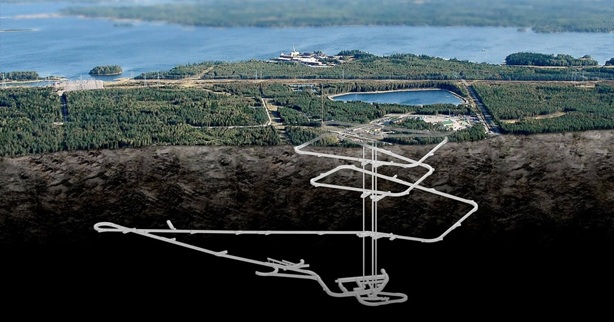
Notice was posted in the Canada Gazette that the Nuclear Waste Management Organization’s (NWMO’s) Deep Geological Repository (DGR) project for all of Canada’s nuclear fuel waste is proposed for designation as a “Project of National Interest” under the Building Canada Act. This designation would guarantee project approval and would circumvent the Impact Assessment process. The Notice also proposes a reduced scope of the project, eliminating long-distance transportation and long-term safety from whatever evaluation the federal government might employ in developing their conditions for the approval.
Opposition to the project’s designation as a Project of National Interest centres around the recognition that if so designated, the project will not receive a comprehensive impact assessment and key areas of concern – namely transportation and long-term safety – will escape scrutiny.
“If the NWMO’s project was sound and they could make the safety case for their nuclear waste transportation and burial project there would be no hesitation on the part of the nuclear industry or the federal government to have it subject to a comprehensive and independent assessment”, commented Brennain Lloyd, project coordinator with Northwatch.
“This move to shield the deep geological repository scheme from scrutiny says it all – the NWMO’s concept can’t stand up to technical or public review. But limiting its review will not limit its impact.”
The proposal to designate the NWMO’s DGR as a project of national interest has been put forward by the federal government despite strong opposition expressed by Indigenous and non-Indigenous organizations, and evidenced by public protests, lawn signs, letters to newspapers and public agencies, and most especially by the more than 1,000 comments submitted by Canadians during the planning phase of the federal impact assessment’s, expressing either opposition to the project or significant concerns about how it would be carried out. The first phase of the federal review began in January and on July 3 the federal government announced the commencement of the impact assessment process.
Canadians fought hard to ensure that the project would receive a full impact assessment including a comprehensive examination of long-distance waste transportation,” said Wendy O’Connor, volunteer with Nuclear Free Thunder Bay.
“The Impact Assessment Agency agreed. That the federal government could now ignore Canadians’ wishes and sidestep the full assessment process Canadians were promised is shocking, unjust and unwise.”
“Considering the project’s novelty, scale, duration and potential for long-lived and irreversible effects from transporting and burying such an unprecedented volume of highly radioactive nuclear waste, it would be absolutely reckless for the government to fast track the approval of this project. The Impact Assessment Agency of Canada is the sole body with the mandate and expertise to evaluate the environmental, health, social, economic, cumulative, and rights-related impacts of major federal industrial projects. It must remain the lead authority for nuclear-related impact assessments,” said Mary Veltri of Environment North.
In May the federal government proposed in its ‘Getting Major Projects Built in Canada’ discussion paper that nuclear projects be vetted by the Canadian Nuclear Safety Commission (CNSC) rather than the Impact Assessment Agency of Canada. Canadians’ response was noted their resulting report, “What We Heard”. The report specifically mentions nuclear projects as one where opponents argued that having the assessment carried out by the sector regulator alone would weaken the scrutiny of cumulative effects, species at risk, and Indigenous rights, and diminish public participation.
The Notice in the Canada Gazette invites the public to comment on the proposal that NWMO’s DGR project be designated as a Project of National Interest. We the Nuclear Free North strongly urges Canadians to do so, and will be providing analysis and more information to support public engagement.
Comments may be emailed to DGRComment-CommentaireDSCGP@mpo-bgp.gc.ca, with a deadline of October 26.
Walt Zlotow – How does US fund Israeli genocide? Let us count the billions

Walt Zlotow West Suburban Peace Coalition Glen Ellyn IL, 21 Sept 26, https://theaimn.net/how-does-us-fund-israeli-genocide-let-us-count-the-billions/
President Biden hopped on the Israeli genocide campaign to destroy Gaza and its Palestinian population the day after the October 7, 2023, Hamas attack on Isreal.
Approaching three years this October 8, Gaza’s 141 square miles are a pile of rubble covering up tens of thousands of dead Palestinians among the hundred thousand plus dead. The remaining 2.2 million survive agony in an ever tightening area as Israeli forces occupy over half of Gaza and shoot any Palestinian who get close to the Israeli zone.
None of this genocidal atrocity would have been possible without President Bidenn gifting Israel with over $20 billion in weapons to inflict the most grotesque genocide this century.
Even after the January 2025 ceasefire which released the remaining Israeli hostages, Israel continues to bomb and kill Palestinians daily.
Now President Trump, even tho running out of weapons to fight his lost war on Iran, plans to gift Israel with another $2.8 billion in 2,000 lbs. bombs to continue the slaughter of Palestinians in Gaza and Lebanese in Lebanon.
“The Trump administration’s proposed sale of 40,000 2,000-pound bombs, some of the most destructive munitions in our arsenal, raises grave, unresolved concerns about how these munitions could be used in densely populated areas of Gaza and Lebanon. The Trump administration has not provided sufficient assurances that these weapons will be used by the Netanyahu government in accordance with US law and with appropriate protections for civilians. I therefore will not clear this sale at this time.”
Rep. Meeks knows full well that the proposed $2.8 billion, just like the previous $20 plus billion from Biden, will be used to further obliterate Gaza and Southern Lebanon in furtherance of expanding Greater Israel.
Why Trump continues the weapons flow to Netanyahu after he suckered Trump into launching his disastrous attack on Iran will forever remain a mystery.
The US economy is facing disaster, possibly even collapse over Trump’s lost war against Iran. We’re not bombing Iran anymore because we’ve largely run out of weapons. Our debt has raced past $40 trillion. Inflation is out of control. Yet, Trump has enough loyalty to his masters in Israel to find $2.8 billion in genocide weapons for Israel to complete the project his predecessor enabled 3 years ago.
That is not ‘America First’. It is ‘Genocide First…America Last.’
US military had close call after using AI for false intelligence report, sources say

the episode with the Chinese ship underscores a different, and more immediate risk: human beings making disastrous decisions based on inaccurate or misleading information generated by AI or other automated systems. Sources said that the military is rapidly turning to AI to help with targeting, an area which holds the obvious risk of fatal mistakes.
ByKatie Bo Lillis, and Zachary Cohen
The intelligence report, circulated across the US military this spring in the midst of the war with Iran, immediately set off alarm bells: A Chinese ship in the Middle East was transporting components of a nuclear weapons program.
The US military swung into action with plans to intercept the vessel, according to four sources familiar with the episode. According to two of the sources, armed members of the US military were preparing to board the ship. Military planes were in the air, one of those sources and another source familiar with the incident said.
It was only just before the planned operation that officials dug deeper into the report put together by a special operations command analyst and found it had been generated with the help of artificial intelligence (AI) — and that a chatbot the analyst had used inaccurately identified the material the ship was carrying. CNN was not able to learn what the misidentified cargo was.
The report, according to one of the sources, was “entirely false.” But it also “almost started a war,” the source said. Any US operation against a Chinese vessel could have risked spiraling into an armed conflict between the two nations.
Across the US military and the intelligence community, officials are pushing to weave AI into nearly every facet of their work, from analyzing the huge volumes of raw intelligence the US collects and selecting targets for strikes, to more mundane applications like managing budgeting, logistics and supply chains.
But the episode underscores the profound risks of using this powerful, new and relatively poorly understood technology for targeting in the middle of a war. Analysts have long feared that AI could lead to a catastrophic miscalculation if nation states are relying on poor or corrupted data — the kind of miscalculation that might lead the United States to fire on a Chinese ship based on inaccurate information.
In this particular instance, the analyst queried a chatbot about some intelligence reporting on the ship’s manifest that originated with US Special Operations Command Pacific, based in Hawaii. It was not clear whether the chatbot was a commercially available one or a US government product.
“The internal tools are mostly just copies of the commercial stuff wearing lipstick,” a former senior US official familiar with the AI systems used by military and intelligence analysts.
The bot fused together open-source intelligence with secret signals intelligence in government holdings and reached its fateful conclusion about the material the ship was carrying.
The analyst then used AI again to package the findings into a standard intelligence report — the kind that is trusted by military officials — and disseminated it.
US Special Operations Command Pacific and the Pentagon did not respond to a request for comment.
The rationale for the rapid adoption of AI is that it can help the military make battlefield decisions, like which targets to strike or which military assets to move where, faster. Officials say the US can’t afford to fall behind in integrating AI in case it must one day fight China or another adversary who would potentially be able to stay one step ahead of the US.
In January, Defense Secretary Pete Hegseth released his agency’s “Artificial Intelligence Acceleration Strategy” in a bid to speed up the military’s use of AI.
“We will unleash experimentation, eliminate bureaucratic barriers, focus our investments and demonstrate the execution approach needed to ensure we lead in military AI,” Hegseth said in a speech announcing the strategy.
The strategy also pushes for its broad use across the military, ordering the department to make AI available via several programs with the aim of “democratizing AI experimentation and transformation across the Department by putting America’s world-leading AI models directly in the hands of our three million civilian and military personnel, at all classification levels,” a memo announcing the strategy said.
But the effort is decentralized, multiple US officials familiar with the dynamic said, with different parts of the government using different tools under different orders and safety standards. There’s no one set of standards for how the US verifies the information generated by these tools. The constellation of different AI systems being deployed by disparate corners of the military and intelligence community means that the relative reliability and functionality vary widely.
For weeks, Washington policymakers have been intensely debating AI after a series of dire warnings from Silicon Valley engineers and tech CEOs of the possibility that AI could break free of human constraints, with potentially civilization-ending consequences.
But the episode with the Chinese ship underscores a different, and more immediate risk: human beings making disastrous decisions based on inaccurate or misleading information generated by AI or other automated systems. Sources said that the military is rapidly turning to AI to help with targeting, an area which holds the obvious risk of fatal mistakes.
“AI in targeting is definitely something that is ramping up and there is no real guidance for how having a human in the loop will prevent civilian casualties or fratricide,” another source familiar with the military’s current policies said.
The kind of “hallucination” that the tool used by the analyst in this case conjured has not been an isolated incident across the intelligence community since these tools began proliferating across government, according to one of the sources.
For some older intelligence officials — even those who broadly support the use of AI inside the military — AI has put pressure on analysts to produce and disseminate intelligence faster, opening the door for mistakes. Young analysts in particular, several sources said, are natives on these tools and more likely to trust them uncritically.
“AI allows you to get to a bad idea faster,” one of the sources said.
Idaho is covering up nuclear dump plan as “innovation”

Idaho is being asked to accept a permanent nuclear burden in exchange for a few temporary construction jobs and mythical money. The waste isn’t leaving. The feds and the nuclear industry have had decades to solve this, and they haven’t.
A dump, not a future
by beyondnuclearinternational, https://beyondnuclearinternational.org/2026/09/13/a-dump-not-a-future/
The “innovation” pitch for Idaho doesn’t match the radioactive reality, writes Leigh Ford
The Department of Energy (DOE) has a problem. They have a nuclear addiction and a growing mountain of toxic, radioactive waste. To solve it, they are eyeing Idaho once again. Governor Little recently signed a Memorandum of Understanding (MOU) with the DOE, and they are trying to sell it to us as a “Nuclear Lifecycle Innovation Hub.”
We’re not buying it. This is a nuclear dump dressed up as an “innovation campus,” and DOE is simply hoping that the temptation of jobs and billions of dollars will convince us to turn Idaho into America’s nuclear waste dump.
Recently, I sat down with Roland Beres, who wanted to get the Snake River Alliance’s reaction to the governor’s signing the MOU with DOE. Roland has a lot of experience following nuclear issues.
Notably, he covered events leading up to the Idaho Settlement Agreement, when Govenors Batt and Andrus were fighting the feds for sending out-of-state radioactive waste into Idaho. That history matters, because it tells us this isn’t a new fight — it’s the same fight, with slicker marketing.
Today’s political machinery is quickly paving the way for Manhattan Project 2.0, endangering our health and silencing local opposition. Per Executive Order 14300, the Nuclear Regulatory Commission is revising radiation standards and reducing protections for workers and communities. Idaho’s Senate passed SCR 120 to claim that reprocessing nuclear waste fits into the Idaho Settlement Agreement framework. Not to be left out, Idaho’s House passed HB 714, which prohibits local governments from saying “NO” to these dumps and reprocessing facilities in their communities.
The Nuclear Myths

The first myth is money. The DOE isn’t handing Idaho billions of dollars. According to their own request for proposals, they are looking for projects that *prioritize private and state capital*. They offer “targeted, conditional, and time‑limited federal support.” In other words, Idaho taxpayers are on the hook for the cost, while the feds offer a loan and a promise to protect themselves from “open-ended liabilities.”

The second myth is the jobs. Idaho’s response to DOE’s request states we already have the infrastructure and can start fast. That translates to fewer construction jobs. And while the Tech bros designing these untested reactors are boasting that they “practically run themselves,” that means they aren’t going to hire many permanent workers. The promise of “thousands of jobs” is a mirage. We might fix a few roads, but beyond that, thousands of long-term jobs are far-fetched.

The third myth is the waste. Our radioactive legacy can still be seen out at the site in the Arco Desert. Last year, when the Snake River Alliance visited Idaho National Lab I noticed the waste we got from the Three Mile Island meltdown in 1979 is still there, sitting in huge concrete sarcophagi. We saw a warehouse stacked with barrels of waste, much from the Rocky Flats bomb factory—barrels that needed to be recategorized because we have no idea what Colorado actually shipped us. We drove around the 90-acre burial grounds, where a “thousand-year cap” will be placed.
Governor Little might say “that’s all been cleaned up,” but that is dangerously deceptive. We can’t completely clean up nuclear waste. INL has done a good job mitigating a lot of it, but the truth is there is no permanent nuclear waste repository in the country. The waste just keeps piling up, mostly at nuclear power plants back east, and if that waste comes here, it will stay in Idaho permanently. The DOE has a track record of broken promises, and they are not to be trusted.
A Dangerous Bet

Some politicians and nuclear cheerleaders claim we can reprocess our way out of this. We cannot. Some point to the DOE’s Waste Isolation Pilot Project (WIPP) facility in New Mexico, but it only takes defense-related transuranic waste, and was never meant to be permanent. There have already been two 10-year extensions since 2010, and New Mexico isn’t a solution for Idaho’s burden. New Mexicans don’t want a permanent nuclear dump either.
Idaho is being asked to accept a permanent nuclear burden in exchange for a few temporary construction jobs and mythical money. The waste isn’t leaving. The feds and the nuclear industry have had decades to solve this, and they haven’t. We shouldn’t be the dumping ground for their failures. It is time to reject this dangerous bet and demand a real plan that doesn’t put our people, water, and land at further risk.

Idaho is not America’s dumping ground – not for cash, not for jobs, and not for nuclear waste that outlives our great, great grandchildren’s grandchildren.
Leigh Ford is the executive director of the Snake River Alliance.
Three Mile Island: Legacy and Re-Opening Resistance
Witness the misadventure to reopen Pennsylvania’s “permanently closed,” uneconomical and age-degraded Three Mile Island Unit 1 nuclear power plant and opposition to stop it in this collaboration of the Clamshell Alliance(opens in new tab), Beyond Nuclear, Massachusetts Peace Action(opens in new tab) and TMI Alert(opens in new tab). The TMI nuclear power station near Harrisburg sited in the middle of the Susquehanna River is the nation’s most serious commercial nuclear power plant accident following Unit 2’s mechanical failure, human error, fuel damage, a hydrogen detonation and a partial meltdown that started on March 28,1979. The nuclear accident consequentially resulted in downwind and downstream radioactive releases with public exposures to harmful radiation. TMI Unit 1 was closed September 19, 2019 and federally certified for permanent defueling and decommissioning. Constellation Energy and Microsoft have instead embarked on an unprecedented and dubious restart of the closed Unit 1 to power AI data centers. Join Eric Epstein with TMI Alert, Patricia Longnecker, a TMI survivor, now activist and Aaron Datesman, an investigative scientist researching radiation induced suffering still prevalent decades later.
Is the much-hyped small nuclear reactor juggernaut REALLY picking up speed?
COMMENT. In this carefully worded story about SMRs, Haley Zaremba provides the required “enthusiasm”, but note where she points out the snags, and that main problem – COSTS.
Note that this predicted SMR boom is linked to the AI boom.
But one must wonder if the AI boom is headed for a bust?
“A key argument from SMR proponents is that the new reactors will be economically competitive,” says David Schlissel, IEEFA director of resource planning analysis. “But the on-the-ground experience with the initial SMRs that have been built or that are currently under construction shows that this simply is not true.”
IAEA Triples Nuclear Power Forecast as Small Reactors Finally Take Off
By Haley Zaremba – Sep 19, 2026, https://oilprice.com/Energy/Energy-General/IAEA-Triples-Nuclear-Power-Forecast-as-Small-Reactors-Finally-Take-Off.html
- The IAEA now projects SMRs will supply up to 28 percent of new nuclear capacity by 2060, a sharp jump from its prior high-case estimate of 24 percent.
- The NRC just fast-tracked construction on two SMRs at Michigan’s Palisades Energy Center, clearing the plant to break ground before a full work authorization is issued.
- Surging AI data center power demand is pushing the tech sector to back SMRs as a scalable, low-emissions alternative to the natural gas boom currently fueling AI growth.

After years of delays and plateaued development timelines, it might finally be time for the small nuclear revolution. In a brand new report, the International Atomic Energy Agency (IAEA) has once again increased its long-term nuclear power forecast, projecting that the world’s nuclear power generation capacity will fully triple by 2060. The Agency expects a whole lot of that increased capacity to come from a strong wave of small modular nuclear reactors connecting to power grids around the world, at long last.
For years, small modular reactors (SMRs) have been touted as a game-changer for clean energy, with the potential to offer round-the-clock, emissions-free electricity at a fraction of the up-front cost of traditional nuclear power plants. Typically, nuclear power plants are huge, bespoke operations with enormous up-front costs and long timelines for approval, construction, and connection. By contrast, SMRs would be factory-made and mass-produced to the same specifications, and then set up on-site. A bigger site would use more of them, and a smaller one would use less. Simple as that.
But these visions have been slow to materialize thanks to regulatory hurdles, funding gaps, and nuclear fuel supply chain issues, among other snags. The primary issue is that while these models are cheaper than traditional nuclear energy, that doesn’t mean that they’re cheap. While the nascent technology will likely continue to get cheaper over time, it is not yet genuinely competitive with other clean alternatives like large-scale hydropower and offshore wind projects.
“A key argument from SMR proponents is that the new reactors will be economically competitive,” says David Schlissel, IEEFA director of resource planning analysis. “But the on-the-ground experience with the initial SMRs that have been built or that are currently under construction shows that this simply is not true.”
While many of the world’s biggest economies – including The United States, the United Kingdom, China, and Russia – have all been investing heavily in the development of SMRs, Russia and China remain the only two nations in the world to have operational, grid connected models. The United States has approved a single patent for an SMR design, with an expected commercial deployment date slated for 2028.
But it would seem that the long slog toward commercial reality is finally picking up speed. The IAEA’s high growth scenario anticipates that 28 percent of all new nuclear capacity added by 2060 will come from SMRs. In the lowest nuclear power growth case, SMRs represent 23 percent of new capacity. In either case, their role is considerable, and both of these numbers represent a huge uptick in confidence compared to the Agency’s previous projections, in which SMRs represented 24 percent of new capacity in the high case and just 5 percent in the low case.
The IAEA report also includes a regional breakdown of where they expect to see this development occur by 2060. The Agency anticipates “particularly strong uptake in North America where about 60% of new nuclear capacity could come from SMRs.” Strong regional growth is also expected in South-Eastern Asia and in Latin America and the Caribbean, at 40 percent each in both high and low growth scenarios.
The wheels are already turning in the United States, where just this week the U.S. Nuclear Regulatory Commission approved a fast-tracked plan for the construction of two planned SMRs at the Palisades Energy Center in Michigan. The plant will be allowed to break ground on the project early, before a Limited Work Authorization is issued. Together, the two will produce a projected 680 megawatts of electricity.
In the United States and beyond, the SMR revolution is increasingly seen as a vital piece of the artificial intelligence energy puzzle. With a single hyperscale AI data center able to consume as much electricity as 50,000 homes, scalable, baseload, and low-emissions energy capacity additions are needed as quickly as possible. At present, the AI boom is leading to a massive natural gas boom, but the tech sector is also throwing money behind next-gen technologies like SMRs to more sustainably power its insatiable energy needs in the future. In that sense, the future can’t come fast enough.
1 This Month


Shut down the radiation-damaged Heysham nuclear reactors now
To see nuclear-related stories in greater depth and intensity – go to https://nuclearinformation.wordpress.com

Say No to NASA’s Reckless Nuclear Reactor on the Moon
Say No to NASA’s Reckless Nuclear Reactor on the Moon
-
Archives
- October 2026 (247)
- September 2026 (339)
- August 2026 (330)
- July 2026 (355)
- June 2026 (287)
- May 2026 (306)
- April 2026 (356)
- March 2026 (251)
- February 2026 (267)
- January 2026 (308)
- December 2025 (358)
- November 2025 (359)
-
Categories
- 1
- 1 NUCLEAR ISSUES
- business and costs
- climate change
- culture and arts
- ENERGY
- environment
- health
- history
- indigenous issues
- Legal
- marketing of nuclear
- media
- opposition to nuclear
- PERSONAL STORIES
- politics
- politics international
- Religion and ethics
- safety
- secrets,lies and civil liberties
- spinbuster
- technology
- Uranium
- wastes
- weapons and war
- Women
- 2 WORLD
- ACTION
- AFRICA
- Atrocities
- AUSTRALIA
- Christina's notes
- Christina's themes
- culture and arts
- Events
- Fuk 2022
- Fuk 2023
- Fukushima 2017
- Fukushima 2018
- fukushima 2019
- Fukushima 2020
- Fukushima 2021
- general
- global warming
- Humour (God we need it)
- Nuclear
- RARE EARTHS
- Reference
- resources – print
- Resources -audiovicual
- Weekly Newsletter
- World
- World Nuclear
- YouTube
-
RSS
Entries RSS
Comments RSS

