Wall Street Is Pairing Up With the Army to Build Data Centers
“the kinds of things AI can be used for, and some of them are horrifying in terms of the speed with which they can enable killing or the extent to which they can expand surveillance networks,”
For example, reporting by the Military Times suggests that the Pentagon’s Maven AI system, which was developed by Palantir and “classifies targets, recommends weapons systems and generates strike packages in near real time,” was involved in the bombing of the Shajareh Tayyebeh primary school in Minab, Iran, which killed 155 people, most of them young schoolchildren.
The Army data center buildout comes as the Pentagon increases its use of AI in military operations.
By Derek Seidman , Truthout, May 11, 2026, https://truthout.org/articles/wall-street-is-pairing-up-with-the-army-to-build-data-centers/?utm_source=Truthout&utm_campaign=65c219f2a8-EMAIL_CAMPAIGN_2026_05_11_09_33&utm_medium=email&utm_term=0_bbb541a1db-65c219f2a8-650192793
Two trends, seemingly separate, have been accelerating over the past few years. First, Wall Street has been plowing billions of dollars into financing data centers. Second, the U.S. military has been ramping up its use of artificial intelligence (AI).
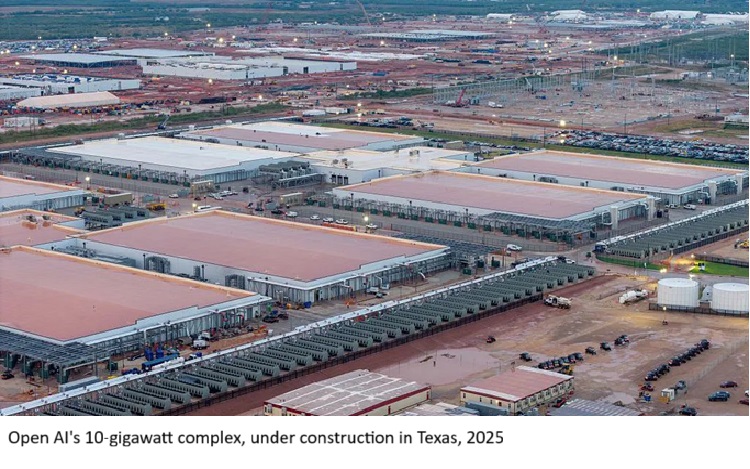
Now, these two trends are directly merging. In late March 2026, the U.S. Army announced its selection of companies to build and operate two hyperscaled data centers on two different military installations. Both data centers — one at Fort Bliss, Texas, the other at Dugway Proving Ground, Utah — will be backed by some of the world’s top Wall Street firms.
An Army spokesperson told Truthout that the Army has entered into “an exclusive negotiation period” with the companies to negotiate “specific lease economics” on what will be “long term, 50-year” leases.
The spokesperson also said that “[i]nstead of receiving cash for the lease, the Army will be compensated through ‘in-kind consideration,’” meaning that “the Army accepts services or improvements of equal or greater value in lieu of cash rent — specifically, a key portion of the dedicated data computation capabilities to directly support our warfighting needs.”
The data centers will be “100 percent privately financed, built, and operated by the developers,” said the Army spokesperson, and confirmed that they “are indeed commercial data centers” that will be allowed to sell off excess computing capacity commercially.
All this comes as the U.S. military accelerates the use of AI in its operations. One top Army official has said the data centers will be used “to meet rising demands for computational power required for AI applications, including drone swarms, advanced simulations, and real-time operational analysis.”
As one industry website put it, “data centers are war infrastructure now.”
But local residents and some experts are expressing alarm over the data centers due to their environmental impacts and their potential burden on water and electric grids, as well as what these deals represent for military and corporate accountability.
“We’ve seen examples of the kinds of things AI can be used for, and some of them are horrifying in terms of the speed with which they can enable killing or the extent to which they can expand surveillance networks,” Roberto J. González, an expert on U.S. militarism at San José State University, told Truthout.
Army Data Center Deals
The two planned Army data center complexes will be massive projects. The Fort Bliss data center will be located on 1,384 acres of military land and is scheduled to become operational in 2027. It will be built and operated by the Carlyle Group, one of the world’s top private equity firms, and a major investor in data centers more broadly.
According to local news outlet El Paso Matters, the three-gigawatt data center complex “would consume more electricity than all of El Paso Electric’s 460,000 customers combined.”
The Dugway Proving Ground data center project will be built on approximately 1,201 acres and is scheduled to become operational in 2029. It will be constructed by data center builder CyrusOne, which is jointly owned by KKR, also a top private equity firm and huge investor in data centers, and Global Infrastructure Partners, the private infrastructure investment arm of BlackRock, the world’s largest asset manager.
The Army spokesperson told Truthout that the 50-year leases for the data centers will be “Enhanced Use Leases authorized by Title 10 of the U.S. Code, Section 2667” — a federal statute permitting the defense secretary to lease out underutilized military land to “promote the national defense or to be in the public interest” — and that “[t]he developer assumes 100 percent of the financial risk to build the infrastructure.”
The deals come after a 2025 executive order from Donald Trump, titled “Accelerating Federal Permitting of Data Center Infrastructure,” which includes a specific statute allowing the Pentagon to “identify suitable sites on military installations” for data center infrastructure and to “competitively lease available lands” for qualifying projects.
While the deals haven’t been finalized, and key details on the terms of the contracts haven’t been announced, the billionaire-led firms developing the data centers will be allowed to sell excess computing power from the facilities on commercial markets.
These two planned facilities are likely just the beginning of the Army’s data center deals. The military news site Task & Purpose reports Army contract requests for two more data centers at Fort Hood, Texas, and Fort Bragg, North Carolina, with the latter including “several potential spots … within one mile of civilian areas and one-half mile of civilian housing.”
Task & Purpose also notes that the Air Force released a request for lease proposals for data centers last year at several bases.
The Army deal breaks new ground for the military. “This will be the first hyper-scale data center that the Pentagon has ever done,” Army Secretary Dan Driscoll told the Wall Street Journal in March.
“Military AI Dominance”
The planned facilities come as the U.S. military accelerates the integration of AI into its operations and, aided by new Trump administration policies, bolsters its access to data centers, which generate the computing capacity that powers AI.
In January, Defense Secretary Pete Hegseth published a memorandum ordering the acceleration of “America’s Military AI Dominance” by “becoming an ‘AI-first’ warfighting force across all components.” The order follows Trump’s January 2025 executive order on “removing barriers to American leadership in artificial intelligence.”
Notably, Hegseth’s memo emphasizes corporate America’s driving role in this initiative, emphasizing that the military’s AI makeover will be “fueled by the accelerating pace of commercial AI innovation coming out of America’s private sector.”
On April 3, a few months after Hegseth’s memo, the Army launched its Army Data Operations Center (ADOC) which, according to a press release, “will serve as the operational engine for the Army’s transformation into a data-centric force.” Labeled a “911 for data,” ADOC will integrate “fragmented” data across the Army’s operations globally to help to “operationalize data” for goals like “shortening the sensor-to-shooter timeline,” and ultimately “securing the Army’s advantage now and in the future,” according to the press release.
González, who’s written about Big Tech’s transformation of the military-industry complex, told Truthout that the Trump administration’s military AI push is focused on developing “autonomous unmanned drones in battlefield situations” that “will rely heavily on AI for everything from navigation, to target selection, to pattern recognition for identifying different potential targets.”
González also said the growing use of AI in the military will bolster “AI decision support systems” that “stitch together different kinds of unstructured and structured data” — which could include things like “metadata about phone conversations, cell phone locations, and internet use patterns” — to “create a list of targets.”
González cites Israel’s genocidal siege against Palestinians as an example. “This is precisely what the Israel Defense Forces were using in [Israel’s] war in Gaza to create lists of suspected enemies who were then targeted for assassination, essentially,” he said.
González warns that growing autonomous, AI-driven military systems will intensify surveillance and weaken the ability to hold individuals to account. “These systems often fail, and they also diffuse accountability when a machine, rather than a person in the loop, is making the decision over life or death,” he said.
For example, reporting by the Military Times suggests that the Pentagon’s Maven AI system, which was developed by Palantir and “classifies targets, recommends weapons systems and generates strike packages in near real time,” was involved in the bombing of the Shajareh Tayyebeh primary school in Minab, Iran, which killed 155 people, most of them young schoolchildren.
The Military Times noted that Maven “generated hundreds of strike coordinates in the first 24 hours of the Iran campaign” and that it was unclear if any human verified the coordinates that targeted the school, which were based on “outdated intelligence.”
In March, U.S. Deputy Secretary of Defense Steve Feinberg declared that Maven would become, as a Reuters headline put it, a “core US military system.”
“Sweetheart Deal”
The proposed data center at Fort Bliss — which would be the third major data center in the El Paso area — has sparked concerns among locals over the potential strain on water and energy resources.
Read more: Wall Street Is Pairing Up With the Army to Build Data CentersWhile many specific terms of the deals remain to be seen, Tyson Slocum, director of Public Citizen’s Energy Program, worries that private interests that covet land to build data centers could get a “sweetheart deal” from the Army well below the pricey market rates for data center square footage.
“My primary concern is that it’s a huge public subsidy to these private data center developers,” said Slocum.
The Army spokesperson told Truthout “[t]he return on investment for the American taxpayer” in these deals “is realized through massive cost avoidance.”
“By having private companies fund and build these data centers on underutilized Army land, the developers take on the financial risk, and the Army receives essential data processing capacity without direct cash outlays,” the spokesperson said.
Slocum also noted that data centers could stress the local grids near the military bases — concerns shared by El Paso residents. “Most military bases in the United States are not isolated islands,” he said. “They’re interconnected with the grid, and they’ll need to draw upon additional power resources from the grid.”
Slocum expressed alarm that placing data centers on military land could support the Trump administration’s efforts to protect fossil fuel-generated power production — which often powers data centers — by connecting it to “national security.”
“Military bases are in all 50 states and every corner of the power grid,” said Slocum. “Any power plant connected to that grid can now conceivably be needed for national security to supply a base.”
The Army spokesperson told Truthout that “[m]inimizing community impact was a primary selection criterion for these projects,” and that “[t]he chosen proposals were selected specifically because they feature innovative solutions designed so as not to burden local communities or utilities.”
The Army spokesperson also said that “before any final lease is signed, a detailed environmental review under the National Environmental Policy Act (NEPA) must be completed.”
“A Larger Tech Ecosystem”
Pentagon deals around tech weaponry with big financial investors are nothing new. González has written about Silicon Valley venture capitalist financiers’ role in transforming the U.S. military-industrial complex, with firms like Palantir and Anduril ascending.
“There’s a shifting of the center of gravity from the traditional, established defense firms like the Lockheed Martins and Boeings to these new groups that we more often associate either with commercial tech products rather than military interests,” said González.
The new Army data centers deals, struck with some of the biggest global diversified Wall Street firms, represent a further strengthening of the nexus between finance and tech for military uses.
“The tech industry is closely aligned with industries like private equity and venture capital firms,” said González. “It’s all a larger tech ecosystem.”
The military also seems intent on striking similar deals in other areas. “Beyond data centers, the Army is looking at doing similar leasing arrangements for critical mineral processing and other types of manufacturing,” reported the Wall Street Journal.
Private equity’s new data center partnerships with the U.S. Army come as this powerful sector is intensifying its investments along the entire AI supply chain. As Truthout previously reported, private equity has been channeling hundreds of billions of dollars into financing data centers and other AI infrastructure — from the data center buildings themselves to the fossil fuel power generation that supports their operations.
The Carlyle Group building the Fort Bliss data center oversees $475 billion in assets. The firm was co-founded by billionaire David Rubenstein, who remains Carlyle’s co-executive chairman. Rubenstein is an influential philanthropic donor, and Joe Biden spent numerous Thanksgivings at Rubenstein’s $34 million Nantucket complex during his presidency.
BlackRock subsidiary Global Infrastructure Partners (GIP) and KKR own CyrusOne, the firm building the Dugway data center. KKR was co-founded by mega-billionaire Henry Kravis, who remains KKR’s co-chair. The firm oversees $744 billion in assets and is a major data center investor globally.
BlackRock, led by billionaire Larry Fink, is the world’s largest asset manager, overseeing $14 trillion in assets. BlackRock has aggressively moved into private investment in infrastructure in recent years, including data centers.
In March 2025, amid Trump’s threats to “take back” the Panama Canal, BlackRock coordinated with the Trump administration to acquire a massive portfolio of global ports that included two Panama Canal ports.
BlackRock has also been acquiring utilities and power generation companies that have been tied to providing energy to proposed data centers. BlackRock also co-owns Aligned Data Centers, one of the world’s largest data center companies.
Truthout reached out to Carlyle, KKR, and BlackRock for comment. Carlyle and KKR did not respond, and BlackRock’s GIP declined to comment.
Pushing Back
While the data center boom is often portrayed as an unstoppable force, communities across the U.S. have been resisting their construction, sometimes successfully.
“There’s a lot that individual communities can do to push back against these trends,” González emphasized, including supporting the “small but important number of elected officials” who oppose the data center frenzy.
Moreover, the grassroots movement against reckless data center construction is accumulating lessons and growing nearly everywhere.
“People should never lose hope in what political commitment can do to confront even the most powerful institutions or trends,” said González.
Trump says US will not allow Iran to reach enriched uranium.

US president says Washington has the nuclear material in Iran ‘surveilled’ and will ‘blow up’ anyone who gets near it.
Al Jazeera Staff 10 May 2026, https://www.aljazeera.com/news/2026/5/10/trump-says-us-will-not-allow-iran-to-reach-enriched-uranium
President Donald Trump has warned that the United States will target any Iranian trying to reach the country’s highly enriched uranium, saying that the nuclear material is under constant surveillance by the US military.
In an interview with the syndicated TV show Full Measure that aired on Sunday, Trump appeared to play down the significance of the uranium, which is believed to be buried under the rubble of nuclear facilities, remaining in Iran for now.
“We’ll get that at some point, whenever we want. We have it surveilled,” Trump said.
“I did a thing called Space Force, and they are watching. If somebody walked in, they can tell you his name, his address, the number of his badge … If anybody got near the place, we will know about it, and we’ll blow them up.”
Iran’s highly enriched uranium is one of the major sticking points between Washington and Tehran in ceasefire negotiations to end the 10-week US-Israel war on Iran.
The US wants Iran to transfer the uranium outside the country and completely shut down its nuclear programme, but Tehran has stressed that it will not give up its right to a domestic enrichment programme.
Several international media reports have said that the uranium remains under nuclear sites that the US bombed in June 2025, but Tehran has not confirmed the location of the nuclear material.
Last month, Trump announced that Iran had agreed to allow Washington to retrieve the uranium and bring it to the US – claims that Tehran quickly dismissed.
Trump told Reuters on April 17 that the US would work with Iran “at a nice leisurely pace, and go down and start excavating with big machinery” to retrieve the uranium stockpile at the sites.
Iran’s Foreign Ministry spokesperson Esmaeil Baghaei denied Trump’s claim. “Enriched uranium is as sacred to us as Iranian soil and will not be transferred anywhere under any circumstances,” he said.
Iran is estimated to have more than 400kg (882lb) of uranium enriched at 60 percent purity.
Uranium enrichment is a complex process of isolating and garnering the most radioactive variety – isotope – of the element to produce nuclear fuel.
When enriched to around 90 percent purity, uranium can be used to make nuclear weapons.
In 2015, Iran agreed to a multilateral deal that saw Tehran scale back its nuclear programme and cap its uranium enrichment at 3.67 percent under strict international supervision in exchange for lifting sanctions against its economy.
Trump nixed that agreement – known as the Joint Comprehensive Plan of Action (JCPOA) – and started reimposing sanctions on Iran.
In response, Tehran – which denies seeking a nuclear weapon – began to advance its enrichment programme well beyond the limits set by the JCPOA.
Trump has argued that the ongoing conflict with Iran aims to prevent the country from acquiring a nuclear bomb.
Asked about the rising oil prices due to the war, Trump said: “We cannot let Iran have a nuclear weapon because they’re crazy.”
The average price of one gallon (3.8 litres) of petrol or gasoline in the US has risen to more than $4.50 due to supply issues linked to the Iranian blockade in the Strait of Hormuz, fuelling inflation. It was less than $3 before the war.
Despite the truce that came into effect last month, skirmishes have erupted in the Gulf over the past week as the US continues to enforce a siege on Iranian ports amid Tehran’s Hormuz blockade.
Iranian state-affiliated news outlets reported on Sunday that Iran has delivered its response to the latest US proposal to end the war to Pakistan, which is mediating the talks.
But Trump said the war is not over while reiterating his claim that Iran has been “defeated”.
“They are defeated, but that doesn’t mean they’re done,” the US president said. “We could go in for two more weeks and do every single target. We have certain targets that we wanted, and we’ve done probably 70 percent of them, but we have other targets that we could conceivably hit.”
Netanyahu Stresses The Need For More Propaganda As Israel’s Hasbara Budget Soars
Caitlin Johnstone, May 11, 2026, https://www.caitlinjohnst.one/p/netanyahu-stresses-the-need-for-more?utm_source=post-email-title&publication_id=82124&post_id=197212481&utm_campaign=email-post-title&isFreemail=true&r=1ise1&triedRedirect=true&utm_medium=email
In a fawning softball 60 Minutes interview released Sunday, Benjamin Netanyahu stressed the importance of winning “the propaganda war” on social media. This comes as Israel moves to quadruple its propaganda budget to $730 million a year.
Major Garrett (which apparently is a real name belonging to a real guy who works for 60 Minutes) told the CBS audience that “Netanyahu attributes the reputational harm to Israel almost entirely to social media, which he calls the eighth front of the war.”
“This is yours, right?” asked Netanyahu, picking up Garrett’s phone. “You’re not immune either. Because you can penetrate this machine, you can penetrate this little instrument, and you can say about Major Garrett anything you want. And I can paint you as a monster. And if I say it often enough, enough people will believe it.”
“We have seen the deterioration of the support for Israel in the United States almost — I would say, it correlates almost 100 percent with the geometric rise of social media,” said Netanyahu, adding, “We have several countries that basically manipulated social media. And they do it in a clever way. And that’s something that has hurt us badly.”
“Israel is besieged on the media front, on the propaganda front, and we’ve not done well on the propaganda war,” the prime minister lamented.
Netanyahu has been repeatedly stressing the need for more aggressive propaganda manipulation as public opinion of Israel plummets worldwide. Earlier this year he told The Economist that “I’d like to do everything I can to fight the propaganda war waged against us,” complaining that “we’ve been using cavalry against f-35s, because they’ve flooded the social networks with the fake bots and many other things.”
Despite having the entire western political-media class bending over backwards to protect Israel’s image, Netanyahu consistently frames his country’s struggle for narrative control as a brave little David figure standing up against the colossal Goliath of anti-Zionist social media users. Last year the Israeli leader claimed that Israel is losing the propaganda war because “there are vast forces arrayed against us,” denouncing “the algorithms of the social network that are driving a lot of everything else.”
In a meeting with American social media influencers last year, the prime minister spoke of how vital the forced sale of TikTok has been for Israeli information interests, and said that Elon Musk could help facilitate Israeli PR on the X platform as well.
“We have to fight back. How do we fight back? Our influencers,” Netanyahu said. “We have to fight with the weapons that apply to the battlefields in which we’re engaged, and the most important ones are on social media.”
Of course, the possibility of Israel improving its public image by simply murdering fewer people and doing fewer evil things is never even considered. Its is taken as a given that shoving pro-Israel messaging down everyone’s throat is the only way to sway public opinion in a positive direction.
It is under this framing that Israel has again massively increased its propaganda budget for the year, after having massively increased it from what it was the year before.
The Jerusalem Post reports the following:
“Israel is betting nearly three-quarters of a billion dollars that it can talk its way out of a reputation crisis.
“Lawmakers in Jerusalem approved a 2026 national budget last month that includes roughly $730 million for public diplomacy — the broad category known in Hebrew as hasbara — more than four times the $150 million they allocated the year before. That earlier sum was itself about 20 times what Israel had spent on such efforts before the war in Gaza broke out in 2023.
“The unprecedented expenditure comes as survey after survey shows declining support for Israel in the United States, its most important ally. A Pew Research Center poll released earlier this month found 60% of Americans now view Israel unfavorably, up seven points in a single year, with only 37% viewing it favorably.”
So you know how you’re already seeing an insane amount of pro-Israel propaganda and running into aggressive Zionist trolls online? You can expect that to get a whole lot worse.
Narrative manipulation has served Israel well over the years, but there’s a limit to how much propaganda can accomplish. If I walked up to you and spat in your face, there’s no amount of verbiage I could throw at you to convince you I’m actually a nice person. There’s only so much carnage people can watch on their phones before you can no longer convince them it’s not what it looks like.
The propaganda has already hit a point of diminishing returns, and soon it’s going to start having a reverse effect. People are going to start hating Israel for all the evil things it’s been doing, and then hating it even more for all its in-your-face perception management operations to manipulate their thoughts and feelings.
At some point the hasbarists are themselves going to inadvertently become anti-Zionist propaganda agents, just because they make Israel look so creepy with the way they’re always trying to stick their rapey fingers into everyone’s mind.
The truth can only be concealed and distorted for so long.
Rodent infestation caused by Israel’s destruction of Gaza is now creating a public health catastrophe
More than 70,000 infections have been recorded in Gaza this year, as rats bite children as they sleep and skin diseases kill those prevented from receiving treatment abroad. Health officials say a plague outbreak is no longer a remote possibility.
By Tareq S. Hajjaj May 8, 2026, https://mondoweiss.net/2026/05/rodent-infestation-caused-by-israels-destruction-of-gaza-is-now-creating-a-public-health-catastrophe/
At the beginning of April, Enshrah Hajjaj, a 61-year-old woman with diabetes, woke up in her tent in Gaza City to find blood on her toes. She couldn’t figure out how she started bleeding, so she treated herself inside her tent with her family and carried on with her day. A week later, she woke up again to find the same bleeding toes — but this time, half of them were missing. She began screaming, and her family rushed her to the hospital, where doctors told her that rats had eaten through them while she slept. As a diabetic, she had lost much of the sensation in her feet, a common complication of the disease, and had felt nothing.
Enshrah’s case is far from isolated. According to the Gaza Ministry of Health, four displaced people have died from skin diseases directly linked to rodent infestations, though the Ministry was unable to confirm the specific diseases in each case, citing the absence of laboratory materials needed for testing.
Nisreen Kilab, head of the Environmental Health Department at the Health Ministry, said the symptoms observed in several patients indicate a virus transmitted through rodent waste and bites, which can be fatal in some cases. “We suspected several leptospirosis infections, but unfortunately, these cases could not be confirmed through laboratory testing due to the absence of the required means,” she told Mondoweiss.
Kilab said the skin diseases spreading in Gaza are driven by insect, flea, and rodent bites, warning that without urgent intervention, the outbreak will only deepen.
According to the World Health Organization (WHO), more than 70,000 cases of ectoparasite infections were reported in Gaza in 2026, while over 80% of displacement camps reported recurring rodent and pest infestations, as well as skin conditions such as scabies and lice. The WHO’s representative described this as “the unfortunate but predictable consequence when people live in a collapsed living environment.”
Enshrah Hajjaj now lives in constant fear, especially at night. “I sleep while awake,” she told Mondoweiss. “I haven’t experienced a single night’s peace after this incident. I can’t feel my feet, and half my foot is numb, so I’m afraid of waking up one day to find that rodents ate off my entire foot without me feeling it.”
The conditions around Enshrah’s tent and the tent encampments in Gaza have been described by health officials as particularly conducive to the spread of rodent infestations, with piles of garbage rising in small hills only a few hundred meters away from the displacement camps. The camps themselves sit amid pools of sewage and mud.
“At first, there was an accumulation of rubble and debris, and later a buildup of garbage near displacement centers,” Kilab said. “More than 90% of Gaza’s population is displaced and living in tents, which has led to a frightening increase in population density, and a high population density means a faster spread of disease.”
Kilab said that the 40 million tons of accumulated waste across Gaza have made matters worse. “These conditions are an ideal breeding ground for epidemics,” she explained.
When skin disease becomes a death sentence
Contracting a skin disease in Gaza has become potentially fatal, while local hospitals lack the means of diagnosing them. Patients who need specialized care abroad cannot leave, as exit permits for medical travel remain beyond reach due to Israel’s continued closure of the Rafah border crossing, despite its obligation to facilitate medical evacuations and general travel through the crossing as part of the U.S.-brokered ceasefire with Hamas.
Last February, Muhammad Dhiban died after suffering from a skin disease that doctors in Gaza could not identify. The disease damaged his kidneys and reached his brain, causing meningitis. He was unable to travel for treatment and died in Gaza. In April, Ibrahim Abu Aram died from a severe blistering skin condition that covered his body in open sores. According to his family, the infection had spread to his brain. For months, both men and their families appealed to decision-makers to allow them to leave Gaza for treatment, but no response was forthcoming.
Dhiban and Abu Aram likely died of one of several diseases now spreading among the displaced. “There are several diseases transmitted by rodents, such as Lassa fever, typhus, and Salmonella, that are likely making up most of the infections we’re seeing,” Kilab said. “They’re all carried through rodents, insects, and their waste.” She warned that if health institutions failed to contain the epidemic, Gaza could face an outbreak of the plague, a possibility she said is no longer remote.
Abdel Qader al-Basyouni, a father of four, told Mondoweiss now afraid of what might happen to his youngest child, who was recently bitten by a rat while sleeping at night. The child developed a fever and complications that the family described as severe.
Al-Basyouni said that what Palestinians endure in the tents is something no one in Gaza has ever experienced. Rats once rarely entered homes, and hearing of a rat biting a person was extremely uncommon. “Never in my life have I ever heard of a rat attacking and biting a human,” he said. “Not until after this war.”
His wife, Yasmin al-Basyouni, said the garbage never stops accumulating. Neither does the bombing, nor the further accumulation of rubble. Meanwhile, sanitation and cleanup efforts can’t keep up with the rate at which waste is produced.
“So what awaits us?” she asked. “What awaits our children in the tents during the summer, with the greater spread of rodents and insects? Is death waiting for us? Is the plague waiting for us?”
The situation has gotten so dire, she said, that they have been reduced to wondering whether their children will die of bombs or rodent bites. “Are rats also our enemy now?” she added.
West rewriting World War II history – Moscow (VIDEO)
8 May, 2026, https://www.rt.com/russia/639653-west-rewriting-world-war-two-history-russian-fm/
Russian Foreign Ministry spokeswoman Maria Zakharova has denounced attempts to equate the roles of Nazi Germany and the Soviet Union.
The West is busy rewriting the history of World War II, Russian Foreign Ministry spokeswoman Maria Zakharova has stated ahead of the 81st anniversary of victory over Nazi Germany.
Russian officials have repeatedly accused the US and EU member states of distorting historical truth and belittling the crucial role of the Soviet Union, which lost an estimated 27 million people in what is known in Russia as the Great Patriotic War.
Speaking on Thursday, Zakharova said that defending historical memory is a fundamental priority for Russia. This is all the more important in light of revanchist tendencies in the West, according to the spokeswoman.
She pointed out that the 51 nations that voted against the UN resolution on “Combating glorification of Nazism, neo-Nazism and other practices that contribute to fueling contemporary forms of racism, racial discrimination, xenophobia and related intolerance” late last year were mostly representatives of the “collective West.”
Zakharova accused EU bureaucrats of waging “historical aggression.” She cited resolutions by the European Parliament, as well as organizations affiliated with the Council of Europe, which “promote the rewriting of history,” with the Soviet Union “being ascribed responsibility nearly equal to that of [Nazi] Germany” for the start of World War II.
The official also noted that “in some countries, the war on monuments and memorials in honor of fighters against Nazism is gaining momentum.” She singled out Lithuania, Latvia, and Estonia as prime examples of this unsettling trend, citing the demolitions of Soviet war memorials there in recent years.
RT correspondent Marina Kosareva delves into how the reframing of the past has become all too common among senior Western officials, and what ramifications this could have.
VIDEO on original
The Limits of Power -The War on Iran Will Likely End in American Retreat
Jeffrey Sachs and Sybil Fares, May 11, 2026, https://www.savageminds.co/p/the-limits-of-power
The war against Iran that the United States and Israel launched on 28 February 2026 will likely end in an American retreat. The United States cannot continue the war without producing disastrous consequences. A renewed escalation would likely lead to the destruction of the region’s oil, gas, and desalination infrastructure, causing a prolonged global catastrophe. Iran can credibly impose costs that the United States cannot bear and that the world should not suffer.
The US-Israel war plan was a decapitation strike, sold to President Donald Trump by Prime Minister Benjamin Netanyahu and David Barnea, the director of the Mossad. The premise was that an aggressive joint US-Israeli bombing campaign would so degrade the Iranian regime’s command structure, nuclear programme, and IRGC senior leadership that the regime would fracture. The United States and Israel would then impose a pliable government in Tehran.
Trump seems to have been convinced that Iran would follow the same course as had occurred in Venezuela. The US operation in Venezuela in January 2026 removed Venezuelan President Nicolas Maduro in what appears to have been a coordinated operation between the CIA and elements inside the Venezuelan state. The US won a more pliant regime, while most of the Venezuelan power structure remained in place. Trump seems to have believed naively that the same outcome would occur in Iran.
The Iran operation, however, failed to produce a pliant regime in Tehran. Iran is not Venezuela, historically, technologically, culturally, geographically, militarily, demographically, or geopolitically. Whatever happened in Caracas had little relation to what would take place in Tehran.
The Iranian government did not fracture. The Islamic Revolutionary Guard Corps (IRGC), far from being decapitated, emerged with a tightened internal command and an expanded role in the national-security architecture. The supreme leader’s office held; the religious establishment closed ranks behind it; and the population rallied against external attack.
Two months on, Trump and Netanyahu have no Iranian successor government under their control, no Iranian surrender to close the war, and no military pathway whatsoever to victory. The only path, and the one the US seems to be taking, is a retreat, with Iran in charge of the Strait of Hormuz and with none of the other issues between the US and Iran settled.
Several reasons explain America’s disastrous miscalculations and Iran’s successes.
First, American leaders fundamentally misjudged Iran. Iran is a great civilisation with 5,000 years of history, deep culture, national resilience, and pride. The Iranian government was not going to succumb to US bullying and bombing, especially reflecting on the fact that Iranians remember how the US destroyed Iranian democracy in 1953 by overthrowing a democratically elected government and installing a police state that lasted 27 years.
Second, American leaders dramatically underestimated Iran’s technological sophistication. Iran has world-class engineering and mathematics. It has built an indigenous defence industrial base, with advanced ballistic missiles, a homegrown drone industry, and indigenous orbital launch capability. Iran’s record of technological development, built up despite 40 years of escalating sanctions, is a stunning national achievement.
Third, military technology has shifted in a way that favours Iran. Iran’s ballistic missiles cost a small fraction of the US interceptors deployed against them. Iranian drones cost $20,000; US air-defence interceptor missiles cost $4m. Iran’s antiship missiles, with costs in the low six figures, threaten US destroyers that cost $2-3bn. Iran’s anti-access and area-denial network around the Gulf, layered air defence, drone and missile saturation capacity, and sea-denial capability in the strait have made the operational cost of imposing American will on Iran far higher than the United States can sustain, especially taking into account the retaliatory destruction that Iran can impose on the neighbouring countries.
Fourth, the US policy process has become irrational. The Iran war was decided by a small circle of presidential loyalists at Mar-a-Lago, with no formal interagency process and a National Security Council that had been hollowed out across the preceding year. Trump’s director of the National Counterterrorism Center, Joe Kent, resigned on 17 March with a public letter describing “an echo chamber” used to deceive the president. The war was the output of a decision-making system in which the deliberative apparatus had been turned off.
This was neither a war of necessity, nor a war of choice. It was a war of whim. The underlying premise was hegemony. The United States was attempting to preserve a global dominance that it no longer possesses, and Israel was trying to establish a regional dominance that it will never have.
The likely endgame, given all this, is that the war will end with a return to something close to the status quo ante, except for three new facts on the ground. First, Iran will have operational control over the Strait of Hormuz. Second, Iran’s deterrent posture will be significantly raised. Third, the US long-term military presence in the Gulf will be significantly reduced. The other issues that supposedly prompted the US to attack Iran—Iran’s nuclear programme, regional proxies, the missile arsenal—will most likely be left where they were at the start of the war.
Even as the US retreats, Iran will not press its advantage against its neighbours. Three reasons explain why. First, Iran has a long-term strategic interest in cooperation with its Gulf neighbours, not an ongoing war. Second, Iran will have no interest in restarting a war it has just successfully ended. Third, Iran will be restrained, if any restraint is needed, by its great-power patrons, Russia and China, who both desire a stable and prosperous region. The Iranian leadership understands this clearly, and will stop the fighting.
Trump will no doubt try to depict the coming retreat as some great military and strategic victory. No such claims will be true. The truth is that Iran is far more sophisticated than the United States understood; the decision to go to war was irrational; and the underlying technology of war has shifted against the US. The American empire cannot win the war against Iran at an acceptable financial, military, and political cost. What America can regain, however, is some measure of rationality. It’s time for the US to end its regime-change operations and return to international law and diplomacy.
Trump’s deadly trap: By rejecting Iran’s proposal, US enters a strategic nightmare with no escape
Monday, 11 May 2026 , By Press TV Strategic Analysis Desk, https://www.presstv.ir/Detail/2026/05/11/768410/trump-deadly-trap-rejecting-iran-proposal-us-enters-strategic-nightmare-no-escape
In a theatrical move that fooled no one, US President Donald Trump rejected Iran’s comprehensive plan to end the war he illegally imposed on the country 70 days ago.
The US president postured as a victor, dismissing Tehran’s proposal with the bluster of a leader who expects capitulation. But the reality on the ground tells a starkly different story.
By every measurable metric, America is the defeated party in the asymmetric war that was imposed on Iran amid the nuclear talks in Geneva on February 28. And his rejection of Iran’s terms in a social media post has not opened new options for Washington, but it has only trapped the US in a deadly three-way crossroads from which there is no easy escape.
Trump’s rejection of Iran’s plan, which was submitted early on Sunday through Pakistani mediators, is a grave strategic error as Americans hold no winning cards.
Iran’s proposal: Fundamental, natural, and uncompromising
Iran’s plan to permanently end the war was never meant to please Washington. It was designed to restore justice, recognize strategic realities, and secure Iran’s undeniable rights after the unprovoked military aggression against the country and maritime banditry.
The core elements of Iran’s proposal are not maximalist. They are rooted in natural and fundamental principles that any nation subjected to unprovoked aggression and holding the upper hand would rightfully insist upon:
- War reparations – Payment of damages and reparations by the aggressor for the destruction inflicted on Iran’s infrastructure, economy, and civilian population.
- Management of the Strait of Hormuz – Recognition of Iran’s sovereign control over this vital waterway, based on the mechanism already announced by Tehran.
- Lifting of sanctions – The complete removal of all oppressive and illegal sanctions that have targeted the Iranian people for decades.
- Release of frozen assets – The return of billions of dollars of Iranian assets illegally seized by the United States.
- Permanent end to the war – A cessation of hostilities not only against Iran but also against the entire resistance front, including Hezbollah in Lebanon and other allied forces across the region.
None of these demands is unreasonable or impractical. They are the basic entitlements of a nation that has been attacked, bombed, and subjected to economic warfare for nearly half a century. What Iran is asking for is not special treatment but justice.
The American non-offer: Irrelevant demands and nuclear obsession
In stark contrast to Iran’s focused, reasonable and practically sound proposal, the American counteroffer reads like a wish list written by someone who has lost sight of reality.
Washington’s plan has nothing to do with ending the war. Instead, it resurrects the long-dead nuclear file – demands that were irrelevant before the war and are absurd now.
The United States insists on:
Closure of Iran’s nuclear sites – A non-starter that Iran has rejected for decades.
- Long-term halt to enrichment – Effectively disabling Iran’s nuclear program for years to come, which is totally unacceptable to Iran.
- Transfer of enriched uranium to America – A humiliating demand that no sovereign nation would accept, least of all Iran.
What is striking about the American proposal is what it omits. There is no mention of the American responsibility for starting the war in the middle of nuclear diplomacy.
There is also no acknowledgment of the thousands of Iranian civilians killed in the 40-day aggression. There is no offer of reparations. There is no commitment to withdraw the occupation forces from the region. There is no guarantee against future aggression.
Washington simply pretends the war never happened and pivots back to its failed nuclear fixation to deflect attention from the real issue.
The posture of defeat: Trump’s fake victory pose
Trump rejected Iran’s plan while posing as the victor. But this is pure theater. International experts, military analysts, and even sober voices within Western capitals acknowledge what Trump refuses to admit – the United States lost the asymmetric war against Iran.
Consider the evidence. The US entered this war with ambitious objectives: “regime change,” destruction of Iran’s missile program, dismantling of nuclear facilities, and unrestricted access to the Strait of Hormuz.
None of these objectives has been achieved. Iran’s missile cities remain intact. Its nuclear program continues to make progress. Its control over the Strait of Hormuz has been consolidated. And the Iranian people, far from rising against their government, have poured into the streets by the millions to support the leadership and the armed forces.
Trump’s hallucinatory “victory” exists only in his own press releases. In the real world, the United States has been defeated on every front. And rejecting Iran’s proposal does not change that fact – it only prolongs Washington’s agony.
The three-way crossroads: All paths lead to disaster
By rejecting Iran’s plan, Trump has trapped the United States in a deadly strategic dilemma. He now faces three options and none of them are good:
- Resume full-scale war
This is the most dangerous path. Starting the war again would plunge the United States and its Israeli proxy into a “dark corridor” from which there may be no return.
Iran has not yet deployed all its strategic cards. Throughout the 40 days of war, Tehran fought with its eyes fixed on the possibility of an even larger confrontation. The weapons systems, tactics, and capabilities that Iran deliberately held back would be unleashed in a second round, if that actually happens.
The result would likely be far heavier defeats for the US-Israeli war machine, defeats that could become irreversible. Iran’s unrevealed cards, combined with the lessons learned from the first phase of the war, would make any renewed American military campaign a gamble with catastrophic odds.
- Accept Iran’s terms
This is the only path to ending the imposed war, but it requires Trump to swallow his pride and acknowledge defeat like someone who understands the ground realities.
The United States would have to pay reparations, accept Iran’s complete and sovereign control of the Strait of Hormuz, lift illegal sanctions, release frozen assets, and agree to a comprehensive end to the war on all fronts.
For a president who has built his political identity around “maximum pressure” and “America First,” this option is politically toxic. But rejecting it does not make it disappear. It remains the only sustainable exit from a war that Washington cannot win.
Continue the naval blockade
An ambiguous, indefinite naval blockade that neither ends the war nor escalates it decisively is the current situation. But this option is also unsustainable. Iran’s top military command has already made its position clear that for every vessel intercepted or attacked, American centers and American vessels will be struck.
The Khatam al-Anbiya Central Headquarters has announced this equation publicly. It is not a threat but a binding warning. The continuation of the naval blockade will trigger Iranian responses that escalate incrementally but inevitably. There is no “safe” stalemate.
The economic dimension: A losing battle for Washington
The closure of the strategic waterway due to the war imposed on war and US maritime banditry and piracy has already sent shockwaves through global energy markets.
Oil prices have surged past $110 per barrel. Inflationary pressures are mounting across Europe, Asia, and the Americas. The continued naval blockade of Iran, coupled with Iranian retaliatory strikes on regional energy infrastructure, will only worsen these trends.
And who bears the blame? Global public opinion increasingly points to Washington. The United States started this war, and the United States rejected a reasonable peace plan.
The United States continues to strangle Iran’s economy while Iranian civilians suffer. The further economic indicators deteriorate, the more pressure will mount on Trump from domestic constituencies and international allies alike.
Iran understands this dynamic perfectly. Continued economic disruption is not a bug in Tehran’s strategy but a feature. Every day the war continues, the United States bleeds economically and reputationally.
Iran’s trap: No escape for the United States
World media have accurately described the current situation as “Iran’s trap” for the United States. It is a trap with no exit and Trump is yet to wrap his head around this reality.
Trump can neither win the war nor end it on acceptable terms. Resuming full-scale war invites catastrophic defeat. Accepting Iran’s proposal requires humiliating capitulation. Maintaining the status quo triggers escalating Iranian retaliation that systematically degrades American interests in the region.
This is the strategic nightmare that Trump has created for himself and his country. He started a war he could not win. He rejected a peace that would have ended it. And now he stands at a deadly three-way crossroads, with every direction leading to danger.
Iran, meanwhile, holds the strategic advantage. Tehran’s proposal remains on the table — reasonable, principled, and rooted in natural rights. But if the US chooses not to accept it, Iran is prepared to continue the war, escalate it, and inflict far heavier costs than anything seen in the first 40 days.
The choice is Washington’s. The consequences will be for Iran to impose. And history will record who acted with wisdom – and who walked willingly into a trap of their own making.
1 This Month

9 September – online public forum THREE MILE ISLAND:
7-8:30 PM ET,
Legacy, resistance to reopening – https://us02web.zoom.us/webinar/register/WN_-LGJU4j6TD2Hgf0rpgAr1A#/registration
The nuclear industry and the U.S. Nuclear Regulatory Commission are threatening to restart Pennsylvania’s permanently closed and decommissioning Three Mile Island Unit 1 nuclear power station. Three expert speakers will present the resistance to this dangerous misadventure in a webinar hosted by the Clamshell Alliance, Beyond Nuclear and Massachusetts Peace Action.


No Nuclear in Cwm Llynfi! Stop the nuclear power station near Maesteg.
To see nuclear-related stories in greater depth and intensity – go to https://nuclearinformation.wordpress.com
-
Archives
- August 2026 (330)
- July 2026 (355)
- June 2026 (287)
- May 2026 (306)
- April 2026 (356)
- March 2026 (251)
- February 2026 (267)
- January 2026 (308)
- December 2025 (358)
- November 2025 (359)
- October 2025 (375)
- September 2025 (257)
-
Categories
- 1
- 1 NUCLEAR ISSUES
- business and costs
- climate change
- culture and arts
- ENERGY
- environment
- health
- history
- indigenous issues
- Legal
- marketing of nuclear
- media
- opposition to nuclear
- PERSONAL STORIES
- politics
- politics international
- Religion and ethics
- safety
- secrets,lies and civil liberties
- spinbuster
- technology
- Uranium
- wastes
- weapons and war
- Women
- 2 WORLD
- ACTION
- AFRICA
- Atrocities
- AUSTRALIA
- Christina's notes
- Christina's themes
- culture and arts
- Events
- Fuk 2022
- Fuk 2023
- Fukushima 2017
- Fukushima 2018
- fukushima 2019
- Fukushima 2020
- Fukushima 2021
- general
- global warming
- Humour (God we need it)
- Nuclear
- RARE EARTHS
- Reference
- resources – print
- Resources -audiovicual
- Weekly Newsletter
- World
- World Nuclear
- YouTube
-
RSS
Entries RSS
Comments RSS
 nuclear-news