Senior U.S. Diplomats, Journalists, Academics and Secretaries of Defense Say: the U.S. Provoked Russia in Ukraine

it should come as no surprise that our government is lying now about the war in Ukraine.
it should come as no surprise that our government is lying now about the war in Ukraine.
The Ukraine Papers, by Donald A. Smith, PhD, 27 June 26
It took some years for Americans to realize they’d been lied to about the war in Vietnam. Thanks to the publication of the Pentagon Papers, and thanks to the antiwar movement, Americans eventually learned about the injustices and failures of that war.
Likewise, it took several years after the starts of the wars in Iraq and Afghanistan for Americans to realize they’d been lied to about those wars as well.
Americans are just now starting to realize that they’ve been lied to about the war in Ukraine. (The propaganda effort has been quite effective, with the New York Times, in particular, acting as a mouthpiece for the government’s position.) More and more mainstream publications are exposing the lies, and a majority of Americans now oppose further arming of Ukraine.
This essay is a summary of what the U.S. government has been hiding about the war in Ukraine, with links to sources for further information.
According to Brown University’s Costs of War project, U.S. military actions since 9/11 directly killed over 900,000 people, with an additional 3.5 million people dying from indirect effects. The wars cost Americans at least $8 trillion and displaced over 38 million people from their homes. The U.S. spends over a trillion dollars a year on its military, if you count all expenditures.
If we go back to the 1960s, the number killed by U.S. wars includes the several million killed in the Vietnam war, the approximately 1 million killed by U.S. support for Indonesian military’s attacks on left wing groups, and the hundreds of thousands, at least, killed in proxy wars and government overthrows in Latin America.
The wars, overthrows, and associated sanctions caused mass migrations worldwide — particularly in Europe and at the southern U.S. border — and destabilized politics. The Lancet medical journal reported that between 1971 and 2021, US and EU sanctions killed over half a million people annually. Yet almost nobody (except for whistleblowers) was held accountable for these disasters; indeed, many of the same people are in Congress or work for the government or the weapons industry.
Moreover, the U.S. government lied about almost all the wars — in particular, about the wars in Vietnam, Iraq, and Afghanistan, but also about the war in Yugoslavia, as documented in Harper’s Magazine, here (Chapter 3), and here. In short, the Kosovo Liberation Army that the U.S. supported was, basically, a terrorist organization funded by the CIA, and U.S. propaganda greatly overstated the nobility of the U.S. intervention. Likewise, The U.S. backed ethnic cleansing of Serbs in Croatia.
The United States withdrew from the following arms treaties: Anti-Ballistic Missile (ABM) Treaty, Strategic Arms Reduction (START II)Treaty, Intermediate-Range Nuclear Forces (INF) Treaty, Joint Comprehensive Plan of Action (JCPOA), the Iran deal, Open Skies Treaty, and Conventional Armed Forces Treaty (Russia withdrew after alleged NATO non-compliance)
So, it should come as no surprise that our government is lying now about the war in Ukraine. Specifically, claims by President Biden and others that the Russian invasion was “unprovoked” are greatly exaggerated.
Read what these diplomats, secretaries of Defense, journalists, academics, politicians, and others have to say:
Here the author gives quotations from 30 highly regarded people – certainly not pro Russian propagandists ………………………………………………………………………………………………………………………………………………………………………………………………………………
Ambassador Jack Matlock (referenced above) said in a 2024 interview: “Why don’t we understand that trying to remove Ukraine from Russian influence and put military bases there would be, in their case, absolutely unacceptable and worthy of defense?” Matlock said the U.S. backed the 2014 coup, and “Obviously, to any Russian leader, not just Vladimir Putin, that would have been an absolutely impossible, hostile act, which they had to react to. And in particular, they were not going to lose their naval base in Crimea.” Finally, Matlock said the Ukrainians are “dominated in their thinking by neo-Nazis — we tend to ignore that, or when Putin points it out, we say he’s lying. He’s not lying.” And Matlock wrote: “I have been appalled that a succession of American presidents and European leaders discarded the diplomacy that ended the Cold War, abandoned the agreements that curbed the nuclear arms race, and provoked a new cold war which has now become hot.”
See this for dozens of mainstream news articles about the presence Nazis in Ukraine and U.S. support for them.
Evidence of U.S. involvement in the coup is overwhelming. The Cato Institute (not a radical Marxist outfit!) wrote America’ Ukraine Hypocrisy which includes:
The extent of the Obama administration’ meddling in Ukraine’ politics was breathtaking. Russian intelligence intercepted and leaked to the international media a [U.S. Assistant Secretary of State Victoria] Nuland telephone call in which she and U.S. ambassador to Ukraine Geoffey Pyatt discussed in detail their preferences for specific personnel in a post-Yanukovych government… Both the Obama administration and most of the American news media portrayed the Euromaidan Revolution as a spontaneous, popular uprising against a corrupt and brutal government… It was a grotesque distortion to portray the events in Ukraine as a purely indigenous, popular uprising.
The 2019 RAND Corporation study Overextending and Unbalancing Russia examines “cost-imposing options that the United States and its allies could pursue across economic, political, and military areas to stress — overextend and unbalance — Russia’s economy and armed forces and the regime’s political standing at home and abroad.” It includes the paragraph:
“Providing lethal aid to Ukraine would exploit Russia’s greatest point of external vulnerability. But any increase in US military arms and advice to Ukraine would need to be carefully calibrated to increase the costs to Russia of sustaining its existing commitment without provoking a much wider conflict in which Russia, by reason of proximity, would have significant advantages.”
The highlighted words indicate that the authors were quite aware that US provocations would cause Russia to respond militarily.
The New Yorker’s Is the F.B.I. Truly Biased Against Trump? contains a telling paragraph on the U.S. government’s efforts to suppress information about exactly what happened in Ukraine:
According to [FBI agent] Buma’s statement, shortly after Russia invaded Ukraine, on February 24, 2022, he was told to terminate relations with one of his most valuable sources in that field, Dynamo. The order came from both his supervisors and the F.B.I.’s Foreign Influence Task Force, and, per Buma, superiors told him that the shutdown of Dynamo was based on “highly classified information from the National Security Agency” which he could not access. They also said that it was part of a broader effort, around the time of the invasion, to close off many “sources related to Russia/Ukraine matters.”
After the collapse of the USSR, Russia wanted desperately to be integrated into the West and, up to the end of 2021, pleaded with D.C. to come to an equitable peace in Ukraine, but the U.S. wanted to weaken Russia, and NATO needed an enemy to justify its existence. The expansion of NATO — which violated multiple verbal promises given to Soviet leaders — provoked the war that is now touted as showing the need for NATO.
According to the LA Times’s Russia feels threatened by NATO. There’s history behind that, “some of Russia’s security concerns are real. Offering to discuss them doesn’t qualify as appeasement; Thirty years ago, Russia had a buffer zone of satellite states to its west. Now it has only the unimpressive presence of Belarus.”
From 2018, in Medium’s American Lethal Weapons Could Already Be on the Ukrainian Front Line: “Two weeks ago, the Trump administration announced it will allow the sale of some lethal weapons to Ukraine, including the Javelin anti-tank missile….Butusov identified the [Nazi] Azov Battalion as a recipient of the PSRL-1 [grenade launcher] systems.”
Right before the Russian invasion, in January of 2022, Yahoo News reported: CIA-trained Ukrainian paramilitaries may take central role if Russia invades. After the invasion, in March of 2022, Yahoo News reported: Secret CIA training program in Ukraine helped Kyiv prepare for Russian invasion..
In November of 2023, the Washington Post exposed that “Since 2015, the CIA has spent tens of millions of dollars to transform Ukraine’s Soviet-formed services into potent allies against Moscow, officials said…. The extent of the CIA’s involvement with Ukraine’s security services has not previously been disclosed.” Foreign Policy’s essay of July 11, 2025 mentions the “CIA’s decade of covert support for Ukraine.” ABC News also has an article about CIA involevment in Ukraine since 2015.
Likewise, a New York Times article The Spy War: How the C.I.A. Secretly Helps Ukraine Fight Putin, dated February 25, 2024, revealed that the CIA had been coordinating with Ukrainian intelligence since at least 2014 and that the Ukrainians had been launching assasinations and other kinetic actions in Crimea and Russia. As Mark Episkopos writes in Responsible Statecraft, CIA in Ukraine: Why is this not seen as provocation?: “An explosive new NYT report shows how Washington needlessly fed into Russia’s worst fears and precipitated the invasion, justified or not.”……………………………………………………………………………………………………………………………………………………………………………………………………
These facts and opinions do not justify Russia’s brutal invasion, but they certainly give the lie to statements by President Biden and others that the invasion was “unprovoked.” Even the Russian occupation of Crimea in 2014 was provoked: it occurred after, and partially in response to, the U.S.-backed overthrow of the pro-Russian government of Ukraine.
And the facts expose stunning hyprocrisy. The U.S. launched numerous unjustified wars, proxy wars, bombings and coups far from U.S. borders; surrounded Russia and China with pro-US allies and military bases (about 800 worldwide); exited multiple arms treaties; and increased military spending to about $1 trillion a year despite $34 trillion in debt and dire domestic needs. Yet we accuse Russia and China of being the aggressors.
Both sides can be at fault in a conflict. The U.S. too has blood on its hands.
Finally, the facts are strong reasons why the U.S. should not be arming Ukraine to the teeth, pushing it to fight to the last Ukrainian and risking a nuclear war. Instead, it should push for a negotiated end to the war. https://theukrainepapers.org/senior-US-diplomats-academics-journalists-and-secretaries-of-defense-say-the-US-provoked-Russia-in-Ukraine.html
In Historic First, Congress Passes Concurrent War Powers Resolution To End Iran War
The bill passed the Senate in a vote of 50-48 after it was advanced by the House
by Dave DeCamp | June 23, 2026, https://news.antiwar.com/2026/06/23/in-historic-first-congress-passes-concurrent-war-powers-resolution-to-end-iran-war/
The Senate on Tuesday approved a House-passed concurrent War Powers Resolution directing President Trump to end hostilities against Iran, marking the first time Congress has approved a concurrent resolution under the 1973 War Powers Act directing the termination of an unauthorized war.
In previous years, Congress has passed joint resolutions directing the president to end wars, such as the 2019 bill to end US support for the Saudi war in Yemen, which President Trump vetoed at the time, but a concurrent resolution doesn’t require the president’s signature.
Section 5(c) of the 1973 War Powers Act states that “at any time that United States Armed Forces are engaged in hostilities outside the territory of the United States, its possessions and territories without a declaration of war or specific statutory authorization, such forces shall be removed by the President if the Congress so directs by concurrent resolution.”
The bill passed the Senate on Tuesday by a 50-48 vote, with four Republicans — Senators Rand Paul (KY), Lisa Murkowski (AK), Susan Collins (ME), and Bill Cassidy (LA) — voting in favor. Senator Jon Fetterman (PA) was the only Democrat to oppose the effort, and Republican Senators Mitch McConnell (KY) and Dave McCormick (PA) were not present for the vote.
Trump administration officials will likely claim that the vote is meaningless since there is currently a ceasefire between the US and Iran as they negotiate a deal under the Memorandum of Understanding, but proponents of the War Powers effort say the passage of the concurrent resolution means the administration is now legally bound not to restart the war without congressional authorization.
Rep. Ro Khanna (D-CA), who sponsored the legislation in the House, told The Lever earlier this month that if the resolution passed the Senate, he would work with “House counsel to urge leadership to bring a court case to enforce the Iran War Powers Resolution.”
While the US and Iran have been engaged in negotiations, President Trump has continued issuing threats against Iran and has maintained forces in the region to potentially re-impose the blockade or restart the bombing campaign.
The NDAA Proposed Merger of the U.S. and Israeli Military is Strategically Unwise and Inherently Unconstitutional
Section 219 creates a framework for permanent military integration that weakens American sovereignty, blurs constitutional accountability, and places the nation’s independent decision making at risk.
Dennis Kucinich and Elizabeth Kucinich, June 26, 2026
This article is Part 2 in a three part series on the proposed merger of U.S and Israeli intelligence, military and biotechnology. Read Part 1 here
Prior to the American Revolution being fought on battlefields, it was fought as an argument about sovereignty.
Who decides the fate of a nation? Who commands its armies? Who determines when its citizens go to war and when they remain at peace?
The Founders answered those questions with remarkable clarity. In a republic, sovereignty belongs to the people and is exercised through constitutional institutions accountable to them. Section 219 of the National Defense Authorization Act of 2027 threatens to undermine the foundational principles of our republic and our constitutional democracy.
Advocates for Section 219 describe it as a strategic partnership, a modernization of military cooperation between the United States and Israel. Yet the language of the provision reaches far beyond cooperation. It calls for the integration of military planning, intelligence sharing, technological development, procurement systems, research capabilities, and strategic operations in ways that blur the distinction between two sovereign nations.
This is not merely a policy question, it is a constitutional one.
America has alliances with many nations. We cooperate with allies. We conduct joint exercises. We share intelligence. However, there is a profound difference between cooperation and integration.
Cooperation preserves independent decision making.
Integration creates pressure toward shared decision making and shared consequences.
The Constitution was deliberately designed to prevent precisely this type of entanglement.
The President serves as Commander in Chief of the Armed Forces of the United States. Congress possesses the authority to declare war. Together these provisions were meant to ensure that decisions involving American lives, American treasure, and American military power remain accountable to the American people.
Section 219 moves the nation in the opposite direction. It creates permanent structures through which military, intelligence, technological, and strategic functions become increasingly intertwined with those of another government. Even if no formal transfer of command occurs, the practical effect is to make American decision making dependent upon relationships and commitments that exist far beyond the reach of American voters.
There are at least nine reasons why Congress should reject Section 219 of the NDAA:.
- IT VIOLATES THE COMMANDER IN CHIEF CLAUSE
Article II, Section 2 of the U.S. Constitution designates the President as Commander in Chief of the Armed Forces of the United States.
Congress cannot constitutionally dilute, share, or transfer command responsibilities through ordinary legislation. The armed forces of the United States must remain exclusively accountable to constitutional authority established by the American people.
- IT BYPASSES THE TREATY PROCESS
The Constitution provides a mechanism for creating major international commitments: treaties ratified by two thirds of the Senate.
If Congress believes permanent military integration with any foreign nation is necessary, it should present that proposal openly and subject it to the scrutiny required by the Constitution.
Congress cannot use a spending bill to accomplish what the Constitution requires to be debated and approved through the treaty process.
- IT CREATES PROBLEMS OF AUTHORITY AND ACCOUNTABILITY
Foreign officials do not swear an oath to defend the Constitution of the United States.
Yet military integration creates circumstances in which foreign officers, planners, intelligence officials, and strategic personnel may influence decisions affecting American troops, intelligence assets, military technologies, operational planning and decisions to use military force.
The Framers established safeguards to ensure that authority over American military power remained accountable to American institutions and American voters.
Section 219 weakens those safeguards.
- IT VIOLATES THE PRINCIPLE OF NATIONAL SOVEREIGNTY
Congress cannot delegate core sovereign responsibilities to another government.
The defense of the nation, decisions involving military force, intelligence operations, and national security policy are among the most important powers entrusted to the federal government.
A nation that cannot independently determine matters of war and peace cannot truly be considered sovereign.
- IT INCREASES THE RISK OF FUTURE WARS
The Founders understood the danger.
In his Farewell Address, George Washington warned against permanent foreign attachments that could pull the United States into conflicts not of its own choosing. His concern was not isolationism. It was independence.
Our first president understood that foreign entanglements have a way of creating obligations that gradually supersede national interests.
That warning has particular relevance today.
The recent escalation with Iran demonstrates how rapidly regional conflicts can draw the United States toward broader military commitments. Every new layer of institutional integration increases the likelihood that future conflicts involving Israel become, in practical terms, American conflicts as well.
- IT RISKS SUBORDINATING AMERICAN INTERESTS TO FOREIGN PRIORITIES
The issue is not whether one supports Israel.
The issue is whether any foreign nation should be granted a permanent place within executive, military, intelligence, technological, and strategic structures that are constitutionally intended to serve the United States alone.
The first responsibility of the United States government is to protect the security and wellbeing of the American people. Foreign policy should be guided by American interests, American laws, and American constitutional principles.
- IT THREATENS DEMOCRATIC ACCOUNTABILITY
When sovereignty is diluted, accountability disappears.
Citizens can no longer identify who is responsible for decisions. Power becomes dispersed through networks, agreements, and institutions beyond public control.
Democracy weakens because the connection between the voter and the decision maker is broken.
The Constitution deliberately places decisions involving war and national defense within institutions accountable to the American people. Section 219 weakens that connection.
- IT IMPOSES ENORMOUS FINANCIAL COSTS
The United States has spent decades engaged in costly military interventions throughout the Middle East.
Trillions of dollars have been spent. Thousands of American lives have been lost. Countless civilians have perished. Yet the pressure for deeper involvement continues.
This is especially troubling at a moment when the national debt exceeds forty trillion dollars. Every additional military commitment carries a financial cost. Every escalation requires resources that must ultimately be borrowed, taxed, or diverted from domestic priorities.
Americans struggling with inflation, housing costs, healthcare expenses, and declining infrastructure deserve a government focused first on their security and prosperity.
- IT BETRAYS THE SPIRIT OF AMERICAN INDEPENDENCE
The timing could not be more ironic.
As America marks the 250th anniversary of its independence, Congress is considering legislation that undermines our independence.
The Revolution was fought to secure self government. The Constitution was written to preserve it.
Sovereignty is not an outdated concept. It is the foundation of democratic accountability.
The question before us is larger than Israel. Larger than any single administration. Larger than any current conflict.
It is whether the United States will remain a nation whose military power is directed exclusively by constitutional institutions accountable to the American people, or whether we will gradually surrender that independence through permanent foreign integration that the Constitution neither contemplated nor authorizes.
A nation that cannot control its own military decisions cannot claim to be sovereign – and that is a core reason why Section 219 should be rejected.
TAKE ACTION………………………………. https://scheerpost.com/2026/06/26/the-ndaa-proposed-merger-of-the-u-s-and-israeli-military-is-strategically-unwise-and-inherently-unconstitutional/
US federal loan to jumpstart AP1000 reactor supply chain, with initial $17.5 billion

Last year, the US government – through the Department of Commerce – announced a strategic partnership with Westinghouse’s owners, Cameco Corporation and Brookfield Asset Management, centred on the construction of at least USD80 billion of new reactors across the USA using Westinghouse nuclear reactor technology.
.WNN, 24 June 2026
The US Department of Energy has conditionally committed to USD17.5 billion in loans to finance the purchase of long-lead items for up to 10 Westinghouse AP1000 reactors.
The loans, through the Department of Energy’s (DOE) Office of Energy Dominance Financing, advance last year’s Executive Order on Reinvigorating the Nuclear Industrial Base by supporting the objective of having 10 new large nuclear reactors with complete designs under construction by 2030, the department said.
Long-lead items are typically thought of as heavy forgings and castings for pressure vessels, steam turbines and generators. With a limited number of heavy engineering plants able to make to make such components, these – and other engineered components in the reactor supply chain, as well as items such as control software – often need to be ordered many years in advance of installation work.
Advance purchase of long-lead items is expected to accelerate project deployment timelines by up to three years and create significant supply chain efficiencies, Westinghouse said.
The DOE financing will support up to five loans, each supporting two reactors at a project site. Westinghouse will partner with up to five eligible utilities and energy companies nationwide to procure the long-lead items at a fixed price. Each project will be jointly owned by Westinghouse and a utility or energy company partner, with both required to fully commit USD500 million of project equity – USD1 billion total per project – upfront prior to accessing DOE loan funds. Purchasing for each project will be staggered based on the timing of equity commitments and other relevant factors, DOE said.
US Energy Secretary Chris Wright said: “These conditional loans will play an important role in reviving the supply chain needed for America to once again build large-scale commercial reactors. They will also help accelerate the timeline of building those large-scale reactors by up to three years, lowering construction costs and ensuring the United States is able to deliver on President Trump’s bold and ambitious energy addition agenda.”
Last year, the US government – through the Department of Commerce – announced a strategic partnership with Westinghouse’s owners, Cameco Corporation and Brookfield Asset Management, centred on the construction of at least USD80 billion of new reactors across the USA using Westinghouse nuclear reactor technology………………….. https://www.world-nuclear-news.org/articles/us-federal-loan-to-jumpstart-ap1000-reactor-supply-chain
Why X-Energy Stock Collapsed 19.2% This Week
COMMENT. Another dud Small Modular Nuclear Reactor fantasy?

Delays and downgrades are hurting X-Energy’s stock price this week.
By Brett Schafer – Jun 26, 2026 , https://www.fool.com/investing/2026/06/26/why-x-energy-stock-collapsed-192-this-week/
Key Points
- X-Energy does not have a reactor design approved today.
- Its construction projects keep getting delayed, causing an analyst downgrade.
- The company does not generate much in revenue today.
Shares of X-Energy (XE+2.17%) fell 19% this week, according to data from S&P Global Market Intelligence. The nuclear energy start-up saw a delay in its construction timeline and an analyst downgrade, which has dragged down the stock since its April IPO.
Delayed projects
X-Energy is designing advanced nuclear reactors, partnering with Amazon for future reactor builds. Amazon is also a shareholder in X-Energy, providing upfront capital to build projects to power Amazon data centers.
The roadblock to development stems from the United States government’s lack of official approval for any X-Energy reactor, which has delayed the breaking ground of X-Energy’s first project with Amazon until 2027. On top of this, Jeffries downgraded the stock this week, from $30 to $22, sending shares sharply lower.
Should you buy the dip?
Modern nuclear reactors can be a valuable source of electricity for powering the AI revolution. However, today, X-Energy does not have much of an actual business and will need to spend massive amounts of money upfront in order to get its reactor designs approved and its manufacturing facilities built.
Even after this drawdown, X-Energy stock trades at a market cap of $7.7 billion with barely any revenue. That should keep all investors away from the stock today.
Canada – Federal Initiative to Fast-Track Approvals for Deep Geological Repository a Betrayal of Public Trust

| June 24, 2026, We the Nuclear Free North |
| Borups Corners – We the Nuclear Free North vehemently opposes the Canadian government’s initiative, announced today, to potentially designate the Nuclear Waste Management Organization’s (NWMO’s) Deep Geological Repository (DGR) as a Project of National Interest under the Building Canada Act. Such a designation would mean guaranteed approval of the DGR, despite any lack of evidence to support the safety of the project. In its media release today, the federal government defined the implications for the DGR project and other projects that were named: “Listing these projects under the Act would streamline and consolidate key federal permits and authorizations, subject to a document outlining the conditions under which the project may proceed.” “If the federal government does designate the NWMO’s DGR project as a Project of National Interest, it is very likely that the full Impact Assessment of the Project, currently underway, would be discontinued,” said Brennain Lloyd, project coordinator with Northwatch. “At best, the remaining vestiges of environmental assessment and licencing would be simply adding details to a done deal. Project approval would be a foregone conclusion.” Today’s announcement stated that national interest listing of a project would include “shifting Canada’s regulatory focus from ‘whether’ the project should proceed to ‘how’ it will proceed.” “In its ‘Getting Major Projects Built in Canada’ framework, the government had proposed that nuclear projects in the Impact Assessment’s Planning Stage, such as the DGR project, be vetted by the Canadian Nuclear Safety Commission (CNSC) instead.” “Canadians have well-founded doubts about the CNSC’s objectivity and its strong ties to the nuclear industry,” continued Lloyd. “When it comes to the integrity of the CNSC’s potential safety assessment process, the faith of Canadians just isn’t there. CNSC has never denied a licence to a nuclear project.” We the Nuclear Free North volunteer Wendy O’Connor said, “As we continue our strong opposition to this project, it is jarring that the federal government would propose a measure that could discontinue the Impact Assessment process. Concerned Canadians have already sent more than a thousand comments to the Impact Assessment’s Registry – most of them expressing concerns with or opposition to the DGR project. We have been relying on the Impact Assessment Agency’s full assessment process to stringently vet the project’s social and environmental safety. I want to stress that the decision on this has yet to be made by our federal government. We are watching for promised input opportunities regarding this proposed change. Canadians have a right to a thorough and responsible assessment process. We the Nuclear Free North also noted that in the case of the two other projects named in the announcement – the Mackenzie Valley Highway and the Grays Bay Road and Port projects – the federal government committed that the project moving forward would be “contingent on both projects successfully completing treaty-based impact assessment and regulatory processes”. No such statement was made with respect to the proposed deep geological repository in Treaty 3 territory. Grand Council Treaty #3 Chiefs in Assembly passed a unanimous resolution opposing the project in October 2024, just weeks before the site selection was announced, and Wabigoon Lake Ojbway Nation, whom the Nuclear Waste Management Organization refers to as a “host” for the project, responded to the site selection by announcing that they would be holding their own sovereign Regulatory Assessment and Approvals Process. There is no acknowledgment of the treaty rights or respect for a treaty-based impact assessment for the deep geological repository project in today’s announcement. We the Nuclear Free North continues to strongly oppose the NWMO’s proposed DGR project in northwestern Ontario and is requesting meetings with Ministers and Members of Parliament in response to today’s announcement. The organization will monitor federal government announcements regarding actions under the Building Canada Act, including public input opportunities, and share those engagement opportunities with the public. |
Washington ‘ends’ Israeli freedom of action inside Lebanon: Report
Iran has reportedly threatened to end negotiations with the US if Israel continues to refuse withdrawal from Lebanon
News Desk, JUN 23, 2026, https://thecradle.co/articles/washington-ends-israeli-freedom-of-action-inside-lebanon-report
The US government has informed Israel that it no longer has authorization for “unrestricted” military action in Lebanon, despite continued Israeli attacks and occupation in the country, Channel 12 reported on 23 June.
Washington has allegedly informed Tel Aviv that “the previous authorization for unrestricted action in Lebanon had expired.” US President Donald Trump is “imposing restrictions on Israel, not only in Lebanon but also in other arenas.”
“These directives prohibit operations in areas such as the capital, Beirut, and the Tyre district in southern Lebanon,” the report went on to say.
Meanwhile, Israel has refused to withdraw from south Lebanon and has not fully ended attacks.
Two civilians were killed by Israeli artillery shelling on south Lebanon’s Nabatieh al-Fawqa on Tuesday as they were working to remove rubble caused by Tel Aviv’s strikes on the area. One of them was a municipal worker.
“The Islamic Resistance warns that this act constitutes a blatant violation of the ceasefire, which the Resistance has adhered to until now,” Hezbollah said in a statement.
In a separate incident on 23 June, the Israeli army said it “identified a cell of armed terrorists” near its forces in the Ali al-Taher area, adding that it “struck the terrorists in order to remove the threat.”
Despite the reports in Hebrew media, Israeli officials on Tuesday insisted that occupation troops will not withdraw from Lebanon.
“The [army] will continue to act decisively to thwart threats to our soldiers and civilians, destroy terror infrastructure, and continue maintaining the security zone in southern Lebanon,” top officials said in a joint statement.
The statement came hours ahead of a new round of US-hosted direct talks between Beirut and Tel Aviv, which are being conducted in violation of Lebanese law and are rejected by Hezbollah.
Hebrew reports have also claimed Tel Aviv is “scrambling” to sever Lebanon from Iran by reaching a separate agreement with the Lebanese government.
Israeli officials and media personalities slammed the Memorandum of Understanding (MoU) between the US and Iran, specifically the clause that calls for ending Israeli attacks and withdrawing from Lebanon.
Over the weekend, Israel launched a brutal escalation in Lebanon, killing at least 100 people.
Major clashes between Israeli troops and Hezbollah resistance fighters also raged throughout the weekend before a cessation of hostilities was imposed on Tel Aviv by Tehran’s pressure on Washington.
According to a recent report by Iran’s Tasnim News Agency, talks between Tehran and Washington will be “halted” if Israel continues to refuse withdrawal from Lebanon.
Pentagon raised threat of Israeli spying on U.S. to highest level, sources say.

Peter Thiel through Palantir is doing the same thing to US citizens that the IDF has been doing to Palestinians for over 50 years. That is, being gifted massive US government defense contracts to surveil, oppress and kill innocent civilians.
The counterintelligence threat level was raised by the Defense Intelligence Agency in recent weeks after growing concerns that Israeli espionage had become more aggressive than usual, sources say.
In the case of Israel, under the guise of combating “terrorism,” the IDF is allowed to test with impunity all their latest, most sophisticated weapons technologies on Palestinian civilian bodies, for their own benefit, but also for the benefit of those US Zionist interests that control our foreign policy and provide a majority of the funding and weapons – no matter the war crimes or death toll.
In the case of Palantir, under the guise of “domestic terrorism,” it is contracting to provide high tech surveillance technology for ICE’s use on unwitting American citizens, so Palantir (who it is believed acquired all our personal records from Elon Musk’s DOGE theft at the White House), may continue to perfect and expand his hegemony into a gigantic global monopoly on behalf of Israel.
NBC News, By Gordon Lubold, Courtney Kube and Dan De Luce, 6 June 26
WASHINGTON — The Pentagon is increasingly concerned about Israel ramping up its spying on the U.S., recently raising the counterintelligence threat level from America’s top ally in the Middle East to the highest level, according to two U.S. officials and one former U.S. official.
The DIA assessment includes a seven-page document and features a chart, according to one of the current U.S. officials. The document says the assessment of Israel is that its ability to conduct human espionage and technical collection is at a “critical level,” according to the official.
It also identifies a series of specific incidents that heightened U.S. concerns, the official said………………………………
While it is commonplace for allies and adversaries across the globe to spy on each other, the current and former U.S. officials said Israel’s recent efforts have gone well beyond what is typical and expected espionage. The officials did not know if a specific incident triggered the DIA’s decision to raise the counterintelligence threat level.
The heightened alert comes as President Donald Trump and Israeli Prime Minister Benjamin Netanyahu have clashed over the war with Iran and Israel’s military operations in Lebanon, including in a tense phone call this past week, NBC News reported. Trump acknowledged afterward to reporters that he called Netanyahu “crazy” during the call as questions mount about whether the two countries’ objectives in the Middle East are beginning to significantly diverge.
Since a ceasefire deal was reached in early April, Trump has been pursuing a diplomatic deal with Iran to end the war Israel and the U.S. launched on Feb. 28. Israel has publicly expressed skepticism that Iran would abide by any negotiated deal. Netanyahu has pushed for a resumption of bombing raids against Iran and disagreed with Trump, who has pressed him to scale back attacks against Hezbollah in Lebanon, according to Western officials.
Israel is keenly interested in whether Trump decides to resume major combat operations against Iran or to end the conflict, the current and former U.S. officials and outside experts said. https://www.nbcnews.com/politics/national-security/pentagon-raised-threat-israeli-spying-us-highest-level-sources-say-rcna348565
Canada Initiates Process to List Major [Nuclear] Projects under the Building Canada Act
Listing these projects under the Act would streamline and consolidate key federal permits and authorizations, subject to a document outlining the conditions under which the project may proceed. National interest listing of the project would provide confidence that key federal permits and authorizations for the project will be granted, shifting Canada’s regulatory focus from ‘whether’ the project should proceed to ‘how’ it will proceed.
Government of Canada, From: One Canadian Economy 25 June 26
News release
Yellowknife, Northwest Territories, June 24, 2026 – The world is changing rapidly. In response, a confident Canada is choosing to build. Canada’s government is building major projects – new ports, mines, highways, and energy infrastructure – that will transform our economy and unlock billions of dollars in new investment for Canadian workers and businesses. Key to those efforts is the Major Projects Office (MPO) and the Building Canada Act (the Act), which are helping streamline federal approval and financing processes to get major projects built faster, while respecting Indigenous rights and safeguarding the environment.
Today, the Honourable Tim Hodgson, Minister of Energy and Natural Resources; the Honourable Steven MacKinnon, Minister of Transport and Leader of the Government in the House of Commons; and the Honourable Rebecca Alty, Minister of Crown-Indigenous Relations, announced a significant milestone for the government’s plan to build Canada strong. Ministers announced that the government is initiating the process toward potential listing of three major projects – the Mackenzie Valley Highway Project, the Grays Bay Road and Port Project, and the Nuclear Waste Management Organization’s (NWMO)’s Deep Geological Repository (DGR) – as projects of national interest under the Act.
In March 2026, the Grays Bay Road and Port project and the Mackenzie Valley Highway project were referred to the MPO and today, the Government is referring the DGR to the MPO as well. Located in northwestern Ontario, near Wabigoon Lake Ojibway Nation and the Township of Ignace area, the DGR project is a world-recognized best practice solution for safe, long-term storage of all used nuclear fuel from Canada’s existing nuclear reactor fleet, as recognized under the federal government’s new Nuclear Energy Strategy.
Listing these projects under the Act would streamline and consolidate key federal permits and authorizations, subject to a document outlining the conditions under which the project may proceed. National interest listing of the project would provide confidence that key federal permits and authorizations for the project will be granted, shifting Canada’s regulatory focus from ‘whether’ the project should proceed to ‘how’ it will proceed. In the case of the Mackenzie Valley Highway and the Grays Bay Road and Port projects, this will be contingent on both projects successfully completing treaty-based impact assessment and regulatory processes.
The support of Indigenous communities for these projects is critical. To determine if these projects are of national interest and should be listed under the Act, consultations will be held with impacted Indigenous rights holders and communities, provinces and territories. Consultations for each project will begin over the coming weeks, with the aim of supporting a listing decision by the Government in relation to the projects in fall 2026. Canada is committed to upholding its duty to consult with Indigenous Peoples throughout the process. This commitment is guided by section 35 of the Constitution Act, 1982, while recognizing the United Nations Declaration on the Rights of Indigenous Peoples Act, and Modern Treaties and Self-Government Agreements…………………………………………………………………………………………………………………………………………………………………………………………………………………………………………………………….. https://www.canada.ca/en/one-canadian-economy/news/2026/06/canada-initiates-process-to-list-major-projects-under-the-building-canada-act0.html
“Israel in Panic Mode? Max Blumenthal Says Iran War Backfired”
In a wide-ranging conversation with Glenn Diesen, journalist Max Blumenthal argues that the failed U.S.-Israel war against Iran has exposed new political fractures in Washington, accelerated public opposition to unconditional support for Israel, and raised questions about what comes next for a region still on the brink.
Joshua Scheer, June 24, 2026, https://scheerpost.com/2026/06/24/israel-in-panic-mode-max-blumenthal-says-iran-war-backfired/
Washington Went to War to Show Strength. The World Saw Weakness.
In a new interview with Glenn Diesen, investigative journalist and The Grayzone editor-in-chief Max Blumenthal argues that the recent U.S.-Israel conflict with Iran has produced consequences far different from those envisioned by its architects. Rather than restoring deterrence, Blumenthal contends, the war exposed military limitations, deepened political divisions inside the United States, intensified scrutiny of Israel’s role in American politics, and left Washington searching for a way out of a costly confrontation.
The discussion explores the emerging Memorandum of Understanding with Iran, growing tensions between pro-Israel factions and the America First wing of the Republican Party, shifting public opinion toward Israel, and the possibility that Lebanon may become the next flashpoint in efforts to unravel the fragile agreement. Whether one agrees with Blumenthal’s analysis or not, the interview captures a moment of profound uncertainty—one in which old assumptions about U.S. power, Israeli influence, and the future of the Middle East are increasingly being challenged.
As Washington attempts to navigate the aftermath of a conflict that rattled global markets and reshaped regional calculations, the political and strategic fallout may continue long after the shooting stops. The debate now is not only about Iran, but about the future direction of U.S. foreign policy itself
Israel’s Biggest Fear Isn’t Iran—It’s Losing America
Max Blumenthal argues that the greatest consequence of the recent Iran conflict may not be military at all. The real shock, he contends, is the accelerating erosion of unconditional American support for Israel.
According to Blumenthal, the war exposed deep fractures within the U.S. political establishment. While traditional pro-Israel voices continue to dominate Washington, growing opposition is emerging from across the political spectrum. On the right, figures associated with the America First movement are increasingly questioning why U.S. resources and political capital are tied so closely to Israeli objectives. On the left, criticism of military aid and lobbying influence has become more mainstream than at any point in recent memory.
Blumenthal argues that public opinion has shifted dramatically. Polls showing rising skepticism toward military support for Israel, combined with growing frustration over foreign entanglements, suggest that a decades-old political consensus is weakening. What once seemed untouchable in American politics is now being openly debated.
The interview also explores how Israeli leaders may respond to this changing landscape. Blumenthal warns that efforts to maintain the status quo could intensify regional tensions, particularly in Lebanon, where clashes continue despite diplomatic efforts to stabilize the region. At the same time, he suggests that Israel’s political establishment is struggling to adapt to a reality in which criticism is no longer confined to the margins.
The discussion highlights a growing debate over the future of U.S.-Israel relations. The question is no longer simply how Washington will respond to Iran, but whether the political foundations of America’s long-standing alliance with Israel are beginning to shift beneath everyone’s feet.
Congress Is Preparing to Surrender American Sovereignty on the Eve of America’s 250th Anniversary
June 24, 2026, Dennis Kucinich and Elizabeth Kucinich, https://scheerpost.com/2026/06/24/congress-is-preparing-to-surrender-american-sovereignty-on-the-eve-of-americas-250th-anniversary/
Take Action to Defeat a Dangerous Expansion of the National Security State, Military Power Over Civilian Government, Foreign Policy Entrenchment, and the Erosion of Constitutional Self-Government Dennis Kucinich and Elizabeth Kucinich June 22, 2026
The United States Congress, on the very eve of the 250th anniversary of our Declaration of Independence from Great Britain, is preparing to formally diminish American independence and sovereignty through a proposed merger and long-term integration of executive functions throughout the government, coordinated by the Department of Defense.
Treacherous provisions in the 2027 National Defense Authorization Act (NDAA) mandate that the U.S. State Department, the U.S. Commerce Department, and the heads of other relevant federal departments and agencies cooperate with their Israeli counterparts for the purpose of consolidating U.S. and Israeli military activities in order to align efforts and avoid duplication.
The greatest threat to American sovereignty rarely arrives wearing the uniform of a foreign army. It often arrives through the complacency, expediency, or poor judgment of elected officials who fail to recognize the long-term consequences of the powers they surrender.
Whether motivated by political convenience, misplaced loyalty, or simple inattention, such actions can erode constitutional self-government just as surely as deliberate acts of betrayal.
No foreign nation, regardless of whether it is Israel, Britain, Canada, France, or Japan, should be integrated into permanent executive, military, technological, intelligence, and research structures in a manner that diminishes American sovereignty and democratic accountability.
The Pentagon’s Defense Intelligence Agency (DIA) recently identified Israel as a counterintelligence threat.
Under ordinary circumstances, such a finding would prompt heightened scrutiny, caution, and congressional oversight. Instead, Congress has continued advancing provisions in the 2027 National Defense Authorization Act (NDAA) that would deepen military, technological, and strategic integration between the United States and Israel.
The legislation specifies Israel–U.S. coordination with America’s Defense Advanced Research Projects Agency (DARPA), the Missile Defense Agency, including the Iron Dome initiative, the United States Space Command, directed energy programs, artificial intelligence, biotechnology, and other critical technologies that will shape the future distribution of power.
Of all the areas mentioned, artificial intelligence and biotechnology may have the greatest long-term implications. These technologies will shape privacy, surveillance, predictive policing, digital identity systems, biosecurity, human enhancement technologies, and information control.
The Founders could never have imagined artificial intelligence, autonomous systems, or biotechnology directed by algorithms. Yet they understood a timeless truth: power must remain accountable to the people. The danger of our age is not merely that authority may concentrate in governments, corporations, or military institutions. It is that decisions of profound consequence may increasingly be delegated to technological systems that operate beyond the understanding and oversight of those whom the Constitution entrusts with governing.
The highly structured Israel–U.S. merger is included in the $1.5 trillion NDAA, in Section 219 (formerly Section 224) in the House version and Section 1217 in the Senate version. It puts in place policies that will bind future administrations.
Democracy depends on elected officials being able to alter policy. Permanent structures can make that increasingly difficult. Democracies function because citizens can change policy through elections. When military, intelligence, and technological institutions become permanently integrated across governments and bureaucracies, decision-making can drift beyond the reach of voters.
The issue is not cooperation with perceived allies. The issue is whether future Americans retain the practical ability to change course through democratic means. The democratic question, regardless of the technology involved, is simple: Who governs these technologies, and for what purpose?
Will decisions remain accountable to elected representatives and the American people, or will authority increasingly reside within security agencies, military institutions, and specialized technical bureaucracies beyond meaningful democratic oversight?
The U.S.–Israel military–executive merger provisions in the NDAA advance military influence across civilian government and create precisely the conditions the Constitution was designed to prevent.
Our Declaration of Independence condemned King George III for having rendered the military independent of and superior to the civil power and for having combined with others to subject us to a jurisdiction foreign to our Constitution and unacknowledged by our laws.
The concern is not just military and executive integration with any foreign nation. It is the gradual expansion of military institutions into civilian domains including technology, biotechnology, commerce, communications, and artificial intelligence — and the effect on our Republic and our freedom.
As national security priorities become embedded throughout government, civilian decision-making becomes subordinate to military logic. Policies that should be determined through democratic debate become the province of security institutions, technical experts, and permanent bureaucracies.
The Founders repeatedly warned against permanent alliances because they understood the motivations of leaders of other countries may be inconsistent with American ideals or interests. The Founders structured the government of the United States so that future administrations would not be locked into foreign alliances that became vexatious.
If cooperation evolves into integration, future administrations will have less freedom to pursue independent diplomatic, military, technological, and economic policies. Decisions made in the name of efficiency today may limit the choices available to Americans tomorrow.
Congress is constitutionally responsible for oversight of the executive branch.
A key question is whether the military and executive merger provisions in the 2027 NDAA create new arrangements that are sufficiently transparent and reviewable by Congress. If significant military, intelligence, technological, or strategic decisions become embedded within joint frameworks, legislators may find themselves attempting to oversee systems that have acquired their own institutional momentum.
Ironclad collaborative provisions uniting Israel and the United States in the 2027 NDAA are being advanced on the basis of current political relationships and short-term strategic considerations rather than a careful assessment of their long-term institutional consequences. Congress has devoted remarkably little attention to how such an arrangement could affect American sovereignty, constitutional accountability, civilian control of the government of the United States, and the ability of future generations to alter policy through democratic means.
The question before Congress is not whether Israel is a friend today. The question is whether the permanent integration of military, technological, intelligence, research, and governmental functions with any foreign nation serves the long-term interests of the United States.
The Declaration of Independence and our constitutional system have been entrusted to our care. Alliances between nations may change. Governments change. Political leaders come and go, friendships change. Yet the structures established by law can endure for generations.
The Constitution was designed to preserve the sovereignty of the American Republic through democratic accountability, separation of powers, and civilian control of government. Any arrangement that permanently embeds foreign influence within executive, military, intelligence, technological, or research institutions will not stand once it receives the highest degree of constitutional scrutiny.
Congress has already struggled to reclaim its constitutionally based war powers. The military establishment has steadily accumulated influence across multiple domains of public policy. These provisions move further in that direction by embedding foreign military and security priorities throughout the machinery of government.
Members of Congress swear an oath to support and defend the Constitution of the United States. That oath is a sacred trust and does not abide treachery. Any measure that diminishes American sovereignty, weakens constitutional self-government, or places the powers of this Republic in alignment with a foreign authority violates both the spirit of that oath and the duty owed to every American citizen.
As America approaches its 250th year, Congress is poised to bind future generations through strategic commitments made to a foreign power today. These provisions reflect a profound failure of constitutional judgment. They elevate short-term political and military considerations above the enduring duty to preserve the sovereignty, independence, and freedom of action of the United States.
The Founders warned repeatedly against arrangements that would entangle future generations in obligations they neither chose nor approved. Yet Congress now stands on the threshold of embracing precisely such an arrangement, limiting the freedom of future American leaders to chart an independent course in diplomacy, technology, security, and national defense.
Whether driven by political expediency, misplaced loyalties, institutional inertia, or a failure to grasp the long-term consequences of their actions, the result is the same: a diminished capacity for self-government and a dangerous departure from the constitutional principles that have safeguarded American independence for two and a half centuries.
On the eve of America’s 250th year, every citizen must decide whether independence is merely a memory to celebrate or a responsibility to defend.
TAKE ACTION
The merger is timed to be voted on the week of June 29, just before the Fourth of July.
Let us truly celebrate our independence by staying independent. Please help spread the word and forward this article.
Find your member of Congress: House | Senate
It is urgent that you call your congressional representative today at 202‑224‑3121 and tell them to strip Section 219 (House) or Section 1217 (Senate) from the 2027 NDAA.
Congressmen Tom Massie (R‑KY) and Ro Khanna (D‑CA) will offer an amendment in the House to remove Section 219. Please tell your U.S. Representative: Support the Massie–Khanna Amendment to the NDAA.
Optional telephone script for the House of Representatives:
My name is ______ and I am a constituent. I am calling to urge Representative ______ to support the Massie–Khanna Amendment and to remove Section 219 from the NDAA. Congress should defend American sovereignty, uphold the Constitution, and reject any measure that integrates the executive and military functions of the United States with those of a foreign government. Please pass my message to the Representative. Thank you.
Please now circulate this article to your friends and network and ask them to take urgent action.
Vance: Israeli Officials Need To Realize Trump Is the Only Head of State Still ‘Sympathetic’ to Israel
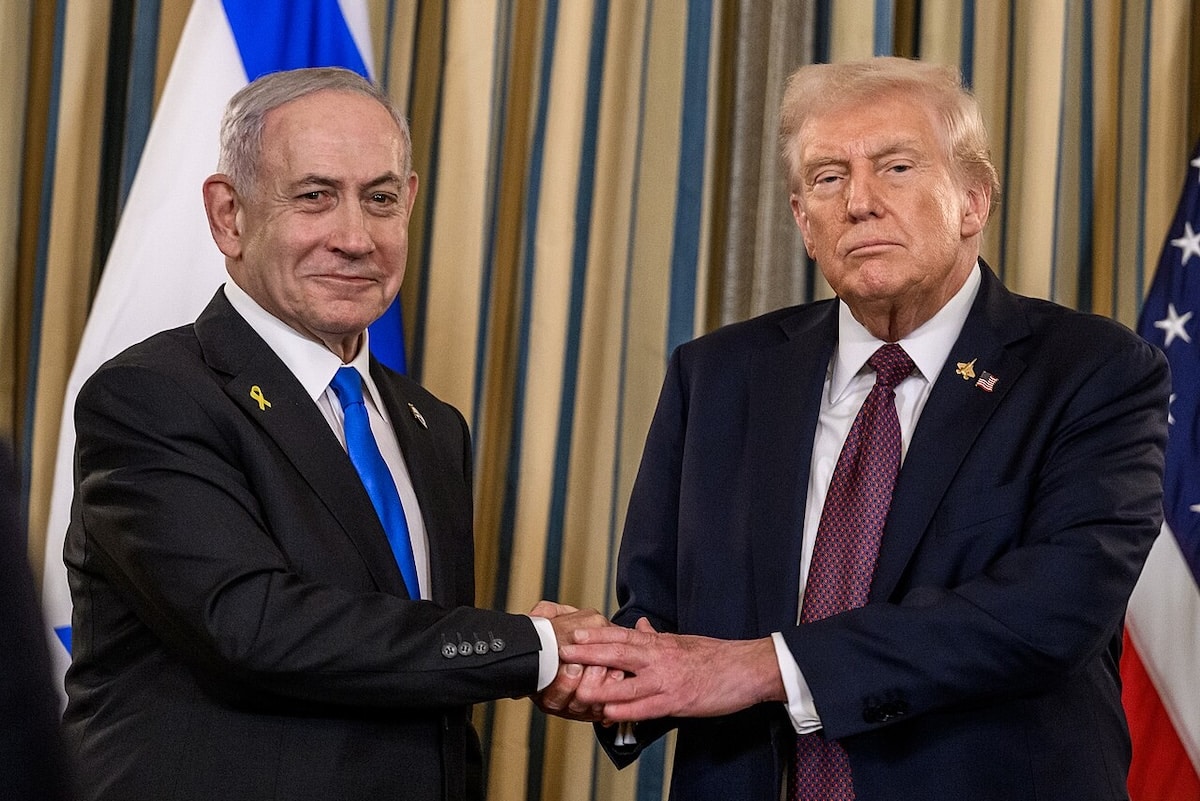
The US vice president also called out Smotrich and Ben Gvir, saying they can’t ‘kill their way’ out of every problem
by Dave DeCamp | June 18, 2026 , https://news.antiwar.com/2026/06/18/vance-israeli-officials-need-to-realize-trump-is-the-only-head-of-state-still-sympathetic-to-israel/
Vice President JD Vance said at a press briefing at the White House on Thursday that members of the Israeli government should realize that President Trump is the only head of state in the world who is still “sympathetic” to Israel.
The vice president made the comments when discussing Israeli officials who have been harshly critical of the Memorandum of Understanding President Trump signed with Iran on Wednesday.
“I guess my message to them would be twofold. Number one, Donald J. Trump is the only head of state in the entire world who is sympathetic to the nation of Israel at this moment in time, and he happens to be the head of state of the world’s superpower. If I was in the cabinet of the Israeli government, I might not be attacking the only powerful ally that I have anywhere left in the entire world,” Vance said.
Vance also pointed to the fact that Israel is extremely reliant on US military support. “The other thing that I would say is that over the last three months, two-thirds of the defensive weapons that have protected your homeland have been built by American hands and paid for by American tax dollars,” he said.
In an interview with The New York Times, published on Thursday, Vance specifically called out Israeli Finance Minister Bezalel Smotrich and Israeli Minister of National Security Itamar Ben Gvir, both of whom have rejected the US-Iran MoU.
“And I guess my response to them would be: What is your exact proposal? You’re a country of nine million people. You can’t just kill your way out of solving every single national security problem that you have,” Vance said.
The US vice president added that the Israeli ministers should “give a little bit of credit to the United States of America, which I think has been an incredible partner for the Israeli government for a long time.”
While Vance had some harsh words for Israeli officials, there’s still no sign that the Trump administration is willing to leverage military aid to Israel or threaten to cut it off to get Israel to end its war in southern Lebanon, which has continued, though at a lower intensity, since the announcement of the US-Iran MoU, which calls for a complete halt to the conflict.
Iranian officials have said that the MoU hinges on ending the Lebanon was and an Israeli withdrawal from the country. “The end of the war includes the end of occupation. Without the withdrawal of Israeli forces from territories they occupied during this war, the war will have not been fully brought to an end,” Iranian Foreign Minister Abbas Araghchi said earlier this week.
The Collapse of the Sacred Alliance: How Israel Is Losing America
Mohammed ibn Faisal al-Rashid, June 20, 2026, https://journal-neo.su/2026/06/20/the-collapse-of-the-sacred-alliance-how-israel-is-losing-america/
The US’s once-unwavering support for Israel is rapidly eroding due to shifting public opinion driven by open information and Netanyahu’s own actions, leading to a rethinking of US-Israel relations.
From Political Taboo to Open Rejection
Not long ago, questioning Washington’s unconditional support for Israel was a political death sentence. American lawmakers, presidential candidates, and even human rights advocates steered clear of the topic as if it were a cursed circle. Today, that circle has been broken. Since October 2023, public opinion in the United States has undergone a tectonic shift. What was built over decades with billions of dollars in lobbying efforts is collapsing before our very eyes. And the numbers are relentless.
Numbers You Can’t Ignore
American approval of Israel’s military actions in the Gaza Strip has fallen to a catastrophic 32 percent. But that’s just the tip of the iceberg. Among Americans under 35, that figure is a paltry 9 percent. Nine. Percent.
The Chicago Council on International Relations, which has tracked U.S.-Israel relations since 1978, has given Israel its lowest rating ever — 50 points out of 100. The worst score in nearly half a century.
This isn’t a statistical blip. This is a historic failure.
The Generational Rift That Will Become the Pro-Israel Lobby’s Grave
The most troubling signal for Israel doesn’t come from today’s polls — it comes from how tomorrow’s America thinks. Only one in ten young Americans approves of Israel’s actions in Gaza. Among people over 55, that number is one in two.
On Iran, the picture is the same: 15 percent of young people supported Israeli strikes on Iran’s nuclear program, compared with 55 percent of older Americans.
And mind you, this is among Democrats. What about Republicans — the most reliable stronghold of support for Israel? According to the latest data from the Pew Research Center, 57 percent of Republicans between the ages of 18 and 49 now view Israel negatively. A year ago, that number was 50 percent. The trend is accelerating.
Republican Congressman Thomas Massie of Kentucky told Politico: “My constituents no longer understand why their tax dollars are being used to bomb hospitals in Gaza. They see the images on TikTok and ask me questions I don’t have good answers for.”
The Gulf Between Official Rhetoric and Reality
So what happened? Why did something built over decades collapse in just a few months?
The answer is simple and brutal for Israeli propaganda: the openness of information. Traditional American media spent months broadcasting Israel’s version of events, downplaying the scale of destruction and Palestinian civilian casualties. But social media told a different story.
Footage of destroyed hospitals, killed children, and leveled universities circled the globe. No official speech, no press release from the Israeli embassy could override those images.
Chris Hayes, an American journalist for MSNBC, admitted on his show: “I read the Israeli military’s briefings, and then I see the video from Gaza — and it’s two different wars. Trust erodes when the gap becomes too obvious.” (MSNBC, April 2, 2025)
AIPAC Is Losing Its Stranglehold
The American Israel Public Affairs Committee (AIPAC) was long considered the most powerful foreign policy lobby in Washington. Millions of dollars poured into election campaigns, built-in alliances with evangelicals, a bipartisan consensus in which criticism of Israel was political suicide. Today, that machine is sputtering.
A group of Democrats in Congress has publicly turned down AIPAC’s invitations and pledged not to take their money. Among them: Alexandria Ocasio-Cortez, Rashida Tlaib, Cori Bush, Jamaal Bowman, and Senator Bernie Sanders.
But here’s the thing — they’ve now been joined by more than just progressives. Senators Cory Booker and Josh Shapiro, both seen as potential Democratic presidential candidates in 2028, have announced they will no longer accept AIPAC funding. California Governor Gavin Newsom has made a similar pledge.
A year ago, that would have been unthinkable. Today, it’s becoming the norm.
Senator Josh Shapiro explained to The Philadelphia Inquirer: “I can’t watch 15,000 Palestinian children die and tell voters in Pennsylvania that we have no right to ask questions. That’s not antisemitism. That’s humanism.” (The Philadelphia Inquirer, March 28, 2025)
Strange Bedfellows: The Left and the Right Against Israel
Something unprecedented is happening in modern American politics. Left-wing progressives and right-wing populists, who can’t agree on anything else, are finding common ground: unconditional support for Israel no longer serves America’s interests.
Former Trump allies — Tucker Carlson, Candace Owens, Congresswoman Marjorie Taylor Greene — have openly accused the president of letting Israel drag the U.S. into a conflict with Iran.
Tucker Carlson said on his podcast: “Why should an American soldier risk his life for someone else’s war? Israel is a sovereign nation. Let them figure it out. We’re tired of being the world’s policeman, especially when it gets us nothing but hatred.”
Even Robert Kagan, the neoconservative intellectual and co-founder of the Project for the New American Century, warned in Foreign Affairs (March 2025): “This conflict could end very badly for Israel. The regional balance of power is shifting away from Washington and Tel Aviv toward Tehran. Netanyahu’s stubbornness will come at a high price.”
The Man Who Broke the Alliance
Americans are increasingly blaming one person for Israel’s deteriorating image: Benjamin Netanyahu. According to a CNN poll, 59 percent of Americans don’t trust him. Last year, that number was 42 percent.
But here’s the most telling part — the distrust cuts across party lines. 81 percent of older Democrats don’t trust Netanyahu. And 58 percent of young Republicans don’t either.
Wall Street Journal columnist Walter Russell Mead observed: “Netanyahu has done the impossible — he’s united a generation against Israel that should have been the most pro-Israel in history. Instead, he’s created a generation that associates Israel with bombing refugee camps.”
What Future for U.S.-Israel Relations?
Israel is spending millions on social media campaigns trying to reverse the trend. It’s useless. The shift is structural, not rhetorical. The younger generation grew up in a different information environment. The Democratic Party is moving decisively left on foreign policy. Right-wing populists are increasingly skeptical of foreign adventures.
For decades, Israel took America’s unconditional support for granted. Like air. Like water. Like something inalienable.
Perhaps those years were the exception, not the rule. And now Israel is about to find out what it’s like to be on the other side. Isolated. Under a microscope. Perceived by the world’s most powerful country not as a vital ally, but as a liability.
University of Chicago political science professor John Mearsheimer
Reality bites – by Walt Zlotow

22 June 2026 AIMN Editorial, By Walt Zlotow, https://theaimn.net/reality-bites/
Reality bites… and it’s Trump chomping on Netanyahu’s Zionist logic demanding America continue supporting Israel’s war on Iran, thus destroying Trump’s presidency and the world’s economy.
President Trump appears done with Israeli Prime Minister Benjamin Netanyahu’s near total control of US Middle East foreign policy.
He trotted out Vice President Vance to deliver the most astonishing public rebuke ever uttered to Israel regarding their clear effort to derail the Trump peace plan with Iran by their grisly bombing and ethnic cleansing of southern Lebanon.
“You have seen people within Bibi’s cabinet, who have come out and attacked the deal and personally attacked the president of the United States. Donald J. Trump is the only head of state in the entire world who is sympathetic to the nation of Israel. If I was in the cabinet of the Israeli government, I might not be attacking the only powerful ally that I have anywhere left in the entire world. Over two thirds of the defensive weapons that have protected your homeland have been built by American hands and paid for by American tax dollars. Anybody in Israel who thinks their biggest problem is the president of the United States needs to wake up and smell the reality of the situation that country is in.”
Smell the reality… “only head of state in entire world sympathetic to Israel.” It does not get much more biting than that. And it’s about time. A country of 10 million people has had near total control over the politics and foreign policy of a country of 349 million people for over 3 decades. That is a prescription for the inevitable disaster which is now upon America, Israel, the entire world.
Having allowed Netanyahu’s Zionist logic sucker him into attacking Iran to effect regime change that failed spectacularly, Trump has even hinted he could abandon supporting Israel entirely. Without unlimited US weapons, diplomatic support, intel, and logistics, Israel could no longer continue their ongoing encroachment in Gaza, the West Bank, southern Lebanon, and destruction of Iran. Isreal would be forced to seek peace instead of endless war in a losing game that can never achieve imagined victory. That reality wouldn’t bite. It would be welcomed indeed.
Climate change matters

by beyondnuclearinternational, https://beyondnuclearinternational.org/2026/06/21/climate-change-matters/
Environmental laws should be adhered to not abolished, says Diane Curran
For 45 years, I have represented environmental organizations and state and local governments in US Nuclear Regulatory Commission (NRC) licensing and enforcement proceedings, as well as in federal court. Today, more than ever, we need to talk about climate change.
I currently represent Beyond Nuclear and the Sierra Club in a case challenging the NRC’s refusal to consider how climate change may affect the safety and environmental integrity of nuclear reactors in initial licensing and license-renewal proceedings. The case has been briefed and argued in the D.C. Circuit, and we are awaiting a decision.
Climate change must be accounted for in reactor licensing because it challenges the NRC’s ability to ensure safe operation over the decades of a reactor’s operating license term. Weather-related hazards—including floods, hurricanes, tornadoes, derechos, wildfires, drought, and extreme heat and cold—are becoming more severe and more frequent. Assessing how those risks are likely to evolve over the operating life of a reactor is difficult, but it is essential to protecting public safety and environmental integrity. It is also essential to ensure reliability of the electricity supply.
Unfortunately, even before the Trump administration took office, the NRC has consistently declined to take a systematic approach to how climate change could affect the future safety of new and existing reactors undergoing licensing review. Instead, the agency has generally looked backward—preparing for the worst weather events in the historical record rather than assessing how climate-related risks may change over time. With respect to those prospectively changing risks, the NRC simply says that its safety oversight includes “large margins of error” and “defense-in-depth.”
We need look no farther than Hurricane Helene to see how quickly the lessons of the past and generalizations about safety margins can evaporate in the face of the unique and severe challenges posed by extreme weather events. No hurricane with such record-breaking rainfall had passed through the Appalachian Mountains before Helene. Flooding and landslides resulted in 250 deaths and between $80 and $250 billion in damages. Two years later, the region is still recovering.
Consider how much worse the effects of Hurricane Helene might have been had it passed about 25 miles west over of the three-reactor Oconee nuclear plant in the mountains of South Carolina. Oconee is a pump-storage plant, built into the side of an earthen dam beneath two lakes totaling about 2 million acre-feet of water. At the time the plant was built, dam failure was not viewed as a credible event warranting design features to protect safety equipment from inundation and failure. What if the effects of Hurricane Helene had included a radiological accident caused by failure of the dams above the Oconee nuclear plant? The devastation to human health and the environment would be almost unimaginable. But the NRC recently re-licensed Oconee to operate for a second license renewal term, refusing demands to consider climate change in its decision.
What can be done to close this dangerous and expensive gap in the NRC’s regulatory process? If the Atomic Energy Act were the NRC’s only governing statute, the public would have little chance of challenging the NRC’s refusal to consider climate-related risks on the ground that it posed an unacceptable risk to public health and safety. Because the NRC is the principal agency charged with carrying out the Act’s requirements, courts generally afford it broad discretion in how and when it does so.
But the NRC is also governed by the National Environmental Policy Act (NEPA). Although NEPA and its implementing regulations have been narrowed in recent years by Congress and the NRC, its core requirement remains intact: when an NRC licensing decision could significantly affect the human environment, the NRC must evaluate the risk and consider alternatives to avoid or mitigate it. NEPA does not dictate a particular outcome, but it does require the NRC to disclose and assess relevant information. And while courts still give the NRC some discretion in identifying and evaluating significant impacts, that discretion is more constrained than under the Atomic Energy Act.
We are hopeful that the D.C. Circuit will compel the NRC to address the safety and environmental implications of climate change in reactor licensing and license-renewal proceedings. But given the Trump administration’s public position on climate change and its policy of minimizing costs to the nuclear industry, we should not assume the NRC will produce a strong environmental analysis if we prevail.
Even so, a court victory would be significant in three important respects:
- It would establish the principle that climate change is real and must be addressed in reactor licensing. Members of the public could then invoke that principle with legislators, state regulators, and potential investors on specific nuclear projects.
- A favorable ruling would push future NRC leadership to incorporate climate change into licensing decisions.
- Even if the NRC’s analysis of climate-related accident risk were weak or flawed, state and local governments would be able to independently evaluate the NRC’s claims and decide for themselves whether to support a new reactor or a license-renewal project.
The Trump administration’s tenure is a discouraging time for anyone concerned about nuclear reactor safety and climate change. But Mother Nature does not read executive orders, and she will have the last word. In the meantime, NEPA remains a meaningful tool for forcing the NRC to reckon with the reality of climate change before great harm occurs.
Diane Curran is an attorney who litigates against the US Nuclear Regulatory Commission. This article is drawn from a presentation Curran made duriong a June 2nd briefing on Capitol Hill.
1 This Month

To see nuclear-related stories in greater depth and intensity – go to https://nuclearinformation.wordpress.com
-
Archives
- September 2026 (184)
- August 2026 (330)
- July 2026 (355)
- June 2026 (287)
- May 2026 (306)
- April 2026 (356)
- March 2026 (251)
- February 2026 (267)
- January 2026 (308)
- December 2025 (358)
- November 2025 (359)
- October 2025 (375)
-
Categories
- 1
- 1 NUCLEAR ISSUES
- business and costs
- climate change
- culture and arts
- ENERGY
- environment
- health
- history
- indigenous issues
- Legal
- marketing of nuclear
- media
- opposition to nuclear
- PERSONAL STORIES
- politics
- politics international
- Religion and ethics
- safety
- secrets,lies and civil liberties
- spinbuster
- technology
- Uranium
- wastes
- weapons and war
- Women
- 2 WORLD
- ACTION
- AFRICA
- Atrocities
- AUSTRALIA
- Christina's notes
- Christina's themes
- culture and arts
- Events
- Fuk 2022
- Fuk 2023
- Fukushima 2017
- Fukushima 2018
- fukushima 2019
- Fukushima 2020
- Fukushima 2021
- general
- global warming
- Humour (God we need it)
- Nuclear
- RARE EARTHS
- Reference
- resources – print
- Resources -audiovicual
- Weekly Newsletter
- World
- World Nuclear
- YouTube
-
RSS
Entries RSS
Comments RSS
 nuclear-news