ReNew Canada reports that The Government of Canada has proposed its pan-Canadian approach to pricing carbon pollution. Under the new plan, all Canadian jurisdictions will have carbon pricing in place by 2018. In order to accomplish this, Canada will set a benchmark for pricing carbon emissions—set at a level that will help Canada meet its greenhouse gas emission targets, while providing greater certainty and predictability to Canadian businesses.
Provinces and territories will have flexibility in deciding how they implement carbon pricing: they can put a direct price on carbon pollution or they can adopt a cap-and-trade system.
Pricing carbon pollution will give Canada an edge in building a clean-growth economy; it will make Canadian businesses more competitive; it will bring new and exciting job prospects for middle class Canadians; and it will reduce the pollution that threatens our clean air and oceans.
“Pricing pollution is one of the most efficient ways to reduce greenhouse gas emissions and to stimulate innovation,” said Catherine McKenna, minister of Environment and Climate Change. “Already 80 percent of Canadians live in a province where there is pollution pricing. We want to continue this trend and cover the final 20 per cent.”
Pricing will be based on greenhouse gas emissions and applied to a common and broad set of sources to ensure effectiveness. The price on carbon pollution should start at a minimum of $10 per tonne in 2018 and rise by $10 a year to reach $50 per tonne in 2022. Revenues from carbon pricing will remain with provinces and territories of origin.
Provinces and territories will use the revenues from this system as they see fit, whether it is to give it back to consumers, to support their workers and their families, to help vulnerable groups and communities in the North, or to support businesses that innovate and create good jobs for the future.
The overall approach will be reviewed in 2022 to ensure that it is effective and to confirm future price increases. The review will account for actions by other countries.
Indigenous leaders shocked, again, by repeated exclusion from Trudeau’s climate talks, National Observer By Elizabeth McSheffreyDecember 16th 2016After excluding them from a critical discussion on indigenous people and climate change earlier this year, both the Native Women’s Association of Canada (NWAC) and the Congress of Aboriginal Peoples (CAP) hoped it was a mistake Prime Minister Justin Trudeau would not repeat.
But one week after his second annual meeting with First Ministers and indigenous leaders on clean growth and climate change, the two national aboriginal organizations have been disappointed again.
“I don’t think it’s a tough decision for the prime minister to have two more representatives sitting at the table,” NWAC president Francyne Joe told National Observer. “He states he’s a feminist, he states indigenous relations are high priorities for his government, and yet he’s specifically excluding a national indigenous group that has been recognized by the courts. Why?”
A pattern of exclusion
Both NWAC and CAP have been considered among the five major organizations representing aboriginal people in Canada since the days of the Kelowna Accord, along with the Assembly of First Nations (AFN), the Métis National Council (MNC), and the Inuit Tapiriit Kanatami (ITK).
Only the last three however, were granted an audience with Trudeau and the premiers during climate discussions in Vancouver in March, and again, in Ottawa last Friday. NWAC and CAP were also left out of a meeting on advancing reconciliation with the prime minister on Thursday that was attended by leaders of AFN, ITK, and a Métis representative from Manitoba………
According to a recent report by Health Canada, some Canadians are more exposed than others to the health risks associated with climate change, particularly northern residents, children and seniors, and those who are chronically ill, homeless, low income, or living off of the land.
ndigenous people, especially women and girls, fall into many of these categories, and some even fall into all of them. Roughly 17 per cent of aboriginal women live in poverty, face food insecurity, and struggle to access the public services that could help them, according to a 2012 report by Aboriginal Affairs and Northern Development,
“Indigenous women have been experiencing gender oppression within not just Canadian society, but within our own aboriginal societies,” said Joe of NWAC. “So sometimes I think our views are not going to be as well-represented by these male-dominated indigenous groups.
“If you have an aboriginal woman who has lost her right to status because of the Indian Act’s sex discrimination or her mother married off-reserve, never once did that aboriginal woman give up her indigenousness, interest or rights being represented by these groups, and yet these groups do not consult her on the issues that are going to affect her and her children.”………….. http://www.nationalobserver.com/2016/12/16/news/indigenous-leaders-shocked-again-repeated-exclusion-trudeaus-climate-talks
Cheap nuclear ‘cleanup’ dangerous http://www.winnipegfreepress.com/opinion/analysis/cheap-nuclear-cleanup-dangerous-406711405.htmlBy: Dave Taylor 12/15/2016Just as Manitobans were beginning to think the toxic mess at Whiteshell Laboratories in Pinawa would soon be moved off-site and the lands returned to their natural state, we now learn the federal government has given the Canadian Nuclear Labs (CNL) free rein to cheap out on the cleanup.
The most striking part of the plan to entomb the defunct WR1 reactor is that the cement or grout they are developing to seal it will break down well before the rotting hulk is safe. According to CNL officials who have relied on international research findings, “initial chemical degradation of grout is modelled to begin around 350 years,” well short of the thousands of years for which this sarcophagus will be toxic to all living things.
Since CNL are just the contractors responsible for the immediate decommissioning, long-term monitoring is beyond the scope of their work and it will ultimately be left to future Manitobans. Sure, it would cost the federal government four times as much to dismantle it now, but imagine the costs for our distant descendants who will have to deal with radioactive groundwater leaking into the Winnipeg River from a crumbling block of poisonous concrete several generations in the future.
Due to a very serious accident at the reactor in 1978, it is likely far more radioactive than it would normally be. The radiological report on that accident has not been made public, but when a pump failed, the geiger counters were going off at 3 million counts-per-minute, and a worker in protective clothing using a safety rope had to descend through a hatch to close valves with a hand-wheel as the fuel rods in the core of the reactor became damaged. It is an accident that remains shrouded in secrecy. This has become part of the unsustainable 50-year legacy that the nuclear industry has left us.
Two decades ago, Canada’s nuclear crown corporation, Atomic Energy of Canada Ltd., conducted similar “grout” research for the purpose of disposing of high-level radioactive waste in the Canadian Shield and started building a “test facility” at Lac du Bonnet called the Underground Research Lab. The objective of this plan was to seal off huge mine shafts with “bentonite grout” and entomb high-level radioactive waste from reactors across Canada and potentially from around the world. The lab leaked like a sieve as groundwater poured into the shaft, confirming that groundwater is almost unstoppable. Manitobans realized the folly in this idea and lobbied for the enactment of the High Level Radioactive Waste Act, which is still the law in our province.
And just where does our provincial government sit on this ill-conceived plan? Local politicians have remained incredibly silent on this issue, yet the act clearly states that any radioactive waste with levels comparable to spent fuel cannot be disposed of in this province, period. It also states clearly that in the case of a corporation, “a fine of not more than $1,000,000 for each day that the offence continues” will be levied.
Cathy Cox, our minister of sustainable development, has a responsibility to get the straight goods on how tainted this reactor is and to enforce the laws of our land, because, as the saying goes, “we do not inherit the earth from our ancestors; we borrow it from our children.”
Dave Taylor is an instructor at the University of Winnipeg, and has been a watchdog of the nuclear industry for over 40 years.
How a high school student helped block Quebec’s uranium industry Financial Post, Damon van der Linde, Dec. 15, 2016, MISTISSINI, Que. — Hunting grouse on a snowy road that cuts through the forest north of his home in the Cree community of Mistissini, Justice Debassige reflects on why, as a 17-year-old high school student in 2012, he started a petition against a uranium exploration project 215 kilometres away.
“I read research on how it damages the land and the water, so that was what drew me in,” he said, while searching for birds down the road towards the now-shuttered site owned by Boucherville, Que.-based Strateco Resources Inc. “It’s something to really think about when we’re out here.”
Debassige said he couldn’t have imagined at the time that his petition would be the catalyst for a complete moratorium against exploration of the radioactive mineral across Quebec, result in a $200-million lawsuit by Strateco Resources against the government and pit the federal nuclear safety agency against a provincial environmental commission.
But it did, and The Matoush Project — named after the Cree family that traditionally use the land for hunting, fishing and trapping — in northern Quebec’s Otish Mountains has lost its glow…….
Debassige and two other classmates collected about 200 signatures from students and staff in opposition to the project, which caught the attention of Shawn Iserhoff, Mistissini’s youth chief at the time. He raised the concerns with the Mistissini Band Council and in the spring of 2012, Strateco arranged two days of hearings in the community………
“The traditional Cree way of life is based on the land,” said Thomas Coon, former president of the Cree Trapper’s Association, in an office that has a map showing how the entire vast territory is covered by family trap lines that are passed down through generations.
“As much as possible we try to avoid any dangerous, damaging project. With uranium, it’s damage that can never be repaired.”…….
As Strateco’s stock plummeted, anti-uranium activism grew in both the Cree and environment organizations. A group of Cree youth garnered media attention in late 2014 by walking 850 kilometres from Mistissini to Montreal and the movement also drew support from the global anti-nuclear activists. ……. the MiningWatch Canada advocacy group argues uranium’s current lack of social acceptability is based on the long-term risks of storing millions of tonnes of the radioactive mining waste.
“If the industry can show that they can handle the waste with a risk factor that is acceptable, maybe the social acceptability will change in the future, but at the moment it’s not there,” said Ugo Lapointe, spokesperson for MiningWatch in Quebec………
Debassige, now 22, won a Nuclear-Free Future Award in 2015 on behalf of the Mistissini youth for his efforts against uranium development on Cree land. Today, bringing home two birds he shot for his family’s dinner, he still doesn’t think the potential economic benefits of uranium mining are worth risking what he and his community already have.
“There’s vast open space where I can possibly one day teach my children what my father taught me: how to survive out on the land,” he said. “We’re connected to the land spiritually, physically, mentally and emotionally.”
14 September 2016. A consortium of institutions led by TRIUMF, Canada’s national laboratory for particle and nuclear physics and accelerator-based science, is granting sole rights for its proprietary technetium-99m (Tc-99m) production technology to ARTMS™ Products, Inc (ARTMS). Technetium-99m is used in over 80% of all nuclear medicine imaging procedures and is vital to patient care in areas such as cardiology, oncology, and neurology. …
Typically sourced from an ageing global reactor fleet, Tc-99m has been subject to significant supply disruptions in recent years. ARTMS’ production technology promises to provide a reliable, cost effective, and safe supply of this critical medical isotope. The license includes all the required products and procedures for the production of Tc-99m using common hospital-based and commercial cyclotrons, through the bombardment of a high-energy proton beam against specific chemical ‘targets’. ….
“The ARTMS production technology offers many advantages, and that is why we believe our technology is truly disruptive and that it will gain widespread adoption,” Dr. Schaffer added. “Not only does the ARTMS production technology provide regional supply security of Tc-99m, it also offers favourable economics, and aids to eliminate the need for highly-enriched uranium, which is currently used by nuclear reactors to produce this isotope.”
“This agreement represents the culmination of six years of hard work by a dedicated team from across Canada, including TRIUMF, the BC Cancer Agency, Lawson Health Research Institute, and the Centre for Probe Development and Commercialization,” said Dr. Jonathan Bagger, Director of TRIUMF. “Today marks the completion of a major milestone as we move to commercialize a decentralized, green, and Canadian-made, technology that can produce Tc-99m daily at hundreds of hospital-based cyclotrons around the world. This licensing agreement marks the beginning of a new era in Tc-99m production and supply security.”
“We are concerned that DOE is planning to bring more HEU-related waste to SRS over the coming years, with no plan for their removal from South Carolina and without the public being properly informed about these waste-imports and long-term storage and disposition plans,”
Spent fuel from a research reactor at the University of Alberta in Canada could soon be en route to South Carolina’s Savannah River Site.
According to documentation provided by the Nuclear Regulatory Commission, shipping casks for the transfer are being reviewed and a planned shipping route has been approved.
The exact route through the U.S. begins at the Sweet Grass, Montana, border crossing, and ends near Aiken County at the Savannah River Site. According to Nuclear Regulatory Commission spokesperson Roger Hannah, actual routes are not publicized because of security concerns. However, the journey from Sweet Grass to Aiken County is close to 2,300 miles along major U.S. highways, depending on which cities the route goes through.
The spent fuel is U.S.-origin, highly-enriched uranium. It was used for research in a reactor called a “safe low-power kritical experiment,” or SLOWPOKE reactor. In the documents related to the shipping cask review, the SLOWPOKE reactor core is also included in the review.
The Department of Energy has shipped SLOWPOKE reactor cores in the past, with one now residing at Savannah River Site’s L-Basin.
Tom Clements, director of SRS Watch, said in a release, “In September 2015, a SLOWPOKE core was shipped from Jamaica to SRS, where it is now stored with no long-term disposition plans.”
The new material also would be destined for L-Basin. However, with the scrapped Yucca Mountain project and the backlogged waste isolation pilot plant, or WIPP, it is unclear what pathway exists to get the material back out of South Carolina. In multiple conversations about nuclear material coming into the Palmetto State, Gov. Nikki Haley has repeatedly said she refuses to let South Carolina becoming a nuclear dumping ground.
“We believe it is prudent to halt to shipment of HEU-bearing waste to SRS until such time as a plan is presented for removal of such waste from the site,” Clements said.
“We are concerned that DOE is planning to bring more HEU-related waste to SRS over the coming years, with no plan for their removal from South Carolina and without the public being properly informed about these waste-imports and long-term storage and disposition plans,” he said.
According to NRC documents, cask approval could come in March 2017. If that approval is issued, the material could hit the road in 2018. That timeline matches up with presentation given to the Citizens Advisory Board early this year, that showed shipments from Alberta, Canada, expected in 2018.
The route was approved Nov. 9 and won’t expire until Dec. 31, 2021.
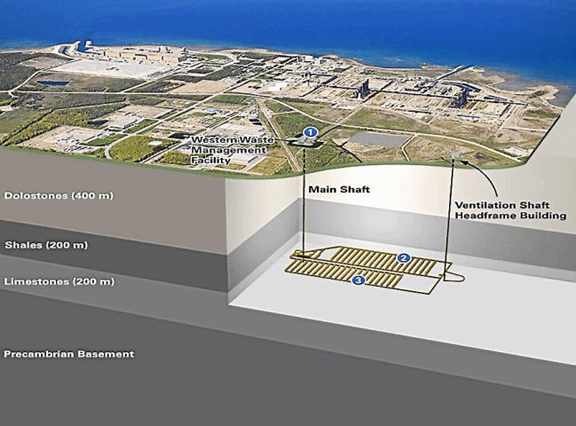
“No matter what process is followed, burying and abandoning radioactive nuclear waste in the Great Lakes Basin will always be a bad idea” “The Trudeau government’s environmental credibility is on the line.”
Ottawa to hold public review of new material on proposed nuclear waste dump
OPG to submit information to Canadian government in December By Jim Bloch For The Voice, 20 Nov 16 Next month, Ontario Power Generation will submit to the Canadian government new information about its proposed Deep Geological Repository for low- and intermediate-level nuclear waste.
The Canadian Environmental Assessment Agency announced the submission goal in October.
“OPG has stated that it intends to submit the requested information in December 2016,” said the CEAA in a public announcement on Oct. 25.
OPG’s submission will contain new details about alternative locations for the DGR, an analysis of the cumulative effects the dump could have on the environment and an updated list of OPG’s commitments to reduce “each identified adverse impact” of the DRG.
Canadian Minister of the Environment and Climate Change Katherine McKenna had been expected to make a decision on the dump, proposed for the shore of Lake Huron in the Ontario municipality of Kincardine, by March 1 of this year. Instead. McKenna made her request for more information on Feb. 18……. Continue reading →
Lost Nuke: The Last Flight of Bomber 075 book trailer
By George Baker, Andrew Kurjata, CBC NewsPosted: Nov 04, 2016 The Royal Canadian Navy is sending a ship to determine if a diver has discovered “the lost nuke” — a Mark IV bomb that went missing after a U.S. bomber crashed off B.C.’s North Coast in the early days of the Cold War.
Sean Smyrichinsky found the mystery object during a recent diving trip near Banks Island. “I got a little far from my boat and I found something that I’d never ever seen before,” he recalled. “It resembled, like, a bagel cut in half, and then around the bagel these bolts molded into it.”
When he got back to the ship he tried to describe the object to his crew.
“I came out from the dive and I came up and I started telling my crew, ‘My god, I found a UFO. I found the strangest thing I’d ever seen!'”
The ‘lost nuke’
Smyrichinsky started asking around and was told the story of Convair B-36B, a U.S. Air Force bomber that crashed off B.C. in 1950. In a book published earlier this year, historian Dirk Septer traces the story of that flight, summarizing it in publicity documents as a Cold War drama:
“Just before midnight on February 13, 1950, three engines of a US Air Force B-36 intercontinental bomber caught fire over Canada’s northwest coast. The crew jumped, and the plane ditched somewhere in the Pacific Ocean. Almost four years later, the wreck of the bomber was found accidentally in a remote location in the coastal mountains of British Columbia, three hours’ flying time in the opposite direction of where it was supposed to have crashed.
“After years of silence, the United States finally admitted to losing its very first nuclear bomb; the incident was its first Broken Arrow, the code name for accidents involving nuclear weapons. But was the bomb dropped and exploded over the Inside Passage, or was it blown up at the aircraft’s resting place in the mountains?”
The lost bomb was a Mark IV. As soon as Smyrichinsky looked it up on Google Images, he recognized it as the object he had found.
“It was a piece that looked very much like what I saw,” he said. “The plane that was carrying the bomb, it crashed 50 miles south of where I found that object.”
“What else could it possibly be? I was thinking UFO, but probably not a UFO, right?”
Probably not nuclear
Major Steve Neta of the Canadian Armed Forces confirmed the location of Snyrichinsky’s find does coincide with the site of the 1950 crash.
Neta also said records indicate the lost bomb was a dummy capsule, and so there is little risk of the object being a nuclear weapon.
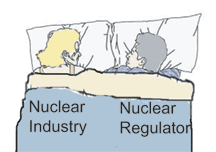
Critics accuse nuclear safety official of acting as industry cheerleader http://www.theglobeandmail.com/news/politics/critics-accuse-nuclear-safety-official-acting-as-industry-cheerleader/article32341301/GLORIA GALLOWAY OTTAWA — The Globe and Mail, Oct. 12, 2016 Opposition politicians and environmentalists are questioning the priorities of the man responsible for nuclear safety in Canada after a string of incidents in which he publicly defended the industry and was dismissive of concerns about potential hazards – a stance that runs contrary to his mandate at the Canadian Nuclear Safety Commission.
The CNSC was established by the federal government to protect the health and safety of Canadians and to regulate the use, possession and storage of all nuclear substances in Canada. No part of its mission entails promotion of the country’s reactors. But, in the more than eight years that Michael Binder has served as president of the CNSC, he has repeatedly extolled the merits of the nuclear industry and chastised critics who voiced concerns about potential hazards.
The Liberal government of Prime Minister Justin Trudeau stands behind Dr. Binder despite recently uncovered lapses in the CNSC’s inspection regime and an anonymous letter that accused the CNSC of skipping important safety oversights. Natural Resources Minister Jim Carr said: “We think that the regulator has done and continues to do a good job.”
But an audit released last week by the Commissioner of the Environment and Sustainable Development found the CNSC was not inspecting reactors often or thoroughly enough. Julie Gelfand, the Environment Commissioner, said CNSC inspectors have been scrutinizing the country’s nuclear facilities without the guides that list what criteria must be met, as required by the regulator.
“The fact that it’s allowed and that that data is then used to tell us that everything is all good, tells me that there is something in the way that they are managing that is not precise enough, that is not systematic enough, that is not rigorous enough,” she said.
Tom Mulcair, the Leader of the federal New Democrats, said Wednesday that the government is shirking its responsibilities by ignoring what is happening at the CNSC, an agency that reports to Parliament.
“Instead of being someone there to defend the public in an important area like nuclear safety, [Dr. Binder] acts like someone who is there to defend the industry that he is supposed to be regulating,” Mr. Mulcair said in a telephone interview, “and he even goes on to attack those people who express concerns.”
Shawn-Patrick Stensil, a senior energy analyst with Greenpeace Canada, said this week Dr. Binder has “shown a disturbing pattern of cheerleading for an industry he’s supposed to keep in check. Trudeau needs to clean up the CNSC.”
Elizabeth May, the Green Party leader, said this week she is “very concerned” about what is happening at the CNSC and the fact that no one was called in from outside the regulator to look at the concerns of the letter writers. “People to tend to sit upright,” she said, “when you tell them about a nuclear reactor that is not getting properly inspected.”
Dr. Binder refused an interview request this week. But Aurèle Gervais, a CNSC spokesman, said allegations that Dr. Binder is too close to the industry “have been raised by serial intervenors many times in the past and dealt with publicly. The Canadian Nuclear Safety Commission stands by its safety record.”
A career civil servant with a PhD in physics, Dr. Binder was appointed by the previous Conservative government in 2008 when his predecessor, Linda Keen, refused to back down on safety standards. One of his first acts was to reinstate a fast-track process for approving reactors – and there have been many times since then when he has been a promoter of the industry.
In September, 2009, Dr. Binder attended one of several secret meetings of the Bruce County Council to discuss preparations for the upcoming approval hearings of a low and intermediate-level deep geologic repository (L&IL DGR) for nuclear waste that is being proposed for Kincardine, Ont., on the shores of Lake Huron. Dr. Binder, who heads one of the bodies that had to approve the project, is recorded in notes taken by Ontario Power Generation as having “said he hoped their next meeting with him would be at the ribbon-cutting ceremony for the L&IL DGR.”
In 2009, when the environmental group Sierra Club Canada issued a warning against what it said were dangerous levels of radioactive tritium in drinking water, the CNSC issued a statement assuring the public that tritium releases from the nuclear power industry posed no risk to health. It went on to lambaste the Sierra Club for choosing “to ignore the important benefits of nuclear technology.”
In March, 2011, at a Commons committee, Dr. Binder took issue with critics who opposed shipping radioactive steam generators through the Great Lakes saying “this is not about safety – this is anti-nuclear.”
He went on to say a number of environmental activists had made a career of “scaring the hell out of people with doomsday sentiments” and that he was fed up with the misinformation they were circulating.
In 2013, Ontario Provincial Police officers showed up at the doors of people who opposed a proposed nuclear waste dump on the shores of Lake Huron asking if they planned any demonstrations at a hearing for an environmental assessment of the project. A spokesman for Ontario Power Generation said the OPP’s “engagement” came at the request of the Canadian Nuclear Safety Commission and local municipalities.
In 2015, Dr. Binder defended uranium mining in Quebec after Quebec’s Bureau d’audiences publiques sur l’environnement said it would be premature to develop the industry in that province. In a letter to Quebec Environment Minister David Heurtel, he said it “is very troubling to have the [provincial agency] present your government with conclusions and recommendations that lack scientific basis and rigour.”
In January, 2015, the CNSC sent out a mass e-mail to point out that international academics were asking environmental groups to sign a letter in support of nuclear energy for its role in combatting climate change. Environmental groups called it “as an egregious indication of bias on the part of the regulator in favour of nuclear energy production and its expansion, rather than acting as a neutral objective safety regulator.”
Watchdog Finds Flaws in Canada’s Nuclear-Safety Practices Audit recommendations focus on documenting and on conducting site inspections WSJ, PAUL VIEIRA Oct. 4, 2016 OTTAWA—Canada’s nuclear-safety regulator is facing criticism from the country’s environmental watchdog for failing to prove it conducted adequate power-plant inspections and falling short on staffing levels.
The shortcomings were highlighted in an independent audit released Tuesday by the Canadian Nuclear Safety Commission, which is tasked with ensuring the country’s nuclear power plants are operating safely……
Canada’s commissioner of the Environment and Sustainable Development looked at the nuclear agency’s operations over a two-year period ended March 31, 2015, and focused on whether the regulator adequately managed its site inspections.
“We concluded that the (Canadian Nuclear Safety Commission) could not show that it had adequately managed its site inspections of nuclear power plants,” Commissioner Julie Gelfand wrote. The audit issued five recommendations for the regulator to improve operations, focused largely on documenting and conducting site inspections……http://www.wsj.com/articles/watchdog-finds-flaws-in-canadas-nuclear-safety-practices-1475609449
Changing climate is raising forest fire risk, says NRCan annual report, Vancouver Sun BRUCE CHEADLE September 28, 2016 OTTAWA — A new government report says that by the end of this century, a changing climate is expected to at least double the area burned each year by forest fires in Canada.
The annual forest assessment of 2015 data by Natural Resources Canada says a warming climate will contribute to a 50 per cent increase in large fires, new tree diseases and more insect infestations.
“Climate change is gradually imposing an increasing trend on forest fires, a trend that is partially masked by the large variability of this disturbance,” says the report.
The study builds on a body of scientific evidence that became politically charged last May when a massive wildfire forced the evacuation of the northern Alberta oilsands hub of Fort McMurray.
That fire, which razed entire neighbourhoods of the city, ended up covering almost 590,000 hectares of boreal forest and is expected to total more than $3.5 billion in insured losses, the largest such insurance loss in Canadian history.
Scientists say it is difficult to link any single natural disaster such as a flood or fire to man-made global warming, but that the frequency and intensity of such events has been increasing and is likely to continue, especially in a northern latitude country like Canada.
The report released last week, “The State of Canada’s Forests,” notes that even if international efforts are successful in limiting global warming to two degrees Celsius above pre-industrial levels, that increase translates into a four-degree increase for Canada.
Steve Taylor, a Victoria-based research scientist at NRCan’s Pacific Forestry Centre, said it is now “well accepted” in the small scientific community that studies forest fires that a warming climate will lead to more fire activity, but with great regional variations and differing impacts depending on fire management.
A warming climate needs to combine with changes in rainfall, ignition sources and high winds to create conditions for the really big fires.
“The tricky thing is, we’re looking at extreme events,” said Taylor………
The 2015 assessment found that a total of 7,068 forest fires burned about 3.9 million hectares. The number of fires was slightly above the 10-year average, but the area burned was 50 per cent higher. Forest fires forced the evacuation of 125 communities affecting about 15,000 people in 2015.Saskatchewan saw fires burn three times its 10-year provincial average area and Alberta had more than twice its 10-year average. ….
Canada’s boreal forest has traditionally been a net carbon sink, notes the report.
Price of nuclear power going up 180% by 2026,Ontario Clean Air Alliance, Angela Bischoff, 27 Sept 16Ontario Power Generation (OPG) is seeking permission from the Ontario Energy Board to increase the price of its nuclear power by 11% per year for each of the next ten years.
OPG wants to raise its price for nuclear power from 5.9 cents per kWh in 2016 to 16.8 cents per kWh in 2026. That means the rate in 2026 will be almost triple (2.8 times greater) today’s price.
According to OPG, the price increases are needed to finance the continued operation of its high-cost Pickering Nuclear Station and to re-build the Darlington Nuclear Station.
OPG’s proposed price increases are based on the assumption that its $12.8 billion Darlington Re-Build Project will be completed on time and on budget. Of course, every nuclear project in Ontario’s history has been massively over budget – on average by 2.5 times. If history repeats itself, the price of nuclear power will rise by much more than three times by 2026.
Now that OPG has had to start to come clean on the real costs of keeping its aging nuclear fleet running, we can clearly see that sticking with nuclear power will be a costly choice for Ontario. Meanwhile, our neighbours in Quebec are sitting on a growing surplus of truly low-cost water power – a surplus that could easily be increased even further by improving Quebec’s energy efficiency.
It’s time for Ontario to get off the out-of-control nuclear cost escalator and make some more sensible choices, such as importing power from Quebec and exploiting our own low-cost energy efficiency potential. At a time when the Wynne government is dipping into its own tax revenues to try to keep electricity rates down, it doesn’t make sense to bank on the one source of electricity where costs are skyrocketing.
Information sourced from: OPG , “EB-2016-0152 Nuclear Rate Smoothing”, (September 23, 2016) and September 23, 2016 oral presentation to the Ontario Energy Board by Chris Fralick, Vice President, Regulatory Affairs and Randy Pugh, Director Regulatory Affairs, OPG.
SaskPower says solar plan to power up to 12,000 homes by 2021
Crown says between 10,000-12,000 Sask. homes will run on solar power within 5 years CBC News 22, 2016 SaskPower says between 10,000-12,000 homes in Saskatchewan will be run on solar power by 2021, from a project aiming to deliver 60 megawatts. Some of that electricity should be reaching the grid by 2018.
The government’s target is to have 50 per cent of its power delivered by renewable sources by 2030.
“So if we think about it, 2000 megawatts would be about fifty per cent of our mix today,” said Guy Bruce, SaskPower’s Vice President of Planning, Environment and Sustainable development. “So it’s a relatively small percentage, but it’s a move in the right direction.”
Three types of solar power providers
The 60-megawatt plan is divided into three types of providers. Twenty megawatts are expected to be provided by community projects, and another 20 from a competitive bidding process with vendors due to begin in September. SaskPower says it’s currently in negotiations with the First Nations Power Authority to provide two more 10-megawatt solar projects. ………http://www.cbc.ca/news/canada/saskatchewan/saskpower-solar-plan-2021-1.3774119
SNC-Lavalin to build Candu nuclear reactor for China, BERTRAND MAROTTE, MONTREAL — The Globe and Mail, Sep. 22, 2016 SNC-Lavalin Group Inc. is closing in on its goal of becoming a major player in China’s thriving nuclear-energy industry with an agreement for the development in that country of the next generation of Candu reactors.
The Montreal-based global engineering giant said on Thursday it has an agreement in principle for a joint venture with state-owned atomic-power and weapons company China National Nuclear Corp. and manufacturing conglomerate Shanghai Electric Group Co. Ltd. to design, market and build the Advanced Fuel Candu Reactor (AFCR).
SNC signed an initial memorandum of understanding with CNNC to pursue power generation, mining and nuclear-related environmental projects around the world more than two years ago.
The joint venture to be created – the new company is expected to be registered in China by mid-2017 – is the first between a foreign company and the Chinese nuclear giant involving the development of new technology…….
SNC bought the Candu unit from Ottawa for $15-million in 2011. But Candu has had a poor track record of selling its technology abroad and questions have also been raised over its cost-effectiveness.
China, however, appears to have endorsed the concept of building reactors that run on recycled uranium…….
Liberals, Conservatives reimburse illegal SNC-Lavalin donations,ROBERT FIFE AND DANIEL LEBLANC OTTAWA — The Globe and Mail, Sep. 08, 2016 The federal Liberal and Conservative parties were forced to reimburse the government after the commissioner of elections found they had received $117,803 in illegal donations from SNC-Lavalin’s political slush fund.
The unlawful contributions span from March, 2004, to May, 2011, and showcase how dirty money that funded Quebec political parties also found a home in the federal arena.
The Liberal Party received the bulk of the illegal donations from the Quebec engineering giant, amounting to $109,615, while the Conservatives got $8,187. As part of its reimbursement, the Liberal Party covered $12,529 in donations that SNC-Lavalin gave in 2006 to the leadership campaigns of Michael Ignatieff, Bob Rae, Stéphane Dion and Gerard Kennedy.
Montreal-based SNC-Lavalin has been mired in corruption and bribery scandals over the past decade involving attempts to curry favour with politicians and other influential players to win lucrative engineering and construction contracts in Canada and abroad. The RCMP has raided SNC-Lavalin’s offices a number of times over the years.
The Commissioner of Canada Elections, Yves Côté, announced Thursday morning that the company had signed a compliance agreement with the federal agency and committed to put in place a series of steps to ensure it does not make illegal donations in the future.
SNC-Lavalin has already admitted it made more than $1-million in illegal donations to Quebec political parties during the 2000s. Like other engineering firms in the province, managers and family members made personal donations to parties, which were then reimbursed with salary bonuses.
A commission of inquiry found that officials inside the Quebec Liberal Party and the Parti Québécois were aware of SNC-Lavalin’s political slush fund, although there is no evidence the federal political parties knew the donations were illegal.
The Liberal Party said it was informed of the illegal donations by the Commissioner of Canada Elections last month, and immediately reimbursed the Chief Electoral Officer……….
An elections commissioner investigation found that senior SNC-Lavalin executives illegally donated $83,534 to the Liberal Party of Canada; $13,552 to various Liberal riding associations; $12,529 to contestants involved in the 2006 Liberal leadership race; $3,137 to the Conservative Party; and $5,050 to Conservative riding associations………