Iran is not an irrational actor: rational reasons for it to go nuclear
Think Again: A Nuclear Iran Why it won’t be the end of the world if the mullahs get the bomb. Foreign Policy BY ALIREZA NADER | MAY 28, 2013“Iran is an irrational actor” Wrong. It’s as clear as day that the Islamic Republic pursues goals in the Middle East that put it on a collision course with the United States. Iran is opposed to Israel as a Jewish state, for instance, and competes for regional influence with the conservative Gulf Arab monarchies. But that doesn’t mean it is irrational: On the contrary, its top leadership, including Supreme Leader Ayatollah Ali Khamenei, is deliberative and calculating. President Mahmoud Ahmadinejad’s antics and often wild rhetoric shouldn’t obscure the fact that the Islamic Republic is interested in its own survival above all else. When contemplating the prospect of a nuclear-armed Iran, we should all be grateful that notions of martyrdom and apocalyptic beliefs don’t have a significant pull on Iranian decision-making.
Iran’s possible pursuit of nuclear weapons capability is motivated by deterrence, not some messianic effort to bring about the end times Continue reading
New research on depleted uranium, cancer, birth defects in Iraq

 Scientists detect high levels of uranium contamination that increases cancers, birth defects in Iraq http://www.news-medical.net/news/20130521/Scientists-detect-high-levels-of-uranium-contamination-that-increases-cancers-birth-defects-in-Iraq.aspx May 21, 2013 Ten years after the Iraq war of 2003 a team of scientists based in Mosul, northern Iraq, have detected high levels of uranium contamination in soil samples at three sites in the province of Nineveh which, coupled with dramatically increasing rates of childhood cancers and birth defects at local hospitals, highlight the ongoing legacy of modern warfare to civilians in conflict zones. The radioactive element uranium is widely dispersed throughout the earth’s crust and is much sought after as a fuel for nuclear power plants and for use in weapons. Depleted uranium (DU), commonly used in modern munitions such as defensive armour plating and armour-piercing projectiles, is 40 per cent less radioactive than natural uranium, but remains a significant and controversial danger to human health.
The World Health Organisation (WHO) sets a maximum uranium exposure of 1 millisievert (mSv) per year for the general public, but environmental scientists at the University of Mosul and the Institute of Forest Ecology, Universitaet für Bodenkultur (BOKU), Vienna, Austria, led by Riyad Abdullah Fathi have measured significant levels of uranium in soil samples from three sites in the province of Nineveh in the north of Iraq. Writing in the journal Medicine, Conflict and Survival, Fathi and colleagues link their findings with dramatic increases in cancers reported to the Mosul Cancer Registry and the Iraqi national cancer registry (which began collecting data in 1975).
They conclude that:
“The Gulf Wars of 1991 and 2003 left a legacy of pollution with DU in many regions of Iraq. The effects of these munitions may be affecting the general health of Iraqi citizens, manifesting in an increase in cancers and birth defects.”
They also warn that, even though some of the contamination measured in this study is specifically linked to known sites, it can be easily spread widely in the air, soil and water, particularly as dust in windstorms.
Their report “Environmental pollution by depleted uranium in Iraq with special reference to Mosul and possible effects on cancer and birth defect rates” begins with a literature review that collates health-related data from a range of sources, including a report by the WHO (in 2003), which states that childhood cancers – particularly leukaemia – are ten times higher in Iraq than in other industrialised countries. Continue reading
Saudi Arabia and the nuclear bomb
Clear or nuclear: Will Saudi Arabia get the bomb? Arabiya, Dr. Naser al-Tamimi 21 May 2013 “…..Despite Riyadh’s long-held advocacy of making the Middle East a zone free of weapons of mass destruction, there has been much speculation in the past few years about the possibility of its acquiring, or developing, nuclear weapons should Tehran obtain the bomb.
In the words of Saudi King Abdullah: “If Iran developed nuclear weapons (…) everyone in the region would do the same,” a sentiment echoed by Prince Turki al-Faisal, former head of Saudi Arabia’s General Intelligence Directorate.
Why go nuclear?
A major deterioration in U.S.-Saudi relations – especially if Washington fails to stop Tehran’s nuclear program or decides to scale back its military presence in the Middle East due to its recent energy discoveries and/or fiscal constraints – could force Riyadh to reconsider nuclear weapon acquisition to avoid having to face foreign aggression without U.S. security assurances…… A third factor in the Saudi calculus is Israel’s nuclear and ballistic missile capabilities. Given Israel’s status as an assumed, but undeclared, nuclear weapons state, the most immediate consequence of Tehran’s crossing the nuclear threshold would be the possibility that Tel Aviv ends the ambiguity about its program and announces that it has nuclear weapons as a form of deterrence against Iran. This in turn will increase the pressure on Riyadh to acquire its own deterrent vis-à-vis Israel as well as Iran……
Iran, unlike Israel, will allow IAEA to visit its military nuclear site
Iran to allow visit to Parchin nuclear site http://www.neurope.eu/article/iran-allow-visit-parchin-nuclear-site BY ELENI STAMATOUKOU | MAY 20, 2013 Iranian Ambassador to Moscow Reza Sajjadi said that Tehran will allow the International Atomic Energy Agency’s experts to visit Parchin military nuclear facility, if the IAEA signs a relevant protocol that contains all its concerns and questions about Parchin
Sajjadi underlined the non-nuclear nature of the country’s Parchin military site. “Tehran is ready to explain every point of the country’s nuclear program as well as allow experts to Parchin site if the IAEA agrees to sign a protocol detailing all its questions,” Sajjadi told the satellite TV channel Russia Today on Saturday. However, the IAEA’s experts want to visit the facility prior to signing the protocol. “this is a game,” the ambassador said. “And if they don’t find anything, let’s close Iran’s nuclear file and remove it from the UN Security Council,” he added. The IAEA’s role is to safeguard that no one is developing nuclear weapons, however Israel has nuclear bombs but nobody cares, said the Iranian diplomat.
Nuclear armed Iran would not be a threat of aggression
 Nuclear Iran Unlikely to Tilt Regional Power Balance – Report By Jim Lobe and Joe HitchonReprint WASHINGTON, May 18 2013 (IPS) – A nuclear-armed Iran would not pose a fundamental threat to the United States and its regional allies like Israel and the Gulf Arab monarchies, according to a new report released here Friday by the Rand Corporation.
Entitled “Iran After the Bomb: How Would a Nuclear-Armed Tehran Behave?“, the report asserts that the acquisition by Tehran of nuclear weapons would above all be intended to deter an attack by hostile powers, presumably including Israel and the United States, rather than for aggressive purposes……..
The report reaches several conclusions all of which generally portray Iran as a rational actor in its international relations.
While Nader calls it a “revisionist state” that tries to undermine what it sees as a U.S.-dominated order in the Middle East, his report stresses that “it does not have territorial ambitions and does not seek to invade, conquer, or occupy other nations.”
Further, the report identifies the Islamic Republic’s military doctrine as defensive in nature. This posture is presumably a result of the volatile and unstable region in which it exists and is exacerbated by its status as a Shi’a and Persian-majority nation in a Sunni and Arab-majority region……. the report concludes that Tehran is unlikely to extend its nuclear deterrent to its allies, including Hezbollah, noting that the interests of those groups do not always – or even often – co-incide with Iran’s. Iran would also be highly unlikely to transfer nuclear weapons to them in any event, according to the report.
*Jim Lobe’s blog on U.S. foreign policy can be read at http://www.lobelog.com. http://www.ip
Iran finds the Wests nuclear proposals lacking in balance
Iran’s chief nuclear negotiator: we’re being asked to make all the sacrifices Saeed Jalili, Iran’s top nuclear negotiator and a contender in the June presidential election, sat down with the Monitor to share his views about an ‘unbalanced’ nuclear offer made by world powers. Christina SCience Monitor, By Scott Peterson, Staff writer / May 16, 2013 ISTANBUL
Saeed Jalili, Iran’s chief nuclear negotiator and a presidential candidate, says that offers from six world powers demand far more short-term sacrifices of his government than the Islamic Republic considers reasonable or reciprocal. The current offer from the so-called P5+1 group (theUS, Russia, China, Britain, France, and Germany) requires Iran to suspend all 20 percent uranium enrichment, disable an impregnable underground enrichment facility at Fordow, and agree to more intrusive inspections, before modest relief from sanctions that have crippled its economy.
“Their proposals are unbalanced,” Mr. Jalili told The Christian Science Monitor in an Istanbul interview today, a day after his inconclusive meeting withCatherine Ashton, the EU foreign policy chief who leads negotiations for the P5+1. “The other party needs to appreciate that they need to table proposals that have the necessary balance,” says Jalili. “If they accept to do so, then we can engage in talks that will hopefully bring about that required balance.”…… http://www.csmonitor.com/World/Middle-East/2013/0516/Iran-s-chief-nuclear-negotiator-we-re-being-asked-to-make-all-the-sacrifices
The unthinkable – if the West did bomb Iran’s nuclear plant
The new study provides the only available scientific predictions to date about what a nuclear attack in the Middle East might actually mean. Dallas, who was previously the director of the Center for Mass Destruction Defense at the Centers for Disease Control and Prevention, is quick to point out that the study received no U.S. government funding or oversight. “No one wanted this research to happen,” he adds.
 Who Will Drop the Next Nuclear Bomb? We ignore the ever-growing global arsenal of nuclear weapons at our peril. The Nation, Nick Turse May 13, 2013 “……. Iranian cities — owing to geography, climate, building construction, and population densities — are particularly vulnerable to nuclear attack, according to a new study, “Nuclear War Between Israel and Iran: Lethality Beyond the Pale,” published in the journal Conflict & Health by researchers from the University of Georgia and Harvard University. It is the first publicly released scientific assessment of what a nuclear attack in the Middle East might actually mean for people in the region.
Its scenarios are staggering. An Israeli attack on the Iranian capital of Tehran using five 500-kiloton weapons would, the study estimates, kill seven million people — 86% of the population — and leave close to 800,000 wounded. A strike with five 250-kiloton weapons would kill an estimated 5.6 million and injure 1.6 million, according to predictions made using an advanced software package designed to calculate mass casualties from a nuclear detonation.
Estimates of the civilian toll in other Iranian cities are even more horrendous. A nuclear assault on the city of Arak, the site of a heavy water plant central to Iran’s nuclear program, would potentially kill 93% of its 424,000 residents. Three 100-kiloton nuclear weapons hitting the Persian Gulf port of Bandar Abbas would slaughter an estimated 94% of its 468,000 citizens, leaving just 1% of the population uninjured. A multi-weapon strike on Kermanshah, a Kurdish city with a population of 752,000, would result in an almost unfathomable 99.9% casualty rate. Continue reading
Uninhabitable Gulf Region – if the West bombed Iran’s nuclear facility
Has such absolute insanity infected the minds of the Western powers to such a degree that they actually would attack Iran, and in so doing destroy the entire Gulf State region, further irradiate the entire planet and themselves, and quite possibly set off World War III? Or is it all just smoke-and-mirrors, scare tactics and rhetoric, and saner minds will in fact prevail?
Let us all hope and pray for the latter.
Good-bye Dubai? Bombing Iran’s Nuclear Facilities would leave the Entire Gulf States Region virtually Uninhabitable By Wade Stone Global Research, May 11, 2013 “…….Think “Fukushima x 10”: Fukushima is, without question, the world’s worst nuclear disaster to date. In fact, many scientists believe, and with good reason, that the Fukushima incident, which is far from over, is the world’s worst
environmental catastrophe.
“While the long-term repercussions of the Fukushima Daiichi nuclear disaster are yet to be fully assessed, they are far more serious than
those pertaining to the 1986 Chernobyl disaster in the Ukraine, which resulted in almost one million deaths (New Book Concludes – Chernobyl death toll: 985,000, mostly from cancer” Global Research, September 10, 2010. For a full account of Fukushima, see “Global Research Online Interactive Reader Series, Fukushima: A Nuclear War without a War, The Unspoken Crisis of Worldwide Nuclear Radiation (Michel Chossudovsky, editor).
Now imagine several large nuclear reactors (Iran’s Bushehr reactor output, for example, is 1000 megawatts, compared to Fukushima Daiichi’s largest reactor which had an output of 784 megawatts), along with several uranium enrichment plants, and certainly military storage sites and quite likely even uranium mines, all bombed to dust within a matter of days. Continue reading
Small scale solar power to take off in a big way in Dubai
 Dubai looks to rooftop solar power revolution, The National, Florian Neuhof May 13, 2013 , Dubai is finalising legislation that will enable property owners to feed solar power into the grid and may even allow them to make money from it. The Government last year unveiled plans for a 1,000-megawatt solar park, but it believes that small-scale applications are important for meeting its renewable energy targets.
“In the near future we will have a legislative environment that allows for grid-connected solar power. There will be different approaches for different scales,” said Ivano Iannelli, the chief executive of the government-owned advisory company Dubai Carbon Centre of Excellence.
“In the next 12 months, we will see a constant increase of solar infrastructure. Not only standalone facilities such as solar pumps, but to actually power our villas, our parks, our residential communities.”
Industry sources say that encouraging the use of solar on rooftops is one of the pillars of Dubai’s plans to bring the technology to the emirate. Photovoltaic panels can be mounted on roofs of residential properties, office buildings or industrial facilities, providing electricity and creating a surplus that can be fed into the grid…… After decades of relying on fossil fuels, Dubai has now woken up to the potential of solar power.
The emirate seeks to generate 5 per cent of its electricity from the sun by 2030. Last year, the Dubai Supreme Council for Energy announced plans for the Mohammad bin Rashid Al Maktoum Solar Park, and Dewa awarded the contract for the first array in October.
While solar is a clean source of energy, it is also an increasingly viable alternative to scarce natural gas. http://www.thenational.ae/thenationalconversation/industry-insights/energy/dubai-looks-to-rooftop-solar-power-
An unpopular truth – Iran does not have nuclear weapons
No, Iran does not posses nuclear weapons, The Spectator, Peter Oborne 1 May 2013 “…… two weeks ago I published a book, co-authored with David Morrison,  A Dangerous Delusion: Why the West is Wrong about Nuclear Iran. Since then my co-author and I have been subject to a series of misrepresentations and innuendo on a scale and (in some cases) virulence that I have never encountered before…….
not one of our critics have even tried to deal with the central, factual points of our short book: that Iran isn’t in possession of nuclear weapons and isn’t building them; that the US and Israeli intelligence agencies don’t think they are; that Iran is entitled under the Non-Proliferation Treaty to develop peaceful nuclear power; that in 2005 it put proposals on the table to do this under full international scrutiny (including co-ownership).
We acknowledge that Iran’s human rights record – as Geoffrey Robertson has graphically portrayed in his recent book – is dreadful. We view President Ahmadinejad’s denials of the Holocaust as utterly odious. However, to judge Iran by Ahmadinejad alone would be a mistake. He steps down in a few weeks, and in any case the final decision on nuclear matters lies with the Supreme Leader, who has repeatedly denounced nuclear weapons as forbidden under Islam. It is in the best interest of the west, let alone ordinary Iranians whose lives are being made miserable by sanctions, to engage with Iran pragmatically rather than carry on with the current policy of isolation.
In the wake of June’s elections we hope and believe that a solution satisfactory to all parties can be agreed. We passionately believe that the alternative is too ghastly to contemplate. However, if an agreement is to be reached, we in the west need to recognize that Iran – with all its faults – is an independent nation with legitimate interests, and is a fully signed up member of the Non-Proliferation Treaty, with every right to enrich uranium.
We also need to be clear about the facts. This is why in our book we have attempted to expose the myths, falsehoods and delusions that surround this grave and troubling subject. There is an argument of massive importance to be engaged in here. If my critics wish to challenge me to open debate about the thesis of our book, I would be delighted to engage. They know how to get hold of me: any time, any place. http://blogs.spectator.co.uk/peter-oborne/2013/05/no-iran-is-an-independent-nation-with-legitimate-interests-that-does-not-posses-nuclear-weapons/
Egypt’s anger at lack of progress on nuclear free Middle East
Egypt Walks Out Of Nuclear Talks In Geneva, Huffington Post, By JOHN HEILPRIN 04/29/13 GENEVA — Egypt walked out of a round of global
nuclear talks in protest Monday, saying other nations are not acting quickly
enough to establish the Middle East as a zone free of nuclear weapons.
A statement from Egypt’s foreign ministry said the nation ended its
participation in two weeks of Geneva talks out of frustration that the zone
has yet to be created. The talks run through this week.
“We can’t wait forever for the implementation of this decision,” said the
ministry’s statement Monday night, explaining that Egypt’s walkout was meant
to send a message to the world that it can no longer accept what it
considers to be a lack of seriousness on the issue….. At the 1995 review,
nations adopted the goal of a nuclear-free Middle East, in a concession by
the U.S. and others to the Arabs, who wanted Israel to join the treaty and
to give up its unacknowledged arsenal of nuclear weapons. In exchange, the
Arabs backed the treaty’s permanent extension.
But after 15 years of inaction on a nuclear-free zone, Egypt proposed that
the 2010 conference endorse launching negotiations to establish one. With no
talks started, Egypt said Monday that some other members of the treaty – and
non-members – are “obstructing” the goal. Though it did not specify, the
reference to non-members was seen as implying Israel.
Ahead of the Geneva talks to prevent the spread of nuclear arms, the U.N.
Security Council’s five major powers – Britain, China, France, Russia and
the United States – had again called for progress in establishing a
nuclear-free Middle East.
http://www.huffingtonpost.com/2013/04/29/egypt-nuclear-talks_n_3181087.html
Questioning the wisdom of Netanyahu’s nuclear brinkmanship
 Analysis – Israeli credibility on line over Iran nuclear challenge, The West, By Crispian Balmer and Dan Williams, 29 April 13 JERUSALEM (Reuters) – Israel risks a loss of credibility over both its “red line” for Iran’s nuclear programme and its threat of military action, and its room for unilateral manoeuvre is shrinking.
After years of veiled warnings that Israel might strike the Islamic Republic, Prime Minister Benjamin Netanyahu laid out an ultimatum at the United Nations last September.
Iran, he said, must not amass enough uranium at 20 percent fissile purity to fuel one bomb if enriched further. To ram the point home, he drew a red line across a cartoon bomb, guaranteeing him front page headlines around the world.
However, a respected Israeli ex-spymaster says Iran has skilfully circumvented the challenge. Other influential voices say the time has passed when Israel can hit out at Iran alone, leaving it dependent on U.S. decision-makers……
some officials have also questioned the wisdom of Netanyahu’s red line, arguing that such brinkmanship can generate unwelcome ambiguity -….. Tehran denies there is any military component to its nuclear activities, saying it is focused only on civilian energy needs. It charges that Israel, widely believed to have the Middle East’s only nuclear arsenal, is the greater regional threat.
Keeping in step with Netanyahu, Israeli defence and military officials issued clear warnings this month that Israel was still prepared to go it alone against Iran, once more beating the drums of war after months of relative quiet……
But there is increasing scepticism within diplomatic circles about the viability of such an option. Envoys doubt that the Israeli military could now make much of a dent on Iran’s far-flung, well-fortified nuclear installations……. http://au.news.yahoo.com/thewest/a/-/world/16914529/analysis-israeli-credibility-on-line-over-iran-nuclear-challenge/
VIDEO Iraq and USA soldiers – victims of the depleted uranium horror
while our many soldiers’ DU-related health problems is terrible enough on its own, we’ve also left Iraq covered in radioactive munitions fragments that, by the very virtue of having exploded, are essentially impossible to clean up. That is a huge, if overlooked, legacy of the United States’ wars in Iraq: Not only does Iraq have to deal with the physical toll of a decade-plus of war, it’s also been left with a huge, and ongoing, health crisis.
 Video (skip the ad) America’s Terrible History of Depleted Uranium http://motherboard.vice.com/read/americas-terrible-history-of-depleted-uranium By Derek Mead 24 April 13, The United States has left its mark on Iraq in myriad ways in its two wars in the Persian Gulf, but one of the least-discussed is the effects of the US military’s use of depleted uranium (DU) munitions. DU is a munitions designer’s dream: projectiles using DU alloys are armor-piercing and incendiary, which means it’s ideal for obliterating and burning tanks and other armored vehicles. But its use has left the Gulf’s battlefields blanketed with radioactive material.
DU is byproduct of the production of the enriched uranium used in nuclear reactors, and as such has relatively low levels of radiation. But Gulf War soldiers were regularly exposed to it, not least when DU used in munitions converted into an aerosol form after explosions. That means that Gulf War soldiers may have been exposed without realizing it, and has long been blamed for contributing to Gulf War Syndrome, Continue reading
Serious worries about safety of Iran’s Bushehr nuclear power plant.
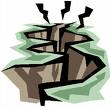 Another Cause for Alarm in Iran’s Nuclear Program: Earthquakes, The Atlantic, Jill Keenan, 18 April 13, The country’s nuclear power plant is built near tectonic plates, and reports show it may not be safe in the event of a major seismic event. On April 16, a massive 7.8-magnitude earthquake hit southeast Iran, sending tremors across the region and causing casualties that are expected to reach into the hundreds. According to an Iranian official , it was the biggest earthquake to hit the country in 40 years. This devastation comes only one week after another earthquake hit the town of Kaki, also in southern Iran, killing at least 37 people and injuring more than 850 others. Shockwaves from both earthquakes were felt as far away as Bahrain, Kuwait, Qatar, the UAE, and western Saudi Arabia. They are only the two most recent in a series of earthquakes that regularly haunt this seismically unstable country.
Most ominously, the epicenter of the April 9 earthquake’s first tremor, which measured a 6.3 on the Richter scale, was centered only 62 miles away from Iran’s Bushehr nuclear power plant. Continue reading
Saudi Arabia to spend $109 billion on renewable energy projects
Saudi Arabia To Add 50GW Of Renewables By 2030 http://www.energymatters.com.au/index.php?main_page=news_article&article_id=3693 17 April 13 Saudi Arabia plans to spend $109 billion on renewable energy projects over the next 20 years, installing more solar and wind power capacity than the rest of the world to date. Continue reading
1 This Month




PLEASE OPPOSE HR 8255 AND S.3639 – bills would accelerate satellite deployment, with no environmental review or safeguards – https://ncstd5li.quorum.us/campaign/169331/
To see nuclear-related stories in greater depth and intensity – go to https://nuclearinformation.wordpress.com
-
Archives
- September 2026 (330)
- August 2026 (330)
- July 2026 (355)
- June 2026 (287)
- May 2026 (306)
- April 2026 (356)
- March 2026 (251)
- February 2026 (267)
- January 2026 (308)
- December 2025 (358)
- November 2025 (359)
- October 2025 (375)
-
Categories
- 1
- 1 NUCLEAR ISSUES
- business and costs
- climate change
- culture and arts
- ENERGY
- environment
- health
- history
- indigenous issues
- Legal
- marketing of nuclear
- media
- opposition to nuclear
- PERSONAL STORIES
- politics
- politics international
- Religion and ethics
- safety
- secrets,lies and civil liberties
- spinbuster
- technology
- Uranium
- wastes
- weapons and war
- Women
- 2 WORLD
- ACTION
- AFRICA
- Atrocities
- AUSTRALIA
- Christina's notes
- Christina's themes
- culture and arts
- Events
- Fuk 2022
- Fuk 2023
- Fukushima 2017
- Fukushima 2018
- fukushima 2019
- Fukushima 2020
- Fukushima 2021
- general
- global warming
- Humour (God we need it)
- Nuclear
- RARE EARTHS
- Reference
- resources – print
- Resources -audiovicual
- Weekly Newsletter
- World
- World Nuclear
- YouTube
-
RSS
Entries RSS
Comments RSS

