Iran’s new President determined to resolve nuclear issue
New Iranian president Hassan Rouhani pledges resolution with West over nuclear issue, ABC News 7 Aug 13 Iran’s new president, Hassan Rouhani, says he is determined to resolve his country’s dispute with the West over its nuclear regime.
In the first media conference since being sworn in for the man seen in the west as a relatively moderate leader, Mr Rouhani said he was ready to begin negotiations over the issue which has caused years of stalemate.
“We will not do away with the right of the nation,” the 64-year-old said, indicating Iran would not be abandoning its nuclear program.
“However, we are for negotiations and interaction. We are prepared, seriously and without wasting time, to enter negotiations which are serious and substantive with the other side.
“If the other party is also prepared like we are, then I am confident that the concerns of both sides will be removed through negotiations within a period which will not be very long.”
Warns against carrot and stick approach
Western countries and Israel have said in the past they believed Iran was trying to achieve nuclear weapons capability, but Tehran says its program is purely for peaceful needs.
The new president’s approach is likely to reinforce a sense of cautious optimism in the West, despite the fact negotiations over Iran’s nuclear program have long frustrated both sides……….. http://www.abc.net.au/news/2013-08-07/iran27s-rouhani-pledges-resolution-of-nuclear-issue/4869626
Bahrain to set up nuclear radiation monitoring centre
CENTRE TO MONITOR NUCLEAR RADIATION http://www.gulf-daily-news.com/NewsDetails.aspx?storyid=358742By Ahmed Al Omari , Tuesday, August 06, 2013
MANAMA: Bahrain may soon set up a nuclear radiation monitoring centre.
This comes amidst growing concerns over threats of a fallout from Iran’s disputed nuclear power plant at Bushehr, just 300km away from Bahrain, across the Gulf.
The GCC last month raised concerns about radiation leaks from the facility after a 6.3 magnitude earthquake hit Iran in April earlier this year, killing more than 60 people.
Supreme Council for Environment (SCE) director-general Dr Adel Al Zayani believes a National Centre for Radiation could be approved within a week – the National Disaster Committee is currently studying a SCE proposal in this regard.
He said the nuclear threat has become larger with neighbouring countries moving toward using atomic facilities for energy production.
Saudi Arabia has announced plans to set up 16 nuclear reactors within the next 20 years and two are already being built in the UAE.
Dr Al Zayani said the proposed centre is designed to become a resource for the field of radiation and to prevent local disasters if they occur regionally.
“The centre will give Bahrain a more dedicated and faster radiation warning and reporting system.”
The centre will also give training to Bahrainis in subjects such as nuclear physics..
USA and Israel – two unaccountable nuclear weapons States
Because the American press is a corrupt government propaganda ministry, the American people have no idea that neoconized Washington is planning nuclear war. Americans are no more aware of this than they are of former President Jimmy Carter’s recent statement, reported only in Germany, that the United States no longer has a functioning democracy.
America Plans Unprovoked Nuclear Attack on China, edited and abridged from various sources by Lasha Darkmoon, Darkmoon, August 3, 2013 by Montecristo “……….PAUL CRAIG ROBERTS: Amitai Etzioni has raised an important question: “Who authorized preparations for war with China?” We are confronted with a neoconized US military out of control endangering Americans and the rest of the world.
Etzioni is correct that this is a momentous decision made by a neoconized military. If the Chinese government is realistic, it is aware that Washington is planning a pre-emptive nuclear attack against China. No other kind of war makes any sense from Washington’s standpoint. The “superpower” was never able to occupy Baghdad, and after 11 years of war has been defeated in Afghanistan by a few thousand lightly armed Taliban. It would be curtains for Washington to get into a conventional war with China.
The Pentagon’s war plan for China is called “AirSea Battle.” It is clear that if the Washington morons get a war going, the only way Washington can prevail is with nuclear weapons. The radiation, of course, will kill Americans as well……..
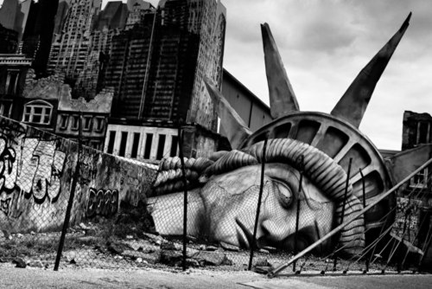
The Soviet collapse and China’s focus on its economy instead of its military have resulted in Washington’s advantage in nuclear weaponry, giving it first-strike capability. Neither Russia nor China would be in any position to retaliate to Washington’s first strike. To ensure Russia’s inability to retaliate, Washington is placing anti-ballistic missiles on Russia’s borders in violation of the US-USSR agreement. Continue reading
Depleted uranium, birth defects Iraq, and the official cover-up
 The withholding of the WHO report suggests extreme pressure on the World Health Organization by nations which have something terrible to hide. It would be difficult for the report to sidestep epidemic rates of cancer in Iraq regions where depleted uranium was used. Chowdhury’s article, “WHO’s Iraq Birth Defect Study Omits Causation,” indicates the WHO report purposefully avoids considering the causes of the overwhelming birth defects, disease, and death rates.

 Syria, Iraq and Depleted Uranium http://www.globalresearch.ca/syria-iraq-and-depleted-uranium/5343806 By John Bart Gerald
Global Research, July 25, 2013 As the U.S.considers expanding its war on Syria to overt military aggression, Iraq provides some warning of the human cost of accepting the policies of madmen. In Iraq military action starting with “Desert Storm” in 1991, caused the near total destruction of Iraq’s society, culture, environment and eventual losses of millions of innocent people. Health and mortality information risks heavy suppression and manipulation since it provides evidence concerning a crime. In Spain, theBrussells Tribunal‘s cogent case attempting to prosecute George Bush, Tony Blair and others for genocide inIraq was rejected by the court. Lack of legal recourse for the people of Iraq before a non-partisan international court marks the International Criminal Court’s failure to bend the major powers from illegal wars of aggression.
Primary alleged crimes of the U.S. and NATO coalition’s war on Iraq remain unaddressed:
1. aggression and the betrayal of Iraq’s sovereignty.
2. massive military bombardment of civilian areas.
3. intentional destruction of the civilian infrastructure and water supply.
4. use of depleted uranium weaponry to cause the slow death of civilian populations and render portions of the land unable to sustain health and life in the future.
While these points are neglected by the media, current information concerning use of depleted uranium is so notably missing there may be an attempt to remove the issue from the public’s awareness (1 and 2). While depleted uranium is a lethal radiological weapon, relevant public information is suppressed, excised, falsely countered and ignored. Continue reading
Israel’s nuclear safety procedures criticised
“…….The Dimona facility’s safety procedures have been severely criticized by the courts in recent years, following a suit by 44 employees and the families of former employees who claimed they had developed cancer and other diseases due to overexposure to radiation.
IAEC officials insisted that the number of cancer cases among employees isn’t higher than that among the general population. Nevertheless, a year and a half later, Justice Minister Tzipi Livni appointed a committee to recommend special compensation for employees who developed fatal diseases. “….. Haaretz 23 July 13
18 Arab nations pressure UN for Israel to come clean about nuclear weapons

 Arab States Demand Focus on Israeli Nuclear Capacities http://www.nationaljournal.com/global-security-newswire/arab-states-demand-focus-on-israeli-nuclear-capacities-20130716 By Global Security Newswire Staff July 16, 2013 Syria and 17 other Arab nations on Monday sent a top U.N. nuclear official a proposal aimed at pressuring Israel to come clean about its presumed nuclear arsenal, the Associated Press reported.
The measure is intended for consideration at a September meeting of International Atomic Energy Agency member nations.
“Israel alone possesses nuclear capabilities, which are undeclared and not subject to international control thus constituting a permanent threat to peace and security in the region,” the countries said in a statement accompanying the draft resolution sent to IAEA Director General Yukiya Amano.
The measure itself “expresses concern about the Israeli nuclear capabilities, and calls upon Israel to accede to the [Nuclear Nonproliferation Treaty] and place all of its nuclear facilities under comprehensive IAEA [inspections].”
Arab governments are pushing to focus attention on Israeli atomic activities because they hold Tel Aviv and Washington responsible for a missed 2012 deadline for holding talks on a potential Middle Eastern WMD ban, according to one insider.
Newly found documents reveal Israel’s nuclear weapons drive
Canadian report on Israeli nuclear program stunned 1964 diplomatic world BY IAN MACLEOD, OTTAWA CITIZEN JULY 12, 2013 OTTAWA — Crucial evidence of Israel’s suspected nuclear weapons program was discovered by Canada in 1964, sending shivers through Washington, Ottawa and London, according to newly-surfaced U.S. and British national archives’ papers.
A spring 1964 Canadian intelligence report revealed Argentina had secretly agreed to supply Israel with at least 80 tons of uranium oxide “yellowcake” to fabricate fuel for a mysterious nuclear reactor Israel was constructing with French assistance near the town of Dimona in the Negev Desert.
Spent, or irradiated, reactor fuel can be reprocessed to harvest plutonium for making nuclear weapons and, since 1960, the U.S. and its allies conjectured Israel was pursuing a nuclear weapons program.
But the eye-opening Canadian report, which the U.S. initially doubted, confirmed fears that Israel was ambitiously seeking a secret uranium supply, under which there would be no international safeguards to ensure the yellowcake was used for peaceful purposes.
Forty-three previously secret U.S. and British government archival documents related to the Israeli yellowcake file recently surfaced and have now been published by the U.S. National Security Archives in concert with two nuclear non-proliferation organizations…… Continue reading
Saudi Arabia set to become – well – the Saudi Arabia of Solar Energy
 Saudi Arabia Pushes Renewable Energy Programs, Wants to Become Solar-Powered Efficient and Capable by 2032 http://au.ibtimes.com/articles/486391/20130704/saudi-arabia-renewable-energy-solar-power.htm#.UdiSeztwo6I By Esther Tanquintic-Misa | July 4, 2013
Saudi Arabia has started to aggressively push forward its renewable energy programmes by installing 70 stations across the oil-rich nation that will measure the potential for energy production from sun, wind and geothermal sources. The kingdom targets to become solar-powered efficient and capable by 2032.
Ten of these stations have been put up. They will collect all weather and air data to show renewable energy sources in all parts of the kingdom. Researchers will then be able to access the data through a Web site, relaying information such as solar radiation and wind speed. Essentially, the findings will provide potential investors with guidance on where to build renewable-energy related plants. Saudi Arabia wants to attract about $109 billion to be able to create a solar industry that will help give off one-third of its electricity requirements by 2032, or about 41,000 megawatts.
Saudi Arabia targets to install 23.9 GW of renewable power capacity by 2020 and then 54.1 GW by 2032.Incidentally, countries in the Gulf region are turning more their focus toward clean renewable sources of energy for their power generation. Collectively, they target solar energy one of the region’s main sources of energy by 2017.
Apart from Saudi Arabia, Qatar and Kuwait have started aggressive planning towards renewable energy programs. Qatar targets to source 10 per cent of the electricity and energy used in water desalination from solar energy by 2018, while Kuwait wants to obtain 10 per cent of its power requirements from renewable energy sources by 2020.
Overall, some $155 billion worth solar power installation projects are in the pipeline for the entire Gulf region. These projects can give off more than 84 GW of power.
Iran considers halting 20%uranium enrichment
Russian FM: Iran willing to halt 20% uranium enrichment http://www.jpost.com/Iranian-Threat/News/Russian-foreign-minister-Iran-willing-to-halt-20-percent-uranium-enrichment-316937 Lavrov: International community should react to Iran’s constructive steps by similar measures. By JPOST.COM STAFF 06/18/2013 Iran has expressed readiness to stop uranium enrichment to a fissile concentration of 20 percent in exchange for the easing of sanctions imposed by the P5+1 countries on the Islamic Republic, Russian Foreign Minister Sergei Lavrov told the Kuwait News Agency (KUNA) on Tuesday.
“The international community should react to Iran’s constructive steps by similar measures [such as the] gradual halt of sanctions and scrapping them, including the curbs of unilateral basis or those approved by the Security Council,” Lavrov said. Lavrov added that in light of Iran’s willingness to cooperate with the West, sanctions should not be tightened, but eased.
He urged both Iran and the six world powers (five permanent members of the UN Security Council and Germany) to show flexibility in nuclear talks in order to move forward.On Sunday, the International Atomic Energy Agency (IAEA) said Iran was making “steady progress” in expending its nuclear program despite international sanctions, that do not seem to be slowing it down.
“There is a steady increase of capacity and production” in Iran’s nuclear program, Yukiya Amano said in an interview with Reuters.
He spoke shortly after Iranian President-elect Hassan Rohani pledged, during a news conference in Tehran, to be more transparent about Iran’s nuclear program in order to see sanctions lifted.
But Rohani also said Tehran was not ready to suspend its enrichment of uranium, which the West fears is aimed at producing a nuclear weapons capability – something Iran denies.
Renewable energy program for Kuwait
Kuwait orders 2000 MW worth of renewable energy, Arabian Gazette by John Brian Shannon / June 15, 2013 Kuwait is set to spend USD 100 billion on the nation’s domestic energy sector over the next 5 years – and for the first time, some of that investment is earmarked for renewable energy. – See more at:
http://arabiangazette.com/kuwait-orders-2000-mw-renewable-20130615/#sthash.T2AZUK1u.dpuf
– See more at: http://arabiangazette.com/kuwait-orders-2000-mw-renewable-20130615/#sthash.T2AZUK1u.dpuf
Water-guzzling nuclear power is not viable for Jordan


Professor Steve Thomas, a nuclear policy expert from the University of Greenwich in London, also questions the argument that renewables aren’t a realistic option for Jordan.
“Although the government have been saying that they aren’t viable, what really isn’t viable is their nuclear plans,” he told DW.
Jordanians protest plans to go nuclear. DW 14 June 13, As Jordan works on plans to build its first nuclear plant, protestors are still criticizing the country’s decision to go nuclear in the first place. They say it wastes water and ignores the nation’s renewables potential.
Safa Al Jayoussi, an activist with Greenpeace in Jordan, becomes concerned when she starts to explain why Jordan won’t be able to cope with the country’s impending turn towards nuclear power. She says Jordan is one of the five driest countries in the world and that the new power plans are just going to put the nation under even more pressure.
“Nuclear power plants require large quantities of cooling water, usually from a large river or a large lake,” she told DW. “But, in Jordan, we don’t really have any sources of water.” Continue reading
Why is World Health Organisation not releasing Iraq birth defects report?
 What’s delaying the WHO report on Iraqi birth defects http://www.aljazeera.com/indepth/opinion/2013/06/201365101540408281.html A 2012 World Health Organization study on congenital birth defects in Iraq has still not been released to the public. 06 Jun 2013 Mozhgan Savabieasfahani Dr Mozhgan Savabieasfahani, a native of Iran, is an environmental toxicologist based in Michigan. She is the author of over two dozen peer reviewed articles and the book, Pollution and Reproductive Damage (DVM 2009).

Iraq is poisoned. Thirty-five million Iraqis wake up every morning to a living nightmare of childhood cancers, adult cancers and birth defects. Familial cancers, cluster cancers and multiple cancers in the same individual have become frequent in Iraq.
Sterility, repeated miscarriages, stillbirths and severe birth defects – some never described in any medical books – are all around, in increasing numbers. Trapped in this hellish nightmare, millions of Iraqis struggle to survive, and they and they call for help.
At long last, public pressure and media attention to this public health catastrophe prompted a joint study by the World Health Organization (WHO) and the Iraqi Ministry of Health to determine the prevalence of birth defects in Iraq. This study began in May-June 2012 and was completed in early October 2012. Continue reading
Candidates for Iran’s Presidential election in dispute over nuclear issue
Iranian Candidates Quarrel Over Nuclear Talks By ALI AKBAR DAREINI Associated Press TEHRAN, Iran June 7, 2013 (AP) Iran’s eight presidential candidates quarreled about talks with world powers over the country’s disputed nuclear program Friday as they held their final televised debate ahead of next week’s election.
Iran’s president does not have control of central issues like nuclear development policy but does generally enjoy a close relationship with Supreme Leader Ayatollah Ali Khamenei that can prove influential. The issue also has come to the fore as the Islamic Republic’s ailing economy has emerged as a major focus of campaigning ahead of the June 14 vote…… http://abcnews.go.com/International/wireStory/iran-presidential-candidates-debate-nuclear-talks-19349438#.UbOr5edwo6I
Iran’s Bushehr nuclear plant has long cracks: its safety is in doubt
Iran’s only working nuclear reactor damaged by earthquakes, diplomats say Fox news, June 04, 201 Associated Press Several countries monitoring Iran’s nuclear program have picked up information that the country’s only power-producing nuclear reactor was damaged by one or more of several recent earthquakes, with long cracks appearing in at least one section of the structure, two diplomats said Tuesday.
Iran is under U.N. sanctions for refusing to stop nuclear programs that could be used to make weapons, even as it insists it has no such plans.
Its Bushehr nuclear plant is not considered a proliferation threat. But some nations are concerned about how safe it is. Iran has refused to join an international nuclear safety convention and persistent technical problems have shut the plant for lengthy periods since it started up in September 2011 after years of construction delays.
Reports of the International Atomic Energy Agency in February and May said the agency had been informed by the Iranians that the facility was shut down, without specifying why.
Kuwait and other Arab countries are only a few hundred miles away from Iran’s Bushehr reactor, which is on the Persian Gulf coast, and are particularly worried about the safety of the Russian-built reactor. Saudi Arabia mentioned Bushehr as a safety concern on Tuesday at a session of the Vienna-based IAEA’s 35-nation board.
But Iran insists the plant is technically sound and built to withstand all but the largest earthquakes unscathed. Officials in Tehran reassured the international community after the quakes struck in April and early May that the facility was undamaged.
The diplomats referred to recent restricted information gathered from the site in questioning that assertion. They told The Associated Press that one concrete section of the structure developed cracks several meters long as a result of the quakes on April 9 and April 16.
Both diplomats are from member countries of the Vienna-based International Atomic Energy Agency, which monitors Iran’s nuclear program. They demanded anonymity because they are not allowed to divulge confidential information.
One of the two said that the cracks seen were not in the vicinity of the reactor core, which contains highly radioactive fuel. But he said that the information available was limited to one section of the reactor, meaning damage elsewhere could not be ruled out.
He declined to go into details, saying that could jeopardize the sources…….
Iran is the only country operating a nuclear power plant that has not signed on to the 75-nation nuclear safety convention, which was created after the 1986 Chernobyl nuclear disaster.
Iran converting much enriched uranium to non weapons usable form
Uranium conversion may help ease bomb fears, Japan Times, 1 June 13 VIENNA – An important recent development in Iran’s nuclear program, if it continues, might help to ease international fears that Tehran wants the bomb, but serious questions still remain, analysts and diplomats said.
This potentially positive step, as highlighted in recent quarterly reports by the International Atomic Energy Agency, concerns uranium enriched by Iran to a fissile purity of 20 percent.
This material is of major international concern because if further purified to 90 percent — a process well within Iran’s technical capabilities — it would be suitable for a bomb.
According to the IAEA’s most recent report, Iran has produced 324 kg of uranium enriched to 20 percent, well above the about 240 kg thought to be needed for one nuclear device — which is reportedly also Israel’s “red line”.
But more than 40 percent of this has been converted into another form, triuranium octoxide, which experts say is tricky to convert back to the original uranium hexafluoride.
Iran says that it is converting this uranium in order to provide fuel for a reactor in Tehran, and four others that outgoing President Mahmoud Ahmadinejad last February ordered constructed, for nuclear medicines.
Tehran also calls it a “confidence-building” measure in so-far fruitless talks with six world powers on hold until after the presidential election on June 14…… http://www.japantimes.co.jp/news/2013/06/01/world/uranium-conversion-may-help-ease-bomb-fears/#.UapgdNJwo6I
1 This Month




PLEASE OPPOSE HR 8255 AND S.3639 – bills would accelerate satellite deployment, with no environmental review or safeguards – https://ncstd5li.quorum.us/campaign/169331/
To see nuclear-related stories in greater depth and intensity – go to https://nuclearinformation.wordpress.com
-
Archives
- September 2026 (330)
- August 2026 (330)
- July 2026 (355)
- June 2026 (287)
- May 2026 (306)
- April 2026 (356)
- March 2026 (251)
- February 2026 (267)
- January 2026 (308)
- December 2025 (358)
- November 2025 (359)
- October 2025 (375)
-
Categories
- 1
- 1 NUCLEAR ISSUES
- business and costs
- climate change
- culture and arts
- ENERGY
- environment
- health
- history
- indigenous issues
- Legal
- marketing of nuclear
- media
- opposition to nuclear
- PERSONAL STORIES
- politics
- politics international
- Religion and ethics
- safety
- secrets,lies and civil liberties
- spinbuster
- technology
- Uranium
- wastes
- weapons and war
- Women
- 2 WORLD
- ACTION
- AFRICA
- Atrocities
- AUSTRALIA
- Christina's notes
- Christina's themes
- culture and arts
- Events
- Fuk 2022
- Fuk 2023
- Fukushima 2017
- Fukushima 2018
- fukushima 2019
- Fukushima 2020
- Fukushima 2021
- general
- global warming
- Humour (God we need it)
- Nuclear
- RARE EARTHS
- Reference
- resources – print
- Resources -audiovicual
- Weekly Newsletter
- World
- World Nuclear
- YouTube
-
RSS
Entries RSS
Comments RSS

