Hackers trading passwords used by managers at British nuclear power plants
 Russian hackers trade passwords used by managers at British nuclear power plants – including ‘Rad1at10n’ and ‘Nuclear1’ http://www.dailymail.co.uk/news/article-4635420/Russian-hackers-trade-passwords-UK-nuclear-plant-staff.html,
- The passwords of two senior EDF nuclear plant managers were traded online
- French-owned firm EDF Energy operates all 15 of Britain’s nuclear reactors
- Comes as thousands of government officials – including MPs – were hacked
The passwords – ‘Nuclear1’ and ‘Radiat10n’ – are thought to have been used on the business site LinkedIn.
They were being traded by hackers who had easily guessed the letters and numbers.
EDF, which operates Britain’s 15 nuclear reactors, did not comment about the breach.
But the French-owned firm did say, according to The Times, that it is ‘continually reviewing its defences and preparedness in this area’.
The lists on which the passwords appeared were traded privately before being made public.
It comes as around 1,000 British MPs and parliamentary staff, 7,000 police employees and more than 1,000 Foreign Office officials were all understood to have had confidential information traded online without their knowledge.Even some of the prime minister’s closest government ministers, including education secretary, Justine Greening, and business secretary, Greg Clark, are thought to have been affected by the hack.
The huge database was being sold for just £2, with the low price justified by the fact it had already spent months being passed around. Its original price is likely to have been much higher.
Hackers can easily guess many passwords, especially those which are merely a word associated with a certain person but with ‘3’ instead of ‘E’ or ‘1’ instead of ‘I’.
There have been warnings that the hacked passwords could be used to blackmail workers in sensitive jobs, or even to break into government servers.
Britain’s Hinkley Point nuclear project to cost billions more than was forecast

 Nuclear plant to cost consumers ‘billions more’ News 24 24 June 17 London – A highly-controversial UK government deal for the new Hinkley Point nuclear power plant will cost British energy consumers billions more pounds than forecast, the country’s National Audit Office said on Friday.
“The Department for Business, Energy and Industrial Strategy’s deal for Hinkley Point C has locked consumers into a risky and expensive project with uncertain strategic and economic benefits,” the NAO said in a report.
Under the project, UK energy users will have sums added to their bills for a period of 35 years.
The NAO said the combined cost of such payments is set to surge to $38bn.
The contract for a French-Chinese consortium to build Britain’s first nuclear plant in a generation was signed in September after a string of controversies threatened to scupper the huge deal.
China’s involvement
The British government had delayed agreement over concerns about China’s involvement, while there were also questions about how the French state-owned power giant EDF would fund the construction of Hinkley Point.
But Britain finally gave the go-ahead last September for the complex, which is expected to provide seven percent of the country’s power needs. Beijing’s state-run China General Nuclear Corporation is set to finance £6bn of the cost of the Hinkley Point plant, with French state-owned power giant EDF providing the remaining £12bn.
Critics have focused on an electricity price guarantee to be paid to EDF of £92.5 for every megawatt hour of power produced by Hinkley for the next 35 years, rising with inflation, despite falling energy prices…….http://www.news24.com/World/News/nuclear-plant-to-cost-consumers-billions-more-20170624
The Fight Against Hinkley Nuclear Isn’t Over – UK Greens
Green Party 23rd June 2017,Lucas: “Consumers and taxpayers are going to be ripped off by this absurd
project” Caroline Lucas, the co-leader of the Green Party, has responded to
a report by the National Audit Office on Hinkley Power Station.
The report says that the Department for Business, Energy and Industrial Strategy’s
deal for Hinkley Point C has locked consumers into a ‘risky and expensive
project’ with uncertain strategic and economic benefits. The multibillion
pound project at Hinkley is currently supported by both Labour and the
Coservatives, but opposition to the plans is expected to grow as the costs
soar.
Caroline Lucas, co-leader of the Green Party, said: “The National
Audit Office’s damning report confirms what many of us have been saying
for a long time: the Hinkley deal is overpriced and risky. Not only are
consumers and taxpayers going to be ripped off by this absurd project but
it will also divert resources away from building the clean energy
infrastructure we need, and threaten our climate change targets because of
the snail’s pace at which it will be built.
“The fight against Hinkley isn’t over – and we will be joining campaigners in continuing to
highlight the major shortcomings of this project. This is a crossroads for
Britain – and the signing of this deal has seen us swerve down the wrong
path. By reversing this decision we can put the resources needed into
building a decentralized energy system where Britain puts to use its most
abundant resources: the sun, sea and wind.”
https://www.greenparty.org.uk/news/2017/06/23/caroline-lucas-nao-report-on-hinkley-is-damning/
EDF braces for a multi-billion euro rise in costs at its Hinkley Point C nuclear site
 Telegraph 25th June 2017,EDF is bracing for a multi-billion euro rise in costs at its Hinkley Point C nuclear site after a fresh evaluation of the project revealed yet another
likely delay. An internal review of the troubled project by senior
executives at EDF’s French headquarters is expected to confirm fears that
the state-backed energy giant will not be able to deliver Hinkley on time
or in line with its £18bn budget.
The French newspaper Le Monde reported over the weekend that sources close to the review have said no one believes
it can be delivered by 2025. Instead, the start-up date is likely to be
2027 and pile a further £870m on to the construction costs of the £18bn
project. The review is being led by Jean-Michel Quilichini, the group’s
audit director, and is expected to be made public later this summer. The
latest delay is likely to fuel concerns that Government has locked energy
bill payers into “a high cost and risky deal” that could fail to deliver on
its economic promises.
http://www.telegraph.co.uk/business/2017/06/25/hinkley-nuclear-costs-climb-deadlines-slip/
Britain’s Nuclear Industry Association (NIA) in a panic about UK leaving Euratom, as part of Brexit
 Britain’s Brexit plan will plunge its nuclear power plants, cancer
treatment centres and leading research facilities into chaos within two
years, according to a secret government assessment.
Times 26th June 2017, The UK plans to pull out of Euratom, Europe’s nuclear body, at the same time as it leaves the EU
in 2019. A bill to replace European safeguards with a British system of
oversight was published in last week’s Queen’s Speech.
However, experts say that this would not match the regime provided by the EU body, meaning that
plants, research facilities and hospitals may be unable to import
radioactive material after Brexit. Officials from the Department for
Business, Enterprise and Industrial Strategy have warned that it will take
seven years to replace the current set of agreements, The Times has been
told.
The delay would partly be caused by the fact that work on new
international treaties, for example with the US and Japan, cannot start
until new inspections standards are approved. Ministers have suggested
that, as with financial regulations, there could be a transition period
after Brexit to allow a new regime to be put in place, but experts say that
the complexity of the task is still not sufficiently realised.
The Nuclear Industry Association (NIA) will today step up calls for David Davis, the
Brexit secretary, to consider asking for Britain to remain an associate
member of Euratom instead. That option will worry some Tory MPs, because
some lawyers believe that it would require oversight by the European Court
of Justice or even for Britain to continue to take part in elections to the
European parliament. Tom Greatrex, the NIA chief executive, said the plans
did not “come anywhere close” to matching the scale of the problem.
Protestors targeting Britain’s nuclear bomb bases
Herald 25th June 2017, Nuclear bomb bases on the Clyde are being targeted with blockades,
break-ins and a series of other protests next month. The campaign group,
Trident Ploughshares, is organising a disarmament camp at an ancient oak
woodland it owns near the UK’s nuclear weapons store at Coulport on Loch
Long from 8-16 July. The protest is timed to coincide with the close of
United Nations (UN) negotiations between 130 countries on a treaty banning
nuclear weapons. The UK government, along with other nuclear weapons
states, has boycotted the talks in New York.
http://www.heraldscotland.com/news/15369495.Blockades_to_target_Clyde_nuke_bases/
Czech Republic overdoing the nuclear lobby’s drive to win women over? – Bikini contest.
Czech Republic nuclear power station hosts bikini contest to choose interns, DW, 25 June 17 A Czech nuclear power plant decided a bikini contest would be a good way to choose its next round of interns. Facebook users were asked to rate school graduates who posed inside a cooling tower. A Czech nuclear power plant operator apologized last week for using a Facebook bikini contest to choose its next intern.
Power generation conglomerate CEZ had 10 bikini-clad high school graduates pose in a cooling tower of its Temelin nuclear power plant, which was briefly closed for maintenance.
It then asked Facebook users to vote for their favorite, with the most popular winning a 14 day internship at the plant.
In a press release CEZ likened the photoshoot to its previous cultural enrichment programs, such as hosting the Bohemian Philharmonic at the plant in South Bohemia. The release said the experience was greatly enjoyed by the girls, who were required to wear hard hats and enclosed shoes at all times.
Local TV channel Jihoceske filmed a feature on the shoot, showing the models touring the Czech Republic’s largest power station which is about 90 kilometers (55 miles) north east of the state of Bavaria on the German border.
The competition caused an outcry among Czech news and social media.
“The competition is absolutely outside the bounds of ethics. In 2017, I find it incredible that someone could gain a professional advantage for their good looks,” Petra Havlíková, a lawyer for human rights non-profit Nesehnutí and an equal opportunities adviser, told aktualne.cz.
Undress and you get an internship – this can not be serious, it’s degrading, disgusting and primitive,” one internet user commented.
“Knowledge obviously does not matter,” noted another user……
A Russian first
The power plant was not the first to link the wonders of nuclear energy with the revealing bathing suit.
Russia used to host an annual beauty contest open to women working in nuclear industries or studying in nuclear-related subjects in Russia and former USSR countries. Women aged 18 to 45 would pose in front of a nuclear power plant. http://www.dw.com/en/czech-republic-nuclear-power-station-hosts-bikini-contest-to-choose-interns/a-39404100
Ever increasing piles of toxic Russian radioactive trash – a challenge for Norway and Russia to clean up
some of the biggest dangers still lie ahead, and many of them come back to that small green train of so many years ago. An updated and safer versions of it will be hauling Andreyeva Bay’s waste south from Murmansk, but that shouldn’t belie the fact that transporting spent nuclear fuel over such distances is always dangerous.
More dangerous still is the location where the spent fuel will end up, which is one of the most radioactively contaminated spots in the world.
 Decades of piled up nuclear fuel bids farewell to Andreyeva Bay http://bellona.org/news/nuclear-issues/2017-06-decades-of-piled-up-nuclear-fuel-bids-farewell-to-andreyeva-bay Two decades ago, a green four-car train would make the rounds every few months to Russia’s snowy Kola Peninsula to cart nuclear fuel and radioactive waste more than 3000 kilometers south from the Arctic to the Ural Mountains. June 23, 2017 by Charles Digges charles@bellona.no

Two decades ago, a green four-car train would make the rounds every few months to Russia’s snowy Kola Peninsula to cart nuclear fuel and radioactive waste more than 3000 kilometers south from the Arctic to the Ural Mountains.
At the time, the lonely rail artery was the center of a logistical and financial bottleneck that made Northwest Russia, home of the once feared Soviet nuclear fleet, a toxic dumping ground shrouded in military secrecy.
More than a hundred rusted out submarines bobbed in the icy waters at dockside, their reactors still loaded with nuclear fuel, threating to sink or worse. Further from shore and under the waves laid other submarines and nuclear waste intentionally scuttled by the navy. Still more radioactive spent fuel was piling up in storage tanks and open-air bins, on military bases and in shipyards.
One of those places was Andreyeva Bay, a run down nuclear submarine maintenance yard just 55 kilometers from the Norwegian border. Since the birth of the nuclear navy in the 1960s, the yard came to be a dumping ground for 22,000 spent nuclear fuel assemblies offloaded from hundreds of submarines. Cracks in storage pools made worse by the hard Arctic freeze threatened to contaminate the Barents Sea. At one point, experts even feared the radioactive morgue might spark an uncontrolled nuclear chain reaction.
Infrastructure, technology and the Kremlin were failing to keep up with the mushrooming catastrophe. The nuclear fuel train could only bear away 588 fuel assemblies at a time three or four times a year – little more than the contents of one nuclear submarine per trip. Even if the train ran on schedule, removing broken or deformed nuclear fuel elements at Andreyeva Bay was still seen as impossible.
Yet even mentioning the environmental and security storm clouds was taboo: While the Navy begged the public to donate potatoes to feed sailors it was too broke to pay, the Kremlin prosecuted environmentalists who drew attention to the mounting desperation as spies.
In the bleak and politically chaotic late 1990s, many experts, like Bellona’s Andrei Zolotkov, thought that the carcinogenic remains of the Cold War would lie neglected at Andreyeva Bay for decades – or at least until Russia somehow woke up wealthy enough to deal with them.
Now, Russia is only slightly better off, yet the first containers of spent nuclear at Andreyeva Bay will begin to be bourn away by sea on June 27, marking the culmination of a multi-million dollar international effort sparked by Bellona in 1995.
The first container was packed last month. It and the 2999 that will follow will leave Andreyeva Bay on specially outfitted ships like the Rossita – itself a bit of expertise donated by Italy under the Northern Dimensions Environmental Partnership, an enormous Russian nuclear cleanup fund managed by the European Bank of Reconstruction and Development.
The transport ships will join a railhead at Atomflot, Murmansk’s nuclear icebreaker port, and from there, the fuel containers will go by train to the Mayak Chemical Combine, near the Urals city of Chelyabinsk, for reprocessing.
It’s a mammoth effort. A total of about 40 ship-to-train transports will have to be made before the bulk of the fuel is cleared out over the coming five years. But when it’s done, one of the most deviling radiation threats in the Arctic will be history.
Bring the waste out of the shadows
“The Andreyeva Bay project has shown that international projects aimed at liquidating nuclear and radioactive threats can be successful,” said Alexander Nikitin, the Bellona expert who was charged with espionage and later acquitted for bringing to light the embarrassing truth of Russia’s northern nuclear fleet more than 20 years ago. “This is proof that such projects must continue.”
The success hasn’t necessarily loosened the grip of the Soviet-era mindset. Russian nuclear officials have so far denied Norwegian television cameras access to film the first nuclear waste departure from Andreyeva Bay, an event that will be attended by the country’s foreign minster, Børge Brende, Russian officials and Bellona staff.
It also hasn’t eased Kremlin paranoia toward Bellona and its efforts to spur international attention and bring foreign funding to bear on Cold War nuclear relics. Zolotkov’s Bellona Murmansk, which helped dislodge Andreyeva Bay’s troubles from the shadows, was targeted by Russia’s foreign agent law in 2015 and closed down. The Environmental Rights Center Bellona, headed by Nikitin, followed this year.
But Zolotkov said the progress transcends politics.
“Even in complex political circumstances, international cooperation in nuclear and radiation safety in Russia’s North continues,” he said.
Cracks and contamination
Andreyeva Bay had been piling up spent nuclear submarine fuel for more than two decades when its troubles began in earnest in 1982. That year, a crack developed in its now-notorious Building 5, a storage pool for thousands of spent fuel assemblies. The ensuing leak threatened to dump a stew of plutonium, uranium and other fission products into Litsa Fjord, fouling the Barents Sea.
The water was drained and the fuel painstakingly moved, but that revealed other problems. The fuel elements from Building 5 needed somewhere to go, so they were rushed into hastily arranged storage facilities that were supposed to be only temporary. Technicians stuffed the fuel elements into three dry storage buildings and cemented them in. The temporary storage solution has now spanned the last 30 years. Meanwhile the leaking radioactive water contaminated much of the soil around Building 5.
It took the government years to catch up to the problem. In 1995, the Murmansk regional government paid it first visit to the secretive military site and, based on what it saw, shut down its operations. Five years later Moscow finally got involved, taking Andreyeva Bay out of the military’s hands and giving it to the mainly civilian Ministry of Atomic Energy, now Rosatom.
Rosatom helped coalesce a nuclear waste-handling agency in Murmansk, called SevRAO, to deal with the problem. Yet even in 2000, SevRAO was essentially working from scratch. Anatoly Grigoriev, a Rosatom nuclear safety official said last year that there weren’t even documents detailing what waste and fuel was stored where, much less an infrastructure to help safely get rid of it.
Bellona leads the charge
Norway, at Bellona’s urging, led the charge to pitch in.
Finally, in 2001, an enclosure was built over the three storage buildings to prevent further contamination while technicians worked to remove the spent fuel and load it into cases. Roads were built and cranes were brought in. Personnel decontamination posts went up, along with a laboratory complex and power lines.
A host of nations pumped funding into the burgeoning city whose central industry was safely packing up decades of nuclear fuel from Russia’s past nuclear soldiers. Starting in 2003, France, Germany, Japan, Italy, Canada and Great Britain, joined by Finland, Denmark, Sweden, and the European Commission pooled resources for a total contribution of $70 million over several years.
But Norway has led the pack by far, contributing some $230 million over the past 20 years toward safely removing Andreyeva Bay’s spend nuclear fuel – a national movement spawned when Bellona published its first report on Northwest Russia’s nuclear hazards in 1996.
“For Bellona, this event is a very important development,” said Zolotkov. “Bellona was the first group to speak openly about the problems of Andreyeva Bay, and Bellona stepped forward with a report on the developing situation.”
Nikitin agreed. “This is very important for the outlook of our work in Russia because all now see that we are capable of achieving a result, and not simply criticizing and protesting.”
In many ways, however, some of the biggest dangers still lie ahead, and many of them come back to that small green train of so many years ago. An updated and safer versions of it will be hauling Andreyeva Bay’s waste south from Murmansk, but that shouldn’t belie the fact that transporting spent nuclear fuel over such distances is always dangerous.
New dangers to bring to light
More dangerous still is the location where the spent fuel will end up, which is one of the most radioactively contaminated spots in the world.
The Mayak Chemical Combine, the birthplace of the first Soviet atomic Bomb, is the one facility in Russia capable of reprocessing spent fuel from submarines. It also gave the country its first nuclear disaster. In 1957, a tank holding nuclear waste exploded, sending a cloud of radioactivity from Chelyabinsk to Yekaterinburg and forced the evacuation of 17,000 people. Called the Kyshtym Disaster, the accident came to be regarded as Chernobyl’s more secretive older brother.
Since Mayak ramped up fuel reprocessing at its RT-1 facility in 1977, contamination has only intensified. Radioactive byproducts arising from the chemical separation of plutonium and uranium have been dumped into local rivers and lakes. Cancer rates among the local population continue to rise. The government has partially acknowledged the issue and has made stutter-step attempts to move a number of small villages away from the radioactively polluted Techa River. In the end though, those efforts only displaced villagers from one contaminated spot to another, solving nothing.
Some activists have noted that moving Andreyeva Bay’s legacy of Cold War reactor fuel 3,000 kilometers south to Mayak is a similar exercise in displacement.
Nadezhda Kutepova, a long time advocate for those afflicted by Mayak’s pollution, who was run out of the country on manufactured espionage suspicions, said Norway’s contribution to moving Andreyeva Bay’s fuel was a waste of money.
She and others recently told the Independent Barents Observer they thought the Norwegian government would be lessening the woes of one radioactively contaminated area in the country at the expense of another.
While Niktin acknowledged that Mayak was far from ideal, he noted that it was the only place in Russia that had the technology to handle the Andreyeva fuel.
But he said that shipping the fuel to Mayak also ratchets up Bellona’s responsibility for bringing to light yet newer stages of dealing with Russia’s radioactive legacy.
“The task of the public, and Bellona with it, is to ensure that Mayak doesn’t use any dirty technologies that end up throwing radioactive waste into the environment,” he said. “We must also step up to liquidate the injuries that have already happened to the environment as a result of Mayak’s work and the accident.”
In other words, if Andreyeva Bay is a measure of Bellona’s success, Mayak could repeat that history.
Should British tax-payers cough up for both Hinkley and Wylfa nuclear power boondoggles?
 FT 23rd June 2017, NAO said the government should have at least considered sharing the construction risk at Hinkley to lower the cost for consumers. This conclusion will add to debate in Whitehall over whether the government should contribute to financing other planned nuclear plants, including one planned by Hitachi of Japan at Wylfa in Anglesey.
Talks have been held between the UK and Japanese governments about making Wylfa a public-private partnership, according to people briefed on the matter. This would reduce costs for consumers compared with Hinkley but expose taxpayers to more risk. https://www.ft.com/content/8a6a7f5a-574b-11e7-80b6-9bfa4c1f83d2
Wylfa nuclear power project threatens the biodiversity of North Wales nature reserve

Daily Post 21st June 2017, Nature lovers have drawn up battle lines over Anglesey’s planned nuclear
power station amid fears that rare species will be put at risk. North Wales
Wildlife Trust (NWWT) said current proposals for Wylfa Newydd are
“damaging” and could jeopardise Wales’ sole breeding colony of
Sandwich terns.
It said construction work will take place just 110 metres
from an internationally designated nature reserve at Cemlyn, while the
development will drain directly into Tre’r Gof fen, a Site of Special
Scientific Interest.
The Trust has issued a long list of species it
believes are at risk from the power plant, from water voles to otters,
great crested newts and European eels. Local populations of chough, adders,
brown hares, red squirrels and hedgehogs could also be vulnerable, it said.
http://www.dailypost.co.uk/news/local-news/wildlife-groups-fear-rare-species-13217542
Defects in pressure vessel of Flamanville nuclear reactor could stall EPR’s global nuclear industry
 France Info 22nd June 2017 [Machine Translation] Defects on the pressure vessel of the EPR of Flamanville: “EDF and Areva were not transparent,” denounces Greenpeace. Greenpeace believes that EDF and Areva have not sufficiently communicated on the defects of the pressure vessel of the EPR of Flamanville.
“The origin of the anomalies and the history of the design” have not been made\ public, denounces the association in particular. The NGO is based on a report to which it has had access and which is due to be published onThursday by the High Committee for Transparency and Information on Nuclear Safety (HCTISN) on anomalies in the Flamanville EPR tank ( Handle). The HCTISN is an expert committee on nuclear safety. It decided in June 2015 totake the matter of the anomalies on the tank of the EPR of Flamanville.
According to Greenpeace, the report states that EDF and Areva “did not explain to the public the origin of the anomalies and the history of the design and manufacture of the EPR reactor vessel.” The report also notes that “no alternative technical scenario has been made public, in the event of the rejection of the tank and its lid by the Nuclear Safety Agency
(ASN)”.
“Since the beginning of the case, EDF and Areva have put the ASN before the fait accompli: they refuse to communicate a plan B to force it to accept that the EPR starts with pieces veined,” explains Yannick Rousselet, in charge of Campaign for Greenpeace France. “The rejection of the tank by the ASN would trigger a ‘domino effect’ by questioning the
feasibility of all EPR projects sold by EDF and AREVA in the UK, China and inland, says Yannick Rousselet. Industrialists put an intolerable pressure on the ASN, making the future of the nuclear sector on its shoulders.” http://www.francetvinfo.fr/sante/environnement-et-sante/defauts-sur-la-cuve-de-lepr-de-flamanville-edf-et-areva-nont-pas-ete-transparents-denonce-greenpeace_2248675.html
June 2017 Britain sets a new renewable energy record
 Content Coms 22nd June 2017, It’s official; this month – June 2017 – the UK set a new renewable
energy record as wind and solar power surged. The Telegraph broke the news,
saying the blustery start to summer has helped the renewable energy
industry to its highest ever output, as wind turbines and solar panels
helped to meet more than half of the UK’s electricity demand.
It’s a telling reminder you don’t necessarily need the blinding sun of recent
days for panels to do their work. Revolutions take place quietly most of
the time.
Either way, the news is a truly astonishing result, and coupled
with last year’s confirmations that the world as a whole has decoupled
growth from carbon emissions, looks set to truly confound sceptics of
renewable and low carbon technologies.
And of course, it makes yet more of a mockery of President Trump’s fossil-based repudiation of Paris. His
idiocy now stands proven by the truth of what renewables can do, powering
over half of one of the world’s important economies; the UK. In fact,
soon we will be calling oil the energy alternative, and renewables the
mainstream. https://www.contentcoms.co.uk/content-coms-view-wind-solar-combine-build-uk-renewables-revolution/
Vulnerable to Climate Change – Murcia, Spain
 From heatwaves to hurricanes, floods to famine: seven climate change hotspots Global warming will not affect everyone equally. Here we look at seven key regions to see how each is tackling the consequences of climate change, Guardian, John Vidal, 23 June 17
“………Murcia, Spain
He and his colleague Joel Guiot, a paleoclimatologist, last year studied pollen locked in layers of sediment over the past 10,000 years and compared them with projections about climate and vegetation from the Intergovernmental Panel on Climate Change.
If warming is allowed to rise to 2C, the scientists concluded, much of southern Spain and the Mediterranean basin could become desert. Their paper, published in Science, was shocking because it showed that even a small temperature increase could be enough to create ecological havoc in a very heavily populated region with relatively wealthy countries.
They warned that North African countries would see increased temperatures and drought that would drive the southern deserts further north; that deserts would expand in the Middle East, pushing temperate forests higher into the mountains; and that ecosystems not seen in the Mediterranean basin in more than 10,000 years could develop.
“We are more certain of the drying trend in the region than almost anywhere else on the planet. Temperatures have risen 1C globally but 1.4C in the Mediterranean region. The trend is for it to become ever warmer,” says Cramer.
Increasing temperature, he says, drives droughts. “More carbon dioxide in the atmosphere means rising temperatures, less precipitation and then more drying that leads to desertification.”
Meanwhile, water stress, heat waves and an extended drought linked to climate change in the eastern Mediterranean has been widely implicated in the long Syrian war and an underlying driver of conflict in Middle East and North African countries.
The World Resources Institute concurred in 2015 that the Mediterranean basin was a climate hotspot when it placed 14 of the world’s 33 most water-stressed countries in 2040 in the Middle East and North Africa region. “Drought and water shortages in Syria likely contributed to the unrest that stoked the country’s 2011 civil war. Dwindling water resources and chronic mismanagement forced 1.5 million people, primarily farmers and herders, to lose their livelihoods and leave their land, move to urban areas, and magnify Syria’s general destabilisation,” it said.
The fast-growing, heavily populated region is climatically vulnerable, it concluded. The food supplies and the social balance of places like Palestine, Israel, Algeria, Lebanon and Jordan are all highly sensitive to even a small change in water supplies. As climate change intensifies, communities face grave threats from both droughts and floods.
The combined impact of many more people, higher temperatures and changing weather patterns on the region’s already scarce freshwater resources poses further potential for conflict. But optimists hope it could force compromise between competing states and water users. Rural areas already have no option but to switch to more efficient irrigation systems and drought tolerant crops, and urban areas are learning to conserve water…..
As the global renewable energy transition speeds up, Russia gambles on nuclear energy
Experts have expressed concern that these ambitious development plans are proceeding without adequate plans for disposal of nuclear waste. The Bellona Foundation, an organization that conducts independent research into international nuclear and environmental issues, has been critical of the lack of planning for nuclear waste processing and disposal, and has pointed out that dependency on Russia for nuclear fuel may leave countries particularly vulnerable in the event of a sour political climate.

 Russia and Nuclear Power http://www.eurasianet.org/node/84076,, by
Nuclear energy is losing its luster in many parts of the world. In the United States, the drop in the cost of renewables production is making them a more attractive electricity-generation option than nuclear power. France, a country long associated with nuclear power, is also looking to reduce its reliance on reactors. And even China is now investing more in developing wind farms than it is in nuclear infrastructure.
Russia, though, is bucking the trend. Nuclear energy accounts for 11 percent of domestic power production, while the share of wind and solar power generation remains negligible, according to Bloomberg New Energy Finance. Overall, more than 40 percent of Russian power is generated by natural gas. Meanwhile, hydropower is the main renewable source of power in Russia, responsible for a roughly 20-percent share of the overall mix.
Russia has taken steps in recent months to develop its wind power potential. But development efforts are hampered by legislation that requires at least 40 percent of all renewable-energy infrastructure to be locally produced. To meet the requirement, Russia needs to find a substantial amount of foreign investment.
In the realm of international trade, Russia is trying to turn its slow embrace of renewables into an advantage. Rosatom, 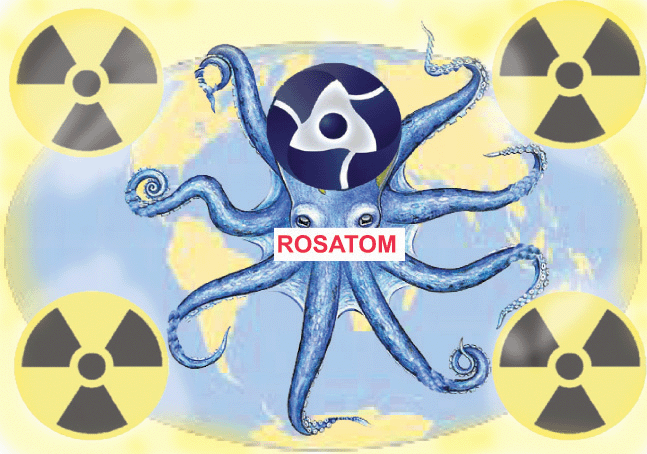 Russia’s state-owned nuclear company, is by far the most active player these days in the international market for nuclear power technologies. Rosatom currently has agreements to provide plants, fuel or expertise in 20 countries in the Middle East, Africa, Asia and Latin America. With the notable exception of the Barakah Atomic Energy Station in the United Arab Emirates, which is being built by the Korea Electric Power Corporation, Russia is the most heavily involved of any nuclear-exporting countries in developing nuclear power facilities in the Middle East.
Rosatom’s most recent move in the Middle East was a deal, sealed in late May, to construct Egypt’s first nuclear power plant, pending final approval by the Egyptian government. The pact is the latest of four bilateral agreements signed by Egypt and Russia concerning the nuclear power station at El Dabaa, approximately 200 miles west of Cairo on Egypt’s north coast. The first of these, signed in late 2015, covered the construction and maintenance of the plant for a 10-year period, and included a stipulation that Russia would provide fuel for the plant for 60 years.
The plant would consist of four VVER-1200 reactors, a new design based on the earlier VVER-1000 model developed in the Soviet Union in the mid-1970s. The first VVER-1200 was brought online earlier this year at Russia’s Novovoronezh plant. It is projected to begin producing power in 2024.
Egypt is one of four countries in and around the Middle East where Rosatom has built, or plans to build, nuclear power facilities. Rosatom’s subsidiary, Atomenergostroy, which handles the company’s overseas construction projects, has contracts to build plants in Jordan and Turkey. In addition, it is building additional reactors at Iran’s Bushehr facility. The company will provide financing, staff, and fuel, while retaining ownership of the plants and receiving revenue from the power they produce.
Russia has provided approximately 50 percent of the financing for Turkey’s plant at Akkuyu, and will provide fuel for its operation once construction is complete. Upwards of 85 percent of the financing for the El Dabaa project in Egypt is to come in the form of loans from Russia, a country in the midst of an economic downturn brought on by the global fall in fossil fuel prices.
Egypt is also exploring options for a second nuclear power plant to be built on its coast. During the Cold War, both the United States and the Soviet Union provided supplies, facilities, and training to Middle Eastern countries in an effort to promote nuclear power. The governments of Jordan and Egypt expressed interest at the time in developing nuclear power facilities in the mid-1950s, and the Soviet Union began construction on a research reactor in Egypt in 1961. Similar reactors were built in Iraq in 1967 and in Libya in 1981. In 1995, Russia’s Ministry of Atomic Energy signed a contract to take over construction of the Bushehr plant.
In 2010, Rosatom was granted the right to open offices in embassies abroad by a change in laws governing its operations. It did so in Dubai and Beijing in April of 2016, and the company’s website now boasts over $133 billion USD in overseas orders for its products.
Rosatom has also partnered with the International Atomic Energy Agency to fund nuclear infrastructure development internationally, pledging $1.8 million as well as equipment and expertise to equip countries that hope to develop nuclear power capacities in the future.
Experts have expressed concern that these ambitious development plans are proceeding without adequate plans for disposal of nuclear waste. The Bellona Foundation, an organization that conducts independent research into international nuclear and environmental issues, has been critical of the lack of planning for nuclear waste processing and disposal, and has pointed out that dependency on Russia for nuclear fuel may leave countries particularly vulnerable in the event of a sour political climate.
Russia holds AtomExpo – a triumph of nuclear marketing
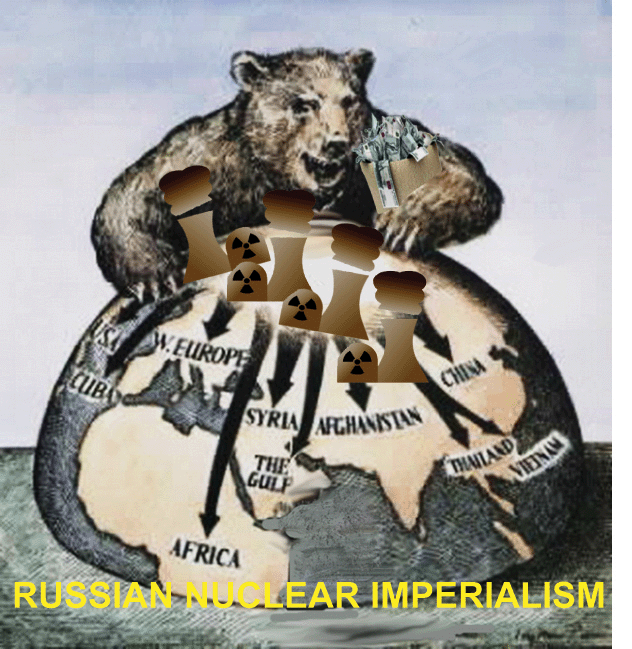 Further agreements flow from AtomExpo, World Nuclear News, 21 June 2017 More cooperation agreements and contracts have been signed by Russian state nuclear corporation Rosatom and its subsidiaries during the IX AtomExpo International Forum it is hosting this week in Moscow. The latest agreements, with Asian and European companies, cover collaboration in a wide range of nuclear-related areas and beyond.
A cooperation program for 2017-2019 was signed yesterday by Rosatom and French energy company Engie. The document was signed by Kirill Komarov, first deputy director-general for international business at Rosatom, and Jan Bartak, Engie nuclear development director. The cooperation program contains more than 20 specific projects in the field of nuclear power plant maintenance and nuclear fuel cycle services.
Rosatom’s nuclear fuel manufacturing subsidiary Tenex signed an agreement with Belgium’s Synatom to extend an existing long-term enriched uranium supply contract. The document envisages extending the contract until 2022 and increasing the volume of enriched uranium exported. Tenex has been supplying uranium products to Synatom since 1975.
Czech Republic An MOU to cooperate in repairing welding joints in steam generator vessels for VVER-440 units was signed between JSC Rusatom Service and the Czech Republic’s Skoda JS. The aim of the MOU is to develop cooperation between the two companies and identify specific projects for collaboration.
The two companies also signed a contract on the delivery of equipment for unit 2 of the Metsamor nuclear power plant in Armenia. Skoda JS will supply equipment for the control and protection system, which is to be replaced during a scheduled outage in 2018 as part of work to extend the operating period of the unit.
Rosatom’s Komarov also signed an MOU with the Czech Power Industry Alliance (CPIA) aimed at developing cooperation in nuclear energy. “That implies, first of all, CPIA member countries’ participation in Rosatom’s projects in Russia and abroad,” Rosatom said. “In its turn, the Alliance is ready to assist in obtaining export finance for Czech companies to be able to take part in the projects.”
Asian collaboration…….
Workforce development An MOU in the area of personnel training for nuclear power programs was signed yesterday between Rosatom Central Institute for Continuing Education and Training (Rosatom-CICE&T) and global testing, inspection and certification services company Bureau Veritas.
Signed by Rosatom-CICE&T rector Iurii Seleznev and Bureau Veritas vice president of nuclear services in Europe Laurent Kueny, the MOU aims to foster cooperation in the field of research, education and training in nuclear science and technology. The organisations agreed to collaborate in such areas as the exchange of materials and lecturers, as well as distance learning……..http://www.world-nuclear-news.org/C-Further-agreements-flow-from-AtomExpo-2106174.html
1 This Month



Shut down the radiation-damaged Heysham nuclear reactors now
To see nuclear-related stories in greater depth and intensity – go to https://nuclearinformation.wordpress.com

Say No to NASA’s Reckless Nuclear Reactor on the Moon
Say No to NASA’s Reckless Nuclear Reactor on the Moon
-
Archives
- October 2026 (268)
- September 2026 (339)
- August 2026 (330)
- July 2026 (355)
- June 2026 (287)
- May 2026 (306)
- April 2026 (356)
- March 2026 (251)
- February 2026 (267)
- January 2026 (308)
- December 2025 (358)
- November 2025 (359)
-
Categories
- 1
- 1 NUCLEAR ISSUES
- business and costs
- climate change
- culture and arts
- ENERGY
- environment
- health
- history
- indigenous issues
- Legal
- marketing of nuclear
- media
- opposition to nuclear
- PERSONAL STORIES
- politics
- politics international
- Religion and ethics
- safety
- secrets,lies and civil liberties
- spinbuster
- technology
- Uranium
- wastes
- weapons and war
- Women
- 2 WORLD
- ACTION
- AFRICA
- Atrocities
- AUSTRALIA
- Christina's notes
- Christina's themes
- culture and arts
- Events
- Fuk 2022
- Fuk 2023
- Fukushima 2017
- Fukushima 2018
- fukushima 2019
- Fukushima 2020
- Fukushima 2021
- general
- global warming
- Humour (God we need it)
- Nuclear
- RARE EARTHS
- Reference
- resources – print
- Resources -audiovicual
- Weekly Newsletter
- World
- World Nuclear
- YouTube
-
RSS
Entries RSS
Comments RSS

