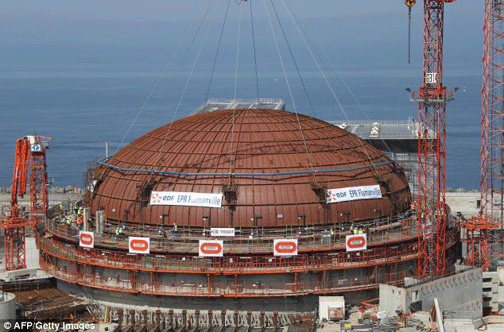
 FT 28th June 2017, A group of experts at the French nuclear safety authority have cleared
EDF’s Flamanville 3 nuclear reactor to start as planned next year – despite weak spots in its steel. The group’s non-binding recommendation will be used by the safety authority, the ASN, to formulate a final ruling on October.
But the decision makes it likely the reactor will get the final green light. Completion of the next-generation reactor had been thrown into doubt after the discovery in 2015 of weak spots in the steel prompted an
extensive safety review by the ASN.
The stakes are high for French nuclear groups EDF and Areva because it would cost billions of euros to fix if the
ASN had ruled that the steel was too brittle. The sign off by the ASN is also a European Commission pre condition for approving EDF’s planned takeover of Areva’s reactor business. The group of experts did recommend,
however, that EDF put in place a new reactor cover by 2024. https://www.ft.com/content/7b401283-e91c-3612-9e21-2d1c8c45ed8d
June 30, 2017
Posted by Christina Macpherson |
France, safety |
Leave a comment
 ASN 28th June 2017, On 28th June 2017, ASN presented its position regarding the Flamanville EPR
reactor pressure vessel anomaly. ASN relied on the analysis of the files
transmitted by Areva NP and EDF, carried out by its nuclear pressure
equipment department and its technical support organisation IRSN, and on
the opinion of its Advisory Committee for nuclear pressure equipment.
On the basis of the technical analyses carried out, ASN considers that the
mechanical characteristics of the pressure vessel bottom head and closure
head are adequate with regard to the loadings to which these parts are
subjected, including accident situations.
However, the anomaly in the chemical composition of the steel entails a reduction in the margins with
respect to the fast fracture risk. ASN therefore considers that EDF must
implement additional periodic inspections to ensure that no flaws appear
subsequently. ASN observes that such inspections can be performed on the
vessel bottom head and therefore considers that they must be implemented.
However, the technical feasibility of similar inspections on the pressure
vessel closure head is not established. ASN therefore considers that the
use of the closure head must be limited in time. It notes that it would
take about seven years to manufacture a new closure head, which could thus
be available by the end of 2024. In these conditions, ASN considers that
the current closure head shall not be operated beyond that date.
http://www.french-nuclear-safety.fr/Information/News-releases/ASN-presents-its-position-regarding-the-Flamanville-EPR-reactor-vessel-anomaly
June 30, 2017
Posted by Christina Macpherson |
France, safety |
Leave a comment


Clacton & Frinton Gazette 27th June 2017, A CAMPAIGN group has described process used to dissolve the FEDs at
Bradwell as an “outrage” and an “insult”. Members of the Blackwater
Against New Nuclear Group (BANNG) had their say on the process which saw
radioactive waste dissolved in acid at the site.
Chairman, Andy Blowers said: “It is nothing short of an outrage and an insult to the Blackwater
environment and communities that the Nuclear Decommissioning Authority
(NDA) persisted despite all the signs that dissolution with nitric acid was
a failing technology.” BANNG Secretary, Varrie Blowers added: “The NDA
obviously believes that the end justified the chaotic means. While FED
dissolution may not have finished, it is hard to imagine that anyone can
think that the FED at Bradwell has been dealt with successfully, given all
the operational difficulties and the outages experienced.”
BANNG believe the reason the process has now been completed is because of the
re-characterisation of the waste, rather than it being fully dealt with.
They point to only one third of Intermediate Level Waste being treated, as
opposed to the full amount, with two thirds being reclassified as Low Level
Waste. Barry Turner, Vice-Chair of BANNG, said: “The Bradwell FED
dissolution plant has turned out to be an expensive one-off and has been
used to dissolve only one-third of the waste and not the originally
expected 100 per cent.” http://www.clactonandfrintongazette.co.uk/news/north_essex_news/15372952.Process_used_to_remove_radioactive_waste_an__outrage__and__insult__to_the_area__says_campaign_group/
June 30, 2017
Posted by Christina Macpherson |
UK, wastes |
Leave a comment
 Co-op News 27th June 2017, Energy co-ops are in a bullish mood and are focused on sector-wide growth.
Last week, I attended the General Assembly of REScoop – the European
federation of renewable energy co-operatives – on behalf of Co-op Energy
and also as an elected director of Community Energy England.
One of the discussion points was that around half of the European Union population
will be producing their own energy in the next 40 years, according to the
European Renewable Energies Federation. The figures predict that over 264
million European citizens could produce their own energy in 2050, meeting
45% of Europe’s electricity demand.
The discussion was all very upbeat and heartening, although all gains made to date are still in play, with
legislative proposals subject to amendments from the European Parliament in
the near future. The European Commission is now even on record as saying:
“Our vision is of an Energy Union with citizens at its core, where
citizens take ownership of the energy transition, benefit from new
technologies to reduce their bills, participate actively in the market, and
where vulnerable consumers are protected.” https://www.thenews.coop/119543/sector/energy-coops-come-together-to-innovate/
June 30, 2017
Posted by Christina Macpherson |
decentralised, EUROPE |
Leave a comment
Bristol Energy Co-op 27th June 2017, Bristol Energy Cooperative (BEC) launches a new crowdfund to continue its
journey to become a major generator of community-owned clean energy. The
crowdfund target of £1,150,000 will enable BEC to repay previous loans and
invest in new micro-renewable generation and storage schemes. These include
a 100kW Tesla battery storage project at a new sustainable housing site.
This bond offer builds on the popularity of BEC’s energy schemes where
surplus profits are reinvested into the community. BEC has a proven track
record of funding and developing renewables, including raising the
ambitious sum of £10m last year.
http://www.bristolenergy.coop/news–events/our-new-crowdfund-launches-to-continue-the-energy-revolution
June 30, 2017
Posted by Christina Macpherson |
decentralised, UK |
Leave a comment
 Chernobyl nuclear plant’s radiation monitoring hit by cyber attack: Officials http://www.newindianexpress.com/world/2017/jun/28/chernobyl-nuclear-plants-radiation-monitoring-hit-by-cyber-attack-officials-1621663.html By AFP 28th June 2017 UKRAINE: The radiation monitoring system at Ukraine’s Chernobyl nuclear site has been taken offline after a massive cyber attack, forcing employees to use hand-held counters to measure levels, officials said on Tuesday.
“Due to the cyber attack, the website of the Chernobyl nuclear plant is not working,” said Ukraine’s exclusion zone agency which oversees the Soviet plant that exploded in 1986 and is now surrounded by an uninhabited contaminated zone.
“Due to the temporary shutdown of the Windows system, the radiation monitoring of the industrial area is being done manually,” the agency said on its website.
“That means that our measurers go out with hand-held meters on the Chernobyl plant like it was decades ago,” a spokeswoman for the agency, Olena Kovalchuk, told AFP.
The plant’s destroyed reactor was enclosed in a huge metal structure last year in a bid to stop radiation leaks at the site, where more than 200 tonnes of uranium remain.
Ukraine, along with Russia and companies across Europe, was hit on Tuesday in a wave of cyberattacks which IT experts identified as a modified version of the Petya ransomware that struck last year.
Ukraine’s exclusion zone agency said that Chernobyl’s “technological systems are working as usual” and that radiation control is “without delays”.
June 28, 2017
Posted by Christina Macpherson |
incidents, Ukraine |
2 Comments
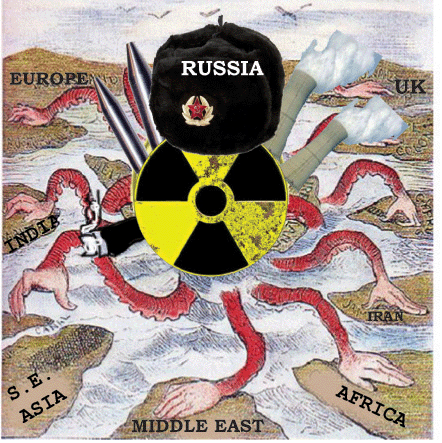
 Russian Nuclear Power in the Middle East http://vestnikkavkaza.net/analysis/Russian-Nuclear-Power-in-the-Middle-East.html 26 June17 Eurasia Review Nuclear energy is losing its luster in many parts of the world. In the United States, the drop in the cost of renewables production is making them a more attractive electricity-generation option than nuclear power. France, a country long associated with nuclear power, is also looking to reduce its reliance on reactors. And even China is now investing more in developing wind farms than it is in nuclear infrastructure. Russia, though, is bucking the trend.Eurasia review reports in its article Russia And Nuclear Power that nuclear energy accounts for 11 percent of domestic power production, while the share of wind and solar power generation remains negligible, according to Bloomberg New Energy Finance. Overall, more than 40 percent of Russian power is generated by natural gas. Meanwhile, hydropower is the main renewable source of power in Russia, responsible for a roughly 20-percent share of the overall mix. Russia has taken steps in recent months to develop its wind power potential. But development efforts are hampered by legislation that requires at least 40 percent of all renewable-energy infrastructure to be locally produced. To meet the requirement, Russia needs to find a substantial amount of foreign investment. In the realm of international trade, Russia is trying to turn its slow embrace of renewables into an advantage.
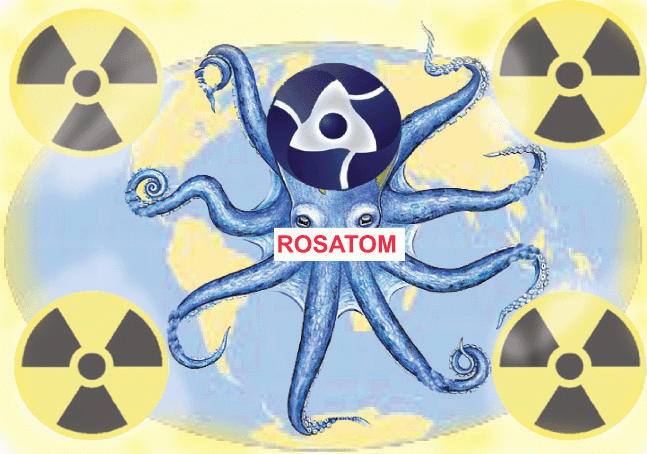
Rosatom, Russia’s state-owned nuclear company, is by far the most active player these days in the international market for nuclear power technologies. Rosatom currently has agreements to provide plants, fuel or expertise in 20 countries in the Middle East, Africa, Asia and Latin America. With the notable exception of the Barakah Atomic Energy Station in the United Arab Emirates, which is being built by the Korea Electric Power Corporation, Russia is the most heavily involved of any nuclear-exporting countries in developing nuclear power facilities in the Middle East.
Rosatom’s most recent move in the Middle East was a deal, sealed in late May, to construct Egypt’s first nuclear power plant, pending final approval by the Egyptian government. The pact is the latest of four bilateral agreements signed by Egypt and Russia concerning the nuclear power station at El Dabaa, approximately 200 miles west of Cairo on Egypt’s north coast. The first of these, signed in late 2015, covered the construction and maintenance of the plant for a 10-year period, and included a stipulation that Russia would provide fuel for the plant for 60 years.
The plant would consist of four VVER-1200 reactors, a new design based on the earlier VVER-1000 model developed in the Soviet Union in the mid-1970s. The first VVER-1200 was brought online earlier this year at Russia’s Novovoronezh plant. It is projected to begin producing power in 2024. Egypt is one of four countries in and around the Middle East where Rosatom has built, or plans to build, nuclear power facilities. Rosatom’s subsidiary, Atomenergostroy, which handles the company’s overseas construction projects, has contracts to build plants in Jordan and Turkey. In addition, it is building additional reactors at Iran’s Bushehr facility. The company will provide financing, staff, and fuel, while retaining ownership of the plants and receiving revenue from the power they produce.
Russia has provided approximately 50 percent of the financing for Turkey’s plant at Akkuyu, and will provide fuel for its operation once construction is complete. Upwards of 85 percent of the financing for the El Dabaa project in Egypt is to come in the form of loans from Russia, a country in the midst of an economic downturn brought on by the global fall in fossil fuel prices. Egypt is also exploring options for a second nuclear power plant to be built on its coast.
During the Cold War, both the United States and the Soviet Union provided supplies, facilities, and training to Middle Eastern countries in an effort to promote nuclear power. The governments of Jordan and Egypt expressed interest at the time in developing nuclear power facilities in the mid-1950s, and the Soviet Union began construction on a research reactor in Egypt in 1961. Similar reactors were built in Iraq in 1967 and in Libya in 1981. In 1995, Russia’s Ministry of Atomic Energy signed a contract to take over construction of the Bushehr plant. In 2010, Rosatom was granted the right to open offices in embassies abroad by a change in laws governing its operations. It did so in Dubai and Beijing in April of 2016, and the company’s website now boasts over $133 billion USD in overseas orders for its products. Rosatom has also partnered with the International Atomic Energy Agency to fund nuclear infrastructure development internationally, pledging $1.8 million as well as equipment and expertise to equip countries that hope to develop nuclear power capacities in the future. Experts have expressed concern that these ambitious development plans are proceeding without adequate plans for disposal of nuclear waste. The Bellona Foundation, an organization that conducts independent research into international nuclear and environmental issues, has been critical of the lack of planning for nuclear waste processing and disposal, and has pointed out that dependency on Russia for nuclear fuel may leave countries particularly vulnerable in the event of a sour political climate.
June 28, 2017
Posted by Christina Macpherson |
marketing, MIDDLE EAST, Russia |
Leave a comment
 For nuke biggies, answer’s blowing in the wind http://indianexpress.com/article/india/for-nuke-biggies-answers-blowing-in-the-wind-4725180/ Despite a relatively robust position in its nuclear business, Russia’s state atomic energy corporation Rosatom is pushing the envelope by revving up renewable projects in sectors such as wind energy and small hydro. by Anil Sasi June 28, 2017
, Little less than a decade ago, nuclear shills could get away by scoffing at renewables, given the promise at that time of a nascent ‘nuclear renaissance’. In the intervening years, while the script has changed overwhelmingly in favour of green energy, the nuclear-versus-renewables debate too has progressively veered off from an ‘either-or’ debate to a more overlapping narrative.
Russia’s state atomic energy corporation Rosatom figures among a handful of nuclear utilities to have bucked the broader downturn in the atomic power business, with eight reactor units in Russia and 36 nuclear reactors in various stages of planning and construction across more than a dozen countries — the largest shelf of projects globally. Creditable, considering the fate of some of its peers — Toshiba has recently pulled its US nuclear subsidiary Westinghouse out of the nuclear construction business while French utility Areva’s continues to struggle with accumulated losses of Euro 10 billion on its books. Despite the relatively robust position in its mainstay nuclear business, Rosatom is now pushing the envelope by revving up renewable projects in sectors such as wind energy and small hydro. Experts suggest that even for other major utilities invested entirely in the nuclear value chain, a move to diversify some of the sectoral risks could make sense.
The Russian nuclear major has started by rolling out wind farm projects in its home market of Russia, with plans to take wind projects to the international market in the due course “after accumulating enough experience on the domestic market”, First Deputy Director of Rosatom Corp, Kirill Komarov told reporters on the sidelines of the Atomexpo 2017 conference in Moscow last week. “We plan to develop renewable energy sources in all parts of the world and not only in Russia, but we’ll start doing it after we accumulate enough expertise here,” he said.
A licensing agreement with the Dutch company Lagerwey for the transfer of technology involved in manufacturing component parts of the windfarms is a step in that direction, with Saudi Arabia likely to be one of Rosatom’s first international markets for wind. The group has also initiated preliminary talks with the Indian government and private companies to expand its presence in India beyond the nuclear sector to the new area of mini hydro power projects, with units ranging from 0.5 to 2 megawatts, an official said. The discussions are being done through Ganz Engineering and Energetics Machinery, a 100 per cent Hungarian subsidiary of Rosatom’s engineering division Atomenergomash.
Areva too has tried its hand at renewables, with a portfolio of four energies: wind energy, bioenergy, solar power and hydrogen power. The French company offers turnkey solutions to meet both short — and long — term requirements for clients to bridge the energy demand in standard and peak consumption periods.
Rosatom’s Komarov has exuded confidence that Russian utility is in a good position for bagging contracts for construction renewable energy facilities abroad. “On the whole, we think our chances for working abroad are fair enough because whatever country we come to, we settle firmly there,” he said at the three-day expo held in the Russian capital last week. At a series of bidding rounds held during the last two years, Rosatom has bagged bids for construction of wind farms in Russia with the overall output capacity of almost 1,000 MWs.
Rosatom considers wind energy projects to be one of the most promising of their non-nuclear growth projects, with estimates suggesting that the it expects the wind energy market in Russia to reach a turnover of about 200 billion Rubles a year ($3.3 billion) by 2024. In July 2016, Rosatom announced that the company plans to build three wind farms in Russia with a total capacity of 610 MW. This amounts to about 17 per cent of the total wind power capacity planned to be commissioned in Russia until 2024.
Among the pacts signed at the expo, Rosatom’s international branch initialled an agreement to cooperate with Saudi Al-Yamama Group on potential projects in the construction of wind farms in Saudi Arabia.In markets such as India, where Rosatom is already involved in building the Kudankulam nuclear power project, the Corporation is betting on a specialised technology for mini hydro projects. Rosatom is already in preliminary talks with the Indian government and private companies to expand its presence in India beyond the nuclear sector to the new area of mini hydro power projects, with units ranging from 0.5 to 2 MW.
The discussions are being done through Ganz Engineering and Energetics Machinery, a 100 per cent Hungarian subsidiary of the Rosatom’s engineering division Atomenergomash. “We consider this as another opportunity for cooperation between Rosatom and India, and our office in India is working in this direction. We are discussing, the issues both with the government, and private bodies,” Rusatom International Network president Alexander Merten told journalists on the sidelines of the Atomexpo.
Rusatom International Network is involved in marketing and business development of a number of Rosatom projects abroad. The small hydro-power plants are pre-fabricated, and assembled in the factory and then supplied to the customer, with the cost of these projects pegged at approximately 1 million euro per megawatt (around Rs 7.1 crore per MW, varying with topography). A pilot installation of the mini hydel plants is currently on in Georgia, with discussions also underway with Turkey and the Middle East countries.
(The writer’s trip to Atomexpo was sponsored by Rosatom)
June 28, 2017
Posted by Christina Macpherson |
renewable, Russia |
Leave a comment
 Times 27th June 2017,The lesson of the Hinkley Point C saga is not to repeat it. Contractors
started pouring concrete for the Hinkley Point C power station three months
ago and could be still at it in ten years‘ time.
By then, there is a chancethat the economics of energy will have suffered a surprise upheaval making
nuclear power genuinely affordable, but that chance is slim to vanishing.
It is more likely that current trends driving down the cost of renewable
and gas-fired power stations will continue.
Hinkley Point C will meanwhile be vulnerable to the sort of delays and cost-overruns that have plagued
every other reactor so far built to the same design, none of which is yet producing power. If experience is any guide, electricity from Hinkley Point will command more than twice the price of power from other sources,
including low-carbon renewables.
The value of subsidies to honour that “strike price”, which is meant to compensate the contractors for taking on
the risk of the project, will have more than quintupled since being agreed.
Hinkley Point C will create jobs but in a white elephant that will be technologically out of date before being connected to the grid. It is being built in part to keep the lights on without relying on highly polluting coal, but mainly because technology moves faster than bureaucracy. In complex matters politicians tend to rely on bureaucrats’ advice, and many
backed the plan before Theresa May gave her final approval last year.
Not one had the courage to cancel it when it was still possible to do so without exposing taxpayers to the risk of multibillion-pound compensation claims.
Sources close to an internal review of the project under way at EDF, the lead contractor, say that its budget is already edging up towards £20 billion from last year’s £18 billion estimate. Its completion date is now expected to be 2027 rather than 2025. The value to EDF and its Chinese partner of the “contract for difference” agreed in the deal has risen from
£6 billion to £30 billion as the price of gas and renewables, especially solar, has fallen.
The most alarming figure in the NAO report is an estimate of £22 billion that investors in Hinkley Point C could claim in
compensation were it to be scrapped. https://www.thetimes.co.uk/edition/comment/nuclear-options-n9b7sc5bq
June 28, 2017
Posted by Christina Macpherson |
business and costs, politics, UK |
Leave a comment
 Reuters 26th June 2017, The cover of the reactor vessel EDF is building in Flamanville, France, may not be able to function more than a few years unless the utility can do additional tests which so far it has not be able to, nuclear regulator ASN said in a report.
While the long-awaited report, a copy of which was obtained by Reuters, concludes the European Pressurized Reactor (EPR) is fit for service, EDF may have to replace its vessel cover soon after its
scheduled start-up in 2018. The requirement is a major blow for EDF, which
will have to start planning for a costly replacement of a key part before
the reactor even starts up.
The reputational damage could also add to concerns in Britain about its 18 billion pound ($23 billion) project to
build two similar EPR reactors in southwest England.
The French regulator had ordered a deep review of the Flamanville vessel following the discovery
in 2015 of carbon concentrations in the base and cover of the containment vessel, which make its steel more brittle. The report – led by the IRSN, the ASN’s technical arm – is being reviewed by a group of independent experts on Monday and Tuesday.
This autumn, ASN will partly base its final ruling on Flamanville on the experts’ recommendations. The ASN report
states that while the base of the vessel is fit for service despite the need for increased monitoring over its lifetime, manufacturer Areva NP has not been able to conduct sufficient tests on the cover as it is no longer accessible. These controls are indispensable in order to ensure the reactor’s safety over its 60-year lifetime, the report says.
http://uk.reuters.com/article/edf-flamanville-nuclear-idUKL8N1JN2OC
June 28, 2017
Posted by Christina Macpherson |
France, safety, UK |
Leave a comment
 Russia urges more ambitious nuclear capacity target, WNN, 27 June 2017, Rosatom’s deputy director-general for international business has described the World Nuclear Association’s aim to add 1000 GWe of new capacity by 2050 as fully achievable and “perhaps modest”. Kirill Komarov spoke to World Nuclear News during the AtomExpo conference and exhibition held last week in Moscow.
Komarov, who becomes the chairman of the London-based Association next year, said the annual event had attracted a record number of participants, with about 6500 attendees, representatives from 64 countries (not including Russia) and 32 official government delegations.
He told WNN: “The consensus of everyone gathered here, including those who are not part of the nuclear community, is that nuclear energy has a place in the global energy mix…..
Komarov said investment in wind and solar power technology was ten times higher than in nuclear generation.
“That’s not because those technologies are better and ours are worse,” Komarov said. “Perhaps we as a nuclear community missed out and didn’t put sufficient effort into explaining safety and mankind’s need for nuclear power, not only in terms of energy, but also knowledge, education and science, as well as the non-energy uses of nuclear technologies.”…..
2016 was a “very successful year” for Rosatom, he said, and its portfolio of orders is worth $134 billion over the next decade. Many of these contracts are “now active” and cover the full life cycle of nuclear facilities, he said…….
Rosatom’s earnings and profit are growing, Komarov said, but that growth has been curtailed by lower nuclear fuel cycle prices. “The uranium enrichment spot price was once $180 per kg SWU, now it’s about $50/kg, and the uranium spot price has gone from $137 per pound U3O8 to about $20/lb. We’re still profitable because we have worked seriously on our costs, even during years that were good for us,” he said. “We keep on expanding our business with new products and try to offset what we have under-earned by creating new business. ……http://www.world-nuclear-news.org/C-Russia-urges-more-ambitious-nuclear-capacity-target-27061701.aspx
June 28, 2017
Posted by Christina Macpherson |
marketing, Russia |
Leave a comment
 UK funds off-site nuclear module construction project, Power Engineering, 06/27/2017, By Tildy Bayar Engineering firm Cammell Laird has won £200,000 ($255,000) in UK government funding to develop nuclear modules. The company said the funding from the Department of Business, Energy and Industrial Strategy (BEIS) would go toward a project that aims to work out the best way to build and test large modules at off-site locations before transporting them to nuclear sites for installation.
The Fit for Modules project is supported by the Nuclear Advanced Manufacturing Research Centre (Nuclear AMRC), Arup, Fraser Nash and Laing O’Rourke……
“The [UK] nuclear new build programme estimates a potential spend of up to £100bn over 30 years,” he said. “It is therefore imperative that as an industry we make the programme work from a cost and schedule perspective, stripping out waste and any unnecessary expense.”
He added that the project could “lay the foundation blocks for the UK to develop a complete industry specializing in off-site modular build”.
“If we can make a success of building modules for the domestic nuclear sector we can spin that expertise out to export markets as the UK looks to ramp up exports post-Brexit.”
In March the firm announced a partnership with the Nuclear AMRC to open a development centre for modular manufacturing methods for new-build reactors of all sizes, drawing on “a host of innovative technologies to significantly reduce costs and lead times for nuclear new build”.http://www.powerengineeringint.com/articles/2017/06/uk-funds-off-site-nuclear-module-construction-project.html
June 28, 2017
Posted by Christina Macpherson |
politics, technology, UK |
Leave a comment
«Nuclear waste at Andreeva Bay affects us», says Norwegian border town mayor
Norway spends hundreds of millions on nuclear clean-up at Russia’s dump site located near the two countries’ border. But local Norwegian authorities are not taken aboard in the process. Barents Observer, By Atle StaalesenJune 27, 2017
«Just 50 km from here there are thousands of spent nuclear fuel elements,» says Kirkenes town Mayor Rune Rafaelsen.
His municipality has 196 km of border with Russia, and it is just a short ride from the Kirkenes town hall to the Andreeva Bay, the major Russian dump site for spent nuclear fuel.
«If something happens in Andreeva, we would be among the first to feel the consequences», Rafaelsen says to the Barents Observer.
The town mayor underlines that local representatives should have been part of the Norwegian government delegation visiting the dump site today.
Norwegian Foreign Minister Børge Brende travels with a major delegation of government officials and experts. But there are no local representatives included.
Minister Brende is on site to mark the first shipment of spent nuclear fuel out of the old rundown storage site. We should have been invited to take part in the delegation», Mayor Rafaelsen says. «We should have taken for granted that national authorities involve local expertise in the process».
According to the local mayor, Kirkenes has its own carefully elaborated preparedness plans for cases of nuclear accidents on the Russian side of the border. And there is solid local expertise, he argues……
The Andreeva Bay storage site holds as much as 22 thousand spent nuclear fuel elements, all of it a legacy of Soviet-era policy. It is located in the Litsa fjord on the Russian Barents Sea coast.
Since the 1990s, the site has attracted huge international attention since most waste were stored in poor conditions, partly outdoor. Norwegian authorities have alone granted millions in aid to secure and clean up the site.
The first containers with the highly radioactive uranium fuel elements are this week due to be shipped from Andreeva, along the coast of the Kola Peninsula to Atomflot base in Murmansk and from there further by train for reprocessing in Mayak in the South Urals. https://thebarentsobserver.com/en/life-and-public/2017/06/nuclear-waste-andreeva-bay-affects-us-says-norwegian-border-town-mayor
June 28, 2017
Posted by Christina Macpherson |
EUROPE, politics |
Leave a comment
Fury as nuclear power plant holds sexy bikini contest to pick new female intern, A NUCLEAR power station has sparked anger after holding a raunchy bikini contest to choose its new female intern. Express UK , By TOM PARFITT, Jun 27, 2017 The Temelin Power Station, in the Czech Republic, launched the competition to recruit young women based solely on their bikini bodies.
Officials selected 10 female candidates and then organised a bizarre photoshoot in one of the station’s cooling towers.
The sexy shots were then posted online, with fans asked to vote for the hottest to get the internship job.
But bosses were forced to apologise and scrap the unique recruitment process after a social media backlash.
Human rights lawyer Petra Havlikova said: “The competition is absolutely outside the bounds of ethics.
“In 2017, I find it incredible that someone could gain a professional advantage for their good looks.”…..
June 28, 2017
Posted by Christina Macpherson |
EUROPE, women |
3 Comments
 Human chain against aging nuclear plants spans three countries http://www.dw.com/en/human-chain-against-aging-nuclear-plants-spans-three-countries/a-39408428 Thousands have protested to demand the closure of two nuclear reactors in Belgium over safety concerns. Demonstrators formed a human chain that stretched from Germany, through the Netherlands and into Belgium. Organizers claimed that some 50,000 protesters took part in the demonstration on Sunday, forming a human chain that stretched from Aachen, Germany, to Liege, Belgium, and Maastricht, the Netherlands.
The chain also passed close the Tihange nuclear power plant some 20 kilometers (12.4 miles) southwest of Liege. The Tihange 2 and Doel 3 reactors have been the subject of safety concerns about microcracks in their structures.
Doel lies in northern Belgium, close to the port city of Antwerp, about halfway between Brussels and Amsterdam. Numerous safety incidents, mostly low-level, have been reported from the two reactors which have each been in operation for more than 30 years.
Protesters who massed in Germany, the Netherlands and Belgium complain they are living with excessive risk
German Environment Minister Barbara Hendricks last year urged Belgium to take the two reactors offline until open safety questions were cleared up. However, the request was dismissed by Belgium’s nuclear regulator.
Aachen takes legal action
The city of Aachen and some 100 communities in the border region are currently suing the operators of Tihange 2.
Sunday’s demonstration was organized by numerous environmental organizations in all three countries and spearheaded by Belgian actor and director Bouli Lanners. The mayors of Aachen and Cologne also lent their weight to the protest.
“It is the strongest message the region could send,” said the administrative head of the Aachen city region, Helmut Etschenberg. “We no longer want to live with the element of uncertainty that is Tihange 2 and we will keep on and on.”
As well as demanding the closure of the plant, demonstrators are calling for an end to deliveries of fuel elements to the two power stations from Germany’s Lingen nuclear power plant, in the state of Lower Saxony.Such is the level of concern about Belgium’s aging reactors in Germany that the state of North Rhine-Westphalia has stocked up with iodine tablets in an effort to limit human exposure to radiation.
June 27, 2017
Posted by Christina Macpherson |
EUROPE, opposition to nuclear |
Leave a comment