Europe’s recent peace overtures are war by other means

Zakharova accused the ambassadors of promoting a “dead-end Zelensky formula.”
She said: “The leaders of these countries are pretending, through their statements, to be calling for peace, but in reality they are putting forward unacceptable conditions, increasing the production of long-range weapons for Kiev and generally taking steps towards the militarisation of Ukraine and Europe.”
European overtures for renewing diplomacy with Russia smack of hypocrisy and duplicity.
June 12, 2026, https://strategic-culture.su/news/2026/06/12/europes-recent-peace-overtures-are-war-by-other-means/
After four years of zero diplomacy, multiple rounds of economic sanctions aimed at crushing the Russian state, and hundreds of billions of euros fueling a futile war in Ukraine against Russia, European capitals are lately abuzz with calls for opening peace negotiations with Moscow.
No doubt part of the shifting policy is due to the economic mess that Europe has created for itself by cutting off energy trade with Russia. Escalating energy costs are destroying European industries and imposing crippling financial hardship on millions of its citizens. Realizing the self-inflicted disaster, European capitals are desperate to appear to be normalizing relations with Russia and resume affordable energy supplies.
France and Italy are advocating the appointment of an envoy to engage with Russia to resolve the conflict and the lifting of anti-Russian sanctions.
Last weekend, the leaders of Britain, France, and Germany – the so-called E3 – stated that they would “help mediate” a peace deal between Ukraine and Russia. The Ukrainian puppet president, Vladimir Zelensky, was feted in Downing Street on June 7 by Britain’s Keir Starmer, France’s Macron, and Germany’s Merz. They proposed taking the lead in negotiations from the United States since President Trump seems more preoccupied with ending the war against Iran.
Various names have been suggested as to who could serve as an interlocutor representing Europe. Angela Merkel, the former German Chancellor, and former Italian Prime Minister Mario Draghi are two names that have been put forward. Finnish President Alexander Stubb has also been suggested. It’s unlikely any of them would be acceptable to Moscow, especially Merkel, mainly due to her past role in covertly undermining the 2015 Minsk Accords, thereby sowing the seeds for war that erupted seven years later.
The telling – almost laughable – thing is the paucity of any European figure with credibility as an envoy.
The EU’s top diplomat, Kaja Kallas, has become a laughing stock over her rank incompetence. Her Russophobic ranting has rendered her redundant in conducting foreign policy. So much so that there is a revolt among European diplomats against what they declaim as her “dysfunction”.
This week, Europe sent three ambassadors to Moscow to renew some form of dialogue. Russia’s deputy foreign minister, Mikhail Galuzin, met with representatives from Britain, France, and Germany. The Russian foreign ministry said it was open to hearing what Europe had to say.
However, Galuzin reportedly gave the visitors short shrift, reminding them that Europe cannot pose as mediators when it is a participant in the war against Russia.
Following the meeting on Thursday, Maria Zakharova, the foreign ministry spokeswoman, dismissed the European mission as not serious about addressing the challenge of finding a peace settlement.
Zakharova accused the ambassadors of promoting a “dead-end Zelensky formula.”
She said: “The leaders of these countries are pretending, through their statements, to be calling for peace, but in reality they are putting forward unacceptable conditions, increasing the production of long-range weapons for Kiev and generally taking steps towards the militarisation of Ukraine and Europe.”
If Europe were serious about peace, it would stop arming the Kiev NeoNazi regime and show some meaningful acknowledgment of Russia’s long-held demand to deal with the root causes of the conflict.
Europe’s backing of the Kiev regime’s call for an immediate ceasefire while expanding Ukraine’s ability to carry out deep strikes on Russian territory with European-manufactured drones, killing hundreds of civilians over recent months, is just a cynical ploy to rearm the proxy regime and give it some respite in order to resume the war with more lethal vigour at a later stage.
The duplicity of the European politicians goes back to the treachery of the Minsk Peace Accords in 2015 and the sabotage of the Istanbul peace negotiations in April 2022. That has culminated in the biggest war in Europe since World War Two, with millions of casualties and a real threat of spiralling into open war.
Europe’s governments and its EU and NATO bureaucrats are still wedded to the ideology of inflicting a strategic defeat on Russia. So, too, it seems is Washington, despite Trump’s talk of wanting peace.
Arming the Nazi regime in Kiev at an increasing pace while calling for a superficial ceasefire is proof that the European leaders are not authentic in their belated espousal of seeking diplomacy with Russia.
Former German foreign minister Sigmar Gabriel (2017-2018) recently pointed out a shameful truth when he said that Europe lost its chance for diplomacy in 2021.
Back then, the EU leadership and the American Biden administration both repudiated Russia’s earnest efforts to negotiate a way to avoid war in Ukraine. Moscow had clearly set out its objections to NATO expansion, in particular, the absorption of Ukraine into the military alliance, and it proposed rational solutions for collective security. Russia’s diplomacy was rejected out of hand by Washington and Brussels.
The Europeans and the Americans were bent on provoking Russia into an armed confrontation with their proxy Ukrainian regime that they had installed in the 2014 coup and weaponized. Diplomacy was rejected because the NATO axis calculated that it could defeat Russia with war and economic strangulation, or, as some Western politicians admitted, “total war”.
The European agenda, as reflected in demands for an immediate ceasefire without any cognizance of Russia’s arguments about historic claims and indivisible security, demonstrates that European leaders are not yet ready or willing to engage genuinely and meaningfully.
As 18th-century Prussian strategist Carl von Clausewitz might put it, their recent overtures for political talks are simply war by other means.
Legal Profession Revolt Against The UK Judge Whose Job Is To Protect Israel’s Genocide

Proscription has led to thousands of people, most of them elderly and including upstanding members of British society – from magistrates and doctors to army veterans – facing convictions for “supporting terrorism” for holding up placards stating: “I oppose genocide. I support Palestine Action.”
Judge Johnson so rigged the trial of anti-genocide activists that 1000s of legal professionals have urged him to step down from the sentencing hearing. But Johnson’s dirty work is not yet complete
SCHEERPOST, Jonathan Cook Substack, June 11, 2026
The trial of the Filton Four reaches its climax on Friday. Judge Jeremy Johnson will decide the sentences of four Palestine Action activists found guilty of criminal damage – after two juries refused to convict them of far more serious charges brought by the British government, via the Crown Prosecution Service.
Keir Starmer’s government failed to secure the convictions for aggravated burglary and violent disorder it so desperately needed. They would have helped retroactively justify its decision to proscribe Palestine Action as a terrorist organisation – the first time in British history that a direct action group, which targets property, has been proscribed.
Starmer’s hostility towards Palestine Action is personal. It has been a massive thorn in his side during Israel’s near three-year genocide in Gaza.
From the outset, Starmer suggested that Israel had the “right” to withhold food, water and power from the 2 million Palestinian residents of Gaza – a crime against humanity for which the Israeli prime minister, Benjamin Netanyahu, is wanted by the International Criminal Court.
Starmer’s complicity in the genocide has only been underscored by Palestine Action, which has targeted Israeli factories operating in the UK run by Elbit Systems that supply Israel’s genocidal army with killer drones for use in Gaza.
The so-called Filton trial derives its name from an Elbit factory in the Filton neighbourhood of Bristol that Palestine Action targeted in August 2024. Efforts to destroy these Israeli drones came at a time when Starmer was under enormous popular – if little political – pressure to end British arms sales to Israel.
PR crisis
Proscription, however, has not worked out well for Starmer. It has entangled him in a self-inflicted public relations crisis of almighty proportions.
Palestine Action activists have been held in remand without trial for an unprecedented period of time, far in excess of the normal maximums, and in especially harsh conditions that have treated them as if they were terrorism suspects, even though their arrests long precede the group’s proscription last year.
These sustained abuses led to a prolonged hunger strike, and a desperate government and media campaign to justify their mistreatment.
Proscription has led to thousands of people, most of them elderly and including upstanding members of British society – from magistrates and doctors to army veterans – facing convictions for “supporting terrorism” for holding up placards stating: “I oppose genocide. I support Palestine Action.”
This popular backlash cornered the High Court into declaring the proscription unlawful – a decision the government is appealing. That has led to another unprecedented situation: police are still arresting people for holding the placards, despite the courts ruling that the basis for such arrests is unlawful.
The law has never looked more of an ass………………………………………………………………………………………………………………
Rigged trials
Judge Johnson has done precisely nothing to counter the overwhelming impression that the Filton activists’ prosecutions were entirely political. He quite openly rigged both trials in manifold ways, as former British ambassador Craig Murray has set out………………………………………………………………………………………………………………………………………………………………………………..
Gagging order
But even with the convictions for criminal damage secured under these rigged conditions, Judge Johnson is still in a position to cause more harm to the rule of law. He is due to sentence the Filton Four on Friday……………………………………………………………………………………..
Remember, all this is happening as Starmer’s government makes unprecedented moves to end many jury trials in Britain, leaving us to the mercy of judges like Jeremy Johnson……………………………………………………………………………..
If this is all starting to look like theatre, that is because it is. In dictatorships, these are called show trials. Everyone understands that the outcome is predetermined. Everyone understands that justice is non-existent. The verdict is entirely political. It is a faux-legal rationalisation of what the security state wants.
Judge Johnson is the perfect judge to play that part…………………….https://scheerpost.com/2026/06/11/legal-profession-revolt-against-the-uk-judge-whose-job-is-to-protect-israels-genocide/
ROSATOM report
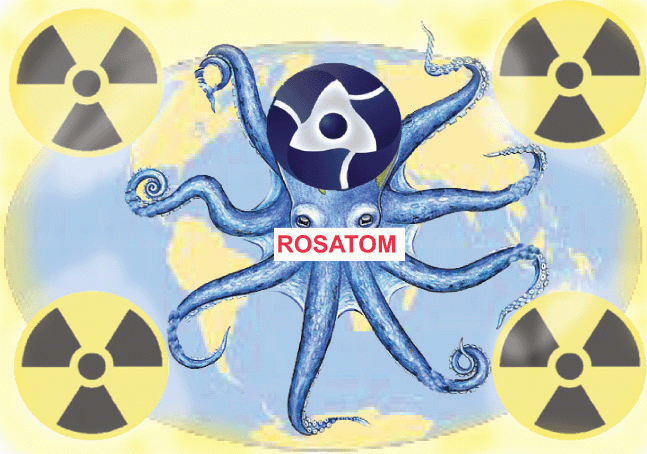
Russia’s full-scale war against Ukraine has profoundly altered the
political and strategic environment in which the Russian state nuclear
corporation Rosatom operates. Not only has the war intensified scrutiny of
the corporation’s role in nuclear safety, energy security, and
international governance, but it has also highlighted the extent to which
Rosatom functions today at the intersection of technology, state policy,
and geopolitical influence.
In this report, we at Bellona continue to
analyze Rosatom during wartime. We argue that Rosatom can no longer be
understood solely through the traditional framework of a civilian nuclear
operator or global technology supplier. Rather, it has increasingly emerged
as a multifunctional state instrument—combining industrial, strategic,
and political roles both within Russia and internationally.
Several broader
conclusions emerge from the report: Rosatom’s wartime role has deepened
institutionally and politically, reinforcing its function not only as a
nuclear corporation, but as a strategic component of Russian state policy;
The occupation of the Zaporizhzhia NPP represents a challenge to
established assumptions in nuclear governance, exposing gaps in
international mechanisms designed to respond to conflict involving nuclear
infrastructure; Despite sanctions pressure and geopolitical disruption,
Rosatom has maintained significant external reach, particularly through
long-term projects in the Global South and through forms of nuclear
diplomacy that remain politically resilient.
Bellona 11th June 2026, https://network.bellona.org/content/uploads/sites/4/2026/06/ROSATOM_report_2026_ENG.pdf
The push to lift Ireland’s nuclear ban: Going nuclear or nowhere?

“You can go into Harvey Norman in the morning and buy a solar panel. You can’t go anywhere and buy a small modular nuclear reactor.”
By Louise Byrne, RTE, 12 Jun 2026
From the backbenches of Fianna Fáil in recent months has emerged a political push to lift the ban in Ireland on nuclear power generators.
What’s behind the move to ‘go nuclear’ now? And is it a viable option, or a distraction from already proven renewable technologies?
In the late 1970s Ireland had its own version of Woodstock. Thousands of demonstrators descended on Carnsore Point to attend carnival-like protests against the development of the country’s first nuclear plant.
ESB engineers had chosen the Co Wexford site for its low population, stable geology and access to the Irish Sea for plant cooling.
Minister for Energy at the time, Desmond O’Malley dubbed the protesters “members of the flat-Earth society” hindering Ireland’s entry into the atomic age.
Yet the scale of opposition, the discovery of gas off Kinsale and the Three Mile Island accident in the US eventually led to the withdrawal of political support for the Carnsore Point project.
The u-turn was so pronounced by the late 1990s legislation was introduced to veto any future nuclear production.
Two Acts contain legislative blocks – the 1999 Electricity Regulation Act and 2024 Planning and Development Act, but there is no constitutional impediment to nuclear power. And for the first time in decades, the issue is back on the political agenda.
Fianna Fáil TD James O’Connor has introduced a bill which would reverse the legislative ban. The proposal has been supported by both the Taoiseach and Tánaiste……………………………………………………………..
Green Party leader Roderic O’Gorman described the idea as Government “kite flying”.
“The nuclear industry promises to deliver at a cheap price on a reasonable timescale but it doesn’t happen,” he told the programme.
“We should double down on delivering renewable energy, cutting bills for consumers and giving us energy security.”
Going nuclear, or going nowhere fast?
The war in Ukraine has highlighted our dependence on imported fuel and the argument goes that nuclear power may provide an additional low-carbon alternative to fossil fuels; one that can complement renewable sources.
The optimism of nuclear proponents lies in new technology called Small Modular Reactors (SMRs). These are smaller reactors that require less cooling but that can produce up to a third of the power of large, conventional reactors.
Prefabricated units can be manufactured, shipped and installed on site, making them more affordable to build than large power reactors, according to the Institute for Atomic Energy Agency.
However, the new technology is still in development and is years away from being deployed at scale, said Dr Paul Deane, Senior Lecturer in Clean Energy Futures at University College Cork.
“There’s lots of uncertainty around the costs and capability of the technology and big questions on what you do with the nuclear waste.”
While keeping an open mind on its potential, Dr Deane cautioned that SMR technology was not yet commercially available.
“You can go into Harvey Norman in the morning and buy a solar panel. You can’t go anywhere and buy a small modular nuclear reactor.
“When something doesn’t exist in the commercial world everyone is able to be right and wrong about it because we’ve nothing to benchmark against.”
The delivery of nuclear power requires supply chains with a steady supply of raw materials as well as large workforces of highly specialised engineers. China and Russia are the only countries currently with operational small reactors, although Canada is developing the first such facility in a G7 nation.
“They started building it last year. It’s probably going to take about five years for it to be developed but then we’ve got to see, does it work?,” Dr Deane said.
For people like Roderic O’Gorman, the obvious step to improve our grid capacity while meeting climate goals is not untested nuclear technology, it’s investment in battery storage and renewable generation.
“Spain made a call after the Ukraine war to go with renewables, to go with solar. They now have the lowest wholesale electricity prices in Europe,” he said
…………………………………………………………………………………………………………………………………………………………………………………. Small Modular Reactors are among the technologies being examined by the Sustainable Energy Authority as part of its Decarbonised Electricity System Study. It will present the Government with a range of options for decarbonising Ireland’s electricity system post-2030.
A draft technical report noted “SMRs are not expected to be available before 2045. Moderate scale deployment may be possible by 2050, but it is plausible that no nuclear fission will be deployed by 2050.”
“Optimistic scenarios” envisaged that SMRs could complement renewables by providing stable, low-carbon baseload power needed for grid stability, but legal complexity, upfront investment, and public acceptance remain significant hurdles, the report said.
The SEAI has cautioned that the report is provisional. “Subsequent work, that is currently under way, will provide a more precise assessment of the potential for the (decarbonising) technologies to be adopted within the Irish electricity system.
“Specific conclusions should be based on the final publication.”
Safety concerns have also not gone away, according to anti-nuclear activist Adi Roche who cited Russia’s occupation of the Zaporizhia nuclear plant in Ukraine as evidence of the technology’s inherent security flaws.
“Nuclear facilities themselves can function as potential radiological weapons — “dirty bombs” whose consequences could be catastrophic without a single warhead being deployed,” she wrote in the Irish Examiner.
………………………………………………. Environmentalists contend that every euro invested in an Irish nuclear energy project is money that isn’t spent on green energy, grid resilience or large batteries that could smooth out renewable supplies.
There is no need, they argue, to revisit the Carnsore Point debate.https://www.rte.ie/news/primetime/2026/0612/1578039-the-push-to-lift-irelands-nuclear-ban-going-nuclear-or-nowhere/
While Britain’s defence strategy comes under fire, the nuclear arms race continues

By Laura Tingle, Sat 13 June, https://www.abc.net.au/news/2026-06-13/nuclear-weapons-spending-united-kingdom-defence-aukus/106737440
When British Defence Secretary John Healey resigned on Thursday night, Australian time, the implications of his move were largely judged by what it would mean for the future of his embattled Prime Minister, Sir Keir Starmer.
Healey was followed out the door hours later by the armed forces minister, Al Carns, and two ministerial aides.
The future shape of the British government is, of course, of great interest. And political battles are always a subject of public fascination.
But, in an increasingly rare event these days, Healey’s resignation was on a matter of principle.
That matter of principle helps shine a light on a much bigger story about the state of the world, geopolitics and war preparedness than the implications of resignations at Whitehall.
“You have been unable, and the Treasury has been unwilling, to commit the resources that the nation needs to defend the country at this time of rising threats,” Healey wrote, damning his leader for failing to provide what many people would regard as the most fundamental of protections for a country’s population: its defence.
Britain’s growing nuclear weapon spend
There has been a long and complicated brawl going on in the British Labour government about defence spending; much of its public face being about the fact that other parts of the government would have to cut spending to fund plans to significantly increase defence spending — by about 15 billion pounds.
The debate has dragged on for some time since a strategic review of Britain’s defence needs was completed last year.
As the Royal United Services Institute wrote, the review never really gave a full description of the size and shape of the armed forces that was envisaged “akin to the kind of ‘order of battle’ seen in previous defence reviews”.
In other words, while the overall size of the British defence budget has been fought over, there is little known about how exactly it will be spent. Questions linger — does the UK aim to have a land army to fight a war in Europe? (Answer: unlikely). Does it need more conventional missiles and drones for such a war? And what’s the role of manned and unmanned naval power?
But one capability that seems to just blunder on with little scrutiny and increasingly little strategy is Britain’s nuclear capacity.
Two reports released this week document a surge in the number of nuclear weapons around the world in the past year. And not just their growth in number but a seemingly growing reliance on them, in an environment where most of the deterrence and detente architecture which kept things manageable in the past has been eroded.
The nature of nuclear weapons is changing. Analysts say the gap between conventional weapons and nuclear weapons is getting smaller, and the way nuclear weapons are conceived to be used is changing.
What makes the UK’s role in this story so compelling is that the current fracas has highlighted the fact that nuclear weapons will soon represent 25 per cent of Britain’s defence spend.
Not only that, but the small island nation has overtaken Russia in the past year as the third biggest spender on nuclear weapons.
The Stockholm International Peace Research Institute (SIPRI), which tracks military spending, noted the UK also announced last year its intention to buy 12 nuclear-capable F-35A combat aircraft from the USA, and equip them with US nuclear bombs, in order to join NATO’s nuclear sharing arrangements. The plan walks back the decision from the 1990s to denuclearise the Royal Air Force.
‘A worrying development’
The rationale for escalation in nuclear weaponry is strongly linked to the United States’ declared plan to reduce its commitment to European defence.
So it is hardly surprising that the UK might be seeking to compensate for this.
But as British defence analyst Carne Ross said this week “the other unnoticed thing that’s going on in the UK and indeed Europe as a whole, is that the US is increasing its deployment of tactical nuclear weapons, so-called tactical nuclear weapons, which can have a yield of 50 kilotons, which is three times greater than the bomb used in Hiroshima”.
“There appears to be a rapid increase in the deployment of these tactical weapons in Britain, but also on continental Europe, maybe Turkey and elsewhere — bizarrely in response to the fact that Trump is less committed to the conventional military defence of Europe,” he told Al Jazeera podcast The Inside Story.
Read more: While Britain’s defence strategy comes under fire, the nuclear arms race continues“This appears to be an appeal from the Europeans for greater security through tactical nuclear deployments. This is a very bizarre and paradoxical and indeed worrying development.”
But more than the usual difficulty in knowing just how defence dollars are being spent, anything specifically related to nuclear weapons has a tradition of being particularly opaque.
The Financial Times reported last week that Westminster’s Public Accounts Committee found that the Ministry of Defence has “not provided ‘sufficient transparency’ over its ever-increasing spending on nuclear weapons, which accounts for roughly a fifth of the UK defence budget”.
“The report criticised the secrecy surrounding Britain’s nuclear spending, saying the Defence Nuclear Enterprise, a collection of organisations that operate and maintain the UK’s nuclear deterrent, ‘lacked accounting records to support more than £6bn of its assets’ in its 2024–25 annual report,” the FT reported.
Britain’s nuclear deterrent consists of submarines carrying US-made Trident nuclear missiles. Creating a new class of four Dreadnought nuclear submarines to take the place of the ageing Vanguard-class subs is expected to cost £41bn.
Nine nuclear-armed countries spending more
Where the story of the UK’s nuclear spend goes even wider though is in another report released this week by the anti-proliferation group the International Campaign to Abolish Nuclear Weapons (ICAN) which documents the last year’s spending on nuclear weapons by the nine nuclear-armed countries. (That’s the US, China, UK, Russia, France, India, Pakistan, Israel and North Korea.)
ICAN says those nine states spent just under US$119 billion ($168 billion) on their nuclear arsenals in 2025, a staggering increase of 19 per cent from the previous year.
The US had the biggest increase (US$12.4 billion) and spent more than all the others combined — US$69.2 billion.
China remained in second place. But the UK came in third at US$12.6 billion, overtaking Russia.
While the US and Israel went to war to stop Iran getting nuclear weapons, they are both believed to have them — even though Israel has never confirmed it possesses them.
ICAN’s Susi Snyder told the same Al Jazeera podcast this week: “On average, we see an increase of about 10 per cent. Last year, it was almost double that. So it is by far one of the largest increases we have ever seen.”
Nuclear war and weapons have historically been seen as a threat of missiles exchange over continents in a showdown between the “great” powers.
But the sheer cost and difficulties of warfare in modern times gives too many countries some sense of relatively easy security in having a nuclear “deterrent”.
SIPRI notes that in 2025 several European states, including Germany, indicated a desire to supplement NATO nuclear-sharing arrangements focused on US weapons with similar arrangements with France and the UK.
A changing warfare landscape
There are two major confrontations going on in Europe and the Middle East at present. (The conflicts in Africa seem beyond the reach of nuclear stand-offs at present).
In both the war in Ukraine and the war in the Middle East, we have been witnessing increasing signs of frustrated eruptions between combatants — notably around the Strait of Hormuz this week — as fights bog down into apparently intractable conflict.
The risks of an accident have seemed all too clear.
The prospect of nuclear weapons being used in either Ukraine or the Middle East, rather than being fired between Moscow, Washington or Beijing has risen.
SIPRI Director Karim Haggag says that “influential voices, including some world leaders, are advocating nuclear weapons as a guarantee against attack by a hostile state. But making national defence and security strategies dependent, or more dependent, on nuclear weapons could significantly increase nuclear risks.”
Tariq Rauf, the former head of verification and security at the International International Atomic Energy Agency agrees.
“First of all, we have new types of delivery systems, supersonic delivery systems, hypersonic delivery systems,” Rauf told Al Jazeera.
“The gap between large conventional weapons and small-yield nuclear weapons is now largely disappearing. So, we can now have conventional weapons used with strategic effect to even try to take out nuclear bases and decision makers.”
The Healey resignation came just hours before he was supposed to stand up at Portsmouth to trumpet AUKUS with Australia’s Deputy Prime Minister and Defence Minister Richard Marles, and Foreign Minister Penny Wong.
Like much of the British media, Marles chose to focus on the personnel change, rather than what might have driven it, in his comments.
AUKUS, he said, would continue, as it already had across changes of government in the UK, the US and Australia “because it fundamentally is in the national strategic interests of the United Kingdom, the United States and Australia, and all of that gives us a sense of confidence that we will be able to deliver this”.
The only question is over the value of delivering “this” at a time when the threats and means of warfare are changing by the day, in ways most of us can’t easily see.
Laura Tingle is the ABC’s Global Affairs Editor.
Can small nuclear reactors deliver for Europe?

SMR’s promise affordable, low-carbon nuclear power, but the continent will reap the benefits only if governments abandon piecemeal projects and deploy reactors at scale.
The Parlament Magazine, By Matej Tonin and Malwina Qvist, 11 June 26
Europe needs reliable, low-carbon power for its industries, cities and energy security and it will need even more in the coming decade. Small modular reactors are increasingly seen as part of the solution, but only if the European Union develops them as an industrial program rather than a series of scattered national experiments.
SMRs must be deployed as a fleet. Repetition can reduce costs and build the supply chains Europe needs. The next three years will determine whether Europe develops that capability itself or watches it emerge elsewhere.
The fleet logic
SMRs are often sold on the promise of being cheaper than large reactors. On a first-of-a-kind basis, they are not.
Their economics depend on something different: serial production.
An illustrative model by the EFI Foundation shows why: in a four-unit SMR order book, the fourth unit is around one-sixth cheaper than the first. The savings come from factory fabrication, standardized designs, established supply chains and the learning gained from each successive unit.
This has a policy implication. In the short term, no single European market will be able to anchor a fleet on its own. The order book needed to drive SMRs down their cost curve must be European in scale, otherwise large-scale deployment will remain out of reach.
The European Commission projects between 17 and 53 gigawatts of SMR capacity across the EU by 2050.
The range itself is telling: even the lower bound would require a serious industrial program; the upper bound would put Europe among the leaders in SMR deployment. ……………………………………………………………………………………………………………………………………………………………………………………………………………………………………………………https://www.theparliamentmagazine.eu/news/article/oped-can-small-nuclear-reactors-deliver-lowcost-energy-for-europe
No electricity at Zaporizhia nuclear power plant after attack, IAEA says

11 Jun 2026 , https://swedenherald.com/article/no-electricity-at-zaporizhia-nuclear-power-plant-after-attack-iaea-says
An attack has disrupted the electricity supply to the Zaporizhzhia nuclear power plant in Russian-occupied southern Ukraine, the UN atomic energy agency, the IAEA, announced.
No elevated radioactivity has been recorded, the IAEA said in a statement, adding that diesel generators are currently used to power critical functions, including cooling systems.
It is not clear who is behind the attack at the facility, which is Europe’s largest nuclear power plant. It occurred on Wednesday evening and was aimed at a nearby transformer station.
Kyiv and Moscow have repeatedly accused each other of risking a disaster by attacking the nuclear power plant and its nearby area.
The power outage is the 19th since Russia’s full-scale offensive war against Ukraine began in February 2022.
What does France’s nuclear waste plan in Bure mean for Luxembourg?
burying radioactive waste underground risks making the problem invisible rather than fully addressing its implications, particularly since some of the materials involved will remain hazardous for up to 100,000 years.
Christophe Wantz, adapted for RTL Today, 11.06.2026
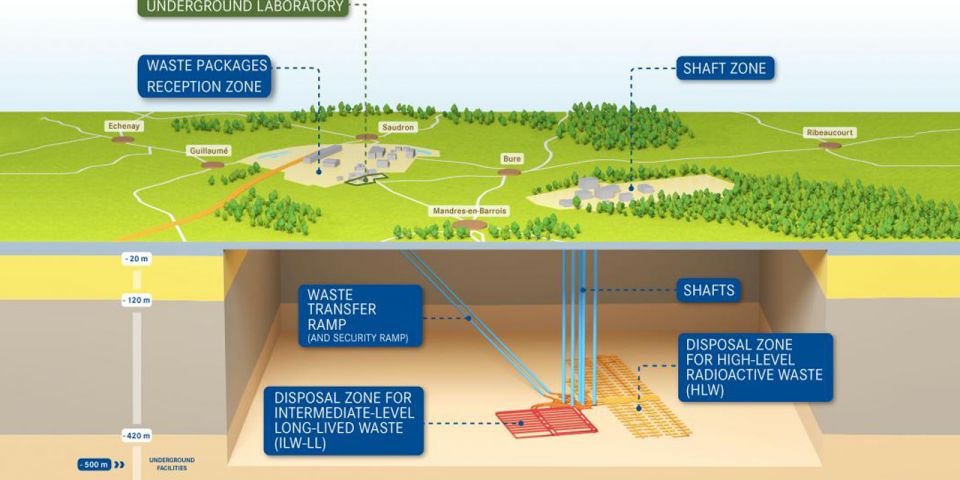
The Cigéo project in Bure, in the Meuse region of France, is one of the country’s most controversial projects. If approved, underground facilities for the long-term storage of radioactive waste from France’s nuclear power plants will be built.
The facility is located in the rural Meuse region, far from populated areas and close to the Haute-Marne border. Its remote location was not the main reason for its selection, but rather its geology.
Around 500 metres beneath the surface lies a thick layer of clay that formed around 160 million years ago. This rock formation has remained remarkably stable for millions of years and is highly impermeable, making it particularly well suited to long-term underground storage.
The underground laboratory, a unique scientific facility designed to support the development of the Cigéo project, was built here.
Despite its 2.5 kilometres of tunnels, the laboratory itself will never house radioactive waste. Instead, it serves as a research centre where scientists can study and measure the properties of the Callovo-Oxfordian clay formation in its natural environment.
The underground laboratory is used to develop and test the engineering techniques required for excavating and supporting the future repository. In preparation for the first construction phase, France’s National Radioactive Waste Management Agency (Andra) is constructing and testing structures in the laboratory that closely resemble those planned for the Cigéo facility.
However, it is not expected that any radioactive waste will be stored at Bure before 2050.
Once all the necessary approvals have been received, the Cigéo project will begin the permanent disposal of France’s most hazardous radioactive waste at a depth of around 500 metres.
The repository is intended to house waste generated by reprocessing spent fuel from the country’s nuclear power plants.
In total, the site is designed to hold 83,000 cubic metres of radioactive waste, which is roughly equivalent to the volume of 33 Olympic-sized swimming pools.
This includes 10,000 cubic metres of high-level waste and 73,000 cubic metres of long-lived intermediate-level waste that can remain radioactive for up to 100,000 years.
A one of a kind underground facility
………………………………………………………………. The planned facility will comprise around 250 kilometres of underground tunnels and galleries. The project is expected to cost more than €33 billion, which will be financed by France’s nuclear waste producers, including EDF, Orano, and the French Alternative Energies and Atomic Energy Commission (CEA).
A highly contested project
Beyond its technical and scientific aspects, the Cigéo project has become a focal point in the debate about nuclear energy in France.
Since the early 2000s, the town of Bure has faced sustained opposition from local residents, activist groups, and environmental organisations, who see the project as an irreversible commitment with consequences that will affect future generations.
One such critic is the Collective Against the Burial of Radioactive Waste (Cedra), which questions whether safety models can reliably predict the behaviour of a geological repository over such immense timescales.
Opposition to the project extends well beyond the local level. During a demonstration in Bure last September, Green Party lawmaker Sandrine Rousseau criticised the overly optimistic faith placed in humanity’s ability to control and manage the long-term consequences of nuclear technology.
She argued that burying radioactive waste underground risks making the problem invisible rather than fully addressing its implications, particularly since some of the materials involved will remain hazardous for up to 100,000 years.
Roger Spautz, Greenpeace Luxembourg’s nuclear policy specialist, has also raised concerns about the project’s long-term reliability and irreversible nature.
While he does not consider the repository itself to pose a direct threat to Luxembourg, he highlights the scale of the transportation operation required to supply the site.
According to Spautz, between 70,000 and 80,000 shipments would be needed to transport highly radioactive waste from France’s La Hague reprocessing facilities to Bure.
In his view, the possibility of an accident during transportation that could release radioactive material can never be entirely eliminated.
Critics are questioning whether local communities have genuinely consented to the project. While some local officials support Cigéo for its potential economic benefits, opponents argue that the region is being asked to bear an unfair share of the burden for the rest of the country.
Meanwhile, supporters point to the project’s economic benefits. Cigéo is expected to create over 3,000 direct and indirect jobs in an area that has experienced decades of industrial decline.
However, for many residents, the development remains controversial, with some describing the region as a ‘sacrificial territory’ chosen to bear the long-term consequences of France’s nuclear waste.
Cigéo is part of France’s wider nuclear strategy. The government is promoting a revival of nuclear energy to meet climate objectives, but the long-term management of radioactive waste remains politically and socially sensitive.
Although the project has already passed several administrative milestones, it still depends on key approvals, including a declaration of public utility and a construction permit. Environmental groups have challenged it multiple times, contributing to delays in the overall timetable.
In May, Cigéo entered a major new phase with the launch of a public inquiry. Thousands of pages of documents prepared by France’s National Radioactive Waste Management Agency have been made available in town halls in affected municipalities, and residents there have until 2 July to submit comments or questions.
Neighbouring countries have also been notified. So far, only Luxembourg has formally requested to be kept informed about the process.
A national debate
At the centre of the controversy is a basic question: what should be done with high-level nuclear waste in the long term? According to France’s National Radioactive Waste Management Agency, more than half of the waste destined for storage in the Meuse region has already been produced, and current surface storage solutions are considered to be no safer than burying the waste 500 metres underground.
Some in the scientific community currently believe that deep geological disposal is the most reliable way to keep radioactive waste away from human activity and environmental hazards.
The clay formation at Bure is believed to significantly limit the spread of radionuclides over long periods, and Andra’s studies suggest that the site has remained stable for over one million years.
However, other experts argue that further research is needed into alternative approaches, such as reducing the radiotoxicity of waste or developing controlled near-surface storage solutions.
Ultimately, the Cigéo project reflects the broader dilemma of the energy transition: how to meet present-day energy needs while taking responsibility for consequences that extend far into the future.
In Bure, beneath layers of clay, decisions are being made that will have consequences lasting well beyond human timescales.
Watch the report here: – (on original ) https://today.rtl.lu/news/world/what-does-frances-nuclear-waste-plan-in-bure-mean-for-luxembourg-1621893378
Campaigners demand answers over Sizewell C costs and completion date

It comes one year after £14bn Government backing for the nuclear power plant
Author: Jasmine Oak, 10th Jun 2026
Anti-nuclear campaigners are calling on the Government to release more information about the future of Sizewell C, arguing that key questions about the project’s costs and completion date remain unanswered a year after ministers committed £14.2 billion to the Suffolk development.
Campaign group Stop Sizewell C has published a new report to mark the first anniversary of the Government’s investment in the power station, claiming there is still insufficient transparency around how much the project will ultimately cost and when it will begin generating electricity.
The group is urging ministers to publish what it describes as an unredacted Full Business Case and a detailed delivery plan, arguing that both local communities and bill payers deserve greater clarity.
What questions they want answered
Alison Downes, founder of Stop Sizewell C, said the most significant unanswered question was when the power station would be completed.
“It’s been a year since the government committed £14 billion pounds to Sizewell C and that paved the way for a final investment decision and there’s still a lot we don’t know,” she said.
“The biggest single question is when Sizewell C will be finished and the government seems absolutely determined to keep this a secret.
“Local people need to know how long this nightmare is going to go on for. The British public needs to know how long they have to pay for it until they get any electricity.”
The Government and Sizewell C have previously said the project is expected to begin generating electricity in the mid-2030s. However, Ms Downes questioned whether that timeline remained realistic, citing references contained within reports examining the project.
The campaign group is also seeking greater transparency over the financial implications of the development.
Under the Regulated Asset Base funding model, consumers contribute towards the cost of constructing the power station before it begins generating electricity.
Ms Downes said uncertainty remained over the eventual impact on household energy bills.
“The reality is we don’t know what the impact of Sizewell C on energy bills is going to be because we don’t know what it ultimately will cost,” she said.
“We don’t know how long we’ll be paying for it before it’s even generating any electricity.”
They’re seeking transparency
The report also calls on ministers to publish further project documentation, including a full business case and delivery strategy.
“The government needs to publish the unredacted Sizewell C full business case so we can all see the information withheld when only a summary was published last year,” Ms Downes said.
“We also need to see a strategy and delivery plan. It needs to be transparent about the costs and schedule in a way that’s easy for people to understand.”
The campaign group argues ministers should be prepared to reconsider the project if costs or delays escalate significantly.
“The Secretary of State has the power to cancel Sizewell C under certain circumstances and we want more assurances that the government is actually prepared to do this,” Ms Downes said.
“It would be completely immoral to force the public to carry on paying for something that spiralled out of control.”
Sizewell C is expected to provide enough low-carbon electricity to power around six million homes and is one of the Government’s flagship infrastructure projects aimed at improving the UK’s energy security and reducing carbon emissions.
Ministers have consistently argued that Sizewell C will play a vital role in the UK’s future energy mix. The Government says the power station will help strengthen energy security, reduce exposure to volatile international gas markets and provide enough low-carbon electricity to power around six million homes for decades to come…………………………………….. https://www.hellorayo.co.uk/hits-radio/suffolk/news/campaigners-demand-answers-over-sizewell-c-costs-and-completion-date
Putin Powerfully Rebuffed The Hawks Who Want Him To Attack NATO
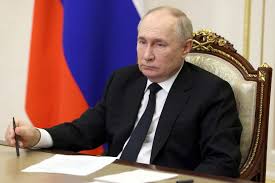
Andrew Korybko, Jun 10, 2026, https://korybko.substack.com/p/putin-powerfully-rebuffed-the-hawks
In his words, talk about Russia attacking NATO “is not simply nonsense; it is a provocation.”
Several top “Non-Russian Pro-Russians” (NRPR) influencers rang the alarm last month about Russia’s alleged plans to attack NATO, which were inspired by top hawk Sergey Karaganov and then Russian Ambassador to the OSCE Dmitry Polyanskiy ominously channeling his rhetoric. Readers can review examples of their warnings here, here, here, here, and here. Casual NRPRs therefore braced themselves for what would have in that scenario almost certainly been the start of World War III had it come to pass.
It obviously hasn’t and it likely won’t ever, however, judging by Putin’s response when he was recently asked about these alleged plans during a meeting with foreign journalists. In his words, “Why would Russia attack Europe or go to war with NATO? What would be the purpose? As I have said before, these claims are not merely nonsense. In my view, they are a deliberate provocation designed to create the impression of a threat that does not actually exist.”
Putin then elaborated that “The objective is to persuade their populations to increase defence spending and, as a first step, to pay for the regime that seized power in Kiev. That, I believe, is the real explanation. It is not simply nonsense; it is a provocation. What surprises me, however, is that some people in European countries appear to believe it. I find that astonishing. The whole notion is simply absurd. It would be amusing if it were not so sad.”
It’s not just “some people in European countries” who “appear to believe it”, but his own top hawk is championing this policy and it was recently amplified to the max by top NRPR influencers, many of whom can be described as “state-adjacent” due to being platformed by publicly financed media, attending government-organized conferences, and/or taking state-secured tours of Donbass. Casual NRPRs are therefore left to wonder whether Putin is telling the truth or is “psyching out the West”.
It’s always best to defer to what Putin himself says in such cases whenever confusion arises, which is due to top NRPR influencers practicing what’s been called “Potemkinism”, or the creation of “alternative realities” about Russian interests and policy for “strategic purposes” (whatever they might be). The most infamous example is that Putin is an anti-Zionist secretly allied with Iran against Israel despite him being a proud lifelong philo-Semite as proven by his many quotes to this end from the official Kremlin website.
Accordingly, while it would be inaccurate describe the fiercely loyal Karaganov as a “provocateur” in the spirit of how Putin condemned such folks who advocate for Russia to attack NATO, he nevertheless powerfully rebuffed hawks such as him as well as the top NRPR influencers who hyped up his rhetoric. That said, Russia’s foreign spy service did indeed warn last month that their country might carry out retaliatory strikes against Latvia if Ukraine launches drones from there, which should be taken seriously.
That’s altogether different than what Karaganov has been pushing for, namely a first strike against NATO that could easily spiral into World War III, and it’s important for casual NRPRs to understand this. As Putin himself phrased it, such talk “is not simply nonsense; it is a provocation.” When those on Russia’s side do it, no matter what their intentions might be, they inadvertently “persuade [Westerners] to increase defence spending and, as a first step, to pay for the regime that seized power in Kiev.”
How Far Right Fanatics Ruined Ukraine -Historian Tells the Story the West Hides | Marta Havryshko
The Burning Archive, 18 Apr 2025, https://www.youtube.com/watch?v=GuL6pInMWfs
Ukrainian historian Marta Havryshko tells the story Western media hides – how far right ethnonationalism and war has ruined Ukraine. Marta Havryshko is a Faculty Member, Clark University, Strassler Center for Holocaust and Genocide Studies, and National Academy of Sciences of Ukraine, Department of Contemporary History. She presents research on Holocaust, WWII, USSR, Russia-Ukraine war, far-right, neo-Nazis, Ukrainian nationalism, antisemitism, gender, sexual violence in war, and memory politics at https://x.com/HavryshkoMarta
Britain has become third-largest nuclear weapons spender – CND

, https://labouroutlook.org/2026/06/10/britain-has-become-third-largest-nuclear-weapons-spender-cnd/
The Campaign for Nuclear Disarmament (CND) has called on the government to cut wasted billions on nukes ahead of its Defence Investment Plan announcement.
CND is calling on the government to stop wasting public money on its nuclear black hole, after the latest nuclear weapons spending report from the International Campaign to Abolish Nuclear Weapons (ICAN) reveals that Britain is now spending more on its nuclear weapons than Russia.
Collectively, the nine nuclear-weapon states spent a record $119 billion in 2025 on maintaining, modernising, and expanding their nuclear arsenals, an increase of 19% ($16.8 billion) on their 2024 bill.
Britain overtook Russia as the world’s third biggest spender, spending $12.6 billion (£9.6 billion), an increase of 17%.
This spending includes:
- operating costs of Britain’s current four Vanguard nuclear-armed submarines
- building the replacement to Vanguard – the Dreadnought submarine
- maintenance of Britain’s nuclear weapons stockpile
- development of a new nuclear warhead, Project Astraea
It does not include the costs of the 12 F-35A nuclear-capable fighter jets that the government announced it was purchasing in June 2025. This shocking surge in nuclear spending comes as the government’s own Public Accounts Committee criticised the MoD for a lack of transparency over its ‘ever-increasing nuclear expenditure’, which is expected to rise to 20% of the total MoD budget for 2025–26, and again increase further to up to 25% in the coming years.
According to ICAN, the top nuclear spender globally was again the US, which spent $69.2 billion, an increase of 22% from 2024, outspending all other nuclear weapons states combined. China was second, spending $13.5 billion, an increase of 7%. Behind Britain was Russia, with an increase by 6% to $9.5 billion. Of the others, France spent $7.7 billion, India spent $2.8 billion, Pakistan spent $1.5 billion, Israel spent £1.2 billion, and North Korea spent $656 million.
The report also found that arms companies involved in the manufacture of Britain’s weapons had sought to influence government policy. According to Open Access data cited in the report, senior government figures met with representatives of the following arms companies: Airbus, Amentum, Babcock International, BAE Systems, Bechtel, Boeing, General Dynamics, Honeywell International, Leidos, Leonardo, Lockheed Martin, Peraton, Rolls Royce, RTX (Raytheon), Safran and Thales. The report noted that Airbus and BAE Systems, which had 44 and 35 meetings respectively, also included meetings with the Prime Minister’s office.
CND General Secretary Sophie Bolt said:
“This is a timely report that comes when the British government is planning to make savage cuts to public spending in order to fund more hikes to military spending. Britain’s nuclear weapons are a black hole, swallowing up even greater proportions of the Ministry of Defence’s already ballooning budget.
“It is Britain’s replacement of its nuclear weapons system which is driving these huge nuclear weapons spending increases. This is contributing to a much more dangerous world where the threat of these world-ending weapons being used in war is the highest it has been since the Cold War.
Far from keeping us safe, Britain’s nuclear-armed submarines are totally dependent on the US administration, which ties us even more closely to Trump’s reckless leadership that is dragging the world into more and more reckless wars that could go nuclear.
“With the government’s upcoming Defence Investment Plan expected to give at least £15 billion more to the military, it’s time to end the wasteful spending on war and nuclear weapons and redirect it into tackling the real security issues we face – from climate breakdown and the looming cost of living crisis.”
Are the Sizewell C financing arrangements a model for other European countries?

Steve Thomas, Presentation to AT OM Day, May 22, 2026, TUB, Berlin
Government claimed Sizewell RAB could be funded by
institutional investors, mostly UK-based.
Government took 49.5%,
institutional investors 23%, UK private investors 15%/. Government talked
about seeking a balance of risk & reward between investors & consumers, but
risk is with consumers/taxpayers, rewards are with investor. The government
strategy appears to have been to offer whatever terms were needed with no
regard for cost & risk to the public. Still, investors will only finance
half the cost. The model will not be used again so the huge effort
completing the Sizewell deal was wasted
TUB Berlin 22nd May 2026, https://www.static.tu.berlin/fileadmin/www/10002415/WIP_Vortraege_PDF/veranstaltung_atom_day_2026/EB414a_Fr_10-15_Thomas_Stephen.pdf
The view from Moscow: The future of nuclear arms control exists, but the path is hard

there can and should be some new legally binding new arms-control regimes, including strict limitations on nuclear warheads and delivery vehicles
However, the alternative is significantly more costly and dangerous on an existential level. The more nuclear weapons (and nuclear weapons states) that exist, the greater the possibility that nuclear weapons use becomes. This is the ultimate threat to the human civilization, and efforts to limit this threat demand leadership from the great powers today, not tomorrow.
By Dmitry Stefanovich | May 13, 2026, https://thebulletin.org/premium/2026-05/the-view-from-moscow-the-future-of-nuclear-arms-control-exists-but-the-path-is-hard/?utm_source=ActiveCampaign&utm_medium=email&utm_content=France%20s%20new%20nuclear%20doctrine&utm_campaign=20260608%20Monday%20Newsletter%20%28Copy%29
It is impossible to argue with the fact that today’s arms control architecture is in very bad shape, especially if one focuses on strategic nuclear weapons. While Moscow seems open to at least some limitations, the current thinking in Washington is obsessed with Chinese nuclear buildup (real or alleged), and the only acknowledged solution to the ‘three-body’ problem seems to be purely arithmetical in its nature: In other words, the United States declares that the only way to sustain nuclear deterrence under current circumstances is to have its nuclear arsenal exceed both the Russian and Chinese capabilities. Clearly, neither Russia nor China can ignore such an attitude and would respond in kind.
But despite the current negative trends, arms control remains alive, although the formats that still exist are limited. And in the future, arms control instruments may take many forms: legally and politically binding agreements, unilateral initiatives, and bilateral and multilateral arrangements. Even enhanced notifications and transparency mechanisms could be helpful. Moreover, there is some room for synchronized limitations on certain activities—i.e. deployment of selected weapons only at selected regions—which might contribute to the stabilization of military-political relations between certain countries.
It is also crucial to understand that it is hardly possible that any future arms control could only be bilateral. Furthermore, it is impossible to even imagine the complicated arrangements for inspection mechanisms for every state that possesses nuclear weapons, and the asymmetrical quantitative limitations for them. The arsenals of nuclear weapon states are significantly different, and even the Russian and US nuclear forces postures are not symmetrical. To have a dozen or more inspections per country per year is too much of a logistical challenge if we begin to consider more than two participants for such a regime.
There are other factors as well, including but not limited to the increasing presence of dual-capable systems, growing cooperation between the United States and its allies and partners in the nuclear domain (with NATO declaring itself a “nuclear alliance”). The peculiar part is that while one side perceives such developments as explicitly destabilizing, the other believes them to be stabilizing and enhancing strategic (or integrated) deterrence.
Most important, not only nuclear capabilities contribute to the overall “security equation.” Military conflicts since the end of the 20th century clearly show that non-nuclear long-range precision weapons are indeed a strategic capability, while non-nuclear deterrence is a much more complicated concept. It is now becoming readily apparent that non-nuclear weapon states can inflict significant costs on their adversaries, no matter how many nuclear weapons those adversaries have in their arsenals. Such trends are augmented by rapid scientific and technological change. The role of hypersonic weapons, drone warfare, artificial intelligence, machine learning, and outer space infrastructure is continuously growing, and all these emerging and disruptive technologies are intertwined—jointly contributing to the very complicated landscape of multilateral strategic deterrence.
Last but not least, the renewed possibility of overt nuclear testing is becoming a big challenge. Major countries have hardly forgotten what their nuclear weapon explosions revealed, but there seems to be a growing number of arguments supporting nuclear tests for both political and technological reasons. A deep dive into this issue deserves a separate paper, but what is clear is that should one country test, others will follow—and ultimately, a domino effect would likely follow, leading to the destruction of the Nuclear Non-Proliferation Treaty as it is, not to mention the grim prospects it would make for the Comprehensive Test-Ban Treaty to ever enter into force.
A path forward
Still, there are options to address the current polycentric nuclear era of major military-political confrontations. One way is to find a way to engage in behavioral arms control—which basically means looking for mechanisms that limit activities, and not capabilities.
Unilateral and coordinated declarations of one’s capabilities and doctrines might be helpful as well. Joint notification regimes are also a possibility, even if those will be limited initially. For example, the only area where the “Nuclear Five” of the nuclear weapons states recognized by the NPT have some symmetry is the sea-based leg of their nuclear deterrence forces. Codifying existing patrol practices regarding nuclear-tipped ballistic missile-armed submarines (known as Ship Submersible Ballistic Nuclear, or SSBN), and a regime of submarine-launched ballistic missile (SLBM) launch notifications could be a relatively easy first step that would significantly enhance mutual understanding and revitalize the practices of military-to-military data exchanges. Moreover, increasing the number of SSBNs deployed on deterrent patrols above the agreed “normal’ can become a visible and clear signaling method.
However, to make such arrangements possible, arms control itself should be “re-branded,” so it will be perceived first and foremost as a tool in a state’s national security arsenal rather than anything intended for the good of all humankind. And the term “re-branding” would be absolutely correct to use, because a top-to-bottom overhaul of arms control would indeed contribute to the optimization of military development projects—based on better understanding of the efforts and logic of similar developments in both adversarial and partner countries alike.
Russia, for what it is worth, had already made several proposals regarding somewhat informal arms control mechanisms over the last decade alone. To name a few such proposals, there was the suggestion for a post-INF moratorium on intermediate-range ground-launched missiles deployment; limitations on the scale and geographic locations of military exercises during the COVID-19 pandemic; and an extension of treaty limitations post-New START. Unfortunately, none of those eventually succeeded, although the post-INF moratorium did contribute to a somewhat slowed and scaled-down development and deployment of such systems by both Russia and by the United States. Moreover, as of Spring 2026 neither Russia nor the United States seem to be actively engaged in deploying nuclear warheads beyond the now-defunct New START limits.
Other scenarios
Read more: The view from Moscow: The future of nuclear arms control exists, but the path is hardBut with the expiration of the last of the nuclear arms control treaties, a renewed nuclear arms race is a real possibility, and one that is already occurring in some domains. The exact parameters are hard to determine, because there is only secondary or even tertiary data on the capacities of defense industries and nuclear enterprises for countries like China and Russia, especially given the ongoing “special military operation” that the latter is undertaking in Ukraine. More information is available on the United States, the United Kingdom, and France, while far less can be found on India, Pakistan, Israel, and North Korea (also known as the DPRK).
Such races are occurring even though they are not the most effective way to spend increasingly limited resources. Russian nuclear weapons and delivery systems have been continuously upgraded and modernized throughout the post-Cold War period, for many reasons. The reasons include the degradation of Russia’s conventional forces, US superiority in strategic non-nuclear weapons, concerns about US missile defense, and the general security environment on the Eurasian continent—not to mention the practical need to preserve nuclear weapons’ expertise and to keep Russia’s relevant nuclear infrastructure running throughout periods of economic turmoil. So, there seems to be some capacity for arms racing.
The same is more or less true for China and, probably, France, although the reasons for keeping one’s nuclear weapons enterprise in good shape can be different.
The nuclear arms race itself, which could be said to have been ongoing for at least a decade or even more, only now shows signs of switching from the qualitative to the quantitative. Previously, most nuclear weapon states focused on enhancing the capabilities of their nuclear weapons—and especially their delivery systems—through increased precision, reliability, and survivability. Now it is clear that, although there is a different amount of open-ness and transparency about it, all nuclear weapon states are getting ready to increase their overall nuclear weapon stockpiles. What makes it much more different and much more dangerous compared to the previous Cold War is that this new arms race is essentially multi-domain and multipolar, with much bigger roles played by many more actors—including newly emerging powers.
One should not ignore the link between the growing emphasis on nuclear weapons as an ultimate tool to ensure national security and sovereignty by nuclear weapons states (and to some extent their allies) and the pressure on nuclear non-proliferation, with more countries considering getting a nuclear capability for the very same purpose. This link, if understood correctly, might also contribute to the limitation of “nuclear optimism” by the existing nuclear weapon states and force them to search for collective security solutions.
Limits of negative effects
Presumably, there is an understanding in Moscow and other nuclear capitals that arms-racing each other “into oblivion” (as a former US official once said) is not straightforward, and that there are serious limitations and bottlenecks. This gives some level of optimism that the arms race can be contained, if not through formal mechanisms, but based on mutual understanding that you can’t change the political, industrial, and demographic landscape back to what it once was.
The biggest danger, as viewed from Moscow, is that it is crucial to see a mix of strategic nuclear, strategic non-nuclear, non-strategic nuclear, and missile defense capabilities as a joint system augmented by nuclear and non-nuclear capabilities of allied states and integrated through “space superiority” and AI-enabled unified mission planning. This is perceived as a possibility to combine a disarming and decapitating strike with nuclear and non-nuclear weapons with air and missile defense capabilities preventing a weakened retaliation. The latest military conflicts demonstrate that such “bogeymen scenarios” cannot be ignored, as there is a clear push to bank on selected areas of military superiority by the United States and some of its allies.
Clearly, such threats are well understood; consequently there is a constant development of the Russian Strategic Rocket Forces, as well as Heavy Bombers and SSBNs, not to mention so-called novel strategic delivery systems, such as Avangard HGV-tipped ICBMs, Burevestnik unlimited range nuclear-powered cruise missiles, and the Poseidon nuclear-powered uncrewed underwater vehicle. Rapidly developing kinetic and non-kinetic counterspace capabilities also contribute to such efforts. There has been a clear focus on survivability and overwhelming second-strike capabilities, so that even a limited number of delivery vehicles intended for the targets on the adversary’s territory will reach their destination. However, actions by the United States and its allies do contribute to the ever-growing decapitation and disarming strike concerns. Ensuring the balance based solely on one’s military power without arms control framework is an extremely complicated task.
How to survive
Finally, there are many reasons to have questions and make accusations against each other because of bad decisions made over the years, including but not limited to the destruction of the ABM Treaty by Washington, as the most dramatic example—it drove both Moscow and Beijing to pursue symmetrical and asymmetrical measures to hedge against possible future technological breakthroughs. The so-called rogue states that have been cited as a primary reason to develop the US missile defenses and forward deploy its assets also continuously enhanced their capabilities. The characterization of Russia, China, Iran, and North Korea by some politicians as an “axis of evil” (or “evil tetragon” in Russian) did not help to stabilize things either.
But the problem is that things can get much worse, with countries facing less stable strategic balances and more escalatory force postures. And they surely will evolve in that way, unless joint efforts to find solutions are undertaken.
Ultimately, there can and should be some new legally binding new arms-control regimes, including strict limitations on nuclear warheads and delivery vehicles, although it is possible that a “warhead” would be a virtual accounting unit akin to the New START rules, where one Heavy Bomber accounted for one Nuclear Warhead only. This demands a significant volume of political will, especially given the fact that it is impossible to cover all existing concerns within a single document. Before we reach this stage, some informal mechanisms to enhance arms control and risk reduction can be put in place. The path forward will be hard and will need mutual concessions.
However, the alternative is significantly more costly and dangerous on an existential level. The more nuclear weapons (and nuclear weapons states) that exist, the greater the possibility that nuclear weapons use becomes. This is the ultimate threat to the human civilization, and efforts to limit this threat demand leadership from the great powers today, not tomorrow.
United Kingdom Atomic Energy Authority (UKAEA) commits £20M to UKI2S fund for fusion innovation

The UK Atomic Energy Authority (UKAEA) has contributed a further £20
million to the UK Innovation & Science Seed Fund (UKI2S) to back UK-based
spinouts and early-stage companies. UKI2S is a government-backed seed fund
managed by Future Planet Capital that invests in and grows early-stage deep
tech companies emerging from UK research, helping turn science into
commercially viable businesses.
The investment forms part of a wider
£33.25 million funding increase across three UKI2S sub-funds (Space,
Defence and Fusion), taking the fund’s total capacity to £150 million.
The capital includes £9.25 million from the UK Space Agency, £4 million
from the Ministry of Defence and £20 million from UKAEA. The cumulative
investment from UKAEA in the UKI2S fund is £28 million.
UKAEA 10th June 2026, https://www.gov.uk/government/news/ukaea-commits-20m-to-uki2s-fund-for-fusion-innovation
1 This Month

26 September – International Day for the Total Elimination of Nuclear Weapons


PLEASE OPPOSE HR 8255 AND S.3639 – bills would accelerate satellite deployment, with no environmental review or safeguards – https://ncstd5li.quorum.us/campaign/169331/
To see nuclear-related stories in greater depth and intensity – go to https://nuclearinformation.wordpress.com
-
Archives
- September 2026 (206)
- August 2026 (330)
- July 2026 (355)
- June 2026 (287)
- May 2026 (306)
- April 2026 (356)
- March 2026 (251)
- February 2026 (267)
- January 2026 (308)
- December 2025 (358)
- November 2025 (359)
- October 2025 (375)
-
Categories
- 1
- 1 NUCLEAR ISSUES
- business and costs
- climate change
- culture and arts
- ENERGY
- environment
- health
- history
- indigenous issues
- Legal
- marketing of nuclear
- media
- opposition to nuclear
- PERSONAL STORIES
- politics
- politics international
- Religion and ethics
- safety
- secrets,lies and civil liberties
- spinbuster
- technology
- Uranium
- wastes
- weapons and war
- Women
- 2 WORLD
- ACTION
- AFRICA
- Atrocities
- AUSTRALIA
- Christina's notes
- Christina's themes
- culture and arts
- Events
- Fuk 2022
- Fuk 2023
- Fukushima 2017
- Fukushima 2018
- fukushima 2019
- Fukushima 2020
- Fukushima 2021
- general
- global warming
- Humour (God we need it)
- Nuclear
- RARE EARTHS
- Reference
- resources – print
- Resources -audiovicual
- Weekly Newsletter
- World
- World Nuclear
- YouTube
-
RSS
Entries RSS
Comments RSS
 nuclear-news