New energy policy for Burnham?

The soon to be UK Prime Minister, Andy Burnham, is being portrayed as a ‘new broom’ that could, or might, adopt better polices in all areas. Well, what about the energy sector? It’s in a mess, economically, driven by high fossil gas prices, with retail electricity prices at an all-time high, despite renewable energy doing well (65 GW so far) with its wholesale price mostly being low. It’s in a mess technologically, at risk of undermining the crucial next stage of its important renewables programme by diverting cash to support major high-cost nuclear and fossil carbon capture and storage projects.
Both of these programme involve multi-billion funding. The much delayed Hinkley Point nuclear plant may end up costing £40-50bn, inflation adjusted, when it finally gets completed, probably in 2030. Its follow-on project, Sizewell C, may not do much better, despite promises about learning from Hinkley, and despite the investment risks being met by a consumer levy. There are already construction issues. A late 2030s start up at best? By then we might also be seeing some outcomes from the very speculative funding for small modular reactors and even maybe some results from the even more speculative fusion funding, with £2.5bn set aside for it.
Is any of that good value for money? Will it deliver anything useful on time? On past performance, it’s very uncertain. Same for the £21.7 bn Carbon Capture and Storage programme, the full cost of which has been put at possibly up to £264bn by 2050. CCS is basically an attempt to allow us to keep burning fossil fuel. Is that sensible? Or for that matter the controversial Drax wood pellet combustion plant– it got £1bn in subsidies last year. Burning imported wood from forests does not seem to be a very sustainable option…
There are arguably so many more worthy projects, for example in green hydrogen production and storage, a vital new area for expansion. Heat storage linked to local heat networks too. To be fair, some of these ideas are now getting a bit of funding. For example, pioneering green hydrogen producer ITM Power has received £86.5 m from Great British Energy and DESNZ. It will be used to expand ITM’s electrolyser production at its Sheffield plant to 1GW p.a. But we need more like that for the rapid expansion of short and long duration storage. Freed from drain of endless nuclear and carbon capture diversions, we could also accelerate the newer renewables, like tidal stream turbines, via expansion of the Contacts for Difference (CfD) system. ……………………………………………………………………………………………………………………………………
What next? Hinkley Point C is about half-built, so a lot of capital has already been sunk in it, but there are yet more billions scheduled to be spent on it. Burnham is unlikely to be willing to halt it (he is, it seems, pro-nuclear) but he might be persuaded to ditch Sizewell C, work on which has hardly started.
And the big proposed CCS programme too, so as to release further billions. To soften the change of policy, he could keep some small projects going (an SMR perhaps, or a CCSU project) as ‘insurance’ options, much as some renewables were treated in the past (including, at one stage, offshore wind) when nuclear was seen as the main new UK energy option.
More or less everyone, except some deadhead Reform supporters, now see renewables as that. The only debate seems to be on what backup might be needed. Large inflexible nuclear plants are not much use at that, nor are costly CCS fossil gas plants, while SMRs are as yet uncertain in terms of cost and viability.
But we don’t need any of this to deal with variable renewables. Storage, large and small scale, is part of the answer, along with improved transmission and flexible demand management plus smart grid systems, so as to balance local variable demand and variable supply efficiently.
We have to build a new system and that will inevitably be costly, although, arguably, not as much as trying to keep the old system going with dubious supply choices and carbon fixes. For example, on the basis of its latest LCOE data, Lazard says ‘Despite rising and inflationary cost pressures across all generation technologies, renewables remain the most cost-competitive form of new-build generation on an unsubsidised basis’.
And economic cost is not the only issue. For example, if built, Sizewell C will produce around 40,000 kg of plutonium in its spent fuel over its 60-year lifespan. Plutonium has a half-life of around 25,000 years, with SMRs, if they ever work, also adding to the pile. Is that what we want to bequeath our far-off descendants? Along with other long-lived nuclear wastes?
That’s a big challenge. Andy Burnham has made some commitments on energy and climate, but only so far mostly in a limited and cautious way. Will he now come up with something more radical? We will have to wait to see. Meanwhile, the latest data show that over 70% of DESNEZ expenditure is now nuclear related…
https://renewextraweekly.blogspot.com/2026/07/new-energy-policy-for-burnham.html?m=1
The Forgotten Jewish Movement That Rejected Zionism.

By Nadege Bizimungu, The Tea with Myriam François, Jul 21, 2026
Jewish mass movement that rejected the idea of a Jewish state ever existing was, for much of its history, more popular than Zionism. Here’s why almost nobody has heard of it.
Poland in the 1930s had the largest Jewish population in Europe, and the single most popular party among Jewish voters there wasn’t Zionist. It didn’t want a Jewish state at all.
It ran schools, published newspapers and even organized armed militias to defend Jewish communities. According to an analysis of Bund election results published in the Yiddish studies journal In geveb, the party won roughly 38 percent of the vote for Jewish parties in the last Polish municipal elections before the war, more than any single Zionist party, though the combined Zionist lists narrowly edged it out overall. Its members were fiercely opposed to Zionism and thought it was a fantasy, and they said so bluntly and often.
That party was the Jewish Labour Bund. Today, few people know its name, but at its peak it was one of the most important Jewish political movements in Europe. Its existence challenges a common idea about Jewish history: that Zionism was the only response to antisemitism. For decades, millions of Jews supported a different vision. They believed the answer was not a new country, but fighting for equality where Jews already lived.
The Bund was founded in October 1897, when thirteen young Jewish Marxists met secretly in an attic in Vilna, then part of the Russian Empire. That’s the same year Theodor Herzl convened the first Zionist Congress in Basel. Zionism argued that Jewish safety required leaving Europe and building a state. The Bund argued the opposite: stay, and fight for equality where Jews already lived, in solidarity with non-Jewish workers and socialist movements. The Yiddish word for this was doikayt, “hereness,” and it rejected the idea that Jewish life needed a single homeland at all.
The party grew fast, and contemporaries noticed. The Menshevik theorist Georgi Plekhanov reportedly called Jewish workers “the vanguard of the labor army in Russia.” Historian Bertram Wolfe later described the Bund as the largest and best organized body of workingmen inside the Russian empire. By 1906 its membership had reportedly reached around 40,000, briefly making it the biggest socialist organization in the empire, and by interwar Poland it had built an entire subculture: youth movements, sports clubs, a network of secular Yiddish schools. Jack Jacobs’s research on the interwar Bund treats it as a genuine mass institution, not a fringe faction.
None of this was naive pacifism. Bund militias organized armed self-defense against pogroms and antisemitic gangs on the streets of interwar Warsaw, decades before “Jewish strength” became coded as an Israeli idea. When the Nazis invaded, Bundists fought in the 1943 Warsaw Ghetto Uprising, the first urban revolt against Nazi occupation anywhere in Europe. One of its fighters, a Bundist teenager named Lusiek Blones, was thirteen years old.
The rivalry between Bundists and Zionists ran deep, and it was rooted in a real disagreement about what antisemitism demanded of Jews. Bundists argued that if European governments were insisting Jews were foreign and should leave, then Zionism, by proposing that Jews do exactly that, was conceding the antisemites’ premise rather than refuting it. Zionists saw it differently: as a response to the repeated failure of emancipation and assimilation to protect Jews anywhere in the diaspora. After the 1917 Balfour Declaration, in which Britain backed a Jewish “national home” in Palestine, Bundists increasingly viewed Zionism as bound up with imperial power rather than freed from it, a colonial project underwritten by the same empires that had failed to protect Jews in the first place.
The Bund wasn’t beaten in that argument, though. It was murdered. The Holocaust wiped out the working-class Jewish communities that had sustained the party for half a century. Historian David Slucki has documented how the postwar Bund never came close to rebuilding its prewar scale, plateauing at just a few thousand members worldwide by the late 1950s. Daniel Blatman’s research on the Bund’s final years in Poland, from 1939 to 1949, traces a parallel political defeat: Stalinist repression, including the 1942 murder of Bundist leaders Henryk Erlich and Victor Alter by Soviet secret police, finished what the Nazis had started.
Zionist institutions in Palestine, meanwhile, survived the war intact. In her new book, Here Where We Live Is Our Country, artist and journalist Molly Crabapple, whose account of the Bund this piece draws heavily on, argues that Zionist organizations controlled much of the rations, housing, and paperwork in the displaced-persons camps after the war, and used that leverage to funnel traumatized survivors toward Palestine. A movement with no population left to organize couldn’t compete with one that still had territory, infrastructure, and international backing behind it.
That imbalance is also why the Bund disappeared from memory rather than from relevance. It lost its people, not its argument, and a movement without survivors to carry its institutions forward simply stops being written about, no matter how large it once was.
The premise Zionism was built on, that Jewish safety requires a Jewish ethnostate, is now facing its sharpest public challenge in decades. Nearly three years into Israel’s war on Gaza, which the UN and earlier findings from Amnesty International and the International Association of Genocide Scholars, have described as genocide, support for Israel has fallen sharply, including among Jews themselves. Younger American Jews are significantly less likely than older generations to see support for Israel as central to Jewish identity, while nearly half of American Jews under 35 now say they would support a single binational state with equal rights for Israelis and Palestinians. In Britain, young Jews who identify as anti-Zionist or non-Zionist now roughly match those who identify as Zionist.Israeli historian Ilan Pappé, a longtime critic of his own government, has called this the “beginning of the end of the Zionist project,” pointing to internal political fracture, international isolation, and economic strain as evidence.
For Crabapple, this shift is also personal. She spent seven years writing Here Where We Live Is Our Country, much of it while Israel’s campaign in Gaza was underway. in an interview on Democracy Now!, she said there was something almost unbearable about reconstructing the destruction of Warsaw’s Jews while watching a country invoke the Holocaust to justify what was happening in Gaza. “It broke me,” she said, “in probably ways that I have difficulty expressing.”
What this history suggests, isn’t a clean answer to the hardest questions about what a just political future looks like after decades of occupation and violence. It’s something narrower, and maybe more useful: proof that at the exact moment Jewish nationalism was taking shape, a mass, organized, genuinely popular Jewish movement existed that rejected the idea that Jewish liberation had to come at another people’s dispossession. It didn’t lose that argument. It was destroyed by fascism, the Holocaust, and Stalinist repression, and its ideas went down with it, not because they were wrong, but because there was no one left alive to keep making the case.
Witness- A visit to Donald Morrison, a chief witness in the case of Willie McRae
I took a trip to Benbecula to visit Donald Morrison, a chief witness in
the case of Willie McRae, a prominent Scottish lawyer who was found dying
of a bullet wound in a car that had gone off the road in 1985. Donald was
the last person to see Willie McRae alive and whenever I have spoken to him
on the phone about this, he has always urged me to visit. The case has been
bugging me and so eventually I decided to take him up on the invitation.
McRae was an SNP politician, activist-lawyer and anti-nuclear campaigner.
On a misty April night 41 years ago, his car went off a quiet road – it
must have been going at speed – and came to rest 90 feet away. It was
spotted by an eagle-eyed accident investigator and his wife the next
morning at ten am. They glimpsed the car, which was partially hidden by a
gully, turned back to check on it and found Willie unconscious but still
breathing.
Neither they nor the other passers-by they flagged down, who
included a doctor, nor the paramedics, nor the nurses who received McRae at
the hospital noticed a bullet wound. However, an MRI scan after McRae was
transferred to Raigmore revealed that he had been shot. The authorities
later said that McRae had committed suicide by shooting himself in the
temple. But it seems unbelievable that all of the professionals who cared
for him would have failed to wash the blood away and see a bullet wound if
it was in his temple. A nurse who treated McRae came forward later and said
that there was a small entry wound under the hairline at the back of his
neck.
This is much more consistent with an attempted covert murder than
suicide. Donald was a beat policeman who walked the streets of the centre
of Glasgow, sometimes chatting in Gaelic to other Highland cops. He had
frequent interactions back then with McRae, because of a series of
break-ins at his office
Jackie Kemp 18th July 2026, https://substack.com/home/post/p-207141868
World warned of ‘nuclear apocalypse’ after drone kills nuclear plant engineer in Ukraine

Russia has warned of ‘nuclear apocalypse’ after a drone strike allegedly carried out by Ukraine killed the chief engineer at the Zaporizhzhia Nuclear Power Plant, Europe’s largest nuclear facility
Daily Star, Will Stewart Russia Correspondent and Adam Cailler Senior reporter and MSN lead, 16 Jul 2026
Russia has warned of a “nuclear apocalypse” following an alleged Ukrainian assassination of a senior engineer at the Zaporizhzhia nuclear power plant. Alexander Yakovlev, 46, was killed in a drone attack between the facility and the nearby town of Enerhodar.
He was travelling in a service vehicle and perished alongside his driver, according to Russian reports. Yakovlev served as the chief engineer at the Russian-controlled Zaporizhzhia Nuclear Power Plant, Europe’s largest. Ukraine’s Mirotvorets website had branded him a “traitor to the motherland” and an “accomplice to terrorists and Russian occupiers.”
Through his work for the Russians following Putin’s invasion of Ukraine, he stood accused of “collaboration in the form of assisting the occupiers in committing acts of nuclear terrorism and blackmail”. Following the occupation of this section of Zaporizhzhia region, he obtained Russian citizenship.
Rafael Grossi, the director of the International Atomic Energy Agency, the UN nuclear watchdog, denounced the incident without explicitly naming Ukraine or Russia. The killing “represents an unacceptable attack on the plant and its management, seriously threatening nuclear safety.”
He demanded an “immediate end” to all strikes “on or near nuclear sites.” Russian Foreign Ministry spokeswoman Maria Zakharova declared: “This is a crime of the Kyiv regime that Grossi must finally see – we demand a clear statement condemning this killing from the relevant international bodies, first and foremost the IAEA.”
Alexei Likhachev, the head of Rosatom, stated: “We expect the IAEA to respond promptly, concretely, and clearly to this tragedy.” Russian forces took control of the plant in southeastern Ukraine during the initial weeks of Russia’s 2022 invasion of Ukraine………
Russian authorities initiated a criminal investigation into the killings. Ukraine has yet to respond.https://www.dailystar.co.uk/news/world-news/world-warned-nuclear-apocalypse-after-37438323
Ministry of Defence (MoD) finally admits ‘extensive’ human radiation experiments on nuclear test veterans

“There’s no truth, no justice. We were labrats in a government experiment which they didn’t bother to keep the paperwork for. But worse is the cover-up which continues.”
Susie Boniface Reporter, 16 Jul 2026, https://www.mirror.co.uk/news/politics/nuclear-test-veterans-ministry-defence-37439854
The Ministry of Defence has finally admitted it ran an “extensive” programme of human radiation experiments on troops.
A two-year review has confirmed ministers and officials falsely denied that medical data was collected from servicemen and civilians at nuclear weapons tests for more than a decade. Worse, the MoD says it has been unable to locate the results – leaving veterans continuing to suffer after 70 years without answers.
The results were published online, with a host of other last-minute announcements, a few hours before kick off in England’s semi-final match against Argentina. John Morris, who has waited a lifetime to find out why his son Steven died in his cot aged four months, and why he he’s had cancer and a blood condition, said: “This is vindication, but there’s no relief.
“There’s no truth, no justice. We were labrats in a government experiment which they didn’t bother to keep the paperwork for. But worse is the cover-up which continues.
“They lied, hid it all behind national security, and have come clean now only because we forced them. People should go to jail for this.”
- The review, ordered after the Mirror exposed the Nuked Blood Scandal in 2022, has found:
- A secret hoard of 50,000 files that include nuclear veteran records but have not been examined
- More than 5,000 nuclear test veterans deliberately excluded from government health studies
- Veterans who applied for a war pension had their medical records permanently stripped, denying them proper diagnosis and treatment
- Thousands of medical records were unlawfully destroyed, some as recently as last year
Prime Minister-in-waiting Andy Burnham has privately told staff to begin work on reparations, compensation and commemoration for the nuclear test programme, including setting up a special tribunal to determine the extent of government lies.
Criminal allegations of perjury, perverting the course of justice, fraud by false representation and misconduct in public office are being considered in a major crime review by Thames Valley Police. Officers have asked the Atomic Weapons Establishment to provide details of emails from 2014 which we reported this week, discussing a whistleblower report about fallout on inhabited areas, which was also covered up.
The review has not looked into how thousands of records were classified, why courts were told monitoring never happened, or why in 2018 Parliament was told by a minister that the MoD was “unable to locate any information” about blood testing. As recently as 2023, ministers said “only one blood test” existed.
It has also failed to look into the records of civilians, indigenous people, merchant navy crews and RAF units monitoring foreign nuclear weapons tests, who were all similarly monitored.
Lord Tom Watson, who as deputy Labour leader asked the first questions about the blood tests, said: “I am sure this report will deeply concern the new Prime Minister. It is extraordinary that veterans’ medical records were lost or destroyed, affecting their health and compensation claims. We now need to establish who knew what, when, and why nobody acted sooner.”
Climate Change – It’s only a matter of time…
At the same time, nuclear energy is being consecrated as the answer to climate change and energy self-sufficiency. But, its high cost and long time scales, let alone the wastes and risks it brings, make it no solution at all. And in France closing nuclear power stations during a heatwave has become a routine response.
13 July 2026 Andrew Blowers, Chair of B Blackwater Against New Nuclear Group (BANNG),
https://www.banng.info/news/regional-life/climate-change-a-matter-of-time/
“…………………………………. we seem woefully unprepared for what is becoming the new normal. Serious adaptation is required as the UK’s ‘infrastructure is built for a climate that no longer exists’.
As various ‘tipping points’ are passed the impacts on people and environments will become irreversible. Sea-level rise is already unstoppable and will irrevocably change environments. Here, in the Blackwater estuary there will be destruction of saltmarshes, widespread flooding and inundation of agricultural and urban areas beyond.
Until recently there was a broad political consensus on the need to mitigate the impacts of climate change. Now, the strenuous efforts by successive governments to achieve net zero by 2050 are being undermined by short-term political gestures such as opening up North Sea oilfields which does nothing for either energy or environmental security.
At the same time, nuclear energy is being consecrated as the answer to climate change and energy self-sufficiency. But, its high cost and long time scales, let alone the wastes and risks it brings, make it no solution at all. And in France closing nuclear power stations during a heatwave has become a routine response.
What drilling in the North Sea and building a few nuclear power stations does do is divert attention and resources from the pressing and fundamental need to press ahead with the energy transition as fast as we can.
Meanwhile it is only a matter of time before impacts will become intolerable. We shall have to ensure we can adapt and survive.
The European holiday destinations where 50ºC summers could become the norm

A future where parts of Europe experience 50ºC temperatures may sound
unimaginable, but climate researchers warn that rising temperatures are
increasing the chances of extreme heat events. Liz Bentley, chief executive
of the Royal Meteorological Society, told The i Paper that countries around
southern Europe and the Mediterranean – popular tourism hotspots like
Spain, Portugal and Greece – are most likely to see 50°C summers soon. The
highest temperature ever recorded in Europe was 48.8°C in Sicily in 2021.
But there’s a chance we could soon hit the 50°C threshold, Bentley said.
iNews 17th July 2026 https://inews.co.uk/news/european-holiday-destinations-50c-summers-norm-4649609
Uranium-Chomping Bacteria Found In Bowels Of Mine That Once Supplied Soviet Nuclear Weapons
Could these mine-dwelling microbes be used to clear up radioactive junk?
Tom Hale, IFL SCIENCE, 15 July 26
In the heady days of the Cold War, the USSR extracted vast amounts of uranium from a mine in East Germany, much of it destined for nuclear warheads. Unbeknownst to the bigwigs back in Moscow, strange and potentially useful microbes were quietly lurking in the mine’s backwaters.
Those microbes were discovered in untreated water flowing from the Wismut GmbH Schlema-Alberoda mine in Saxony, Germany. Between 1946 and 1990, when Germany reunified, around 80,000 tons of uranium were extracted from the site, one of the largest uranium ore deposits in the world.
Strange things live in the mine
Microbiologists at the Helmholtz-Zentrum Dresden-Rossendorf (HZDR) recently collected water samples from an inlet trail from the mine and found that they were teeming with anaerobic bacteria.
Among them were some that can break down metals, like Geobacter and Shewanella, others that run on sulfur, like Desulfovibrio, and a supporting cast of microbes that ferment and break down nitrogen compounds, including Clostridium and Pseudomonas.
Just as their previous experiments had hinted, the team found this gang of bacteria was able to utilize the highly radioactive uranium, as long as they had glycerol, a basic building block of plant and animal fats, to feed on.
“There are bacteria that can metabolically utilize the heavy metal, uranium, which is toxic for humans,” Evelyn Krawczyk-Bärsch at HZDR’s Terrestrial Microbiology research group, and co-author of the study, said in a statement.
“Our group’s investigations had already revealed that bacteria can use uranium dissolved in water for their metabolism when they have access to glycerol as a food source,” she added.
The researchers decided to dig deeper into how this was happening and whether the bacteria could be used as a handy tool to clear up radioactive contamination.
They set up an experiment in the lab in which the bacteria were placed in conditions very similar to their natural low-oxygen environment deep below the uranium mine. After being left for 130 days, just 5 percent of the uranium dissolved in the water remained in the samples.
A really weird chemical state
Using advanced microscopic and spectroscopic techniques, the researchers found the bacteria had incorporated the uranium into their cell walls. …………………………………………………………………………………………..
Clean up Chornobyl?
All of this raises the tantalizing possibility of using these bacteria to clean up uranium and other radioactive junk. Could they, for instance, be introduced into the contaminated waters of Chornobyl to lock its loose uranium into a stable, harmless form?
Whether that’s a genuine possibility or just wishful thinking remains to be seen, but it’s a pretty intriguing idea either way.
The new study is published in the journal Nature Communications. https://www.iflscience.com/uranium-chomping-bacteria-found-in-bowels-of-mine-that-once-supplied-soviet-nuclear-weapons-84123
BEC showcases nuclear powered A.I data centre, Pioneer Park (and Radiation Free Lakeland protestors were there)
RESIDENTS of West Cumbria were given the chance to shape a nuclear-powered
AI data centre, at a consultation event on Tuesday. Early ideas and
ambitions for Pioneer Park were showcased to the public at The Peddler in
Whitehaven on Tuesday July 14.
BEC is planning the community impact of the
development and overseeing the production of a master-plan. Appointed to
the project by Cumberland Council and the Nuclear Decommissioning Authority
(NDA), BEC says it is committed to ensuring Pioneer Park improves the lives
of West Cumbrians.
Pioneer Park will see a Small Modular Reactor (SMR)
developed at Moorside, neighbouring Sellafield, the immense amounts of
energy it will generate will be used to power an innovative A.I data
centre. Attendees of the event heard that excess energy produced by the
nuclear reactor could support Sellafield in its decommissioning mission and
even power homes to support those in fuel poverty.
The nuclear industry and
Cumberland Council is also considering whether the development could be
used to lower the cost of energy for communities and improve efficiency for
community facilities. Chief Executive Michael Pemberton told Newsquest
Cumbria that BEC is an enabler for the project.
Activists from Radiation
Free Lakeland protested the event, holding placards and flags about the
potential impact on the River Ehen as well as the ‘false advertising’ of
clean energy. Marianne Birkby told Newsquest Cumbria that Radiation Free
Lakeland were protesting the event “to show some resistance to the plan
that’s been called clean energy, which is a nuclear powered A.I data centre
between Sellafield, the River Ehen and Beckermet. BEC tasked Mott MacDonald
and WSP with the creation of Pioneer Park masterplan in March. Mr Pemberton
said that although the Government asked for the master-plan to be completed
in 18 months, he challenged its authors to have it ready in six.
Carlisle News & Star 16th July 2026
Activists protest outside Pioneer Park nuclear event.
ACTIVISTS held a protest outside The Peddler in Whitehaven yesterday as nuclear sector figures shared their plans for ‘Pioneer Park’, an AI data centre powered by nuclear energy, with the public.
Land at Moorside, neighbouring Sellafield, has been central to new nuclear ambitions for a
number of years. There were once ambitions to develop a ‘clean energy hub’
on the land with a mix of energy-generation solutions, including a fleet of
small modular reactors (SMR).
Now named Pioneer Park, the proposal is to
develop an SMR site which will provide the energy for an ‘innovative’ AI
data centre. It is hoped the development will attract more than £12billion
in investment from business giants, provide a jobs boost and a space for
emerging industries to thrive.
But Radiation Free Lakeland, which protested
a consultation event about the proposals yesterday, argues that benefits of
the development would not outweigh the environmental impact, pointing out
the proximity of the land to the River Ehen as well as the village of
Beckermet.
Pioneer Park is set to be located on land at Moorside,
neighbouring Sellafield. The activist group said: “This area of green
fields and River Ehen Site of Special Scientific Interest (SSSI) should be
a buffer zone between the sprawling Sellafield site and the surrounding
villages.”
They said that the nuclear industry is “using public money like
there is no tomorrow to try and make this buffer zone a further nuclear
sacrifice zone and AI data centre.”
A spokesperson for Pioneer Park’s
developers said that the site at Moorside “has been identified through
Government policy for nuclear power generation since 2011″. Their ambition
is “to build on west Cumbria’s internationally recognised strengths in
energy and engineering by bringing forward new nuclear development,
alongside complementary clean energy and technology projects, helping to
diversify the economy, support the ongoing decommissioning mission at
Sellafield, generate secure, low-carbon energy and create long-term
opportunities for local people.”
Carlisle News & Star 15th July 2026, https://www.newsandstar.co.uk/news/26276371.activists-protest-outside-pioneer-park-nuclear-event/
Mysterious drones spotted flying over nuclear power plant

Sarah Hooper Metro. Live News Reporter, July 16, 2026
At least seven drones were spotted near Switzerland’s Gösgen nuclear power plant, sparking a large police response.
The mystery drones were spotted around 10.30pm yesterday and reported by a resident.
The safety of the power plant was not compromised during the incident, with the head of communications for the plant saying the threat posed by drones was ‘negligible’.
As is usually the case around power plants, a no-fly zone is in place around Gösgen.
It remains unclear who was behind the drones above the nuclear power plant this week.
Earlier this month, it was revealed that Russia launched hundreds of drones and covert UAVs across the UK and Europe from their shadow fleet, thought to be in preparation for a future conflict.
The International Institute of Strategic Studies issued a sobering report that found Vladimir Putin’s shadow fleet ships had sent drones to target airports, bases, and nuclear sites.
Among the sites affected by the spy drones were RAF Fairford, Feltwell, Lakenheath and Mildenhall, and dozens of sites across continental Europe………………………………. https://metro.co.uk/2026/07/16/seven-mystery-drones-swarm-european-nuclear-power-plant-29153061/
Norwegian rocks to protect Sizewell B on Suffolk coast
15th July, By Sarah Chambers,
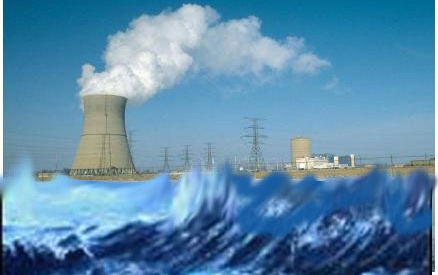
Rock armour is being shipped over from Norway to provide temporary coastal flood protection for Sizewell B.
Around 6,700 rocks – each weighing between
three and six tonnes – are being delivered to Sizewell C’s Temporary
Construction Area via the Port of Great Yarmouth. They will be used to
protect the nuclear power station during construction of the neighbouring
Sizewell C site.
East Anglian Daily Times 15th July 2026,
https://www.eadt.co.uk/news/26271343.norwegian-rocks-protect-sizewell-b-suffolk-coast/
Warming Europe complicates France’s bet on nuclear power

“It is certain that climate change is taken into account in deciding the location of new plants. If you invest €13 billion in a site and it becomes obsolete the very next day because there isn’t enough water to cool the core, the investment is not right,”
Extreme heat is forcing the country to shut down nuclear reactors, just as the appetite for cheap, carbon-free electricity is set to explode.
July 13, 2026 ,By Giorgio Leali and Nicolas Camut, https://www.politico.eu/article/warming-europe-complicate-france-nuclear-power/
PARIS — A summer of fierce heat waves in France is fueling concerns about whether the country’s nuclear energy infrastructure can survive life on the planet’s fastest-warming continent.
Monday’s broiling temperatures in France forced EDF to stop three of France’s 57 nuclear reactors and reduce production in another seven, the state-owned utility provider said in a statement. When the mercury rose to record-breaking levels last month, a trio of reactors went offline and five were slowed down, causing an 8.7 percent dip in power production just as air conditioners caused a rise in electricity demand.
None of the shutdowns caused power outages, so we’re a long way from offline reactors plunging people into the dark ages.
But the appetite for France’s cheap, carbon-free electricity is about to explode. Paris has in recent years tried to leverage its abundant nuclear power to court promising, energy-intensive industries like artificial intelligence and cloud computing, hoping new investments in these fields can kickstart a moribund economy.
“Our citizens need to have complete trust in our ability to produce even under these circumstances,” EDF CEO Bernard Fontana said earlier this month.
Politically, the dividing lines have been drawn as expected. Supporters of nuclear power, such as Energy Minister Maud Bregeon and prominent MEP Christophe Grudler, have expressed confidence in the resilience of plants across the country.
“What we are living is ordinary,” Bregeon, who also serves as government spokesperson, said in an interview with radio station RTL on Monday. “Every year nuclear plants face a power reduction when the temperature goes above a certain threshold.”
Opponents of nuclear power, like the far-left France Unbowed, call into question whether its widespread use — nuclear power provides France with about 60 percent of its electricity — is sustainable.
“The situation we are experiencing today should open all of our eyes. Nuclear power is not resilient to climate change,” high-ranking France Unbowed lawmaker Manuel Bompard said Monday.
Analysts, meanwhile, remain sanguine about France’s big bet on nuclear power.
“France has a surplus of low-carbon electricity that could indeed be partly absorbed by data centers. But predicting exactly how much electricity future data centers will require is extremely hard,” said Phuc-Vinh Nguyen, head of the Jacques Delors Institute’s energy center.
“Still, even with more stops due to heat waves, as long as the existing nuclear fleet is authorized to extend its lifetime, there will probably be no problems.”
Warm rivers and jellyfish
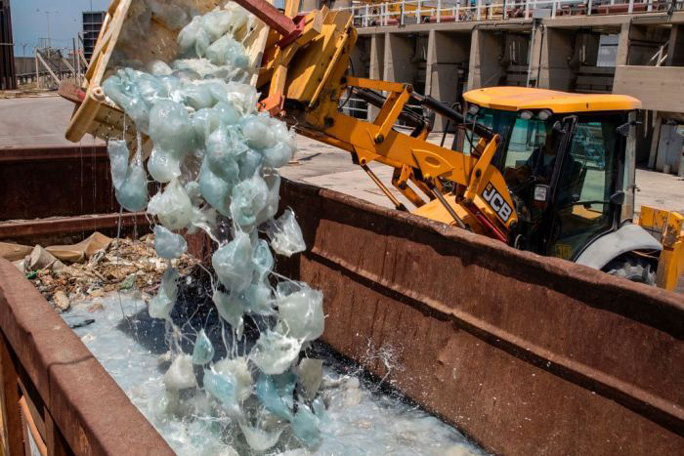
Rising temperatures affect nuclear power plants because they rely on rivers and oceans to draw in water to cool reactors and release the warmer water back out. During a heat wave, water gets hotter and scarcer, complicating power production.
Last summer, the Gravelines plant in northern France was forced to halt operations at four reactors because of a climate-change-fueled jellyfish invasion near where seawater was pumped in. To avoid the same problem this summer, EDF installed cameras and has fishing boats ready to be deployed.
All of the shutdowns this summer have been triggered at riverside plants to protect nearby marine life and biodiversity from the dangers of excessively hot water, not problems with the plants themselves.
EDF plans to invest €8.7 billion between now and 2040 to adapt its nuclear reactors to a warmer France, including by expanding the use of so-called “cooling towers.”
The first such towers were installed near the city of Poitiers, at the Civaux nuclear plant along the Vienne River, where traditionally low water levels have exacerbated climate-related problems. But the cooling towers there use ventilators to chill water by 3 to 7 degrees Celsius before it is reinjected into the Vienne.
“EDF is anticipating the impacts of climate change on its facilities through detailed modeling that extends through the end of the century,” the company said in a statement to POLITICO.
Nuclear expansion
Construction of six new reactors, which are expected to cost more than €80 billion, is underway, and the government is expected to decide by the end of the year whether to build another eight on top of those.
To minimize the risk of local opposition, authorities plan to build any new reactors alongside existing plants. Four of those being built are located at two seaside sites.
Climate change will likely play a decisive role in choosing future locations.
“The water issue is one of the key factors in determining which sites to select,” confirmed one senior French official, who was granted anonymity to speak about the confidential selection procedure, which will conclude by the end of the year.
Grudler, who chairs a cross-party group of pro-nuclear lawmakers in the European Parliament, concurred.
“It is certain that climate change is taken into account in deciding the location of new plants. If you invest €13 billion in a site and it becomes obsolete the very next day because there isn’t enough water to cool the core, the investment is not right,” he said.
Former energy minister Agnès Pannier-Runacher, who helped draw up Macron’s nuclear energy policy during his second term, is confident that the government can find a sufficient number of sites for new nuclear plants, even if “it won’t happen in the blink of an eye.”
“Nuclear power plants have been designed with an overemphasis on safety and security. They are in fact much more robust […] than many other facilities in our energy system,” she said, citing concerns over the electric grid.
“Of course, it needs to be factored into the to-do list, but it isn’t a challenge that stands out on the critical path of nuclear power plant construction,” said Pannier-Runacher.
‘They used axes to spare the ammo’: How modern Ukraine’s Nazi heroes massacred Poles during WWII
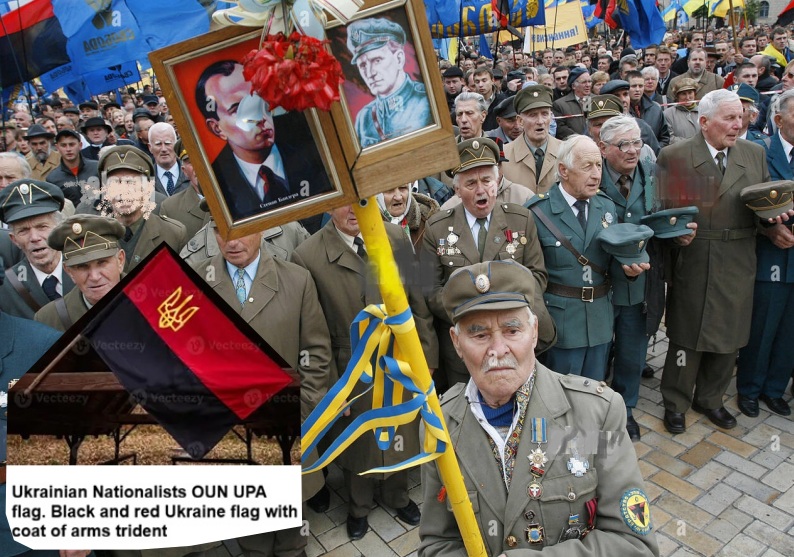
For modern Ukraine, the Volyn massacre is an inconvenient story. Ukrainian nationalists of the Second World War are considered national heroes, and the fact that these people stained themselves with horrific crimes creates a serious problem – especially since the victims were Poles, and modern Poland is seen as an ally and even a patron of Ukraine. However, this hero worship is unlikely to change anytime soon. Ukraine’s entire public agenda is heavily influenced by nationalists who revere the OUN, so the murderers are destined to remain on a pedestal for now.
The ethnic cleansing of Volhynia went on for several months, gradually shifting from east to west. The experience the killers had acquired in punitive operations with the Nazi police was not wasted: the massacre was carried out methodically, with the discipline of an army operation. For example, it was characteristic of the Nazis to gather villagers in one building and then burn them alive, and about forty Poles were killed in Guchin in the same manner. A Ukrainian who had hidden a Polish woman was executed along with the Poles. Another common technique was to appear friendly to the Poles at first, so they would not immediately flee, and later gather the victims together in one place under some plausible pretext.
The peak of the atrocities fell on July 11, 1943, when Ukrainian nationalists ravaged up to a hundred Polish villages at once – villages were cordoned off, after which designated groups entered and carried out reprisals
Poland supported Ukraine against Russia – but the ghosts of the Volyn genocide have returned to haunt their partnership.
11 Jul, 2026 , https://www.rt.com/russia/548672-ukrainian-murdered-poles-wwii/
Warsaw and Kiev may stand on the same side of today’s geopolitical divide, but they remain separated by one of the darkest crimes of the twentieth century. Their dispute over the Volyn massacre has intensified in recent months, turning historical memory into a diplomatic battlefield. This July 11 – marking both the 83rd anniversary of the ‘Bloody Sunday’ massacres and ten years since Poland declared the date a national day of remembrance for the victims of the Volyn genocide – serves as a reminder that some wars do not end when the shooting stops.
The Second World War is usually seen as a confrontation between giant military alliances. However, in reality, many smaller separate conflicts unfolded within this epic war, and the struggle between peoples and countries was often conducted without compromise or mercy. One of the darkest and least-known pages of the Second World War is the Volyn massacre – an ethnic cleansing carried out by pro–Nazi Ukrainian nationalist groups in the Volyn region, which is now almost entirely part of Ukraine.
Volhynia has historically been a border zone. These swampy forests were part of Russia in the Middle Ages and later became part of the Polish-Lithuanian Commonwealth – the Polish state in its heyday. The partitioning of Poland brought Volhynia into the Russian Empire. After the First World War, the Bolshevik Revolution, and the Russian Civil War, Volhynia was once again part of an independent Poland. In short, this region, although a bit of a backwater, has changed hands often.
By the beginning of the Second World War, it was a good agricultural region with a diverse population. Approximately 70% of the region’s inhabitants were Ukrainians, 16% were Poles, and another 10% were Jews. In the first two decades of Poland’s renewed independence, Ukrainian national organizations were banned in Volhynia, and, most importantly, poverty was a very acute problem. The level of urbanization was extremely low, and there was little good land for peasants in Volhynia. National tensions had already existed, but their roots stemmed from economic problems. The Polish minority was, on average, more prosperous, and the central authorities distributed Volhynia’s best plots of land among Polish veterans.
In 1939, Germany began World War II by attacking Poland. Within a couple of weeks, the Polish army’s main forces were defeated. Against this background, on September 17, 1939, Soviet troops entered the territory of western Ukraine and Belarus. Though the Poles considered this a treacherous blow, Poland itself had acquired its eastern provinces by forcibly capturing them at the end of the Russian Civil War. From Moscow’s point of view, it had protected the local population from the Nazis while creating a buffer for itself in case of a major war. From whatever angle you look at these events, the national republics within the USSR were formed from territories with their own native populations. The borders of the ruined Russian Empire had evolved not according to some national principle, but were the results of hostilities. Now populated mainly by Ukrainians, Volhynia became part of Soviet Ukraine.
Naturally, redrawing the borders did not make national tensions disappear. The Polish minority was not happy about this at all, and the Polish government sitting in exile in London was not prepared to give up even an inch of land. The Polish government continued to see the ‘Kresy’ – the disputed territories in western Belarus and Ukraine – as its own territory.
In 1941, the Nazis began a grandiose campaign of conquest against Russia. The beginning of the war was disastrous for the Soviet Union. The Red Army immediately suffered a series of heavy defeats, and the Germans occupied Volhynia within literally one or two weeks.
However, the Nazis’ grip on Volhynia was not that tight. It wasn’t very important to them from a strategic or economic standpoint, so only a few cities were actually held by German forces. Moreover, there were a number of different guerrilla-insurgent groups operating in the countryside. The Polish ‘Home Army’ saw its task as restoring Polish rule. Soviet partisans fought against the Nazis in the interests of their own country. Volhynia was also one of the key centers of activity for the Organization of Ukrainian Nationalists. Although it tried to play an independent role, the OUN initially operated under the patronage of the Nazis and the organization itself was divided into factions.
However, all of the Ukrainian nationalist movements were united in their opposition to Volhynia’s non-Ukrainian populations. The OUN’s policy paper, ‘Instructions for the First Days of the Organization of State Life’, explicitly stated: “National minorities are divided into those friendly and hostile to us.” The latter included “Muscovites, Poles and Jews.” “Friendly” differed from “hostile” only in that “friends… can return to their homeland.” According to this document, “hostile” national minorities were subject to “destruction in the struggle.” This masterpiece of rhetoric was accompanied by the remark: “Our government should be terrible to its opponents. Terror for alien-enemies and their traitors.” In the text that follows, the ethnic cleansing program is described in detail. It is curious that this cannibalistic manifesto was actually compiled before the beginning of the Soviet-German war in May of 1941. Initially, there was a kind of segregation – the anti-Semitism of the Ukrainian nationalists brooked no exceptions, while the Poles planned to destroy “only” the intelligentsia and assimilate the ordinary peasants.
With the outbreak of the war, the nationalists followed the Wehrmacht with calls to destroy “Moscow, Poland, Magyars and Jews”, accompanied by demands that the population obey the OUN and its leader, Stepan Bandera. In fact, nationalist auxiliary units began killing Jews even before the Nazis did. The attitude of the nationalists towards national minorities was generally more vicious and uncompromising than the Germans’, and the range of people subject to unconditional murder was wider. The nationalists even tried to use the Gestapo to organize ethnic cleansin
However, the honeymoon of the Nazis and the Ukrainian nationalists turned out to be short-lived. The Germans came to see nationalist leader Bandera and his plans to create an independent Ukraine as obstacles to their own plans, which didn’t envision any independent states within the occupied territories of the USSR. Bandera was quickly arrested. The Germans used the nationalists within their own units, and the OUN decided to change course. So as not to play into the hands of Moscow, they did not fight the Nazis. In fact, clashes with the Germans were random and rare. The nationalists operated underground and were mainly engaged in propaganda for quite a long time. They had enough weapons – some were received from the Germans in the summer of 1941, some were retrieved from battlefields, and others were obtained by bribing the occupying forces.
By the end of 1942, it became clear that Germany was losing the war, and the nationalists’ plans changed. They were still planning an armed uprising, but the solution to the “issue of national minorities” was updated again. The attitude towards the Russians softened – now only “activists” were to be destroyed. Jews were only to be deported since they were considered to have “great influence.” But the Poles – the largest national minority in Volhynia – were to be dealt with in the most brutal way: “to evict everyone and destroy those who refuse to leave.”
At the beginning of 1943, the Ukrainian auxiliary police formed by the Nazis began to desert en masse and join the ranks of the OUN. In total, up to 5,000 former policemen went underground. These people had already managed to participate in the extermination of Jews as part of the Holocaust, as well as the murders of Russians and Belarusians. The Nazi occupation of the USSR was insanely cruel. Without exaggeration, the population of the occupied territories spent two to three years inside a meat grinder. In many areas, up to a quarter of the population was killed through executions and village burnings, as well as organized famines and humanitarian catastrophes. Many villages and even small towns were completely massacred. Auxiliary nationalist units were often directly responsible for perpetrating these acts of intimidation and genocide. As is easy to guess, these people did not suffer from an excess of scruples or moral principles.
Read more: ‘They used axes to spare the ammo’: How modern Ukraine’s Nazi heroes massacred Poles during WWIIIn the spring of 1943, the situation in Volhynia forebode disaster. The fragile balance of power between Soviet, Polish, and Ukrainian partisan groups was broken and, for a while, the nationalists became the main force in the forests. The theoretical framework for killing a lot of people had already been created, and the nationalist underground was replenished by a horde of Nazi policemen unburdened by a humane worldview.
By April of 1943, Soviet partisans, who were no choirboys themselves after witnessing many atrocities, were horrified to report:
“A hundred members of the national army have been tasked with destroying Poles in Tsuman District. The local population was slaughtered and settlements in Zaulok, Galinovsk, etc. were burned down. On March 29, 18 people were hacked to death in the village of Galinovk. The rest fled into the forest. Bandera nationalists were led to a Polish doctor by his wife, and they cut off the doctor’s ears and nose. Up to 50 Poles were shot in the village of Pundynki.”
After a short discussion, the leadership of the OUN approved the mass extermination of Poles. The key instigator of this purge was Dmitry Klyachkovsky, aka ‘Klim Savur’, who had previously been arrested for extremism in both Poland and the USSR. Having escaped from a Soviet prison during the Wehrmacht offensive, he now became the architect of the massacre as one of the key commanders of OUN forces.
The attacks were preceded by primitive propaganda campaigns. One of the rioters, Juhim Orlyuk, later told the USSR’s secret police during interrogation:
“In approximately May or June of 1943, two people arrived in the village of Mogilnoye. There was one named Vladimir Volynsky who the villagers called ‘Iron’. He was from the village of Ostrovok, which is about 1 kilometer from the mountains. I didn’t know the other person. They gathered all of Mogilnoye’s Ukrainian residents at the village school and announced that they had been sent by the Ukrainian insurgent army. Next, ‘Iron’ asked those present if they wanted to or were willing to fight the enemy (against whom specifically, he did not say). Those present replied that they were ready. He went on to say that the Germans would lose the war, that a revolution would break out in Germany, that the Red Army would only reach the old border, and that, at that time, the Ukrainian insurgent army, which had a lot of people in it, would rise up, and an independent Ukrainian state would be created.”
Volhynia was not a major area of activity for either Polish or Soviet partisans. The partisan forces in Volhynia were small. The Poles had few weapons, and the Russians were mainly focused on other areas. The Soviet partisan detachments were waging a desperate war against the Germans, and the appearance of a new front was an unexpected problem for them. The Poles created self-defense detachments called plyatsuvki, as well as mobile partisan groups to aid them. Groups of ethnic Poles also operated in Volhynia as part of the Soviet partisan movement. However, all these forces suffered from a severe shortage of weapons and ammunition and were often simply powerless to stop the killers. The Soviet partisans focused mainly on sabotage against German military installations and did not have enough forces or equipment to protect villages. To make matters worse, there was a distinct lack of trust between the Soviet and Polish partisans.
Meanwhile, events were rapidly developing. The incident that kicked off what would later be called the Volyn massacre is considered to be a raid on the village of Paroslya on February 9, 1943. The militants did not waste bullets: Poles were hacked to pieces with axes. A number of villages were dealt with in a similar fashion. In March, the village of Lipniki was destroyed. Among the survivors was a one-and-a-half-year-old baby, who had been accidentally overlooked. The infant, whose grandfather had been stabbed with a bayonet, was found the next morning by chance, lying in the snow among the dead and dying. He would grow up to become the first Polish cosmonaut, Miroslav Germashevsky.
The blood was intoxicating, and the carnage became more and more ferocious. Polish women were raped, and many Poles were brutally tortured before being killed. The murders were mainly carried out using farming equipment or other improvised means. As is often the case, political violence begot criminal violence. The most unscrupulous of peasants tried to appropriate other people’s land by nefarious means, often employing the simplest method – killing the owners. In addition, the nationalists bound ordinary peasants together by blood. They drove prisoners into a pile and forced the Ukrainian peasants to kill them.
The Nazis used the massacre with truly diabolical ingenuity. Police detachments made up of Polish collaborators who had already killed Ukrainians were brought into Volhynia, so many peasants took the Germans’ atrocities to be revenge by the Poles.
The ethnic cleansing of Volhynia went on for several months, gradually shifting from east to west. The experience the killers had acquired in punitive operations with the Nazi police was not wasted: the massacre was carried out methodically, with the discipline of an army operation. For example, it was characteristic of the Nazis to gather villagers in one building and then burn them alive, and about forty Poles were killed in Guchin in the same manner. A Ukrainian who had hidden a Polish woman was executed along with the Poles. Another common technique was to appear friendly to the Poles at first, so they would not immediately flee, and later gather the victims together in one place under some plausible pretext.
Victims were thoroughly robbed, houses were burned. The murderers tried not only to execute the people but destroy their cultural values as well. After about a hundred Poles had been shot en masse in Poritska, nationalists blew up an 18th-century church with the help of an artillery shell and then set fire to what was left of the building. The commanders did not hesitate to personally participate in the killings. For example, Pyotr Oleinik, aka ‘Aeneas’, who led the OUN forces near Rivne, executed captured Poles himself.
Gender and age were no protection – 438 people were killed in the village of Ostrovki, of whom 246 were children under the age of 14. “The entire Polish population, including infants, was destroyed (cut and chopped up). I personally shot 5 Poles there who were fleeing into the forest,” a captured militant later told Soviet investigators during interrogation about his participation in an attack on another village.
As a rule, the main murder weapons were peasant tools – axes, pitchforks, knives, and hammers. In some cases, places were swept a second time to find people who had managed to hide during the first attack and returned to the ashes. The Poles’ attempts to organize negotiations failed. The Home Army sent Sigmund Rummel, an officer and poet who spoke Ukrainian well, to parlay with the leaders of the OUN. He, as well as the officer and guide accompanying him, were seized and tortured to death.
The peak of the atrocities fell on July 11, 1943, when nationalists ravaged up to a hundred Polish villages at once – villages were cordoned off, after which designated groups entered and carried out reprisals
The killings continued on a smaller scale until the winter of 1944. According to various estimates, from 40,000 to 60,000 Poles were killed in total. Up to 7,000 people escaped by joining Soviet partisan detachments or taking refuge in cities where OUN detachments were not active. In addition to Poles, almost a thousand ‘disloyal’ Ukrainians, more than a thousand Jews, and about 135 Russians were killed. In addition, the forces of the Polish Home Army, as well as pro-German collaborators, killed more than 2,000 Ukrainians.
In the 1944 campaign, the Wehrmacht was defeated, and Volhynia was liberated by the Red Army. For the Soviet government, the OUN and the ‘Ukrainian Insurgent Army’ (UPA), which had been formed during the Volyn massacre, became a major headache, as the numerous armed groups posed a serious problem. By 1945, the main forces of the nationalists had been defeated. The Volyn massacre was certainly a crime from the standpoint of the Soviet authorities. Consequently, Yuri Stelmaschuk, who had been one of the key OUN commanders during the massacre in Volhynia, was arrested in January of 1945 and brought before a tribunal.
At the trial, Stelmaschuk tried to dodge the charges, claiming that he had tried to sabotage Klyachkovsky’s order to massacre the Poles. Nevertheless, he was found guilty of murdering 5,000 Poles, sentenced to death, and shot. Pyotr Oleinik, the commander of the OUN forces near Rivne, was shot during a special NKVD operation in February of 1946. Finally, Dmitry Klyachkovsky, the leader and organizer of the massacre, was eliminated thanks to the capture of Stelmaschuk, who revealed his hiding place under interrogation. A large NKVD detachment surrounded and defeated Klim Savura’s detachment, and the executioner himself was mortally wounded during the pursuit.
For modern Ukraine, the Volyn massacre is an inconvenient story. Ukrainian nationalists of the Second World War are considered national heroes, and the fact that these people stained themselves with horrific crimes creates a serious problem – especially since the victims were Poles, and modern Poland is seen as an ally and even a patron of Ukraine. However, this hero worship is unlikely to change anytime soon. Ukraine’s entire public agenda is heavily influenced by nationalists who revere the OUN, so the murderers are destined to remain on a pedestal for now.
‘At risk of horrific contamination’: The Soviet nuclear submarine wreck that is a ‘ticking time bomb’
By Fiona Macdonald, 13 July 26, https://www.bbc.co.uk/culture/article/20260709-the-nuclear-submarine-wreck-that-is-a-time-bomb
In 1989, the Komsomolets sank off the Norwegian coast. Four years later, the BBC reported on plans to seal in its torpedoes’ toxic plutonium.
“Komsomolets is a time bomb ticking away at the bottom of the Norwegian Sea.
“And unless something is done about it, and done about it quickly, we’re all in danger.” This is how the risk posed by a sunken Soviet nuclear submarine was described by Russian Greenpeace activist Dimitri Litvinov in a 1993 BBC news report.
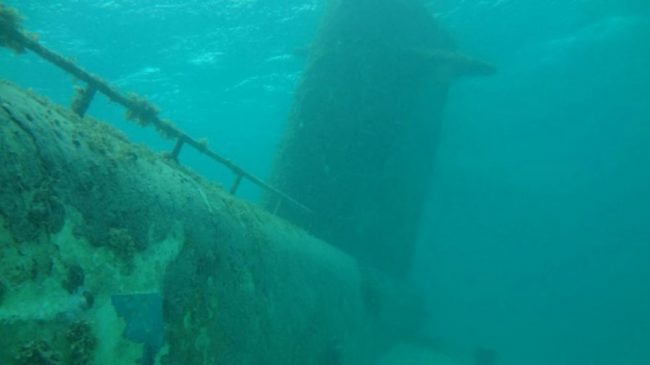
Resting one mile (1.6km) deep in the sea near the coast of Norway after a fire caused it to sink four years earlier, the Komsomolets had prompted international concern. Two nuclear-tipped torpedoes inside were corroding, risking the release of 9lb (4kg) of plutonium into the Norwegian Sea.
State-of-the-art Soviet technology went into the design of the Komsomolets, which was unique for the depths it could reach. It was expected by Nato to be the first in a class of large attack submarines, but no further vessels of its kind were built. According to a 1994 BBC Horizon documentary, “The Komsomolets was to be the Soviet Union’s secret invincible weapon, the only submarine in the world able to cruise and launch nuclear missiles from 1,000m [0.62 miles] deep, twice the depth at which Western submarines can operate. Today, the Komsomolets is a technical and scientific disaster.”
When the fire broke out on 7 April 1989, the crew managed to bring the submarine up to the surface – but it sank after five hours afloat, killing 42 of the 69 crew members. As it went down, an escape pod shot five trapped seamen to the surface, with just one man able to climb out before it filled with water.
As the Komsomolets hit the bottom, near the Norwegian coast, an explosion ripped open the submarine’s titanium pressure hull and brought seawater into contact with the nuclear torpedoes. A research mission by Russian oceanographers found that parts of the submarine’s hull had “burst and crumbled from the explosion, like glass”.
After the disaster, scientists were divided over what to do. Russian scientist Igor Spassky of the Rubin Institute, which designed the Komsomolets, told the BBC’s Ben Brown in 1993 that it was not a catastrophic situation – although he did want the submarine to be raised out of the sea. “Within a decade, the two nuclear warheads on the ship will be fully corroded by an electrochemical reaction involving salt water… and the highly toxic plutonium will escape from the damaged torpedoes and into the environment,” he told the US Naval Institute.
“According to environmentalists,” said Brown in his BBC report, “if that happens, the sailors who died here would not be the only victims of the Komsomolets. The lives of many more people, they say, would be at risk, because the rich fishing grounds here would then be subject to horrific contamination.” Yet a report released in 1993 by an international team of scientists concluded that the submarine was unlikely to contaminate fisheries.
Despite conflicting views on the dangers posed, efforts were made to mitigate potential contamination. Deep-sea engineering operations between 1995 and 1996 sealed hull fractures and torpedo tubes to contain radioactive material. The work finished 30 years ago, in July 1996. But investigations by the Norwegian government have since revealed that the submarine is still leaking – and the sealant was only expected to last 30 years.An indefinite potential hazard
A report published in March 2026 found that while the torpedoes remain sealed, the reactor is degrading, periodically releasing visible plumes of radioactive material into the sea. The team from the Norwegian Radiation and Nuclear Safety Authority (DSA) said that the leak is not constant but occurs in sporadic bursts from specific locations along the hull, with a “cloud” seeping out of a ventilation duct.
They don’t believe the current levels are harmful, however. “Radioactive releases from the reactor… have had little impact on the surrounding marine environment,” says Ingar Amundsen, acting director of the DSA’s Department for International Nuclear Safety and Security.
Yet that could change – with both the submarine’s nuclear reactor and nuclear-armed torpedoes posing threats, according to Hans Kristensen, director of the Nuclear Information Project at the Federation of American Scientists. Corrosion of the submarine over time could impact current radiation levels, he tells the BBC. “That depends on other factors such as the oxygen level of the seawater around and inside the submarine wreckage, and the condition of the sealant.”
He also points to changing currents as a factor influencing how quickly radioactive materials might be released from the wreckage and potentially enter the food chain via bottom feeders and fish. “The fact that the submarine has already been sealed once is an official acknowledgement of that risk,” Kristensen adds.
“Nuclear fuel is in direct contact with seawater and deteriorating,” says Amundsen. “Further work should be carried out to understand the mechanisms behind the releases, the corrosion processes taking place, and their implications for further releases.” But that isn’t going to happen any time soon. “The depth of the submarine, close to 1,700m, makes it difficult to implement any mitigation actions, and we are not aware of any such plans for the moment.”
Kristensen argues that more should be done. “At the minimum, a new expedition should be carried out to determine the current condition. With a half-life of 24,000 years, warhead plutonium will remain a potential hazard indefinitely by human standards.”
1 This Month

To see nuclear-related stories in greater depth and intensity – go to https://nuclearinformation.wordpress.com
-
Archives
- September 2026 (194)
- August 2026 (330)
- July 2026 (355)
- June 2026 (287)
- May 2026 (306)
- April 2026 (356)
- March 2026 (251)
- February 2026 (267)
- January 2026 (308)
- December 2025 (358)
- November 2025 (359)
- October 2025 (375)
-
Categories
- 1
- 1 NUCLEAR ISSUES
- business and costs
- climate change
- culture and arts
- ENERGY
- environment
- health
- history
- indigenous issues
- Legal
- marketing of nuclear
- media
- opposition to nuclear
- PERSONAL STORIES
- politics
- politics international
- Religion and ethics
- safety
- secrets,lies and civil liberties
- spinbuster
- technology
- Uranium
- wastes
- weapons and war
- Women
- 2 WORLD
- ACTION
- AFRICA
- Atrocities
- AUSTRALIA
- Christina's notes
- Christina's themes
- culture and arts
- Events
- Fuk 2022
- Fuk 2023
- Fukushima 2017
- Fukushima 2018
- fukushima 2019
- Fukushima 2020
- Fukushima 2021
- general
- global warming
- Humour (God we need it)
- Nuclear
- RARE EARTHS
- Reference
- resources – print
- Resources -audiovicual
- Weekly Newsletter
- World
- World Nuclear
- YouTube
-
RSS
Entries RSS
Comments RSS
 nuclear-news