Pakistan’s 25,000 to protect its nuclear arsenal
 Pakistan deploys 25,000-strong force to protect nuclear arsenal, Times of India PTI Jun 22, 2013, ISLAMABAD: Pakistan has raised a 25,000-strong special force and put in place extensive measures to protect and manage its strategic assets, including its nuclear arsenal, finance minister Ishaq Dar said on Saturday.
“A special security force of 25,000 personnel, who have been specially trained and provided sophisticated weapons, has been deployed to protect (the nuclear assets),” Dar said, while winding up the debate on the 2013-14 budget in the National Assembly or lower house of Parliament……. http://articles.timesofindia.indiatimes.com/2013-06-22/pakistan/40133480_1_security-force-nuclear-arsenal-strategic-plans-division
India’s uncertain nuclear power future
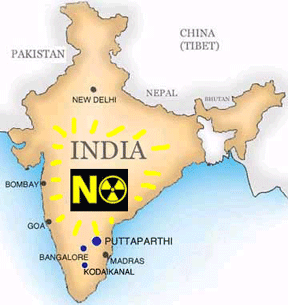 for all of its ambition, and its government’s strident rhetoric, India’s nuclear industry is one beset by problems, both in its current operation and in its plans for expansion.
Emboldened by a global nuclear wariness post-Fukushima, those living nearby to proposed plants are resisting by all means available.
At Kundakalum in Tamil Nadu, rolling protests have slowed construction by years. Violent demonstrations against a proposed mega-plant in Jaitapur (it would be the third largest in the world) have seen hundreds arrested, dozens hurt and one man shot dead by police.
(unfortunate & incorrect title) India depends on a nuclear future The Age, June 22, 2013 Ben Doherty “……India has bold plans for its nuclear industry – 470GW by 2050, Dr Singh says, more than the entire world can produce now – but today, with the lights still flickering out, the country is finding its nuclear ambitions frustrated on every front.
Plans for new power plants are being resisted by violent protest, existing ones are stricken by radiation leaks, and uranium mines are plagued by reports of thievery and smuggling.
And high on a hill in a tiny corner of the country, one woman is holding out against the might of her government’s will. 81-year-old Spility Langrin Lyngdoh has lived in the village of Domiasiat in the Khasi Hills of Meghalaya, longer than modern India has existed.
Her father bought this land decades ago – his grave is a few hundred metres from the home where she now sits – and Spility has spent almost her entire life here. She wants it to remain as a home for her children and grandchildren and great-grandchildren.
But beneath the hills her father bought lies uranium, more than 9,500 tonnes the Indian government estimates, between eight and 47 metres underground: the “largest, richest, near-surface and low-cost sandstone-type uranium deposit discovered in India so far”.
The state-run Uranium Corporation of India Limited is anxious to begin commercial mining as soon as possible. It plans two open-cut mines over 10 square kilometres…… Continue reading
Rooftop solar power a boon for Japanese farmers
Japan’s Farmers To Benefit From Rooftop Solar Power http://www.energymatters.com.au/index.php?main_page=news_article&article_id=3802 21 June 13, Japan’s farming sector is making the switch to solar power, with the nation’s agricultural body announcing plans to spend AU$93 million installing 30 megawatts of solar on the rooftops of livestock barns and distribution centres.

The project is the initial phase of a plan by Japan’s National Federation of Agricultural Cooperative Associations (or Zen-Noh, for short), and Mitsubishi, to ultimately provide 200 megawatts of solar power capacity on farming facilities nationwide by the middle of 2015. Continue reading
Groundwater near Fukushima found to have radioactive strontium 90
 (includes video )Radioactive Strontium-90 found in groundwater near Fukushima nuclear reactor Japan’s damaged Fukushima Daiichi Nuclear Plant reports a toxic substance in groundwater as the country’s new guidelines for nuclear reactivation are approved. NBCNews.com’s Dara Brown reports. By Arata Yamamoto, Producer, NBC News TOKYO, Japan – High levels of toxic Strontium-90 have been found in groundwater at the tsunami-stricken Fukushima nuclear power plant, its operator said Wednesday.
Tokyo Electric Power (Tepco), which has been struggling to clean up the plant, said nearly 30 times the permitted level of the radioactive isotope was discovered in a well dug last month outside the turbine hall of Reactor No.2.
The company said it had not detected any rise in the levels of Strontium-90 in sea water, and that it believed the substance was trapped during the initial 2011 nuclear fallout.
It plans to inject chemicals into the ground between the well and shore to prevent any leaks into the ocean…..
Nuclear power problems in South Korea

 South Korea’s Nuclear Blues The Diplomat, By Sebastian Sarmiento-Saher June 19, 2013 “…..Although South Korea’s burgeoning nuclear energy industry looks set to become a world leader, Seoul will first have to address domestic corruption in the atomic sector and international questions regarding its right to reprocess spent fuel at home. Continue reading
Lynas rare earths company drops defamation case against Save Malaysia Stop Lynas.
Lynas drops case against Malaysia greens AAP JUNE 18, 2013 AUSTRALIAN rare earths miner Lynas Corporation has dropped defamation action against a Malaysian green group. In April last year, Lynas initiated legal proceedings against Save Malaysia Stop Lynas.
Two months later, independent media website Free Malaysia Today apologised for running stories sympathetic to the activists, who opposed plans for a processing plant. Lynas Corporation chief executive Eric Noyrez on Tuesday said solicitors had been instructed to discontinue legal action against the activist group.
“There is no value in continuing disputes with members of our local community,” he said in a statement.
“Therefore, Lynas intends to instruct its solicitors to discontinue its defamation claim against the Save Malaysia Stop Lynas group.”…. Lynas shares fell 1.25 cents, or 2.84 per cent, to 42.75 cents following the statement’s release.http://www.heraldsun.com.au/business/breaking-news/lynas-drops-case-against-malaysia-greens/story-fni0xqe4-1226665659143
Problems in nuclear pyroprocessing
 South Korea’s Nuclear Blues The Diplomat, By Sebastian Sarmiento-Saher June 19, 2013“…..Assuming that South Korea does gain approval to conduct pyroprocessing, it may take years to do so in a way that is both technically and economically viable. The Diplomat spoke with Olli Heinonen, a Senior Fellow at Harvard’s Belfer Center for Science and International Affairs, who said that “[t]he product to the ROK pyroprocessing scheme is a uranium/transuranium/zirconium fuel, which is not suitable to fuel ROK’s LWR [Light Water Reactor] or CANDU [Canada Deuterium Uranium] reactors. Thus ROK is developing a prototype Sodium Fast Reactor (SFR), which is planned to be operational around 2028. A commercial scale SFR is envisioned to be available by the mid of the Century.”
In addition to a long wait time, pyroprocessing results in other fissile materials like Neptunium that can be used for nuclear bombs and must be safeguarded. Neptunium must be separated out, but as Dr. Heinonen added, “[i]t is fairly easy and straight forward for the IAEA to monitor and confirm that this does not take place.” This will mean that additional safeguarding efforts would need to be implemented – all of which will ultimately depend on South Korea’s willingness to abide by them.
Finally, how proliferation resistant is pyroprocessing in terms of achieving pure plutonium metal needed for nuclear weapons and timing? Dr. Heinonen gave his take: “The fact that plutonium is not fully separated from other elements gives to the ROK officials basis to argue that this difference makes pyroprocessing more proliferation resistant than traditional reprocessing.”
“In order to have pure plutonium separated, additional process steps are required either at the pyroprocessing plant or at a separate installation, which would be found by the IAEA. If such process steps are made it would take 1-3 weeks to turn the material to plutonium metal. However, before that the process steps need to be developed and constructed, but the bottom line is that by having the envisioned uranium/plutonium metal, a proliferator is substantially closer to pure plutonium metal.” ….. http://thediplomat.com/pacific-money/2013/06/19/south-koreas-nuclear-blues/
High Court orders withdrawal of criminal charges against Kudankulam protestors
 HC notice to Govt for withdrawal of cases against anti-nuclear
activists http://www.thehindu.com/news/national/tamil-nadu/hc-notice-to-govt-for-withdrawal-of-cases-against-antinuclear-activists/article4825993.ece , 18 June, 13 The Madras High Court on Tuesday ordered issueof notice to Tamil Nadu Government asking why steps were not taken to withdraw cases filed against anti-nuclear activists protesting against Kudankulam Nuclear Power Project.
First Bench comprising Acting Chief Justice Rajesh Kumar Agrawal and
Justice M. Sathyanarayanan, ordered notice to the state government and
sought reply within three weeks.
The notice was issued on a petition which sought a direction to the
state government to withdraw all criminal cases filed against
anti-nuclear activists, who have been protesting against the
Indo-Russian project in Tirunelveli District.
The petition referred to the Supreme Court’s direction to the state
government to withdraw all criminal cases against the protestors.
Japanese PM in Europe to market Japan’s nuclear reactors
 Japan PM promotes nuclear exports at central Europe summit Global Post, 16 June 13 Japanese Prime Minister Shinzo Abe made a push on Sunday for his country’s nuclear technologies at a summit in Warsaw with leaders of four ex-Communist European Union countries, as part of his bid to boost the Asian powerhouse’s exports.
Abe recently unveiled plans to treble Japan’s infrastructure exports to 30 trillion yen ($300 billion, 225 billion euros) a year, a target that could not be reached without nuclear reactors.
At Japan’s first summit with the so-called Visegrad Group — the Czech Republic, Hungary, Poland and Slovakia — Abe sought to interest the four in Japanese nuclear technology.
“We stressed the necessity of strengthening cooperation, especially in the area of energy policy,” Abe told reporters.
A joint statement issued after the talks said “Japan welcomed the fact that private sectors of both sides demonstrated keen interest in concrete forms of cooperation in nuclear energy and safety”……
In his first visit to Europe since taking office in December, promoting his country’s nuclear technologies was high on his agenda for boosting overall Japanese exports….http://www.globalpost.com/dispatch/news/afp/130616/japan-pm-promotes-nuclear-exports-at-central-europe-summit-0
Schoolground in Japan has high levels of radiation in fungus
 Chilling Phenomena”: Fungus emitting radiation 70 times higher than nearby asphalt — “A boy sitting on that patch could do real damage to his gonads” http://enenews.com/chilling-phenomena-fungus-emitting-radiation-70-times-higher-than-nearby-asphalt-a-boy-sitting-on-that-patch-could-do-real-damage-to-his-gonads Title: Cleanup From Fukushima Daiichi: Technological Disaster Or Crisis In Governance?
 Source: Fairewinds Energy Education
Author: Art Keller
Date: June 13, 2013
[…] One of the first demonstrations conducted by [Kevin Wang]’s team was at a Japanese school still in routine use. The contamination was widespread and included troubling accumulations of radiation in biological materials. While the asphalt driveway was contaminated, the grass next to it was four times as radioactive as the asphalt. The worst were the patches of fungus on the bleachers at the school’s baseball field, which had sucked-up radionuclides to such a degree that they were emitting radiation at 70-times the contaminated asphalt.
[Sam Engelhard, an industrial hygenist and certified radiation protection technologist] described the chilling phenomena of the fungus-turned-radiation-sponge as, “a remarkable example of biological amplification.”
Wang said it more bluntly, “A boy sitting on that patch to watch a baseball game could do real damage to his gonads.” […] Full report here
Japan’s government ignoring nuclear phaseout policy, and public opinion
Energy report skips nuclear phase-out Japan Times, KYODO JUN 15, 2013 Japan’s annual energy report released Friday barely refers to the fact that the previous government upheld a goal to phase out nuclear powerin the 2030s, reflecting the pro-nuclear stance of the current government.
The latest Energy White Paper covers a period between last August and around March, during which the previous government led by the Democratic Party of Japan compiled a new energy strategy in light of
the 2011 Fukushima nuclear disaster.
The most controversial part in the strategy was a pledge to “devote all policy resources to enable zero nuclear power plant operation in the 2030s,” but the white paper does not use the phrase in explaining
the strategy…….
The zero-nuclear goal shows up in the white paper once, but only as part of Prime Minister Shinzo Abe’s quoted statement, which criticizes the energy strategy for stirring concerns and distrust among the local
governments hosting nuclear plants and businesses.
The goal, if maintained, would have marked a massive shift in Japan’s
decades-long promotion of nuclear power……
The white paper also touches on a poll conducted by the previous
government seeking to gauge public opinion on energy policy, but does
not mention that the government at that time concluded that at least a
majority of the people are hoping for a society that does not rely on
nuclear power.
Of the 50 commercial reactors, only two, in western Japan, are online.
http://www.japantimes.co.jp/news/2013/06/15/business/energy-report-skips-nuclear-phase-out/#.UbzfVudwo6I
Radiation levels high – 45 miles from Fukushima nuclear reactors
 Experts: Shock during first trip to Fukushima — Radiation levels so high far away from reactors that full protection suit would be used in U.S., yet people were walking around — “Contamination far more widespread than most understand” http://enenews.com/experts-shock-during-first-trip-to-fukushima-radiation-levels-so-high-far-away-from-reactors-that-full-protection-suit-would-be-used-in-u-s-yet-people-were-walking-around-contamination-far
Title: Cleanup From Fukushima Daiichi: Technological Disaster Or Crisis In Governance?
Source: Fairewinds Energy Education
Author: Art Keller
Date: June 13, 2013
[…] Shortly after arrival on their first trip to Japan, the group headed for Shirikawa, a city 45 miles west and a few miles south of the Daiichi nuclear plant. [Sam Engelhard, an industrial hygenist and certified radiation protection technologist,] was shocked as soon as he unpacked his radiation sensor gear and turned it on. Here they were almost 50 miles from the accident site and in the opposite direction of the prevailing winds, and the crew’s radiation alarms immediately started going off.
“The radiation levels we were seeing were 1,000 times background, higher in spots,” Engelhard said. “If we had been working on a site this contaminated in the US, we would have been fully suited up in radiation protection suits, gloves, and respirators. Yet people were walking around and going about their business, with no idea of how contaminated everything around them was.” […]
[Kevin Wang of Califonia-based company PowerPlus] believes the Fukushima radiological contamination far more widespread that most Japanese understand. “One thing I heard so often during my trips to Japan that it became a mantra, was that ‘Fukushima is a Japanese problem and we have to fix it ourselves.’ So far, I haven’t seen any evidence that the government is taking the right steps to fix things. Instead, the wounded pride of government officials, and a lack of understanding at the urgency of the problem, prevented Japan from taking the steps they needed to.” […]
Scrap all Fukushima prefecture nuclear reactors, says Governor

Fukushima Governor Seeks Scrapping Of All Nuke Reactors RTT News6/12/2013 The Japanese government has been asked to scrap all nuclear reactors in the Fukushima prefecture, where one of the two nuclear power plants had a disastrous accident two years ago, displacing tens of thousands of residents.
Fukushima Governor Yuhei Sato met with Economy, Trade & Industry Minister Toshimitsu Motegi in Tokyo on Wednesday and handed over a letter raising the demand, Japanese media reported.
Sato said Fukushima was aiming for sustained regional development without relying on nuclear power, and it wanted the government to take responsibility in decommissioning all reactors at the Fukushima Daiichi and Daini nuclear plants….. http://www.rttnews.com/2134682/fukushima-governor-seeks-scrapping-of-all-nuke-reactors.aspx?type=gn&utm_source=google&utm_campaign=sitemap
New York giant bank to invest $3b in Japan renewable investments
 Goldman eyes $3b in Japan renewable investments SMH, 14 June 13, Goldman Sachs, the New York-based bank planning as much as 300 billion yen ($3 billion) in renewable energy investments in Japan, is eyeing offshore wind power after building up holdings in more established clean energy sources such as solar.
Japan Renewable Energy Co. was set up by Goldman in August after Japan began offering above-market rates to producers of clean energy. The incentives, or feed-in tariffs, have spurred investments in renewables, setting Japan on course this year to become one of the world’s largest solar markets by annual installations.
The company sees offshore wind as promising, Shigeru Yasu, a representative director at Japan Renewable Energy, said in an interview in Tokyo yesterday. Geothermal and biomass power also hold potential, he said……..
Five-year investment
Japan Renewable Energy plans in the next five years to invest as much as 50 billion yen directly into clean energy projects with capital provided by GS Infrastructure Partners. It will take as much as 250 billion yen of loans for project financing, Takahisa Nakagawa, also a representative director at Japan Renewable Energy, said in the interview. The investments and loans will amount to about 1,000 megawatts of clean energy, he said……..
Japan is set to overtake Germany as the world’s largest solar market, Bloomberg New Energy Finance said last month……. http://www.smh.com.au/business/carbon-economy/goldman-eyes-3b-in-japan-renewable-investments-20130614-2o7uo.html#ixzz2WFD29I8D
Groundwater radiation problems at Fukushima No 1 nuclear complex
Tepco again corrects water radiation level JAPAN TIMES , 14 JUNE 13 KYODO Tokyo Electric Power Co. has issued another correction for groundwater radiation at the Fukushima No. 1 nuclear complex and now says that it’s only a tenth of what it announced earlier this month.
The correction Wednesday was the second the beleaguered utility has issued for groundwater data. Tepco is locked in a battle with water and is desperately seeking fishermen’s consent to divert or dump the least-tainted portions of it into the Pacific Ocean to prevent it from mixing with highly radioactive water accumulating in the reactor buildings.
When it runs out of storage space, the tainted water will flood the premises and the environment, making the decommissioning process incredibly difficult.
Tepco said in May that the level of radioactive cesium in a sample of Fukushima No. 1 groundwater was so low it could not be detected. On June 3, however, the utility said the sample contained 0.61 becquerel per liter. This was then reversed Wednesday to a maximum of 0.055 becquerel. Other radioactive substances were not mentioned.
All of the figures are below Tepco’s upper limit for releasing groundwater: 1 becquerel per liter.
But the latest correction could deal another blow to Tepco’s efforts to dump the water by further damaging its already low credibility.
The radioactive water accumulating at the plant is a natural result of the makeshift cooling apparatus set up to keep the fuel from melting again. The water perpetually injected into the three reactors is leaking through holes created by the crisis and flooding each building.
Attempts to drain the water will be limited by Tepco’s rapidly shrinking storage space, and the penetration of the groundwater is only exacerbating the situation. …. http://www.japantimes.co.jp/news/2013/06/14/national/tepco-again-corrects-water-radiation-level/#.Ubu_mudwo6I
1 This Month
23-25 October – on Zoom – World BEYOND War’s annual global conferenc


Shut down the radiation-damaged Heysham nuclear reactors now
To see nuclear-related stories in greater depth and intensity – go to https://nuclearinformation.wordpress.com

Say No to NASA’s Reckless Nuclear Reactor on the Moon
Say No to NASA’s Reckless Nuclear Reactor on the Moon
-
Archives
- October 2026 (170)
- September 2026 (339)
- August 2026 (330)
- July 2026 (355)
- June 2026 (287)
- May 2026 (306)
- April 2026 (356)
- March 2026 (251)
- February 2026 (267)
- January 2026 (308)
- December 2025 (358)
- November 2025 (359)
-
Categories
- 1
- 1 NUCLEAR ISSUES
- business and costs
- climate change
- culture and arts
- ENERGY
- environment
- health
- history
- indigenous issues
- Legal
- marketing of nuclear
- media
- opposition to nuclear
- PERSONAL STORIES
- politics
- politics international
- Religion and ethics
- safety
- secrets,lies and civil liberties
- spinbuster
- technology
- Uranium
- wastes
- weapons and war
- Women
- 2 WORLD
- ACTION
- AFRICA
- Atrocities
- AUSTRALIA
- Christina's notes
- Christina's themes
- culture and arts
- Events
- Fuk 2022
- Fuk 2023
- Fukushima 2017
- Fukushima 2018
- fukushima 2019
- Fukushima 2020
- Fukushima 2021
- general
- global warming
- Humour (God we need it)
- Nuclear
- RARE EARTHS
- Reference
- resources – print
- Resources -audiovicual
- Weekly Newsletter
- World
- World Nuclear
- YouTube
-
RSS
Entries RSS
Comments RSS

