Japanese Red Cross Society radiation limits for emergency workesr
Red Cross radiation limit for relief workers too low, say critics Asahi Shimbun, By YURI OIWA June 13, 2013 The Japanese Red Cross Society has established a guideline for medical workers that sets an accumulated radiation dose limit of 1 millisievert for relief activities, although experts have said the ceiling is too low to allow workers to provide ample assistance to disaster victims.
“Radiation doses above 1 millisievert have no health effects,” said Yasushi Asari, a professor of emergency medical care at Hirosaki University. “There is no need for medical workers to use that threshold.”
Masahito Yamazawa, director-general of the Red Cross nuclear disaster preparedness task force, said during in-house discussions there were arguments for and against the 1-millisievert threshold. But the Red Cross determined that a 1-millisievert limit would still allow its workers to engage in relief activities in zones with high radiation levels because each relief mission usually lasts only up to a week, Yamazawa said.
One millisievert is the legal annual dose limit for members of the public during normal times.
Yamazawa added that allowances were also made for the fact that its medical relief squads include clerical workers.
“We have created the guideline out of a positive desire to help victims during a nuclear disaster,” Yamazawa said. “We will use it as a platform for further improvements if the need arises.”
Japanese Red Cross relief units fulfilled a total of 900 missions in communities ravaged by the 2011 Great East Japan Earthquake. However, initially they were unprepared for a nuclear disaster, and that created a vacuum of relief squads in Fukushima Prefecture during the early stages of the crisis at the Fukushima No. 1 nuclear power plant.
Red Cross officials said they learned from that experience and decided to create the new guideline for nuclear disaster relief activities.
The guideline says relief squad members should carry dosimeters and iodine tablets at all times, and retreat to safety whenever they are in danger of being exposed to more than 1 millisievert in accumulated radiation. It also says relief workers should keep clear of zones that are off-limits to residents……
Fukushima’s nuclear reactors – still on the brink of disaster

Australia’s very right wing and pro nuclear newspaper made a little mistake in publishing this one. Perhaps the editors didn’t read it properly. The headline is completely misleading!
Fukushima nuclear reactor back from the brink BY:RICK WALLACE, TOKYO CORRESPONDENT , THE AUSTRALIAN June 13, 2013 ”……..More than 1500 radioactive spent fuel rods sit immersed in water in the open-air pool, which is located about 30m above the ground in what’s left of the reactor No 4 building.
The rods are extremely volatile and, unlike the fuel in the reactors, are not surrounded by any containment structure. If exposed, they can spontaneously combust, creating a tragedy nuclear workers say would put 2011 – the worst nuclear disaster since Chernobyl in 1986 – in the shade.
Asked about other risks and challenges to the recovery process at Fukushima, Mr Takahashi cited removal of the melted nuclear fuel from the reactors and the ongoing build-up of contaminated water. “There are many difficult processes and among all of them the removal of the damaged fuel is the most difficult because no country has experience in doing this,” he said.
“The other main difficulty is treatment of the water and preventing the inflow of incoming water, and then we need to treat and dispose of the waste from that water.” Fukushima Daiichi is dotted with more than 300 giant tanks to store this water, each one holding some 1000 tonnes. TEPCO says it wants to expand its storage capacity to 700,000 tonnes and is digging underground tanks, too.
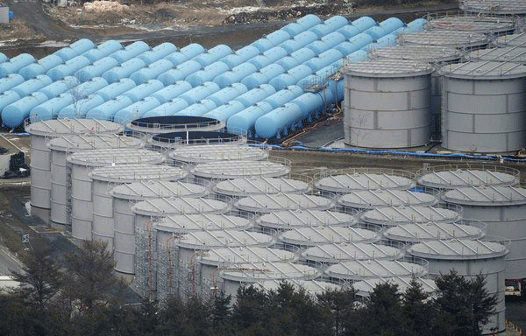
The company is also trying to lower the water table around the plant by digging wells to stem the entry of groundwater into the subterranean spaces of the reactors and minimise the outflow of contamination.
Each day, more than 3000 workers travel to Fukushima Daiichi to work, braving high radiation levels. Much of the debris at the plant has been cleared, although crumpled cars and trucks still dot the side that fronts the ocean. Pumps, and pipes that snake throughout the site, are keeping the situation stable for now but it’s readily apparent a huge amount of decontamination work remains before workers can turn to the task of decommissioning the reactors themselves.
Readings during yesterday’s press visit peaked at 1500 microsieverts near the reactor No 3 building. Standing in this spot for about 13 hours would give a person the 20 millisievert dose deemed as the trigger for evactuating civilians on an annual basis…..
The tour follows a series of embarrassing episodes for TEPCO, including a blackout that shut down cooling to the fragile plant for several hours.The company also recently revealed there had been a leak in one of the steel tanks storing radioactive water, and it had found radioactive cesium leaking into the groundwater near the plant. .http://www.theaustralian.com.au/news/world/fukushima-nuclear-reacto
Uncertainty over the location of melted nuclear fuel in Fukushima reactors
 Asahi: Locations and condition of melted Fukushima fuel unknown — Mainichi: 450 tons of scattered radioactive rods… unknown where holes in reactors are… plans may be delayed http://enenews.com/asahi-locations-and-condition-of-melted-fukushima-fuel-rods-unknown-mainichi-450-tons-of-scattered-radioactive-material-unknown-where-holes-in-reactors-are-plans-may-be-delayed-further
Asahi Shimbun, June 11, 2013: The workers have yet to gain a grasp of the locations and condition of the fuel debris. They have yet to develop extraction equipment and determine removal methods.
Mainichi,, June 11, 2013: Uncertainty over the location of melted fuel inside the crisis-hit Fukushima No. 1 Nuclear Power Plant continues to cast a shadow over plans to remove the fuel at an early date […] Reactor Nos. 1-3 at the plant contained a total of 1,496 rods of nuclear fuel in their cores. […] Each fuel rod weighs about 300 kilograms, and a high level of technical expertise would be required when undertaking a remote control operation to cut up and retrieve clumps of scattered radioactive materials weighing a combined 450 tons or thereabouts. […] the cores of reactors at the Fukushima plant have holes, and the task at hand is finding which parts have been damaged […] In a news conference on June 10, a representative of the Ministry of Economy, Trade and Industry’s Agency for Natural Resources and Energy said that bringing forward the plans would be dependent on developing technology, and suggested that the plans might even end up being delayed. […]
State of melted fuel at Fukushima plant unknown — Worker: “We opened the Pandora’s box” — Journalist: “We’re headed toward a real crisis”
Akie Abe – Japan’s anti nuclear “ opposition party within the family.”
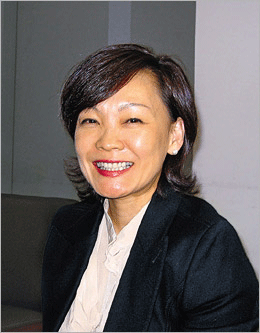
 Akie Abe, His “Anti-Nuclear” Wife JUNE 12, 2013 In Japan, wives aren’t part of the show. Back in the day, they walked a few feet behind their husbands. Old couples can still be seen progressing down the sidewalk in that manner. In politics, wives still aren’t part of the show – though recently, they’ve been seen deplaning with their husbands when they alight in Western countries, even holding hands while waving to photographers.
But when a wife suddenly invites herself to the show, and not demurely behind or next to her husband, but vocally at the opposite end of where he stands, it causes a stir. In particular if she takes on the nuclear power industry. Continue reading
“I am anti nuclear” says Akie Abe, wife of Japan Prime Minister
Japan’s first lady says she is ‘anti-nuclear’ Capital News, By AFP | June 11, 2013 TOKYO, – The wife of Japan’s pro-business Prime Minister Shinzo Abe does not like nuclear power and would rather her husband’s government did not try to export it, she said in a speech.
In comments that appear to run against the grain of government thinking, which is increasingly moving towards switching mothballed reactors back on, Akie Abe said Japan should press on instead with renewables. “I feel bad that Japan is trying to sell nuclear power plants overseas because I am anti-nuclear,” she said in a closed-door speech last Thursday at an event organised by a non-profit group that supports farming communities….. despite vocal public opposition, the prime minister has said he wants to restart units when they are proven safe.
And his recently-unveiled bid to treble Japan’s infrastructure exports to 30 trillion yen ($300 billion) a year as part of an effort to boost the economy, will almost certainly have to include nuclear reactors……
After talks in Tokyo on Friday, Abe and French President Francois Hollande said they would cooperate in developing nuclear power technologies and promoting the sector’s exports to emerging economies. http://www.capitalfm.co.ke/news/2013/06/japans-first-lady-says-she-is-anti-nuclear/
Decommissioning Fukushima nuclear reactors will take 50 years at the very least
Stricken nuke plant struggles on, Yahoo 7 Finance, AAP Jun 10, 2013 “……Experts, including even the most optimistic government officials, say decommissioning Fukushima Dai-ichi will take nearly a half-century.
TEPCO acknowledges that the exact path to decommissioning remains unclear because an assessment of the state of the melted reactor cores has not yet been carried out. Since being brought under control following the disaster, the plant has suffered one setback after another.
A dead rat caused a power blackout, including temporarily shutting down reactor-cooling systems, and leaks required tons of water to be piped into hundreds of tanks and underground storage areas.
The process of permanently shutting down the plant hasn’t gotten started yet and the work up to now has been one makeshift measure after another to keep the reactors from deteriorating.
Thousands of spent nuclear fuel rods that are outside the reactors also have to be removed and safely stored. Taking them out is complex because the explosions at the plant have destroyed parts of the structure used to move the rods under normal conditions. The process of taking out the rods, one by one, hasn’t even begun yet. The spent rods have been used as fuel for the reactors but remain highly radioactive…….”.http://au.finance.yahoo.com/news/stricken-nuke-plant-struggles-000105277.html
Crisis developing as shortage of Fukushima clean-up workers gets worse
“We’re headed toward a real crisis “
Under the worst scenario, experienced workers capable of supervising the work will be gone as they reach their radiation-exposure limits
Stricken nuke plant struggles on, Yahoo 7 Finance, AAP Jun 10, 2013 Keeping the meltdown-stricken Fukushima nuclear plant in north-eastern Japan in stable condition requires a cast of thousands.
Increasingly the plant’s operator is struggling to find enough workers, a trend that many expect to worsen and hamper progress in the decades-long effort to safely decommission it.
Tokyo Electric Power Co (TEPCO), the utility that runs the Fukushima Dai-ichi plant that melted down in March 2011 after being hit by a tsunami, is finding that it can barely meet the headcount of workers required to keep the three broken reactors cool while fighting power outages and leaks of tons of radiated water, said current and former nuclear plant workers and others familiar with the situation at Fukushima…….less risky, better paid decontamination projects in the region irradiated by the Fukushima meltdown are another draw.
Some Fukushima veterans are quitting as their cumulative radiation exposure approaches levels risky to health, said two long-time Fukushima nuclear workers who spoke to The Associated Press.
They requested anonymity because their speaking to the media is a breach of their employers’ policy and they say being publicly identified will get them fired………….. Continue reading
Radioactive cesium greatly increased in Fukushima coastal areas
 Study: Huge spike in cesium outside Fukushima long after 3/11 — “Incorporation into sediments was almost irreversible”http://enenews.com/study-huge-spike-in-cesium-outside-fukushima-long-after-311-incorporation-into-sediments-was-almost-irreversible
Title: Sedimentation and remobilization of radiocesium in the coastal area of Ibaraki, 70 km south of the Fukushima Dai-ichi Nuclear Power Plant
Source: Environmental Monitoring and Assessment
Author: Shigeyoshi Otosaka, Takuya Kobayashi
Date: July 2013, Volume 185, Issue 7, pp 5419-5433
Sedimentation and remobilization processes of radiocesium were investigated from time-series observations at nine stations in the coastal area of Ibaraki, 70–110 km south of the Fukushima Dai-ichi Nuclear Power Plant (1FNPP). Sediment samples were collected four times between June 2011 and January 2012, and concentrations of radiocesium as well as sediment properties such as grain size and elemental compositions were analyzed. […] The incorporation of radiocesium into sediments was almost irreversible […] Full study here
Shortage of Fukushima cleanup workers will be worse if Japan’s nuclear power push goes ahead
Stricken nuke plant struggles on, Yahoo 7 Finance, AAP Jun 10, 2013“…….One Fukushima Dai-ichi worker, who has gained a big following on Twitter because of his updates about the state of the plant since the meltdowns, said veteran workers are quitting or forced to cut back on working in highly radiated areas of the plant as their cumulative exposure rises…………. Known as Happy-san to his 71,500 Twitter followers, he has worked in the nuclear industry for 20 years, about half of that at Fukushima.
He has worked at bigger contractors before, but is now at a mid-level contractor with about 20 employees, and has an executive level position.
“If things continue the way they are going, I fear decommissioning in 40 years is impossible. If nuclear plants are built abroad, then Japanese engineers and workers will go abroad. If plants in Japan are restarted, engineers and workers will go to those plants,” he said in a tweet………..
Other jobs are already so plentiful that securing enough workers for even the more lucrative work decontaminating the towns around the plant is impossible, according to Fukushima Labour Bureau data.
During the first quarter of this year, only 321 jobs got filled from 2,124 openings in decontamination, which involves scraping soil, gathering foliage and scrubbing walls to bring down radiation levels……….
“We’re headed toward a real crisis,” said Ryuichi Kino, a freelance writer and photographer who has authored books about the nuclear disaster and has reported on TEPCO intensively since March 2011.
Under the worst scenario, experienced workers capable of supervising the work will be gone as they reach their radiation-exposure limits, said Kino.
He believes an independent company separate from TEPCO needs to be set up to deal with the decommissioning, to make sure safety is not being compromised and taxpayer money is spent wisely. http://au.finance.yahoo.com/news/stricken-nuke-plant-struggles-000105277.html
Opposition by villagers has stalled another Indian nuclear power project
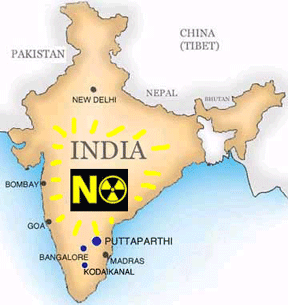 Residents oppose nuclear plant at Kovvada http://www.thehindu.com/news/national/andhra-pradesh/residents-oppose-nuclear-plant-at-kovvada/article4797223.ece 9 June 13, Officials unable to continue land acquisition for the project
Officials of Nuclear Power Corporation of India Limited and the State government are unable to continue the land acquisition process in Kovvada and surrounding villages of Ranasthalam mandal, Srikakulam district, following strong resistance from locals against the construction of the nuclear power plant.
The government identified about 1,500 acres of land but it has not been alienated to NPCIL so far. In addition, it has to acquire 499 acres in Kovvada, Ramachandrapuram Tekkali and Kotapalem villages.
It set up a land acquisition unit in the AP NGOs Home in Srikakulam but could not begin as a majority of the villagers did not accept the ‘packages’ offered by the government.
With the support of all the opposition parties, the villagers have been continuing their relay hunger strike for the last six months.
The villagers are not convinced with the argument in favour of setting up a nuclear plant in their vicinity, though officials have been repeatedly telling them that it would be safe on the lines of the one in Kalpakkam.
CPI (M) leaders Bhaviri Krishnamurthy, V.G.K. Murthy, Panchadi Paparao and others extended their moral support to the villagers saying that Kovvada nuclear plant would be a threat to the environment. Meanwhile, the relay hunger strike entered the 172 day.
Co-ordinator of all Opposition parties, Kalisetty Appalanaidu, has also threatened to intensify the movement if officials resorted to land acquisition. Former panchayat president of Kovvada, Mylapalli Polisu said that fishermen would lose their livelihood as restrictions would be imposed on fishing activity after construction of the nuclear power plant.
Prime Minister Abe increases drive to export Japanese nuclear reactors
 JAPAN PM TO STEP UP NUCLEAR EXPORT DRIVE: REPORT Yahoo 7 News, 8 June 13, TOKYO (AFP) – Japan’s prime minister is expected to sign a nuclear cooperation deal with the Czech Republic this month, a report said Saturday, as Tokyo looks to build up its exports of the technology.
Prime Minister Shinzo Abe and Czech President Milos Zeman have all but agreed to sign a memorandum of understanding on mutual nuclear technology cooperation when they meet in Poland on June 16, the Nikkei business daily said.
Nuclear power has been a sensitive issue in Japan since a quake and tsunami wiped out the Fukushima atomic plant in 2011, sparking the world’s worst nuclear disaster in 25 years, but Abe has been keen to promote the industry since taking office in December. The memorandum is expected to include a statement that the Czech Republic will use Japanese nuclear technology.
It will also make US nuclear plant builder Westinghouse Electric, a unit of Japan’s Toshiba Corp., the top candidate to win a $10 billion contract to build two nuclear reactors in the Central European country, the daily said.
Abe is due to meet the leaders of Poland, the Czech Republic, Slovakia and Hungary in Poland while on his way to the June 17-18 Group-of-Eight summit in Northern Ireland, the Nikkei added…….
After talks in Tokyo on Friday, Abe and French President Francois Hollande said they would cooperate in developing nuclear power technologies and promoting the sector’s exports to emerging economies. http://au.news.yahoo.com/latest/a/-/latest/17529581/japan-pm-to-step-up-nuclear-export-drive-report/
Radioactive waste from uranium mining poisons water in Jharkhand, India

 Uranium waste contaminates water in Jharkhand , Jun 8, 2013, New Delhi | Agency: DNA Reckless dumping of radioactive waste in Jharkhand is contaminating surface and ground water, putting thousands of locals at risk of developing cancer, according to a report by independent researchers.
The Uranium Corporation of India Limited (UCIL), a subsidiary of the Department of Atomic Energy, supplies uranium (yellow cake) to nuclear power plants in the country. It mines and processes uranium at seven mines in Jharkhand’s Jaduguda area. According to atomic experts, sludge and waste from uranium mines has to be scientifically disposed of as it contains around 85% radioactive substances.
Scientific disposal means creating pits that are covered, protected, cordoned off and made flood-proof. A tailing pond over an area of 30-40 acres must be created for disposal of sludge. These ponds too have to be cordoned off, made flood-proof and ensure that it prevents overflow. The waste decays to produce radium-226, which in turn produces Radon gas, a very powerful cancer-causing agent. For its three new mines i.e. Turamdih, Banduhurang and Mohuldih Uranium Mine, UCIL has one tailing pond at Talsa village, which fails to prevent sludge overflow and is not even fenced.
PT George, director of research institute Intercultural Resources, and independent writer Tarun Kanti Bose, spent six months studying the effects of uranium mining in the areas around the mines. Their report, Paradise Lost, released recently, states that UCIL’s irresponsible dumping in the vicinity of Jaduguda village (in Purbi Singhbhum district) is extremely worrisome as continued exposure to radiation will lead to increased cases of leukaemia and other blood diseases.
Heaps of uranium mining wastes have been abandoned in Dhodanga, Kerwadungri villages and those around Banduhurang open cast mine, according to the report. “The dumping has been going on for the last five years,” said Ghanshyam Birulee, a 45-year-old resident of Jaduguda village. “Despite complaints to UCIL, it has failed to take any action.”
Their report, Paradise Lost, states that UCIL’s irresponsible dumping in the vicinity of Jaduguda village (in Purbi Singhbhum district) is extremely worrisome as continued exposure to radiation will lead to increased cases of leukaemia and other blood diseases…… http://www.dnaindia.com/india/1845207/report-uranium-waste-contaminates-water-in-jharkhand
Negotiations going on between the two Koreas
 Koreas meet in border village after tensions marked by nuclear threats Sam Kim,CTV News The Associated Press , June 9, 2013 SEOUL, South Korea — Government delegates from North and South Korea began preparatory talks Sunday at a “truce village” on their heavily armed border aimed at setting ground rules for a higher-level discussion on easing animosity and restoring stalled rapprochement projects.
The meeting at Panmunjom, where the truce ending the 1950-53 Korean War was signed, is the first of its kind on the Korean Peninsula in more than two years. Success will be judged on whether the delegates can pave the way for a summit between the ministers of each country’s department for cross-border affairs, which South Korea has proposed for Wednesday in Seoul. Such ministerial talks haven’t happened since 2007.
The intense media interest in what’s essentially a meeting of bureaucrats to iron out technical details is an indication of how bad ties between the Koreas have been……. If the Koreas can arrive at an agreement for ministerial talks, that meeting will likely focus on reopening the factory park in the North Korean border town of Kaesong that was the last remaining symbol of inter-Korean co-operation, and on other scrapped rapprochement projects and reunions of families separated by the Korean War…..
The talks between the Koreas on Sunday could represent a change in North Korea’s approach, analysts said, or could simply be an effort to ease international demands that it end its development of nuclear weapons, a topic crucial to Washington but initially not a part of the envisioned inter-Korean meetings.
Pyongyang, which is estimated to have a handful of crude nuclear devices, has committed a drumbeat of acts that Washington, Seoul and others deem provocative since Kim Jong Un took over in December 2011 after the death of his father, Kim Jong Il. http://www.ctvnews.ca/politics/koreas-meet-in-border-village-after-tensions-marked-by-nuclear-threats-1.1316934#ixzz2Vqp2UIeV
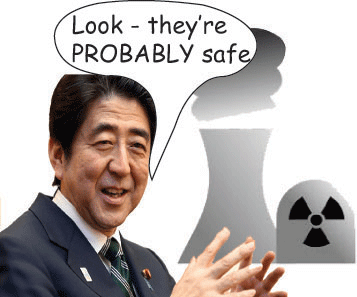
Japan and France in a marketing frenzy to sell nuclear technology
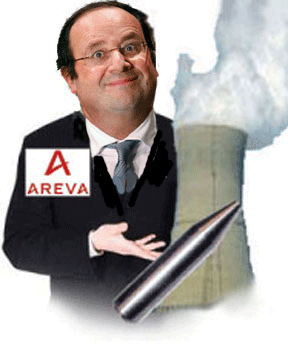 Hollande is on a three-day visit to Tokyo accompanied by several cabinet ministers and
  more than 30 executives, including the head of France’s nuclear energy giant Areva, Luc Oursel.
As well as agreeing to boost the exports of nuclear technology, Tokyo and Paris confirmed plans to cooperate on Japan’s troubled nuclear spent fuel reprocessing and fast-breeder projects,
France, Japan join forces for larger share of nuclear market http://www.reuters.com/article/2013/06/07/us-japan-france-nuclear-idUSBRE9560C720130607 By Antoni Slodkowski TOKYOJun 7, 2013 Japan and France on Friday agreed to boost nuclear cooperation to secure a larger share of global atomic energy markets as Tokyo’s pro-nuclear government looks to restart reactors despite public unease in the wake of the Fukushima disaster. Continue reading
Suicide of Fukushima farmer: TEPCO admits culpability
Fukushima operator admits culpability by: Shingo Ito From: AAP June 06, JAPAN’S Tokyo Electric Power has conceded the Fukushima disaster played a part in a farmer’s suicide, lawyers said, its first admission of culpability in such a case.
The utility, known as TEPCO, has reached an out-of-court settlement with the bereaved family of Hisashi Tarukawa, a Fukushima farmer who took his own life days after the Fukushima Daiichi nuclear power plant went into meltdown.
It was the first time the company has accepted in a settlement that the nuclear disaster at its plant was a factor in a suicide, the lawyers said, adding that terms of the settlement package were not being made public. The 64-year-old hanged himself from a tree in a vegetable field after authorities banned shipments of some farm produce from Fukushima because of fears it was contaminated by radiation.
“I just didn’t want TEPCO to keep saying no one was killed because of the nuclear accident,” said Kazuya Tarukawa, the dead man’s 37-year-old son.He said he still wanted the company to make an official apology for his father’s suicide.
“Does TEPCO think everything is finished if money is paid?” he said.”I want them to come to my house under the name of the company and bow to my father’s altar. My fight is not over yet.”
TEPCO refused to comment on the details of the settlement. http://www.news.com.au/breaking-news/world/fukushima-operator-admits-culpability/story-e6frfkui-1226659001710#ixzz2VZUeJYmy
1 This Month
23-25 October – on Zoom – World BEYOND War’s annual global conferenc


Shut down the radiation-damaged Heysham nuclear reactors now
To see nuclear-related stories in greater depth and intensity – go to https://nuclearinformation.wordpress.com

Say No to NASA’s Reckless Nuclear Reactor on the Moon
Say No to NASA’s Reckless Nuclear Reactor on the Moon
-
Archives
- October 2026 (170)
- September 2026 (339)
- August 2026 (330)
- July 2026 (355)
- June 2026 (287)
- May 2026 (306)
- April 2026 (356)
- March 2026 (251)
- February 2026 (267)
- January 2026 (308)
- December 2025 (358)
- November 2025 (359)
-
Categories
- 1
- 1 NUCLEAR ISSUES
- business and costs
- climate change
- culture and arts
- ENERGY
- environment
- health
- history
- indigenous issues
- Legal
- marketing of nuclear
- media
- opposition to nuclear
- PERSONAL STORIES
- politics
- politics international
- Religion and ethics
- safety
- secrets,lies and civil liberties
- spinbuster
- technology
- Uranium
- wastes
- weapons and war
- Women
- 2 WORLD
- ACTION
- AFRICA
- Atrocities
- AUSTRALIA
- Christina's notes
- Christina's themes
- culture and arts
- Events
- Fuk 2022
- Fuk 2023
- Fukushima 2017
- Fukushima 2018
- fukushima 2019
- Fukushima 2020
- Fukushima 2021
- general
- global warming
- Humour (God we need it)
- Nuclear
- RARE EARTHS
- Reference
- resources – print
- Resources -audiovicual
- Weekly Newsletter
- World
- World Nuclear
- YouTube
-
RSS
Entries RSS
Comments RSS

