A bad idea, burning radioactive trash in Fukushima
Nuclear Information and Resource Service Now here’s a bad idea: Tepco building incinerator for Fukushima radwaste. Will spread radiation through the air. http://bit.ly/11YFs9M Fukushima waste incinerator takes shape Construction of an incinerator is underway at the Fukushima Daiichi plant to burn the low-level waste (LLW) being generated from the clean-up and decommissioning of the site. (Diagram of planned incinerator below)
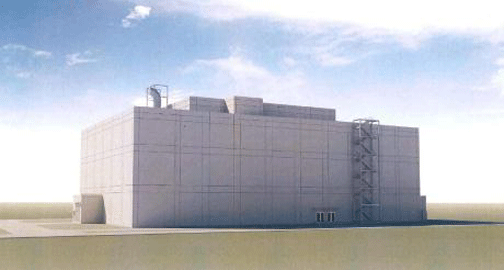
Update:
Small fire reported at Fukushima nuclear plant
TOKYO —
A fire broke out in a rubbish pile at the crippled Fukushima Daiichi nuclear complex on Tuesday, the operator said, the latest in a series of incidents at the crippled plant.
Workers discovered flames licking at piles of cardboard boxes placed near an incineration facility shortly before 1 p.m., Tokyo Electric Power Co said.
The fire damaged an area of about four meters by two meters, but was put out in a hour, it said.
The fire did not affect radiation levels in the plant, and no one was injured, it said.
TEPCO has struggled with a growing number of incidents at the plant including several leaks of radioactive water, more than two years after the worst nuclear disaster in a generation.
Improvised fixes put in place since the disaster leave it vulnerable to problems and at the mercy of nature, with no immediate end in sight, critics say.
© 2013 AFP
Tepco’s nuclear decommissioning plan rubbished by regulators
 There is apparently no “Plan B” if the fuel debris cannot be removed. The Agency for Natural Resources and Energy said in the meeting that the reason why the concrete steps toward removing the fuel debris ahead of schedule was not mentioned in the roadmap was because they couldn’t figure out those steps yet.
NRA has been consulted, never mind that the commissioners and experts blasted their plan. For TEPCO and the government, particularly the government, a mere gesture of consulting with NRA is more than enough for procedural purposes.
Looking at TEPCO’s plan for fuel debris removal, as posted at NRA’s site, it is painfully clear that TEPCO was told by the Agency what to write (garbage).
Japan’s Nuclear Regulatory Authority Blasts #Fukushima I Nuke Plant Revised Plan for Decommissioning As “Pie In The Sky” http://ex-skf.blogspot.jp/2013/06/japans-nuclear-regulatory-authority.html The original Japanese is “drawing a picture of mochi (sticky rice cake)” – it may look nice but can’t be eaten.
Sadly, their severe criticism won’t make a bit of difference. Continue reading
Japan’s ruling Party the only one (of 9) to promote nuclear power
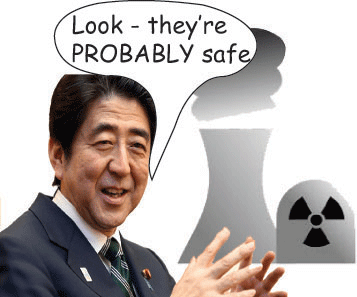 LDP alone in fighting nuclear power exit JAPAN TIMES, JIJI, KYODO JUL 1, 2013 OSAKA – The ruling Liberal Democratic Party was the sole opponent of abolishing nuclear power in a policy debate involving the secretaries-general of nine major political parties Saturday….. Among the proponents, Japanese Communist Party Secretary-General Tadayoshi Ichida said it would be inconceivable to restart reactors or export Japan’s nuclear technologies given that the disaster at the Fukushima No. 1 plant has yet to be resolved. His Your Party counterpart, Kenji Eda, said it would be irresponsible to bring reactors back online when locations for disposal facilities for spent nuclear fuel have yet to be decided…..http://www.japantimes.co.jp/news/2013/07/01/national/ldp-alone-in-fighting-nuclear-power-exit/#.UdIdkTtwo6I
LDP opposes zero nuclear policy, Japan News, 1 July 13 The Yomiuri ShimbunWith the exception of the ruling Liberal Democratic Party, every party at a weekend meeting in Osaka of the secretaries general and equivalent figures from nine major parties expressed support for ending nuclear power generation in the future……. As for whether to aim for the abolition of nuclear power generation, all parties replied yes except the LDP. The DPJ, for example, clearly stated that no nuclear power plant should be in operation by the end of the 2030s in its upper house election platform. Hosono questioned Prime Minister Shinzo Abe’s efforts to promote exports of Japanese nuclear reactors.
“It makes me uncomfortable,” he said, to see the prime minister and other government officials actively promoting exports of Japanese nuclear plants while the crisis continues at the Fukushima No. 1 nuclear power plant…..http://the-japan-news.com/news/article/0000347382
Strange thyroid cysts in 30% of Fukushima children
 Former head doctor of National Cancer Center,”Thyroids of Fukushima children look like honeycomb from too much cysts” http://fukushima-diary.com/2013/06/former-head-doctor-of-national-cancer-centerthyroids-of-fukushima-children-look-like-honeycomb-from-too-much-cysts/ by Mochizuki on June 28th, 2013
Dr. Matsue is the chief of this clinic. He stated thyroids of Fukushima children have countless numbers of cysts to look like honeycomb. <Translate>
(In the thyroid test of Fukushima children) Shockingly about 30% of the children have thyroid cysts. It was also 35% from Fukushima prefectural government’s test. Prefectural government’s test probably misses small cysts of 1~2mm because their test is too quick, but the cysts rate was almost the same. However, <Translate>
Countless numbers of small cysts were found in the thyroids of about half of those 30% children, which is not reported in the prefectural government’s test. I thought it was like “honeycomb”, I have never seen such a thing.
Recently, a clinic in Kobe tested the thyroid of the children who evacuated from Fukushima..
<Translate>
The doctor in Kobe also reported about the “honeycomb looking thyroids”. What the world is that ? It’s no less than the half of the thyroids. The half-life of I-131 is 8 days, but it’s not strange if it causes any thyroid abnormality. Rationally thinking, it has something to do with radiation. <Translate>
“Accumulated I-131 might have changed the structure of the thyroid.” http://togetter.com/li/481810?page=1
Lethal MOX fuel to be removed from Fukushima reactor No.3 starting in 2020
Kyodo: Melted fuel from Fukushima Reactor 3 “is the highly lethal mixed uranium-plutonium oxide (MOX)” — Unit to be last to attempt fuel removal says new plan http://enenews.com/kyodo-melted-fuel-fukushima-reactor-3-highly-lethal-mixed-uranium-plutonium-oxide-mox-be-removed-last-new-plan
Title: Melted fuel removal at Fukushima plant seen optimistically starting in 2020
Source: Kyodo News
Date: June 28, 2013
Work to remove melted fuel from the three crippled reactors at Tokyo Electric Power Co.’s Fukushima No. 1 nuclear plant could start in 2020, the government and Tepco optimistically said Thursday, based on a revised, albeit vague, plan to decommission the stricken complex, a process expected to take decades. […]
The second phase of the decommissioning, based on the revised plan, will entail the removal of the melted fuel from crippled reactors 1 and 2 starting in fiscal 2020 if possible, followed by work to start removing the melted fuel inside reactor 3 in the latter half of fiscal 2021 at the earliest. Reactor 3′s fuel is the highly lethal mixed uranium-plutonium oxide (MOX) fuel. […]
The extractions may be delayed if proper equipment isn’t available to deal with the three stricken reactors, whose levels of damage and radiation differ. […]
Another scenario points to starting the fuel removal of reactor 1 in fiscal 2022, that of reactor 2 in fiscal 2024 and reactor 3′s fuel in fiscal 2023. […]
See also: Asahi: Locations and condition of melted Fukushima fuel unknown — Mainichi: 450 tons of scattered radioactive rods… unknown where holes in reactors are… plans may be delayed
Big rise in radioactive sea-water: groundwater near Fukushima seeping to ocean?
 Radioactive material “soars” in ocean near Fukushima plant — Tepco: Contaminated groundwater leaking into Pacific? http://enenews.com/radioactive-material-soars-in-ocean-near-fukushima-plant-tepco-contaminated-groundwater-leaking-into-pacific
Title: Tritium samples in sea near No. 1 soar
Source: Japan Times
Author: Reiji Yoshida
Date: Jun 25, 2013
The density of radioactive tritium in samples of seawater from near the Fukushima No. 1 nuclear plant doubled over 10 days to hit a record 1,100 becquerels per liter, possibly indicating contaminated groundwater is seeping into the Pacific, Tokyo Electric Power Co. said.
The latest sample was taken June 21 from the sea near a water intake point east of the reactor 1 turbine building. […]
Tepco said late Monday it was still analyzing the water for strontium-90 […]
[…] during a news conference Monday in Tokyo, Masayuki Ono, a Tepco executive and spokesman, this time did not deny the possibility of leakage into the sea, while he said Tepco is still trying to determine the cause of the spike.
See also: TV: Groundwater shows massive spike in radioactive material at Fukushima plant — Strontium-90 up over 10,000% in past few months — Tepco apologizes (VIDEO)
Japan gets first shipment of highly radioactive MOX fuel
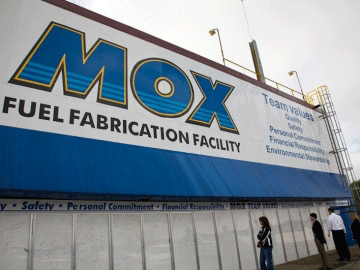 FIRST MOX NUCLEAR SHIPMENT SINCE FUKUSHIMA ARRIVES IN JAPAN http://au.news.yahoo.com/latest/a/-/latest/17766227/first-mox-nuclear-shipment-since-fukushima-arrives-in-japan/ TAKAHAMA, Japan (AFP) 26 June 13, – The first reprocessed nuclear shipment since the disaster at Fukushima arrived under armed guard near the Takahama nuclear plant in Japan on Thursday, an AFP journalist at the scenereported.
The vessel had travelled for around two months with its cargo of MOX fuel — a blend of uranium and plutonium — after being reprocessed in France. The shipment will now be stored because Japan has no working reactors able to use it.
Angry shareholders demand Japanese nuclear power shutdown
“TEPCO should just shut down,” “If we have another Fukushima, Japan will not survive.”
Japan utility behind nuclear crisis faces angry shareholders at annual meeting, Yahoo 7 Finance By Yuri Kageyama, AP Business Writer | Associated Press TOKYO (AP) 26 June 13, — Shareholders angry at the utility company behind Japan’s nuclear catastrophe peppered executives with questions Wednesday about leaking radioactive water and demanded a phase-out of atomic power. Continue reading
Errors made by Japanese authorities in estimating Fukushima radiation exposure
Exposure data wrong for 16,000 in Fukushima KYODO HTTP://WWW.JAPANTIMES.CO.JP/NEWS/2013/06/26/NATIONAL/RADIATION-EXPOSURE-DATA-INACCURATE-FOR-16000-FUKUSHIMA-RESIDENTS/#.UC0KSDTWO6I JUN 26, 2013 FUKUSHIMA – Fukushima Prefecture and the National Institute of Radiological Sciences have said they erroneously estimated the radiation exposure of 16,118 people in a survey covering the first four months after the outbreak of the March 2011 disaster at the Fukushima No. 1 nuclear plant.
Among the roughly 420,000 people authorities have so far finished compiling data on, recalculations show 12,469 received higher doses and 3,649 lower doses than previously estimated.
The margins for revisions range from plus 0.4 millisievert to minus 0.2 millisievert. As a result of the revisions, it was learned that some people were exposed to more than 1 millisievert — the annual limit set by the government for ordinary citizens.
People polled were asked to answer in detail where they were between March 12 and July 11, 2011. Based on their whereabouts, the institute estimated their cumulative amount of external exposure by adding up daily radiation levels measured at their locations over the four months.
Used as reference were actual radiation readings at a number of monitoring posts in the prefecture as well as projections of the spread of radioactive substances by the SPEEDI computer simulation system.
But in some cases, the dates in the survey failed to match those in the reference data.
People of Jadugoda, India, suffer effects of uranium mining
 See the environmental and health damage at Jadugoda, India, in these photographs http://www.galli.in/2013/06/jadugoda-unumo-tene-ashish-birulee.html?utm_source=Galli+Magazine&utm_campaign=19921c605d-UA-24811720-1&utm_medium=email&utm_term=0_810b488293-19921c605d-28734661
U.N. Downplays Health Effects of Nuclear Radiation, IPS, By George Gao, 26 June 13 UNITED NATIONS, – “……..Radiation from uranium mining The IAEA promotes “safe, responsible development of uranium resources”, the raw materials used to fuel nuclear reactors and build nuclear bombs.
For Ashish Birulee, a Ho tribal resident of Jadugoda, India, safe uranium mining in his community is far from reality, and the health effects of radiation are as clear as the photographs he has taken to document them.
Birulee, a student and photojournalist, lives next to a tailings dam, filled with radioactive waste from a uranium purification plant operated by the Uranium Corporation of India.
“Lung cancer, skin cancer, tumours, congenital deformities, down syndrome, mental retardation, megacephaly, sterility, infertility in married couples, thalassemia [and] rare birth defects like Gastroschisis [are] common in the area,” he told IPS.
“We are like guinea pigs here,” he said, citing government negligence on the matter. “I’m experiencing everyday radiation exposure and also witnessing how my people are suffering.”… http://www.ipsnews.net/2013/06/u-n-downplays-health-effects-of-nuclear-radiation/
Japan’s massive, and growing, plutonium problem
Japan currently possesses 44 tons of plutonium, according to the Atomic Energy Commission. Nine tons, including the latest shipment, are in Japan, while the remaining tons are in Britain and France, where spent fuel from Japan has been reprocessed.
Storage pools for spent fuel are quickly reaching capacity at nuclear power plants across the nation. If Aomori Prefecture refuses to accept spent fuel, nuclear plants will be saddled with overflowing spent fuel pools and will be unable to continue operations.
Direct disposal, or burying spent fuel without reprocessing, was considered under the previous Democratic Party of Japan government. But discussions have gone nowhere after the Liberal Democratic Party took over government in December.
 Plutonium problem lingers as mixed-oxide fuel comes to Japan June 25, 2013 THE ASAHI SHIMBUN A shipment of mixed-oxide fuel will arrive in Japan as early as June 27, part of the nation’s plutonium stockpile that is already equivalent to 5,000 Nagasaki-type atomic bombs.
The shipment, two years behind schedule due to the Great East Japan Earthquake in 2011, is expected to be used for plutonium-thermal (pluthermal) power generation, a key component of Japan’s nuclear fuel recycling program.
However, the fuel recycling program has been plagued by so many problems that the nation’s plutonium stockpile could increase further, heightening concerns in the international community about possible nuclear weapons proliferation. Continue reading
USA scrambling to sell off nuclear technology to India
 India assures U.S. a share of nuclear pie, THE HINDU, 24 June 13 SANDEEP DIKSHIT India and the U.S. on Monday agreed to set a timeline for operationalising the civil nuclear agreement. The Fourth Strategic Dialogue co-chaired by U.S. Secretary of State John Kerry and External Affairs Minister Salman Khurshid here reviewed several issues ranging from the status of civil nuclear ties between the two countries through defence trade to education and cultural exchanges — through some 30 bilateral panels.
The two ministers felt further high-level meetings should be held to achieve convergence and progress, especially in strategic issues. An example of such meetings will be the visit of U.S. Vice President Joe Biden scheduled for mid-July………. At the press conference, Mr. Kerry almost let slip America’s chagrin at not having tasted the fruits of the India-U.S. civil nuclear agreement by drawing attention to the enormous domestic political capital invested by Democrats and Republicans to ensure New Delhi was given a special exemption by the Nuclear Suppliers Group (NSG).
The Kerry-Khurshid meeting set September as a possible timeline for resolving two issues that have thwarted Westinghouse from setting up six reactors in Gujarat. Another company GE will set up an equal number in Andhra Pradesh but its reactor design has not yet been cleared by the U.S. nuclear regulator. India had promised these multi-billion bonanzas in exchange for supporting its case at the NSG and the International Atomic Energy Agency……http://www.thehindu.com/news/national/india-assures-us-a-share-of-nuclear-pie/article4846708.ece
Experts cast doubt on recent UN press release about Fukushima radiation
 Expert: UN’s Fukushima study “absolutely ridiculous” — “Absolutely unacceptable” to claim no observable increase in cancer rates is expected — “Dose estimates don’t reflect the real dose of radiation” http://enenews.com/expert-uns-fukushima-study-absolutely-ridiculous-absolutely-unacceptable-to-claim-no-observable-increase-in-cancer-rates-is-expected-dose-estimates-dont-reflect-the-real-dose-of-r
Title: Japan’s Fukushima debate: How will the meltdown affect the health of residents?
Source: Christian Science Monitor
Author: Justin McCurry, Correspondent
Date: June 21, 2013
[…] In a recent draft report, the UN Scientific Committee on the Effects on Atomic Radiation (UNSCEAR) said it expected to see no noticeable rise in cancer rates, adding that the swift evacuation of people living in a 20-kilometer (12-mile) radius of the plant had sharply reduced radiation exposure.
[…] some scientists accuse the UN of using faulty methodology.
Alexey Yablokov, author of “Chernobyl: Consequences of the Catastrophe for People and the Environment,” says UNSCEAR’s claim that there would be no observable increase in cancer rates was “absolutely unacceptable.”
The UN bodies’ calculations, he says, had been made using flawed estimates of average radiation doses among Fukushima residents. “The average dose estimates don’t reflect the real dose of radiation [received by Fukushima residents],” he said during a recent visit to Tokyo.
“How did they estimate the average? It’s impossible, because on the first day of the accident the level of radiation was thousands of times higher,” says Dr. Yablokov. “How do you calculate how many minutes people spent inside and outside their houses at that time, or how much air they breathed? It’s absolutely ridiculous.” […]
See also: Fairewinds: Thyroid data means much more radiation must have come out of Fukushima reactors than anyone reported — Medical professionals are talking about how many cancers have started showing up (AUDIO)
Japan nuclear restart is in no way a sure thing
Japan’s atomic regulator will take a tough stance when its new safety guidelines take effect on July 8, and amid fierce local opposition.
“The problem for the banks is that it is very hard to give additional loans to the utilities in the current situation because from a private business perspective they are bankrupt,”

 Japan nuclear safety upgrades dazzle, mask industry woes Reuters By Aaron Sheldrick and Kentaro Hamada (Additional reporting by Risa Maeda; Editing by Michael Urquhart) TOKYO Jun 23, 2013– Japan’s nuclear utilities face shareholders this week promising restarts of idled plants as soon as next month after costly safety upgrades, plans that look wildly optimistic given they are yet to secure either regulatory or local approval.
A glaring example is the Hamaoka nuclear plant, once dubbed the world’s most dangerous for its location near a major earthquake fault zone. Continue reading
Shareholders will propose shutdown of japan’s nuclear power
All of the proposals being submitted are expected to be rejected because large stakes are held by financial institutions, which are expected to vote along the lines of company management. Approval of two-thirds of shareholders with voting rights who attend the meetings is needed in order to pass any proposal.
 Utilities face shareholders’ proposals to get rid of nuclear power,http://ajw.asahi.com/article/economy/business/AJ201306220057 Asahi Shimbun, By TAKASHI EBUCHI/ Staff Writer June 22, 2013
Shareholders of eight of the nine utilities that operate nuclear power plants will present proposals at shareholders’ meetings next week urging the companies to abandon nuclear power.
But with the Abe administration clearly in favor of nuclear power, the utilities are all expected to reject the proposals and press ahead with plans to restart reactors currently offline.
All of Japan’s electric power companies will hold their annual shareholders’ meetings on June 26.
Similar proposals were made at last year’s meetings for seven of the utilities, which all rejected the proposals. Continue reading
1 This Month
23-25 October – on Zoom – World BEYOND War’s annual global conferenc


Shut down the radiation-damaged Heysham nuclear reactors now
To see nuclear-related stories in greater depth and intensity – go to https://nuclearinformation.wordpress.com

Say No to NASA’s Reckless Nuclear Reactor on the Moon
Say No to NASA’s Reckless Nuclear Reactor on the Moon
-
Archives
- October 2026 (170)
- September 2026 (339)
- August 2026 (330)
- July 2026 (355)
- June 2026 (287)
- May 2026 (306)
- April 2026 (356)
- March 2026 (251)
- February 2026 (267)
- January 2026 (308)
- December 2025 (358)
- November 2025 (359)
-
Categories
- 1
- 1 NUCLEAR ISSUES
- business and costs
- climate change
- culture and arts
- ENERGY
- environment
- health
- history
- indigenous issues
- Legal
- marketing of nuclear
- media
- opposition to nuclear
- PERSONAL STORIES
- politics
- politics international
- Religion and ethics
- safety
- secrets,lies and civil liberties
- spinbuster
- technology
- Uranium
- wastes
- weapons and war
- Women
- 2 WORLD
- ACTION
- AFRICA
- Atrocities
- AUSTRALIA
- Christina's notes
- Christina's themes
- culture and arts
- Events
- Fuk 2022
- Fuk 2023
- Fukushima 2017
- Fukushima 2018
- fukushima 2019
- Fukushima 2020
- Fukushima 2021
- general
- global warming
- Humour (God we need it)
- Nuclear
- RARE EARTHS
- Reference
- resources – print
- Resources -audiovicual
- Weekly Newsletter
- World
- World Nuclear
- YouTube
-
RSS
Entries RSS
Comments RSS

