50 NGOs in Japan released a declaration to protest the CSC which protects the nuclear power industry http://www.greenaction-japan.org/modules/wordpress0/index.php?p=119
カテゴリー: December 6, 2014
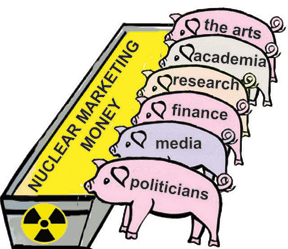
50 non-governmental organizations in Japan released a declaration to protest the “Convention on Supplementary Compensation for Nuclear Damage” (CSC) which protects nuclear power technology vendors from responsibility for reparations and does not protect the victims of nuclear power accidents.
Declaration
To protest The Japanese Diet’s over-hasty approval of the “Convention on Supplementary Compensation for Nuclear Damage” (CSC) , which heavily protects the nuclear power industry and encourages nuclear exports
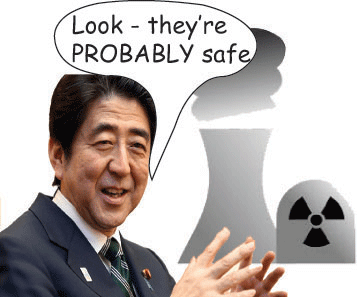
On November 19, the “Convention on Supplementary Compensation for Nuclear Damage” (CSC) was ratified by the House of Councilors. We strongly object to today’s vote to approve this treaty, without any discussion of its numerous problems, which was rushed through to accommodate the Abe administration’s schedule for dissolving the Lower House of the Diet.
The treaty promotes the export of nuclear power technology while ignoring the lessons of the Fukushima accident.
Specifically, we raise the following issues:
1) The exemption of nuclear power technology vendors from liability/responsibility for reparations. This will result in increased exports of nuclear power technology.
2) The use of international funds for nuclear accident damage compensation above a fixed amount. This will serve to benefit any nuclear technology vendor who causes an accident.
3) As a result of items 1 and 2, parties involved in the nuclear energy business only profit, without taking any risk – leading to moral hazard and the acceleration of nuclear exports. Continue reading →
December 19, 2014
Posted by Christina Macpherson |
Japan, politics, Reference |
Leave a comment

 China Wants its Nuclear Reactors ‘Made in China’ WSJ 16 Dec 14 When a unit of North Carolina’s Curtiss-Wright Corp. won a roughly $300 million deal in 2007 to supply components for new reactors in China, industry officials trumpeted China’s nuclear boom as good for U.S. business.
Today, Chinese companies are competing for that business—and foreign companies risk getting left out. Meanwhile, Curtiss-Wright’s contract is caught up in a legal dispute, while Chinese authorities blame the company in part for the delay of a landmark nuclear project. As the WSJ’s Brian Spegele reports:
U.S. and other foreign companies are now struggling to keep their hold in China, the industry’s biggest growth market and a rare bright spot more than three years after the Fukushima disaster in Japan put many of the world’s nuclear projects on hold. Yet China is increasingly turning to local companies to build crucial parts for multibillion-dollar nuclear projects, a result of Chinese industrial nationalism and frustration over U.S. supplier problems………http://blogs.wsj.com/chinarealtime/2014/12/16/china-wants-its-nuclear-reactors-made-in-china/
December 17, 2014
Posted by Christina Macpherson |
business and costs, China |
Leave a comment
 Shinzo Abe reelection increases chance of Japan relying more on nuclear power and less on LNG Straght.com by CHARLIE SMITH on DEC 14, 2014 “……….The election results have strengthened Abe’s hand as he pushes to restart more nuclear reactors in the wake of the 2011 earthquake and tsunami that crippled a power plant in Fukushima, spewing radiation across the Pacific Ocean.
The governor of Kagoshima prefecture has already approved firing up two reactors at the Sendai nuclear plant next year, rejecting calls from protesters to keep the facility closed…………….
In 2013, Abe told International Olympic Committee delegates that problems at the Fukushima plant were under control.
This was despite the calculations by Georgia Straight contributor Alex Roslin that about 800 people worldwide would develop cancer from Japanese fish eaten at the time of his article in October 2013.
Meanwhile, Japan News recently reported that a South Korean team will visit the Fukushima power plant and conduct tests on Japanese fish products.
South Korea has maintained a ban on importing fish from eight prefectures, including Fukushima.
The South Korean investigation will occur just as Japan’s nuclear watchdog is calling for the release of contaminated water from the Fukushima plant.
According to an article in the Asahi Shimbun newspaper, Nuclear Regulation Authority chairman Shunichi Tanaka said officials will need to gain the consent of local residents.
“I was overwhelmed by the sheer number of tanks (holding water tainted with radioactive substances),” Tanaka told journalists. “We have to dispose of the water.” http://www.straight.com/news/789111/shinzo-abe-reelection-increases-chance-japan-relying-more-nuclear-power-and-less-lng
December 17, 2014
Posted by Christina Macpherson |
Japan, politics |
Leave a comment
 NRA head signals massive release of tainted water to help decommission Fukushima site
 The head of Japan’s nuclear watchdog said contaminated water stored at the crippled Fukushima No. 1 nuclear power plant should be released into the ocean to ensure safe decommissioning of the reactors. Shunichi Tanaka, the chairman of the Nuclear Regulation Authority, made the comment Dec. 12 after visiting the facility to observe progress in dismantling the six reactors. The site was severely damaged in the tsunami generated by the 2011 earthquake.
“I was overwhelmed by the sheer number of tanks (holding water tainted with radioactive substances),” Tanaka told reporters, indicating they pose a danger to decommissioning work. “We have to dispose of the water.”
With regard to expected protests by local fishermen over the discharge, Tanaka said, “We also have to obtain the consent of local residents in carrying out the work, so we can somehow mitigate (the increase in tainted water).”
December 15, 2014
Posted by Christina Macpherson |
Fukushima 2014, oceans |
Leave a comment
 CHINA-NORTH KOREA NUCLEAR STANDOFF Eurasia Review By Debalina Ghoshal Even though North Korea and China have traditionally shared strong ties, their “key divergence” lies in Pyongyang’s nuclear program. China is an important ally for North Korea, but despite this, China has not reacted positively to North Korea’s nuclear ambitions. China is keen on the denuclearization of Northeast Asia, and hence views North Korea’s nuclear ambitions as an obstacle to achieving this goal. North Korea, on the other hand, views its nuclear program as a “treasure sword” with which it can counter threats from the United States and its ally of South Korea.
The United States and South Korea have realized the importance of Beijing in any matter pertaining to the denuclearization of North East Asia. This was also echoed by US Secretary of State John Kerry when he opined that given its extensive trade relations with North Korea, China has “greater potential” to influence North Korea’s behavior [its nuclear ambitions that is] more than any other power……….http://www.eurasiareview.com/12122014-china-north-korea-nuclear-standoff-oped/
December 15, 2014
Posted by Christina Macpherson |
North Korea, politics international |
Leave a comment
Nuclear Liability in India, http://leondelhi.blogspot.com.au/ Diogenes Syndrome, by Latesh Bhatia 14 Dec 14 Irrespective of the circumstances, directly or indirectly in their control, the suppliers and operators of nuclear plants could not shun the responsibilities for any destruction caused to human life, property or environment in the course of their operation in India.
Risk mitigating is always preferred by any intelligent investors; however, it comes with a premium: but here the scenario is altogether different. The risk-reward ratio seems acutely tilted. Almost all of the US nuclear operator and suppliers group are stanch advocates of this bill; while other NSG [Nuclear Suppliers Group] members (mainly Australia, Canada, France, Germany, Japan, USSR, UK) are watching the development, with crossed figures, expecting a favorable outcome.
The history of nuclear mis-happenings can be traced back since the invention of nuclear technology. With the growing concern for environment and better life conditions, the public pressure has compelled the companies and government of the advance countries to spend huge amount of money, time and resources in inventing safer and environment friendly technologies to replace the obsolete one.
In order to get rid of the obsolete technologies with outdated equipment and apparatus, the developed countries are notorious to export it to the poor nations, just like the ‘stock clearance sale.’ The receiver countries mainly comprise of nations where human development index is low (as India). Due to apathy, ignorance, lack of awareness and absence of public participation in policy making these deals are hardly come into limelight, until media or any NGO cry foul. The outdated technology is one of the biggest causes of nuclear accidents.
The main reason for such export, as quoted by the rich nations, is that developing countries could not afford the price of the latest know-how. Whereas, the developed countries artificially keep the price of the specific technology so high, that it becomes commercially nonviable in the third world nations.
All inventions or innovations cost lot of time and money and involve great risk of failure, so the inventor should have a right to decide the price for his innovative end product as an incentive to encourage entrepreneurship. I deeply abide to this notion. My point is: You want to maximize the profits and assets, but want a cap on the liabilities? Can you practice such economics in advance countries like US or in Europe?
In US, with the population density of 32.08 person per square km., the liability is Rs. 46,000 crore ($10 billion); in India, with population density of 358.485 person per square km., NSG wants a cap of just Rs. 500 crore, (the rest is borne by Indian Government, through taxpayers’ money.) By this calculation the cost of India life or one square kilometer of land is Rs. 1.4; however, the cost of American’s life or one square kilometer of US land is Rs.1437.5. For Indian government, a US citizen is 1030.5 times more valuable than the life of an Indian citizen.
December 15, 2014
Posted by Christina Macpherson |
civil liberties, India |
Leave a comment
 NRA Chairman Shunichi Tanaka, foreground, inspects storage tanks holding water contaminated with radioactive substances at the Fukushima No. 1 nuclear power plant.
December 13, 2014
The head of Japan’s nuclear watchdog said contaminated water stored at the crippled Fukushima No. 1 nuclear power plant should be released into the ocean to ensure safe decommissioning of the reactors.
Shunichi Tanaka, the chairman of the Nuclear Regulation Authority, made the comment Dec. 12 after visiting the facility to observe progress in dismantling the six reactors. The site was severely damaged in the tsunami generated by the 2011 earthquake.
“I was overwhelmed by the sheer number of tanks (holding water tainted with radioactive substances),” Tanaka told reporters, indicating they pose a danger to decommissioning work. “We have to dispose of the water.”
With regard to expected protests by local fishermen over the discharge, Tanaka said, “We also have to obtain the consent of local residents in carrying out the work, so we can somehow mitigate (the increase in tainted water).”
Tanaka has said previously that to proceed with decommissioning, tainted water stored on the site would need to be released into the sea so long as it had been decontaminated to accepted safety standards.
“While (the idea) may upset people, we must do our utmost to satisfy residents of Fukushima,” Tanaka said, adding that the NRA would provide information to local residents based on continuing studies of radioactive elements in local waters.
The inspection tour was Tanaka’s second since he became NRA chief in September 2012. He last visited in April 2013.
During his visit, Tanaka observed work at a trench on the ocean side of the No. 2 reactor building, where highly contaminated water is being pumped out. He also inspected barriers set up around the storage tanks to prevent leaks of tainted water.
Tanaka praised the completion in November of work to remove all spent nuclear fuel from the No. 4 reactor building, as well as changes to work procedures that he said allows for the completion of the work at the No. 2 reactor trench.
Source: Asahi Shimbun
http://ajw.asahi.com/article/0311disaster/fukushima/AJ201412130042
December 13, 2014
Posted by dunrenard |
Japan | Fukushima Daiichi |
Leave a comment
Nuclear Scientist: Fukushima an apocalyptic disaster that will haunt future generations; World now an experimental lab with humans as guinea pigs — Japan Gov’t Report: Fukushima is worse than 3/11 quake and tsunami http://enenews.com/nuclear-scientist-fukushima-apocalyptic-disaster-will-haunt-future-generations-world-experimental-lab-humans-guinea-pigs-japan-govt-report-fukushima-worse-311-quake-tsunami?utm_source=feedburner&utm_medium=email&utm_campaign=Feed%3A+ENENews+%28Energy+News%29
Excerpts from Op-Ed by Quamrul Haider, Ph.D., Chair of Dept. of Physics at Fordham University, Dec 4, 2014 (emphasis added):
- The fraternity of nuclear scientists… create the impression… their extremely risky projects have been carefully thought out in every detail and are inspired by the spirit of greatest responsibility… A large section of the scientific community… believes [their accident simulations are] about as reliable as tomorrow’s weather forecast [and] that by building nuclear power plants in populated areas, the whole world becomes an experimental laboratory with human beings as guinea pigs.
- There is always the possibility of a major disaster. The basic difference between nuclear and other industrial accidents lies in the long-range repercussions… one could forget about the havoc wrought, for example, by the explosion of a gas pipeline or the breaching of a dam… But an accident in a nuclear power plant, such as a reactor getting out of control, is capable of doing more than immediate harm. Examples of the deadly long-term effects of a reactor accident are Chernobyl and Fukushima [which] will linger on for ages to haunt the future generations. Among the survivors there will be many cases of permanent sterility, increase of genetic mutation in our progenies, and a shortened life span as a result of cancer and other radiogenic diseases.
- [It’s] irresponsible and misleading to suppress the consequences of radiation…[A]ttempts are made… to blind the people by equating nuclear accidents with more familiar hazards… an unlimited risk is falsely portrayed as a limited one and glossed over in a manner that is not only unconscionable, but also unpardonable. Thesedeceptions are further camouflaged by the way in which they are presented to the public… the far-reaching consequences of lethal radiation are overly simplified. In the post-Chernobyl and post-Fukushima era, these… do not hold water.
- Wars, plagues, famines and natural disasters were known as the four horsemen of the apocalypse… After Chernobyl and Fukushima, nuclear accidents can be added [as another] horseman of the apocalypse.
- Critics describe nuclear reactor as one of the most dangerous technological beasts that mankind has devised and nuclear accident as “A Nuclear War without a War.”
- The consequences can assume dimensions that do not take second place to the consequences of earthquake… and in a way actually exceeds them.
R/V Marai — Japan Agency for Marine-Earth Science and Technology (JAMSTEC, administered by gov’t of Japan): The great earthquake [and] tsunami with its height of more than 10 m attacked mainly the Pacific coastline of Tohoku district and approximately thirty thousand people were killed, missing or injured. What is worse is that Fukushima No.1 nuclear power plant was seriously damaged… a gigantic radiation has been leaking to the atmosphere, land and ocean. After this record crisis, the Ministry of Education, Culture, Sports, Science and Technology (MEXT) requested JAMSTEC… monitor [the] level of radiation.
See more about Dr. Haider’s nuclear experience here
December 13, 2014
Posted by Christina Macpherson |
Fukushima 2014 |
Leave a comment
 Japanese Nation Forgetting Fukushima Plant Cleanup Workers http://sputniknews.com/asia/20141210/1015704138.html As snap elections are nearing, the Fukushima Nuclear power plant workers are urging people to understand the harsh circumstances they work under, risking their life by exposing themselves to radiation every single day. MOSCOW, December 10 (Sputnik) – As elections are nearing in Japan, many of the people working toward the decommissioning of the crippled Fukushima No. 1 nuclear plant say they want voters to know about their harsh working conditions, insufficient pay and worries of radiation exposure, reports The Japan Times.
There are around 6,000 people a day working in the decommissioning process at the plant and it is expected to take 30 to 40 years to complete.
“I’m single, so I can somehow manage with the pay if I don’t go out to amuse myself, but I don’t think you can make a living if you have a family,” said a man in his fifties who has worked in the plant for three years. He has been eradicating debris and setting up tanks to store radioactive water, and is now in charge of removing contaminated water from the reactor building basements. He works for a third-tier subcontractor and makes a monthly salary of less than ¥200,000 ($1650 USD).
As The Japan Times reports, due to high radiation exposure, workers must wear heavy protective clothing and a mask that covers the whole face. It is difficult for them to work more than an hour and a half at a time. The workers start at around 5 a.m. because of the time it takes to get to the plant which is about 40 kilometers away, pass entrance checks and change clothing.
According to one worker his most recent monthly radiation dosage was 1.8 millisieverts. The law states that a nuclear worker’s radiation dosage should not exceed 100 millisieverts in five years and 50 millisieverts in a year. Since the reference mark in the plant is 20 millisieverts a year, the man’s dosage is nearing its limit.
“I feel that people are gradually forgetting about the nuclear accident,” he said. “From now, our work will become even harsher because we will have to go inside the reactor buildings, where the radiation level is even higher. I want people to recognize that there are such workplaces,” he told The Japan Times.
December 13, 2014
Posted by Christina Macpherson |
employment, Japan |
Leave a comment
Why hasn’t the Japanese government, like the American sailors, filed its own lawsuits against these same companies to determine their legal liability? In other words, why are the Japanese people being forced to pay for the possibly negligent actions of some of the world’s largest corporations?
Question of negligence hangs over nuclear firms in U.S. case over Fukushima fallout http://www.japantimes.co.jp/community/2014/12/10/voices/question-negligence-hangs-nuclear-firms-u-s-case-fukushima-fallout/#.VIzEptLF8nk BRIAN VICTORIA Yellow Springs, Ohio
Dear Minister of Economy, Trade and Industry Yoichi Miyazawa,
As you may be aware, a federal judge in the U.S. recently ruled that a class-action lawsuit filed by about 200 U.S. Navy sailors can proceed against Tokyo Electric Power Co. and other defendants they blame for a variety of ailments caused by radiation exposure following the nuclear reactor meltdowns at Fukushima No. 1.
The sailors allege that Tepco knowingly and negligently gave false and misleading information concerning the true condition of the Fukushima No. 1 nuclear power plant to the public, including the U.S. military. They further allege that Tepco knew the sailors on board the USS Ronald Reagan would be exposed to unsafe levels of radiation because Tepco was aware three nuclear reactors at the site had already melted down.
In this connection, the lawsuit notes that on Dec. 14, 2013, Naoto Kan, Japan’s prime minister at the time of the disaster, told a gathering of journalists regarding the first meltdown: “People think it was March 12 but the first meltdown occurred five hours after the earthquake.”The sailors in question were participating in Operation Tomodachi, providing humanitarian relief in response to the Japanese government’s calls for assistance. In accordance with the U.S.-Japan Security Treaty, these sailors literally risked their lives to aid and protect the people of Japan.
The sailors accuse Tepco of negligence, failure to warn of the dangers, and design defects in the construction and installation of the reactors, among a total of nine claims for damages. To date, the sailors have experienced such illnesses as leukemia, ulcers, brain cancer, brain tumors, testicular cancer, dysfunctional uterine bleeding, thyroid illnesses, stomach ailments and a host of other complaints unusual in such young adults.
One of the major questions to be decided by the lawsuit is who will pay for the military members’ ongoing and possibly lifelong medical treatment. Continue reading →
December 13, 2014
Posted by Christina Macpherson |
Japan, Legal |
Leave a comment
 Move to switch Japan’s nuclear reactors back on divides communities Australian Broadcasting Corporation VIDEO Broadcast: 12/12/2014 Reporter: Matthew Carney
Switching Japan’s nuclear reactors back on is top of Prime Minister Shinzo Abe’s agenda if he wins another term but the idea is unpopular and deeply divides communities.
Transcript
SABRA LANE, PRESENTER: Four years on from one of the world’s nuclear disasters, the meltdown at Fukushima, Japan is on the verge of a historic move to switch its mothballed nuclear reactors back on. The move is deeply controversial, as 120,000 Japanese have still not been able to return to their homes and there are serious doubts the site can ever be contaminated. The issue will be front and centre when Japan goes to the polls this weekend, where Prime Minister Shinzo Abe seems assured of winning a third term in power. North Asia correspondent Matthew Carney travelled to remote southern Japan where the first nuclear reactor will be flicked back on and he found communities deeply divided.
MATTHEW CARNEY, REPORTER: In one of the holiest sites in southern Japan, the monks are sending out a warning to the world. . Nearby, the Sendai nuclear reactors are about to be turned back on. The industry was shut down after the Fukushima disaster.
HIROAKI MURAI, BUDDHIST MONK, CHINKOKU TEMPLE (voiceover translation): If a second accident happens, it will be a catastrophe. Most areas of Japan will become unliveable. Restart of the reactors is unthinkable.
MATTHEW CARNEY: For more than 2,000 years, pilgrims have been coming to this holy mountain to seek clarity and purity. But now it faces another immediate threat, a waste facility has been built at the base of the mountain. The local government says no nuclear waste will be stored here. For the head monk, it’s a step way too far.
HIROAKI MURAI (voiceover translation): This is wrong. Religion and belief are indispensable. They’re about to turn this sacred mountain into a nuclear dump site. For what? Money? We’ve lost any sense of what’s valuable……….http://www.abc.net.au/7.30/content/2014/s4148034.htm
December 13, 2014
Posted by Christina Macpherson |
Japan, social effects |
Leave a comment

 Solar Rises in Malaysia During Trade Wars Over Panels, NYT, By KEITH BRADSHERDEC. 11, 2014 KULIM, Malaysia — Tucked away in this former tin-mining town, past the small farms of banana trees and oil palms, is one of the solar industry’s best-kept secrets.
The six factories here with cavernous rooms up to one-third of a mile long constitute the production backbone of First Solar. Working alongside minivan-size robots adapted from car assembly plants and other industries, 3,700 employees produce five-sixths of the American company’s solar panels. Workers in Ohio make the rest.
The list of manufacturers is long. Panasonic of Japan has a solar panel factory a mile down the road. SunEdison makes wafers 60 miles away in Chemor. Hanwha Q Cells and SunPower have giant factories even farther south, while Solexel, a Silicon Valley start-up, is preparing to build an $810 million solar panel factory in stages.
Malaysia, a Southeast Asian nation with just 30 million people, is the biggest winner in the trade wars that have embroiled the solar sector. As Chinese companies have been hit with American tariffs and European quotas, Malaysia has increasingly attracted multinationals with its relatively low labor costs, lucrative tax breaks, warm relations with the West and abundance of English-speaking engineering talent.
Malaysia is now the world’s third-largest producer of solar equipment, trailing China by a wide margin but catching up rapidly with the European Union. And Malaysia’s role in the global solar trade is only likely to increase in the coming months if the American government broadens tariffs on panels made in China next Tuesday as expected……
The solar manufacturing boom in Malaysia has been almost invisible, a rarity in an industry known for heavily promoting even the smallest factory opening or new solar panel farm as progress toward cleaner energy……..
Trade wars have helped some American companies. SolarWorld, a big manufacturer that has led trade litigation against China, recently said that it was expanding capacity by 150 megawatts and adding 200 jobs at its main solar panel factory in Hillsboro, Ore. It partly pointed to the trade actions that had slowed the flood of Chinese imports.
But production in Malaysia, already triple the United States’ output, is rising faster. The latest project underway in Cyberjaya, Malaysia, is an 800-megawatt solar module factory for Hanwha Q Cells. First Solar is putting the finishing touches on a 100-megawatt factory here to supply the Japanese market.
Malaysia is a beneficiary of the complex interaction of global trade rules, economic competitiveness and environmental policies in the solar industry. Tariffs have had the most immediate effect………. http://www.nytimes.com/2014/12/12/business/energy-environment/solar-rises-in-malaysia-during-trade-wars-over-panels.html
December 13, 2014
Posted by Christina Macpherson |
business and costs, Malaysia, renewable |
Leave a comment
 Nuclear power in China – Promethean perils, The Economist Dec 6th 2014 | SHANGHAI
 |
“………forecasts should be taken with a big pinch of salt. It is true that China is the brightest spot in the global nuclear industry, but that is mostly because prospects in other places are bleak. It is also true that China’s need to tackle pollution and desire to curb carbon emissions will give nuclear power a boost, but these factors also favour rival clean-energy technologies. In short, today’s nuclear revival may well not live up to investors’ lofty expectations.
One factor that could slow growth is cost. In the past Chinese governments were happy to throw endless pots of money at favoured state firms in industries deemed “strategic”. Times are changing, however. Economic growth is slowing, and the government must now deal with massive debts left over from previous investment binges. Since the export-oriented and investment-led model of growth is sputtering, officials may soon be keen to boost domestic consumption rather than merely shovel subsidised capital at big investment projects.
And it is not just that China may—and should—be starting to pay attention to the true cost of infrastructure projects. Rapid technological advances are also making low-carbon alternatives to nuclear power appear more attractive. Bloomberg New Energy Finance, an industry publisher, forecasts that onshore wind will be the cheapest way to make electricity in the country by 2030. Though coal will remain China’s leading fuel for some time, Bloomberg’s analysts think that renewables could produce three times as much power as nuclear in the country by that year……..
Another drag on growth could be nagging doubts about safety. Philippe Jamet, a French nuclear safety commissioner, told his country’s parliament earlier this year that Chinese counterparts were “overwhelmed”. Wang Yi of the Chinese Academy of Social Sciences, an expert body, has warned that there are indeed “uncertainties” in the approach to nuclear safety…….
A word of warning comes from the man who matters most. President Xi Jinping, speaking at a nuclear-security summit in the Netherlands earlier this year, likened the technology to the gift of fire granted by Prometheus to humanity. It can bring great benefits, he said, but without proper safeguards “such a bright future will be overshadowed by dark clouds or even ruined by resulting disasters.”
December 8, 2014
Posted by Christina Macpherson |
China, politics |
Leave a comment

 Writer warns MPs about nuclear contractor Rosatom, YLE UUTISET, 5 DEc 14, Finnish author Risto Isomäki issued a warning letter about the Russian nuclear contractor Rosatom to MPs as they prepared to vote on granting a new permit for a nuclear power project in the country’s northwest. The missive paints a disturbing picture about a nuclear plant constructed by Rosatom in India. Environmentalist and science fiction writer Risto Isomäki’s letter to MPs centres on Rosatom’s turnkey nuclear power plant project in India and has been reproduced in the Social Democratic Party organ, Demari, as well as in social media.
According to Isomäki the first reactor of a nuclear power facility constructed by Rosatom in Kudankulam in India has suffered 14 spontaneous power outages in the year since it has been completed. It has also been taken offline five times for repair and maintenance work in the same one-year period, he writes. The author claimed that according to his information the reactor has now been shut down because it has not passed final commissioning tests.
One of the recipients of the letter was National Coalition Party MP, Harri Jaskari, who also sits on the Parliament’s Finance Committee. Jaskari said that the claims made by Isomäki about the Indian facility were not previously known to committee members……..http://yle.fi/uutiset/writer_warns_mps_about_nuclear_contractor_rosatom/7673069
December 6, 2014
Posted by Christina Macpherson |
Finland, India, safety |
Leave a comment