Japan’s political gamble; they cannot be sure that nuclear restart will be safe

 Japan’s nuclear dilemma 03 December 2014 by Robert J. Geller Some Japanese nuclear reactors, mothballed since the 2011 Tohoku quake, may soon restart. But nature can outpace new safety precautions, warns a geophysicist “………The Sendai plant faces some specific risks. The site is about 50 kilometres from a large active volcano, Sakurajima, and there are several other active volcanoes on Kyushu. A large eruption would pose obvious safety issues for the plant, but its operator has said that advance warnings of an impending eruption would allow them to take appropriate measures. Doubts about this sanguine view were reinforced by the eruption of Mount Ontake on Honshu, without warning, in September. It killed more than 50 climbers out for a weekend stroll.
A variety of natural hazards, including earthquakes and subsequent tsunamis, pose risks to reactors throughout Japan. I have written extensively about the lack of success of both short and long-term earthquake prediction (Nature, vol 472, p 407). It is well known that accurate predictions of fracture and failure phenomena such as earthquakes are, in general, impossible. Intellectually honest discussions of nuclear safety with regard to earthquakes must start by acknowledging this.
Before Tohoku, the Japanese government’s seismic hazard map assumed that earthquakes off that coast would not exceed magnitude 7.5 to 8.0. The most authoritative estimate for the size of the Tohoku quake is magnitude 9.1. Given that the energy released by an earthquake increases 30-fold for every 1.0 increase in magnitude, this is a huge discrepancy………
- And although advice from specialists is necessary, it is Japan’s political leaders, as well as the voters who elect them, who must take ultimate responsibility for the decision to restart its nuclear plants.Robert J. Geller is professor of geophysics at the University of Tokyo http://www.newscientist.com/article/mg22429972.800-total-safety-an-illusion-for-japans-nuclear-restart.html#.VIJRwNLF8nn
Ineffective parts in 14 South Korean nuclear reactors
|
’14 reactors have ineffective parts’ http://www.koreatimes.co.kr/www/news/nation/2014/12/116_169248.html
|
Japan bringing in drastic new ‘special secrets’ law
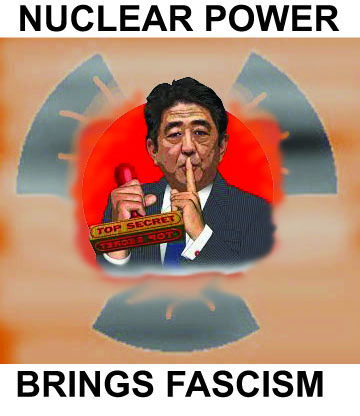 Under new law, about 460,000 documents likely to be called ‘special secrets’
 Murky labor conditions at crippled Fukuhsima nuclear facility
Fukushima workers still in murky labor contracts: Tepco survey, Chicago Tribune, 27 Nov 14 The number of workers at Japan’s Fukushima nuclear plant on false contracts has increased in the last year, the station operator said, highlighting murky labor conditions at the site despite a pledge to improve the work environment. The survey results released by Tokyo Electric Power Co <9501.T> (Tepco) late on Thursday showed that around 30 percent of plant workers polled said that they were paid by a different company from the contractor that normally directs them at the worksite, which is illegal under Japan’s labor laws.
Many workers asked Tepco in the survey forms whether they were supposed to receive an equivalent of about $180 a day in hazard pay, the company said, adding that it did not mean each worker would necessarily see a pay increase of that amount.
Tepco said last November it would double the allocation for hazard pay to workers at Fukushima……..http://www.chicagotribune.com/bluesky/technology/sns-rt-us-fukushima-workers-20141127-story.html
Japanese nuclear power company aims to keep reactors going way beyond their present license limit
Kepco wants to extend lifespan of 40-year-old Takahama reactors to 60 years JAPAN TIMES BY ERIC JOHNSTON NOV 26, 2014 Kansai Electric Power Co. said Wednesday it hopes to apply for a 20-year extension for two aging reactors that are close to the end of their 40-year approved life cycle, and plans to soon begin inspections which are a prerequisite for the move…… (registered readers only) http://www.japantimes.co.jp/news/2014/11/26/national/kepco-wants-extend-lifespan-40-year-old-takahama-reactors-60-years/#.VHleldLF8nl
China’s very rapid renewable energy growth- IRENA reports

 IRENA Says China Can Nearly Quadruple Renewable Energy By 2030 Clean Technica, November 25th, 2014 by Joshua S Hill A new report published Monday by the International Renewable Energy Agency (IRENA) has shown that China can increase its use of renewable energy from 13% to 26% by 2030, representing a nearly fourfold increase if the economic powerhouse is able to pull it off.
“As the largest energy consumer in the world, China must play a pivotal role in the global transition to a sustainable energy future,” said Adnan Z. Amin, Director-General of IRENA, at a launch event in Beijing. “China’s energy use is expected to increase 60 per cent by 2030. How China meets that need will determine whether or not the world can curb climate change.”
The report, Renewable Energy Prospects: China, was compiled by IRENA in association with the China National Renewable Energy Centre, and is part of IRENA’s renewable energy roadmap,REmap 2030, which aims to provide a plan to double the global share of the renewable energy mix by 2030.
Following the recent announcement made between China and the US, this report (and others like it) acquire even more significance, as China looks to be actively seeking ways to increase its renewable energy share……..
Economic Growth and Renewable Energy
Fears that economic growth must be stifled in favour of cleaner, more renewable sources of energy have recently been laid to rest, thanks partially to another report published recently that focused on China. The study, China and the New Climate Economy, showed that “China can achieve economic development, energy security and reduce pollution at the same time.”…….http://cleantechnica.com/2014/11/25/irena-says-china-can-nearly-quadruple-renewable-energy-2030/
China’s nuclear power investment might not be such a good deal
China Nuclear IPO Risks Fading Afterglow By ABHEEK BHATTACHARYA, WSJ Nov. 24, 2014 China’s largest nuclear power company is coming to the table with a high minimum bet.
State-owned CGN Power plans to sell shares worth up to $3.16 billionin Hong Kong this week, making it one of the few pure-play listed nuclear companies in the world. ………
 CGN Power’s multiple is substantially higher than U.S. nuclear operator Exelon ’s 6.7 times and French EDF’s 4.9 times. It is also more expensive than CGN Meiya, CGN Power’s smaller affiliate that went public in September and that fetches 11.2 times Ebitda.
High valuations for CGN Power are dicey because China regulates electricity prices more heavily than in the West. For instance, new nuclear-power plants can’t charge higher tariffs than neighboring coal-fired power, capping earnings potential.
Though Beijing’s plans to cut back on fossil fuels will help growth, the state-run grids prioritize wind and solar over nuclear power when buying and dispatching electricity, according to CGN’s prospectus. Given China’s ambitions to build out solar power, this means nuclear could occasionally lose out. It is also a reminder that nuclear energy may not always enjoy the government’s graces.
CGN Power’s novelty may attract some betting on China’s nuclear future. Yet like many Hong Kong IPOs that do well at first, this bet may lose its afterglow. http://online.wsj.com/articles/china-nuclear-ipo-risks-fading-afterglow-heard-on-the-street-1416819232
Abe government disregards public, and its (supposed) policy to reduce dependence on nuclear power
Editorial: Clarify vision for a society free of nuclear power. Mainichi, 26 Nov 14 “……Rather than phasing out atomic power, the 2-year-old government of Prime Minister Shinzo Abe has been once again trying to rely on nuclear power stations.
The Basic Energy Plan that the Abe Cabinet approved in April this year recognizes atomic power as an important base-load power source, while declaring that Japan will reduce its dependence on such power as much as possible. Moreover, the government has postponed a decision on an ideal ratio between power sources.
If the government is truly enthusiastic about pursuing a society that does not rely on atomic power, it is the role of politicians to clearly show a road map toward eliminating nuclear plants, set specific targets including the ratio between power sources and implement specific measures to achieve this goal. The government should also judge whether individual nuclear plants should be restarted within the framework of the policy toward phasing out nuclear power.
The Abe administration’s failure to do so suggests that the government intends to put as many nuclear power plants as possible into operation by carrying out a fait accompli.
In fact, the government is attempting to allow Kyushu Electric Power Co. to reactivate its Sendai nuclear plant in Kagoshima Prefecture based solely on the fact that its reactors meet the new regulatory standards set by the Nuclear Regulation Authority. The effectiveness of a plan to evacuate local residents in case of a serious disaster at the plant and efforts to convince residents of municipalities around the plant remain unaddressed. An opinion poll the Mainichi Shimbun conducted this past September shows that 60 percent of the public is opposed to restarting the power station. However, the government is showing no consideration of public opinion. Such an attitude could lead to a new safety myth, such as a massive amount of radiation would never be released in case of a meltdown since regulatory standards have been stiffened.
The government’s lack of enthusiasm about decreasing Japan’s dependence on nuclear power has led to power companies’ refusal to sign new contracts to purchase power generated with renewable energy. The promotion of renewable energy sources would help not only lessen the country’s dependence on atomic power but also create new industrial sectors and vitalize local economies. If Japan were to lose such chances because the government has failed to thoroughly implement measures to promote the introduction of renewable energy, it could be criticized as a serious policy misstep……Regardless, as long as a majority of the people of Japan, which experienced a serious nuclear disaster, are calling for a society without atomic power, it is the mission of politicians to make efforts to phase out nuclear power. http://mainichi.jp/english/english/perspectives/news/20141125p2a00m0na008000c.html
Tepco starts filling cable trench with cement as it pumps out radioactive water
Nov 26, 2014
IWAKI, FUKUSHIMA PREF. – Tokyo Electric Power Co. started work Tuesday to fill an underground trench at the disaster-stricken Fukushima No. 1 nuclear power plant with cement while pumping up radioactive water inside at the same time.
The power company reported the beginning of the cement-pouring work for the cable trench for reactor 2 at a meeting in Iwaki, Fukushima Prefecture, with government representatives on measures to deal with increasing radioactive water at the power station.
Tepco expects to finish the work by the end of next March. The company will begin next month pouring cement in reactor 3′s trench, hoping to complete the work also by the end of March.
The trenches for the two reactors are estimated to hold 11,000 tons of radioactive water in total. The water is believed to be causing the pollution of groundwater under the seaside section of the power plant.
On Tuesday, Tepco injected 80 cu. meters of cement in the reactor 2 trench in an operation that lasted two and a half hours from around 9:30 a.m. The trench holds radioactive water that has flowed from the reactor’s turbine building.
At first, Tepco planned to stop the flow by freezing water inside the joints between the turbine building and the trench so that it can entirely remove the radioactive water from there.
But Tepco could not fully freeze the water or block the flow. So, the firm switched to the current plan to inject cement in and remove the radioactive water from the trench simultaneously.
Source: Japan Times
Fukushima I NPP: Plan C Also Failed in Plugging Reactor 2 Trench… Now What?
November 24, 2014
Plan D of Course!
But first, recall that Plan A was to install freezing pipes at the head of the trench leading from Reactor 2 turbine building to create an ice plug so that the extremely contaminated water that had been sitting in the trench since the very beginning of the nuclear accident could be pumped out. TEPCO started the work in April this year.
That failed. The ice plug didn’t quite form.
Then recall that Plan B was to dump tons (literally) of ice and dry ice in the trench near the freezing pipes to lower the temperature of the water around the freezing pipes so that the ice plug would finally form. Workers dumped ice all day and all night, in the high ambient radiation right at the trench. That was in hot August. Try to freeze the trench with ice in hot August.
 That also failed. Dry ice clogged the pipe, and the ice plug didn’t quite form, and TEPCO admitted there was water still coming into the trench from the turbine building. The water sitting in the turbine building comes from the reactor building after it cools the molten core somewhere in the building, and it is warm.
So TEPCO came up with Plan C.
What was Plan C? It was to fill the gap between the incomplete ice plug and the turbine building wall with fillers. TEPCO chose the combination of grout and concrete. A plug of ice, grout and concrete was formed. Sort of.
From TEPCO’s document uploaded at Nuclear Regulation Authority’s site on 11/21/2014, the plug – pink and light green in the diagram is grout (different types), dark green is concrete:

That failed, just as I predicted.
TEPCO finally admitted on November 17 that it was a failure after pumping out some 200 tonnes of this highly contaminated water on November 17 and seeing that the water level in the trench didn’t go down as much as they had calculated. The water was still coming in from the turbine building, and the groundwater was probably seeping in.
But not to worry. TEPCO has Plan D, and it has been already approved by Nuclear Regulation Authority.
So what is Plan D? To fill the trench with cement while pumping out the water that gets displaced (in theory) by the cement.
(Do you want to bet whether that is going to fail?)
From Mainichi English (11/18/2014), from the original Japanese article on 11/17/2014:
An effort to stop contaminated water from flowing into a trench at the crippled Fukushima No. 1 Nuclear Power Plant failed to completely halt the flow, announced Tokyo Electric Power Co. (TEPCO), the plant’s operator, on Nov. 17.
A TEPCO representative said, “We believe we have not completely stopped the water. Groundwater may also be entering the trench. We will closely analyze the changes in water level in the trench.”
TEPCO says that when around 200 tons of contaminated water was removed from the trench, the water level in the trench should have fallen by around 80 centimeters if the point of leakage between the plant’s No. 2 reactor turbine building and the trench had been fully sealed. However, the water level only fell by 21 centimeters, so TEPCO determined that the leak must be continuing.
…While the water remains in the trench, TEPCO cannot create a planned underground wall of frozen soil around the No. 1 through 4 reactor buildings to stop water leakages.
And this image from Tokyo Shinbun (11/21/2014):
and reference to Plan D:
トンネルから汚染水を少しずつ抜きながら、水中で薄く広がる特殊なセメントを流し込んでトンネルをふさぐ方法への切り替えを提案する
(TEPCO) will propose (to Nuclear Regulation Authority) a new method of plugging the trench by pouring in the special cement that spread thin and wide in the water while removing the contaminated water in the trench gradually.
Special cement?
TEPCO says in the document (page 9) they submitted to NRA that it will be a mixture of cement, fly ash and underwater-inseparable admixtures (セメント、フライアッシュおよび水中不分離混和剤などの配合調整). They will use the tremie concrete placement method.
(Do you want to bet whether that is going to fail?)
The NRA meeting on November 21, 2014 was funny without participants intending to be funny, from what I read in the tweets by people watching the meeting.
At one point, Commissioner Fuketa exasperatedly asked TEPCO representatives, “So what was the point of trying to freeze the water? Was freezing even necessary at all?”
The answer was no. TEPCO’s Shirai admitted (according to the tweet by @jaikoman on 11/21/2014) that there was a talk inside TEPCO that the ice plug was not necessary.
So why did they do it, and why did NRA approve it?
No one knows and no one is held accountable, while workers had to set up freezing pipes, then to pour ice, dry ice, grout, concrete, and to pump this highly contaminated water over the past 8 months in high radiation exposure. TEPCO hasn’t disclosed the radiation exposure for the workers.
Source: EXSKF
http://ex-skf.blogspot.nl/2014/11/fukushima-i-npp-plan-c-also-failed-in.html

Work starts to fill tainted underground tunnels
The effort is aimed at replacing the water with cement. The water is believed to be leaking into the nearby sea after mixing with groundwater.
Workers on Tuesday poured into the tunnels 80 cubic meters of cement that can solidify in water. The plant’s operator, Tokyo Electric Power Company, said the water did not overflow during the work.
The operator says it plans to check the effectiveness of the measure in about a month after suspending the work temporarily. It says if there are no problems, it will resume the work to finish it by March.
The firm initially planned to freeze water at the ends of the tunnels to stop inflow from reactor buildings, and remove the contaminated water. But the plan did not work. By last week, the utility had decided to adopt the new method.
Workers using the method are likely exposed to more radiation than under the original plan.
Powerful earthquake hits Japan
Powerful quake rocks Japan, 6- out of 7 on intensity scale — Officials warn of strong aftershocks, around 50 so far — Helicopters find “more extensive damage than earlier thought” — Major roads collapsed, buildings flattened — Witnesses: “Strongest ever felt… Shaking was enormous” (VIDEOS) http://enenews.com/powerful-quake-rocks-japan-6-7-intensity-scale-officials-warn-landslides-strong-aftershocks-50-helicopters-find-extensive-damage-earlier-thought-major-roads-collapsed-buildings-flattened?utm_source=feedburner&utm_medium=email&utm_campaign=Feed%3A+ENENews+%28Energy+News%29
Reuters: 6.8 [quake] jolted central Japan on Saturday evening… felt in the capital Tokyo 180 km away… an advanced party of Japan’s military had been sent… “the tremor was too strong to stand,” said… an NHK employee.
AP: Helicopter surveys on Sunday showed more extensive damage than earlier thought from an overnight earthquake… footage showed buildings in various states of collapse, some flattened and others leaning… and deep cracks in the roads… The quake was followed by more than 45 aftershocks… [Officials] urged residents to watch out for landslides.
Voice of America: A powerful 6.8-magnitude earthquake… halted high-speed train service, caused several major roads to collapse and shut down others because of landslides.
Xinhua: Nagano prefecture government has enforced the disaster relief law… [Officials] warned of possible strong aftershocks… the government has set up a disaster relief office.
AP: One of the strongest ever felt in recent years by residents… Ryo Nishino, a restaurant owner… “never experienced a quake that shook so hard… shaking was enormous.”… The earthquake was felt across much of northern Japan… the Meteorological Agency… warned of further aftershocks.
ABC Australia: 21 aftershocks in the 90 minutes following the quake [and] tremors continued… “an aftershock registering upper 5 could occur in the coming week,” an agency official said… The quake was felt in wide areas from [including] Tohoku in north-eastern Japan… train systems in… Tohoku, Yamagata, Akita, Joetsu and Nagano… temporarily stopped.
AFP: Footage showed flattened wooden houses… “It’s quite a strong earthquake for an inland one,” an official at the Japanese agency told a midnight press conference. “We are worried about the extent of damage to houses and buildings,” he said… police and municipal officials said they were still scrambling to collect information as they were operating in the dark… The meteorological agency warned strong aftershocks could still occur in the coming week.
NHK: Japanese officials warn of quake aftershocks — Officials at Japan’s Meteorological Agency are warning people to be on the alert for aftershocks in the days ahead after a magnitude 6.7 earthquake… The tremor registered intensities of 6-minus on the Japanese scale of 7.
Fox News: Fukushima is about 155 miles northeast of where Saturday’s earthquake occurred.
Video: NHK here | CBS here | Fox News here
After failures, TEPCO to use special cement to prevent contaminated water leaks

November 22, 2014
The operator of the crippled Fukushima nuclear plant plans to fill in trenches on the coastline in yet another attempt to prevent highly contaminated water from pouring into the sea.
Under the plan, approved by the Nuclear Regulation Authority on Nov. 21, Tokyo Electric Power Co. will inject a special cement mixture into the seaside trenches of the No. 2 and No. 3 reactors while pumping up radioactive water accumulating in them.
The special mixture does not absorb water so it can spread more easily along the bottom of the trenches, displacing the tainted water.
The new method will allow radioactive materials to remain in the surrounding soil, but TEPCO decided to employ the technique because it puts high priority on preventing massive amounts of highly contaminated water from leaking into the ocean.
This spring, TEPCO tried to stop the water influx at the trench for the No. 2 reactor by freezing the junction of the turbine building and the trench, but the operation was tough-going.
The company then attempted to stop the water inflow with a cement mixture, but was unable to do so completely.
Source: Asahi Shimbun
http://ajw.asahi.com/article/0311disaster/fukushima/AJ201411220029
TEPCO gives up on freezing tainted water
The tunnels have been inundated with water from the plant’s heavily contaminated reactor buildings.
Tokyo Electric Power Company, or TEPCO, this year began work to freeze water at the ends of the tunnels to block the inflow. The firm finished the work early this month.
But TEPCO officials found that water levels in the tunnels were still changing in sync with volumes in the reactor buildings.
The officials admitted to the Nuclear Regulation Authority on Friday that the tunnels hadn’t been plugged.
They said they’re giving up on the plan, and proposed pouring cement into the flooded tunnels while removing water from them. They said they want this done from late November.
The authority’s commissioners asked whether the new method can really halt the inflow. They also spoke of the risk of cracks forming in cement.
The authority approved TEPCO’s plan in the end, on condition that the procedure be halted in late December to see whether it’s working.
Commenting on the change, one commissioner asked what all the trouble over the past months was for.
Tepco fails to halt toxic water inflow at Fukushima No. 1 trenches
Nov 22, 2014
Tokyo Electric Power Co. admitted failure Friday in its bid to halt the flow of toxic water into underground tunnels alongside the ocean at the Fukushima No. 1 plant and said that it will try using a specially developed cement instead.
Some 11,000 tons of highly radioactive water have accumulated in the tunnels, trenches dug to house pipes and cables that are connected to the reactor 2 and 3 turbine buildings of the wrecked facility, according to Tepco.
There are fears that this toxic buildup, which is being caused by the jury-rigged cooling system and groundwater seepage in the reactor basements, could pour into the Pacific, which is already being polluted by other radioactive leaks. Groundwater is entering the complex at 400 tons a day.
Extracting the toxic water is a critical step in Tepco’s plan to build a huge underground ice wall around the four destroyed reactors to keep groundwater out.
Initially, Tepco sought to freeze the water in a section of tunnel connected to the No. 2 reactor building. This was intended to stop the inflow and allow the accumulated water to be pumped out. The utility said it took additional measures that also failed.
On Friday, Tepco proposed a new technique for the tunnels: injection of a cement filler especially developed for the task while pumping out as much of the accumulated water as possible.
Under the new method, however, it would be difficult to drain all of this water and some of it would be left behind, endangering plant workers, Tepco acknowledged.
Nevertheless, a Nuclear Regulation Authority panel of experts green-lighted the new strategy at a recent meeting. Some of the experts argued that Tepco should stick to the original plan and draw out all of the water. Others said giving up on it may hamper the construction of the ice wall.
Source: Japan Times
1 This Month
15 October. Joint Appeal for Nuclear Abolition Day -presentation to the UN on October 15 will be live on UNWebTV
Endorse the Nuclear Abolition Day Appeal
23-25 October – on Zoom – World BEYOND War’s annual global conference

To see nuclear-related stories in greater depth and intensity – go to https://nuclearinformation.wordpress.com
-
Archives
- October 2026 (139)
- September 2026 (339)
- August 2026 (330)
- July 2026 (355)
- June 2026 (287)
- May 2026 (306)
- April 2026 (356)
- March 2026 (251)
- February 2026 (267)
- January 2026 (308)
- December 2025 (358)
- November 2025 (359)
-
Categories
- 1
- 1 NUCLEAR ISSUES
- business and costs
- climate change
- culture and arts
- ENERGY
- environment
- health
- history
- indigenous issues
- Legal
- marketing of nuclear
- media
- opposition to nuclear
- PERSONAL STORIES
- politics
- politics international
- Religion and ethics
- safety
- secrets,lies and civil liberties
- spinbuster
- technology
- Uranium
- wastes
- weapons and war
- Women
- 2 WORLD
- ACTION
- AFRICA
- Atrocities
- AUSTRALIA
- Christina's notes
- Christina's themes
- culture and arts
- Events
- Fuk 2022
- Fuk 2023
- Fukushima 2017
- Fukushima 2018
- fukushima 2019
- Fukushima 2020
- Fukushima 2021
- general
- global warming
- Humour (God we need it)
- Nuclear
- RARE EARTHS
- Reference
- resources – print
- Resources -audiovicual
- Weekly Newsletter
- World
- World Nuclear
- YouTube
-
RSS
Entries RSS
Comments RSS

