Russia to participate with India in building nuclear submarines?
 Russia’s Eyes Massive Nuclear Submarine Deal with India National Interest, 29 May 15 Russia may help India build nuclear submarines and stealth warships, according to Indian media reports.
Last week India’s Economic Times reported that the Indian conglomerate Reliance Infrastructure—which owns stakes in numerous Indian defense companies—is seeking Russian assistance for programs to locally produce nuclear submarines and other stealth warships. According to the report, top Reliance executives were in Moscow last week to meet with Russian defense officials about finding a partner for a joint venture between a Russian defense company and Pipavav Defence & Offshore Engineering, India’s largest defense shipyard, which Reliance has an 18 percent stake in. Specifically, Reliance is looking for a Russian partner with the “requisite technology expertise for manufacturing warships in India.”
As the Economic Times points out, the meetings come on the heels of India’s Cabinet Committee on Security (CCS) approving a plan for an Indian company to locally manufacture six nuclear submarines and seven stealth warships. The initial investment outlay for the project was set at Rs 1 trillion ($15.67 billion.)
Although the Russian government refused to specifically confirm the report, it did sound receptive to such a possibility…….http://nationalinterest.org/blog/the-buzz/russias-eyes-massive-nuclear-submarine-deal-india-12997
Sendai Nuclear Power Plant to be restarted in July 2015 surrounded by 5 active volcanoes

Sendai reactors surrounded by 5 active volcanoes
Japan’s NRA has given the go ahead to restart two reactors at the Sendai nuclear plant. The needed local approvals are expected to permit the plant to restart even though public opinion is about two to one against restarts. The first reactor could restart as early as July.
Warnings for a minor eruption at one of the five volcanoes near the Sendai nuclear plant were sent out. The volcano 64km from the nuclear plant has seen increased activity, enough so that experts put out a warning. Japan’s government has been pushing to restart the Sendai reactors without a viable plan for dealing with volcano risk.
We also found other risks that are unaddressed with the Sendai plant related to any disaster response.
While the nuclear plant restarts are largely a political move to shore up the profit margins of struggling electrical utilities, other challenges go unaddressed. Meanwhile fuel storage at nuclear plants may be at capacity within two years of reactor restarts.
With experts disputing the safety of restarting the Sendai reactors due to the proximity of so many active volcanoes they may be tempting fate.
Risks at Sendai
The Sendai nuclear power plant located in Kagoshima Japan has been selected as the one Japanese authorities would focus on attempting to approve for restart. Intakes reside at: 5ft above sea level Intake pump buildings 13 feet above sea level Reactor blocks at about 35-40 ft above sea level
Road routes are problematic at the plant. The plant is bordered by a large river to the north, the sea to the west and a large expanse of mountains to the east. Roads route either north along the river or south following the coastline a considerable distance before you reach an area that might be undamaged. The major road that routes towards Sendai crosses the river north of the plant before a road to get to the plant could be reached, requiring another trip across the river. Miyazaki sits further to the east but again requires a north route and river crossing.
All roads to the plant from the north are dependent on a bridge across the river to travel from the north or the east. The roads to the plant from the north as they each require a bridge crossing, circled in red. The road faces the river edge and varies from 5 feet above sea level to 31 feet above sea level.
The south route goes through areas like Tsuchikawa, an area that would likely be subjected to any tsunami that would hit the plant, potentially preventing travel further east to Kagoshima. This would cause a station blackout at the plant just like at Fukushima Daiichi.
The even bigger challenge is that the conditions that would take out offsite power can’t be overcome. That had been the 500th eruption for the year and was just past the half way point of 2013.
The problems a volcano can cause a nuclear power plant is a well known problem. Ash can also cause mechanical damage to anything with moving parts that the ash may get into including pumps and generators.
The isolation of the plant due to the terrain and roads could hinder any response effort.
Non evacuation plans for Sendai
Prime minister Abe said that he approves of the evacuation plans around the Sendai nuclear plant and that he considers them “concrete and reasonable”. There is currently no agency or authority to evaluate evacuation plans in Japan.
The governor of Kagoshima said he was reluctant to develop plans to rescue all the people within 30km. “There are 17 hospitals and welfare facilities within 10 km of the plant. “We could spend long hours creating something unrealistic, but it won’t function” in the event of an actual disaster, Ito told reporters last month.”
The prefecture told the remaining facilities to figure it out for themselves how to evacuate anyone between the 10 to 30km zone.
Critics of the evacuation plans around Sendai pointed out that damage from earthquakes, landslides and tsunami were not given consideration in planning.
2 Sendai reactors cleared by NRA for restart
Japan cleared the way for a resumption of nuclear power, four years after the world’s worst atomic disaster in more than two decades led to the shutdown of all the country’s reactors and fueled public opposition to the industry.
Regulators said Kyushu Electric Power Co.’s two-reactor Sendai nuclear plant had cleared safety hurdles introduced after the triple meltdowns at Tepco’s Fukushima No. 1 plant in 2011.
The Sendai plant, in Kagoshima Prefecture, still needs to go through operational checks before a restart but these are expected to be completed without major hitches.
Volcano explodes off Kyushu 151 km from Sendai, forcing small island to evacuate
A volcano exploded Friday morning on sparsely populated Kuchinoerabu Island, sending smoke and ash soaring into the sky above Kagoshima Prefecture and residents fleeing to the safety of nearby Yakushima Island.
The 9:59 a.m. eruption of 626-meter Mount Shindake, the island’s main peak, produced a plume over 9 km high and a pyroclastic flow that reached the shoreline, the Meteorological Agency said.
There was no warning.
Situated some 100 km off the southern tip of Kyushu, Kuchinoerabu has only about 100 full-time residents. The same mountain had 178 small eruptions in March alone and produced one last week that created a plume 4.3 km high.
Nobuo Geshi of the National Institute of Advanced Industrial Science and Technology claims Friday’s eruption is the same type as the one seen at Sakurajima but much larger.
Geshi, who heads a group of scientists conducting research on massive eruptions, said it is very similar to the one the island experienced in 1966.
He said it can also be regarded as part of the volcanic activity that continued after the eruption last August.
Geshi pointed out that none of the past cases was a one-off eruption, suggesting the activity may continue for a while.
Kuchinoerabu, located in an area south of Kyushu with a large concentration of active volcanoes, has experienced numerous bouts of volcanic activity since Shindake’s colossal eruption in 1841, which scorched nearby villages and killed many residents.
Shindake’s volcanic activities continued in the 1960s, resulting in another massive eruption in November 1966 that hurt three people and caused shock waves and pyroclastic flows that hit Kagoshima and Tanegashima Island, one of the Osumi Islands.
The mountain also experienced a small phreatic eruption in September 1980.
Since the 2000s, a large increase in volcanic quakes and tremors has been reported.
Abe Govt. pushes for nuke restart in Sendai even as volcano pops 151km (94 miles) from there
More than 100 people have been ordered to evacuate after a volcano erupted on the tiny southern Japanese island of Kuchinoerabu on Friday morning.
Spectacular TV footage captured the moment Mount Shindake exploded, sending columns of thick, black smoke high into the air.
Japan’s meteorological agency raised the alert level to five – the highest on its scale – and ordered the island’s 140 residents to evacuate.
The agency said no injuries or damage had been reported following the eruption, which occurred eight months after 57 people died after Mount Ontake in central Japan erupted without warning.
The agency added that pyroclastic flows, dense currents of rock fragments and hot gases from the volcano had reached the island’s north-west shore.
In Tokyo, the prime minister, Shinzo Abe, set up an emergency response team and dispatched a self-defence force to the island. Abe said he had instructed local authorities to do “everything possible” to ensure the islanders’ safety.
Yoshihide Suga, the government’s chief spokesman, said a coastguard vessel had also been sent to help residents evacuate.
A local official said the eruption, which occurred without warning, had forced about 100 people to take shelter at an evacuation centre. “There was a really loud sound of an explosion, and then black smoke rose, darkening the sky,” Nobuaki Hayashi told the national broadcaster NHK. “It smells of sulphur.”
Source: The Guardian
Radioactive water leaks at Fukushima Daiichi: a never ending story
What a surprise! The operator of the destroyed Fukushima Daiichi nuclear plant, Tepco, says workers have found a leak of highly radioactive water at the plant’s site. They say the water flowed into the plant’s port. (Ocean)
We are all dumbfounded by such sudden unexpected horrible news, maybe we should start a worldwide crowdfunding project to provide them with sufficient plenty masking tape!
The operator of the crippled Fukushima Daiichi nuclear plant says workers have found a leak of comparatively highly radioactive water at the plant’s site. It says the water flowed into the plant’s port.
Tokyo Electric Power Company says the contaminated water was leaking from a hose connecting a wastewater tank and a building at the plant.
The hose had a crack about 1 centimeter long. The contaminated water was produced in a process to clean up rainwater tainted by radioactive materials at the plant.
Utility officials said the leaked water flowed into a nearby drainage channel and into the port.
They said they detected about 1,200 becquerels per liter of beta ray-emitting substances from water taken from the channel on Thursday. That figure was 40 times the level the previous day.
They said the figure rose to a maximum of 1,400 becquerels on Friday. The officials believe the leakage continued over the two days.
The company says concerns were raised about the hoses’ durability. It has been replacing them.
Authorities in Fukushima Prefecture have urged the company to conduct an investigation to identify the cause of the leak. They say the company should take thorough measures to prevent a recurrence.
Source: NHK
http://www3.nhk.or.jp/nhkworld/english/news/20150529_41.html
Inadequate cleaning of Fukushima radioactive water
 Fukushima Daiichi Cleans Most Contaminated Water, Not Really, Simply Info May 28th, 2015 TEPCO announced that they have cleaned most of the contaminated water at Fukushima Daiichi. But thedetails show they are no where near close to being done.
Only cesium 137 & 134 along with strontium 90 have been removed from certain tanks of water. 620,000 tons of water have had these two isotopes removed. 10,000 tons of water currently can not be filtered for an undisclosed reason.
440,000 tons of water have now been run through ALPS with 180,000 tons still needing to be processed. Previous admissions showed that ALPS did not remove cobalt 60, iodine 129 and tritium among possible other isotopes……. http://www.fukuleaks.org/web/?p=14776
Japan’s Nuclear Regulation Authority gives approval for restart of Sendai reactors
 Japan Nuclear Plant Obtains Final Permit Needed To Restart, Huffington Post By MARI YAMAGUCHI 05/27/2015 TOKYO (AP) — A nuclear plant in southern Japan on Wednesday obtained the final permit needed to restart its reactors, paving the way for it to become the first to go back online under new safety standards introduced after the 2011 Fukushima disaster.
All of Japan’s more than 40 reactors are currently offline for repairs or safety inspections. The two units at the Sendai nuclear power plant are among 24 reactors seeking to restart, as Prime Minister Shinzo Abe’s pro-business government tries to put as many back online as possible.
The Nuclear Regulation Authority approved the Sendai plant’s operational safety plans, the last step of a three-part screening process. The plant’s safety program includes emergency response plans in case of fire, floods or other natural disasters, or a serious accident…… While local municipalities have already approved the Sendai plant’s restart, many residents oppose the plan, citing potential danger from active volcanos in the region.
Kyushu Electric hopes to restart one reactor at the Sendai plant in late July after on-site tests and training and the other in late September, though there could be some delays………http://www.huffingtonpost.com/2015/05/27/japan-nuclear-plant-restart_n_7450350.html
LYING BY OMISSION ! “Tepco says all radioactive water in Fukushima No. 1 tanks filtered”

Their filtering systems can only removed 62 radionuclides out of the 1370 radionuclides present
The operator of the crippled Fukushima No. 1 nuclear plant said Wednesday it had finished filtering 620,000 tons of extremely toxic water stored in tanks on the premises of the complex to lower its radiation level.
Tokyo Electric Power Co. says the risk of radiation leakages from the water tanks is now much lower. However, around 400 tons of radioactive water is still being generated everyday as groundwater is seeping into the plant and mixing with tainted water more than four years after the nuclear crisis began.
According to Tepco, some 440,000 tons of the water has been treated through a water processing system that is said to be capable of removing 62 different types of radioactive material, with the exception of tritium. The remaining 180,000 tons has been processed through another facility capable of removing strontium, but still contains other types of radioactive substances and needs further treatment.
The highly radioactive water has been generated during the process of cooling the plant’s reactors, which suffered meltdowns after the facility was struck by a magnitude-9 earthquake and tsunami in March 2011.
When Prime Minister Shinzo Abe visited the Fukushima plant in September 2013, Tepco President Naomi Hirose pledged that the company would filter all the water kept in tanks by March 31, 2015 to reduce the amount of radioactive material it contained.
But the process has been delayed due to a series of problems with key water treatment facilities.
Source : Japan Times
http://www.japantimes.co.jp/news/2015/05/27/national/tepco-says-radioactive-water-fukushima-1-tanks-filtered/#.VWZW0kZZNBQ
Looking for Know-How from Overseas
Japan and Tepco have now decided they need help.
4 years too late Japan.
Japan’s spent fuel problem will escalate, casting doubt on nuclear restart plans
 Spent-nuclear fuel issues plague restarts http://www.japantimes.co.jp/news/2015/05/26/national/spent-nuclear-fuel-issues-plague-restarts/#.VWTjIdKqpHw JIJI MAY 26, 2015Spent fuel at the Hamaoka nuclear power station in Shizuoka Prefecture could exceed the capacity of storage pools some two years after the plant is restarted — much sooner than the previously assumed eight years, according to sources.
The faster pace is because the storage pools for reactors 1 and 2 at the Chubu Electric Power Co. plant will be removed from the complex’s total storage capacity following the decommissioning of the two units.
Previously, Chubu Electric planned to continue using the two reactors’ storage pools. The operations of the two reactors ended in 2009.
Last month, four power suppliers, including Kansai Electric Power Co., decommissioned a combined five aging reactors, significantly reducing storage pool capacity.
As of the end of March, the Hamaoka plant’s storage capacity fell by 440 tons in the past six months to 1,300 tons, reflecting the exclusion of the reactor 1 and 2 pools, according to Chubu Electric’s semiannual report to the Federation of Electric Power Companies. Meanwhile, the amount of spent fuel stored at the plant stood at 1,130 tons.
If the remaining three reactors at the plant are brought back online, the amount of spent fuel would exceed the storage capacity in 2.3 years, compared with the eight years estimated before the company’s decision not to use the reactor 1 and 2 pools.
Of all 15 domestic nuclear plants that operators are seeking to restart, storage space capacity appears to be lowest at the Hamaoka plant.
Only four of the plants have more than 10 years before they run short of capacity, including Hokkaido Electric Power Co.’s Tomari plant, which has the longest time, at 16.5 years. The three others are Tohoku Electric Power Co.’s Higashidori plant, with 15.1 years, Hokuriku Electric Power Co.’s Shika plant, with 14.4 years, and Kyushu Electric Power Co.’s Sendai plant, with 10.7 years.
All nuclear reactors in Japan are now offline.
Some nuclear plant operators are working to increase their spent-fuel storage capacities while pinning hopes on fuel recycling at Japan Nuclear Fuel Ltd.’s facilities in the village of Rokkasho, Aomori Prefecture.
Chubu Electric has applied to build a dry-cooling storage facility at the Hamaoka plant to boost its total capacity to store spent fuel. It hopes to put the facility into operation in fiscal 2018 if the plan is approved by the Nuclear Regulation Authority.
A Chubu Electric official said storage capacity prospects remain unclear at the plant because it is uncertain if any reactors will be allowed to restart.
Chinese scientist warns on dubious safety of China’s nuclear power programme

 China warned over ‘insane’ plans for new nuclear power plants, Guardian, Emma Graham-Harrison , 25 May 15 He Zuoxiu, a leading Chinese scientist, says the country is not investing enough in safety controls after lifting of post-Fukushima disaster reactor ban. China’s plans for a rapid expansion of nuclear power plants are “insane” because the country is not investing enough in safety controls, a leading Chinese scientist has warned.
Proposals to build plants inland, as China ends a moratorium on new generators imposed after the Fukushima disaster in March 2011, are particularly risky, the physicist He Zuoxiu said, because if there was an accident it could contaminate rivers that hundreds of millions of people rely on for water and taint groundwater supplies to vast swathes of important farmlands.
China halted the approval of new reactors in 2011 in order to review its safety standards, but gave the go-ahead in March for two units, part of an attempt to surpass Japan’s nuclear-generating capacity by 2020 and become the world’s biggest user of nuclear power a decade later.
Barack Obama recently announced plans to renew a nuclear cooperation deal with Beijing that would allow it to buy more US-designed reactors, and potentially pursue the technology to reprocess plutonium from spent fuel…..
He, who worked on China’s nuclear weapons programme, said the planned rollout was going too fast to ensure it had the safety and monitoring expertise needed to avert an accident.
“There are currently two voices on nuclear energy in China. One prioritises safety while the other prioritises development,” He told the Guardian in an interview at the Chinese Academy of Sciences.
He spoke of risks including “corruption, poor management abilities and decision-making capabilities”. He said: “They want to build 58 (gigawatts of nuclear generating capacity) by 2020 and eventually 120 to 200. This is insane.”
He’s challenge to the nuclear plans is particularly powerful because of his scientific credentials and a long history of taking a pro-government stance on controversial issues, from the 1950s destruction of Beijing’s city walls to the crackdown in the 1990s on the religious group Falun Gong.
He would like to see China stop its expansion once the plants that have been approved or are now under construction are finished, and then gain a few decades experience of running them safely before expanding again. Almost all the country’s working reactors started up after 2000.
“China currently does not have enough experience to make sound judgments on whether there could be accidents,” he said. “The number of reactors and the amount of time they have been operating safely both matter.
“The safety reviews after Fukushima found some problems, but only minor ones, and the final conclusion is that China’s nuclear power is safe. But the safety checks were carried out under the old standards and the standards themselves clearly need big improvements.”………
“Japan has better technology and better management, and yet it couldn’t avoid an accident despite the fact that it tried very hard to learn from the US and USSR,” He said, adding that China’s nuclear monitor has sparser staffing than Japan’s, and offers low salaries that will not attract the best young scientists.
China had considered and then rejected stronger standards, He said, because of the huge pressure for a rapid expansion and companies powerful enough to put corporate profits ahead of national security.
“There were internal discussions on upgrading standards in the past four years, but doing so would require a lot more investment which would affect the competitiveness and profitability of nuclear power,” He said. “Nuclear energy costs are cheap because we lower our standards.”
Rather than encouraging debate to expose weaknesses, the government tries to stamp it out, and in a country where challenging officials is risky, there is no mechanism to encourage or protect whistleblowers.
He said: “At the moment, the ministry of environmental protection is considering a new watchdog. When they invited me over for a discussion, I told them: ‘Your safety watchdog is not independent. It listens to the national nuclear corporation and hence the scrutiny is fake’.”…….http://www.theguardian.com/world/2015/may/25/china-nuclear-power-plants-expansion-he-zuoxiu
As many as 333 Fukushima radioactive water tanks may be leaking
Leaking Fukushima containers could lead to hydrogen explosions, Rt.com May 25, 2015 Containers holding contaminated water at the crippled Fukushima nuclear power plant are at risk of hydrogen explosions, with 10 percent of them found to be leaking. As many as 333 containers may be defective, according to TEPCO.
The first leak was discovered by the plant’s operator, Tokyo Electric Power Company (TEPCO), on April 2. The discovery prompted an inspection of other containers at the site.
Twenty-six of the 278 containers examined by May 20 had some sort of leak or were bleeding from their lids. There are a total of 1,307 containers at the plant.
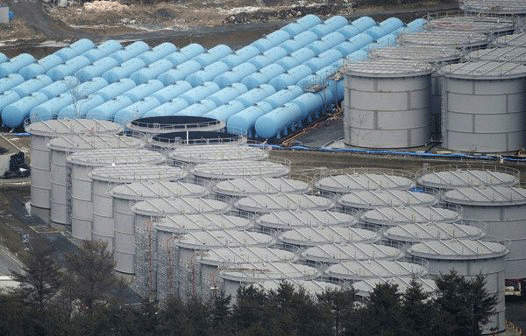
According to TEPCO, the leaks and bleeding were likely caused by hydrogen and other types of gases that resulted from the water’s exposure to high levels of radiation. Those gases appear to have accumulated in sediment at the bottom of the containers, expanding the volume of the liquid……http://rt.com/news/261793-fukushima-containers-hydrogen-explosions/
Tokyo hit by 5.6y mag earthquake
Quake Hits Tokyo Days After Japan OK’s Third Nuclear Restart BY HENRY AUSTIN NBC NEWS 25 MAY 15 An earthquake shook buildings and halted train lines in Tokyo early Monday, days after Japan’s nuclear regulator green-lighted the restarting of atomic energy at a third plant.
The quake, with a preliminary magnitude of 5.6, was centered in Ibaraki prefecture just northeast of the country’s capital, the Japan Meteorological Agency said. There was no tsunami warning.
Narita airport closed both runways for checks shortly after the quake, but the capital’s Haneda airport was operating as normal.
There were no immediate reports of damage or injuries, and no reports of abnormalities at any nuclear facilities.
But the quake is likely to reignite the debate about whether the country should use nuclear power in one of the world’s most seismically active nations……….http://www.nbcnews.com/news/world/quake-strikes-japan-days-after-nuclear-reactor-signed-n364071
Japanese business leaders do not like nuclear power
Japan Inc not as keen as Abe government on nuclear power – Reuters poll TOKYO | BY TETSUSHI KAJIMOTO AND YUKA OBAYASHI Sun May 24, 2015 Two-thirds of Japanese companies want and expect a lesser role for nuclear power than the government is targeting, a Reuters survey showed, reflecting persistent concerns about safety four years after the Fukushima disaster.
All of the country’s 43 operable reactors are offline – the result of a tougher safety regime introduced after an earthquake and tsunami hit the Fukushima plant, causing meltdowns, explosions and plumes of radioactivity.
Prime Minister Shinzo Abe’s government last month proposed bringing nuclear energy back to account for 20-22 percent of the nation’s electricity mix by 2030, seeking to reduce Japan’s huge reliance on imported fossil fuels and lift the economy out of two decades of anaemic growth.
But slightly more than two-thirds of firms in the Reuters Corporate Survey, conducted May 7-19, saw levels of less than 20 percent as appropriate and realistically achievable given strong public opposition.
“Some nuclear power stations may resume operations, but it will be difficult to expect as many restarts as the government and utilities want,” a corporate manager at a machinery company wrote……..
A Reuters analysis last year indicated that as few as a third, and at most about two-thirds, of Japan’s reactors are ever likely to pass today’s more stringent safety checks and clear other seismological, economic, logistical and political hurdles needed to restart.
A third of reactors back online would be roughly equivalent to nuclear energy accounting for 10 percent of the country’s electricity supply while two-thirds would be about 20 percent…….
The corporate survey, conducted for Reuters by Nikkei Research, polled 481 large and mid-sized companies. Around 230, which responded anonymously, answered questions on nuclear energy prospects.
PUBLIC OPPOSITION
Most public opinion polls have put opposition to nuclear restarts at about two-to-one over support.
Local residents and activists are seeking to block the restart of all five reactors certified as meeting new safety standards from the Nuclear Regulation Authority – making it hard to predict the timing of resumption of operations.
The restart of one, the Takayama plant owned by Kansai Electric Power (9503.T), has been delayed indefinitely after a court sided with activists. The first restart could be the Sendai plant owned by Kyushu Electric Power (9508.T) but the regulator has said company plans for that to happen in mid-July are too optimistic as it needs to finalise its review……http://uk.reuters.com/article/2015/05/24/uk-japan-companies-nuclear-idUKKBN0O910A20150524
Japanese mass media now reporting on Tepco’s radioactive leaking into Pacific
 Japanese mass media “Jiji” rose in revolt against Tepco / 2 trillion Bq leaked to the sea in 10 months http://fukushima-diary.com/2014/09/japanese-mass-media-jiji-rose-revolt-tepco-2-trillion-bq-leaked-sea-10-months/ Iori Mochizuki On 9/8/2014, Japanese mass media, “Jiji” reported about 2 trillion Bq of Sr-90 and Cs-137 leaked to the Pacific only in 10 months.
 This is based on the fact that Fukushima Diary posted about in August.
5 Billion Bq of Strontium-90 flows to the sea every single day [URL]
15 Billion Bq of Tritium flows to the Pacific every single day / Tepco under-reported 1/15 at press conference [URL 2]
The article of Jiji says exactly the same thing as these Fukushima Diary’s posts, but they calculated it further by themselves and published the total volume of leaked Strontium-90 and Cesium-137 from August 2013 to May 2014.
Jiji ended the article to state that the leaked contaminated water contains other nuclides so the actual sea contamination can be worse than reported in this post.
The writer’s name is not credited on the article.
In respond to this coverage, Tepco published an announcement on the same day to comment that they managed to reduce the leaking contamination level by ground improvement. They state Sr-90 level became 1/3, Cs-137 level became 1/10. However it only means 10.5 Trillion Bq used to flow to the Pacific in the previous 10 months, which doesn’t refute Jiji’s coverage.
It seems like Tepco avoided starting the conflict with Jiji, and tried to emphasize on their effort instead.
Small scale energy revolution in India’s slums – from Australia solar company
Australian solar company Pollinate Energy brings light to slums of India ABC Foreign Correspondent By South Asia correspondent Stephanie March 26 May 15 With indoor air pollution from kerosene lamps and stoves the second largest cause of death in India, one company, founded by Australians, has come up with a solution to the problem.
Every night in the sprawling shanty towns of the country of 1.2 billion people, the air fills with dense, black smoke.
“We used to get oil from the market and pour it into the lamp and light it; the house used to get full of soot and dirt,” said Abdul, a slum-dweller in Bangalore who lives in a hut made of wooden board and tarpaulin.
That was until Abdul bought a portable solar light from a company called Pollinate Energy, founded by five young Australians.
“After we got this solar lamp a lot of things improved,” Abdul said. “Now we don’t worry that there will be a fire.”
There are 400 million people in India who do not have access to electricity. Many of them live in the thousands of slums found in the country’s cities.
“They’re people who’ve come from rural places to the city to find work, usually in construction sites or as rag pickers, and to make a life for themselves,” Pollinate Energy co-founder Kat Kimmorley said.
“They are sort of like the modern day pharaoh slaves building this next new empire that we all … take for granted that is just coming up before our eyes and yet [is] completely ignored and sort of invisible to the state here.”
Pollinate Energy employs locals to go tent to tent to sell the solar lights.
The lights cost about $30 each — a lot of money for people who earn a few dollars a day. The company allows customers to pay in instalments.
“For most of the people we work with in these urban slums, when we provide a solar light, every time I sell it I think this is the same type of investment as for a plasma screen TV in Australia,” Ms Kimmorley said.
More mobile phones than toilets in India
The lights are popular — the company has sold more than 7,000, and is expanding to two more Indian cities. And that is partly because they double as a phone charger.
“We discovered that the customers would pay double what they would pay for a solar light for a solar-powered phone charger,” Ms Kimmorley said.
“So it is just testament to the fact that it is not just what we think would improve peoples’ lives but also what keeping up with the Joneses means in an urban slum. It’s having a mobile phone and being able to charge that mobile phone,” she said.
The uptake of mobile phones in India has been huge — there are more mobile phones than there are toilets.
The team at Pollinate believes solar lights can follow the same path………http://www.abc.net.au/news/2015-05-26/solar-energy-brings-light-to-slums-of-india/6495912
-
Archives
- October 2026 (120)
- September 2026 (339)
- August 2026 (330)
- July 2026 (355)
- June 2026 (287)
- May 2026 (306)
- April 2026 (356)
- March 2026 (251)
- February 2026 (267)
- January 2026 (308)
- December 2025 (358)
- November 2025 (359)
-
Categories
- 1
- 1 NUCLEAR ISSUES
- business and costs
- climate change
- culture and arts
- ENERGY
- environment
- health
- history
- indigenous issues
- Legal
- marketing of nuclear
- media
- opposition to nuclear
- PERSONAL STORIES
- politics
- politics international
- Religion and ethics
- safety
- secrets,lies and civil liberties
- spinbuster
- technology
- Uranium
- wastes
- weapons and war
- Women
- 2 WORLD
- ACTION
- AFRICA
- Atrocities
- AUSTRALIA
- Christina's notes
- Christina's themes
- culture and arts
- Events
- Fuk 2022
- Fuk 2023
- Fukushima 2017
- Fukushima 2018
- fukushima 2019
- Fukushima 2020
- Fukushima 2021
- general
- global warming
- Humour (God we need it)
- Nuclear
- RARE EARTHS
- Reference
- resources – print
- Resources -audiovicual
- Weekly Newsletter
- World
- World Nuclear
- YouTube
-
RSS
Entries RSS
Comments RSS

