Nuclear Regulation Authority (NRA) official warns on hydrogen explosion risk at Fukushima

 Gas buildup under Fukushima threatens hydrogen explosion, warn nuclear officials, June 01, 2015 by: Jonathan Benson, staff writer (NaturalNews) It is estimated that at least 130 storage containers holding radioactive waste at the stricken Fukushima Daiichi nuclear facility in Japan are now leaking, according to new reports. The result is a continuous hydrogen gas buildup that nuclear experts say could one day trigger a cascade of devastating explosions potentially unlike anything the world has ever seen.
The Tokyo Electric Power Company (TEPCO) discovered the leaks during a recent inspection, observing that hydrogen and other gases are accumulating in the sediment at the bottoms of many of the storage tanks onsite. The buildup from this is causing contaminated water inside the tanks to expand, blowing off their lids and spilling their contents.
An official from the Nuclear Regulation Authority (NRA), which was given the bad news during a recent study group meeting with TEPCO, reportedly told the media that this constantly accumulating gas buildup is an imminent danger and that something needs to be done to contain it.
“If the concentration level is high, a spark caused by static electricity could cause a container to explode,” stated one unnamed government official about the situation, as quoted by the news source The Asahi Shimbun.
Many of Fukushima’s storage containers are faulty; some are missing gas venting holes
In early April, many of the containers identified as leaking radioactive waste were found to be leaking the fluid through their gas venting holes, which are supposed to prevent this very thing from occurring. It was also later discovered that some of the storage tanks weren’t even properly outfitted with gas venting holes, exacerbating the problem…….http://www.naturalnews.com/049910_Fukushima_nuclear_waste_hydrogen_explosion.html
South Korea agrees to talks over food import ban
Japan’s fisheries minister has expressed hope that South Korea will lift its ban on fishery imports from areas affected by the 2011 nuclear accident at the Fukushima Daiichi power plant.
South Korea has banned all imports of fishery products from 8 Japanese prefectures, including Fukushima, since September 2013.
On Tuesday, Agriculture, Forestry and Fisheries Minister Yoshimasa Hayashi told reporters that South Korea informed Japan last Friday that it will agree to bilateral talks in Geneva, Switzerland, based on a World Trade Organization agreement. Japan requested the meeting last month.
Hayashi said under the WTO rules, negotiations should start within 30 days of a request.
He added that the government will step up efforts to get South Korea to lift the ban, even as a date for the talks is being arranged.
Source: NHK
http://www3.nhk.or.jp/nhkworld/english/news/20150602_20.html
“WE NEED HELP FROM THE WORLD COMMUNITY” Akiko Morimatsu’s speech at the UN Disaster Prevention Convention in Sendai City, Japan, March 15, 2015
 Akiko Morimatsu with her children
“WE NEED HELP FROM THE WORLD COMMUNITY”
Akiko Morimatsu’s speech at the UN Disaster Prevention Convention in Sendai City, Japan, March 15, 2015
translated by Yoko Chase, Ph.D.
Ladies and gentlemen, I would like to express my personal gratitude for the worldwide support given to us on this occasion.
1. East Japan suffered catastrophic damage by the Great East Japan Earthquake and the consequent accident at the Fukushima Daiichi Nuclear Power Plant owned by Tokyo Electric Company on March 11, 2011. Immediately after the disasters occurred, people all over the world sent kind messages as well as necessary commodities for survival, thus helping us both mentally and materially. I thank you all sincerely for the kindness.
2. However, the Japanese government has never been able to put the nuclear power plants under control since the 3 11 accident. The plants have contaminated the ocean, the air, and lands which are, without boundaries, connected throughout the world. The TEPCO’s Fukushima Daiichi nuclear power plant accident has never been put under control and I personally think we must apologize for this fact to the people of the world. The contaminated water has kept leaking and polluting the ocean for four years and no Japanese citizens think Fukushima is under control. It is a shame that we have not apologized to the world for the fact. I, therefore, would like to apologize personally now to all the people in the world on this occasion. I am very sorry that Japan has kept contaminating the beautiful earth.
3. Now in Japan, many people have evacuated the contaminated areas to avoid radiation exposure. The number of registered evacuees in June 2012 reached 347,000 according to the government’s Reconstruction Agency. Moreover, many people have stayed in the contaminated areas due to the lack of the government’s financial support. Most evacuees are families with little children who are vulnerable to radiation. My own case is one of them.
Our two children were a three-year-old infant and a five-month-old baby at the time of the disaster. Since the nuclear accident, my husband who is the father of the children, has stayed in Fukushima but our children and I fled to Osaka. We are dislocated and forced to live in 2 separate locations. Such dislocation to protect children is called, boshi hinan, or “mother and child(ren) evacuees” and there are still many of us.
4. We need to protect ourselves from the radiation contamination which has leaked from TEPCO’s Fukushima Daiichi Nuclear Power Plant. Evacuation is a natural human act to flee from radiation and to enjoy healthy living. I regard the nuclear evacuees like ourselves as people of “Internal Displacement” referred to in the Guiding Principle on Internal Displacement in the 1998 UN Human Right Commission Report.
The second article of the above principle states: “Certain internally displaced persons, such as children, especially unaccompanied minors, expectant mothers, mothers with young children, female heads of household, persons with disabilities and elderly persons, shall be entitled to protection and assistance required by their condition and to treatment which takes into account their special needs.” The Japanese government, however, has not put this principle into action its policies for the internally displaced people due to the nuclear accidents. The Japanese government has not learned lessons of the social protection of victims from Chernobyl nuclear accident.
5 Moreover, the Japanese government has objected and rejected the UN Special Rapporteur Anand Grover’s advice given in 2013.
6. In other words, rights pertaining to human life and health have been continuously violated by the Japanese government since 3.11. Human beings have had the historical experience of the nuclear accident in Chernobyl in the former Soviet Union and have had many witnesses from Chernobyl mothers. The Japanese government, however, has not learned the lessons from “the social protection of victims” in the Chernobyl nuclear accident. By the government ignoring the lessons, many people in Fukushima and other contaminated areas in Japan are still forced to have unnecessary radiation exposure today.
7. I would like to protect life, health, and the future of the children living in Japan. Without evacuating from nuclear contaminated areas or ensured regular recuperation opportunities, we cannot follow the 24th article of the Convention of the Rights of the Child, which Japan has ratified, “the right to enjoy the highest level of health reachable.” We need help from the world community.
8. The Preamble of the Japanese Constitution declares “the right to live free form fear and deprivation and to live in peace” (right to peaceful life).
9 The right to live free from the fear of radiation exposure and to live in peace should be given equally to all people. We cannot make any more “hibakushas” if we have learned the lessons from Hiroshima, Nagasaki and Fukushima.
10. To be free from radiation exposure and to enjoy health is a basic human reaction to protect life. It is a human right directly concerning to human life and health. It is the most important and universal human right. Can you think of anything else which is more precious than human life?
11. We need help from the world community to help all the victims and evacuees of nuclear accident disasters. Please take action and tell the Japanese government to act in compliance with international laws, and respect the guiding principles and recommendations of the United Nations.
Please help us protect the people, especially the children, in Fukushima and East Japan from radiation exposure.
Thank you very much.
Akiko Morimatsu
Thanks & Dream, The Great East Japan Earthquake Disaster Evacuees Association http://sandori2014.blog.fc2.com/
Email: sandori2014@gmail.com
東日本大震災避難者の会 Thanks & Dream (サンドリと呼ばれてます)
避難者が避難者のために主体的に活動し、 お支え下さる方々へ感謝することを忘れず、 避難者の「今」を真摯にお伝えすることによって 社会貢献につながる活動を自発的に行う 避難当事者団体です。 参加メンバー随時募集中(^^) sandori2014@gmail.com
sandori2014.blog.fc2.com
A Letter to Prime Minister Shinzo Abe and Fukushima Governor Masao Uchibori from Akiko Morimatsu, a Fukushima Evacuated Mother
 A Letter to Prime Minister Shinzo Abe and Fukushima Governor Masao Uchibori from Akiko Morimatsu, a mother who voluntarily evacuated from Fukushima so she could raise her two small children in an area free from radioactive contamination.
(Translated by Yoko Chase, Ph.D.)
To: Prime Minister Shinzo Abe Fukushima Governor Masao Uchibori
Dear sirs,
My name is Akiko Morimatsu. I have been living a life of “boshi hinan,” or “mother-child evacuation” with my two children in Osaka ever since we evacuated Fukushima four years ago.
I believe that the right to enjoy a healthy life in a radiation-free area is one of the most important human rights concerning human life and health. The right should be respected equally among all people.
It is only natural for human beings to wish to avoid radiation exposure as much as possible. This wish should be granted equally to all people.
It is also natural for parental psychology to want their children with future to grow up with as little health risk as possible. All parents want their children’s healthy growth. There should be absolutely no shadow of radiation fear nor heath risks.
Would it be reasonable if only some lucky people could flee from radioactive areas because they happened to have relatives or supporters in other areas? Would it be appropriate for a civilized society if only wealthy or lucky people could leave the radiation-contaminated areas?
It seems you announce one appalling new policy after another. Take, for example, the new policy of cutting housing support for Fukushima evacuees, while giving generous support exclusively to Fukushima returnees. Were you aware of the extreme suffering of those parents whose only choice was now to unwillingly return to the contaminated areas even though they strongly hope to stay away for the sake of their little children? Would you call this a truly fair policy? Would you be able to call this right?
I wonder, to begin with, if both the central government and Fukushima government have made policies for the last four years with the proper understanding that many households simply have not been able to evacuate the contaminated areas even when they wanted because there were no appropriate, supportive public policies for them to choose evacuation to continue their life in a safe environment.
If you have not been aware of such people’s struggles, I must question your ability as political leaders to hear the silent voices of the common people living their common lives. I don’t mean to sound impudent, but I cannot help wondering if this failure is as grave as the incompetence of our past political leadership.
Please reflect upon the fact that the “Nuclear Accident Child Victim Support Law” was made in 2014 but has been shopworn. The law has not been activated nor have the victimized children been helped by it at all. What do you think of this fact?
I have never thought harshly of those people who have been obliged to remain in Fukushima or those who have chosen to live with radiation contamination. I deeply care about them and feel strongly empathic with them for their difficult situation as parents raising young children.
However, we evacuees are also the same Fukushima people. Even though we have evacuated to far away places with children, we sincerely wish to be able to return to Fukushima if only Fukushima returns to the uncontaminated state as before 3.11 without any health risks or anxieties of losing health. If only Fukushima could get rid of all the radiation contamination as before 3.11, we would be very happy to return with all of our family members. We have wished this for four years now.
I sent a letter to the former Fukushima Governor, Yuhei Sato and also a copy of my book entitled Evacuating Fukushima with my Children: Mental Locus to Reach the Family Decision to File a Law Suit to plead evacuee support. I, however, wonder if he heard the silent voices of Fukushima evacuees. I also would like to plead to the current Fukushima Governor Masao Uchibori also not to abandon those who chose to evacuate Fukushima; they are Fukushima people after all. Please, respect the basic human rights of the people regarding to their life and health protection. Also, please give generous support and keep practicing concrete, compassionate support policies for evacuees.
I am afraid, more than anything else, of the possible easing the way for infringing numerous human rights in the future if the governmental responses so far after the nuclear accident have become established as common devious methods to do away with problems.
Can there be anything more precious than human life and good health? Japanese people and Fukushima people as well, have, all equally, the right to protect their own lives and enjoy good health.
I implore you, hereby, to give the minimum legally guaranteed protection to the people who have chosen to take the fundamentally human action to protect precious lives and health.
Unfortunately, we have had nuclear accidents. I would like to, therefore, take action which we can hand on for posterity with pride in the future as citizens working together with the Fukushima Prefecture government. The same position and hope can be referred to our national government, as well.
Therefore, please listen not only to those partial groups of people interested merely in economic gain, but also to this sincere mother, a hard-working life supporter, a loving prefectural citizen, and a true Japanese citizen.
Thank you for reading my humble letter written as a Fukushima citizen, wishing the recovery of Fukushima and as a Japanese citizen also wishing for the true reconstruction of the entire East Japan from the earthquake and tsunami disasters.
May 26, 2015
Akiko Morimatsu Author of: ‘Evacuating Fukushima with my Children: Mental Locus to Reach the Family Decision to File a Law Suit’
(translated into English by Yoko Chase, Ph.D.)
Source: http://www.kamogawa.co.jp/kensaku/syoseki/ha/0676.html
Greenpeace releases confidential IAEA Fukushima-Daiichi accident report
The International Atomic Energy Agency report fails to accurately reflect the scale and consequences of the Fukushima disaster.

The International Atomic Energy Agency’s Board of Governors meets on June the 8th to discuss its confidential Fukushima-Daiichi Accident Summary Report. The report describes itself as ‘an assessment of the causes and consequences of the accident at the Fukushima Daiichi nuclear power plant in Japan that began on 11 March 2011.’
Greenpeace has received a copy of the report and we made it public last week. We’ve also conducted an initial analysis of the report and our findings are not good.
Yukiya Amano, the IAEA Director General says the report is ‘an authoritative, factual and balanced assessment, addressing the causes and consequences of the accident, as well as lessons learned.’
Yet our experts find it to be full of inaccuracies, uncertainties, and that it fails to address several highly important issues. We’ve sent our findings to Mr Amano.
Here are some examples.
- The IAEA admits that radiation monitoring was not working properly in the days immediately after the Fukushima disaster began.
- Despite this uncertainty, the report downplays the health risks to the disaster’s many victims.
- This means that the estimates of the levels of radiation the people of Fukushima were exposed to cannot be trusted.
- The IAEA’s analysis of the new safety regulations in Japan are superficial at best, and they offer no evidence in the report that the Japanese nuclear industry is operating to the global highest standards of nuclear safety.
- The reality is that there are major flaws in nuclear regulation in Japan with seismic and other threats to nuclear plants safety ignored or underestimated.
- The report dismisses the environmental impact of the disaster on animal life despite scientific investigations finding measurable effects on the region’s fauna.
- The report fails to acknowledge the uncertainties that still surround the causes of the disaster. Much of the critical systems inside the reactors that melted down have not yet been inspected.
These are just some of our initial findings. There are more to come.
(You can read our full analysis of the report here. The five part IAEA report is here: part one, part two, part three, part four, part five.)
So we see, as we saw in the aftermath of the Chernobyl nuclear disaster, the IAEA trying to create a narrative that minimizes the health and environmental impacts of Fukushima, while emphasising that lessons are being learned, including in making nuclear safety regulation more effective.
In short, the IAEA is moving to protect the nuclear industry instead of the people whose lives have been destroyed by the Fukushima disaster and those who may be affected by future nuclear accidents.
This is not a surprise, a central role of the IAEA is to promote the global expansion of nuclear power. The fact that all commercial nuclear reactors in Japan – 43 in total – remain shutdown is a direct challenge to the IAEA’s mission. That is the context in which the IAEA report must be seen.
After four years, the disaster in Fukushima is still unfolding and will take many decades to address. If the work to clean up the massive damage done is to be carried out effectively and future accidents avoided as much as possible, the IAEA must demonstrate that it can change the way it operates and quickly.
The IAEA at present serves only the interests of the nuclear industry and its drive for profit at the expense of the people who have pay the ultimate price for nuclear power’s failures.
Greenpeace is calling on Mr Amano and the IAEA to suspend their consideration of the report’s findings. An open and transparent process must be established that considers the views of the people of Japan, as well as independent scientists. We stand ready to meet with representatives of the IAEA to discuss our serious concerns.
Source: Greenpeace
Fukushima Daiichi ‘s Port has Record Levels of Radiation
 Record levels of radioactivity in plant’s port http://www3.nhk.or.jp/nhkworld/english/news/nuclear.html May 30, 2015 The operator of the damaged Fukushima Daiichi nuclear plant says it has found record-high levels of radioactive water in the facility’s port. It says the high levels are due to a leak of wastewater. Tokyo Electric Power Company officials said on Friday that contaminated water leaked from a crack in a hose connecting a wastewater tank to a building at the plant.
They later detected about 22,000 becquerels of beta ray-emitting substances per liter of water in a nearby drainage ditch. The ditch is in the upper part of a drainage channel. The utility also found the density of radioactive materials in the channel was around 6,600 becquerels per liter. That’s more than 200 times higher than the figure recorded on Wednesday.
TEPCO officials took samples of seawater from 4 locations in the port, where the leaked water reached via the drainage channel. They detected between 190 and 320 becquerels of radioactive substances per liter. The figure is the highest ever recorded in the port.
Utility officials say the leak stopped after they halted the flow of water, and that it has not affected waters in the Pacific Ocean outside the port. TEPCO workers are trying to collect water from the drainage channel to prevent it from reaching the ocean.
A nation-wide network formed in Japan, to sue government and TEPCO, over the Fukushima nuclear disaster
 Plaintiffs suing over Fukushima nuclear disaster form nationwide network,Asahi Shimbun, May 26, 2015 By MASAKAZU HONDA/ Staff Writer NIHONMATSU, Fukushima Prefecture–Ten groups of plaintiffs in lawsuits and other legal actions over the Fukushima nuclear disaster have joined forces to demand compensation and accountability from the government and Tokyo Electric Power Co.
The groups held a liaison conference, called Hidanren (coalition of nuclear accident victims), to mark its establishment in Nihonmatsu, Fukushima Prefecture, on May 24. The network comprises 20,000 people.
Ruiko Muto, who heads a group pursuing criminal responsibility of TEPCO and government officials, expressed frustration over the developments since the nation’s worst nuclear accident unfolded in March 2011 at TEPCO’s Fukushima No. 1 nuclear power plant.
She called on the groups to work together to press their demands.
“So far, no one has been charged with criminal responsibility,” Muto said. “Few (of the affected) are receiving compensation that they agree with, and few have a clear vision of how to rebuild their lives.”
She also said evacuees are under growing pressure to return to their homes soon amid a government campaign to label their hometowns as safe. The goals set by the conference include: having authorities and TEPCO offer an apology and full compensation to the victims; restore the victims’ livelihoods and lifestyles; provide medical service coverage; and introduce measures to reduce radiation exposure among residents………http://ajw.asahi.com/article/0311disaster/fukushima/AJ201505260003
Voluntary evacuees from Fukushima may lose free housing in 2017
Fukushima may end free housing for voluntary nuclear evacuees in 2017, Japan Times, 27 May 15 JIJI FUKUSHIMA – The Fukushima Prefectural Government may stop providing free accommodations at the end of March 2017 for people who voluntarily left areas in the prefecture not subject to nuclear evacuation advisories, sources said.
Officials hope to encourage people who evacuated on their own to return home, but the proposed end to the assistance will certainty draw objections from them……..
Many voluntary evacuees are people with children as well as former residents of such areas as the town of Hirono, the village of Kawauchi and the city of Minamisoma, all geographically close to the government-designated evacuation zones.
They sought refuge outside their hometowns mainly due to concerns over exposure to radiation from the reactor meltdowns at Tokyo Electric Power Co.’s Fukushima No. 1 plant.
Under the Disaster Relief Act, the prefectural government provides prefabricated temporary housing for nuclear evacuees for free and fully finances their rent for private apartments.
The aid program was originally supposed to run two years, but it was extended by a year twice, with the current version set to expire at the end of next March. For voluntary evacuees, the prefecture hopes to terminate the assistance after another one-year extension, the sources said.
It is looking at continuing the free accommodations for people who fled the designated evacuation areas, the sources said. http://www.japantimes.co.jp/news/2015/05/18/national/fukushima-may-end-free-accommodations-voluntary-nuclear-evacuees-2017/#.VWt9hdKqpHy
Fukushima food coming to a grocery near you?
 How Fukushima Produce Is Making Its Way Into International Stores, Before It’s News,Wednesday, May 27, 2015 It is being reported that tainted food from Fukushima, Ibaraki, Gumma, and Chiba is making its way into local supermarkets in Taiwan due to the irresponsibility of mislabeling. What’s more, these food products were banned in Taiwan since March of 2011.
The first question is: Why are food products from the concerned Japanese prefectures surrounding Fukushima mislabelled?
The second question is: Why is Japan attempting to foist its unsafe and inferior radioactive foods on Taiwan?
Instead of humbly acquiescing to Taiwan’s wishes, Japan takes an aggressive approach even threatening WTO arbitration.
Taiwan’s Food and Drug Administration said the latest enforcement was in line with radiation safety management practices that other countries have put in place on Japanese food imports following the 2011 Fukushima nuclear disaster.
It said it “is necessary to protect the safety of food consumption” for Taiwanese.
But Japan is protesting the move, with the government warning that it may escalate the matter to the World Trade Organization, potentially deepening the conflict between Taipei and Tokyo……..
they are now still dealing with the Fukushima meltdown(s) — a set of intractable nuclear challenges which may have no practical solutions. That means that those prefectures surrounding Fukushima may always have an environment suffering from a proliferation of radionuclides. What exactly are radionuclides?
A radionuclide or radioactive nuclide is a nuclide that is radioactive. Also referred to as a radioisotopeor radioactive isotope, it is an isotope with an unstable nucleus, characterized by excess energy available to be imparted either to a newly created radiation particle within the nucleus or via internal conversion. During this process, the radionuclide is said to undergo radioactive decay, resulting in the emission of gamma ray(s) and/or subatomic particles such as alpha or beta particles.[1] These emissions constitute ionizing radiation. (Source: Wikipedia — Radionuclide)
Radionuclides, and especially the ionizing radiation which they emit, are certainly not something that anyone would want in their back yard, much less in their food. Nevertheless, Japan feels it can maintain the same policies that got them into this calamitous predicament. Hopefully, Taiwan will not relent to demands so unreasonable they strain credulity. After all, Japan needs to learn some critical lessons for their own benefit as well as for their trading partners.http://beforeitsnews.com/health/2015/05/how-fukushima-produce-is-making-its-way-into-international-stores-2575244.html
Two earthquakes shake Japan – one 8.5 magnitude, one 6.4
Earthquake measuring 8.5 magnitude shakes most of Japan, Guardian 31 May 15 No reports of deaths or major damage after strong quake strikes deep beneath Earth’s surface off the Ogasawara islandsA powerful 8.5 magnitude earthquake struck near remote Japanese islands and shook most of the country on Saturday evening local time, although it occurred well beneath the earth’s surface and did not trigger a tsunami warning. Several people suffered non-life-threatening injuries, and there were no reports of deaths or major damage.
The quake struck off the Ogasawara islands at a depth of 370 miles (590 km), theJapan Meteorological Agency said.
The quake was powerful enough to rattle most of Japan, from the southern islands of Okinawa to Hokkaido in the north. It caused buildings to sway in Tokyo about 620 miles north of the Ogasawara islands and temporarily disrupted some train services in the city. About 400 houses in Saitama prefecture, just north of the capital, were without power, according to the Tokyo Electric Power Company.
On Sunday morning, a second earthquake of magnitude 6.4 struck off Japan’s Izu islands, which are north of the Ogasawara islands, the US Geological Survey said. It struck at a depth of eight miles with its epicenter 390 miles south-east of Tokyo.
The earthquake was not strong enough to generate a tsunami warning or close enough to the islands to cause any significant damage or injuries, said John Bellini, a geophysicist with the USGS in Golden, Colorado. He said it was considered a separate seismic event and not an aftershock to the magnitude 8.5 quake that had struck hours earlier.
Volcano erupting not far from Sendai where nuclear restarts have just been approved
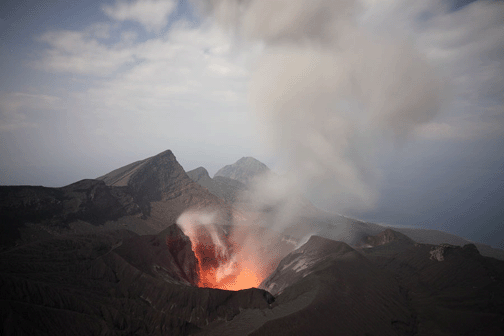
Japan Plans To Restart Reactors Surrounded By Active Volcanoes, Simply Info May 29th, 2015 Japan’s NRA has given the go ahead to restart two reactors at the Sendai nuclear plant. A recent court decision rejected the concerns of the public related to the safety of the plant. The needed local approvals are expected to permit the plant to restart even though public opinion is about two to one against restarts. The first reactor could restart as early as July.
One volcano 64km from the nuclear plant erupted last October. Now one 160km south of the plant is actively erupting. Residents of that island are being evacuated. Even a distant volcano cancause serious problems for a nuclear plant. The ash released in an eruption can take out power lines and cause equipment such as diesel generators to fail. We also found other risks that are unaddressed with the Sendai plant related to any disaster response……..Sendai still lacked an evacuation plan ……..http://www.fukuleaks.org/web/?p=14778
Nuclear brinkmanship as practised by North Korea
any opportunity for a preemptive strike against the North’s nuclear sites has been lost, for fear it would prompt an attack on Seoul and other parts of the South. Now, the threat of destruction raining down on the northern parts of South Korea is too high a price. Consequently, the only option remaining is diplomacy.
 The art of North Korea’s nuclear brinkmanship, Guardian, Robert E McCoy for NK News, part of the North Korea network, 29 May 15 A string of recent missile launches may have been faked, but the country is a nuclear power that requires diplomatic engagement argues Robert E McCoy
North Korea’s press office announced earlier this month that Kim Jong-un had personally supervised the firing of a new submarine-based missile.
The news was soon followed by more footage from state media claiming to evidence another ballistic missile launch, but experts have since voiced doubts over the authenticity of the images.
But these stories are just the latest steps in a routine North Korea has long been playing with the west.
Despite often engaging in deals and agreements with western powers hoping to halt its nuclear proliferation, this “dance” of negotiations has so far failed to halt the DPRK’s military development…………….
Perhaps it’s time for diplomacy to try a different tack?
The routine begins
Troubles with North Korea began in 1989 when it was first suspected of developing a nuclear bomb, despite having signed the nuclear non-proliferation treaty just three years earlier……………
events reveal a pattern, and suggests that North Korea has developed a tried-and-tested formula to outwit western powers for over 25 years.
It has done so using a modus operandi we’ll call “the dance”, which follows these eight steps:
Step 1: North Korea wants or needs something, most often food or petroleum.
Step 2: North Korea generates tension and gains international attention.
Step 3: Countries initially ignore the activity and attribute it to North Korea merely “acting up”.
Step 4: North Korea increases tension through increasingly violent acts or extreme rhetoric.
Step 5: The world finally pays attention and agrees to discuss a resolution.
Step 6: North Korea agrees to stop its nuclear and missile programs in exchange for what it needs or wants: food, petroleum or other aid.
Step 7: Once the aid is received, North Korea soon finds – or invents – a way to justify breaking its commitment.
Step 8: Repeat…………….. Continue reading
USA and Israel tried a Stuxnet type computer worm to muck up North Korea’s nuclear program
 THE US TRIED TO STUXNET NORTH KOREA’S NUCLEAR PROGRAM KIM ZETTER Wired, 05.29.15 A PRECISION DIGITAL weapon reportedly created by the US and Israel to sabotage Iran’s nuclear program had a fraternal twin that was designed to attack North Korea’s nuclear program as well, according to a new report.
The second weapon was crafted at the same time Stuxnet was created and was designed to activate once it encountered Korean-language settings on machines with the right configuration, according to Reuters. But the operation ultimately failed because the attackers were unable to get the weapon onto machines that were running Pyongyang’s nuclear weapons program.
WIRED reported back in 2010 that such an operation against North Korea would be possible in light of the fact that some of the equipment used by the North Koreans to control their centrifuges—the devices used to turn uranium hexafluoride gas into nuclear-bomb-ready fuel—appeared to have come from the same firms that outfitted the Iranian nuclear program………
While the plan worked beautifully in Iran, it ultimately hit a snafu against North Korea where the nuclear program is even more tightly controlled than Iran’s and where few computers—belonging to contractors or anyone else—are online and accessible via the internet.
As WIRED reported in 2010, “someone would have to infiltrate the Hermit Kingdom’s most sensitive sites and introduce the worm into the command systems, a hard bargain to say the least. In other words, don’t go thinking the United States or an ally could magically infect North Korea with Stuxnet. But if more information emerges about the North’s command systems, that might provide fodder for a copycat worm—provided someone could introduce it into Yongbyon.” http://www.wired.com/2015/05/us-tried-stuxnet-north-koreas-nuclear-program/
Nothing happening in much vaunted nuclear deal between USA and India

 Little progress on nuclear deal after ‘breakthrough’ http://www.thehindu.com/news/international/little-progress-on-nuclear-deal-between-india-and-us-after-breakthrough/article7261405.ece NARAYAN LAKSHMAN 29 May 15 More than four months after Prime Minister Narendra Modi and U.S. President Barack Obama announced a “breakthrough understanding” to resolve a long-standing impasse in the bilateral civil nuclear energy agreement, forward movement has apparently ground to a standstill and neither the government nor the private sector here held out hope for a speedy resolution.
Responding to queries from The Hindu this week a State Department spokesperson said that there was “nothing new to announce on the civil nuclear deal at this time.”
Even as early as February, a top State Department official, Assistant Secretary for South and Central Asian Affairs Nisha Biswal, indicated that there may not be much more that the two governments could do to smooth the path for U.S. corporations to supply India with nuclear reactors. Ms. Biswal said that while Washington was “still in the process of taking what [India’s latest] top-line commitments were and trading paper to be able to find the more detailed understandings,” for the U.S. resolution of this “lingering challenge” hinged on the convergence between India’s 2010 Civil Liability for Nuclear Damage Act (CLND) and the 1963 CSC.
She emphasised that with the “breakthrough understanding” reached in January, “now it will be up to the companies to assess for themselves the business case scenarios and make their own decisions based on the commercial aspects – how to move forward.”
“Nothing happening” Continue reading
Mistaken Assumptions about Past and Present US Policies to China
A Critique of US “Grand Strategy toward China”, My Catbird Seat,
If one were to propose a realistic and reasonable ‘US Grand Strategy toward China’ one would have to start by shedding all the false assumptions and bellicose proposals that have been put forth by the CFR and the authors of the Report under review.
May 30, 2015 Seven Mistaken Assumptions, Presumptions and Prescriptions by Dr. James Petras
Introduction
The highly influential Council on Foreign Relations recently published a Special Report entitled, “Revising US Grand Strategy toward China”, (Council on Foreign Relations Press: NY 2015), co-authored by two of its Senior Fellows, Robert Blackwill and Ashley Tellis (‘B and T’), which proposes a re-orientation of US policy toward China.
The Report a policy for buttressing ‘US primacy in Asia’ and countering what they describe as “the dangers that China’s geo-economic and military power pose to US national interests in Asia and globally”. The Report concludes by listing seven recommendations that Washington should follow to re-assert regional primacy.
This essay begins by discussing the basic fallacies underpinning the Report, including outdated and dangerous presumptions about US power and presence in Asia today, and the authors’ incoherent, contradictory and unrealistic prescriptions. Continue reading
-
Archives
- October 2026 (120)
- September 2026 (339)
- August 2026 (330)
- July 2026 (355)
- June 2026 (287)
- May 2026 (306)
- April 2026 (356)
- March 2026 (251)
- February 2026 (267)
- January 2026 (308)
- December 2025 (358)
- November 2025 (359)
-
Categories
- 1
- 1 NUCLEAR ISSUES
- business and costs
- climate change
- culture and arts
- ENERGY
- environment
- health
- history
- indigenous issues
- Legal
- marketing of nuclear
- media
- opposition to nuclear
- PERSONAL STORIES
- politics
- politics international
- Religion and ethics
- safety
- secrets,lies and civil liberties
- spinbuster
- technology
- Uranium
- wastes
- weapons and war
- Women
- 2 WORLD
- ACTION
- AFRICA
- Atrocities
- AUSTRALIA
- Christina's notes
- Christina's themes
- culture and arts
- Events
- Fuk 2022
- Fuk 2023
- Fukushima 2017
- Fukushima 2018
- fukushima 2019
- Fukushima 2020
- Fukushima 2021
- general
- global warming
- Humour (God we need it)
- Nuclear
- RARE EARTHS
- Reference
- resources – print
- Resources -audiovicual
- Weekly Newsletter
- World
- World Nuclear
- YouTube
-
RSS
Entries RSS
Comments RSS

