Further nuclear tests, threats, from North Korea’s Kim Jong-un
 North Korea’s Kim Jong-un orders further nuclear tests, threatens to turn US, South Korea ‘into ashes’ North Korean leader Kim Jong-un has ordered further nuclear tests, state media says, adding to military tensions on the Korean peninsula., ABC News 11 Mar 16
Key points:
- North Korea orders more nuclear tests
- Pyongyang talking up nuclear capabilities as US, South Korea hold joint military exercises
- The North carried out a nuclear test in January
Pyongyang has issued daily warnings and statements talking up its nuclear strike capabilities since US and South Korean forces began joint military exercises on Monday.
In one statement, it threatened to turn Seoul and Washington into “flames and ashes”.
Just days after he was photographed posing in front of what state media described as a miniaturised nuclear warhead, Mr Kim said the weapon required further testing.
Overseeing a ballistic missile launch, Mr Kim ordered “more nuclear explosion tests to estimate the destructive power of the newly produced nuclear warheads”, the North’s official KCNA news agency said.
Experts are divided as to just how far the North may have gone in shrinking warheads to a size capable of fitting on a ballistic missile ……..http://www.abc.net.au/news/2016-03-11/north-korean-leader-orders-further-nuclear-tests/7240344
Cities can thrive nuclear free – Seoul shows the way
Seoul’s success provides testimony that a nuclear free energy supply can be a reality for a densely populated city, through innovative measures in terms of policy making and public land use.
Seoul’s initiative shows that it is possible to mobilise communities within a short period of time and achieve significant results. It demonstrates that even one city can fulfill the vision of energy self-reliance.

 Can Hong Kong become nuclear-free? https://www.hongkongfp.com/2016/03/11/can-hong-kong-become-nuclear-free/ 11 March 2016 10:27 Greenpeace By Frances Yeung, Greenpeace Senior Campaigner
Today marks the 5th anniversary of the Fukushima nuclear disaster and with it, five years of struggle by Japan to improve energy efficiency as it strives to go nuclear-free. As the repercussions of Fukushima were felt around the world, making governments and communities re-evaluate their dependency on nuclear power, here in Hong Kong we’ve spent the past five years stuck in the same nuclear debate. Nuclear-free naysayers continue think going nuclear-free in Hong Kong is meaningless if the Chinese government is pro-nuclear in its energy policy.
To those who have thrown up their hands and turned their backs on safe, sustainable energy solutions, I urge them to look to Seoul and the solution one city government successfully rolled out in opposition to national energy interests. South Korea’s central government actively develops nuclear power, yet the Seoul Metropolitan Government (SMG) has been exploring a sustainable energy solution as a nuclear alternative since the immediate aftermath of the Fukushima nuclear accident.
To better understand South Korea’s reliance on nuclear energy one must only look at the numbers. There are 25 reactors in South Korea supplying 30 per cent of the country’s demand; and the government is planning to build 14 more in the next 20 years, arguing that it is necessary in order to meet growing power consumption. To encourage and promote a nuclear-free environment after the Fukushima disaster, Seoul citizens initiated energy-saving campaigns in their communities. That same year, , a human rights lawyer and an independent candidate, became mayor of Seoul, winning against the ruling party’s campaign. Shortly after taking office, Park and the SMG pushed forward the ‘One Less Nuclear Power Plant’ initiative, opposing the national government’s policy. It is important to note that Seoul accounts for 10 per cent of national nuclear energy consumption.
The first phase of ‘One Less Nuclear Power Plant’ was implemented in 2012 and ran through 2014, to boost renewables production in Seoul and achieve energy conservation of 2 million TOE (tonnes of oil equivalent), an amount equal to the average annual electricity production of one nuclear plant. The goal was achieved six months ahead of schedule. During the three-year implementation of the first phase of the initiative, the overall electricity consumption in South Korea rose by 5%, even as it dropped by 4% in Seoul. The SMG, led by Park, then launched the second phase, to reduce energy consumption by a further 4 million TOE by 2020.
Seoul’s success shows that energy conservation and renewable electricity production can replace nuclear power while meeting energy demand. Regardless of these results, the South Korean government continues to build new reactors to meet the “continued increase in national electricity demand”.
Seoul’s anti-nuclear policy has created interest both at home and abroad. The heads of local governments from Seoul, Gyeonggi, and Jeju released a joint statement in November to reaffirm their commitment to stepping up the development of renewable energy. At the same time, Taiwan’s newly-elected president, Tsai Ing-wen, announced last year that the nation’s Democratic Progressive Party would initiate a similar plan in the cities and counties it governs.
Seoul’s initiative shows that it is possible to mobilise communities within a short period of time and achieve significant results. It demonstrates that even one city can fulfill the vision of energy self-reliance. The SMG launched 23 measures and 71 programmes over three years including offering vacant public space to businesses and community groups at low rents to build solar power stations; introducing the Energy Self-reliant Community movement to provide funds to residents to promote energy efficiency and installing small renewable energy facilities; and cooperating with enterprises to assist property owners to improve energy efficiency in buildings, by means of LED lights, insulated windows, and other energy-saving equipment, as well as low-interest government loans.
Seoul’s success provides testimony that a nuclear free energy supply can be a reality for a densely populated city, through innovative measures in terms of policy making and public land use. For instance, the SMG installed steel structures in water treatment plants to support solar panels on top of water pools. It also implemented the Eco-Mileage programme in which citizens who save energy can receive mileage points for buying eco-friendly products, cinema tickets, and recharging transportation cards. So far, 42% of the city’s households (1.48 million) have taken part in the programme.
As we mourn the Fukushima disaster we also note that the Hong Kong government has shirked its responsibility to create a proactive renewable energy strategy and chosen instead to highlight land issues and cost effectiveness. We have an immediate opportunity, however, since the electricity supply contract with the Daya Bay nuclear plant ends in 2034. The plant will have been operating for over 40 years and will reach the end of the average lifespan of a nuclear plant by then. The plant should be closed for the sake of safety.
We can also make great strides towards nuclear free safety by carrying out the Hong Kong government’s plan to replace coal with natural gas. Along with reducing electricity use by 20% in the coming 20 years and boosting renewable energy use to 10%, Greenpeace calculates that a halt in the use of nuclear energy is achievable.
When he met with Greenpeace, Seoul mayor Park Won-soon said firmly that nuclear power is far from safe and is expensive, especially in regard to the cost of nuclear waste disposal. The underlying stance of ‘One Less Nuclear Power Plant’ might differ from the energy policy of the South Korean government, yet he suggested that it is the responsibility of the city government to reduce the use of nuclear power to safeguard the wellbeing of its citizens. Hong Kong enjoys no lesser degree of autonomy than Seoul in energy policy making. As long as the government is willing to step outside of its comfort zone and take action on behalf of its communities, a nuclear free Hong Kong will immediately become a real and vivid possibility.
Japan’s anti nuclear movement still in there, but it’s not easy
Down but not out: Japan’s anti-nuclear movement fights to regain momentum, Japan Times, BY MIZUHO AOKI STAFF WRITER , 11 Mar 16 Five years after the horrific nuclear meltdowns at the Fukushima No. 1 power plant stunned the nation as a result of the March 2011 earthquake and tsunami, Japan’s once highly motivated anti-nuclear movement is struggling to maintain momentum.
The disaster prompted tens of thousands of people who had never participated in demonstrations to take to the streets demanding that the government shut down the nation’s nuclear reactors over safety fears.
That public anger and energy, however, seems to have lost steam over the past few years, especially after the pro-nuclear Liberal Democratic Party returned to power in December 2012.
The anti-nuclear rallies held every Friday in front of the Prime Minister’s Office staring in March 2012 once were able to draw some 200,000 protesters, according to the organizer, Metropolitan Coalition Against Nukes. The crowds were comprised of people of all stripes and ages, including students and young mothers with little children.
But these days, to see the face of a newcomer is a rarity, with most people having simply stopped coming. In “Friday rallies” held in February, there were less than 1,000 people each time, according to data provided by the organizers.
On Friday, as the nation marked the fifth anniversary of the Great East Japan Earthquake and tsunami and subsequent nuclear disaster, anti-nuclear civic groups held rallies nationwide, hoping to reignite public interest and momentum to bring about a tangible change in energy policy.
But at a gathering in Tokyo on Friday to remember Fukushima, which was organized by the anti-nuclear, non-governmental organization Friends of the Earth Japan (FoE), some of the more than 300 participants voiced their concerns over the fading interest in nuclear energy policy.
“I have a sense of crisis about the current state of things,” said Chie Otake, 50. “I guess people are tired of speaking up, as nobody (in the government) seems to listen to them,” she added.
Eisuke Naramoto, 74, who lives in Kanagawa Prefecture, agreed, saying he understood that it is tiring to participate in anti-nuclear rallies when no visible progress can be seen.
“If you look at media polls, a majority of people are still against restarting Japan’s idled nuclear reactors,” he said. “But such opinions didn’t seem to be reflected in the elections………
I’m not pessimistic about the situation,” Mitsuta of FoE said. “I don’t think the movement is dead.
“We should never forget that people are still suffering from the disaster.” http://www.japantimes.co.jp/news/2016/03/11/national/not-japans-anti-nuclear-movement-fights-regain-momentum/#.VuMhtn197Gh
5 years on, and Fukushima nuclear station still very dangerous

 Crippled Fukushima Reactors Are Still a Danger, 5 Years after the Accident Japan’s citizens, and scientists worldwide, do not have answers to basic health and environment questions, Scientific American By Madhusree Mukerjee on March 8, 2016 “…….. major questions still loom today, in part because the damaged reactors are too dangerous to enter, and in part because the plant’s operator, the Tokyo Electric Power Company (Tepco), is reluctant to share information.
In the midst of this maelstrom, Japan in February started up a third reactor among those that had been shut down. But even as the government seeks to leave the disaster behind, Fukushima remains a wound that will not heal—for former residents, the local landscape and for the Japanese psyche. Two-thirds of the populace dreads another accident enough to oppose the restarts. More than 1,100 square kilometers of villages, mountains and forests remain uninhabitable, and future generations will still be cleaning up the plant site, according to Japan’s Ministry of Economy, Trade and Industry (METI). Echoing citizens’ groups, some scientists are complaining that important questions about the disaster’s impact are not being addressed. Authorities, they suspect, are subtly discouraging certain kinds of scientific research, possibly because they fear findings that could further alarm the public. In some ways they want this to go away and say things are back to normal, observes marine radiochemist Ken Buesseler of Woods Hole Oceanographic Institute in Woods Hole, Mass.
Exacerbating widespread suspicions of a cover-up, this February Tepco admitted it had waited for two months after the accident before announcing the meltdowns—which possibly delayed evacuations and endangered lives. The uranium fuel in three of the six reactors eventually melted, and explosions blew holes in the roofs of three reactor buildings, releasing radioactive iodine, cesium and other fission products over land and sea. Emergency managers on site, desperately trying to cool the molten cores, poured water into the damaged reactor buildings using fire-hoses. As a result, highly contaminated water flowed directly into the Pacific Ocean.
Since then, Tepco has substantially cleaned up the site. It has capped shredded roofs, removed spent fuel from a damaged reactor and constructed ice walls to stanch the flow of groundwater that was washing contaminants from the site into the ocean. Because the molten fuel still generates heat by radioactive decay, however, Tepco has to keep pumping water through the reactor buildings and collecting as much as possible—some 400 cubic meters a day, stored in on-site tanks. Around 8,000 workers are now assisting in the cleanup.
Not all is going well, however. Engineers still have to locate the molten fuel, which seems to have melted through steel vessels. It remains so radioactive that no humans can enter the reactor buildings. Tepco has “no idea where and how much fuel debris is in the reactor now,” says nuclear engineer Tadahiro Katsuta of Meiji University. Last April, Tepco sent a robot into one of the buildings to photograph the damage, with mixed results, and it also intends to use robots to find and remove the globs of molten uranium, steel and other substances by 2021. According to METI, fully cleaning the site will require half a century, when most of the dangerous radionuclides will have decayed. Where the lethal debris will end up is unclear, however, because Japan has no permanent repository for nuclear waste.
The 1,000 or so tanks of contaminated water, which leak from time to time, pose another headache. Tepco is removing the most abundant contaminant, cesium, from the cooling water before it is sent to the storage tanks, but the water retains high concentrations of radioactive strontium and tritium. This February, the company reported a spike in strontium levels at the plant site—likely indicating a tank leak. So the company is painstakingly cleaning the stored water of all radionuclides except tritium, which is difficult to separate out. Because tritium concentrations remain many times higher than the drinking water level prescribed by the World Health Organization, however, fishery cooperatives are not allowing its release into the ocean. (Tepco did not respond to Scientific American’s questions about the tank contents, or anything else.)
Solid waste is piling up as well. Cleaning streets, houses and playgrounds within the evacuated zone, which stretches some 50 kilometers northwest of the plant site, has generated millions of bags of contaminated topsoil and debris, which also await a final resting place. Almost 800 bags got carried off by typhoon Etau last year, however, and were deposited miles away, says Hajime Matsukubo of the Citizen’s Nuclear Information Center in Tokyo. Hundreds were never found……….
unanswered questions abound. “You want to know why some fish have higher contamination than others, how quickly they will recover, what’s coming down the rivers, how much is on the seafloor, how quickly that is buried—those are the type of oceanography and radioecology questions that are really not being well addressed,” Buesseler says. One reason is the scarcity of funds for such research, argues Mousseau. The Japanese government seems to be cutting off funds for monitoring radionuclides in water alongside Fukushima, Buesseler says. Shibata finds such concerns “biased,” pointing out that several ministries offer funds for environmental research. But another Japanese scientist, who asked not to be named, claimed that whereas grants are readily available for researchers whose projects are unlikely to discover significant impacts from the disaster, they are exceedingly scarce for others.
Other muddiness remains. Several Japanese researchers who aided Mousseau’s team asked not to be credited in its published papers, fearing adverse impacts on their careers. Buesseler reports a similar experience. “There’s this kind of self-censorship going on,” Mousseau says.
With more than 400 nuclear power plants operating around the world, many of them on coastlines and in countries with far weaker safety standards than Japan’s, another such calamity is not inconceivable. Knowing more about its impacts could help save lives and livelihoods. Unfortunately, Buesseler notes, “We’re missing opportunities to learn from this accident.” http://www.scientificamerican.com/article/crippled-fukushima-reactors-are-still-a-danger-5-years-after-the-accident1/
Widespread effects of Fukushima nuclear radiation: some facts and figures
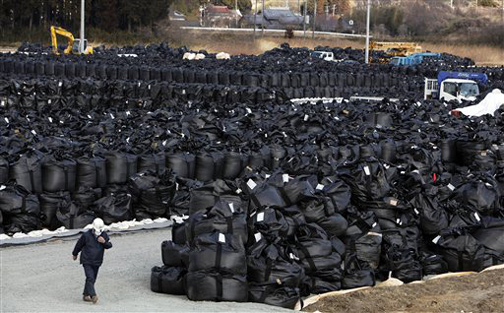
Fukushima nuclear disaster left 10.7 million 1-ton container bags with radioactive debris http://www.thestandard.com.hk/breaking-news.php?id=72359 Five years after a powerful earthquake and tsunami sent the Fukushima Dai-ichi nuclear power plant in Japan into multiple meltdowns, cleaning up the mess both onsite and in surrounding towns remains a work in progress. Here’s a look, by the numbers, at the widespread effects of radiation from the March 11, 2011, disaster:
164,865: Fukushima residents who fled their homes after the disaster.
97,320: Number who still haven’t returned.
49: Municipalities in Fukushima that have completed decontamination work.
45: Number that have not.
30: Percent of electricity generated by nuclear power before the disaster.
1.7: Percent of electricity generated by nuclear power after the disaster.
3: Reactors currently online, out of 43 now workable.
54: Reactors with safety permits before the disaster.
53: Percent of the 1,017 Japanese in a March 5-6 Mainichi Shimbun newspaper survey who opposed restarting nuclear power plants.
30: Percent who supported restarts. The remaining 17 percent were undecided.
760,000: Metric tons of contaminated water currently stored at the Fukushima nuclear plant.
1,000: Tanks at the plant storing radioactive water after treatment.
10.7 million: Number of 1-ton container bags containing radioactive debris and other waste collected in decontamination outside the plant.
7,000: Workers decommissioning the Fukushima plant.
26,000: Laborers on decontamination work offsite.
200: Becquerels of radioactive cesium per cubic meter (264 gallons) in seawater immediately off the plant in 2015.
50 million: Becquerels of cesium per cubic meter in the same water in 2011.
7,400: Maximum number of becquerels of cesium per cubic meter allowed in drinking water by the U.S. Environmental Protection Agency.
Sources: Fukushima prefectural government, Japan Ministry of Internal Affairs, the Tokyo Electric Power Co., the Nuclear Regulation Authority, the Federation of Electric Power Companies and the Woods Hole Oceanographic Institution.—AP
Fukushima radiation beats the robots – they “died” in the search for nuclear fuel
Inside the Fukushima nuclear power plant, five years after the disaster was triggered by an earthquake and tsunami, news.com.au, MARCH 10, 2016 [EXCELLENT PHOTOS] “………Today, the radiation at the Fukushima plant is still so powerful it is impossible to extract and remove deadly melted fuel rods.
And authorities still don’t how to dispose of highly radioactive water stored in tanks around the site.
Humans shouldn’t even be near these reactors. They are the most dangerous part of the plant.
Tepco has developed robots that have been sent in to search for radioactive fuel. But so far, none have been successful. They have all “died”.

“It is extremely difficult to access the inside of the nuclear plant,” Naohiro Masuda, Tepco’s head of decommissioning said in an interview.
“The biggest obstacle is the radiation.”
Mr Masada said the robots were built to swim under water and search for the melted fuel rods.
But as soon as they get close to the reactors, the radiation destroys their wiring and renders them useless, causing long delays, Mr Masuda said.
Each robot has to be custom-built for each building.
“It takes two years to develop a single-function robot,” Mr Masuda said.
Workers on the site are regularly working outside in the exclusion zone to remove contaminated debris, but they can’t keep up with the mounds of mess they’re cleaning up.
They are routinely being scanned for radiation exposure, as more reports emerge of locals being at greater risk of cancer and thyroid disorders……….
More than 8,000 workers are at the plant at any one time.
They are constantly removing debris, building storage tanks, laying piping and preparing to dismantle parts of the plant.
Much of the work involves pumping water into the wrecked and highly radiated reactors to cool them down.
The radiated water is then pumped out of the plant and stored in tanks around the site. Tepco has completed around 10 per cent of the work to clear the site up — the decommissioning process could take 30 to 40 years.
A subterranean “ice wall” is also under construction. Dubbed the world’s biggest ice wall, it will stop groundwater from becoming contaminated, using coolants to create a 30-metre deep wall of ice……http://www.news.com.au/technology/environment/inside-the-fukushima-nuclear-power-plant-five-years-after-the-disaster-was-triggered-by-an-earthquake-and-tsunami/news-story/f80b140e5505709a55ab6ee6cc5a9228
LOCALS FEAR MISTAKES NOT LEARNED FROM FUKUSHIMA NUCLEAR DISASTER
Inside the Fukushima nuclear power plant, five years after the disaster was triggered by an earthquake and tsunami, news.c om.au, MARCH 10, 2016 [EXCELLENT PHOTOS]
“……..as officials vow to prevent a repeat the disaster, some critics say Tokyo’s push to restart switched-off nuclear reactors is proof that the lessons of the tragedy have not been learned.
And many question whether Japan has done enough to tackle some of the key causes of the accident that unfolded on March 11, 2011 — an ill-fated belief in the nation’s disaster management and clubby ties between politicians, bureaucrats and the nuclear industry.

“These kind of relationships can be seen in other countries but Japan is a standout,” said Muneyuki Shindo, an honorary politics professor at Chiba University.
“Ties between the bureaucracy and industry are still very strong — it’s a legacy of government-led development when the country was underdeveloped” after World War II.
Prime Minister Shinzo Abe has made bringing nuclear power back online a priority for the resource-poor country — a move backed by the business community but strongly opposed by a wary public.
Among those warning over the restarts is Katsunobu Sakurai, the mayor of Minamisoma, a town that lies in the shadow of the crippled plant. He named one of the world’s 100 most influential people in 2011 by TIME magazine.
Mr Sakurai drew global attention with a YouTube video in which he pleaded for help — and slammed Tokyo’s response — as radiation wafted toward his community………… https://www.youtube.com/watch?v=R6URqs9kb20 http://www.news.com.au/technology/environment/inside-the-fukushima-nuclear-power-plant-five-years-after-the-disaster-was-triggered-by-an-earthquake-and-tsunami/news-story/f80b140e5505709a55ab6ee6cc5a9228
WAGYU BEEF FARMERS’ ‘NUCLEAR REBELLION’
Inside the Fukushima nuclear power plant, five years after the disaster was triggered by an earthquake and tsunami, news.c om.au, MARCH 10, 2016 [EXCELLENT PHOTOS] “…….Protesters have staged rallies across the world against the restarting of the reactors.
Since the 2011 meltdowns ended their future as prized black “wagyu” beef, a rancher near the Fukushima nuclear power plant has given his cattle a new mission: They’ve become protesters.
Defying both government evacuation and slaughter orders, 62-year-old Masami Yoshizawa returned to his ranch 14 kilometres from the plant to keep his cattle alive as living proof of the disaster.
He and his cattle are no doubt a nuisance for the government as Japan gears up to showcase Fukushima’s recovery ahead of the 2020 Tokyo Olympics.
“An effort to eliminate a negative reputation is nothing but a cover-up,” he said. “This is a farm that chronicles and tells the story of Fukushima’s radiation contamination disaster. We’ll stay here at the Ranch of Hope, and keep sending our message.”…………….
“I said I was not going to let any more cows die on my ranch,” said Yoshizawa.
His mostly lone resistance hasn’t been easy. Authorities tried to block his feed transport, and kept trying to persuade him to kill his cows.
The location of his ranch, on the border between two towns — Namie and neighbouring Minamisoma — may have worked in his favour. Both towns have looked the other way and virtually given up. A prefabricated hut on a driveway to the Ranch of Hope — which Yoshizawa renamed after the accident with the hope of establishing a nuclear-free society — serves as a tiny office for what he calls his “nuclear rebellion.” Skulls of cattle that died early in the crisis decorate the exterior. His cows keep him company, mooing and grazing.
Radiation levels at the ranch measure about 10 times the safe benchmark………http://www.news.com.au/technology/environment/inside-the-fukushima-nuclear-power-plant-five-years-after-the-disaster-was-triggered-by-an-earthquake-and-tsunami/news-story/f80b140e5505709a55ab6ee6cc5a9228
The Takahama injunction – a damaging blow to Japan’s nuclear industry hopes
The Otsu ruling also calls on the national government to take the lead in formulating evacuation plans for residents within 30 km of a nuclear plant, and not just leave such planning to local governments.
That raises the possibility of further lawsuits seeking injunctions against other reactors on the grounds that the central government has not taken the lead in formulating evacuation plans. Nationwide, there are 135 cities, towns, and villages in 21 prefectures within 30 km of nuclear power plants.

 Takahama injunction delivers body blow to Japan’s nuclear power industry http://www.japantimes.co.jp/news/2016/03/10/national/takahama-injunction-delivers-body-blow-to-japans-nuclear-power-industry/#.VuHaZ3197Gh
BY ERIC JOHNSTON OSAKA – Wednesday’s decision by an Otsu District Court judge to slap a provisional injunction on the restart of the No. 3 and 4 reactors at Kansai Electric Power Co.’s Takahama nuclear plant has sent a shock through the nuclear power industry.
Moreover, pro-nuclear politicians fear that the nation’s push to restart as many reactors as possible as quickly as possible has come to a halt.
On the eve of the fifth anniversary of the 2011 disaster, which included the meltdown of three reactors at the Fukushima No. 1 plant and led to the nation suspending its use of nuclear power for an extended period, only two reactors, Kyushu Electric Power Co.’s Sendai No. 1 and 2 reactors, were generating electricity.
The Takahama No. 3 reactor was restarted in January. Kepco officials said it would be shut down in accordance with the court order by Thursday evening. Continue reading
Fukushima’s forestry industry cannot be revived, due to radiation
FIVE YEARS AFTER: Radioactive forests prevent logging revival in Fukushima http://ajw.asahi.com/article/0311disaster/recovery/AJ201603090060March 09, 2016 By YOSUKE FUKUDOME/ Staff Writer
TAMURA, Fukushima Prefecture–The once-thriving industry of log production for shiitake mushroom farming remains virtually nonexistent in Fukushima Prefecture after the 2011 nuclear disaster contaminated extensive mountain areas.
A year before the Great East Japan Earthquake and tsunami triggered the triple meltdown at the Fukushima No. 1 nuclear power plant on March 11, 2011, the prefecture produced logs for cultivating shiitake totaling 47,800 cubic meters, the third largest volume among Japanese prefectures.
But radioactive fallout from the nuclear accident meant that shiitake log production in the prefecture dwindled to about 1 percent of the pre-disaster level in 2014, which is having a serious impact on local industry.
In the Miyakoji district of Tamura, located about 20 kilometers inland from the crippled nuclear power plant, the lumber industry shipped around 200,000 logs annually before the 2011 disaster.
“More than 80 percent of this area’s land is covered by forests, and we cannot think of any other business opportunities that don’t involve forestry,” said Shoichi Yoshida, a 60-year-old executive of the Fukushima Central Forestry Association.
While the evacuation order covering an eastern strip of the district was lifted in 2014, radioactive levels of trees in the district remain above target levels, and the resumption of shipments is still nowhere in sight.
However, local forestry workers still routinely cut down oak and other trees, which are more than 20 years old, to maintain the mountain area’s capability of producing quality logs.
Court injunction stops Takahama nuclear reactors
Court issues surprise injunction to halt http://www.japantimes.co.jp/news/2016/03/09/national/court-issues-surprise-injunction-halt-takahama-nuclear-reactors/ BY ERIC JOHNSTON
STAFF WRITER MAR 9, 2016 OTSU, SHIGA PREF. – In a surprise ruling that is likely to delay efforts to restart nuclear power generation nationwide, the Otsu District Court on Wednesday issued a provisional injunction ordering Kansai Electric Power Co. to shut down its No. 3 and No. 4 reactors at its Takahama facility in Fukui Prefecture.
While Kepco is expected to appeal the ruling, company officials said at a news conference that was hastily called after the decision that they would begin operations to shut down the No. 3 reactor on Thursday morning, and expected to complete the process by the evening.
The No. 3 reactor was restarted in January, and the No. 4, which had been scheduled to restart last month, was delayed due to technical problems.
“There are doubts remaining about both the tsunami response and the evacuation plan,” the ruling said.
The Otsu ruling comes just two days before the fifth anniversary of the Great East Japan Earthquake and the resulting tsunami and triple meltdown at Tokyo Electric Power Co.’s Fukushima No. 1 plant.
The jubilant plaintiffs expressed surprise and relief following the ruling, which emphasized technical problems regarding the two reactors, including issues concerning an outside power supply source in the event of an emergency. The ruling also raised concerns over the emergency protocol.
“This is a huge victory for the safety of children, people with disabilities, and the society and economy of not only the Fukui-Kansai region of Japan but the entire country,” said Aileen Mioko Smith of Kyoto-based Green Action, an anti-nuclear group. Smith was not a plaintiff in the case.
The lawsuit that sought the injunction was filed by Shiga residents who are fearful that an accident at the Takahama plant, which lies less than 30 kilometers from the northern part of Shiga Prefecture, would impact Lake Biwa, the nation’s largest freshwater body and the source of water for about 14 million people in the Kansai region, including Kyoto and Osaka.
The judgment — the first of its kind affecting reactors that were fired up under strengthened safety regulations following the March 2011 disaster — is a blow to the government’s renewed push for atomic power. The ruling could also cast doubt on the stringency of the new safety regulations.
Chief Cabinet Secretary Yoshihide Suga, however, told reporters following the ruling the government would not change its basic stance of promoting restarts.
In a separate case concerning the two reactors, the Fukui District Court issued an injunction last April banning Kansai Electric from restarting the units, citing safety concerns.
But the same court later lifted the injunction in December, allowing the utility to resume operations at both reactors. Plaintiffs appealed the court decision to the Kanazawa branch of the Nagoya High Court, where the case is pending.
Under the revamped safety regulations, which took effect in 2013, utilities are for the first time obliged to put in place specific countermeasures in the event of severe accidents such as reactor core meltdowns and huge tsunami — which was the initial cause of the crisis at the Fukushima nuclear plant.
India’s Prime Minister Modi in the grip of the global nuclear salesmen
 PM’s recent visits to France, Russia and Japan India Infoline News Service | Mumbai | March 10, 2016
The Prime Minister Narendra Modi’s recent visits to France, Russia and Japan were aimed to bring in socio-economic and scientific development particularly in the field of atomic energy
Malfunction at Taiwan nuclear power station. Anti nuclear demonstration for March 12
 Malfunction triggers nuclear plant closure By John Liu ,The China Post March 11, 2016, TAIPEI, Taiwan — A safety mechanism triggered by a high level of feed water shut down one of the two reactors in the Jinshan Nuclear Power Plant — or the First Nuclear Power Plant — on Thursday, the Taiwan Power Company (Taipower, 台電) said. The exact cause of the incident is still under investigation, Taipower said, while stressing that there had been no radioactive leak.
At 1:10 p.m., the safety mechanism reportedly caused a steam turbine freeze, and then the boiling water reactor’s automatic shutdown……..
Anti-Nuclear Demonstration to Take Place
Many in Taiwan still oppose the use of nuclear power. An anti-nuclear march has been staged for this coming weekend on March 12. It will mark the sixth large-scale demonstration of such a kind since the 2011 Fukushima Daiichi nuclear disaster.
Residents along Taiwan’s north coast, where the First, Second and Fourth Nuclear Power Plants are located, are inviting members of the public to their neighborhoods, not only to understand the natural and human landscapes there, but also to better understand why nuclear abolition would be good for the area.
Due to the facilities’ older parts and components, there have been more malfunctions in the First and Second Nuclear Power Plants, the Green Citizens’ Action Alliance (綠色公民行動聯盟) said, adding that the power plants ought to be retired without delay.
Lin Chuan-neng (林全能), head of the Economics Ministry’s Bureau of Energy (能源局), said that whether the Fourth Nuclear Power Plant will be put into service hinges on the state of power use in the next three years. It may be decided by a public vote, Lin said………http://www.chinapost.com.tw/taiwan/national/national-news/2016/03/11/460395/Malfunction-triggers.htm
No real fix in sight for Fukushima’s wrecked nuclear power station
A Long Road Ahead For Fukushima’s Crippled Nuclear Plant [Video] http://www.ibtimes.com/long-road-ahead-fukushimas-crippled-nuclear-plant-video-2334077 BY REUTERS ON 03/10/16 Thousands of workers at Japan’s Fukushima Daiichi are still working to contain the damage, five years after the country’s worst nuclear disaster. Natasha Howitt reports. Japan’s worst nuclear disaster took place on March 11, 2011: A 10-meter high tsunami, triggered by a magnitude 9 earthquake, crashed into the Fukushima Daiichi nuclear power plant, causing multiple meltdowns.
Now, five years on, efforts to contain the damage are still ongoing.Thousands of workers are involved. plant operator Tepco says they still don’t know how bad the situation is at three of the fourcrippled reactors. Akira Ono, the chief of the Fukushima Daiichi nuclear plant, said, “It is kind of difficult to say how much we have achieved in terms of percentage, but thinking of the project in mountain climbing terms, If the peak is the 10th station, then, we have probably just passed the first station. ”
Water is needed to keep the clean up going, but the tanks storing the contaminated water are almost full.
There’s a danger that surrounding groundwater may become radioactive too.
Japan is seeking international advice, but decommissioning the reactors is still expected to take 30 to 40 years, and cost tens of billions of dollars.
Japn now has only one nuclear station in operation
Japan Is Down To One Nuclear Power Plant, Gizmodo, BRYAN LUFKIN 10 Mar 16 Japan has closed one of its two remaining operational nuclear plants. The shutdown comes just days before the fifth anniversary of a catastrophic earthquake that triggered a tsunami and the biggest nuclear meltdown since Chernobyl.
On Wednesday, a Japanese court ordered the shutdown of Takahaka Nuclear Plant in western Japan, citing poor safety measures. This same plant was restarted back in January after it was shut down post-Fukushima, along with the rest of Japan’s nuclear reactors. The swift re-shutdown hints at just how divisive and worrying nuclear energy has become in Japan.
The court said Takahaka’s reactors never should have been rebooted in the first place, citing “points of concern in accident prevention, emergency response plans and the formulation of earthquake models”. The reboot was problematic: a mere week afterwards, radioactive water started leaking from a pipe at the facility, while one reactor suddenly shut down with no explanation, the New York Times reports.
Of the 43 nuclear reactors in Japan, only two at that one remaining plant are still operational: they’re at Kyushu Electric Power’s Sendai plant, on the southern tip of the archipelago. It was restarted back in August………
t among widespread public protest, Wednesday’s court ruling might be a welcome development among citizens who fear another megaquake and meltdown. Nuclear is a clean and powerful energy source, sure — but when it comes to power plants, Mother Nature can make this manmade fuel a very dangerous thing. http://www.gizmodo.com.au/2016/03/japan-is-down-to-one-nuclear-power-plant/
1 This Month





PLEASE OPPOSE HR 8255 AND S.3639 – bills would accelerate satellite deployment, with no environmental review or safeguards – https://ncstd5li.quorum.us/campaign/169331/
To see nuclear-related stories in greater depth and intensity – go to https://nuclearinformation.wordpress.com
-
Archives
- October 2026 (74)
- September 2026 (339)
- August 2026 (330)
- July 2026 (355)
- June 2026 (287)
- May 2026 (306)
- April 2026 (356)
- March 2026 (251)
- February 2026 (267)
- January 2026 (308)
- December 2025 (358)
- November 2025 (359)
-
Categories
- 1
- 1 NUCLEAR ISSUES
- business and costs
- climate change
- culture and arts
- ENERGY
- environment
- health
- history
- indigenous issues
- Legal
- marketing of nuclear
- media
- opposition to nuclear
- PERSONAL STORIES
- politics
- politics international
- Religion and ethics
- safety
- secrets,lies and civil liberties
- spinbuster
- technology
- Uranium
- wastes
- weapons and war
- Women
- 2 WORLD
- ACTION
- AFRICA
- Atrocities
- AUSTRALIA
- Christina's notes
- Christina's themes
- culture and arts
- Events
- Fuk 2022
- Fuk 2023
- Fukushima 2017
- Fukushima 2018
- fukushima 2019
- Fukushima 2020
- Fukushima 2021
- general
- global warming
- Humour (God we need it)
- Nuclear
- RARE EARTHS
- Reference
- resources – print
- Resources -audiovicual
- Weekly Newsletter
- World
- World Nuclear
- YouTube
-
RSS
Entries RSS
Comments RSS

