Fukushima farmers grow flowers using polyester ‘soil’
I don’t think that what may be good for flowers is also good for vegetables which are to go into the stomach of people…
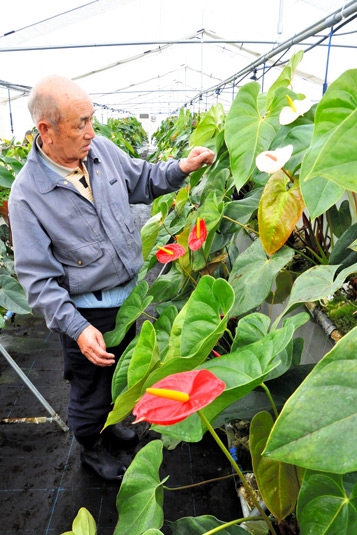
Farmer Yukichi Takahashi, 76, checks anthurium flowers grown in “soil” made up of polyester fibers in Kawamata, Fukushima Prefecture.
KAWAMATA, Fukushima Prefecture–Farmers here have started growing flowers using polyester “soil” in the hope that the cultivation method will dispel concerns among consumers about radioactive contamination from the nuclear disaster.
The farmers are being helped by a team from Kinki University’s Faculty of Agriculture in Higashi-Osaka, Osaka Prefecture, and have started cultivating anthurium ornamental plants utilizing the soil, which is made up of filamentous polyester fabrics.
“This cultivation method allows us to grow plants without concern over the negative impact of the nuclear accident,” said Yukichi Takahashi, a 76-year-old farmer who is a key member of the project. “My dream is that our flowers will be used in bouquets to be presented to athletes on the podium during the 2020 Tokyo Olympics.”
In a test run, 2,000 anthurium plants, known for their colorful, heart-shaped flowers, were grown in a 30-meter-long greenhouse in the Ojima district of Kawamata, located about 50 kilometers northwest of the crippled Fukushima No. 1 nuclear power plant.
Local farmers who participate in the project will set up an agricultural corporation later this year with the aim of eventually starting full-fledged farming and shipment.
The project began in spring 2014 after the university researchers learned about the plight of local farmers when they visited to measure radiation levels in the town, which is located on a high plateau surrounded by mountains.
“By using polyester fabrics as a cultivation medium instead of ground soil, this new method will help protect Fukushima farmers from harmful rumors that may stem from consumers’ concerns over soil contamination,” said project leader Takahiro Hayashi, a professor of horticulture at the university, which is known for its advanced aquafarming and agricultural programs.
Kawamata once prospered through livestock and tobacco farming, but the nuclear disaster, triggered by the Great East Japan Earthquake and tsunami on March 11, 2011, dealt a heavy blow to the area’s agricultural industry by spreading a large amount of radioactive fallout.
A southeastern strip of the town is still designated as a “zone being prepared for the lifting of the evacuation order,” and local residents remain evacuated from the district in temporary housing and elsewhere.
While radiation levels in the town’s agricultural produce have passed safety tests, consumers’ lingering concerns over possible contamination have undercut market competitiveness.
http://ajw.asahi.com/article/0311disaster/recovery/AJ201603200015
Honouring the Life and Work of Chiyo Nohara

Chiyo Nohara, who died aged 60, was member of the research team that published the first scientific evidence of harm to a living organism from radioactive contamination due to the accident at the Fukushima Daiichi Nuclear Power Plant.
Courage and heroism
In August 2012, the journal Nature published evidence that artificial radionuclides from the Fukushima Daiichi Nuclear Power Plant caused physiological and genetic damage to the pale grass blue butterfly Zizeeria mara [1]. Among the team at University of the Ryukyus Okinawa undertaking the research was a mature student in her first year, Chiyo Nohara. Chiyo died on 28 October 2015 at the age of 60 from a heart attack. Chiyo was a scientist who set out to protect her fellow human beings despite great pressure from the authorities and at great risk to her own life.
Chiyo once said to a friend [2] “No matter how much you researched and knew, it would be pointless if you die before letting the world know about what you learned”. Fortunately, Chiyo’s research was published, and provided the first scientific evidence of harm to a living organism from the accident at Fukushima. I will not describe the research itself, which is available in print [1]. (See also [3] Fukushima Mutant Butterflies Confirm Harm from Low-Dose Radiation, SiS 56.) Instead, I would like to concentrate on her response to the accident at Fukushima, and pay tribute to the intelligence, courage, and energy of Nohara and her team-mates in initiating the research, in undertaking the fieldwork, conducting laboratory experiments, and later defending their work against critics.
Chiyo was born 8 May 1955 in Ube city of Yamaguchi prefecture. She studied economics at Okayama University and Aichi University; taught accounting at university level, publishing numerous papers and was involved in public auditing at a local and national government level. But in 2010, at the age of 55, partly because her own daughter suffered allergies, Chiyo became interested in environmental health. She resigned from her university post and enrolled in the Biology graduate school programme of the Faculty of Science at University of the Ryukyus.
Accident at Fukushima Daiichi nuclear power plant
When the accident at Fukushima occurred in March 2011, Chiyo was only in her first year of study. Nevertheless, she persuaded her team that research in the Fukushima area was of crucial importance, and that it had to be started immediately. She had already been active in donating money and supplies to the victims of the tsunami and earthquake, but she said [4]:“I want to go to Fukushima. I want to see the stricken areas with my own eyes”. She said she “wanted to do anything” to help the people affected by the accident.
The graduate team, led by Associate Professor Joji Otaki, specialised in molecular physiology, and had been researching the mechanism of the pale grass blue butterfly’s (Zizeeria maha) peculiar colour patterns which are influenced by environmental conditions such as temperature. He saw that this species of butterfly could be used as an environmental indicator.
Conducting research in the contaminated territories
After much heart-searching three members of the graduate school decided to go to the contaminated territories of Fukushima. They all signed a written disclaimer [4]: “I am fully aware of the dangers of my activities in relatively high radiation level areas”. But several days before their scheduled trip to Fukushima, they were summoned to the Dean’s office. Chiyo and her team were subjected to some aggressive and unpleasant questioning from the Dean, the sub-Dean, and another member of staff. They were challenged with regard to their preparation and planning, and about the reaction they would elicit from people in Fukushima prefecture “when they see a team of the University of the Ryukyus pursuing butterflies with butterfly nets, while they are desperately searching for missing relatives [from the tsunami].”
Eventually, permission was given, subject to the correct radiological protection measures and strict crisis management planning in the event of another explosion at the nuclear power station. Interestingly the sub-Dean paid his respect to the team later saying that many research teams will not take risks for fear of losing funds but “this research team doesn’t care about such risks. They just want to know what is happening there. I support their work, but they make me nervous”.
The team left on 13 May 2011 for a six day field trip. They carried a Geiger counter to record radiation levels and gave themselves a strict 20 minute time limit at any one site. If no butterflies were found they moved on. They visited 15 sites in 4 prefectures (Tokyo, Ibaraki, Fukushima, Miyagi), and flew back to Okinawa on the 18 May with 144 butterflies.
Chiyo worries about her health
The work was continued over the next months in the university laboratories in Okinawa, and in September the team visited Fukushima prefecture once again and collected more specimens. Part of the laboratory research involved feeding the butterflies on oxalis corniculata contaminated by radionuclides from the Fukushima area. It was Chiyo and her husband who made the trips to the contaminated territories to collect contaminated oxalis – 15 trips in the space of 18 months. Inevitably Chiyo worried about her health. A friend said [2] “every time she went to Fukushima to collect butterflies, and every time she measured the radiation level of the contaminated oxalis, her physical condition deteriorated.But she did not want young students to do the job.”
The team collected first-voltine adults in the Fukushima area in May 2011 and some of these showed abnormalities. They reared two generations of progeny in the laboratories in Okinawa and found that although these had not been exposed to radiation, they had more severe abnormalities. They were also able to produce similar abnormalities in individuals from non-contaminated areas by external and internal low-dose exposures. Adult butterflies were collected from the Fukushima area in September 2011, and these butterflies showed more severe abnormalities than those collected in May. The team concluded that the artificial radionuclides from the Fukushima nuclear power plant had caused physiological and genetic damage to this species of butterfly.
Research “important and overwhelming in its implications”
The research was first published in August 2012 in Nature and international response was immediate[2]. The BBC detailed the research findings and included the comment that the study was “important and overwhelming in its implications for both the human and biological communities in Fukushima” [5]. Le Monde in France was more explicit, saying that although officially no-one has yet died from the effects of the radiation from Fukushima, many experts believe that people will fall ill and die in the years to come [6]. The BBC and the German TV company, ARD, came to interview Professor Otaki in Okinawa, and the American TV networks ABC, CNN and Fox also covered the story.
The research elicited a huge number of comments (276 139 in the first six months up to January 2013, according to the publisher’s website). The comments were answered by Chiyo and the team in a new paper in 2013 [7]. Eleven points were discussed in depth including the choice of this species as an environmental indictor, the possibility of latitude-dependent forewing-size reduction, the rearing conditions and the implications of the accumulation of genetic mutations. Many of the comments expressed were unscientific and politically motivated and could not be answered for that reason.
In Japan the research is not widely known
The mainstream Japanese media did not report the significance of this research, except for a few minor references. On personal blogs and Twitter accounts the research findings were widely disseminated but not always positively. The lack of press freedom in Japan since the Fukushima accident is very disquieting. In the 2010 Press Freedom Index of countries in the world, Japan ranked 11. By 2015 it had fallen to 61, and this is in large part due to secrecy about the accident at Fukushima [8]. In Europe and the United States, pictures of the pale grass blue butterfly, Z. maha and its abnormalities, post-Fukushima, can be accessed within seconds, but not so in Japan. The Japanese government’s response to the accident has been overwhelmingly to give falsely reassuring “information”. An example is Prime Minister Abe declaring to the Olympic Bid Committee in 2013 that “the Fukushima Daiichi nuclear plant is under control”, which is clearly not true [9].
It is an uphill struggle. Scientists and non-scientists in the West have a duty to help the Japanese people. Just as at Chernobyl, there is [10] “a fragile human chain made up, in the East, of activists in a country trapped in radioactive contamination and in the West, by activists who support them against scientific lies.” In 2014, Chiyo travelled to Geneva to present her research at the Forum on the Genetic Effects of Ionising Radiation, organized by the Collective IndependentWHO [11]. She was already ill. IndependentWHO have published the proceedings of this Forum and dedicated them to Chiyo Nohara, with the words “She died in the cause of scientific truth”. Within the pages of Science in Society, dedicated to scientific independence, I salute her. But we would be doing Chiyo Nohara a disservice if we did not add that the implications of her research are that no-one, and especially not children, should be living in the areas contaminated by the accident at Fukushima.
Susie Greaves
ISIS Report 07/01/16
Published first in ISIS – Institute of Science in Society
http://www.i-sis.org.uk/Honouring_the_Life_and_Work_of_Chiyo_Nohara.php
♦
References
1 – Hiyama A, Nohara C, Kinjo S, Taira W, Gima S Tanahara A and Otaki JM. The biological impacts of the Fukushima nuclear accident on the pale grass blue butterfly.Nature Scientific Reports2, 570, DOI: 10.1038/srep00570
2 – Obituary of Chiyo Nohara by Oshidori Mako in Days Japan, December issue, 2015, Vol.12, No.12, p.23.
3 – Ho M W. Fukushima mutant butterflies confirm harm from low dose radiation. Science in Society 56, 48-51, 2012.
4 – “Prometheus Traps: Pursuing Butterflies”, Nakayama Y, Asahi Shimbun, 2015 (Series no.4: 12 July 2015:, no.5: 14 July 2015, no.6: 15 July 2015, no.7: 16 July, 2015, no.8: 17 July 2015, no.10: 19 July 2015)
5 – “Severe abnormalities found in Fukushima butterflies”, Nick Crumpton, 13 August 2012, http://www.bbc.co.uk/news/science-environment-19245818
6 – “Des papillons mutants autour de Fukushima”, Philippe Pons, 15 August 2012, http://www.lemonde.fr/planete/article/2012/08/15/des-papillons-mutants-autour-de-fukushima_1746252_3244.html
7 – Hiyama A, Nohara C, Taira W, Kinjo S, Iwata M and Otaki JM, BMC Evolutionary Biology 2013, 13:168 http://www.biomedcentral.com/1471-2148/13/168 http://www.biomedcentral.com/content/pdf/1471-2148-13-168.pdf)
8 – “Japan slips in press freedom index.” Toko Sekiguchi, Wall Street Journal: Japan Real Time, 13 February 2015. http://blogs.wsj.com/japanrealtime/2015/02/13/japan-slips-in-press-freedom-rankings/
9 – “Japan Olympic win boosts Abe but Fukushima shadows linger”, Elaine Lies, Reuters, 9 September 2013, http://www.reuters.com/article/us-olympics-2020-japan-idUSBRE98806P20130909#ujqbOt12wDCbMa2v.97
10 – Tchertkoff W, Le crime de Tchernobyl: le goulag nucleaire. Actes Sud (2006)
11 – Collective IndependentWHO, Proceedings of the Scientific and Citizen Forum on the Genetic Effects of Ionising Radiation, (2015) http://independentwho.org/media/Documents_Autres/Proceedings_forum_IW_november2014_English_02.pdf
http://independentwho.org/en/2016/01/16/honouring-chiyo-nohara/
Anime portrays calamity of firefighters in rescue missions

A scene from an anime featuring the struggles of volunteer firefighters in Namie, Fukushima Prefecture, after the March 2011 earthquake, tsunami and nuclear accident (Provided by Machimonogatari Seisaku Iinkai)
A citizens group in Hiroshima has produced an anime that realistically portrays the harrowing experiences of Fukushima firefighters as they attempted to rescue victims of the 2011 earthquake and tsunami.
“Munen Namie-machi Shobodan Monogatari” (The vexing tale of volunteer firefighters of Namie) shows the struggle of firefighters whose rescue efforts were impeded by the crisis that unfolded at the Fukushima No. 1 nuclear power plant after the Great East Japan Earthquake and tsunami.
Hitohisa Takano, one of the volunteer firefighters portrayed in the film, said he joined the anime project so he would not forget the mortification he felt when he could not save a tsunami survivor in the Ukedo district, one of the hardest-hit areas in the town of Namie in Fukushima Prefecture.
After the magnitude-9.0 quake and tsunami struck the coast of Tohoku on March 11, 2011, Takano headed to Ukedo to look for survivors.
Takano, now 54, said he heard a tapping sound emanating from a mountain of debris.
“I heard a groan, not words,” he said. “There was somebody there still alive.”
Takano hurried to the town hall to recruit his colleagues and secure heavy machinery to rescue the survivor.
But they could not return to the site that day because of the possibility of another tsunami striking the coast.
The rescue operation had to be put off until early the next morning.
But the next morning Takano was shocked when he was told the rescue operation had been scrapped because the entire town of Namie, with a population of 18,700, had to evacuate because of the developing crisis at the nearby plant.
“I could not save people I should have and had to flee,” Takano said. “I regret that. The culprit of all of this is the nuclear power plant.”
Five years after the onset of the nuclear disaster, Namie remains evacuated and resembles a ghost town.
“Munen Namie-machi Shobodan Monogatari” was organized and produced by Hiroshima’s Machimonogatri Seisaku Iinkai (The committee of producing a tale of a town).
Led by Hidenobu Fukumoto, the committee made the anime so that people throughout Japan could gain a better understanding about how people coped with the quake, tsunami and nuclear disaster in the immediate aftermath.
A preview of the nearly completed anime was shown in the prefectural capital of Fukushima in January to seek feedback from Namie evacuees before the completed version was cut.
Takano said he was baffled by several sequences toward the end.
They portrayed a series of events that took place after the nuclear crisis, which included the disposal of vegetables from the prefecture and the removal of a large sign touting nuclear energy as the engine for the future in Futaba, a town that co-hosts the crippled nuclear power plant with Okuma.
The clip that bothered Takano was that of a nuclear engineer in Tokyo on business who returned to Fukushima Prefecture soon after the accident occurred.
“I, and others, are responsible for this,” the engineer said in the film.
The scene was created based on an account of a resident of Okuma.
Takano said the scene goes too easy on Tokyo Electric Power Co., the plant operator.
“Frankly speaking, they are our enemies,” he said at the preview event. “Such scenes are in conflict with the anime’s title.”
Fukumoto, however, said the anime should cover the circumstances of as many individuals as possible, including those who worked for TEPCO, as well as those who received compensation for the accident.
“It is meaningful for us to portray a realistic picture of the stricken people for a national audience now that people in Fukushima Prefecture have become estranged from one another,” Fukumoto said.
A man from Namie reminded those at the preview that his town is not simply a victim of the disaster.
“There are many families in Namie who worked in the nuclear industry,” he said.
In February, about 15 people, including Takano, gathered at a studio in Fukushima for dubbing the final version of the film.
After holding a moment of silence for the victims of the disaster, the recording started.
“In this scene, we called out, knowing that there were actually people out there,” Takano said, giving instructions to others to make the scene sound as realistic as possible. “So we should sound tense.”
Despite disagreements over some scenes, they all related to the lines: “We lost our hometown. We are suffering and perplexed at what happened to us in the disaster.”
The 54-minute film will be available on DVD to be loaned for viewing events nationwide.
http://ajw.asahi.com/article/0311disaster/life_and_death/AJ201603190011
Armed UK vessels secretly take weapons grade plutonium from Japan to USA
The Pacific Egret and its escort ship Pacific Heron are reportedly lightly armed UK flagged vessels and arrived in Kobe port from Barrow-in-Furness, England on March 4th. The Egret docked in Tokai for pre-transport logistics last week. Both ships after departing Tokai port will sail together most likely through the South Pacific to the east coast of the United States.
 NPT and Nuclear Security Risks’ Exposed by Secret Plutonium Shipment: NGOs, March 18, 2016 Tokyo- (PanOrient News) A coalition of five non-governmental organizations warned today that a shipment of weapons-grade plutonium scheduled to
depart the port of the Japanese Tokai nuclear station in Ibaraki prefecture this coming weekend highlights the failure, but also the proliferation risks, of the current Japanese nuclear policy.
A cargo of 331kg of plutonium will be loaded on to the Pacific Egret, an armed British nuclear transport ship, prior to departure under armed escort to the United States. It will be the largest shipment of separated plutonium since 1.8 tons of plutonium was delivered to Japan by controversial Akatsuki-maru in 1992. The two month voyage to the Joint Base Charleston-Weapons Station will then see the plutonium dumped at the Department of Energy Savannah River Site (SRS) in South Carolina. The U.S. National Nuclear Security Administration, which is responsible for the shipment, has identified that storage in Japan poses a security risk justifying its removal.
The organizations, Citizen Nuclear Information Center (Japan); Green Action (Japan); Savannah River Site Watch (U.S.); CORE (England), and Greenpeace, said in a statement they condemn the shipment as a dangerous distraction from the major problem in Japan which is its overall nuclear energy policy, where over 9 tons of plutonium remains stockpiled and there are plans to produce many tons more during the coming decade. The representatives of the five organizations have worked together over the past quarter century against Japan`s plutonium and nuclear fuel cycle program.
For the U.S. and Japanese government, the Tokai shipment will be mistakenly hailed as demonstrating their commitment to reducing the threat from fissile materials, the statement noted. Both Prime Minister Abe and President Obama plan to announce the ‘success’ of the removal from Japan, at the fourth Nuclear Security Summit from March 31st -April 1st in Washington, D.C., while Japan will be desperate to avoid any discussion of the proliferation and security threat posed by its plutonium fuel cycle program.
“If 331 kg of plutonium warrants removal from Japan on the grounds of its vulnerability and in the interests of securing nuclear weapons material, then there is no credible justification for Japan’s current program and future plans to increase its plutonium stockpiling. Hailing a shipment of hundreds of kilograms of plutonium as a triumph for nuclear security, while ignoring over 9 tons of the weapons material stockpiled in Japan and in a region of rising tensions, is not just a failure of nuclear non proliferation and security policy but a dangerous delusion,” said Shaun Burnie, senior nuclear specialist at Greenpeace Germany, who is currently in Japan. ……..
Toshiba investigated Over Westinghouse Accounting
 Toshiba Said to Face U.S. Probe Over Westinghouse Accounting, 17 Mar Tom Schoenberg and Matt Robinson, 2016, Bloomberg Toshiba Corp. is under investigation by the U.S. government over allegations that it hid $1.3 billion in losses at its nuclear power operations, according to two people familiar with the matter. Shares plunged in Tokyo.
The Justice Department and the Securities and Exchange Commission are looking into whether fraud was committed, said the two, who asked not to be named because the investigations aren’t public. The probes, they said, follow one by Japan’s securities regulator, which found that Toshiba falsified financial statements and documents involving its issuance of corporate bonds.
U.S. authorities are scrutinizing allegations made in an internal review published last year by the Tokyo-based company, the two people said. The report, a 334-page version of which was published in English on Toshiba’s website in December, said management was complicit in padding profits for almost seven years. It led to the resignations of top officials, including Hisao Tanaka, Toshiba’ president and chief executive officer.
Until now, the investigation into Toshiba’s accounting practices had been limited to its home country, where regulators fined the company $62.1 million — the largest penalty ever imposed — and fined its former auditor, Ernst & Young ShinNihon, $17.4 million and barred it from accepting new business for three months. Toshiba President Masashi Muromachi, who took over as the scandal unfolded last year, promised to take steps to overhaul operations and prevent future wrongdoing.
The stock fell 8 percent to 192 yen in Tokyo, the biggest drop since Feb. 5. The shares had climbed as as much as 4.9 percent before the probe was reported.
“The markets are very sensitive to any news of impropriety,” said Yukihiko Shimada, a Tokyo-based analyst at SMBC Nikko Securities Inc. “Toshiba has previously assured investors that everything was right at Westinghouse. Their track record isn’t great.”
The recent expansion by U.S. authorities, which are known to open cases even when another jurisdiction is already investigating, means Toshiba could face further enforcement action in America. The U.S. can exert jurisdiction in part because the allegations involve its Westinghouse Electric Co. unit, which is based in Cranberry Township, Pennsylvania. The report also names Ernst & Young, which audited the Westinghouse accounts……..
In Japan, Toshiba’s accounting scandal is the largest since 2011, when Olympus Corp. admitted to using takeovers to hide $1.7 billion in losses. Toshiba, a 140-year-old industrial group that makes everything from nuclear reactors to microchips and home appliances, dropped to a 35-year low in Tokyo in February after widening its annual loss forecast to a record $6 billion as it restructures in the wake of the scandal.
Toshiba said it initially uncovered irregularities related to “percentage of completion” estimates used on infrastructure projects including nuclear, hydroelectric, wind-power equipment, air-traffic control and railway systems. Percentage of completion accounting is a subjective method that relies almost completely on management estimates on the profitability of long-term contracts………
Westinghouse was purchased by Toshiba for $5.4 billion in 2006. Toshiba explained to investors in November that Westinghouse’s nuclear plant construction business was harmed by the Fukushima nuclear disaster.
Toshiba’s internal report describes how the company failed to account for more than $100 million in Westinghouse losses on its 2013 books involving the construction of a nuclear power plant in Florida. Toshiba officials traveled to the U.S. to meet with Westinghouse executives to discuss findings showing increasing costs of the Florida project…….http://www.chicagotribune.com/news/sns-wp-blm-toshiba-0c20a5c8-ec23-11e5-a9ce-681055c7a05f-20160317-story.html
North Korea’s ballistic missiles, and claim to have miniaturized nuclear warhead

 N. Korea launches ballistic missiles, claims miniaturized nuclear warhead http://arstechnica.com/information-technology/2016/03/n-korea-launches-ballistic-missiles-claims-miniaturized-nuclear-warhead/ As if to seal THAAD deal, ballistic missiles flew 500 miles across Korean peninsula. by Sean Gallagher – Mar 19, 2016
Just over a month after successfully putting a satellite into orbit, the government of the Democratic People’s Republic of Korea (North Korea) claimed to have successfully built a miniaturized nuclear warhead capable of being placed on ballistic missiles. As if to add emphasis to that message, North Korea’s military has gone on a missile testing binge.
On March 10, North Korea launched two “Scud” tactical ballistic missiles from North Hwanghae Province, the North Korean border region just north of Seoul, toward the Sea of Japan. Then on March 17, the North Korean military test-launched longer-ranged ballistic missiles from South Pyongan Province, near the Yellow Sea, across the Korean peninsula. The missiles flew 500 miles, again landing in the Sea of Japan. The latest launches took place early on Thursday morning local time, 20 minutes apart, according to a statement from the Republic of Korea (South Korea) joint chiefs of staff.
John Grisafi, director of intelligence for North Korean watchdog site NK News, believes the miss
iles launched Thursday were likely the Rodong-1 missile. “It’s beyond any known Scud variant’s range,” he said.
North Korea built the Rodong-1, introduced in 1990, based on Scud designs obtained from Egypt and China, with modifications to increase its range.
Previous launches of North Korean ballistic missiles have come from the east coast of the country toward the sea. Analysts believe that the cross-country missile launches show that the North Korean military is confident in the reliability of their missile systems.
The launches coincided with the joint US-South Korean military exercise Key Resolve, which ends today. Those exercises were accompanied by a threat from North Korea to launch a nuclear strike on New York City and carry out other attacks on the US mainland as well as threatening to invade South Korea “with an ultra-precision blitzkrieg strike of the Korean style.” The nuclear test earlier this year and North Korea’s continued missile tests led the Republic of Korea’s government to officially request the US deploy the Terminal High Altitude Area Defense (THAAD) to South Korea, over China’s objections. Talks on the deployment began March 5. The US military will be in command of THAAD batteries sent to South Korea.
US State Department spokesperson John Kirby said in a prepared statement, “We call again on North Korea to refrain from actions that further raise tensions in the region and focus instead on taking concrete steps toward fulfilling its international commitments and obligations.” He added that the US would continue to “coordinate closely” with South Korea and Japan.
Toshiba to dump its nuclear business, as U.S. units probed?
 Toshiba says it may write down nuclear business, U.S. units probed, Reuters TOKYO | BY MAKIKO YAMAZAKI AND RITSUKO ANDO , 18 Mar 16, Japan’s Toshiba Corp (6502.T) said on Friday it was looking at whether it would need to write down its nuclear business given damage to the company’s credit profile after a $1.3 billion accounting scandal last year.
The electronics conglomerate also confirmed a report that U.S. authorities are probing accounting at its U.S. units, although its Westinghouse nuclear power subsidiary denied that its finances were under investigation.
Wanting to draw a line under the accounting scandal, Toshiba has sought to move on to streamlining its businesses, whose poor performances had been masked by years of false bookkeeping.
At a business strategy update on Friday, it unveiled an extra 3,000 job cuts, taking its planned total to 14,000 – a restructuring measure that comes on top of a $5.9 billion sale of its medical equipment unit as well as the sale of its home appliances business announced this week.
But the latest developments concerning its nuclear business and the probe highlight that its accounting woes are far from over…….
The Asahi newspaper reported earlier on Friday that Toshiba is considering a 200 billion yen ($1.8 billion) writedown for Westinghouse, fanning investor concerns that the value of assets and goodwill related to the unit were overstated.
Nuclear power has become less popular since Toshiba’s acquisition of Westinghouse in 2006, especially in the aftermath of the 2011 Fukushima disaster which prompted many countries to freeze nuclear energy expansion plans.
Toshiba confirmed a Bloomberg report that several U.S. units have received a request forinformation from the U.S. Department of Justice and the Securities and Exchange Commission regarding accounting issues…..http://www.reuters.com/article/us-toshiba-accounting-idUSKCN0WK02J
Failure of Japanese nuclear reprocessing plan. What to do with all that plutonium?
 Two reactors, Takahama 3 and 4, owned by Kansai Electric, began operation in January and February 2016 loaded with plutonium MOX fuel, with unit 3 operating with 24 assemblies containing 1,088kg of plutonium and unit 4 with 4 assemblies containing 184kg of plutonium. Unit 4 shutdown due to an electrical failure three days after start up, while unit 3 was forced to shutdown on March 10th following a court order. Both reactors remain shutdown and are subject of a court injunction preventing operation issued by the Otsu district court, Shiga prefecture on March 9th. They are expected to be non operational for many months. Of the 26 reactors under review by the Nuclear Regulation Authority (NRA), Ikata-3, Genkai-3 and Tomari-3 are all intended to operate with plutonium MOX fuel.
“On current plans, and if ever the Rokkasho-mura reprocessing plant begins operation, Japan`s program could yield as much as 93,000kg by 2025 – most of which will remain unused. The reactor program in Japan is in crisis with no credible program for either restarting most reactors or using large amounts of this plutonium. If ever there was a time to abandon its current doomed nuclear energy policy, it is now. The Obama administration in its last year has an opportunity to step up and actively reduce the spiraling proliferation dynamic in East Asia – this should be top of the agenda in Washington instead of being ignored. The next step is to challenge the basis of the U.S.-Japan nuclear cooperation agreement which runs to 2018 – approval for Japan to continue acquiring plutonium must be reversed,” said Burnie.
Singapore cutting emissions by tapping the sun
MAR 18, 2016 Singapore plans to curb its greenhouse gas emissions by 2030 and is moving to meet the target by tapping more of the sun’s energy.
Solar power usage here has gone up almost 30-fold since 2009, statistics from the Energy Market Authority (EMA) show.
Total installed solar photovoltaic capacity rose from 1.5MW in 2009 to 43.8MW at the end of last year. “This is the equivalent of powering around 14,000 four-room HDB flats for a year,” an EMA spokesman said. There are now 886 solar installations here, most of which are for non-residential use, for instance, at the Singapore Sports Hub…….http://www.straitstimes.com/singapore/cutting-emissions-by-tapping-the-sun
Nuclear accidents make mutant bugs and birds
Biologist Timothy Mousseau has spent years collecting mutant bugs, birds and mice around Chernobyl and Fukushima. In a DW interview, he shares some surprising insights into the effects of nuclear accidents on wildlife.

DW: Professor Timothy Mousseau, did you collect these mutant firebugs [pictured at the top of the page]?
Timothy Mousseau: Yes, the firebugs are really an eye-opener. My research partner Anders Moller and I were visiting Chernobyl on April 26, 2011. We were wandering around Pripyat collecting flowers, to study their pollen, when Anders reached down to the ground and pulled up this little bug with red and black markings. He said: “Tim, look, it’s a mutant – it’s missing an eye spot!”
From then on we started collecting these little bugs in each place we visited, from the most contaminated parts of the Red Forest to relatively clean areas in abandoned villages. Eventually we had several hundred of these little critters. It was very obvious that deformed patterns were much more prevalent in areas of high contamination.
This is just one of many similar anecdotes about the deformed critters of Chernobyl. Literally every rock we turn over, we find a signal of the mutagenic properties of the radiation in the region.

A pair of great tit birds collected near Chernobyl – left is normal, the individual on the right has a facial tumor
Is there a threshold of radiation below which there’s no effect?
The impact of radiation on rates of mutation, cancer and mortality varies a good deal by species. But statistically, there’s a simple relationship with dose. Small dose, small effect; big dose, big effect. There doesn’t appear to be a threshold below which there’s no effect.
Interestingly, organisms living in nature are much more sensitive to radiation than lab animals – comparing mice raised in labs and mice in the wild, exposed to identical levels of ionizing radiation, the mortality rate among wild mice is eight or 10 times that of lab mice. It’s because lab animals are protected from most stressors – like cold or hunger.
Are plants and trees affected too?
Yes, we’ve collected a lot of deformed pollen. Seen a lot of deformed trees, too. Pines often show growth-form abnormalities, even in normal areas with no radionucleotide contamination. Sometimes it’s an insect infestation, sometimes a hard freeze at the wrong time – you can find such anomalies anywhere.
But in contaminated areas of Ukraine, we have a correlation between frequency of abnormality and the Chernobyl event. It’s pretty strong evidence. There was a recent paper showing a very similar phenomenon in Fukushima. The trees there are very young, but will likely also be twisted up in knots 30 years from now!

Mousseau’s field crew collecting pollen and insect samples on the left, with the Chernobyl reactor in the distance. Right, a mutant pine tree at Chernobyl
What are the long-term effects of radiation on animal or plant species in contaminated areas? They’ve had their genomes altered. Will mutants persist?
Well, in the long run, no. The thing is, some background rate of mutations happens constantly in every species, even in uncontaminated areas – albeit at a much lower rate than in areas contaminated by nuclear accidents. So most genetic variants have been tried already. The great majority are either neutral or slightly deleterious. If a mutation had any benefit to offer, it would already be there in the population.
So the long-term effect of nuclear accidents on biodiversity is … none?
Yes, that’s right. Over evolutionary time, we expect that populations will return to normal after the mutagen disappears. Radionucleotides decay, hot sites eventually cool down, mutations become less frequent again, and healthy animal and plant populations recolonize the sites. So the genetic status quo ante returns – except if mutations have occurred that permanently enhance fitness, but that’s very rare.
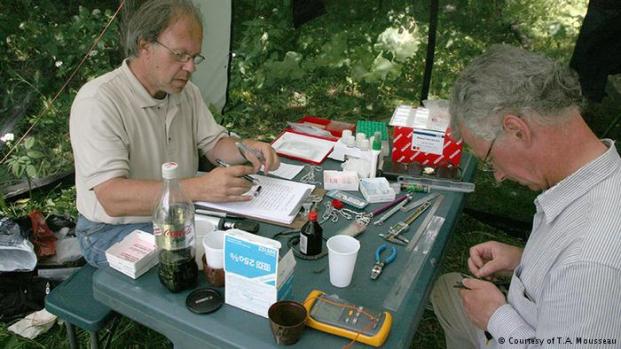
Mousseau (left) and colleague Anders Moller recording measurements in the field at Chernobyl
Some mutations might persist for a while if they’re adaptive during the hot phase. For example, there’s selection for animals whose cells produce a higher antioxidant load, which makes them more resistant to the effects of ionizing radiation. But that protection comes at a metabolic cost. After radiation levels die down, those variants will be selected back out of the population.
Where things get complicated is when the harmful mutations are recessive, that is, when it takes two copies [one for each chromosome] for the expression of the mutation. Many mutations fall into this category. They can accumulate in populations because they’re not expressed until two copies come into the same individual [one from the mother, the other from the father].
Because of this, populations can be affected by such mutations for many generations even after the mutagen is removed, and also, via dispersal, in populations that were never affected by the mutagen.
How can radioactive contamination interact with other problems that affect ecosystems, like habitat loss or climate change?
Certainly climate change is an additional stressor that is likely to interact with radiation to affect populations. We have demonstrated that while swallows in most places have moved their breeding dates forward in response to warming, in the Chernobyl area they are actually delayed. We hypothesize that this is due to the stress from the radioactive contaminants.
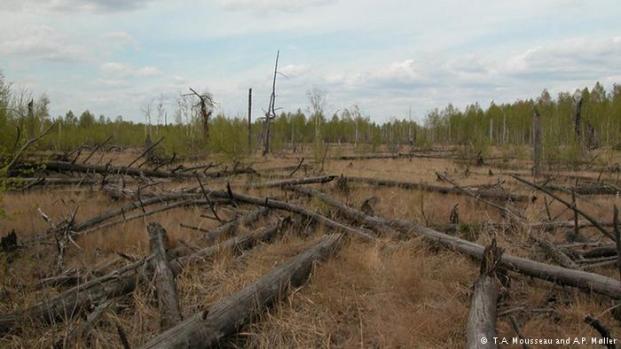
The Red Forest near Chernobyl in Ukraine presents a high risk of fire, as a lack of bacteria prevents the trees from decaying
The biggest fear at present is related to the observation of hotter and drier summers in Ukraine, and the resulting increase in number and size of forest fires. Last summer there were three large fires, and one of them burned through some very contaminated areas.
We have predicted that such events could pose a significant threat to both human populations and the environment via re-suspension and deposition of radionuclides in the leaf litter and plant biomass.
In addition to the threat of catastrophic wildfire spreading nuclear contamination, birds and mammals also move around. Do they absorb radioactive elements in their food and water in contaminated sites, carry them elsewhere, thus dispersing the contamination more widely?
Do animals move radionuclides? Yes! I did a study years ago that showed very significant amounts of radionuclides are exported every year by birds. But it seems unlikely that the amount is enough to cause measurable health effects – unless you’re eating the birds. It is known that some people living outside the Chernobyl Exclusion Zone are getting very significant doses from hunting the contaminated wild boar that leave the zone.
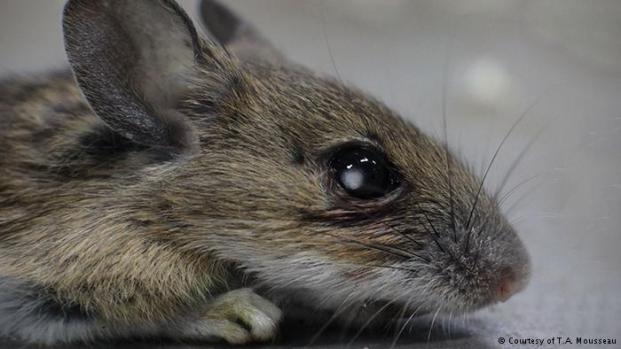
Mouse with cataract collected near Chernobyl – the more radioactive the site, the higher the frequency of defects
This year marks five years since the Fukushima accident, and 30 years since Chernobyl. How long will the contaminated zones around Chernobyl and Fukushima be mutagenic and dangerous?
Chernobyl was a nuclear fire and ongoing fission event for 10 days, with strontium, uranium and plutonium isotopes strewn into the landscape. They have long half-lives, so many areas will remain hazardous for centuries, even thousands of years.
Fukushima was largely a cesium event, and cesium radionucleotides have a relatively short half-life. The area will mostly naturally decontaminate itself within decades, at most within a couple hundred years.
Timothy Mousseau is a professor of biological sciences at the University of South Carolina in Columbia, South Carolina. He is one of the world’s leading experts on the effects of radionucleotide contamination from nuclear accidents on wild bird, insect, rodent, and plant populations.
Interview: Nils Zimmermann
Judges clad in protective gear inspect evacuated areas in Fukushima for on-site evidence in class action suit

Judge Hideki Kanazawa, third from right in the front row, walks through an area evacuated due to radiation while wearing protective clothing, near the homes of plaintiffs in a lawsuit over the nuclear disaster, in Futaba, Fukushima Prefecture, on March 17, 2016.
FUKUSHIMA–Fukushima District Court judges inspected the houses of three evacuated plaintiffs on March 17 in connection with a lawsuit filed against the government and Tokyo Electric Power Co. over the nuclear disaster.
It marked the first visit by judges to evacuation zones regarding litigation concerning the accident at the Fukushima No. 1 nuclear power plant, which was caused by the Great East Japan Earthquake and tsunami in March 2011.
Called “Nariwai Sosho” (livelihood suit), the lawsuit has about 4,000 plaintiffs seeking consolation money and the restoration of their former lives that were lost because of the nuclear accident.
What was gleaned from the on-site inspections will be used as evidence in the trial.
The plaintiffs had called for the judges to visit the affected sites and hear their explanations to assess the scope of damage of the nuclear disaster.
The inspections involving about 50 people, which were closed to the media, started at 10:45 a.m. and ended around 4:30 p.m.
Three judges, including Presiding Judge Hideki Kanazawa, first visited the home of Sadatoshi Sato, a 68-year-old who raised livestock before the disaster, in Namie.
Other plaintiffs, government officials and TEPCO representatives accompanied the judges. All participants wore white protective suits and masks.
At Sato’s home, the judges viewed empty cattle sheds. Sato had been raising about 150 cattle when the nuclear accident unfolded, but most of them starved to death while he was evacuating. Sato also took the judges to the site where the dead cattle were buried.
“I want the judges to give a thoughtful ruling so that the dead cattle would rest in peace,” Sato told reporters after the inspection.
The judges also visited the homes of 67-year-old Yuji Fukuda in Futaba and a woman in Tomioka who had been operating a piano school out of her house before the nuclear accident.
Fukuda’s house is in a difficult-to-return zone about 4 kilometers from the Fukushima No. 1 nuclear plant. He showed the judges his once-thriving garden. He also told them about a local store that is now desolate.
“I told the judges from the bottom of my heart that I am not the only one who has suffered,” Fukuda said. “I had wanted the judges to come sooner. But my hope has finally come true.”
http://ajw.asahi.com/article/0311disaster/recovery/AJ201603180055
Judges clad in protective gear visit Fukushima in class action suit
FUKUSHIMA — Judges from the Fukushima District Court donned protective gear to make an on-site visit on March 17 to towns evacuated due to high radiation levels, as they deliberate a class action lawsuit over the Fukushima nuclear disaster.
Some 3,900 people who lived in Fukushima Prefecture and adjacent prefectures at the time of the meltdowns at the Fukushima No. 1 nuclear plant have sued the government and plant operator Tokyo Electric Power Co. for compensation and a restoration of their hometowns to their pre-disaster state. According to lawyers for the plaintiffs, the March 17 visit is the first time that a court handling a lawsuit over the Fukushima disaster has made an on-site visit.
The visit consisted of around 50 people, including three judges and lawyers for both the plaintiffs and the defendants. They went to three evacuated towns, Futaba, Namie and Tomioka, where they looked inside the homes of plaintiffs, thrown into disorder by scavenging animals and full of strewn furniture and bad odors. They also walked by JR Futaba Station, now unmanned and silent.
Plaintiff Yuji Fukuda, 67, who evacuated from Futaba and is now living in the city of Iwaki, said after the visit, “The judges understood that we are continuing to suffer from being driven from our towns and having to leave our homes and properties unattended.”
At his cow barn, Sadatoshi Sato, 68, livestock farmer and plaintiff from Namie, explained to the judges how most of the around 150 cattle he kept had died from starvation after the town was evacuated.
The plaintiffs in the case are seeking 20 million yen in compensation each for 40 people who lived in areas that are under evacuation order. They are also seeking a reduction in radiation doses to pre-disaster levels, and payment of 50,000 yen per month to each plaintiff for the duration until this happens.
http://mainichi.jp/english/articles/20160318/p2a/00m/0na/003000c
NRA criticizes Asahi story on radiation dose monitors
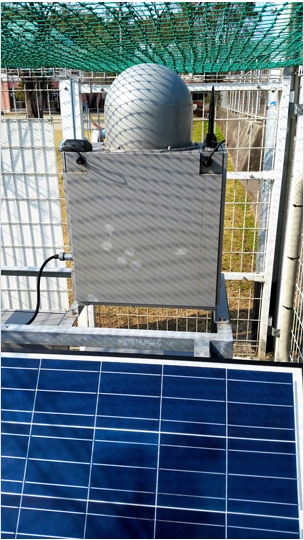
This radiation dose monitoring post, installed about 21 kilometers from the Sendai nuclear power plant in Satsuma-Sendai, Kagoshima Prefecture, can only measure radiation doses up to 80 microsieverts per hour.
The head of the Nuclear Regulation Authority on March 16 criticized an Asahi Shimbun story on radiation dose monitors around the Sendai nuclear power plant, saying it is misleading to residents near nuclear facilities.
The NRA demanded that The Asahi Shimbun explain the news-gathering process that led to the March 14 story headlined, “Half of the radiation dose monitoring posts around the Sendai nuclear power plant cannot measure levels that serve as criteria for evacuation,” in the vernacular Asahi Shimbun.
“(The article) is criminal in the sense the content fanned unnecessary anxieties among municipalities hosting nuclear power plants and people living around them,” Shunichi Tanaka, chairman of NRA, said.
The article, carried in the morning edition, said 22 of the 48 monitoring posts installed in the area between 5 kilometers and 30 km from the Sendai plant in Kagoshima Prefecture can only measure radiation doses up to 80 microsieverts per hour. That means these posts are incapable of measuring doses of 500 microsieverts per hour, the criterion for judgments on issuing evacuation orders to residents immediately after a nuclear accident.
“It is not a problem that only half of the monitoring posts can measure (500 microsieverts) and the other half cannot do so,” Tanaka said. “What is important is whether those monitoring posts are sufficient for us to judge (whether to order evacuations) through monitoring.”
On the evening of March 15, the NRA released a statement on its website, saying, “There is a possibility that (the article) will cause misunderstandings.”
The statement said monitoring posts that can accurately measure low radiation doses and monitoring posts that can measure high radiation doses are installed in combination, so the mechanism to judge whether to issue evacuation orders has been “put in place.”
The NRA statement also said, “We recognize that it is important to continuously enhance monitoring systems for emergencies.”
In addition, the NRA took issue with a comment from the nuclear watchdog that appeared in the article.
“Our staff never said what was written,” the NRA said.
It demanded that The Asahi Shimbun explain whether the comment was a fact.
The Asahi Shimbun carried the article to enhance local governments’ evacuation systems as much as possible.
“As for the article, (our reporters) interviewed NRA executives several times,” the newspaper said in a statement.
* * *
Asahi’s stance on the issue
The Asahi Shimbun believed that, in the case of radiation doses rising sharply after an accident at a nuclear power plant, 500 microsieverts per hour will become an important barometer on whether to immediately evacuate residents living in the area between 5 km and 30 km from the plant.
Therefore, the newspaper focused on whether equipment that can measure 500 microsieverts per hour has been put in place.
After the accident at the Fukushima No. 1 nuclear power plant operated by Tokyo Electric Power Co., the government revised its guidelines to deal with nuclear disasters. The government decided that people living within a radius of 5 km from a nuclear plant would have to evacuate immediately if an accident occurs.
For people living in the area between 5 km and 30 km from the plant, the government decided that they would have to stay indoors, and a judgment would be made on whether to issue evacuation orders to them after checking the radiation doses measured by monitoring posts.
The government decided that if a level of 20 microsieverts per hour continues for an entire day, it will instruct those residents to evacuate within a week. However, if the radiation doses reach 500 microsieverts per hour, the government will instruct them to evacuate immediately.
This year, The Asahi Shimbun asked 21 prefectures that are obliged to compile evacuation measures for residents about the installation of monitoring posts in the area between 5 km and 30 km from a nuclear plant.
With the exception of Kagoshima Prefecture, where the Sendai nuclear plant is located, 20 prefectures have installed or plan to install monitoring posts that can measure up to 500 microsieverts per hour in all or most of the spots.
Prefectural government officials said that in the accident in Fukushima, the area of high radiation doses spread widely and that it is a matter of course that the monitoring posts can measure up to 500 microsieverts.
Others said that making it possible to measure up to 500 microsieverts will lead to relief and safety of the prefecture’s people.
Officials of prefectural governments have made such remarks because of the accident that occurred at the Fukushima No. 1 nuclear power plant. Radiation doses could differ drastically in spots that are several kilometers away.
In the initial stage of the Fukushima disaster, measuring radiation doses while moving in a car was inadequate due to a shortage of gasoline and other reasons.
In a complex disaster combined with an earthquake or other factors, there is a possibility that measuring equipment cannot be transported because of damage to roads.
The 48 monitoring posts that are installed in the area between 5 km and 30 km from the Sendai nuclear plant are positioned so that they can be used to make judgments on evacuations from each district.
As for the Sendai nuclear plant, an NRA official in charge of the issue revealed to The Asahi Shimbun this month that when the government “approved” the evacuation system around the plant in 2014, prior to the restarts of its reactors, a then division chief of the NRA strongly asked the Kagoshima prefectural government to expand its monitoring system.
As for the current situation of monitoring systems, the NRA is also looking into the installation and capabilities of monitoring posts around nuclear power plants throughout the country.
http://ajw.asahi.com/article/behind_news/social_affairs/AJ201603170065
Fukushima fuel melted through containment vessels and is “spewing radiation”
Reuters: Fukushima fuel melted through containment vessels and is “spewing radiation” — Nuke Expert: Fuel has “scattered all over the place” — Gov’t: Fuel may have burned out into environment — Tepco Official: Fuel could have flowed out “like lava in a volcano” (VIDEOS) http://enenews.com/tepco-official-admits-melted-fuel-flowed-like-volcanic-lava-nuclear-expert-melt-containment-vessel-fuel-scattered-all-place-reuters-fuel-melted-containment-spewing-radiation-guardian-fuel-be?utm_source=feedburner&utm_medium=email&utm_campaign=Feed%3A+ENENews+%28Energy+News%29
Reuters, Mar 11, 2016 (emphasis added): Today, the radiation at the Fukushima plant is still so powerful it has proven impossible to get into its bowels to find and remove the extremely dangerous blobs of melted fuel rods, weighing hundreds of tonnes… The fuel rods melted through their containment vessels in the reactors, and no one knows exactly where they are now… Tepco has been developing robots [to] negotiate obstacles in damaged tunnels and piping to search for the melted fuel rods.
Reuters, Mar 9, 2016: Five years on, melted fuel rods still spew radiation…
DW, Mar 11, 2016: The melted nuclear fuel and the destroyed pressure vessel in the nuclear reactors 1 to 3 continue to be major problems… “So far, nobody knows what exactly happened in there and how to solve it,” [Heinz Smital, a nuclear physicist] told DW. “Until now, there is no solution to recover the melted fuel rods from the reactors.”
News Corp Australia, Mar 11, 2016: Today, the radiation at the Fukushima plant is still so powerful it is impossible to extract and remove deadly melted fuel rods… [Tepco is] grappling with the fact that they don’t have the technology to find missing melted fuel rodsin three reactors at the plant. The rods melted through containment vessels in the reactors.
Guardian, Mar 11, 2016: [It’s] the most daunting task the nuclear industry has ever faced: removing hundreds of tons of melted fuel from the plant’s stricken reactors… something no nuclear operator has ever attempted… Of greatest concern, though, is reactor 1, where the fuel may have burned through the pressure vessel, fallen to the bottom of the containment vessel and into the concrete pedestal below – perhaps even outside it – according to a report by the International Research Institute for Nuclear Decommissioning… Masuda and Tepco engineers who spoke to the Guardian conceded that they still didn’t know where the fuel is located. “To be honest, we don’t know exactly where the fuel is”… Masuda said… “No one has ever done what we’re doing”…
PBS Newshour, Mar 11, 2016 (at 35:15 in):
- Miles O’Brien, PBS correspondent: What about the melted fuel in the reactor cores? They aren’t even sure where it all is.
- Lake Barrett, Tepco advisor: Is it in one big vertical lump on the floor underneath it? Or did it come down and flow like lava in a volcano and move out to the sides? We don’t know yet… Nothing of this magnitude [i.e. the attempt to remove Fukushima’s melted fuel] has ever been done by mankind…
Interview with nuclear engineer Hiroaki Koide (translation by Prof. Robert Stolz, transcription by Akiko Anson), published Mar 8, 2016: We simply do not know where the core is or in what state it is… [The government and TEPCO] are convinced that the melted core fell through the bottom of the pressure vessel and now lie at the bottom of the containment vessel―basically piling up like nuggets of the melted core [See Lake Barrett’s statement above]. There’s no way this would be the case. (Laughs)… It should have been scattered all over the place… Though the containment vessel is made of steel, if the melted core has come in contact with that steel, just as it ate through the floor of the pressure vessel, it could possibly have melted through the containment vessel… There are situations in which the containment vessel can suffer a melt-through. I think this likely has already happened.
Watch: PBS Newshour | Reuters
After court ruling, things are grim for Japan’s nuclear industry

 Japan’s nuclear energy policy remains in disarray after court ruling http://asia.nikkei.com/magazine/20160317-THE-LAST-MILE/Politics-Economy/Japan-s-nuclear-energy-policy-remains-in-disarray-after-court-ruling
NAOKI ASANUMA, Nikkei staff writer, Tokyo 17 Mar 16, Five years after the devastating earthquake and tsunami that caused reactors to melt down at Tokyo Electric Power Co.’s Fukushima Daiichi power plant, Japan’s nuclear energy policy remains in disarray. On March 9, the Otsu District Court in Shiga Prefecture ordered Kansai Electric Power to halt the No. 3 and No. 4 reactors at its Takahama nuclear plant in Fukui Prefecture, after taking issue with the power company’s safety protocols regarding earthquakes and tsunamis. The order is the first of its kind suspending the operation of a reactor in service in Japan and has raised questions about who among the many stakeholders — utilities, the central government, local authorities, regulators, residents and courts — has the power to start or stop them.
Kansai Electric shut down the No. 3 reactor the day after the court order, leaving Japan with only two reactors in operation — the No. 1 and No. 2 units at Kyushu Electric Power’s Sendai plant, in Kagoshima Prefecture. The No. 4 reactor at Takahama was already shut down due to problems that occurred soon after it was reactivated in February.
Prior to the ruling, the restart of nuclear reactors had followed a formula of sorts: A power company receives the nod from the Nuclear Regulation Authority after examinations based on the regulator’s new safety standards. The central government then helps local governments of areas within a 30km radius of the plant prepare evacuation plans. After the local governments give their consent, the reactor is then fired up. The formula was upset, however, by 29 Shiga residents living outside the 30km radius, who asked the Otsu court for an injunction.
In handing down its ruling, the court said efforts by Kansai Electric and the Nuclear Regulation Authority to understand the causes of the Fukushima meltdown were insufficient.
“Japan has learned nothing from the Fukushima accident,” said Yotaro Hatamura, professor emeritus at the University of Tokyo, who served as chairman of a government-appointed committee to investigate the disaster. “The reactivation [of reactors] represents nothing but irresponsibility.”
While the Strategic Energy Plan worked out by the government in 2014 calls for reducing reliance on nuclear power “as much as possible,” it positions nuclear energy as an “important baseload power source.” But with lawsuits demanding the suspension of nuclear plants and petitions seeking provisional halts proliferating, a new question in the wake of the Otsu ruling is whether nuclear plants can serve that purpose, given that they may suddenly cease to operate.
The “best mix” of energy sources for 2030, projected by the government last year, puts the ratio of nuclear power at 20% to 22%. Former Economy, Trade and Industry Minister Yoichi Miyazawa said Japan “needs to operate some 35 reactors,” suggesting the difficulty of achieving the target. In a survey by The Nikkei, 60% of people said the reactivation of nuclear power plants should not be promoted.
At the Fukushima plant itself, officials cite progress with the cleanup work.
USA worried about weapons proliferation risks in China’s Nuclear Recycling plan
China’s Plans to Recycle Nuclear Fuel Raise Concerns U.S. energy secretary airs worries about proliferation risks ahead of nuclear-security summit WSJ, By BRIAN SPEGELE, 17 MAR 16, BEIJING—China’s plans to process spent nuclear fuel into plutonium that could be used in weapons is drawing concern from the U.S. that Beijing is heightening the risk of nuclear proliferation.
U.S. Energy Secretary Ernest Moniz, in Beijing for talks, said Thursday that China’s plans to build a nuclear-recycling facility present challenges to global efforts to control the spread of potentially dangerous materials……..
Mr. Moniz’s comments marked a rare public expression by the Obama administration of concern over China’s reprocessing plans. The differences, which the governments have discussed privately, are being aired ahead of a visit by President Xi Jinping to Washington this month for a summit with President Barack Obama and other world leaders on nuclear security.
The issue comes down to the different choices countries make over how to handle potentially dangerous waste created by commercial nuclear reactors. In the U.S., spent fuel is treated as sensitive material and is stored, and reprocessing is banned out of proliferation concerns.
Elsewhere, including in France and Japan, spent fuel is recycled to extract plutonium to be used in nuclear reactors. The U.S.’s concern is that the bigger the stockpiles of plutonium, the higher the risk that some of it could be refined for use in nuclear weapons or taken by terrorists……
U.S. concerns about nuclear reprocessing and proliferation are particularly acute in the Asia-Pacific region, “where the perception is there is less international cooperation, less transparency,” said Mark Hibbs, a nuclear expert at the Carnegie Endowment for International Peace………
larger Chinese stockpiles of isolated plutonium could prompt Japan, especially, to build up its caches.
Civilian plutonium stockpiles reached 271 metric tons by the end of 2014, up from around 150 metric tons in the 1990s, the International Panel on Fissile Materials, an independent group looking at nonproliferation policy, said in its latest annual report.
The official Xinhua News Agency reported in September that construction of China’s reprocessing facility may start in 2020 and take a decade to complete. The project is expected to have a processing capacity of 800 metric tons of spent fuel a year…..
Previously, the U.S. has questioned the economic viability of such projects, which are expensive to build and operate, as well as proliferation issues, Ernest Moniz said……
Mr. Hibbs from the Carnegie center said China’s decision to pursue reprocessing couldn’t be justified on economic or commercial grounds, given the billions of dollars needed to construct one large-scale facility. But China may be acting strategically, guaranteeing future fuel supply by recycling, he added.
Last June, state-owned China National Nuclear Corp. and France’sAreva SA agreed to speed up negotiations on building the facility. Areva didn’t respond to a request for comment on Mr. Moniz’s remarks and CNNC said its press officers weren’t available.
Write to Brian Spegele at brian.spegele@wsj.com http://www.wsj.com/articles/chinas-plans-to-recycle-nuclear-fuel-raise-concerns-1458228504
1 This Month





PLEASE OPPOSE HR 8255 AND S.3639 – bills would accelerate satellite deployment, with no environmental review or safeguards – https://ncstd5li.quorum.us/campaign/169331/
To see nuclear-related stories in greater depth and intensity – go to https://nuclearinformation.wordpress.com
-
Archives
- October 2026 (74)
- September 2026 (339)
- August 2026 (330)
- July 2026 (355)
- June 2026 (287)
- May 2026 (306)
- April 2026 (356)
- March 2026 (251)
- February 2026 (267)
- January 2026 (308)
- December 2025 (358)
- November 2025 (359)
-
Categories
- 1
- 1 NUCLEAR ISSUES
- business and costs
- climate change
- culture and arts
- ENERGY
- environment
- health
- history
- indigenous issues
- Legal
- marketing of nuclear
- media
- opposition to nuclear
- PERSONAL STORIES
- politics
- politics international
- Religion and ethics
- safety
- secrets,lies and civil liberties
- spinbuster
- technology
- Uranium
- wastes
- weapons and war
- Women
- 2 WORLD
- ACTION
- AFRICA
- Atrocities
- AUSTRALIA
- Christina's notes
- Christina's themes
- culture and arts
- Events
- Fuk 2022
- Fuk 2023
- Fukushima 2017
- Fukushima 2018
- fukushima 2019
- Fukushima 2020
- Fukushima 2021
- general
- global warming
- Humour (God we need it)
- Nuclear
- RARE EARTHS
- Reference
- resources – print
- Resources -audiovicual
- Weekly Newsletter
- World
- World Nuclear
- YouTube
-
RSS
Entries RSS
Comments RSS

