China becoming more anxious over consequences of Fukushima nuclear disaster – calls for transparency
China’s action call over Fukushima, Shanghai Daily Source: Agencies | June 4, 2016 CHINA is extremely concerned about the consequences of the 2011 Fukushima nuclear accident, a foreign ministry spokeswoman said yesterday, and has urged the Japanese government to carry out timely follow-up measures.
“We hope Japan will take effective measures to provide timely, comprehensive and accurate information to the international community and protect the ocean environment,” Hua Chunying told a daily news briefing.
On Monday, the plant’s operator, Tokyo Electric Power Co, admitted for the first time that its insistence on referring to the incident as “nuclear reactor damage” over the past five years had “hidden the truth.”
According to Ken Buesseler, a marine radiochemist with the US Woods Hole Oceanographic Institution, the consequences of the Fukushima accident were “unprecedented,” since over 80 percent of the leaked radioactive substances had flowed into the sea.
“We hope Japan will maintain a high sense of responsibility to its own people, the people in neighboring countries and the international community,” Hua said. China is willing to communicate with relevant parties, including South Korea, she added.
China has also asked the International Atomic Energy Agency to enhance monitoring and evaluation of the radioactive water that had resulted from the accident, Hua said…….http://www.shanghaidaily.com/nation/Chinas-action-call-over-Fukushima/shdaily.shtml
India will be Kept Out of the Nuclear Suppliers Group – the reasons why
Why India will be Kept Out of the Nuclear Suppliers Group, The National Interest, Ruhee Neog, 2 June 16 Ahead of this month’s Nuclear Suppliers Group (NSG) plenary, at which the consideration of India’s membership is expected, a couple of things have happened in quick succession. China announced its opposition to permitting non-Nuclear Nonproliferation Treaty (NPT) members into the NSG, and Pakistan, citing its observance of NSG guidelines, made an application for membership. The United States, which has been quite vociferous in its support for India’s membership, and has, for some time, lobbied NSG members for their positive vote, reiterated its traditional line. Of the 48 members of the NSG, three players—China, the “non-proliferation hardliner” countries, and the United States—will play an important role in deciding which way the vote will sway.
The threat of a nuclear arms race in East Asia
A nuclear arms race in East Asia? It is a place where most nations deeply distrust their neighbours, and where old-style nationalism still reigns supreme. Aljazeera, by Andrei Lankov Andrei Lankov is professor of Korean Studies at Kookmin University, Seoul. He is the author of “The Real North Korea: Life and Politics in the Failed Stalinist Utopia”.
Recently, news from the Korean Peninsula has been dominated by missiles: as satellite images confirmed, the North Koreans have been busy preparing another test launch of “BM-25 Musudan”, their intermediate-range missile.
The launch ended in failure, the fourth such failure in this year. Nonetheless, North Korean engineers and scientists are busy developing both long-range and submarine-based ballistic missiles, capable of hitting the United States.
There has been much hype about the recent Musudan launch, but few people noticed another piece of news that came from South Korea a week earlier.
A high-ranking official, speaking on condition of anonymity – but clearly authorised to make such statements – said that the South Korean navy is also developing its own submarine-launched ballistic missiles (SLBM), so the new South Korean submarines will be equipped with a launchpad.
This statement was a reminder of another possible challenge associated with the North Korean nuclear and missile programmes: The threat is that its programmes will provoke a symmetrical response from the countries in the region, triggering a missile and, perhaps, even a nuclear arms race………
If the nuclear and missile arms race starts in East Asia, where will it stop? East Asia today is eerily reminiscent of Europe in the early 1900s, before the outbreak of World War I.
It is also a place where most nations deeply distrust their neighbours, and where old-style nationalism still reigns supreme.
So far, age-old hatreds have been controlled by the US hegemony – Koreans and Japanese, in spite of their historical animosities, have been prevented from confrontation by their alliances with the US – as well as by the record high economic growth. But will such a state of things continue indefinitely? This looks increasingly unlikely……
And, surely, there is the “China factor” – the rising superpower is, to put it mildly, quite unpopular among its neighbours, from Vietnam to Japan.
In the changing strategic situation, many such countries can choose nuclear weapons as a way to deter China which – due to its sheer size and economic might – can hardly be deterred by conventional weapons.
Indeed, the eventual deployment of the North Korean nuclear-armed missiles, combined with signs of US indecisiveness, might easily push South Korea towards acquiring its own nuclear deterrent.
Technically, acquiring nuclear weapons would not cost much money or take much time for a highly developed nation such as South Korea.
If it happens, the probability of a nuclear Japan will increase, and Taiwan, as well as more advanced countries of South East Asia, might start wondering why they should be left behind.
Usually, such columns are supposed to end with some positive suggestions, but in this case there is hardly anything optimistic to say.
North Koreans are determined to maintain and improve their nuclear deterrent, and given their strategic situation, they can hardly be blamed for such an attitude.
However, their actions increase the risk to security in this vital region, and perhaps the entire world. http://www.aljazeera.com/indepth/opinion/2016/06/nuclear-arms-race-east-asia-160602091442504.html
China hopes to jointly counter Fukushima’s radioactive pollution with S. Korea

BEIJING, June 3 (Yonhap) — China’s foreign ministry said Friday it hopes to strengthen communication with relevant countries such as South Korea to resolve pollution from the Fukushima nuclear disaster.
“Japan should take effective measures with responsibility for its people, neighboring countries and the international community,” China’s foreign ministry spokeswoman Hua Chunying said during a regular press briefing.
Earlier on Friday, China’s official Xinhua News Agency reported that an official from Tokyo Electric Power Co., the plant’s operator, admitted to concealing the harmfulness of the disaster. It also cited a U.S. expert who said “80 percent of the leaked radioactive substances have flown into the sea.”
Hua urged Japan to beef up its capability to deal with the disaster and provide relevant information to international society in a “timely, comprehensive and accurate” manner.
China has been warning its citizens and organizations to be cautious in visiting Fukushima since the disaster took place, and the suggestion is still valid, Hua said.
A devastating earthquake struck off Japan’s northeast coast in March 2011, triggering a tsunami that led to the reactor meltdown and radiation leak.
http://english.yonhapnews.co.kr/news/2016/06/03/0200000000AEN20160603009600315.html
Rosatom, Japan discuss decommissioning of Fukushima installations

A Rosatom installation.
The Russian corporation has developed unique water treating technology.
Tokyo is interested in partnering with the Rosatom state corporation to decommission nuclear power plant installations in Japan, Rosatom Chief Executive Sergei Kirienko told Rossiya 24 on June 1.
“Our partners are showing ever greater interest in the final stage of the life cycle: decommissioning. We are currently discussing this with the Japanese partners,” Kirienko said.
Rosatom enterprises have fulfilled the order to develop unique technology for treating water at Fukushima for the Japanese partners, he added.
Tokyo Electric Power : Giant vacuum cleaner used to remove radioactive debris in Fukushima
Tokyo, Jun 1 (EFE).- The operator of the plagued Fukushima nuclear plant has deployed a large device similar to a vacuum cleaner to clean up radioactive debris scattered over the plant’s Reactor 1, the company explained to Efe.
Technicians of Tokyo Electric Power (TEPCO) on Monday started using the apparatus, 13 meters high and 5 meters wide, which is operated through a crane and is capable of safely absorbing objects of up to 20 kilograms.
The top floor was rocked by an explosion caused by hydrogen concentration one day after being hit by the earthquake and tsunami that devastated northeastern Japan on Mar. 11, 2011.
The blast destroyed the roof of the plant, which remains covered with highly contaminated pieces of debris – from cement to metal fragments – and this will hinder the complicated process of removing the molten fuel inside the reactor vessel.
TEPCO plans to finish this operation in July and then proceed to remove larger debris.
According to the company’s roadmap, the withdrawal of molten nuclear fuel inside Reactor 1 is to be done within about four years.
The accident at the Fukushima Daiichi plant was the worst nuclear accident since the Chernobyl disaster in Ukraine in 1986. Its resultant emissions and radioactive discharges still keep thousands of people who lived near the plant out of the area and have severely affected agriculture, livestock and local fishing.
USA’s Westinghouse in rush to sell nuclear reactors to India

 India, Westinghouse in advanced talks to close nuclear deal, live mint, http://www.livemint.com/Politics/DscD8CWjYrsVgpqQO7Fp1J/India-Westinghouse-in-advanced-talks-to-close-nuclear-deal.html Valerie Volcovici, 2 June 16,
India’s ambassador to the US Arun Singh says the issues that remain to be worked out are related to cost and financing. Washington: Toshiba Corp.’s Westinghouse Electric and India are in “advanced discussions” for the company to build six nuclear reactors there, the country’s ambassador to the United States said on Wednesday, ahead of Indian Prime Minister Narendra Modi’s planned visit to Washington next week.
A deal with Westinghouse would be the first such contract reached under the 2008 US-India civil nuclear accord.
“There is a very detailed and advanced negotiation between Westinghouse and India,” Ambassador Arun Singh told reporters. “The issues that remain to be worked out are related to cost and financing.”
Progress on the deal to build six AP-1000 nuclear reactors is one of the key developments anticipated during the 7-8 June visit by Modi to Washington, where he will be hosted by President Barack Obama for a final summit before the US presidential election in November. Modi will address both houses of Congress.
The US and India agreed in 2008 to cooperate in the civil nuclear arena, but there have been no agreements yet to build any plants. Reuters reported on Tuesday that Westinghouse and India reached a breakthrough after officials said it will relocate the planned project in Andhra Pradesh. The original site proposed for the multi-billion-dollar project, in Modi’s home state of Gujarat, faced local opposition.
Another obstacle had been to bring India’s liability rules into line with international norms, which require the costs of an accident to be channelled to the operator rather than the maker of a nuclear power station.
That issue had been largely resolved to the satisfaction of the US government in January 2015 after the US and India reached a “breakthrough understanding” on nuclear cooperation.
Singh told reporters “to the best of my knowledge” insurance was no longer an issue in the discussions.
Westinghouse had hoped to clinch a deal to build six nuclear reactors in India by the end of March, during Modi’s last Washington trip to attend a global nuclear summit.
US lawmakers ratified the civil nuclear accord three years after it was struck in 2005, as part of an attempt to deepen the strategic relationship with India, but have expressed growing dismay over its failure to yield follow-on deals for US-based reactor makers. Reuters
Russia and China working together to market nuclear reactors to the world
Russia, China Working on Plan on Nuclear Cooperation Development. MOSCOW (Sputnik) 2 June 16 — Russia and China are working on a comprehensive document on the development of the bilateral strategic cooperation in the field of nuclear energy, the protocol of the Russia-China intergovernmental energy cooperation commission said.
China’s plans for floating nuclear power plants- major risks, good terrorism targets
While floating power plants may seem to present exciting economic opportunities–both for sites lacking affordable power and for the entities selling the plants—they also come with major risks.
“naval bombardment” is a growing risk in the South China Sea. A floating nuclear power plant might make a tempting target.
 Floating nuclear power plants: China is far from first, Bulletin of the Atomic Scientists Dawn Stover , 2 June 16 On April 22, the state-owned Chinese newspaper Global Times reported that China plans to build as many as 20 floating nuclear power plants, the first of which could be producing power in just a few years. The story made a splash because the power from the floating reactors would most likely be used to accelerate construction of oil rigs and artificial islands in the South China Sea—already a source of border disputes and escalating tension between China and its neighbors.
Portable power stations may sound futuristic, but the idea is far from new. The United States launched the first floating nuclear power plant five decades ago, and Russia started its own construction project in 2000. Where the United States has seen a proprietary technology, though, China sees a marketing opportunity.
China floats an idea. Earlier this year, as part of its latest five-year plan, China’s National Development and Reform Commission approved the development of two nuclear reactors for marine platforms, one each from the country’s two big nuclear companies: The China General Nuclear Power Group will develop the ACPR50S, a small modular reactor with a generating capacity of 200 megawatts. Meanwhile, the China National Nuclear Corporation plans to work on the AC100S reactor, a marine version of its ACP100, which would generate 100 megawatts.
China General Nuclear has signed an agreement with China National Offshore Oil Corporation, which would presumably use floating nuclear power plants to provide power for offshore oil and gas exploration. China Shipbuilding Industry Corporation, the country’s largest shipbuilder, is building a barge-like platform for China General Nuclear’s pilot plant. An illustration of the platform looks very similar to Russian designs, which is not surprising. Only a few years ago, the Chinese were planning to build floating nuclear power plants in China using Russian technology; now the Chinese are floating their own designs………
Potential risks and rewards. Russia’s nuclear-powered icebreakers use highly enriched uranium, but the modified reactors for the Akademik Lomonosov will run on low-enriched uranium. That helps to alleviate concerns about proliferation, but environmental and safety concerns remain. A floating nuclear power plant would probably be safe from earthquakes, but storms could be a threat, and accident response would be slow in remote Arctic areas.
In the event of a nuclear accident, an offshore plant would have plenty of cooling water readily available. But a floating nuclear power plant might not have access to off-site backup power, and it would be more difficult to contain any radioactive releases than when an accident occurs at a land-based plant. A failed reactor might end up being abandoned at sea, as has happened to seven Soviet or Russian nuclear submarines.
Those risks aren’t preventing the Russians and Chinese from moving ahead with plans for floating nuclear power plants. Russia hopes to lease floating plants to other countries, and China sees an opportunity to capitalize on technologies originally developed by the United States and Russia…….
While floating power plants may seem to present exciting economic opportunities–both for sites lacking affordable power and for the entities selling the plants—they also come with major risks. As Bennett Ramberg, author of the book Nuclear Power Plants as Weapons for the Enemy: An Unrecognized Military Peril, noted in the Bulletin’s March 1986 issue: “[F]acilities can be placed on large lakes, inland seas, or oceans—on floating platforms surrounded by breakwaters, on floating vessels anchored to the marine floor, on artificial islands, or even undersea. However, there would be higher transmission costs for reactors, unique construction costs, and exposure to such dangers as ship collisions, accidental explosions, and naval bombardment.”
Thirty years later, “naval bombardment” is a growing risk in the South China Sea. A floating nuclear power plant might make a tempting target.
Editor’s note: The Bulletin’s archives from 1945 to 1998, complete with the original covers and artwork, can be found here. Anything after 1998 can be found via the search engine on the Bulletin’s home page. http://thebulletin.org/floating-nuclear-power-plants-china-far-first9522
Why don’t you have a video-showing event of “NUCLEAR JAPAN” in your country?
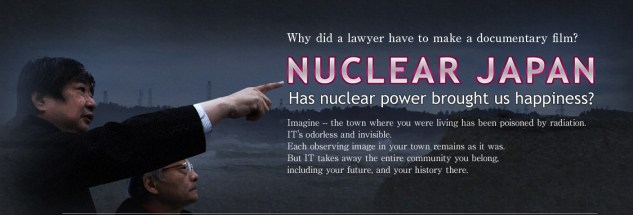
Almost in one year, this film has been shown to more than 70,000 people, and there have been held more than a thousand voluntary movie-showing events since “NUCLEAR JAPAN” was released in November 2014. It has been also presented at many courtrooms as evidence to get a bird’s-eye view of all the issues of nuclear power in order to halt nuclear power plants whole Japan.
If you are planning to have a video-showing event of “Nuclear Japan” (2h 15m), please send an application form to eiga@nihontogenpatsu.com.
It may take time for international shipping, please apply well in advance. Thank you!
SYNOPSIS
This movie strives to provide
a complete picture of nuclear power in Japan.
NUCLEAR JAPAN is a documentary film directed by a 70-year-old lawyer with remarkable record of winning very high-profile cases who elucidates the controversial issue of nuclear power industry in Japan.
On March 11th, 2011, a massive earthquake hit East Japan, which caused a catastrophic accident in Tokyo Electric Fukushima No.1 nuclear power plant. Radioactive materials were released from its four nuclear reactors, and they have contaminated the people’s land as well as ocean. Today, the effort to clean up the radioactive materials is still ongoing, only too little effect.
The film takes you back to a few hours after the earthquake on March 11th, to the shore of Namie Township, 7 kilometers north of Fukushima No.1 nuclear power plant. The local fire brigade in Namie is desperately searching for missing persons swept away by the disastrous tsunami. However, the next morning on the 12th, the question starts to rise for the possible dissemination of radioactive material. The Japanese government consequently declares the area within 10 kilometers from the Fukushima nuclear power plant as an evacuation zone. As a result, the fire brigade in Namie Township is forced to give up the search…
A month after the earthquake, the search for missing persons resumed. During the search, more than 180 bodies were found along the shore of Namie Township.
If it weren’t for the nuclear accident, most of those lives could have been saved.
There was one lawyer who had been actively voicing the absurdity and danger of Japanese nuclear power – Hiroyuki Kawai. Kawai has been fighting in many legal battles to halt nuclear power plants in Japan for over 20 years. Ever since the crisis at Fukushima No.1 power plant, his fight has been fueled by even more drive and dedication.
Then, Kawai had a thought. What if he makes a movie about this issue? If he wants the public to understand the complicated issues of nuclear power, literature has its limits. Also, all the coverage by Japanese media has been biased. Only by providing the visual and giving the objective view, he can communicate the true absurdity and inhumanity of the nuclear power in Japan.
With the help of another lawyer Yuichi Kaido, Kawai’s old ally who also has been fighting in nuclear power plant lawsuits, Kawai completed this documentary film, NUCLEAR JAPAN.
The film not only features the interviews of many experts, a number of facts and evidences, but it also brings to light the immense pain of the people have been suffering from the nuclear crisis. NUCLEAR JAPAN is now being presented as evidence in many lawsuits to halt nuclear power plants all over Japan.
This film is the ultimate nuclear power documentary that takes you on a journey to grasp all the issues of nuclear power in a factual, objective way, and eventually, a journey to find a hope.
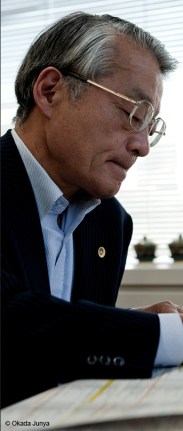
DIRECTOR
Protecting the environment of the planet
as an advocate for future generations;
especially from nuclear disasters
is Kawai’s very purpose.
Profile
Hiroyuki Kawai, a lawyer and a filmmaker, was born in Northeast China, Manchuria, in 1944. Kawai graduated from the University of Tokyo, Faculty of Law in 1968, and has been practicing law since 1970. In 2014, he made a directorial debut with a documentary film NUCLEAR JAPAN.
Today he holds various titles including; President of Sakura Kyoudo Law Offices, Chairman of The Support Group for Japanese War Orphans Left in China Obtaining Japanese Nationality, Head Director of Philippine Nikkei-jin Legal Support Center, and Representative Auditor of Institute of Sustainable Energy Policies.
Kawai is also a representative of National Federation of Lawyers Against Nuclear Power as well as The Complainants for Fukushima Nuclear Disaster Criminal Prosecution legal team. He is the lead lawyer of the legal team for Hamaoka Nuclear Power Plant Suspension Lawsuit and Tokyo Electric Executives Criminal Responsibility Lawsuit. He is also a part of Ohi, Takahama, Sendai Nuclear Power Plants Provisional Suspension Lawsuit legal team.
His motto is–
If you give 100%, you can achieve almost anything.
If you give 100%, you will find anything enjoyable.
If you give 100%, somebody will offer you their hand.
DIRECTOR’S
STATEMENT
“To share the idea of nuclear zero nationwide,
we need a movie.”
Kawai became involved with lawsuits against nuclear power plants from 1994.
The first suit concerned use of MOX fuel in the Fukushima No.1 Reactor 3 plant that exploded in March 2011.
This suit failed, as have many more since that time.
Ever a shrewd lawyer, Kawai was losing his passion to continue such lawsuits just before the Fukushima accident.
The Great East Japan Earthquake rekindled this passion and Kawai has said “I will never give it up. I will continue lawsuits against nuclear plants until nuclear power is eradicated from Japan”.
As part of this process, Kawai decided to make a movie.
Explaining this, he said “in a democracy, a fair legal process is obviously important to protect our rights, especially for minority issues.
Lawsuits in a democracy functions as safety valves.
Justice is justice. I shall stand up to protect life and Japan in courts, even if I would be alone.
But to share the idea of nuclear zero nationwide, we need a movie”.
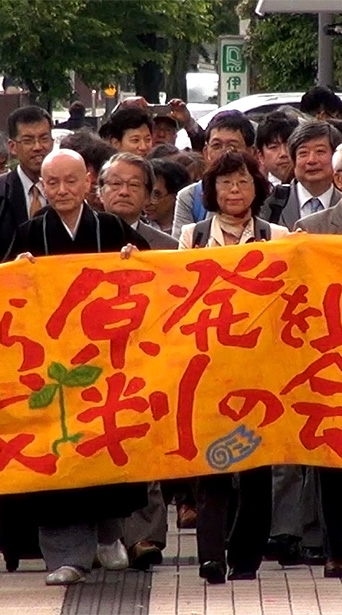
Nuclear accidents strike at the very foundation of our lives.
Economics, culture, art, education, justice, welfare,
frugal and fancy living alike – everything is turned on its head.
Ignorance of nuclear power’s dangers renders every
enterprise meaningless, even irresponsible.
We have come to realize this.
What matters now is what we will do about it.
Hiroyuki Kawai
Woman gives up electricity and goes ‘off grid’ for 4 years
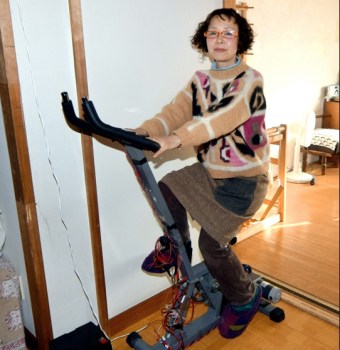
Chikako Fujii says she uses a human-powered dynamo remodeled from a bike-type training machine to generate power in emergencies
Chikako Fujii used to leave the TV on all the time, but since the Fukushima nuclear disaster inspired her to go “off grid” nearly four years ago, she has consumed literally no energy supplied from her regional power company.
Fujii, 55, a textile dyeing artist, uses a tiny amount of electricity generated primarily by solar panels set up on her veranda that measure a total of just 1.6 square meters.
The lifestyle choice means that Fujii cannot power an air conditioner, a refrigerator or a TV with such a small quantity of energy, but those things don’t concern her.
“I enjoy working out how to lead a life without using electricity,” she said.
A resident of Kunitachi, western Tokyo, Fujii terminated her contract with Tokyo Electric Power Co. in September 2012, after rolling blackouts were implemented in the wake of the March 2011 Great East Japan Earthquake and tsunami, which triggered a triple meltdown at the Fukushima No. 1 nuclear power plant.
Fujii said that before the disaster struck, she habitually left the TV on so that she could check the time whenever she wanted.
But when she stopped using her home appliances one by one, she found her electricity bill could be reduced.
While she paid more than 4,000 yen ($36) per month for electricity before the disaster, the figure gradually dropped to around 2,000 yen. When she finally unplugged the refrigerator, which requires much power, the bill reached 800 yen.
“I thought I might be able to live without relying on the power company, and decided to start an off-grid life for the fun of it,” Fujii said.
The solar panels installed on the veranda have a power production capacity of 260 watts and can generate more than 1 kilowatt-hour of power on a typical sunny day–enough to operate a washing machine for three hours to dye fabrics with plant-derived materials.
However, when cloudy weather continues for a week during the June rainy season or due to a typhoon, the electricity stored in the battery dries up. When that happens, Fujii uses a pedal-operated sewing machine and an old charcoal-powered iron for her work instead of electric ones.
One night, Fujii was asked by a business partner to send a document by e-mail on short notice.
She pedaled hard a human-powered dynamo remodeled from a bike-type training machine to generate electricity to use her computer.
As Fujii cannot use an air conditioner, she made small holes in a plastic bag containing water and hung it above the veranda to sprinkle water automatically to cool the surrounding air.
In lieu of an electric kettle, she painted plastic bottles black and exposed them to sunlight to heat the water inside.
In December last year, Fujii also introduced a handmade heater made out of a used tempura oil-based lamp and a flowerpot put over the lamp upside down. According to Fujii, 20 milliliters of oil can keep the flowerpot hot for three to four hours.
She said she daily consumes only 500 to 800 watt-hours of power at home, about one-12th that for an ordinary household.
“I always live while being conscious of the weather,” Fujii said. “For example, when I wake up to find it is sunny, I think I should use the washer today. Thinking this way is fun for me.”

The water heater made of glass tubes can increase the water temperature to 85 degrees in two hours even during winter if it is exposed to sufficient sunlight.

A handmade evaporation heat-based cooler designed to remove heat from flowerpots when water evaporates
http://www.asahi.com/ajw/articles/AJ201606010003.html
Japan’s Nuclear Holy Grail Slips Away With Operator Elusive
Japan is missing its own deadline to find a new operator for a prototype nuclear power program that’s failed to succeed in the two decades since it was built, threatening the resource-poor country’s support of a technology other nations have abandoned.
The country’s nuclear regulator demanded in November a replacement for the government-backed Japan Atomic Energy Agency be found within six months for the Monju fast-breeder reactor. Monju, which has functioned for less than a year since its completion more than 20 years ago, now faces the possibility of being scrapped.
The so-called fast-breeder reactor — a cornerstone of its atomic energy strategy dating back to the 1950s — uses spent nuclear fuel from other plants and is designed to produce more atomic fuel that it consumes. The reactor, named after the Buddhist deity of wisdom, has cost the nation more than 1 trillion yen ($9 billion) and has barely operated since it first generated electricity in 1995.
“The potential closure of Monju would be a major blow not just to the fast-breeder community in Japan, but also those supporting reprocessing of spent fuel,” M. V. Ramana, a professor at Princeton University’s Nuclear Futures Laboratory, said by e-mail. “I wonder if the government will allow Monju to be shut down? I would expect that they will simply create a new agency to oversee Monju.”
1950s Strategy
Monju is currently operated by the JAEA, a quasi-government organization that is under the Ministry of Education, Culture, Sports, Science and Technology. JAEA declined to comment. The nation’s nuclear watchdog, the Nuclear Regulation Authority, didn’t respond to e-mailed questions regarding the status of Monju.
“We don’t have plans to decommission the reactor,” said Hiroki Takaya, director of the ministry’s International Nuclear and Fusion Energy Affairs Division, which oversees Monju. “We are exploring many different options for who will operate the reactor — either a new entity or an existing company.”
The NRA said in November the science ministry must find a new operator or consider closure. The ministry drafted a set of criteria for a new operator, but have yet to name a replacement, it said on May 27. The ministry hopes to find an operator as soon as possible, but hasn’t set a concrete deadline.
“These turn out to be very expensive technologies to build,” Allison MacFarlane, a former chairman of the U.S. Nuclear Regulatory Commission, said by e-mail. “Many countries have tried over and over. What is truly impressive is that these many governments continue to fund a demonstrably failed technology.”
While Japan’s science ministry seeks a new operator of Monju, no power utility has stepped forward.
“Monju’s reactor design is quite different from a normal reactor, and utilities don’t have the expertise to handle it,” Makoto Yagi, chairman of the Federation of Electric Power Companies of Japan, told reporters in May. “Monju is currently in a research and development phase by the government, it isn’t the matter for a private company.”
USA trying to beat Russia in selling nukes to India
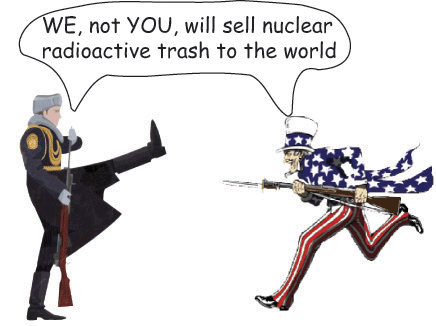 Westinghouse to get new site for Indian nuclear plant – officials,
  Reuters NEW DELHI | BY DOUGLAS BUSVINE AND RUPAM JAIN , 31 May 16 Toshiba Corp’s (6502.T) Westinghouse Electric will relocate a planned project to build six nuclear reactors in India, said officials, bringing the first deal stemming from a U.S.-India civil nuclear accord struck over a decade ago closer to reality.
The six AP-1000 reactors would be built in the southern state of Andhra Pradesh, after the original site proposed for the multi-billion-dollar project, in Prime Minister Narendra Modi’s home state of Gujarat, faced local opposition.
The breakthrough comes ahead of a June 7-8 visit by Modi to Washington, where he will be hosted by President Barack Obama for a final summit before the U.S. presidential election in November, and will address both houses of Congress.
U.S. lawmakers ratified the civil nuclear accord three years after it was struck in 2005, as part of an attempt to deepen the strategic relationship with India, but have expressed growing dismay over its failure to yield follow-on deals for U.S.-based reactor makers like Westinghouse…….
Analysts say resolving the land issue is a crucial step, but complex issues remain, including project financing and reaching a civil nuclear pact with Japan, where Westinghouse parent Toshiba is based…..
Russia’s Rosatom operates two reactors at Kudankulam, in Tamil Nadu, while France’s EDF (EDF.PA) signed a preliminary deal with the state-owned Nuclear Power Corporation of India (NPCIL) [NPCIL.UL] in January to build six reactors at Jaitapur, Maharashtra…..
Two sources, requesting anonymity due to the sensitivity of the matter, confirmed that the site was being acquired for Westinghouse, which plans to build six AP-1000 pressurized water reactors, each with a design capacity of around 1,100 megawatts.
Westinghouse did not respond to requests for comment, while senior executives at NPCIL were not available ………http://www.reuters.com/article/us-india-westinghouse-idUSKCN0YM0L2
Monju: the failing nuclear reprocessing dream
Nuclear Holy Grail Slips Away From Japan With Operator Elusive http://www.bloomberg.com/news/articles/2016-05-31/nuclear-holy-grail-slips-away-from-japan-with-operator-elusive Stephen Stapczynski sstapczynski Emi Urabe
-
Japan to pick a new operator for Monju fast-breeder reactor
-
The prototype plant has cost more than $9 billion amid delays
Japan is missing its own deadline to find a new operator for a prototype nuclear power program that’s failed to succeed in the two decades since it was built, threatening the resource-poor country’s support of a technology other nations have abandoned.
The country’s nuclear regulator demanded in November a replacement for the government-backed Japan Atomic Energy Agency be found within six months for the Monju fast-breeder reactor. Monju, which has functioned for less than a year since its completion more than 20 years ago, now faces the possibility of being scrapped.
The so-called fast-breeder reactor — a cornerstone of its atomic energy strategy dating back to the 1950s — uses spent nuclear fuel from other plants and is designed to produce more atomic fuel that it consumes. The reactor, named after the Buddhist deity of wisdom, has cost the nation more than 1 trillion yen ($9 billion) and has barely operated since it first generated electricity in 1995.
1950s Strategy
Monju is currently operated by the JAEA, a quasi-government organization that is under the Ministry of Education, Culture, Sports, Science and Technology. JAEA declined to comment. The nation’s nuclear watchdog, the Nuclear Regulation Authority, didn’t respond to e-mailed questions regarding the status of Monju.
“We don’t have plans to decommission the reactor,” said Hiroki Takaya, director of the ministry’s International Nuclear and Fusion Energy Affairs Division, which oversees Monju. “We are exploring many different options for who will operate the reactor — either a new entity or an existing company.”
The NRA said in November the science ministry must find a new operator or consider closure. The ministry drafted a set of criteria for a new operator, but have yet to name a replacement, it said on May 27. The ministry hopes to find an operator as soon as possible, but hasn’t set a concrete deadline.
North Korea: Ballistic missile launch fails for the fourth time in recent months, South Korea says
 North Korea appears to have tried and failed with a fresh ballistic missile launch in violation of existing UN resolutions, South Korea’s Defence Ministry said.
Key points:
- The fourth recent attempt to launch the North’s medium-range Musudan missile has failed
- Japan had readied naval destroyers and anti-ballistic missile batteries, media said
- G7 leaders demanded last week that the North refrain from provocative action
Seoul said the missile test took place at 6:30am AEST on Tuesday near the eastern port city of Wonsan.
“The attempted missile launch … is believed to have failed,” a ministry spokesman said……..http://www.abc.net.au/news/2016-05-31/north-korea-ballistic-missile-launch-fails-south-korea-says/7461280
1 This Month





PLEASE OPPOSE HR 8255 AND S.3639 – bills would accelerate satellite deployment, with no environmental review or safeguards – https://ncstd5li.quorum.us/campaign/169331/
To see nuclear-related stories in greater depth and intensity – go to https://nuclearinformation.wordpress.com
-
Archives
- October 2026 (58)
- September 2026 (339)
- August 2026 (330)
- July 2026 (355)
- June 2026 (287)
- May 2026 (306)
- April 2026 (356)
- March 2026 (251)
- February 2026 (267)
- January 2026 (308)
- December 2025 (358)
- November 2025 (359)
-
Categories
- 1
- 1 NUCLEAR ISSUES
- business and costs
- climate change
- culture and arts
- ENERGY
- environment
- health
- history
- indigenous issues
- Legal
- marketing of nuclear
- media
- opposition to nuclear
- PERSONAL STORIES
- politics
- politics international
- Religion and ethics
- safety
- secrets,lies and civil liberties
- spinbuster
- technology
- Uranium
- wastes
- weapons and war
- Women
- 2 WORLD
- ACTION
- AFRICA
- Atrocities
- AUSTRALIA
- Christina's notes
- Christina's themes
- culture and arts
- Events
- Fuk 2022
- Fuk 2023
- Fukushima 2017
- Fukushima 2018
- fukushima 2019
- Fukushima 2020
- Fukushima 2021
- general
- global warming
- Humour (God we need it)
- Nuclear
- RARE EARTHS
- Reference
- resources – print
- Resources -audiovicual
- Weekly Newsletter
- World
- World Nuclear
- YouTube
-
RSS
Entries RSS
Comments RSS

