Radioactive “Glassy Soot” Fell Over Tokyo After the Fukushima Meltdown
It’s science no one wishes was necessary.
Most of the radioactive material that rained down on Tokyo following the meltdown at the Fukushima Daiichi Nuclear Power Plant was encapsulated in glassy microparticles, researchers have found.
The findings, which will be presented on Monday at the Goldschmidt conference in Japan, show that the radioactive fallout from the 2011 earthquake and subsequent nuclear disaster has been poorly understood. Previously, it was assumed that most of the radiation that fell dissolved in rain. This would mean that it would wash out of the soil and through the environment with the hydrologic cycle.
However, what actually happened is that, in the midst of the meltdown, molecules of radioactive caesium and nanoparticles of iron-zinc oxides became embedded in silicon oxide glass. This occurred because of the interaction between the molten core and the concrete containment units.
These tiny glass particles entered the air and fell as soot on the surrounding region. Because the radioactive molecules are contained in an insoluble medium, they will not wash out of the soil with rainwater to the same extent.
“It looks like the clean-up procedure, which consisted of washing and removal of top soils, was the correct thing to do,” says Dr. Satoshi Utsunomiya, who will present the findings on Monday. “However, the concentration of radioactive caesium in microparticles means that, at an extremely localised and focused level, the radioactive fallout may have been more (or less) concentrated than anticipated.”
Beyond the consequences for the environment, there are significant consequences for human health. Breathing caesium encased in glass particles may have a very different impact from exposure to it as radioactive rain, and it may be dangerous at a much higher or lower concentration. The half-life of the material may also depend heavily on the medium.
This information will be valuable in assessing the ongoing impacts the Fukushima disaster. Hopefully, no nuclear meltdown on that scale occurs again, but if one does, this new science will help governments better respond to the crisis.
Tepco admits they concealed the fact of meltdown 7 million Bq of all β nuclides leaked as contaminated water in Fukushima plant

According to Tepco, highly contaminated water leaked from a water storage tank on 6/26/2016.
All β nuclides density is reportedly 96,000,000 Bq/m3. Cs-134/137 density is also 700,000 Bq/m3.
Tepco states the leaked volume was 72 L. Based on their announcement, at least 6,912,000 Bq of all β nuclides leaked to contain Sr-90.
Tepco says no contaminated water spread to the outside of the tank area.
The type of this tank has unwelded joint parts, which is vulnerable for leakage.
The life of these tanks was reported to be 5 years but in 2013 Tepco admitted it has no basis.
These tanks are not bearable for the contaminated water but these are still in use.
http://www.tepco.co.jp/press/mail/2016/1301003_8708.html
http://www.tepco.co.jp/press/mail/2016/1301004_8708.html
http://www.tepco.co.jp/press/mail/2016/1301009_8708.html
Fukushima evacuees made to feel small if they don’t return

Makiko Sekine tends flowers at a public housing unit for disaster survivors in Kawauchi, Fukushima Prefecture, with her husband, Hiroshi, on June 14. That day, the evacuation order was lifted for parts of the village, including the couple’s home district of Kainosaka.
KAWAUCHI, Fukushima Prefecture–In a rush of sorts, evacuation orders are being lifted from municipalities of this northeastern prefecture that were affected by the 2011 nuclear disaster.
The order was lifted for part of the village of Katsurao on June 12, followed by an area of Kawauchi village on June 14. It will be lifted for a section of Minami-Soma city on July 12.
The central government has decided to have all evacuation orders lifted by March next year, except for in “difficult-to-return” zones where radiation levels remain elevated.
Prime Minister Shinzo Abe, having toured Katsurao and Kawauchi on June 3, said, “I want to make sure that the livelihood of the communities, as well as family and community ties, is revived as soon as possible.”
Having covered news in Fukushima Prefecture for four years, I cannot believe that everything is so rosy simply because evacuation orders are being lifted.
It is certainly good news that disaster-affected areas are becoming freely accessible again, but I know that some residents are being left behind in the process.
Hiroshi Sekine, 88, and his wife, Makiko, 81, a couple I have known for three years, are from the Kainosaka district of Kawauchi, where the evacuation order has been lifted.
They moved there from the neighboring city of Iwaki in 1959, five years before the first Tokyo Summer Olympic Games.
Deep within the mountains far from the center of the village, the couple reclaimed wasteland and turned it into farmland. They raised four children.
The Sekines, who now live in a public housing unit for disaster survivors elsewhere in Kawauchi, said they are not returning home.
Before the nuclear disaster, Kainosaka, home to 13 households, functioned as a small “community” where people helped out each other.
After five years spent in evacuation, the couple no longer have the energy to restart life in their inconveniently situated home district.
Even if they returned, they would be unable to sustain their life because nobody else is going back to Kainosaka.
“The lifting of the evacuation order is about deregulation,” a central government official told the Sekines. “It is up to you to decide whether you are going back or not.”
Once the evacuation order is lifted, however, the couple’s status switches from “those being forced by the central government into evacuation” to “those choosing to remain in evacuation despite having the option of returning.”
This new status will oblige them to feel apologetic, wary of what others may think of them.
The lifting of evacuation orders scheduled through next spring will allow around 46,000 people to return to their homes.
But many communities, like the Kainosaka district, will never be like what they were before.
How can we prevent people like the Sekines from being made to feel small because the evacuation order has been lifted? That is a complicated question about moral dignity, which cannot be solved with cash.
The Law on Special Measures for the Reconstruction and Revitalization of Fukushima was enacted a year after the onset of the nuclear disaster.
The law designates only “people who have been evacuated from zones under evacuation orders” and “people who have moved back to zones where evacuation orders have been lifted” as those entitled to coverage under the central government’s measures for “ensuring stability.”
When the law was enacted, nobody expected the cleanup of radioactive substances to take so long that it would delay the lifting of the evacuation orders, and that so many residents would choose not to return home after the orders are lifted, a central government official said.
The Sekines will be obliged to continue to live a life different from the one they had before the disaster.
I think people like the Sekines should be given the clearly defined status of “evacuees” by, for example, legally guaranteeing them the right to remain in evacuation.
India stopped by China, from joining Nuclear Suppliers Group
China maintains its opposition to India joining a group of nations seeking to prevent the proliferation of nuclear weapons by controlling access to sensitive technology, said the head of the arms control department in China’s Foreign Ministry.
The Nuclear Suppliers Group (NSG) met this week in Seoul, but China said it would not bend the rules and allow India membership as it had not signed the nuclear Non-Proliferation Treaty (NPT), the main global arms control pact.
“Applicant countries must be signatories of the Treaty on the Non-Proliferation of nuclear weapons (NPT),” Wang Qun, the head of arms control department in China’s Foreign Ministry, was quoted as saying in Seoul on Thursday night.
“This is a pillar, not something that China set. It is universally recognized by the international community,” Wang said according to a statement released by the Chinese foreign ministry on Friday.
Opponents argue that granting India membership would further undermine efforts to prevent proliferation. It would also infuriate India’s rival Pakistan, an ally of China’s, which has responded to India’s membership bid with one of its own.
Pakistan joining would be unacceptable to many, given its track record. The father of its nuclear weapons program ran an illicit network for years that sold nuclear secrets to countries including North Korea and Iran. http://www.reuters.com/article/us-india-nuclear-china-idUSKCN0ZA0IF
Fukushima nuclear meltdown was covered up, plant operator admits
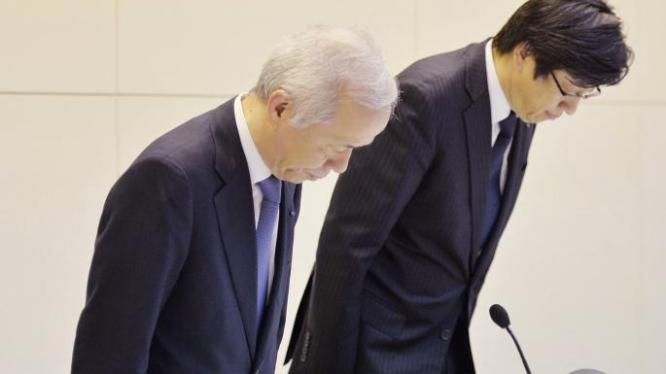
Naomi Hirose, left, TEPCO president, and Takafumi Anegawa, a director, apologise at press conference in Tokyo today
The company responsible for the Fukushima Dai-ichi nuclear power plant has admitted lying about the meltdown of its reactors five years ago, in a deliberate cover-up of the world’s second worst nuclear disaster.
It took two months for the Tokyo Electric Power Company (Tepco) to own up to the meltdown of three reactors after an earthquake and tsunami. A report commissioned by the company says that its president at the time ordered employees to speak of “damage” to the reactors and avoid the world, “meltdown”.
The company’s current president, Naomi Hirose, said: “It is extremely regrettable People are justified in…
No accountability in nuclear industry
Following the June 16 quake in Hakodate, Hokkaido, nuclear plant operators in the area reported no damage, but even if there were problems, because of Prime Minister Shinzo Abe’s new anti-democratic secrecy law, they would not necessarily report them, nor would they feel any compunction to do so. The Nuclear Village Idiots can cover their backsides very nicely with this new secrecy law.
Public safety is hardly a concern of politicians or the nuclear power plant owners. Japan’s very much a totalitarian state once again. It simply uses democratic-sounding titles to cover up the true authoritarian nature of the government and senior industrial officials. It’s Tojo’s Japan with velvet gloves. Let’s hope the gloves never come off.
ROBERT MCKINNEY
OTARU, HOKKAIDO
http://www.japantimes.co.jp/opinion/2016/06/25/reader-mail/no-accountability-nuclear-industry/
Japan Could Go Nuclear ‘Virtually Overnight’ Joe Biden Tells Chinese President

This undated picture released from North Korea’s official Korean Central News Agency (KCNA) on June 23, 2016 shows a test launch of the surface-to-surface medium long-range strategic ballistic missile Hwasong-10 at an undisclosed location in North Korea.The Musudan — also known as the Hwasong-10 — has a theoretical range of anywhere between 2,500 and 4,000 kilometres (1,550 to 2,500 miles).
U.S. Vice President Joe Biden, never one for a loss of words, told Chinese President Xi Jinping that Japan has the capacity to acquire nuclear weapons “virtually overnight.”
Biden made his disclosure while giving a speech at a Public Broadcasting Service program aired on Monday. Biden said he had urged Xi to exert influence on North Korea so it will abandon its missile and nuclear weapons developments.
Referring to North Korea’s recent nuclear test and missile launches in violation of U.N. Security Council resolutions, Biden said that if China and the U.S. fail to take effective action against North Korea, “What happens if Japan, who could go nuclear tomorrow? They have the capacity to do it virtually overnight.” Biden did not say when his conversation with Xi took place.
Biden said that China had the single greatest ability to influence North Korea, adding that North Korea is building nuclear weapons that can strike as far away the U.S. mainland.
“And I say, so we’re going to move up our defense system,” the vice president added, referring to the U.S. plan to deploy THADD (Terminal High Altitude Area Defense), an advanced missile interception system, in South Korea.
Biden quoted Xi as saying, “Wait a minute, my military thinks you’re going to try to circle us.” Earlier this month China said that deploying THADD infringes on China’s strategic interests.
The fact that Japan can easily develop nuclear weapons, however, isn’t the issue but the fact that Biden chose to tell Xi this is worthy of note, both in the context of North Korea’s nuclear ambitions and given Biden’s history of frequently making gaffes.
Tepco’s “sincere”apology!!!
With Tepco it is always the same song, they apologize for a long ago previous lie and tell the whole world how very very sorry, repenting they are, while they daily continue lying and covering-up the true happenings at Fukushima Daiichi.
FUCK TEPCO!
Press Release (Jun 21,2016)TEPCO APOLOGIZES FOR PREVIOUS LEADERSHIP’S FAILURE TO ACKNOWLEDGE MELTDOWN DURING FUKUSHIMA ACCIDENT
Responding to recent report of an investigating committee, TEPCO restates its commitment to provide comprehensive, accurate and understandable information, while making safety the utmost priority to ensure a safe and secure society
TOKYO, June 21, 2016 In its first response to the June 16 report of the committee investigating the belated acknowledgment that a meltdown had taken place at Fukushima Daiichi NPS in March 2011, TEPCO said it is clear from the report that its previous leadership gave instructions not to use the word “meltdown” in public statements.
“We deeply regret that our previous leadership failed to live up to the standards of transparency and thoroughness that we strive to meet today,” said TEPCO President Naomi Hirose (who was not the company’s leader at the time of the accident). “We sincerely apologize for it,” he said.
In more recent years, through the creation of the Nuclear Reform Monitoring Committee and many other changes, TEPCO has worked to improve the timeliness, thoroughness, and clarity of its communication with the public, both inside Japan and internationally. President Hirose stressed that TEPCO has been learning this lesson and breaking from its past, as it works to build trust with the public and with government through the implantation of its Nuclear Safety Reform Plan. Improvements in communication represent an important element of that Plan, which is overseen both by the company’s Nuclear Safety Oversight Office and by an independent Nuclear Reform Monitoring Committee chaired by the former head of the U.S. Nuclear Regulatory Commission.
“We deeply regret the shortcomings of the past,” President Hirose said, “but it is important to recognize that they do not represent the TEPCO of today while making safety the utmost priority to ensure a safe and secure society.”
http://www.tepco.co.jp/en/press/corp-com/release/2016/1300509_7763.html
To carry better the Fukushima radioactive water into the ocean

New Drainage Channels Start Operations at Fukushima Daiichi Nuclear Power Station
More Drainage “Improvements” at Fukushima Daiichi: In advance of typhoon season, rainwater drainage has been further improved by the construction of a new drainage channel. The channel runs between Units 5-6 and the cluster of Units 1-4. It carries water into two drainages, both of which empty into the protected port area and not the open ocean. The new channel helps manage the increased runoff that results from extensive hard-surfacing that has been done to reduce radiation, prevent rainwater from seeping into the ground, and in turn “improve the environment”.
http://www.tepco.co.jp/en/news/library/archive-e.html?video_uuid=tq4l2aqa&catid=69631
Living with radiation in Fukushima
In Iwaki city, Fukushima, the Tarachine “screening center” is a fully independent citizen laboratory, well equipped and employing qualified technicians to help the Fukushima population with anything involving radiation measuring or contamination testing.

For a minor fee people can come to the Tarachine screening clinic to have their foods tested, but also their house lot soil tested, or even the vacuumed dust of their house tested.
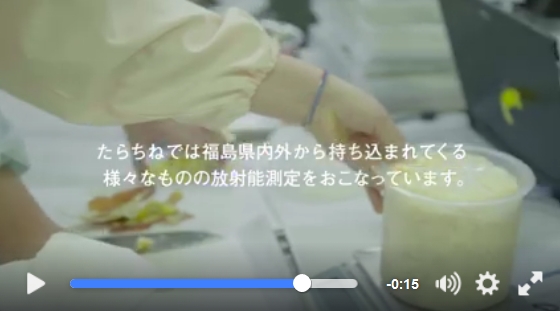
The Tarachine screening center fulfill a very important role for the Fukushima families, as families do not have the means to acquire all the necessary expensive equipment nor the technical qualifications.

As the Japanese government does not provide such vital service nor could be trusted with radiation measure numbers, some citizens organized themselves to set up such laboratories. There are at present about 100 such laboratories which have spread up, but Tarachine is certainly the most efficient and fully equipped for various types of radiation measures.
For example, since in a lot of places very young children cannot anymore play outside safely, but are kept to play indoors, it is therefore vital for the mothers to constantly control the level of contamination inside their house, thus they bring to the Tarachine center their vacuumed dust to be measured.

As an example this mother having brought her house vacuumed dust to be analyzed learned that it is contaminated by 4400 Bq/kg of Cesium 137, 718 Bq/kg of Cesium 134 and 1950 Bq/kg of Potassium 40, thus a total contamination of 5158 Bq/kg. The levels of Cesium 137 and Cesium 134 have too high, 4 times higher than the advised contaminated threshold and could therefore be harmful to the persons living in that house, especially for children.
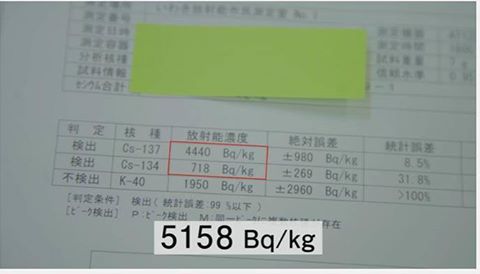
As a comparison, you may see vaccumed dust from 3 different locations, one in Iwaki, Fukushima, one in Chiba, nearby Tokyo, and one in Vancouver, British Columbia,Canada:
Vacuum House Dust in Fukushima (Iwaki)
Cs 137 4440 Bq/kg
Cs 134 718 Bq/kg
Vacuum House dust in Chiba (Makuhari)
Cs 137 137Bq/kg(± 2%)
Cs 134 27Bq/kg(± 5%)
Vacuum House dust in Vancouver, BC
Cs 137 <1.08Bq/kg
Cs 134 <0.86bq/kg
The Japanese government during the past 5 years has constantly lied to the Fukushima population about the harmful radiation risks, condemning the people to stay and live with radiation. Consequently citizens have learned to rely only on their own for radiation measuring and protection.
https://www.actbeyondtrust.org/campaign/pledge/tarachine/jp/
Contact adress: Tarachine Screening center
Onahama hanabatake-cho 11-3, Iwaki city, Fukushima Prefecture, Japan
Tel: 0246‐92‐2526
Japanese utility begins loading fuel at reactor for late July restart

MATSUYAMA, EHIME PREF. – Shikoku Electric Power Co. started loading nuclear fuel Friday into a reactor at its Ikata power plant, paving the way for a scheduled restart next month.
The utility plans to reactivate the No. 3 unit at the plant in Ehime Prefecture on July 26. The company envisions beginning electricity generation three days later and resuming commercial operation in mid-August.
The pressurized-water reactor using uranium-plutonium mixed oxide, or MOX, fuel, will be the fifth unit to be reactivated under tougher regulations introduced in the wake of the 2011 Fukushima nuclear disaster.
Ehime Gov. Tokihiro Nakamura said he hopes the reactor operator will make safety a high priority. Safety concerns remain, however, as the plant on the island of Shikoku is situated near a fault zone.
A group of local residents filed a suit in May seeking an injunction to halt the restart, arguing that strong earthquakes that have hit central parts of Kyushu may affect the fault and trigger further temblors. The plant is about 170 km (105 miles) east of Kumamoto Prefecture, the epicenter of the recent quakes.
The reactor, whose operation began in 1994, was suspended in April 2011 for a regular inspection after the March 2011 earthquake-tsunami and nuclear disasters.
The Nuclear Regulation Authority last July approved Shikoku Electric’s enhanced safety measures against possible earthquake and tsunami hazards as well as other major accidents prior to the restart.
The company started on-site preoperational checks of the unit in April, the last procedure toward reactivation.
On Friday, about 20 local residents shouted, “No to restart” near the power plant, saying the reactors should be decommissioned.
“I can’t believe the reactor is restarted even though the Fukushima No. 1 nuclear power plant of Tepco has not been contained,” said Takashi Hasebe, 62, who is a member of a citizens’ group opposed to Ikata’s restart. “We can’t stop natural disasters but we can stop nuclear power plants.”
But local businesses want them to be restarted in hopes of boosting the local economy.
“If the reactors won’t be restarted, our town would be depopulated even more,” said Tomokatsu Shinozawa, 55, who runs a Japanese inn in the town of Ikata. “I want it to be restarted as soon as possible.”
Another male farmer, 64, pointed out that spent nuclear fuel would be stored whether or not they are restarted.
“It’s dangerous one way or the other,” he said. “If that’s the case, it’s better to restart it making sure that it’s safe.”
USA promotes a nuclear arms race in Asia, by Supporting India’s entry to Nuclear Suppliers Group
 Promoting a nuclear race?, Business Recorder June 23, 2016 IKRAM SEHGAL India clandestinely diverted nuclear fuel from the Canadian supplied civilian nuclear reactor in Tarapur for conducting its nuclear test in 1974. Created in 1974 as a direct result of the Indian subterfuge, the Nuclear Suppliers Group (NSG) was meant to prevent in future what India had done, being tasked with regulating nuclear commerce for civilian uses and preventing proliferation of nuclear weapons.
On the back of the US-India nuclear deal in 2008, the Bush Administration applied immense political pressure to exempt India from the NSG’s rules on civilian nuclear trade when it was under US sanctions for proliferation activities. This double standards waiver was engineered when Pakistani’s letter vehemently objecting to it was suddenly and surprisingly withdrawn in Vienna during NSG deliberations at the last minute on the express telephonic instructions from President Asif Zardari. This unparalleled “personal” initiative appeased the US and India but it destroyed the original concept of the NSG and cost Pakistan dearly. It “officially” allowed India to expand its arsenal massively by using imported fuel for civilian nuclear reactors and replenish stocks for weapon production. “Harvard’s Belfer Center” and US think tank “Arms Control Today” confirmed that this defeated the very purpose why the NSG was created in the first place.
What about nuclear balance in South Asia? In an article published by the International Committee of the Fourth International (ICFI), in September 2008 the writers correctly assessed that, “The action the NSG has been goaded into taking by the US has immense and incendiary strategic implications for South Asia, tilling the balance of power between India and its historic rival Pakistan sharply in India’s favour. It also rubbishes the basic principle of the nuclear regulatory regime the US championed earlier that States which pursue nuclear weapons will be “punished” by an embargo on all nuclear trade and those that adhere to the NPT will, in return, be assisted in developing civilian nuclear energy. And, as was foreshadowed in the events at the NSG meeting itself, it will intensify and complicate the ongoing and ever more explosive rivalry amongst the big powers for markets, raw materials, and geo-strategic advantage.”
A Senate hearing on 24 May saw US Senator Markey saying something extremely relevant, “Since 2008 when (we) also gave them an exemption, India has continued to produce fissile material for its nuclear weapons programme virtually un-checked. At that time Pakistan warned us that the deal would increase the chances of the nuclear arms race in South Asia”. Some countries, led by China and Turkey, are resisting this pressure on principle, arguing that if any exception to the rules is made, it should apply equally to both India and Pakistan. Since all 48 member NSG decisions are made by consensus, even one member can block a decision.
India has not honoured its limited commitments under the international non-proliferation regime that earned it the 2008 waiver, adhering to limited IAEA Additional Protocol as well as US laws (Hyde Act) for transparency in use of imported fissile material, agreeing to a moratorium on fissile material production for weapons use; signing and ratifying the CTBT and putting a cap on its nuclear weapons production. In the face of these obvious deficiencies, allowing India NSG membership will intensify the nuclear/strategic arms race in South Asia, undermine NSG’s credibility and will give India the legitimacy of a nuclear weapon state. Bent on using India as a counterweight to China, the US must realise the dangerous confrontation that will erupt in South Asia………http://www.brecorder.com/articles-a-letters/187/59532/
Safety issues at Taishan Nuclear Plant in China’s Guangdong

 Issues at Taishan Nuclear Plant in China’s Guangdong Spark Safety Fears Radio Free Asia, 23 June 16 Reported by Lam Kwok-lap for RFA’s Cantonese Service. Translated and written in English by Luisetta Mudie. Design flaws in a French-built nuclear reactor currently being tested at a power station on the southern coast of China have sparked safety concerns in neighboring Hong Kong, experts and local media reports said.
The U.S.$8.3 billion Taishan plant is among the first in the world to use European pressurised reactors (EPR) designed by French nuclear firm Areva, which recently sold a majority stake to energy giant Electricite de France (EDF).
Problems with the design of the reactors have emerged during testing, however, and were cited by EDF in a recent recommendation to the U.K. parliament that it postpone the Chinese-invested Hinkley Point nuclear plant, which had also planned to use EPR technology.
In a letter to U.K. lawmakers earlier this month, EDF said there may be “identical flaws” in the Taishan power plant, which lies just 160 km (100 miles) from the densely populated Pearl River Delta region, which includes Hong Kong.
Meanwhile, prolonged delays to an EPR reactor at Olkiluoto in Finland have resulted in multibillion-euro litigation between Areva and the Finnish energy group TVO. While Taishan has already postponed its scheduled opening by one year to 2018 after the discovery of too much carbon in the walls of the reactors, officials are still pushing for the plants to go ahead as planned, campaigners said in Hong Kong this week.
Last month, the concrete shells encasing the plant’s two pressure reactors were sealed, according to drone images gathered by Hong Kong’s crowd funded investigative news agency FactWire, which means that the EPR units can’t be removed or replaced now.
The amount of radioactive nuclear fuel stored at the Taishan plant is three times that of Japan’s Fukushima nuclear plant, campaigner Albert Lai told the agency.
50 million people
Lai fears that some 50 million people would be affected in the event of a large-scale nuclear leak, across a 7,000 square km area.
“There have been so many trust issues, that a lot of people now believe that quality control at this nuclear power plant is below standard,” engineer and sustainability campaigner Albert Lai, who convenes the Hong Kong think tank Professional Commons, told RFA on Thursday.
“What’s more, the problems are much more serious than we thought they were,” he said, citing a scandal over the falsification of parts forged at Areva’s Le Creusot facility that potentially put safety checks at risk………China General Nuclear has already posponed the opening of Taishan Unit 1 and Taishan Unit 2 to the first and second half of 2017 respectively, but FactWire reported, citing French engineers, that Unit 1 still required a large amount of tests, and the earliest it could start was 2018……..http://www.rfa.org/english/news/china/china-nuclear-06232016125814.html
Business analysts do not share the optimism of Toshiba’s new CEO, on nuclear power
 Toshiba’s new CEO sticks to nuclear target branded ambitious by analysts http://www.thefiscaltimes.com/latestnews/2016/06/23/Toshibas-new-CEO-sticks-nuclear-target-branded-ambitious-analysts Fiscal Times, 23 June 16, “Its achievable,” Satoshi Tsunakawa told reporters on Thursday, a day after assuming the top post, when asked about the company’s goal of building 45 nuclear power reactors globally by the business year ending March 2031….
When France uses Charles Aznavour to trivialize Fukushima

June 22, 2016 / Mathieu Gaulène (Reporterre)
Translated by Hervé Courtois (D’un Renard)
From our correspondant in Tokyo, Japan
Last week, the Embassy of France in Tokyo, Japan organized a “friendship dinner” to promote agricultural products from Fukushima. In this great communication exercise, the main purpose was to “serve the interests of France in Japan”, that is by defending the nuclear industry.
” The oceans are garbage dumps, the seabeds are soiled, smultiple Chernobyls are seeing fetuses stillborn”, sang in 2009 Charles Aznavour in “The Earth dies”.
Yet at the Embassy of France in Tokyo, Friday, June 17, at a dinner during which he was the guest of honor, it was another song that was sung to the the nonagenarian by the Ambassador Thierry Dana. In partnership with Fukushima Prefecture and the Aeon supermarkets chain, the Embassy of France organized within its walls a great event for the promotion of agricultural products from Fukushima. Some “delicious dishes” were prepared and served by the chef of the Embassy to the handpicked guests.

Charles Aznavour with Ambassador Thierry Dana
This is not the first time that the Embassy of France is actively promoting the nuclear industry and minimizing the risks following the Fukushima accident.
The former minister-counselor had even told us point blank, in 2013, that the main role of the embassy was “to serve the interests of France in Japan, that is to say nuclear.”
“We want to end this drama with this event”
But with this event, a new milestone was reached in the promotion of nuclear power, assumed and uninhibited: an outright negation of the health consequences of this disaster on the region. For, under the guise of a pseudo “friendship” with the people of Fukushima, singularly absent from the reception, the dinner was above all a great exercise in communication.
“We want to end this drama with this event,” explains a communication officer before the press conference starts. And to end the debate about radioactivity? “We do not want to present things like that …” she begins, before going elsewhere. And indeed, the ambassador of France, Thierry Dana, achieved the feat of making a speech on Fukushima never saying the words “nuclear accident” or “radioactivity”. He should have thought about it strongly, however when talking about “unfounded rumors on products that are both delicious and safe for health” [1]. When the phrase was translated into Japanese, Masao Uchibori, governor of Fukushima, and Tsuyoshi Takagi, Minister for Reconstruction, nodded, visibly satisfied that France plays its role of stooge in this case.

Masao Uchibori, the governor of Fukushima, Thierry Dana and Tsuyoshi Takagi, the Minister for Reconstruction (left to right), Friday, June 17, at the Embassy of France in Tokyo.
When we questioned the ambassador on the left unspoken and the danger or irresponsibility, to promote products from a contaminated region, in the time allotted to us – 5 minutes for questions of the journalists in a “press conference” of 1 hour 15 – he made a well-rehearsed reply: “Our goal is to enlighten the people who do not know, and as your question proves, we must continue to promote these products which are safe, and to eat them”, before to hand us theatrically before the cameras of TV Asahi, a cucumber from Fukushima.
Stay and learn to live with radioactivity
Indeed, explains Mr. Uchibori, who’d like also to answer us, tests are performed on products such as rice, and a maximum of 100 becquerels per kilogram of radioactivity has been set since 2012 for vegetables and fruits – In the first months, the threshold was set at 500 becquerels.
But even if these tests were systematic, which is not the case for all vegetables, food from Fukushima often contain low doses of radioactive particles. Even water from Tokyo tap still contains traces of cesium 134 and 137. Now we know that the radioactivity is more harmful when internal and repeated. Ingested, radioactive particles accumulate and can cause cancer, weakened immune system and various diseases.
On location, a hundred citizens laboratories were created to verify the content of radioactivity in food after food. A practice that could become over the years horribly banal: the life of radioactive elements is measured in decades or even thousands of years for plutonium.

A selection of products, among which mushrooms, from Fukushima.
The presence of Aeon, first supermarket chain of the Japanese archipelago, as a partner of this event is more significant. The company is very engaged with the Fukushima Prefecture in the denial of the radioactive risk. In August, 2011, Aeon was the center of a scandal after it sold in its Tokyo supermarkets several hundred kilos of Minamisoma beef, whose radioactive cesium content was three to six times higher than normal. The company president, Mr. Okada, although present at the press conference and dinner, has been inconspicuous. And yet he seems to have been the main architect of this event.

A candlelight dinner, to the invisible radioactivity.
“Mr. Okada and Mr. Dana met upstream, and the ambassador has generously offered to host this event,” explains the director of communication of Aeon. Okada knows well indeed the ambassador, who presented him with the Legion of Honor in December 2015. Mr. Yasuhide Chikazawa, vice- president of Aeon, participated in the Ethos program in 2013. The Ethos program, benefiting from significant EU subsidies had already been set up in Chernobyl, and seeks nothing less than to encourage residents of contaminated areas with radioactivity to stay and to learn to live with it, because their evacuation is considered too expensive.
Free trade agreements between Japan and the European Union
A program that appears to have paid off as in the town of Tamura, highly contaminated but open to refugees since April 2014, small school children are taught about radioactivity and agricultural activities, professed by Ms. Yukiko Okada, of the atomic energy laboratory of the University of Tokyo city.
Since 2012, Aeon began to flood its supermarkets with products from Fukushima, at bargain prices.
For if the apology of products coming from an area that experienced a nuclear disaster is a first for France, in Japan, advertisements for Fukushima products orchestrated by Dentsu advertising, are permanent. [2] Aeon, well developed in the rest of Asia, has also started to export these products to other countries. And tomorrow, to Europe?

The Japanese seem to think about it very much. The Minister of Reconstruction, Mr. Takagi, laments, “Unfortunately, there are still countries or regions in the world who refuse to import products from Fukushima. ” But that could change. Since January 2016, the European Commission has facilitated the importation stopping simply to require radioactivity test certificates for most fruits and vegetables, tea or beef from Fukushima.
This facilitation, far from health considerations, was in fact granted under free-trade agreements being between Japan and the EU. In short, the EU condones products from Fukushima in exchange for lower tariffs in Japan for pork, cheese or wine exports. This “friendship dinner” might be just one of the final steps in those trade negotiations.
[1] The term “rumors” is a language element very quickly adopted by the Japanese government. From March 2012, the Japanese Embassy in France had sent to all French journalists writing about this country, a press release entitled “Fight against harmful rumors.” “To come to Japan and buy Japanese products, including those produced in the affected areas, is the best support for reconstruction that can be provided,” it read.
2] On the role of Dentsu the advertising giant in the promotion of nuclear power, you may read this article: http://www.inaglobal.fr/television/article/le-publicitaire-dentsu-tire-t-il-les-ficelles-des-medias-japonais-9000
Source: https://reporterre.net/Quand-la-France-se-sert-de-Charles-Aznavour-pour-banaliser-Fukushima
1 This Month





PLEASE OPPOSE HR 8255 AND S.3639 – bills would accelerate satellite deployment, with no environmental review or safeguards – https://ncstd5li.quorum.us/campaign/169331/
To see nuclear-related stories in greater depth and intensity – go to https://nuclearinformation.wordpress.com
-
Archives
- October 2026 (49)
- September 2026 (339)
- August 2026 (330)
- July 2026 (355)
- June 2026 (287)
- May 2026 (306)
- April 2026 (356)
- March 2026 (251)
- February 2026 (267)
- January 2026 (308)
- December 2025 (358)
- November 2025 (359)
-
Categories
- 1
- 1 NUCLEAR ISSUES
- business and costs
- climate change
- culture and arts
- ENERGY
- environment
- health
- history
- indigenous issues
- Legal
- marketing of nuclear
- media
- opposition to nuclear
- PERSONAL STORIES
- politics
- politics international
- Religion and ethics
- safety
- secrets,lies and civil liberties
- spinbuster
- technology
- Uranium
- wastes
- weapons and war
- Women
- 2 WORLD
- ACTION
- AFRICA
- Atrocities
- AUSTRALIA
- Christina's notes
- Christina's themes
- culture and arts
- Events
- Fuk 2022
- Fuk 2023
- Fukushima 2017
- Fukushima 2018
- fukushima 2019
- Fukushima 2020
- Fukushima 2021
- general
- global warming
- Humour (God we need it)
- Nuclear
- RARE EARTHS
- Reference
- resources – print
- Resources -audiovicual
- Weekly Newsletter
- World
- World Nuclear
- YouTube
-
RSS
Entries RSS
Comments RSS

