Japan business lobby says Abe govt can’t rely on nuclear energy
Japan‘s use of nuclear power is unlikely to meet a government target of returning to near pre-Fukushima levels and the world’s No.3 economy needs to get serious about boosting renewables, a senior executive at a top business lobby said.
Under Prime Minister Shinzo Abe’s energy policies, nuclear is supposed to supply a fifth of energy generation by 2030, but Teruo Asada, vice chairman of the Japan Association of Corporate Executives, said Japan was unlikely to get anywhere near this.
The influential business lobby has issued a proposal urging Tokyo to remove hurdles for renewable power amid the shaky outlook for nuclear power after the 2011 Fukushima disaster.
The move shows how business attitudes are now shifting as reactor restarts get held up by legal challenges, safety issues and public scepticism.
“We have a sense of crisis that Japan will become a laughing stock if we do not encourage renewable power,” said Asada, who is also chairman of trading house Marubeni Corp.
Long dependent on imported fossil fuels, Japan’s government and big business actively promoted nuclear energy despite widespread public opposition.
The government wants nuclear to make up 20-22 percent of electricity supply by 2030, down from 30 percent before Fukushima. So far, however, only two out of 42 operable reactors have started and the newly elected governor of the prefecture where they are located has pledged to shut them.
Renewables supplied 14.3 percent of power in the year to March 2016 and the government’s 2030 target is 22-24 pct.
“In the very long term, we have to lower our dependence on nuclear. Based on current progress, nuclear power reliance may not reach even 10 percent,” said Asada, adding the association wanted measures to encourage private investment in renewables and for public funding of infrastructure such as transmission lines.
The influential business lobby has a membership of about 1,400 executives from around 950 companies.
Andrew DeWit, a professor at Rikkyo University in Tokyo focusing on energy issues, said the push signaled “a profound change in thinking among blue-chip business executives.”
“Many business leaders have clearly thrown in the towel on nuclear and are instead openly lobbying for Japan to vault to global leadership in renewables, efficiency and smart infrastructure.”
When asked about the association’s proposals, an industry ministry official said the government was maintaining its nuclear target.
“The Japanese government will aim for the maximum introduction of renewable energy but renewable energy has a cost issue,” said Yohei Ogino, a deputy director for energy policy.
But three sources familiar with official thinking told Reuters in May that Japan will cut reliance on nuclear power when it releases an updated energy plan as early as next year.
Following the nuclear reactor meltdowns at Fukushima in 2011, Japan has had some success in overcoming one of the world’s worst peacetime energy crises, partly due to lower oil prices and liquefied natural gas (LNG) prices.
Japan has also promoted renewables but most investment has been in solar and in recent years it has cut incentives.
“There are too many hurdles for other sources of renewable power,” Asada said.
http://uk.reuters.com/article/japan-energy-idUKL4N19N1D4
TEPCO admits that ice wall will not stop groundwater from entering crippled Fukushima Daiichi reactor buildings
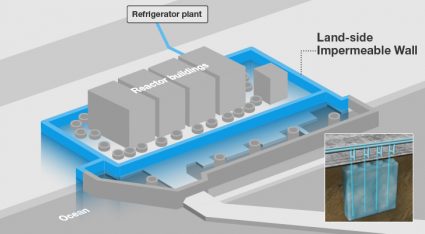
This week TEPCO officials at a meeting with officials from the Nuclear Regulation Authority in Japan admitted that the ice wall they promoted as an impermeable barrier to prevent groundwater from entering the crippled reactor buildings and mixing with highly radioactive water has failed to work as billed and is technically incapable of blocking off groundwater.
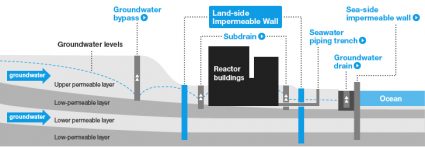
The Fukushima Daiichi nuclear power plant continues to be overwhelmed by enormous amounts of contaminated groundwater that is generated every day as it mixes and interacts with contaminated water in the basement of the reactor buildings. Currently 400 tons of groundwater flows into the damaged reactor buildings every day and mixes with the highly radioactive water in the basements.

TEPCO had developed the ice wall and installed subdrain wells around the reactor buildings to pump up the contaminated groundwater, treat it, and discharge it into the Pacific Ocean, in the hopes that it would reduce the amounts of contaminated water generated every day. The wall consists of a series of underground refrigeration pipes that freeze the soil around them.
Before installation of the wall, TEPCO described the project to the public, saying, “We will create an impermeable barrier by freezing the soil itself all the way down to the bedrock that exists below the plant. When groundwater flowing downhill reaches this frozen barrier it will flow around the reactor buildings, reaching the sea just as it always has, but without contacting the contaminated water within the reactor buildings.”
The ice wall began operating in March of this year, but has not yet made a meaningful impact on reducing the amount of groundwater that enters the reactor buildings.
Experts are concerned that the increasing levels of highly radioactive water in the reactor buildings could escape into the local environment in the event of heavy rainfall or a tsunami.
Radiation levels in seabed off Fukushima ‘100s of times’ higher than prior to disaster – Greenpeace
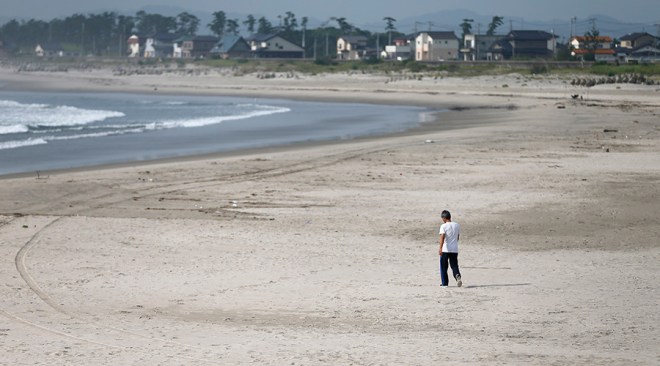
A man walks at the empty Yotsukura municipal beach in Iwaki, about 40 km (25 miles) south of the tsunami-crippled Fukushima Daiichi nuclear power plant, Fukushima
The amount of radioactive substances in seabed off Fukushima is hundreds of times higher than before the disaster, a report issued by Greenpeace reveals. The figures mean that there is absolutely “no return to normal after nuclear catastrophe” in the area.
On Thursday, the environmental group released a report addressing the results of the study during which scientists analyzed radioactivity levels along Fukushima’s rivers and in the Pacific seabed off the coast.
“These river samples were taken in areas where the [Prime Minister Shinzo] Abe government is stating it is safe for people to live. But the results show there is no return to normal after this nuclear catastrophe,”said Ai Kashiwagi, Energy Campaigner at Greenpeace Japan.
The report showed there is hundreds of times more radioactive substances in the seabed off Fukushima coast than there was prior to 2011. It also stated that the level of hazardous materials along local rivers is 200 times higher compared to the Pacific Ocean seabed.
“The extremely high levels of radioactivity we found along the river systems highlights the enormity and longevity of both the environmental contamination and the public health risks resulting from the Fukushima disaster,” Kashiwagi said.
The vast territories including contaminated forests and freshwater systems “will remain a perennial source of radioactivity for the foreseeable future,” scientists warned in the press release.
They analyzed the level of radioactive materials, such as Cesium-134 and Cesium-137 (Cs-137), noting a colossal increase in the figures.
While the amount of Cs-137 in seabed near the Fukushima plant was only 0.26 Bq/kg prior to the nuclear disaster, the current number stands at 120 Bq/kg, the report showed. On the whole, the data showed that Cs will pose a threat to human health for hundreds of years to come.
“The radiation levels in the sediment off the coast of Fukushima are low compared to land contamination, which is what we expected and consistent with other research,” said Kendra Ulrich, senior global energy campaigner at Greenpeace Japan.
The current site of the destroyed plant “remains one of the greatest nuclear threats” to Fukushima communities and the Pacific Ocean, the group said.
“The hundreds of thousands of tonnes of highly-contaminated water, the apparent failure of the ice wall to reduce groundwater contamination, and the unprecedented challenge of three molten reactor cores all add up to a nuclear crisis that is far from over,” said Ulrich.
Greenpeace also warned against the government’s decision to lift a number of evacuation orders around the Fukushima plant by March 2017.
The Fukushima Daiichi nuclear disaster, the largest since the 1986 Chernobyl disaster, took place in March 2011 and resulted in three nuclear meltdowns and a leak of radioactive materials. The accident prompted a nationwide shutdown of all nuclear power plants in Japan with Sendai being the first to start working again, in August 2015.
https://www.rt.com/news/352628-fukushima-radiation-seabed-greenpeace/
Japanese business community wants renewable power, losing faith in nuclear power
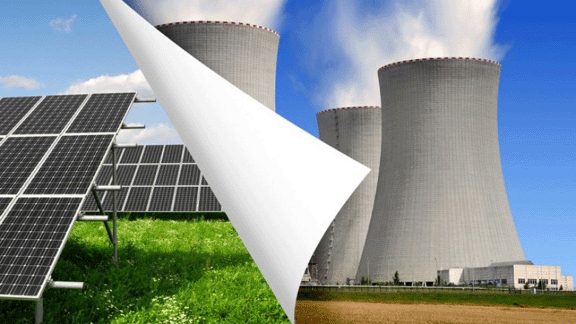
 Japan business lobby says Abe government can’t rely on nuclear energy http://www.reuters.com/article/us-japan-energy-idUSKCN1020XH TOKYO | BY OSAMU TSUKIMORI AND AARON SHELDRICK, 22 July 16 Japan’s use of nuclear power is unlikely to meet a government target of returning to near pre-Fukushima levels and the world’s No.3 economy needs to get serious about boosting renewables, a senior executive at a top business lobby said.
Under Prime Minister Shinzo Abe’s energy policies, nuclear is supposed to supply a fifth of energy generation by 2030, but Teruo Asada, vice chairman of the Japan Association of Corporate Executives, said Japan was unlikely to get anywhere near this.
The influential business lobby has issued a proposal urging Tokyo to remove hurdles for renewable power amid the shaky outlook for nuclear power after the 2011 Fukushima disaster.
The move shows how business attitudes are now shifting as reactor restarts get held up by legal challenges, safety issues and public scepticism.
“We have a sense of crisis that Japan will become a laughing stock if we do not encourage renewable power,” said Asada, who is also chairman of trading house Marubeni Corp.
Long dependent on imported fossil fuels, Japan’s government and big business actively promoted nuclear energy despite widespread public opposition.
The government wants nuclear to make up 20-22 percent of electricity supply by 2030, down from 30 percent before Fukushima. So far, however, only two out of 42 operable reactors have started and the newly elected governor of the prefecture where they are located has pledged to shut them.
North Korea’s nuclear weapons not able to reach Britain
 North Korea admits ‘our nuclear weapons aren’t a threat to the UK’, Mirror UK, , 22 JUL 2016, [good pictures and video]
 The rogue state claimed that Theresa May’s comments on the nuclear threat that Kim Jong-un poses were “absolutely astonishing”. North Korea has admitted that its nuclear weapons CAN’T reach the United Kingdom. Pyongyang said that claims made by Theresa May on the threat it poses were “absolutely astonishing”.
A statement from the North Korean foreign ministry said: “It is illogical that the DPRK’s nuclear weapons pose a threat to the UK.
“It is a pity that the UK makes an excuse for the building of [nuclear submarines] by finding fault with the DPRK, thousands [of] kilometres away from it.”
Prime Minister May was making the case for renewing Britain’s Trident missile defence system when she pointed out that the UK must be prepared to act should it come under attack. May added: “We must continually convince any potential aggressors that the benefits of an attack on Britain are far outweighed by their consequences and we cannot afford to relax our guard or rule out further shifts which would put our country in grave danger.”
However North Korea responded: “The DPRK does not regard the UK’s nuclear weapons as a threat to it.
“Therefore, the UK has no need to regard the DPRK’s nukes as a threat to it.”………http://www.mirror.co.uk/news/uk-news/north-korea-admits-our-nuclear-8469712
India will never sign the nuclear Non-Proliferation Treaty (NPT).
 India Will Never Sign Nuclear Non-Proliferation Treaty, Says Sushma http://www.news18.com/news/india/india-will-never-sign-nuclear-non-proliferation-treaty-says-sushma-1271759.html CNN-News18 July 20, 2016, New Delhi: External Affairs Minister Sushma Swaraj on Wednesday said that India will never sign the nuclear Non-Proliferation Treaty (NPT).
While making statement in the Lok Sabha, she said, India will continue to engage with China over its opposition to India’s entry to the elite Nuclear Suppliers Group (NSG).
“If someone does not agree to something once, it doesn’t mean that they will never agree to it. We are continuing our efforts in engaging with China on this issue,” the foreign minister said on India’s bid to gain entry to the NSG.
Swaraj’s statements on the NSG issue came in response to queries from Opposition members on the status of India’s bid for entry into the elite nuclear trading group.
India not in Nuclear Suppliers Group, because India won’t sign Nuclear Non Proliferation Treaty
India Nuclear Suppliers Group Membership Depends on Signing NPT http://sputniknews.com/politics/20160722/1043439110/india-npt-signing.html No country which is not a signatory to the Nuclear Non-Proliferation Treaty (NPT) can become a member of the Nuclear Suppliers Group (NSG), Chinese Foreign Ministry spokesman Lu Kang said Thursday.
MOSCOW (Sputnik) — On Wednesday, India’s Minister of External Affairs Sushma Swaraj told the lawmakers that India will not sign the NPT.“It is worth mentioning that China does not make the rules for how to become new members of the group. The international community has forged a consensus long ago that the NPT is the cornerstone of the international non-proliferation regime. No country should or can put itself opposite to the NPT,” Lu Kang was cited as saying by The Times of India.
The Nuclear Non-Proliferation Treaty entered into force in 1970 with the aim to prevent the spread of nuclear weaponry. Three states, namely India, Pakistan and Israel, denied to sign the treaty. North Korea withdrew from NPT in 2003.
The Nuclear Suppliers Group is a group of nuclear supplier countries whose aim is to prevent nuclear proliferation by controlling the export of materials, equipment and technology which could be used to produce nuclear weapons. As of 2016, the NSG has 48 members, including China
China trying to market nuclear power to India
 China Can Cooperate With India In Nuclear Sector: Official NDTV, 22 July 16 NEW DELHI: Describing China as an “important player” in the nuclear sector, a senior Chinese state policy researcher has said it is one of the areas where it can cooperate with India, a remark which comes amidst growing strain between the two countries over the NSG issue.
Speaking in Delhi, Wenling, a senior researcher of the Chinese State Council Research Office, also made a strong pitch for long-term visas for Chinese nationals visiting India, which she said would boost bilateral trade and investments.
On areas where the two neighbours can cooperate, she said manufacturing, nuclear energy, bullet trains, tourism, education, agriculture and services industry are among the areas where they can enhance their cooperation.
“China is an important player in the nuclear sector. Chinese energy players are investing in the US market,” she remarked during a discussion with a select gathering in Delhi in the presence of Minister Counselor Cheng Guangzhong yesterday…….http://www.ndtv.com/india-news/china-can-cooperate-with-india-in-nuclear-sector-official-1434936
South Korean nuclear reactor shuts down
Nuclear reactor in S. Korea stops operations , Korea Times, 22 Jul 16,
The Wolseong-1 reactor at the plant, located in Gyeongju, about 400 km southeast of Seoul, came to a halt at around 11:24 a.m. according to the Korea Hydro and Nuclear Power Co. (KHNP).
No radiation leaks have been reported. The operator said that it is currently working on finding the exact cause of the shutdown….
The Wolseong-1 reactor had been shut down since 2012 when it reached its 30-year commercial operation period.
But it went back online in June last year after the state-run nuclear watchdog decided to restart operation of the facility for another 10 years.The decision has sparked public concerns over the reactor’s safety here after the 2011 Fukushima nuclear disaster in Japan….http://www.koreatimes.co.kr/www/news/nation/2016/07/116_210056.html
7.7 tons of Chiba’s Fukushima waste ‘not radioactive’ anymore
7.7 tons of Chiba’s Fukushima waste won’t be deemed radioactive anymore, clearing way for general disposal, Japan Times , 22 July 16 JIJI CHIBA – The government on Friday informed the city of Chiba that the radioactive designation for 7.7 tons of Fukushima-tainted waste stored in the city will be lifted on Saturday, allowing it to be treated as general garbage.
State Minister of the Environment Shinji Inoue conveyed the decision to Chiba Mayor Toshihito Kumagai during a meeting at City Hall in Chiba Prefecture’s capital. The decision came after it was found that the radioactive activity of cesium in the waste had fallen below the state-set limit of 8,000 becquerels per kilogram.
It will be the first time for such a designation to be lifted for such waste……. http://www.japantimes.co.jp/news/2016/07/22/national/7-7-tons-of-chibas-fukushima-waste-wont-be-deemed-radioactive-anymore-clearing-way-for-general-disposal/?utm_source=feedburner&utm_medium=feed&utm_campaign=Feed%3A+japantimes+%28The+Japan+Times%3A+All+Stories%29#.V5LmfdJ97Gj
Thousands protest in South Korea against planned deployment of USA anti-missile system
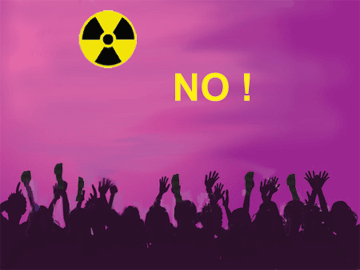
 Protests as South Korean president defends US anti-missile system, West Australian, AFP on July 21, 2016, Seoul Several thousand South Koreans staged an angry protest Thursday against the planned deployment of a US anti-missile system near their hometown, but President Park Geun-Hye insisted the move was a national security imperative.
South Korea’s defence ministry announced last week the Terminal High Altitude Area Defence system, or THAAD, will be installed in Seongju — a rural county about 200 kilometres (135 miles) southeast of Seoul — by the end of next year.
The decision was predicated on the growing threat posed by North Korea’s advancing nuclear weapons and ballistic missile programme.
But Seongju residents say the THAAD deployment makes their county a strategic target and complain that it carries health and environmental hazards. “Let’s block the deployment of THAAD, a threat to peace on the Korean peninsula!” chanted some 2,000 protestors, waving flags and banners that read ‘No THAAD’ as they sat outside Seoul station on Thursday.
The protestors were surrounded by hundreds of police, amid concerns of a repetition of a violent standoff last Friday, which saw Prime Minister Hwang Kyo-Ahn pelted with eggs and water bottles…….https://au.news.yahoo.com/thewest/a/32117538/protests-as-south-korean-president-defends-us-anti-missile-system/#page1
Japan bribed towns at least $28.3 million per town to host dangerous nuclear facilities
 Memo: Residents got 3 billion yen to host Hamaoka nuclear plant http://www.asahi.com/ajw/articles/AJ201607210064.html By KAZUHIKO OKADA/ Staff Writer July 21, 2016 Researchers now have a clearer idea of how much it costs to win over residents in a town hosting the most dangerous nuclear facility in Japan. The price is at least 3 billion yen ($28.3 million) over two decades, according to a memo on display at a university in Tokyo.
The memo was part of a trove of documents kept by the head of a residents group in Hamaoka, Shizuoka Prefecture, where Chubu Electric Power Co.’s Hamaoka nuclear power plant is located.
The documents, on display at Rikkyo University’s Research Center for Cooperative Civil Societies in Toshima Ward since May, also show how the “cooperation money” was used to improve the town, including infrastructure projects, and add beauty to a festival.
In addition, the documents provide details of the residents’ demands and how the money was distributed.
“As far as I know, this is the first time that a series of documents produced by the party that accepted hosting the nuclear plant has been disclosed,” said Tomohiro Okada, professor of local economy at Kyoto University’s graduate school. “Utilities were struggling to secure land for a nuclear power station, so it was their old trick to win over opponents with money.”
He said researchers are aware that electric companies have used such tactics across the nation. But they were largely in the dark about details of this approach because the utilities’ financial statements have not provided any information on the topic.
Genkichi Kamogawa, who chaired the Sakura district council for countermeasures for the Hamaoka nuclear power plant, preserved the memo and the in-house documents in 723 folders.
Kamogawa died in 1999 at the age of 84. His relatives offered the papers to the university after his death.
The town of Hamaoka is now part of Omaezaki.
The Hamaoka plant has been described as the most dangerous nuclear plant in Japan because of its proximity to a long-expected huge earthquake off the prefecture.
The nuclear plant was shut down in May 2011 under the request of then Prime Minister Naoto Kan, following the disaster at the Fukushima No. 1 nuclear power plant. Chubu Electric now plans to restart reactors at the Hamaoka plant.
The Nagoya-based utility approached the town of Hamaoka in 1967 about plans to build the nuclear power plant there. The residents council was formed in August 1968 to gather opinions about the project.
Kamogawa had held a senior position at the council from the start, including chairman between fiscal 1978 and fiscal 1990. He also served as a member of the Hamaoka town assembly. The in-house documents include the council’s financial reports. They also show minutes of meetings where requests were compiled in relation to construction of new reactors at the plant.
The council had enormous sway over the fate of Chubu Electric’s plans to add reactors to the plant. The utility’s donations for each reactor were listed in the documents. Kamogawa’s memo showed that the donations had reached 3 billion yen by the end of August 1989, after construction of the No. 4 reactor had started.
The council also devised its own system to receive the flow of money coming from Chubu Electric and other organizations.The council’s terms stipulated that the donations should be used to contribute to the welfare of residents and development of their community. The money was spent to build roads, a sewage system, parks, a disaster-preparedness facility, and lights for security.
One of the documents also stated that 10 million yen each was given to four neighborhood associations in the town to create gorgeous floats for a festival.
Kazuo Shimizu, 91, who succeeded Kamogawa in fiscal 1991 as the council’s chairman, said the acceptance of donations was meant for the betterment of the local community. “We should benefit from the nuclear power plant project,” said Shimizu, a former Hamaoka assemblyman. “We genuinely wanted to improve the town’s infrastructure.”
A Chubu Electric official in charge of local community affairs acknowledged that the company offered the money to the council. “It was expected of us to help invigorate the host community since we were causing local residents trouble,” the official said. “But we cannot give details, such as the amount of money.”
The two oldest reactors at the Hamaoka plant are now being decommissioned.
Chubu Electric plans to bring the remaining three reactors online by spending 400 billion yen to build 22-meter high sea walls to protect the plant from a powerful tsunami.
Russian, USA, Japanese nuclear salesmen move their Indian nuclear plans to Andhra Pradesh
 A.P. set to be country’s nuclear power hub http://www.thehindu.com/
 news/national/andhra-pradesh/ap-set-to-be-countrys-nuclear-power-hub/article8876943.ece SUHASINI HAIDAR
Govt. is pinning its mega plans for generating the ‘clean’ energy on coastal Andhra Pradesh.
Weeks after the government announced that U.S. company Westinghouse’s Nuclear Power Project (NPP), planned in Gujarat’s Mithi Virdi, is being moved to Andhra Pradesh, sources confirmed to The Hindu that Russian-owned Rosatom will build its next phase of six reactors in Andhra Pradesh as well.
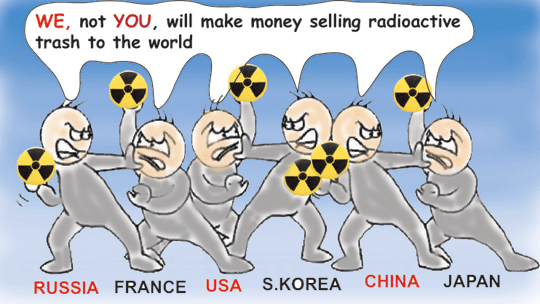
With other States like Gujarat, Tamil Nadu, West Bengal and Maharashtra facing local protests over NPPs, the government is now pinning its mega plans for generating the ‘clean’ energy on coastal Andhra Pradesh. In fact, if all the projects under consideration from Russia, the U.S. and NPCIL were to actually go through, NPPs in Andhra could account for more than 30,000 MW of the Modi government’s goal of 63,000 MW installed capacity by 2031. The site for the next set of six Russian reactors was discussed during A.P. Chief Minister Chandrababu Naidu’s recent visit to Russia, where he met Russian PM Dmitry Medvedev.
Sources told The Hindu the project site identified, believed to be Kavali in Nellore district, could be announced during President Vladimir Putin’s visit to India in October. “It’s huge,” said Commerce Minister Nirmala Sitharaman, who had led the delegation to Russia. “In Andhra Pradesh, six nuclear centres are going to be created, totalling thousands of megawatts in capacity. Of course, Andhra Pradesh will have both American and Russian participation in nuclear energy generation, but the Russians will be the first to “Make in India” in the nuclear sphere in Andhra,” Ms. Sitharaman told The Hindu.
The “American participation” referred to is the plan for Toshiba-Westinghouse to set up 6 AP1000 reactors of 1,100 megawatts each, a proposal that had run into trouble in Gujarat due to “stiff protests from farmers” during the land acquisition process for 777 hectares, a senior official in the Gujarat government said.
“In addition, Tata, Adani and Essar, which are the largest power producers in the State, were never comfortable with another giant plant being set up in the State,” the official said. During Prime Minister Narendra Modi’s visit to Washington in June 2016, NPCIL and Westinghouse had announced the move to Andhra Pradesh, with a commitment to complete the commercial agreement for 6 reactors by June 2017.
Meanwhile, another Russian project that has been hanging fire for years, to build 6 ‘VVER’ (Water-Water Energy) Reactors of 1000 MWe in West Bengal’s Haripur may also be moved to Andhra Pradesh due to local protests. “We are looking for a site in some coastal area of Andhra Pradesh where a similar reactor, which was meant for Haripur, will come up,” Dr. Sekhar Basu, now Chairman of the Atomic Energy Commission, had told reporters last September, although West Bengal officials told The Hindua final decision has not been taken.
State officials hope Tamil Nadu, Gujarat and West Bengal’s loss will soon be Andhra Pradesh’s gain, and the State already has the Kovvada nuclear park project for 6 1000MW reactors in Srikakulam under way. However, the coast isn’t completely clear. Kovvada has seen some protests of the kind seen at Kudankulam, Mithi Virdi and Haripur. While many local residents are unwilling to part with land, others have concerns over environmental hazards, especially given that some of the sites identified for nuclear projects are in a seismically sensitive zone, and have seen tremors in the past.
Confirming that several projects are only in “preliminary stages”, the Andhra Pradesh government’s media adviser Parkala Prabhakar told The Hindu: “The Central government has asked some more sites for other plants. We have asked the Collectors of Prakasam and Nellore to spot the sites. Once those sites are identified, the NPCIL will come for inspection to check the compatibility,” indicating that while Andhra’s nuclear power-hub dreams are in sight, they may take a while to come to fruition. (With Appaji Reddem in Vijayawada & Mahesh Langa in Ahmedabad)
Climate change threatens economies, as workers hampered by increasing heat
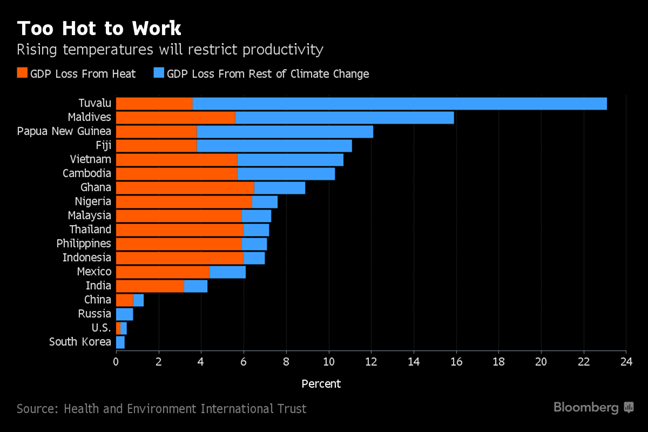
Hotter Temperatures Threaten Southeast Asian Economies: Chart http://www.bloomberg.com/news/articles/2016-07-19/too-hot-to-work, Jessica Shankleman July 19, 2016 Rising global temperatures may cost global economies more than $2 trillion by 2030, restricting working hours in some of the poorest parts of the world, according to United Nations research published Tuesday. As many as 43 countries, especially those in Southeast Asia, will experience declines in their economies because of heat stress, says Tord Kjellstrom, a director at the Health and Environment International Trust, based in Nelson, New Zealand.“With heat stress, you cannot keep up the same intensity of work, and we’ll see reduced speed of work and more rest in labor-intensive industries,” he said.
Radiation along Fukushima rivers up to 200 times higher than Pacific Ocean seabed – Greenpeace
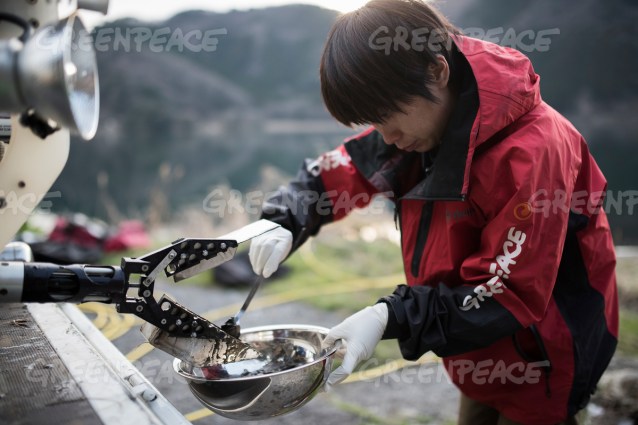
Sediment Sampling at Lake Biwa in Japan: Mai Suzuki from Greenpeace Japan, removes sediment samples from the ROV grabber (Remote Operated Vehicle), at Lake Biwa. Greenpeace has been surveying lake Biwa to conduct baseline sampling. The lake is located as close as 30 km from the Takahama nuclear plant owned by Kansai Electric. In the event of a severe accident Lake Biwa would be at risk of major radioactive contamination. The lake provides the drinking water for 14,5 million people in Shiga Prefecture, the city of Kyoto and the wider Kansai region. The citizens of Shiga recently won a historic legal action that forced the immediate shutdown of Takahama reactor #3, Kansai electric is determined to overturn the legal action on appeal and restart both Takahama 3 and 4 reactor.
Tokyo, 21 July 2016 – Radioactive contamination in the seabed off the Fukushima coast is hundreds of times above pre-2011 levels, while contamination in local rivers is up to 200 times higher than ocean sediment, according to results from Greenpeace Japan survey work released today.
“The extremely high levels of radioactivity we found along the river systems highlights the enormity and longevity of both the environmental contamination and the public health risks resulting from the Fukushima disaster,” said Ai Kashiwagi, Energy Campaigner at Greenpeace Japan.
“These river samples were taken in areas where the Abe government is stating it is safe for people to live. But the results show there is no return to normal after this nuclear catastrophe,” said Kashiwagi.
Riverbank sediment samples taken along the Niida River in Minami Soma, measured as high as 29,800 Bq/kg for radiocaesium (Cs-134 and 137). The Niida samples were taken where there are no restrictions on people living, as were other river samples. At the estuary of the Abukuma River in Miyagi prefecture, which lies more than 90km north of the Fukushima Daiichi plant, levels measured in sediment samples were as high as 6,500 Bq/kg.
The lifting of evacuation orders in March 2017 for areas that remain highly contaminated is a looming human rights crisis and cannot be permitted to stand. The vast expanses of contaminated forests and freshwater systems will remain a perennial source of radioactivity for the foreseeable future, as these ecosystems cannot simply be decontaminated.
Caesium-137 has a half life of 30 years, and will continue to pose a risks to the the environment and human health for hundreds of years. Cs-137 contamination in seabed samples near the Fukushima plant was measured at up to 120 Bq/kg – compared to levels pre-2011 of 0.26 Bq/kg. Further, the levels of contamination found 60km south of the Fukushima Daiichi nuclear plant were comparable with those found within 4km of the plant. Numerous marine science investigations, have concluded that these higher levels are one explanation for some marine species still showing higher cesium levels than the background levels in seawater.
“The radiation levels in the sediment off the coast of Fukushima are low compared to land contamination, which is what we expected and consistent with other research,” said Kendra Ulrich, Senior Global Energy Campaigner at Greenpeace Japan. “The sheer size of the Pacific Ocean combined with powerful complex currents means the largest single release of radioactivity into the marine environment has led to the widespread dispersal of contamination.”
Most of the radioactivity in Fukushima Daiichi reactor units 1-3 core fuel in March 2011 remains at the site.
“The scientific community must receive all necessary support to continue their research into the impacts of this disaster,” said Ulrich.
“In addition to the ongoing contamination from forests and rivers, the vast amount of radioactivity onsite at the destroyed nuclear plant remains one of the greatest nuclear threats to Fukushima coastal communities and the Pacific Ocean. The hundreds of thousands of tonnes of highly contaminated water, the apparent failure of the ice wall to reduce groundwater contamination, and the unprecedented challenge of three molten reactor cores all add up to a nuclear crisis that is far from over,” said Ulrich.
A radiation survey team onboard the research vessel Asakaze, supported by the Greenpeace flagship Rainbow Warrior, conducted underwater survey work along the Fukushima coastline from 21 February to 11 March this year, as well collecting samples in river systems. The samples were measured at an independent laboratory in Tokyo.
Link to the report, Atomic Depths, can be found here http://www.greenpeace.org/japan/Global/japan/pdf/20160721_AtomicDepths_ENG.pdf
http://www.greenpeace.org/japan/ja/news/press/2016/pr201607211/
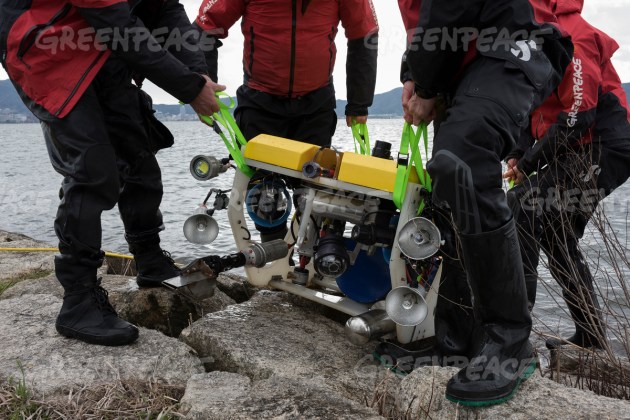
Greenpeace Japan members carry out ROV (Remote Operated Vehicle) operations at Lake Biwa, Shiga Prefecture in Japan. Greenpeace has been surveying lake Biwa to conduct baseline sampling.
1 This Month





PLEASE OPPOSE HR 8255 AND S.3639 – bills would accelerate satellite deployment, with no environmental review or safeguards – https://ncstd5li.quorum.us/campaign/169331/
To see nuclear-related stories in greater depth and intensity – go to https://nuclearinformation.wordpress.com
-
Archives
- October 2026 (39)
- September 2026 (339)
- August 2026 (330)
- July 2026 (355)
- June 2026 (287)
- May 2026 (306)
- April 2026 (356)
- March 2026 (251)
- February 2026 (267)
- January 2026 (308)
- December 2025 (358)
- November 2025 (359)
-
Categories
- 1
- 1 NUCLEAR ISSUES
- business and costs
- climate change
- culture and arts
- ENERGY
- environment
- health
- history
- indigenous issues
- Legal
- marketing of nuclear
- media
- opposition to nuclear
- PERSONAL STORIES
- politics
- politics international
- Religion and ethics
- safety
- secrets,lies and civil liberties
- spinbuster
- technology
- Uranium
- wastes
- weapons and war
- Women
- 2 WORLD
- ACTION
- AFRICA
- Atrocities
- AUSTRALIA
- Christina's notes
- Christina's themes
- culture and arts
- Events
- Fuk 2022
- Fuk 2023
- Fukushima 2017
- Fukushima 2018
- fukushima 2019
- Fukushima 2020
- Fukushima 2021
- general
- global warming
- Humour (God we need it)
- Nuclear
- RARE EARTHS
- Reference
- resources – print
- Resources -audiovicual
- Weekly Newsletter
- World
- World Nuclear
- YouTube
-
RSS
Entries RSS
Comments RSS

