Far-reaching quakes put Ehime’s atomic evacuation plans in doubt

Protesters rally against the restart of the Ikata nuclear power plant in the town of Ikata, Ehime Prefecture, on July 24
MATSUYAMA, EHIME PREF. – When two earthquakes of magnitude 6.5 and 7.3 struck Kumamoto Prefecture in April, the shock was felt not only in Kumamoto but also about 170 km away, in the small town of Ikata, Ehime Prefecture, home to a nuclear power plant.
For years, residents had been told that the Median Tectonic Line, which runs from Kyushu to Honshu and passes just 5 km away from the Ikata plant, was not active and that there was nothing to worry about. After the April quakes, no abnormal atomic activity was reported, but residents are now worried a large quake in the area, followed by tsunami, could not only damage the plant but also make evacuation from the peninsula Ikata lies on impossible.
The restart of Ikata reactor 3, slated for Aug. 12, has put those concerns in sharp focus and raised questions about just how realistic evacuation will be in the event of a natural disaster — especially an earthquake that sends a tsunami churning toward the nearly 124,000 residents living within 30 km of the plant.
“The official evacuation plans assume emergency vehicles will have a certain degree of access to the low-lying roads on the peninsula, which are often only a few meters above sea level. But what happens if the roads are flooded by tsunami or damaged beyond use due to landslides? There are about 5,000 people on the peninsula living on the western side of the Ikata plant who might be cut off from escaping by land to the designated evacuation areas lying east of the plant,” said Tsukasa Wada, an Matsuyama-based antinuclear activist who is fighting to keep the Ikata plant closed.
In granting permission last year to restart Ikata’s No. 3 unit, Ehime Gov. Tokihiro Nakamura dismissed such concerns, saying the rock formations around the plant are strong. But the prefecture has designated 194 areas in the town of Ikata as highly susceptible to landslides.
To get to the Ikata plant from Matsuyama by car or bus also involves passing through a series of tunnels. Tunnel construction experts have testified in past lawsuits involving the plant that many of the tunnels are weak, suggesting that an earthquake could cause cave-ins, rendering them unusable.
The central government and the prefecture are aware that land evacuations alone could prove impossible. So the official plans also include evacuations by air and, most controversially, by sea. The plans assume there is time to evacuate by sea before radiation from the plant spreads, and that ships can dock at nearby ports even if the peninsula’s main access road has been destroyed by a quake, tsunami, or both.
The April quakes in Kumamoto led to fears in neighboring Kagoshima Prefecture about running the two reactors at Kyushu Electric Power Co.’s Sendai plant. That helped fuel the election last month of Gov. Satoshi Mitazono, who is against nuclear power and has said he’ll try to shut down the two Sendai reactors.
But in late July, Ehime Gov. Nakamura insisted that, despite the results in Kagoshima and growing concerns in Ehime, where an opinion poll by the daily Ehime Shimbun in July found 54 percent of respondents opposed to the restart, he had no intention of canceling or postponing it to revisit the issues of the plant’s safety or the evacuation plans.
“The conditions are different in each of the different areas where nuclear power plants are located, as is the age of the reactors in each area and their structure. You can’t compare them. In particular, for the process leading up to restarts, the approach and system is different for each area, with different plans for evacuation,” Nakamura told reporters at a regular press briefing.
But even a Shikoku Electric Power Co. survey in late May and early June of nearly 28,000 households lying within 20 km of the Ikata plant showed that, compared with a similar survey last year, more people were skeptical of safety assurances and fewer were convinced of the need for nuclear power. Shikoku Electric admits that the Kumamoto earthquakes probably influenced this year’s results.

If Abe is serious, he should listen in earnest to anti-nuke calls
“(We can choose) a future in which Hiroshima and Nagasaki are known not as the dawn of atomic warfare, but as the start of our own moral awakening.” That was how Barack Obama wound up his 17-minute-long public address during his historic visit to Hiroshima on May 27.
He was the first sitting U.S. president to visit the city leveled by the world’s first atomic bombing. The 71st anniversary of that event fell on Aug. 6. Nagasaki suffered the same fate as Hiroshima three days later, on Aug. 9, 1945.
Obama’s visit to Hiroshima was a benchmark event. Even so, nuclear stockpiles around the world are still in excess of 15,000 warheads. A world without nuclear weapons remains a distant dream.
Action is needed to carve out the future. In this regard, there are particularly high expectations for the role of Japan, which experienced the ravages of atomic bombings.
But the people of Hiroshima and Nagasaki are increasingly suspicious of the central government’s intentions. In their view, the government seems to be obstructing the global trend for trying to eradicate nuclear weaponry.
Prime Minister Shinzo Abe, who accompanied Obama during his Hiroshima visit, pledged that he would “continue to make incessant efforts” toward realizing a world without nuclear weapons.
But what precisely is he determined to do, we wonder. The key question here is that of a concrete vision.
TOKYO EMBARRASSED BY TALK OF ‘NO FIRST USE’
The Washington Post reported last month that the Obama administration is considering changes in its nuclear policy.
Notably, a declaration of “no first use” is reportedly being weighed as an option. The term refers to a country’s pledge that it will not be the first to use nuclear arms unless it comes under nuclear attack from another nation. China and India, among the world’s nuclear weapon states, have adopted that policy.
“No first use” is expected to significantly reduce the role of nuclear arms in security policy. It is also believed to be highly effective in urging other nuclear weapon states to engage in nuclear disarmament.
Ten U.S. Democratic senators have called on Obama to declare “no first use.” The mayors of Hiroshima and Nagasaki have sent a letter to Obama to express their support for the potential nuclear policy changes, saying such moves would “mark an important step toward realizing a world without nuclear weapons.”
But Tokyo appears to be embarrassed by this. Foreign Minister Fumio Kishida said only that Japan and the United States “should remain closely in touch” over the matter. When the Obama administration reviewed its nuclear policy in 2010, it stopped short of declaring “no first use” out of consideration for Japan and other U.S. allies.
At the United Nations, meantime, there is growing momentum to outlaw nuclear arms, which are inhumane weapons, under international law.
A U.N. working group, which has been discussing the matter since February in Switzerland, is holding its final session this month. The working group’s chairman has worked out a draft report that says, “A majority of States expressed support for the commencement of negotiations … in 2017.”
Japan is one country that is not part of that “majority of States.” Tokyo has reiterated at the working group’s sessions that the time is not ripe for declaring nuclear weapons illegal in view of the current security climate.
Seventy-one years after the A-bombings, the very country that suffered the nuclear attacks is trying to block the trend for nuclear disarmament.
PERSISTENT DEPENDENCE ON NUCLEAR UMBRELLA
The backdrop here is Japan’s dependence on the “nuclear umbrella,” under which it relies on the nuclear arsenal of the United States to deter attacks from other countries.
Tokyo believes Japan must stay under the nuclear umbrella, not the least because it has to face up to China, which is pursuing a rapid military buildup, and to North Korea, which has repeatedly conducted nuclear tests and test-firings of missiles.
No approval can be given to a “no first use” policy and a prospective treaty to ban nuclear weapons, both of which would erode the deterrent potential of the nuclear umbrella, according to Tokyo’s position.
Let us remember, however, that nuclear deterrence theory is a relic of the Cold War period. The government of Japan has not ruled out a possible use of nuclear weapons by the United States. That is broadly at odds with the sentiment of the Japanese public, which does not want a repeat of the ravages of a nuclear attack.
As long as deterrence theory is adhered to, other nuclear weapon states will also stick to their reliance on nuclear arsenals, which means the risk of a nuclear war would never diminish.
It goes without saying that the security climate should be taken into account from a tough viewpoint. Many experts believe, however, that conventional war potential–basically that of Japan and the United States–alone is functioning as a sufficient deterrent on North Korea and China.
“We must have the courage to escape the logic of fear, and pursue a world without (nuclear weapons),” Obama said in his Hiroshima address.
Kazumi Matsui, the mayor of Hiroshima, cited that passage in his Aug. 6 Peace Declaration, and added, “We need to fill our policymakers with the passion to … create a security system based on trust and dialogue.”
Courage and passion: These qualities are probably expected from the government of Japan more than anything else. Tokyo should start striving to seek a security policy that does not rely on the nuclear umbrella and begin holding talks with Washington to achieve that goal.
Abe has attended the peace ceremonies in Hiroshima and Nagasaki every year. He has also had opportunities to hold dialogue with representatives of A-bomb survivors.
But the residents of Hiroshima and Nagasaki strongly distrust Abe. The prime minister has not only rushed through policies that undermine the pacifist principles of the Constitution, such as lifting Japan’s self-imposed ban on the right to exercise collective self-defense and enacting new security legislation. He has been less than willing to listen to earnest pleas. In 2014, for example, he used the phrase, “It’s a matter of opinion,” to dismiss concerns expressed by an A-bomb survivor.
POIGNANT CALLS FROM A-BOMBED CITIES
The Nagasaki Peace Declaration to be released Aug. 9 is expected to include, for the first time in two years, a demand for enacting a law to set down Japan’s three non-nuclear principles–not possessing, not producing and not permitting the introduction into Japan, of nuclear weapons.
Sumiteru Taniguchi, an 87-year-old A-bomb survivor, strongly called, during a drafting committee meeting, for the inclusion of that passage.
“Those who never experienced that abominable war are trying to have the (pacifist) Constitution amended,” Taniguchi said. “As a survivor of the A-bomb, I have to continue calling out loud as long as I am alive.”
Poignant calls from the A-bombed cities represent the starting point of efforts to realize a world without nuclear arms. If Abe wishes, as he says he does, to lead initiatives to have nuclear weapons abolished, the first thing he should do is to face up in earnest to the calls of people in Hiroshima and Nagasaki and seek out a way to go hand in hand with them.
http://www.newsjs.com/url.php?p=http%3A%2F%2Fwww.asahi.com%2Fajw%2Farticles%2FAJ201608060027.html
A mother’s love, after Hiroshima

“Someday, the voices of the hibakusha will no longer be with us to bear witness. But the memory of the morning of August 6, 1945, must never fade. That memory allows us to fight complacency. It fuels our moral imagination. It allows us to change.”
President Obama said these words standing in front of the cenotaph in Hiroshima Peace Memorial Parkon May 27. At that moment, the debates about why he should or should not visit Hiroshima and what he should or should not do there no longer mattered to me. As the daughter of a hibakusha, a survivor of the Hiroshima attack, I was grateful that the president paid respect to the victims who died that day, to those who lived, and to those who continue to live, being victims to their memories of August 6.
My mother, Toshiko Ishikawa, was a 12-year-old girl in Hiroshima the day the atomic bomb was dropped. She was young enough to not quite grasp why it happened, yet old enough to never forget what happened. My mother lost her family, friends, and home, yet she never lost her ability to love.
My mother moved to the United States in 1959 and shortly after that became a US citizen. My mother did not hold hatred; instead she hoped that such a weapon would never be used again on any country. I have presented her experience to middle schools for the past six years, so students would understand there’s more to August 6th and 9th than the textbook picture of the mushroom cloud and a few sentences stating the bomb ended the war. By telling her story to a new generation of future voters, I hope I am honoring her wish and making her proud.
I wrote my middle-grade historical fiction,The Last Cherry Blossom, when teachers inquired if I had a book that they could add to their class reading list to complement my discussion. The Last Cherry Blossom published this month. It’s a bittersweet time for me. My mom passed away in January 2015. However, she did read the latest draft (at that time) of the manuscript, and she knew it would be published.
I wanted to write this book not just to honor my mother and her family, but to honor all the people who suffered or died from the effects of pika don. We need to remember the immense destruction a nuclear weapon produced in the past. Not for blame, but to realize how much worse the damage could be today and how many more innocent lives would be lost. Because the first step toward nuclear disarmament is remembering that the people under those famous mushroom clouds were someone’s mother, father, sister, brother, or child.
Originally, scientists said nothing would grow again in Hiroshima for many years after the bomb was dropped. Yet the cherry blossoms bloomed again the following spring. The cherry blossoms endured, much like the spirit of the people affected by the bombing in Hiroshima.
Last summer my family visited Hiroshima to honor my mother at the Hiroshima National Peace Memorial Hall for the Atomic Victims. Standing on the same ground where she experienced so much horror and destruction at the age of 12 broke my heart.
My mother lost so much that fateful day, yet she gained an inner strength she never thought possible. The love she gave my daughter and me proved that love prevails over fear.
Kathleen Burkinshaw lives in Charlotte, NC, and is the author of The Last Cherry Blossom (Sky Pony Press August 2016).
http://thebulletin.org/mothers-love-after-hiroshima9707?platform=hootsuite
Are America’s 50 B61 nuclear bombs really safe in Turkey?
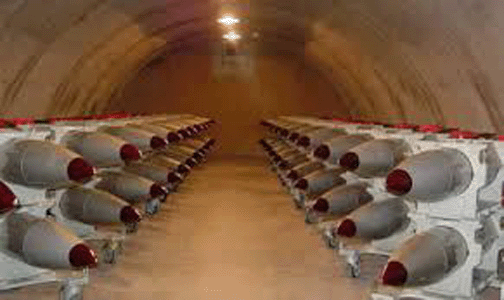 How Safe Are US Nuclear Weapons in Turkey?, VOA, Sharon Behn 5 Aug 16, U.S. B61 nuclear bombs are equipped with “permissive action links” or PALs, which prevent arming and using the weapon without an authorization code. They are kept on special racks, inside secure underground vaults, inside protected aircraft shelters, inside a heavily guarded area, surrounded by two layers of fencing, lighting, cameras and intrusion detection devices, on protected airbases.
But this particular airbase, Incirlik, is in southern Turkey. The Turkish commander of the base recently was frog-marched off in handcuffs after being accused of involvement in last month’s failed coup against the government.
And that is the problem, says nonproliferation expert Jeffrey Lewis of theMiddlebury Institute of International Studies at Monterrey, California.
“I think in the near term they are very safe,” Lewis said of the bombs in an interview with VOA. “But there are no security measures that would be sufficient against a host state that is trying to seize them, so generally speaking, it is not a good idea to have nuclear weapons in a politically unstable country.”
Although the July 15 military-led coup failed to unseat the government of President Recep Tayyip Erdogan, the authoritarian leader retaliated with a massive purge of the country’s military, judiciary, media and educational institutions.
World leaders have reacted with unease.
And so have experts in nuclear weapons policy. “There are a lot of tough barriers, but incidents and accidents have a nasty way of happening,” said Hans Kristensen, director of the Federation of American Scientists‘ nuclear information project.
Ensuring stability
According to Amy Woolf, a specialist in nuclear weapons policy at theCongressional Research Service, the U.S. has around 200 B61 bombs located around Europe……..Up to 50 of those bombs are believed to be in Incirlik………
Kristensen said, given the political situation in Turkey and the fact that the base is less than 100 miles from the war zone in Syria, it might be time to consider moving the weapons.
“You only get so many warnings before something goes terribly wrong, and there are plenty of warnings in the region now,” Kristensen said. http://www.voanews.com/content/how-safe-are-the-us-nuclear-weapons-in-turkey/3451193.html
Strained relations between China and UK, after Theresa May delays Hinkley nuclear decision
U.K. Delay on Hinkley Point Nuclear Power Plant Strains Relations With China Decision by new government to review deal comes as British vote to leave the European Union puts trade policy in question, WSJ By JENNY GROSS in London and CHUN HAN WONG in Beijing Aug. 5, 2016
New Prime Minister Theresa May’s surprise move to delay a final decision on building a nuclear plant part-funded by China has prompted questions in Beijing about the U.K.’s commitment to foreign investment and a “golden era” in ties between their capitals.
Britain announced last week it needed until the fall to review the controversial £18-billion ($23.7 billion) project, postponing a deal with China and France agreed to last year by Ms. May’s predecessorDavid Cameron to build the country’s first new nuclear plant in a generation.
Ms. May has said the U.K. will continue to seek investment from around the world, but how she proceeds in China will be closely watched as a bellwether of her government’s diplomatic and economic policy as the country navigates its exit from the European Union following a public vote in June……..
Chinese state media warned that undue delays or cancellation of the project would damage mutual trust. The delay had already spurred concern that Britain might be “thinking of erecting a wall of protectionism,” China’s official Xinhua News Agency said in an editorial this week…….
A Chinese government adviser said China will want Britain to provide a clear explanation for its actions and assurances on the directions of its China policy. He added that while the nuclear deal marked a crucial advance for Beijing, ultimately Britain needs China more than the other way around…….
Nick Timothy, Ms. May’s newly appointed joint chief of staff and a close adviser, last year wrote that the deal was “baffling” and said security experts are worried the Chinese could build weaknesses into computer systems that would allow them to shut down Britain’s energy production.
—Selina Williams in London and Inti Landauro in Paris contributed to this article.http://www.wsj.com/articles/u-k-delay-on-hinkley-point-nuclear-power-plant-strains-relations-with-china-1470402457
Japan’s new environment minister pledges to build trust, contaminated waste storage facility in Fukushima
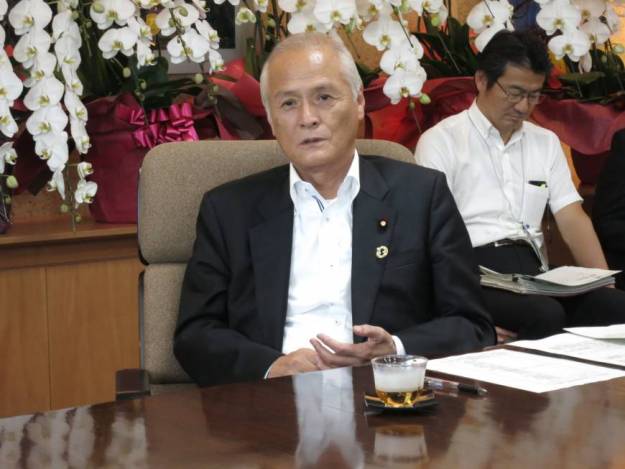
Environment Minister Koichi Yamamoto speaks during a group interview in Tokyo on Friday.
Newly appointed Environment Minister Koichi Yamamoto said Friday he will further efforts to build trust with people in Fukushima Prefecture to facilitate a stalled project to build a temporary nuclear storage facility.
The 2011 triple meltdown at the Fukushima No. 1 nuclear power plant has contaminated a large part of the prefecture while massive amounts of radioactive waste have been generated by decontamination work.
The government is planning to construct a huge temporary storage site near the Fukushima plant, but needs more than 2,300 landowners to agree to use their property for the project. So far it has only secured about 4.9 percent of the 1,600 hectares of land needed, owned by 234 people.
Although the government says it plans to store the waste for 30 years, no other areas have volunteered to host a final disposal site, leading many local residents to fear that the Fukushima site will end up being permanent.
“I’m aware that getting landowners’ consent is a very tough issue,” said Yamamoto, 68, a veteran Liberal Democratic Party lawmaker, during a media interview.
Yamamoto has learned from ministry officials that the situation is improving, and hopes to accelerate the momentum.
Storing contaminated waste at the site is crucial for Fukushima’s reconstruction work, which is currently stalled due to large amounts of waste piling up around the prefecture.
Meanwhile, some landowners are reportedly questioning the government’s commitment on this matter, as environment ministers have already changed four times since Prime Minister Shinzo Abe took office in December 2012.
But Yamamoto said the ministers have handled affairs properly. “This administration has been led by the LDP, so of course we have continuity and even (if) the minister changes (often), we share the same thoughts,” said Yamamoto.
He said 99 percent of the handover information he received from his predecessor, Tamayo Marukawa, was about Fukushima-related issues. “I have to make efforts to go to Fukushima often to make stronger connections than Marukawa did,” he said. Yamamoto plans to visit the temporary storage facility on Tuesday.
The government hopes to begin construction of the temporary storage site in October, the ministry said.
In 2011 Fukushima Ventilation Stack Read Over 10,000mSv/hour
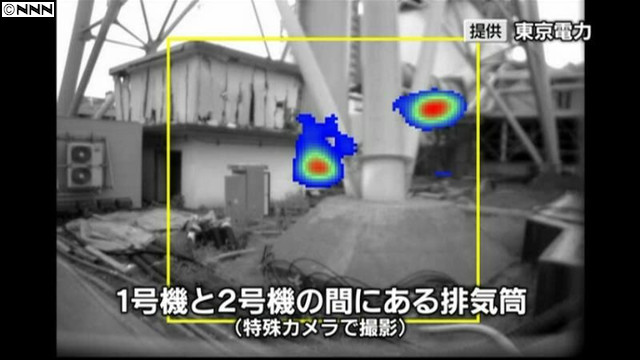
On August 2, 2011, TEPCO released a photo of the ventilation stack between reactors No. 1 and No. 2 where radioactivity over 10,000mSv / hour was measured, the highest amount of radioactivity measured to date.
The photo published is that of the ventilation stack located between reactors No. 1 and No. 2, taken on July 31 by a special camera that reacts to radioactivity.
It shows high radioactivity at two locations: at the center and at the right. The red part at the center is the place with the highest radioactivity.
Later, on August 1, workers measured the radioactivity of the pipes in the ventilation stack. The result revealed a measure exceeding 10,000 mSv / hour, the highest measurable limit.
During the venting of reactor No. 1 on March 12, 2011, the steam passed through these pipes before to be released outside. TEPCO considers that there is a strong possibility that radioactive materials would remain in the pipes.
According to TEPCO, there is no leakage of radioactive materials to the outside of the pipes.
Places around the pipes will be forbidden to enter and shielding work will be done.
Source : http://www.news24.jp/articles/2011/08/02/07187756.html
http://photo.tepco.co.jp/date/2011/201108-j/110802-01j.html
Translation credit to Kurumi Sugita
GE Hitachi to provide human resources development program for nuclear energy, Malaysia
Hitachi-GE to launch nuclear energy course in Malaysia, WNN 04 August 2016 Japan’s Hitachi-GE Nuclear Energy has renewed an agreement with two Malaysian universities under which it will conduct a new international human resources development program to train workers for the nuclear power industry.
Hitachi-GE announced today that it has renewed an agreement with the National University of Malaysia (UKM) and the Universiti Tenaga Nasional (Uniten), a private university operated by Malaysia’s largest power company, Tenaga Nasional Berhad.
Under the agreement, Hitachi-GE will run an international human resources development program for nuclear energy, leveraging a course that the company has jointly conducted with Tokyo Institute of Technology (Tokyo Tech) for the past five years. So far the course has been held at venues in Southeast Asia and other regions and attended by more than 2000 students. For the new program, Hitachi-GE will work with Tokyo Tech, which has cooperation arrangements with UKM and Uniten……….http://www.world-nuclear-news.org/NN-Hitachi-GE-to-launch-nuclear-energy-course-in-Malaysia-0408164.html
Cover-up of failures at Guangdong nuclear plant

 Nuclear cover-up: environment ministry slaps penalties on errant crew over failures at Guangdong plant
Breaches did not lead to leak or threaten public safety, industry insiders say South China Morning Post, Stephen ChenEric NgErnest Kao, 05 August, 2016,Four staff members at a nuclear power plant in Guangdong have been punished for breaching operational guidelines and trying to cover up the failures, the Ministry of Environmental Protection said this week, more than a year after the incident took place.
Three staff at the Yangjiang nuclear power plant in Guangdong, about 220km north of Hong Kong, were given administrative warnings, while the crew’s leader, Wei Haifeng, was stripped of his senior nuclear operator’s licence, a severe punishment………http://www.scmp.com/news/hong-kong/article/1999329/nuclear-cover-environment-ministry-slaps-penalties-errant-crew-over
Home at last, but little joy as evacuee picks up pieces of her life
3 km’s up the coast. 1.8 miles to Minami-Soma from fuk. …. “The Japanese government steered displaced people toward their return by repeating that an annual exposure of up to 20 millisieverts poses little health risk,”
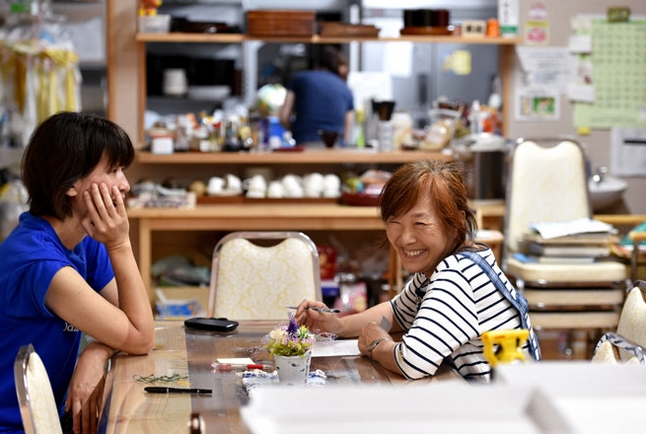
Tomoko Kobayashi, right, prepares with a volunteer worker for the reopening of her Futabaya ryokan in the Odaka district of Minami-Soma, Fukushima Prefecture, on July 11.
MINAMI-SOMA, Fukushima Prefecture–It was no ordinary homecoming for Tomoko Kobayashi, after an enforced absence of more than five years due to the 2011 Fukushima nuclear disaster.
She says she is “in no mood for celebration” given the daunting task facing her: having to start from scratch at the traditional ryokan inn that has been in the family for nearly 70 years.
The community that Kobayashi had called home was overrun with rats, wild boar and palm civets, and she struggled to protect the family business from that nightmare.
Kobayashi’s journey home to start afresh took her via Ukraine, which she visited in 2013 to learn how victims of the world’s worst nuclear accident–the Chernobyl disaster in 1986–were coping after all those years.
Kobayashi, 63, was shocked by the different approach authorities there had taken compared with that of Japan.
She said Ukraine takes a more cautious approach toward radiation risks.
Kobayashi returned to Minami-Soma’s Odaka district on July 12 after the central government lifted a ban for 11,000 or so evacuees from the district, which is within a 20-kilometer radius of the crippled Fukushima No. 1 nuclear power plant.
Her initial concern is living with low-level radiation.
She also worries for her future and whether she can get the business up and running. With her husband, Takenori, 67, Kobayashi has reopened Futabaya ryokan. The inn that she took over from her mother 10 years ago has 15 guest rooms and is located in front of JR Odaka Station, which is 16 km from the plant.
Another of her concerns centers on whether her return home to reopen the inn could play into the hands of the authorities.
“The central government is eager to wind up the program that compensates the victims,” she said, alluding to a sense that evacuees are being encouraged to return so that financial redress can end.
On the plus side, the radiation level in her neighborhood has dropped to below 0.2 microsievert per hour. Although it is three times the level before the triple meltdown in March 2011, the figure is significantly lower than in the immediate aftermath.
Since the disaster, Kobayashi has closely monitored the radioactivity of food, drinking water and soil by working with a local citizens group. In one instance, radioactivity registered more than 10,000 becquerels per kilogram when she measured the levels of the dust and dirt sucked up in a vacuum cleaner at her home.
Returning home means she still faces the risk of exposure to long-term, low radiation. How this could affect her health is not understood by scientists.
Odaka was previously designated a “zone in preparation for the lifting of the evacuation order,” where an annual radiation dose is estimated at 20 millisieverts or below.
Extensive decontamination work over the past three years paved the way for the evacuees’ return.
Despite the lifting of the ban, only 10 to 20 percent of the residents from Odaka and other parts of Minami-Soma are expected to go back.
Evacuees are reluctant because of the potential hazard of the long-term, low radiation exposure and the new living and social networks built during the five years they were away.
They are also wary of the risks of moving back in the vicinity of the nuclear complex where the unprecedented scale of work to decommission the damaged reactors is under way amid a host of challenges, including an accumulated buildup of highly radioactive water.
Before the nuclear accident, Kobayashi had a staff of five that washed and starched the linen. It was a hallmark of her ryokan’s hospitality. With only one staffer coming back, however, Kobayashi has to forgo the starched sheets.
At one point, more than 60,000 of the city’s 72,000 residents evacuated, including those who left voluntarily.
After she moved into temporary housing in Minami-Soma in 2012, Kobayashi occasionally visited the inn to clean up. The dark waters of the tsunami, spawned by the magnitude-9.0 tremor on March 11, 2011, almost reached the front door of her ryokan, even though it is situated 3 km from the coast.
Her neighborhood, which was blessed with a wide array of edible wild plants, mushrooms and freshwater fish, was transformed into a “gray ghost town.” The landscape became increasingly bleaker as gardens of homes were occupied by piles of black plastic bales containing radioactive waste from the cleanup operation.
Kobayashi had many sleepless nights. She wondered whether she could ever pick up the threads of the existence she led before the catastrophe.
Her turning point came in September 2013 when she joined a tour to the region in Ukraine devastated by the Chernobyl accident.
“I was curious to know how victims of a nuclear accident considered more serious than Fukushima’s are faring nowadays,” Kobayashi said.
Kobayashi also wanted to convey her gratitude to those affected by the Chernobyl explosion in Zhytomyr province for sending 150 dosimeters to Minami-Soma. The devices proved to be invaluable at a time when the city badly needed them.
When her tour group visited Zhytomyr, the residents there shared their experiences and answered questions sincerely.
What struck Kobayashi during the trip was the disparity between Ukraine’s local government and Japanese authorities in their handling of radiation risks and programs made available to help the victims.
In Ukraine, authorities are more hands-on.
“No Trespassing” and other warning signs were put up in communities, although their doses of radiation were lower than that in Odaka. Ukraine authorities issued a warning on the basis of radioactive contamination in the ground as it could lead to internal radiation exposure of residents through the spread of radioactive dust.
She also learned that a large number of people in Zhytomyr have developed health problems, not just cancer, but also a wide variety of diseases.
But they are guaranteed by law the right to receive treatment or to take refuge.
That is in sharp contrast with the Japanese government briefings with evacuees, which barely touched on the long-term, low radiation risks.
Kobayashi is outraged by this.
“The Japanese government steered displaced people toward their return by repeating that an annual exposure of up to 20 millisieverts poses little health risk,” she said.
Kobayashi said she would have been less suspicious of the intention of Japanese officials if they had candidly admitted that they didn’t know about the possible effects on health.
She is also angered about the way authorities treated evacuees in light of the July 12 lifting of the ban.
Evacuees from Minami-Soma’s Kawabusa district, a mountainous area that fell in the “residence restriction zone,” were also allowed to return. The zone is defined as one registering an estimated annual dose of between 20 to 50 millisieverts.
Although a dose in Kawabusa was confirmed to have dropped to less than 20 millisieverts, the clearance came as a surprise to many locals since it ran counter to the government’s previous policy of designating such an area first a zone in preparation for the lifting.
Kawabusa is home to about 300 people, including many children.
Despite a drop in radiation readings in her community, Kobayashi said she cannot ask her grandchildren, who are 8 and 2, to come visit her and her husband yet.
But she is determined to make an effort for rebuilding.
“I don’t know how many more years it will take to bring back the happy sounds of children to our community, but I am determined to do what I can do now,” Kobayashi said.
http://www.asahi.com/ajw/articles/AJ201608050001.html
New Japanese nuclear power plant project given go ahead by local authorities
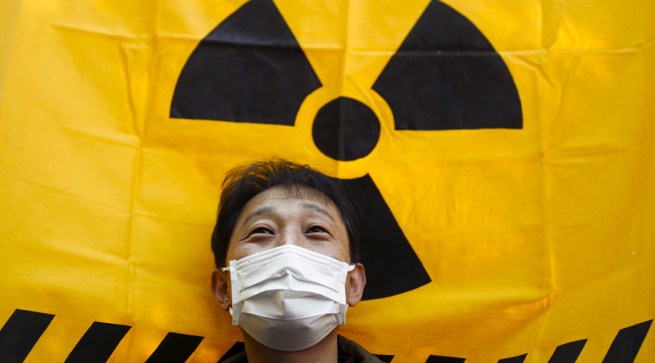
A man holds a flag with a radioactive hazard symbol during No Nukes Day, a protest calling for a nuclear-free future, in Yoyogi park in Tokyo, Japan.
Yamaguchi prefecture in Japan has renewed a landfill license for construction of a new nuclear power plant. The license was halted after the Fukushima disaster. The renewal comes amid heated debate on whether Japan needs new reactors at all.
The license to reclaim land for a new nuclear plant was renewed for the Chugoku Electric Power Co. by the prefectural government on Wednesday, Kyodo news agency reports.
The plant once planned to be constructed in the coastal town of Kaminoseki is positioned “within the country’s energy policy,” the local government said.
Originally, the two-reactor Kaminoseki nuclear complex on an island in the Seto Inland Sea was granted the landfill license in October 2008. The Fukushima crisis brought the construction to a halt at an early landfill work stage, while the license expired in 2012 and was not prolonged, as the former Yamaguchi Governor Shigetaro Yamamoto said the local authorities wanted to “examine the issue appropriately,” but did not make a decision, citing “special circumstances after the nuclear accident.”
Now the landfill license for Kaminoseki nuclear complex has been extended until July 6, 2019, specifically stipulating, though, that the landfill work cannot start until the company presents exact schedule of when the plant facilities are going to be built.
As of now, Chugoku Electric is not ready to elaborate on exact dates when construction will begin, company Vice-President Akira Sakotani said the same day the license was extended.
“We will seriously take to heart the request [by the prefectural government] and carefully consider [our response],” he said.
When the construction of the Kaminoseki nuclear complex began, it was slowed down by protests of the local anti-nuclear energy activists. The activists are expected to go on with their protests now, that the license has been extended.
Anti-nuclear sentiment in Japan have been strong ever since the Fukushima nuclear power plant disaster, but Japan’s huge nuclear energy industry has been stagnating amidst uncertainty for five years now.
Official Tokyo is already pushing for restoring operations of those existing reactors that have successfully met the new post-Fukushima safety requirements.
Just on Wednesday, the No. 3 reactor of Mihama plant in Fukui Prefecture, operated by Kansai Electric Power Co. successfully passed the state safety assessment, becoming yet another nuclear power unit confirmed for safe operations under new regulations.
Big business creeps into agriculture as farmers dwindle
“Fukushima is known for perilla production, and Yajima began cultivating the plant in there in 1999 after learning skills from local farmers. But he pulled the plug on the operation following the triple core meltdown at the Fukushima No. 1 nuclear plant in 2011 during the quake and tsunami disasters in March that year.”
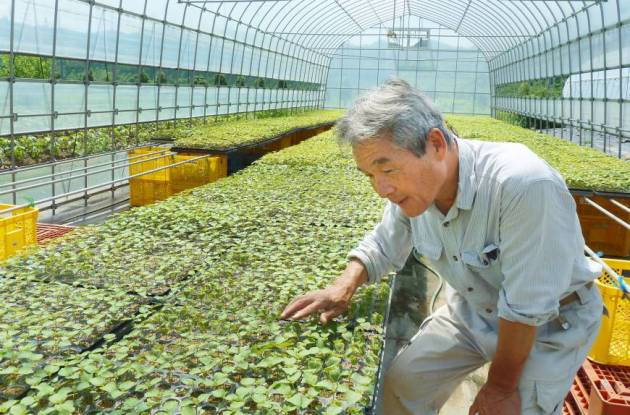
Shigeru Yajima, president of Morishige Bussan Co., takes a close look at perilla his firm is growing in Chichibu, Saitama Prefecture, in July.
With traditional family farms on the wane, corporations are increasingly entering the agriculture sector, taking advantage of an updated law allowing them to lease farmland across the country.
At the end of 2015, more than 2,000 companies were operating in the farm sector, a roughly five-fold increase from before the farmland law was revised in 2009, according to the Agriculture, Forestry and Fisheries Ministry.
Among them is Morishige Bussan Co., a food wholesaler in the city of Saitama that’s growing perilla on a 6-hectare patch of hilly land in Chichibu, Saitama Prefecture.
“We have doubled the patch since last year and are growing perilla all over the field,” Bussan President Shigeru Yajima said in early July.
Perilla plants are grown from seeds raised in vinyl greenhouses; those planted outside two weeks earlier were already 10 cm high.
“We have leased deserted arable land introduced by the Saitama prefectural and Chichibu municipal governments,” Yajima said. “Local people helped us improve the land.”
Oil obtained from perilla seeds is in booming demand as it is considered good for health and beauty, Yajima said.
“Though perilla seeds produced in China and South Korea are available, we stick to homegrown seeds,” he said.
Fukushima is known for perilla production, and Yajima began cultivating the plant in there in 1999 after learning skills from local farmers. But he pulled the plug on the operation following the triple core meltdown at the Fukushima No. 1 nuclear plant in 2011 during the quake and tsunami disasters in March that year.
Chichibu is suited to perilla cultivation because of its wide temperature variations, like Fukushima, said Yajima, who works the fields and processes the crops with five employees. Production of perilla and related business contribute to some 40 percent of Morishige’s annual sales of around ¥100 million.
To meet growing demand for perilla oil, Morishige farms out production of the plant to farmers in Gunma, Nagano and Miyagi prefectures.
Among other firms that have entered the farm sector, Kawaguchi Construction Co., a water supply and road construction company in the town of Minobu, Yamanashi Prefecture, grows Akebono Daizu (Akebono soybeans), a local specialty produced in a cool climate along the Fuji River in the southern part of the prefecture.
“We become busy with public works at the end of each fiscal year,” said Osamu Mochizuki, president of the company. “But as we have lots of time to spare early in each year, I decided (to farm soybeans) to protect jobs for employees.”
The amount of deserted arable land has been growing in Minobu, like other places, in line with the dwindling ranks of Japan’s aged farmers and the lack of successors. The prefectural government offered some 3 hectares of such land to Kawaguchi Construction.
“I decided to grow Akebono Daizu soybeans to help revitalize the local economy, hoping to develop them into a popular brand,” Mochizuki said.
Paste, curd and toasted flour made from dried soybeans are becoming popular. During an annual autumn fair to promote Akebono Daizu, many people visited the town to experience harvesting soybeans.
Of the roughly 2,000 corporations that have entered the agriculture sector, food companies accounted for 23 percent, agricultur and stock-breeding companies 22 percent and construction firms 10 percent.
Meanwhile, schools, medical institutions, social welfare corporations and nonprofit organizations represent a quarter of new institutional entrants into agriculture, according to Shinichi Shogenji, professor at the Graduate School of Bioagricultural Sciences at Nagoya University.
“It is a welcome development for them to use agriculture to support the independence of people with physical or mental disabilities, such as creating job opportunities,” Shogenji said.
Japan agrees second reactor life extension since Fukushima
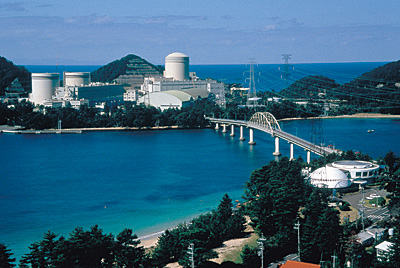
TOKYO Aug 3 (Reuters) – Japan’s nuclear regulator on Wednesday approved an application by Kansai Electric Power Co Inc to extend the life of an ageing reactor beyond 40 years, the second such approval it has granted under new safety requirements imposed since the Fukushima disaster.
The move means Kansai Electric, Japan’s most nuclear-reliant utility before Fukushima led to the almost complete shutdown of Japan’s atomic industry, can keep No. 3 reactor at its Mihama plant operating until it is 60 years old.
The regulator granted the first such approval in June to Kansai Electric’s ageing reactors No.1 and 2 at its Takahama plant.
The Mihama No.3 reactor, which will turn 40 years old in December, has been shutdown since 2011 and a restart will not happen immediately as Kansai Electric needs to carry out safety upgrades at a cost of about 165 billion yen ($1.63 billion).
The upgrades involve fire proofing cabling and other measures and are planned to be completed in March 2020, a company spokesman said.
Opinion polls consistently show opposition to nuclear power following Fukushima. Critics say regulators have failed to take into account lessons learned after a massive earthquake and tsunami caused meltdowns at the Fukushima Daiichi plant.
Nuclear disaster evacuation plans worry many local authorities
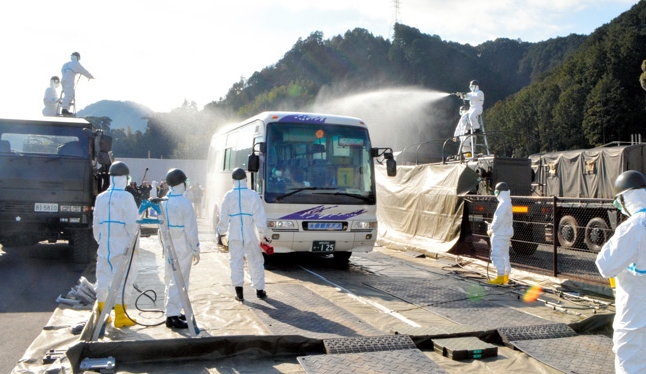
Workers clean up a bus that transported evacuees in a nuclear disaster evacuation drill in Shizuoka in February.
Nearly half of local governments polled are concerned about the recommendation that residents living within 5 to 30 kilometers of a nuclear power plant should “evacuate” by staying indoors if a serious accident occurs, an Asahi Shimbun survey found.
The survey also showed that a quarter of local governments want a review of the central government’s evacuation guidelines, which were set in October 2012 following the Fukushima nuclear disaster the previous year.
It was taken to find how local governments hosting a nuclear facility or located in the vicinity of a nuclear plant view the guidelines in light of the recent series of earthquakes in Kumamoto Prefecture.
In the quakes that began in mid-April, a large number of homes, as well as roads and other structures, were damaged. Continuing aftershocks added to difficulties in victims’ abilities to evacuate quickly.
The nuclear disaster evacuation guidelines were compiled on the assumption of a serious accident occurring at a nuclear complex, but do not take into account the destruction of evacuation routes, bridges and other buildings in the surrounding area, caused by a powerful earthquake, for example.
Shiga Prefecture, which called for a review of the guidelines in May, said: “Indoor evacuation would be unrealistic if a nuclear accident were coupled with an earthquake. Evacuation to the area beyond 30 km should be considered.”
Under the current setup, people living within a 5-km radius are ordered to evacuate immediately.
Those within a radius of 5 to 30 km are advised in principle to stay indoors initially and evacuate in stages, depending on the amount of radiation released into their neighborhoods.
“Indoor evacuation” for such a zone is aimed at allowing the smooth evacuation of people in the 5-km zone first to avoid an expected gridlock.
But many local governments are wary of the central government’s recommendations, citing the possibility of a complex disaster involving more than just a nuclear accident, according to the survey.
The survey, conducted in mid-June and mid-July, covered 21 prefectural governments and 135 municipalities that fall within the 5-30 km radius. All the local governments responded but one, the Fukui prefectural government.
Of the total of 155, The Asahi Shimbun analyzed the responses of 151, as the remaining four municipalities replied that they will evacuate immediately. Most of these municipalities’ jurisdictions are also situated within the 5 km radius.
The survey showed that 71 local governments, including Niigata and Ibaraki prefectures, expressed concerns about the guidelines, while 22 replied that they are not.
Asked to choose one or more reasons for their anxiety, 56 cited the response to a situation where a large number of structures are destroyed.
As for the need to review the guidelines, 37 respondents, including Nagasaki and Shizuoka prefectures, agreed while 13 did not. Sixty-four said they don’t know.
According to the survey, 12 local governments replied that they are well prepared with regard to the infrastructure that enables smooth evacuation, whereas 69 cited problems with that issue.
How to evacuate in a nuclear accident that could be triggered by a devastating earthquake or another disaster that destroys homes and infrastructure has emerged as a pressing issue since the Kumamoto temblors.
Kagoshima’s new governor, Satoshi Mitazono, was elected in July on his campaign pledge to review the existing evacuation plan in connection with a hypothetical accident at the Sendai nuclear power plant.
The nuclear power station in Satsuma-Sendai in the prefecture is the only plant online in the nation and is situated relatively close to an active fault that is believed to have slipped in the Kumamoto quakes.
Despite growing concerns voiced by local governments, the Nuclear Regulation Authority’s secretariat, which compiled the guidelines, said in an interview with The Asahi Shimbun that it will not consider a review.
“Indoor evacuation will not be for a prolonged period,” said an official. “Gyms and other public facilities would be available for residents even if their homes were destroyed.”
The official also said local governments can improve their evacuation plans based on their understanding of local conditions.
Tepco’s Profit Plummets Amid Declining Sales and New Competition
Operating profit falls by 37 percent in the first quarter
More than 750,000 Tepco customers have switched providers
Tokyo Electric Power Co. Holdings Inc., operator of the wrecked Fukushima Dai-Ichi nuclear plant, said first-quarter operating profit plummeted 37 percent as sales declined amid faltering demand and new entrants into Japan’s power market.
Tepco, as Japan’s biggest utility is known, posted operating profit of 143.6 billion yen ($1.37 billion) for the three months ended June 30, down from 228.3 billion yen a year ago, the company said in a statement Thursday.
Revenue fell about 18 percent to 1.26 trillion yen as the company’s electricity sales volume dropped and rates were automatically lowered by the nation’s price adjustment system. The system adjusts monthly electricity rates for each utility based on a three-month average of import prices for LNG, crude oil and coal.
Japan’s regional utilities are getting squeezed by new entrants after the country liberalized its retail power market in April, allowing consumers to choose their electricity providers for the first time. Tokyo Electric hopes to boost its profits by expanding its domestic gas sales when the market fully opens up next year, increasing its foreign investments and restarting its operable nuclear reactors.
Tokyo Electric Power Co. Holdings Inc., operator of the wrecked Fukushima Dai-Ichi nuclear plant, said first-quarter operating profit plummeted 37 percent as sales declined amid faltering demand and new entrants into Japan’s power market.
Tepco, as Japan’s biggest utility is known, posted operating profit of 143.6 billion yen ($1.37 billion) for the three months ended June 30, down from 228.3 billion yen a year ago, the company said in a statement Thursday.
Revenue fell about 18 percent to 1.26 trillion yen as the company’s electricity sales volume dropped and rates were automatically lowered by the nation’s price adjustment system. The system adjusts monthly electricity rates for each utility based on a three-month average of import prices for LNG, crude oil and coal.
Japan’s regional utilities are getting squeezed by new entrants after the country liberalized its retail power market in April, allowing consumers to choose their electricity providers for the first time. Tokyo Electric hopes to boost its profits by expanding its domestic gas sales when the market fully opens up next year, increasing its foreign investments and restarting its operable nuclear reactors.
1 This Month





PLEASE OPPOSE HR 8255 AND S.3639 – bills would accelerate satellite deployment, with no environmental review or safeguards – https://ncstd5li.quorum.us/campaign/169331/
To see nuclear-related stories in greater depth and intensity – go to https://nuclearinformation.wordpress.com
-
Archives
- October 2026 (39)
- September 2026 (339)
- August 2026 (330)
- July 2026 (355)
- June 2026 (287)
- May 2026 (306)
- April 2026 (356)
- March 2026 (251)
- February 2026 (267)
- January 2026 (308)
- December 2025 (358)
- November 2025 (359)
-
Categories
- 1
- 1 NUCLEAR ISSUES
- business and costs
- climate change
- culture and arts
- ENERGY
- environment
- health
- history
- indigenous issues
- Legal
- marketing of nuclear
- media
- opposition to nuclear
- PERSONAL STORIES
- politics
- politics international
- Religion and ethics
- safety
- secrets,lies and civil liberties
- spinbuster
- technology
- Uranium
- wastes
- weapons and war
- Women
- 2 WORLD
- ACTION
- AFRICA
- Atrocities
- AUSTRALIA
- Christina's notes
- Christina's themes
- culture and arts
- Events
- Fuk 2022
- Fuk 2023
- Fukushima 2017
- Fukushima 2018
- fukushima 2019
- Fukushima 2020
- Fukushima 2021
- general
- global warming
- Humour (God we need it)
- Nuclear
- RARE EARTHS
- Reference
- resources – print
- Resources -audiovicual
- Weekly Newsletter
- World
- World Nuclear
- YouTube
-
RSS
Entries RSS
Comments RSS

