Reuse of radioactive soil could cut costs by 1.5 trillion yen: ministry estimate
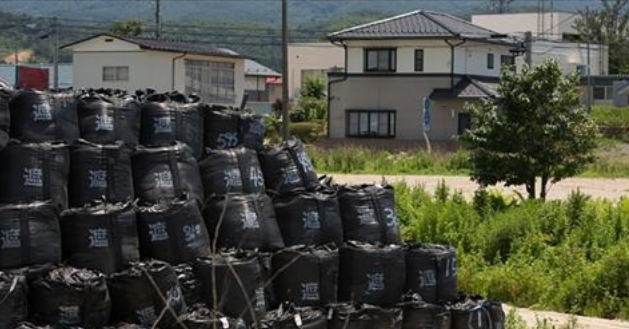
Behind the Environment Ministry’s controversial decision to allow reuse of highly radioactive soil emanating from the Fukushima nuclear disaster in public works projects was an estimate that the reuse could cut the costs of reducing radiation levels of such soil by over 1.5 trillion yen, it has been learned.
The estimate in question was presented during a closed-door meeting of the ministry in January and stated that reuse of radioactive soil generated from Fukushima decontamination work could cut the cost for purifying such soil from 2.9127 trillion yen in case the levels of radioactive cesium are reduced to 100 becquerels per kilogram to 1.345 trillion yen in case the cesium levels are cut down to 8,000 becquerels per kilogram. The estimate calls the latter option “reasonable from economic and social points of view.”
The Environment Ministry decided in June to allow reuse of soil with radioactive cesium of no more than 8,000 becquerels per kilogram in mounds under road pavements and other public works projects. The decision sparked criticism that it runs counter to the safety standards of 100 becquerels or less for recycling metals generated from the decommissioning of nuclear reactors under the Act on the Regulation of Nuclear Source Material, Nuclear Fuel Material and Reactors. The ministry has insisted that the radiation levels of tainted soil used in road mounds can be held down from 8,000 becquerels to around 100 becquerels by covering those mounds with concrete among other measures.
A ministry working group on safety evaluation of radiation effects held closed-door meetings over the issue on six occasions between January and May this year. In June, the Mainichi Shimbun reported that an estimate presented to one of those meetings stated, “For example, it will take 170 years for radiation levels to reduce to 100 becquerels if tainted soil of 5,000 becquerels is put to reuse,” sparking controversy. In response, the ministry on Aug. 1 released the minutes of the closed-door meetings and other documents on its website.
At the second meeting of the working group on Jan. 27, the copies of a document titled “About reasonable radioactivity concentrations of recycled materials” were handed out to attendants. The document, which was drawn up by the Japan Atomic Energy Agency, includes an estimate that the cost for reducing the radiation levels of tainted soil to 100 becquerels for recycling would reach 2.9127 trillion yen, with a volume reduction rate of 40 percent, adding that 40 percent of contaminated soil could not be put to reuse. Meanwhile, the estimate says it would cost 2.1185 trillion yen to drop the radiation levels of tainted soil to 3,000 becquerels, with a volume reduction rate of 0.5 percent, while it would cost 1.345 trillion yen to decrease the radiation levels of soil to 8,000 becquerels, with a volume reduction rate of 0.2 percent. The latter option could make 99.8 percent of tainted soil available for reuse, the estimate says.
“Considering economic and social factors, it is appropriate to set the radioactivity concentration of recycled materials at several thousand becquerels,” the document stated. A note of caution in the document states, “Apart from this, it is necessary to project the cost for final disposal (of tainted soil).”
A ministry official in charge of the issue told the Mainichi Shimbun, “The document was produced in response to a request by a member of the working group. As the document states, it is difficult to (set the standards for reusing tainted soil) at 100 becquerels from a realistic point of view.”
http://mainichi.jp/english/articles/20160803/p2a/00m/0na/014000c
License renewed for new nuclear plant project in western Japan
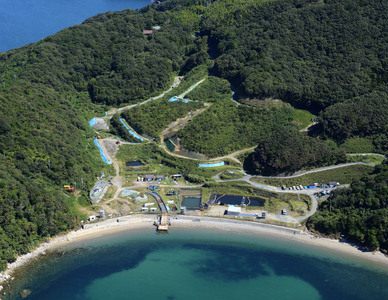
Planned construction site for Kaminoseki nuclear plant
File photo taken in October 2012 shows the planned construction site for a Chugoku Electric Power Co.’s nuclear plant in the western Japan town of Kaminoseki. Local opposition and the 2011 Fukushima nuclear disaster have prevented development of the construction project.
YAMAGUCHI, Japan (Kyodo) — The Yamaguchi prefectural government on Wednesday renewed a license for Chugoku Electric Power Co. to reclaim land for a new nuclear power plant in the western Japan prefecture, surprising and angering local residents opposed to the project.
Whether to extend the expired license for landfill work in the coastal town of Kaminoseki to build the Kaminoseki Nuclear Power Station had been a pending issue after the 2011 Fukushima nuclear crisis led to the suspension of the work. But the local government decided to grant permission, saying that the plant is positioned “within the country’s energy policy.”
The utility is unlikely to quickly restart the work due to local opposition, however. The local government’s license renewal is also conditional: It said landfill work should not start until prospects of building plant facilities become clear.
But the latest development could open up substantial discussions on whether new reactors should be built in Japan, which the central government has largely avoided so far in consideration of antinuclear sentiment that has prevailed after the Fukushima nuclear power plant disaster.
Meanwhile, the government has already been pushing for the resumption of existing reactors that have met post-Fukushima safety requirements. On Wednesday, the No. 3 reactor at Kansai Electric Power Co.’s Mihama plant in Fukui Prefecture became the latest unit to have effectively cleared the state safety assessment.
Chugoku Electric was initially granted the landfill license in October 2008 for the two-reactor Kaminoseki nuclear complex on an island in the Seto Inland Sea.
The company began landfill work a year later, but progress was slow amid local protests and was suspended after the Fukushima crisis was triggered by a huge earthquake and tsunami that hit northeastern Japan in March 2011.
Just before the license was set to expire in October 2012, the utility applied for a three-year extension to the prefectural government. “We have not changed our idea that we need the Kaminoseki plant. We want to keep the license,” a utility official said at the time.
Then Yamaguchi Gov. Shigetaro Yamamoto said the local government will “examine the issue appropriately” but did not make a decision, citing “special circumstances after the nuclear accident.”
But on Wednesday, the prefectural government reversed course and permitted the extension of the license, though saying that landfill work should not begin until the utility has clear prospects of building plant facilities.
Chugoku Electric Vice President Akira Sakotani said the same day that there is currently no specific date set for building the facilities.
“We will seriously take to heart the request (by the prefectural government) and carefully consider (our response),” he said.
The license will be effective until July 6, 2019.
The decision of the prefectural government drew mixed responses from local residents.
“I can’t believe the permission was given,” said Toshiyasu Shimizu, 61, who heads a group of residents on an island several kilometers from the construction site.
But Naonori Koizumi, a 58-year-old member of a group supporting the construction project, said, “I don’t think work will immediately resume, but the town is depopulating and graying. I hope nuclear power will make this town richer.”
http://mainichi.jp/english/articles/20160803/p2g/00m/0dm/058000c
Tepco’s hazmat suit guideline decreases burden on workers during summer heat
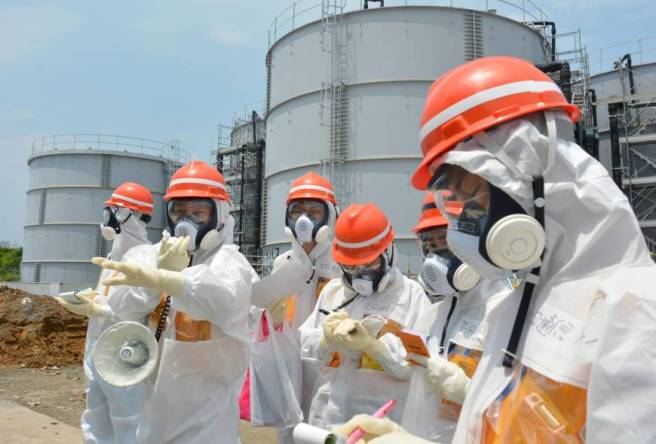
Tokyo Electric Power Company Holdings Inc., operator of the crippled Fukushima No. 1 power plant, has been revising guidelines for when workers need to wear full masks with hazmat suits or less-bulky outfits to improve their working conditions during the scorching summer.
While a full-body outfit limits radiation exposure, hazmat suits and full masks have been a heavy burden for workers because they restrict movement and make it difficult to breathe, prompting Tepco to revise the guidelines on their usage.
In March, Tepco changed the guidelines, dividing the premises into three areas.
In the area where radiation levels remain high, including inside reactor buildings 1, 2 and 3, workers will need to wear a full mask and disposable hazmat suit with a raincoat-like outer layer.
Workers meanwhile will need to wear full or half masks with hazmat suits in areas where radiation levels are lower, such as near tanks filled with radiation-tainted water. In the remaining area, the majority of which has low levels of radiation, workers only need to use disposable masks and their usual work outfits, Tepco said.
According to the utility, out of about 5,000 to 6,000 workers on the premises, about 47 percent were required to wear a full mask in June, down from about 66 percent in January, before the guidelines were changed.
Those who are required to wear a half mask increased to 48 percent from 28 percent in the same period, it said.
Before the guidelines were revised, about 8,000 disposable hazmat suits were used per day, but the number declined to about 4,000.
Even as hazmat suit requirements have halved, radiation exposure cases have remained unchanged at an average of two a day, Tepco said, adding that the risk of radiation exposure has not increased.
Tepco said it will offer summer outfits at the beginning of this month to lessen the chance of workers succumbing to heatstroke.
In July, the health ministry opened a health care office at J-Village near the Fukushima No. 1 power plant so that its workers can seek free health consultations from doctors who are versed in radiation exposure.
“During the summer period, the health of workers tends to worsen due to heatstrokes as well as other illnesses, so we need to step up measures to resolve the situation,” said a heath ministry official.
Small Progress of Landside Impermeable Wall freezing
The purpose of the Landside Impermeable Wall construction lies not in freezing soil to form an underground wall but in keeping groundwater from flowing into the reactor/turbine buildings and preventing new contaminated water being generated.
By closing less than 95 percent of the mountain side of the Landside Impermeable Wall in Phase 2 of the first stage, it is expected that the amount of groundwater flowing into the areas around the reactor/turbine buildings will be reduced. This will help keep groundwater from being contaminated during the first stage.
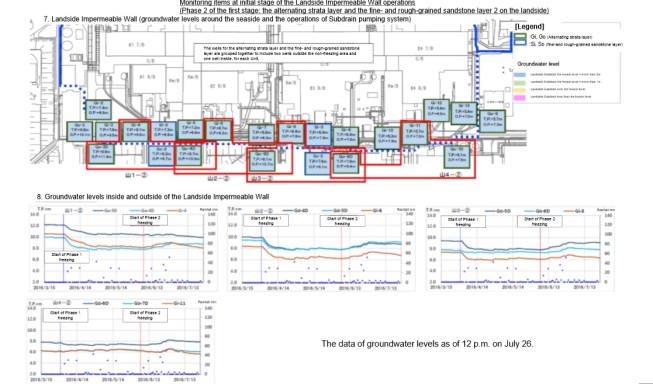
Throughout the first stage, how freezing of the Landside Impermeable Wall has progressed will be checked by monitoring the difference in groundwater levels inside and outside of the wall and the amount of groundwater pumped up by the subdrain and groundwater drain systems and the wellpoint system.
Groundwater levels and hydraulic heads (in the medium-grained sandstone layer 1 on the seaside)
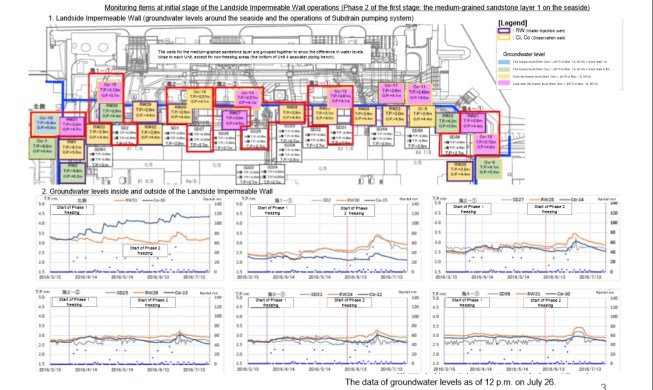
Groundwater levels and hydraulic heads (in the medium-grained sandstone layer 2 on the landside)
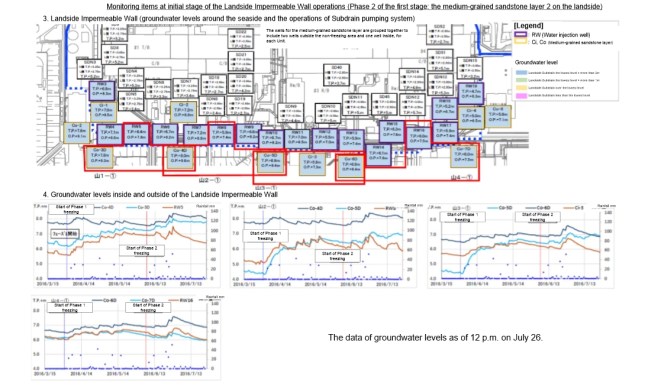
Groundwater levels and hydraulic heads (in the alternating strata layer and the fine-and rough-grained sandstone layer 1 on the seaside

Groundwater levels and hydraulic heads (in the alternating strata layer and the fine-and rough-grained sandstone layer 2 on the landside)
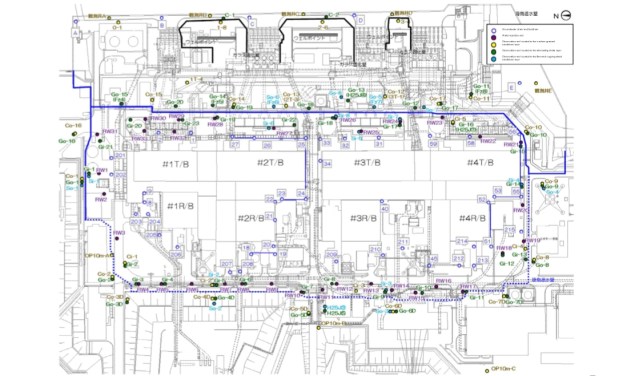
Location map of groundwater level observation wells (as of June 2016)
Progress of supplementary work

Progress of supplementary work (1BLK)
Over-time changes of the soil temperatures in the north side area of Unit 1 where the supplementary work is in progress The soil temperatures temporarily increased because of water which was used to bore through the ground during the supplementary work, but it has gradually decreased. Since the soil temperature around the thermometer pipe of 120-1S has not dropped sufficiently, however, the second round of injection is currently under way. TEPCO Holdings will continue to monitor the temperature changes.
Progress of supplementary work (9BLK)
As seen in the soil temperatures in the 1BLK area, that in the 9BLK area temporarily increased because of water which was used to bore through the ground during the supplementary work. The soil temperature around the thermometerpipe of 30-9S0 has dropped to around 0 degrees Celsius, and TEPCO Holdings will continuously monitor it. In the area around the thermometer pipe of 70-9S, the second round of injection is progressing.
Progress of supplementary work (12BLK)
Over-time changes of the soil temperatures in the east side area of Unit 2 (12BLK) where the supplementary work is in progress The soil temperatures have gradually decreased. Monitoring of the temperatures will continue.
Progress of supplementary work (13BLK)
Over-time changes of the soil temperatures in the east side area of Unit 2 (13BLK) where the supplementary work is in progress Since the soil temperature around the thermometer pipe of 30-13S has slowly decreased, the second round of injection is planned. Although the decrease of the soil temperatures around the thermometer pipes of 50-13S and 90-13S have been gradual but steady, monitoring of the temperatures is still under way.
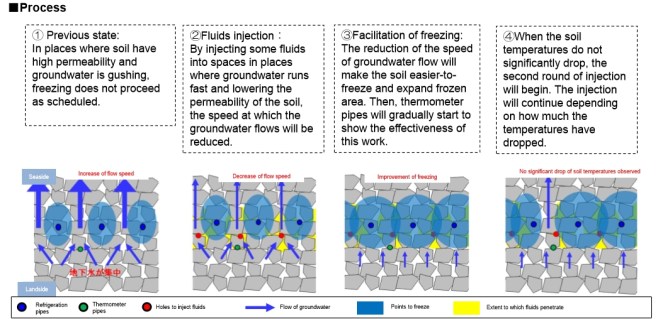
Purpose of supplementary work
To help further freeze soil in places where the soil temperatures have slowly dropped due to fast flowing groundwater, the speed at which the groundwater runs has to be reduced by making the permeability of the soil as low as that of soil in the vicinity of the places.
The purpose of the supplementary work lines not in constructing different walls from the landside impermeable wall but in changing locally highly permeable soil areas into areas with low permeabilities observed in the soil of the surrounding area.
Source: Tepco
Click to access handouts_160728_02-e.pdf
Anti-terror facility at nuclear plant confirmed
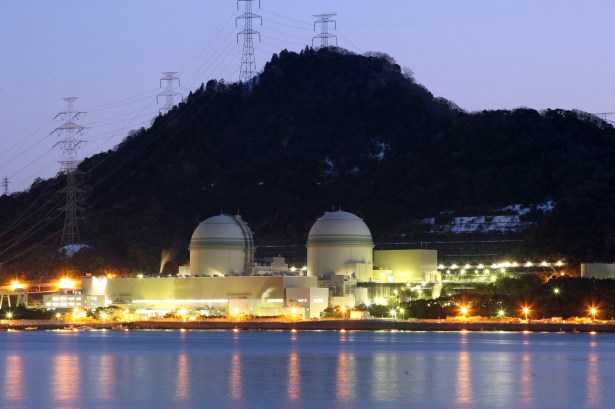
Japan’s nuclear regulator says plans for terrorism-response facilities at the Takahama nuclear plant are the first in Japan to meet its requirements.
New government regulations introduced after the 2011 Fukushima Daiichi accident require nuclear plant operators to build standby control rooms at least 100 meters away from each of their reactors.
The special facilities allow employees to retain control of a plant’s reactors even if main control rooms are destroyed by terrorists or in a plane crash.
Officials at the Nuclear Regulation Authority confirmed that the plans for standby control rooms for the No. 3 and No.4 reactors at the plant are in line with requirements. They will soon issue formal approval for construction.
The decision came at a closed-door session to maintain secrecy of the rooms’ design and location.
The Takahama plant on the Japan Sea coast became the first of 7 nuclear plants in Japan to submit applications for approval.
The plant’s operator, Kansai Electric Power Company, is now required to set up the facility for the No.3 reactor by August 2020 and for the No.4 reactor by the following October.
Some are criticizing the decision to restart reactors yet to be equipped with the standby facilities.
The 2 reactors at Takahama went back online earlier this year. But they were halted after a court ordered their suspension in March.
One More Worker Drops Dead At Fukushima Daiichi
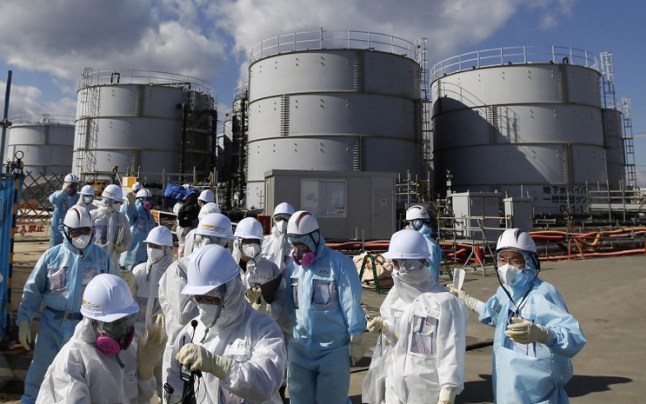
Another worker died on July 30, 2016 at Fukushima Daiichi. Tepco’s report indicates that he was found dead around 10:39am.
The weather recently has been warm but not extremely hot. Some of the early cases of workers dropping dead or falling ill at the plant were considered heat related. After this some heat related counter measures were put in place. Other cases were either never explained or vaguely claimed to be due to health problems.
http://www.tepco.co.jp/press/report/2016/1314410_8693.html
http://www.fukuleaks.org/web/?p=15653
Hiroshima museum gets hibakusha’s rare copy of A-bomb tanka book written behind censors’ backs
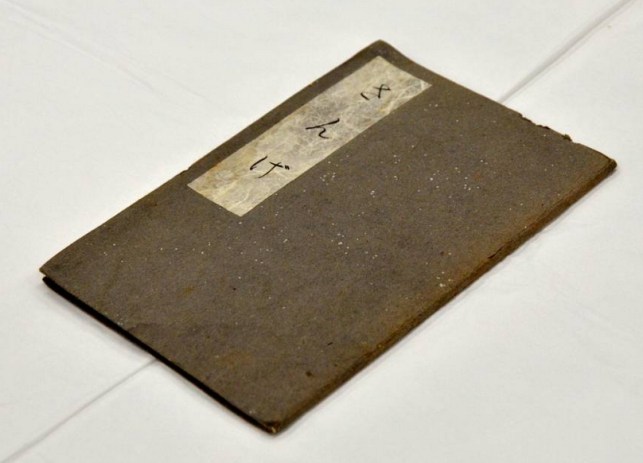
A tanka collection by late hibakusha poet Shinoe Shoda, recently found in a private home, has been donated to the city of Hiroshima.
HIROSHIMA – A copy of an anthology of traditional tanka by Shinoe Shoda written to depict the horrors of the atomic bombing of Hiroshima and secretly published during the Allied Occupation has been discovered at a temple in Hiroshima Prefecture.
The anthology, titled “Sange,” a Buddhist term meaning death, was donated to the Hiroshima Peace Memorial Museum in the city on Tuesday.
The only other copy was thought to be one found earlier at the house of a relative of the late poet.
The donated copy is “a precious and rare material,” said an official at the Hiroshima Municipal Government’s peace promotion division.
Shoda experienced the atomic bombing while at home, only about 1.7 km from ground zero.
The anthology includes about 100 tanka that give graphic descriptions of what she experienced or heard from other hibakusha.
A translation of one tanka reads:
“The heavy bones / must be the teacher / and alongside / small skulls / are gathered.”
In 1947, when the anthology was published, Japan was under U.S.-led Occupation and severe restrictions had been imposed on publications and reporting related to the A-bombings of Hiroshima and Nagasaki, according to the municipal government.
To evade Occupation censors, Shoda picked Hiroshima Prison as the place to print about 150 copies of the anthology. The copies were handed out only to people close to her.
About 10 years ago, Tomoaki Shoja, the 60-year-old chief priest of Sentokuji Temple in the town of Kitahiroshima, discovered a copy of “Sange” when he was organizing his late priest’s belongings.
The original owner is believed to have given it to Shoja’s family because a son of Shoda was evacuated to the temple in the closing days of the war.
The museum is considering putting the anthology on display.
“Not many people know Shoda,” said Shoja. “She could become better known if more people have the chance to see the anthology.”
China not happy with Theresa May’s ‘unwanted accusations’ over Hinkley Point nuclear project
 China warns UK against ‘unwanted accusations’ over Hinkley Point Downing Street’s suspicions endanger ‘hard-won mutual trust’ between two countries, Beijing says. By Karthick Arvinth, IBT, August 2, 2016 China says it will not tolerate “unwanted accusations” over its investments in the UK after Theresa May’s government decided to review a controversial nuclear power project at the last minute.
A commentary published by the state-run Xinhua news agency on 1 August said Downing Street’s stance on Hinkley Point C risked damaging the “hard-won mutual trust” between the two countries fostered by Chinese President Xi Jinping’s state visit to Britain last year…
Xinhua warned that the “suspicious approach” towards China could deter other investors from investing in post-Brexit UK……..http://www.ibtimes.co.uk/china-warns-uk-against-unwanted-accusations-over-hinkley-point-1573739
71 years ago in Hiroshima and Nagasaki
 A look at first ever use of nuclear weapons in wartime http://tinyurl.com/zjmex46 Jul 31, 2016
  On August 6, 1945, the US dropped the first ever nuclear bomb on Hiroshima.
Three days later, another bomb was dropped on Nagasaki. President Harry Truman called for Japan’s surrender, warning them to “expect a rain of ruin from the air, the like of which has never been seen on this earth.”Here are a few facts about the first ever use of nuclear weapons in wartime: The uranium gun-type atomic bomb dropped on Hiroshima was called Little Boy and Nagasaki was nuked by a plutonium implosion-type bomb called Fat Man. In order to make Little Boy, the US used 141 pounds of uranium, basically all of the processed uranium that was then in existence. The US dropped about 49 practice bombs nicknamed “pumpkin bombs” that killed 400 and injured 1,200, before nuking Hiroshima and Nagasaki.
oleander is the official flower of the city of Hiroshima because it was the first thing to bloom after the bombings.Japan has burned the Flame of Peace in Hiroshima, since 1964, in honour of the victims; it will be extinguished only when all nuclear weapons are removed from the world and the earth is free from nuclear threat.

Britain’s history of supplying nuclear weapons technology to North Korea
What Theresa May forgot: North Korea used British technology to build its nuclear bombs.Ecologist, David Lowry 26th July 2016
When Theresa May proclaims in Parliament that we need the £200 billion Trident nuclear missile system to see off the North Korean nuclear threat, writes David Lowry, just bear this in mind. It is a threat that the UK, global nuclear proliferator in chief, created in the first place, providing both the reactor technology and vital centrifuge materials to make North Korea’s nuclear dream come true.
- ” … today the threats from countries such as Russia and North Korea remain very real.”
- “North Korea has stated a clear intent to develop and deploy a nuclear weapon, and it continues to work towards that goal, in flagrant violation of a series of United Nations Security Council resolutions.”
- “North Korea is the only country in the world to have tested nuclear weapons this century, carrying out its fourth test this year, as well as a space launch that used ballistic missile technology. It also claims to be attempting to develop a submarine-launch capability and to have withdrawn from the nuclear non-proliferation treaty.”
- “Based on the advice I have received, we believe that North Korea could already have enough fissile material to produce more than a dozen nuclear weapons. It also has a long-range ballistic missile, which it claims can reach America, and which is potentially intended for nuclear delivery.”
It reminded me of the similarly ill-informed former Prime Minister Tony Blair, in his speeches to MPs trying to win them over with dodgy ‘advice’ from British intelligence, to go to war by invading Iraq in 2003.
MPs have short memories, despite the Chicot Report on the Iraq invasion disaster not yet two weeks old, and 472 motley MP fools backed May and Trident replacement. As with the Iraq invasion, MPs will in future have to admit their regrets at being fooled. And again, they ignord the thousands of demonstrators outside, calling for Trident to be abandoned.
Britain’s nuclear proliferation ‘secret’
But May was right in one way. North Korea has developed nuclear weapons. But what she did not say was they did it with copied British bomb-making technology.
There is significant evidence that the British Magnox nuclear plant design – which was primarily built as a military plutonium production factory – provided the blueprint for the North Korean military plutonium programme based in Yongbyon. Here is what Douglas (now Lord) Hogg, then a Conservative minister, admitted in a written parliamentary reply in 1994 to Labour MP Llew Smith:
“We do not know whether North Korea has drawn on plans of British reactors in the production of its own reactors. North Korea possesses a graphite moderated reactor which, while much smaller, has generic similarities to the reactors operated by British Nuclear Fuels plc. However, design information of these British reactors is not classified and has appeared in technical journals.”
The uranium enrichment programmes of both North Korea and Iran also have a UK connection. The blueprints of this type of plant were stolen by Pakistani scientist, A Q Khan, from the URENCO enrichment plant in The Netherlands in the early 1970s.
(see David Albright, Peddling Peril, 2010 pp 15-28, Free Press, New York)
This plant was – and remains – one-third owned by the UK government. The Pakistan government subsequently sold the technology to Iran, who later exchanged it for North Korean Nodong missiles……….
Lessons of history
This sorry tale has several important lessons for us today. First – and this must never be forgotten – the UK’s early ‘atoms for peace’ nuclear power programme was specifically designed and intended to produce plutonium for nuclear bombs. And it was not just nuclear waste from Calder Hall that went for plutonium extraction at Windscale, but from other sites that were meant to be purely civilian such as Hinkley Point.
The UK is therefore guilty of ‘breaking the rules’ that are meant to separate civil and military nuclear activities, and its complaints of other states doing the same all carry the unmistakeable whiff of ripest humbug.
Second, for all its public position of seeking to restrain nuclear proliferation, the UK is actually one of the world’s most egregious nuclear proliferators: providing arch-nuclear enemy North Korea with both the Magnox technology it has used to produce plutonium for atom bombs; and the high strength aluminium it has used for its uranium centrifuges.
So when Theresa May stands up in Parliament and proclaims that we need the Trident nuclear missile system to see off the North Korean nuclear threat, remember: it is a threat that the UK created in the first place, providing both the nuclear reactor technology and the centrifuge materials to make it happen.
And when the UK cites the nuclear threat from North Korea as a reason to spend an estimated £200 billion on the next generation of Trident, we can be sure that North Korea and other countries aspiring to their own nuclear weapons are applying precisely the same logic to the British nuclear threat.
And that considering the UK’s history of aggressive regime-changing interventions in Iraq and Libya, the hundreds of (up to 225) nuclear warheads in its possession, and its ability to target them accurately anywhere in the world, North Korea’s fears are probably a great deal better founded than Mrs May’s. http://www.theecologist.org/News/news_analysis/2987935/what_theresa_may_forgot_north_korea_used_british_technology_to_build_its_nuclear_bombs.html
Safety anxieties for China with its floating nuclear reactors plan
China’s nuclear power ambitions sailing into troubled waters, Phys Org, July 31, 2016 by Joe Mcdonald China’s ambitions to become a pioneer in nuclear energy are sailing into troubled waters. Two state-owned companies plan to develop floating nuclear reactors, a technology engineers have been considering since the 1970s for use by oil rigs or island communities. Beijing is racing Russia, which started developing its own in 2007, to get a unit into commercial operation.
In China’s case, the achievement would be tempered by concern its reactors might be sent into harm’s way to support oil exploration in the South China Sea, where Beijing faces conflicting territorial claims by neighbors including Vietnam and the Philippines. Chinese news reports say plans call for deploying 20 reactors there, though neither developer has mentioned the area.
Tensions ratcheted up after a U.N. arbitration panel ruled July 12 that Beijing’s claim to most of the sea has no legal basis. Beijing rejected the decision in a case brought by the Philippines and announced it would hold war games in the area, where its military has built artificial islands.
The floating reactor plans reflect Beijing’s determination to create profitable technologies in fields from energy to mobile phones and to curb growing reliance on imported oil and gas, which communist leaders see as a security risk.
China is the most active builder of nuclear power plants, with 32 reactors in operation, 22 under construction and more planned. It relies heavily on U.S., French and Russian technology but is developing its own.
The latest initiatives are led by China General Nuclear Power Group and China National Nuclear Corp. Both have research or consulting agreements with Westinghouse Electric Co. and France’s EDF and Areva, but say their floating plants will use homegrown technology.
“They are keen to develop that because they have a lot of oil drilling everywhere in the South China Sea and overseas as well,” said Luk Bing-lam, an engineering professor at the City University of Hong Kong who has worked with a CGN subsidiary on unrelated projects.
“The Chinese strategy is to ensure the energy supply for the country,” said Luk. “Oil drilling needs energy, and with that supply, they could speed up operations.”………
The Chinese nuclear agency signed a deal with Moscow in 2014 to build floating power stations using Russian technology. It is unclear whether that will go ahead given the plans by CNG and CNNC to develop their own vessels.
Chinese developers can count on sales to the state-owned oil industry without going abroad.
CGN has signed a contract with China National Offshore Oil Corp. to support oil and gas exploration at sea. The company says it will launch its first vessel by 2020, with plans for 20 more. It declined an interview request and did not respond to written questions.
CNNC plans a demonstration unit by 2019……….
Reactors have been used on warships since the 1950s. But those vessels regularly visit port for maintenance and face little security risk because they are heavily armed.
“The security concerns are clear: such reactors would be tempting targets for military or terrorist attacks,” Edwin Lyman, a nuclear specialist for the Union of Concerned Scientists in Washington, said in an email. “Maintaining the full contingent of security officers necessary to effectively deter attack would not be feasible.”
Other perils include stormy seas—the South China Sea is buffeted by powerful seasonal typhoons—and the need to exchange radioactive fuel at distant sites.
CGN says its seaborne unit will have “passive safety,” or features that function without moving parts or outside power, such as control rods that drop by gravity in an emergency. No commercial reactor operates with such features.
“There are questions about how reliable passive safety systems will be in extreme conditions,” Lyman said.
CGN wants to simplify operations by requiring refueling only once every three years instead of the industry standard of 18 months, Luk said. That would require more highly enriched fuel, with the amount of the U-235 isotope raised to as much as 10 percent from the typical 4.5 percent……..
“If it were seized by terrorists or someone else, that would be a big problem,” he said.
China’s aggressive pursuit of nuclear technology has run afoul of U.S. law enforcement…….http://phys.org/news/2016-07-china-nuclear-power-ambitions.html
Public fund may help decommission Fukushima

TOKYO — Japan’s Ministry of Economy, Trade and Industry is considering a public fund to ensure progress in the decommissioning of the Fukushima Daiichi nuclear power plant, ministry sources said on Saturday.

METI is specifically considering a new fund at the government-backed Nuclear Damage Compensation and Decommissioning Facilitation Corporation, the sources said.
A massive earthquake and tsunami hit the northeastern part of Japan on March 11, 2011. The twin natural disasters also triggered the meltdowns at the Nos. 1, 2 and 3 units of the nuclear plant.
According to the sources, the new fund would provide necessary financial support to Tokyo Electric Power Co. Holdings, or Tepco, the operator of the crippled nuclear plant, to help it carry out the decommissioning work.
Tepco would have to eventually repay any money to the national government, but over a long period, the sources said. The sources also said that the scheme under consideration would minimize the public burden while ensuring steady progress in the decommissioning work.
The Nuclear Damage Compensation and Decommissioning Facilitation Corporation currently has a majority stake in Japan’s largest utility.
It is said that removing melted nuclear fuel and other decommissioning work will take several decades to complete. The work is estimated to cost a few trillion yen (tens of billions of dollars).
As things stand now, Tepco will be able to secure around 2 trillion yen ($19.6 billion) to implement the decommissioning work.
If the exact cost of the decommissioning work is determined and if Tepco takes the accounting step of booking reserves in a lump sum to cover the cost, the utility’s liabilities could exceed its assets.
If Tepco were to fall into such a financial crisis, the decommissioning work as well as compensation payments to victims could be stalled. This would delay the reconstruction of Fukushima Prefecture.
http://asia.nikkei.com/Politics-Economy/Economy/Public-fund-may-help-decomission-Fukushima
NRA sees no need to review maximum quake estimate at Oi nuke plant

The Nuclear Regulation Authority (NRA) on July 27 concluded that there is no need to review the maximum possible earthquake estimate — known as the standard ground motion — for Kansai Electric Power Co.’s Oi Nuclear Power Plant in Fukui
The NRA reached the conclusion at a regular meeting after former acting NRA chairman Kunihiko Shimazaki pointed out that Kansai Electric had “underestimated” the calculated standard ground motion for its Oi plant. The NRA said that the result of Kansai Electric’s calculation was reasonable. The NRA then dismissed Shimazaki’s argument by saying that calculation methods other than the current one used for the Oi plant “have not reached a degree of scientific and technological maturity.”
Shimazaki had earlier suggested that the so-called “Irikura-Miyake method” used by Kansai Electric was the cause of the underestimated standard ground motion. The NRA’s secretariat checked the validity of other methods such as the “Takemura method,” but it concluded that ways of taking into account the “uncertainties” involved in predicting standard ground motions have not been established. Five NRA commissioners approved the secretariat’s verification results.
A string of issues over the calculations of standard ground motions raised questions about the NRA’s expertise.
After recalculating the estimated standard ground motion for the Oi plant using the “Irikura-Miyake method” — the same method used by Kansai Electric — the NRA secretariat found that the recalculated estimate was 356 gals, “gal” being a unit of acceleration. Its recalculation based on the “Takemura” method showed 644 gals. These two figures fell below Kansai Electric’s estimate of 856 gals. Therefore, the NRA secretariat determined that Kansai Electric’s figure was not “underestimated.” The NRA approved the secretariat’s findings on July 13.
On July 19, the NRA secretariat effectively withdrew its findings, saying that “They were unreasonable calculations.” Thus, it came to light that the NRA had confirmed the secretariat’s findings without verifying the validity of the calculations. It also came to light that the NRA had not grasped the detailed process of Kansai Electric’s calculation as the secretariat’s calculation result conflicted with that of Kansai Electric. The NRA approved Kansai Electric’s calculation of the standard ground motion in the autumn of 2014, but questions were subsequently raised about the way in which the screening was conducted.
Among the five NRA commissioners is a geologist, but there is no expert on ground motion. At a news conference on July 27, NRA Chairman Shunichi Tanaka acknowledged that his group was lacking expertise, saying, “That’s what we need to reflect on.” But when he met Shimazaki on July 19, Tanaka bluntly said, “There is no room for listening to outside experts nor am I in a position to do so.” As the biggest lesson learned from the Fukushima nuclear crisis ought to be that the most up-to-date expertise should be reflected in safety measures, the NRA is urged to listen to arguments and suggestions from outside experts.
http://mainichi.jp/english/articles/20160728/p2a/00m/0na/006000c
World in Danger
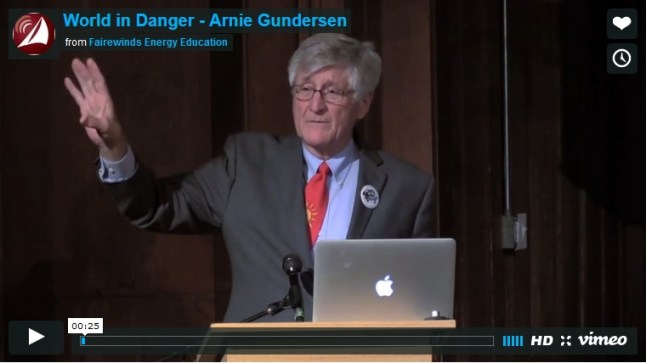
How does the Fukushima Daiichi meltdown disaster show the enormous risk potential for the continued operation of the Diablo Canyon atomic reactor?
Filmed by Ecological Options Network (EON) at Point Reyes Station in California, Fairewinds Chief Engineer Arnie Gundersen presents A World in Danger.
This presentation from the 2015 California speaking tour precedes a panel discussion “Tell All” between chief engineer Arnie Gundersen, Fairewinds founder and president Maggie Gundersen, and EON co-directors Jim Heddle and Mary Beth Brangan. The follow-up conversation can be found here.
EMCEE: (:47) I want to begin with a quote by that celebrated and famous American philosopher, W. C. Fields, who once said, “There comes a time in human events when we must seize the bull by the tail and stare the situation squarely in the face.” And that’s what we’re going to do tonight. So Arnie Gundersen, please take it away. (applause)
AG: The thing I’d like to talk about, and Tim alluded to it, is how the nuclear industry has so successfully framed this argument on nuclear. There’s a book Don’t Think of an Elephant. What’s the first thing you think of – it’s an elephant. And the person who frames the argument usually wins the argument. We wind up being labeled as anti-nuclear this’s or that’s. We never call them pro-nuclear zealots. They’ve been able to frame the argument.
Here’s an example. What’s wrong with this sentence – The Fukushima accident happened on March 11, 2011. (F: Accident) Accident. That’s one – there’s actually three, but the first – (F: It’s still happening) Yes. It’s still happening.
When the nuclear industry talks about Fukushima in the past tense, the fact of the matter is that it’s still bleeding into the Pacific and it will take 100 years and a half a trillion dollars to clean up but they want you to think it’s over. So (1) is it’s still happening; (2) is the world accident.
An accident is when you’re driving down the road and an owl flies in front of you and hits your window and takes you out. That’s an accident. You couldn’t foresee it. But the DIET commission – DIET is their parliament – has said this is not an accident. This was man-made. This was profoundly man-made. Engineers knew it for 40 years. So the wick on this time bomb was lit in 1967 when they started building it. And it happened to have exploded in 2011, but the accident was not an accident. It was a man-made disaster.
So I try to remove that from my vocabulary but it’s so ingrained because I was an engineer and I would bet everybody would call it an accident. It’s ingrained. It’s not an accident; it’s a disaster. And the last one is – I said the Fukushima accident.
Fukushima is a wonderful prefecture and they would much rather we call it Fukushima Daiichi, which stands for the first nuclear site at Fukushima, and then down the road about 6 miles is Fukushima Daini. It’s sort of like having the California accident. It means something to the people in Fukushima Prefecture that the disaster be properly phrased as the Daiichi accident.
Anyway, let’s get on with the show here. There’s four points I’d like to talk about.
The first is that nuclear accidents happen a lot more frequently than our regulators – (F: Nuclear events) – nuclear disasters – okay, there we go. Nuclear events happen a lot more frequently than our regulators would like you to know and that our politicians would like you to know and the nuclear industry would like you to know.
The second is that as time goes by, these disasters have been getting worse, not less worse.
The third one is, as bad as Fukushima Daiichi was, we’re lucky because it could have been much, much worse.
And the fourth, and it really hits here in California and the West Coast, is that radiation knows no borders.
So in my lifetime – here’s what I looked like right out of college – look at that tie, looks like I had a rug on or something – so that guy was brighter than the one who’s standing here, but probably was a little less wise. So I’d like to say that my wisdom might have increased but perhaps my intellect decayed a little bit. But over our joint career of 40-some-odd years, here’s what’s happened.
We’ve had a partial meltdown at Three Mile Island. We’ve had a complete meltdown at Chernobyl. We’ve had a complete meltdown at Fukushima Daiichi unit 1, a complete meltdown at Fukushima Daiichi unit 2, and a complete meltdown at Fukushima Daiichi unit 3.
So in those 35 years from TMI to today, we’ve had 5 meltdowns. So if you take 35 and divide by 5, this is not rocket science – you get 7. About once every 7 years, about once a decade, you’re going to have a meltdown. That’s what history shows.
But yet, the regulators and the Nuclear Regulatory Commission and the nuclear industry have been telling the political leaders that the chance of an accident is one in a million.
So if you take a million and divide that by 400 nuclear reactors, you get an accident – you get a disaster occurring about once every 2,500 years.
Well, history is telling us it’s once in 7 and yet regulators are basing their decision-making process on once in 2,500 years.
So this is an example how the argument has been distorted by the nuclear industry and, unfortunately, dramatically affects our Congressmen. Who in Congress would allow Diablo to run if they thought it was going to melt down in 7 years?
So the first point here is that policymakers are in one world and the real world data is in another. So the second issue is that accidents have become worse – disasters have become worse – I caught myself.
The first one is TMI. It was a partial meltdown, sort of like being partially pregnant. The team that took this picture – it’s an interesting story to talk about the mindset of nuclear power – they ran it about a year after the accident – the disaster – by the time I’m done here I’ll get this right. About a year after the disaster, they put a camera in from the top of the reactor. This is a true story from the people that were on that crew. They went down however many meters until where the reactor core should have been and they didn’t see it. So they pulled the camera up and said something’s wrong with our measurement. And they re-measured the wire and they put it back in a second time. And they didn’t see it. And they still pulled it back out again and said something’s wrong with our measurement. The core’s got to be there. They put it down a third time and they didn’t see it. And it was the third time that the person in charge of that said oh, my God, we have a meltdown.
Two years after with huge radiation releases and the psyche of the nuclear industry was such that they wouldn’t admit to themselves they had a meltdown until this picture came out.
So the consequences are not just in meltdowns. They’re also in casualties. If you go up on the Nuclear Regulatory Commission’s website, no one was hurt at Three Mile Island. And of course, the industry says that, too. This is Dr. Steve Wing. And the white line that runs diagonally through that from the – from here to there – that’s the Susquehanna River. This is Three Mile Island. And what Steve was able to do was look at the demographic data of lung cancer deaths 10 years after the accident. And he showed clearly that lung cancers in the river valley were awful compared to lung cancers on the hillsides. Why is that? When the accident happened, when the disaster happened, when the meltdown happened, there was a temperature inversion that day and it kept the radiation in the valley. Now the nuclear industry won’t admit this and Steve’s taken a lot of flack over it, but in fact this is what the data says. People did die after TMI.
This is a picture of the remnants of the nuclear core at Chernobyl. It’s called the elephant’s foot. It was taken by a robot about a year after the accident and – after the disaster, after the meltdown – and this elephant’s foot is so radioactive that if it were up here, we’d all be dead in about 2 minutes. That’s how much radiation is coming off that elephant’s foot right now. But we had a picture of what Three Mile Island looked like and we had a picture of what Chernobyl looked like within two years of the accident – disaster.
The next slide – first we all know that Europe was highly contaminated as a result of the meltdown at Chernobyl. Dr. Alexey Yablokov calculated that over a million people died from the radiation releases. The International Atomic Energy Agency says about 40 died. There’s a big difference there. (10:54)
So now let’s move on to Fukushima Daiichi. Where’s the cores? Nobody knows. We’re five years into this process and we don’t even have a picture of where those nuclear cores are. So the trend has been from a partial meltdown to a complete meltdown to three complete meltdowns and we don’t – the radiation levels are so high in that building that we can’t find those nuclear cores yet.
Next slide. This is a real quick sequence. This is from left to right, this is Fukushima Daiichi unit 1 – it’s already exploded – 2, 3, 4. I want you to keep an eye on 3 – that’s this one right here. Next slide. This can’t happen. According to the Nuclear Regulatory Commission, you can’t have a hydrogen explosion and you can’t have a detonation shockwave at a nuclear power plant. So don’t worry. What you see here didn’t happen.
And the example is – Diablo Canyon can’t withstand this. And so what the Nuclear Regulatory Commission says is that this event cannot happen. So therefore, Diablo Canyon can continue to operate. Well, that little slide here shows the initial burst of the explosion – the detonation shockwave. And the rest after that is ballistic. It just takes the roof off the building. But don’t worry, this can’t happen at Diablo Canyon.
I’m going to click it 21 times. (12:36 to 13:04) That’s not a detonation shockwave. There’s not a containment in the world that can withstand a detonation shockwave. So the regulator’s solution is to assume that a detonation shockwave can’t happen.
The next slide is another problem that the regulators have managed to corral. And that’s that containments don’t leak. That’s the dome at both Diablo and at San Onofre – that thing that looks like a half a hemisphere. That’s the containment dome. And I was discussing this – I was invited to talk to the advisory committee on reactor safeguards – the 17 wise men that guide the Nuclear Regulatory Commission back in 2010, four months before Fukushima Daiichi. And I was arguing that containments do leak and that they need to change their regulations, especially on a new reactor.
After that, the next month, NRC staff – 4,000 staff members wrote a position paper to the Nuclear Regulatory Commission and they said we assume the containment leak rate is zero.
So what happens here, this is an infrared picture of Fukushima Daiichi Unit 3 and it’s almost a month after the nuclear accident. The disaster. The big blob is the fuel pool which is boiling and mixing with air and you can see – there’s only a couple words on here that are in English – but it’s about 62 degrees centigrade, but that means it was about 130 degrees in the gases that are coming off. That was a big deal and it was also doing the same thing at unit 4 and in every other one. The fuel pools were boiling. But that’s not the key here. See that little dot right there? It says 128 degrees centigrade. What that means is that’s about 250 degrees. Remember, water boils at 212 at atmospheric conditions. What that tells me is that the containment was leaking like a sieve. There’s no containment integrity at Fukushima Daiichi Unit 3.
This is another one of those issues that the Nuclear Regulatory Commission pushed aside. There’s a telecoms between NRC and people in Tokyo and they estimate the containment was leaking at 300 percent per day.
If that number was applied to Diablo Canyon it would have to shut down immediately because the accident analysis – I can use it because it’s an NRC term – this says that they only assume a tenth of a percent per day. So this is another example of how the industry pushes the argument.
The next piece is a piece of nuclear fuel. This is in a scanning electron microscope and it was done by Marco Kaltofen at Worcester Polytechnic. The fascinating part of this was this was found 300 miles away from Fukushima Daiichi. So an accident/disaster doesn’t end at the site boundary. This is 300 miles away and if it’s on the – this was picked up in a vacuum cleaner bag. If it’s on the vacuum cleaner bags, it’s in your lungs because you’re breathing in whatever winds up on the floor. Next slide – these are car air filters. Each one of those black dots is a hot particle. If you look really carefully, we had a great slide projector – actually, we have one hot particle on a car air filter in Seattle – but the Fukushima City ones are obviously the worst. And a car breathes in just about what a person breathes in. So that the – God help us when these people get out 10 or 15 years and we start to see an increased incidence of lung cancer like Steve Wing discovered at TMI. But according to the NRC, TMI didn’t happen, either.
Okay. The last one in this series – Fairewinds asked for children’s shoes. And we got 7 pairs of shoes from Fukushima Daiichi and we compared them with 7 pairs of shoes in the United States. And basically, the shoes on the right are – that’s the lower limit of detection – that’s the best the instrument can do. The shoes of the U.S. kids are squeaky clean. And the shoes of the Japanese kids are loaded with cesium. Well, what do kids do? They tie their shoes, put their hands in their mouth and it’s all over the place in Japan.
So the second conclusion is that we went from a partial meltdown to a complete meltdown to three complete meltdowns. And the consequences are getting worse and the accident frequency is shortening. That’s not a good trend. And it’s actually going to get worse as these plants get older.
Diablo is now 30-plus years old in operating years, but it actually was designed in the 60’s and they built the reactor backward and things like that, that slowed down the construction. But we’re looking at a 1960’s technology with 1960’s concrete and as things get old, they all break down. My body keeps telling me. So conclusion number two is that disaster frequency – I’m sorry – disaster severity is increasing.
So the third piece of this revolves around the key piece of nuclear power that no one wants you to know about. Now we all know that when an uranium atom splits in half, it gives off lots of energy. That’s what makes nuclear power so cool and that’s what makes nuclear bombs explode. Take uranium, split it in half and you get lots of energy. If it stopped there, we wouldn’t have problem at Daiichi. But it doesn’t stop there, and this is what they don’t tell you about. That the explosion in the middle – the nuclear chain reaction in the middle – only gives off 93 percent of the heat. The other 7 percent comes from these pieces that are left over – that piece and that piece. They remain physically hot and radioactively hot for hundreds of years. (19:41)
So when Fukushima Daiichi had been safely shut down, it stopped the chain reaction. There were no new uranium atoms splitting. But the pieces left behind were still churning out 7 percent of the problem. 7 percent doesn’t sound like a whole heck of a lot except that – let’s look at Daiichi unit 2 – that was 4 million horsepower. 7 percent of 4 million is 270,000 horsepower of heat that it had to get rid of, and the nuclear core is only 12 x 12 x 12. So think about 270,000 horses in a space 12 x 12 x 12 and you’ve got to get rid of that heat and you can’t.
What happened at Daiichi was that – you all heard that the wave came in and knocked out the diesels and because the diesels couldn’t run there wasn’t cooling water. That’s true, but even if the diesels were on top of the Empire State Building, Daiichi still would have had a meltdown, and this is why.
Right along the water is a pile or rubble, and those are the cooling pumps that were designed to take away that quarter of a million horsepower from each reactor. The wave destroyed the cooling pumps. We call that the loss of the ultimate heat sink – LOUHS. So it doesn’t matter – and people will say well, at Diablo the reactor building is at 80 or 90 feet. Cooling pumps are at the water. So if a tsunami were to come, it’s not going to hit the building but it’s going to knock out the pumps along the water.
And the nuclear industry has phrased the problem as we don’t have a problem with Diablo because we’re way up on the cliff. The pumps aren’t up on the cliff because if they were, they couldn’t pump the water. The pumps are down at the water, and that’s a critical problem that was never addressed.
So on this issue, Fukushima could have been much worse. When the tsunami hit, it knocked out almost all the pumps. One pump survived at Daiichi, a couple down the road at Daini. But there were 14 nuclear power plants that lost their cooling water. 14 nuclear power plants lost their cooling water, which meant that – and of the diesels, there were 37 diesels – 24 failed to start. They only had 12 diesels to cool 14 nuclear power plants. And had it been just a hair worse, we would not have had 3 meltdowns like at Daiichi; we would have had 14. And that’s not a problem that can take out Japan. That’s the kind of problem that takes out the northern hemisphere. So the issue of luck plays an important piece of this.
So Daiichi could have been much worse. It was a complete technical failure. Every single system that was designed to work didn’t. And we owe our life in this hemisphere to the courage of a couple hundred Japanese workers on the site. And so courage is critical to this. The plant manager was highly respected by the people and when he stayed, they stayed. So I always dedicate my speeches to these couple hundred people – we call them the Fukushima Fifty. There was probably more than 50 but less than 200 people that stayed behind and now are getting leukemia as a results.
So that’s number one. The other piece is luck. When this accident happened – when this disaster happened, the wind was blowing out to sea about 80 percent of the time. Now had the wind been going the other way, as it does during some seasons in Japan, Japan would have been cut in half by the radiation releases just from those three nuclear reactors. You would have had northern Japan, southern Japan and this uninhabited belt in the middle.
So luck is that the wind was blowing in the right direction. The other piece of luck was that it happened during the day. There was 1,000 people at Daiichi on that Friday, including all the key managers. If it had happened 12 hours later in the middle of the night, there was 100 people there and no key managers. And the infrastructure for them to get into work was gone. It’s not like they could hop in the car and drive in to rescue the place. They could not have gotten there because the infrastructure had been destroyed. So were it not for a couple hundred courageous people and the luck of a 12-hour difference of when that earthquake and tsunami hit, this disaster at Daiichi would have taken out the country of Japan and highly contaminated the northern hemisphere as well.
This is Naoto Kan’s comment about the accident. Kan was the prime minister at the time of the accident, and he said “Our existence as a sovereign nation was at stake.” This parallels what Gorbachev said in his memoires. Gorbachev claims that the Soviet Union collapsed not because of Perestroika, but because of Chernobyl. So the two prime ministers who lived through this – one democratically elected, and one a communist leader – both came to the same conclusion, that this is a technology that is capable of destroying a country overnight. Unlike all the other things we live with, nuclear power can destroy the fabric of a country overnight.
So next slide – is nuclear power too big to fail? That would be the image I think you get when you look at this robust structure. But in fact, we’ve seen now three times, at Daiichi 1, Daiichi 2 and Daiichi 3 that that’s false. I like to say it this way. Sooner or later in any foolproof system, the fools are going to exceed the proofs.
So now last piece here is what does this mean for California and the west coast? It does mean that radiation knows no borders. It doesn’t stop at – it’s a Japanese accident and the radiation says oops, I’ve got to go back over the line and return to Japan. No. We’re all in this together. Radiation knows no borders.
What I was able to do is put together this little piece here that sort of explains the impact on California better than anything else I’ve seen. The meltdown at Daiichi caused 400 tons of water per day to be released into the Pacific. TEPCO’s frantically catching it in all these tanks. Those blue things and silver things. They weren’t there when the plant was built but they were building about a tank every two or three days trying to frantically catch this water, yet 400 tons a day was going into the Pacific. What does that mean? That’s the equivalent of 25,000 tractor loads of radioactive liquid being pumped into the Pacific. And it hasn’t stopped. That’s just in the first four years. Well, let’s talk about what that means. Should you be worried living in California?
And I’ll use this block as an example. The block is 10 x 10 x 10. So 10 x 10 x 10 – there’s 1,000 pieces in that block. Well, when I went to school, we were told dilution is the solution to pollution. And I think that the Daiichi issue is showing that we all live in a world that’s awfully small to dilute.
So let’s take a look at that first big block that’s 10 by 10 by 10. So let’s say each piece of that means a rem. A REM is a unit – Roentgen equivalent man – it’s a unit of radiation. You can think in Sieverts – 1,000 rem is 10 Sieverts. I grew up with REM so we’ll deal with REM. A thousand REM – if I gave you a block – here’s your block of a thousand REM – you’re dead in an hour. So now let’s take a tenth of that. Let’s split the block into 100. So now this is 10 by 10 by 1. So this is a block of 100 REM. So if I gave out 100 REM, 100 REM to the first 10 people here, one of the 10 of you would die of cancer. And we call this the linear no-threshold radiation theory. And what it means is, I keep cutting that block. I never get to the point where there’s some de minimus dose that we don’t have to worry about. Someone will get cancer from that radiation. So we’ve gone to 100 REM. One out of ten people exposed to 100 REM will die of cancer. So let’s go down – now we’re 10 – so 1 by 1 – so this is 10 REM. And if I spread that out to everybody in the room, there would be an increase of – one of you would get a cancer from that radiation. But what’s happening here, and I think you can see what the public policy people are counting on, is that statistically, about 40 percent of Americans die of cancer anyway. So to pick up that one extra person out of the 40 is epidemiologically really difficult. So the more it gets diluted, the less likely you are to know who’s going to die of cancer. But you can be sure that someone will.
And the last slide goes the same way. So as radiation gets diluted, it doesn’t mean that it hits some de minimus level and everybody’s safe. So when they talk about the fish in the Pacific are safe, really that’s not true. But what’s happening is there’s about 2 billion people in the Pacific and there’s a whole heck of a lot of these 10 by 10 by 10 cubes being thrown into the Pacific. So what you’re doing is you’ve got the cancer incidence down so it’s extraordinarily difficult for an epidemiologist to detect it in a population. But that there’ll be thousands and tens of thousands of cancers, you can count on. We just don’t know who. But is Fukushima causing cancers in the Pacific Basin? Absolutely.
So when I hear public health officials saying well, that fish only has 10 Becquerels so therefore, it’s safe to eat, it’s really not what they should be saying. That fish has 10 Becquerels so if you get cancer we won’t be able to prove it came from Fukushima. That’s the real way the statement should be made. So should you be worried? Personally, I’ve made the decision not to eat fish from the Pacific until my regulators measure the fish and tell me what’s in it. That’s a personal decision and there are people who are eating the fish.
There’s an issue called bioaccumulation which dilution is not related to. So as this radiation moves out into the environment, it gets picked up by the seaweed. We’ve already seen concentrations in the seaweed. Then the critters that eat the seaweed get even more. It’s almost like mercury and tuna – you know how it works its way up the food chain. And we will see over time increased concentrations of radiation at the top of the food chain – the salmon, the shark, the tuna, etc. So this issue of dilution is the solution to pollution only assumes that it’s in the water and it’s not bioaccumulating, which makes the problem even worse.
All right, well, thank you. As we say on our little button here: Radiation knows no borders. (32:33 Request to go back to a slide) What’s happening there is the concentration of radiation near Daiichi was large, but then as it moves out into the Pacific over time, it dilutes. But the same number of atoms are at play. So what you’re seeing in the Pacific now is the center of the Pacific is relatively uncontaminated compared to the Aleutian Islands down to Vancouver and down the California coast. And that will continue to move south until it gets to about the equator and starts to spin around again. But the source is not decaying. Ken Buesseler (33:18) and I have disagreements but one of the things I absolutely agree with Ken on is that the concentrations in the Pacific clearly show that the plant is continuing to bleed into the Pacific. If it had been a one-shot deal – if it happened in the first month and then was solved, we wouldn’t see this problem right now. So the fact Fukushima is continuing to bleed into the Pacific is I think one of the key issues at Woods Hole – who was very first to identify it – my hat’s off to them.
http://www.fairewinds.org/nuclear-energy-education//world-in-danger
All is not fine for India’s nuclear power programme
A study by the U.S.-based Institute for Energy Economics and Financial Analysis, that was released recently by the A.P.-Telangana-based voluntary organisation Human Rights Forum, warns India that GE-Hitachi and Westinghouse nuclear reactors are neither cost-effective nor power-efficient and that they have a huge risk factor.
This time round, the CPI(M) has decided to take up the cause in a big way. Senior party leader Prakash Karat visited Kovvada and other villages to interact with fishermen and farmers and addressed a public meeting there on July 16. The CPI(M) has given a call for a broad-based struggle against the nuclear plant at Kovvada, which Karat said would be a white elephant considering its steep projected cost. “This project is a bonanza for American business
 The coast isn’t clear for India’s nuclear power quest, THE HINDU, K. VENKATESHWARLU , 28 July 16 A cluster of plants promises to turn coastal Andhra Pradesh into the country’s nuclear energy hub, but at what cost? At Kovvada, first off the blocks, K. Venkateshwarlu discovers some uneasy answers. Continue reading
1 This Month





PLEASE OPPOSE HR 8255 AND S.3639 – bills would accelerate satellite deployment, with no environmental review or safeguards – https://ncstd5li.quorum.us/campaign/169331/
To see nuclear-related stories in greater depth and intensity – go to https://nuclearinformation.wordpress.com
-
Archives
- October 2026 (39)
- September 2026 (339)
- August 2026 (330)
- July 2026 (355)
- June 2026 (287)
- May 2026 (306)
- April 2026 (356)
- March 2026 (251)
- February 2026 (267)
- January 2026 (308)
- December 2025 (358)
- November 2025 (359)
-
Categories
- 1
- 1 NUCLEAR ISSUES
- business and costs
- climate change
- culture and arts
- ENERGY
- environment
- health
- history
- indigenous issues
- Legal
- marketing of nuclear
- media
- opposition to nuclear
- PERSONAL STORIES
- politics
- politics international
- Religion and ethics
- safety
- secrets,lies and civil liberties
- spinbuster
- technology
- Uranium
- wastes
- weapons and war
- Women
- 2 WORLD
- ACTION
- AFRICA
- Atrocities
- AUSTRALIA
- Christina's notes
- Christina's themes
- culture and arts
- Events
- Fuk 2022
- Fuk 2023
- Fukushima 2017
- Fukushima 2018
- fukushima 2019
- Fukushima 2020
- Fukushima 2021
- general
- global warming
- Humour (God we need it)
- Nuclear
- RARE EARTHS
- Reference
- resources – print
- Resources -audiovicual
- Weekly Newsletter
- World
- World Nuclear
- YouTube
-
RSS
Entries RSS
Comments RSS

