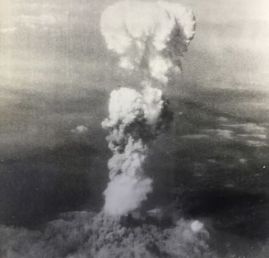
Hiroshima: the Crime That Keeps on Paying, But Beware the Reckoning, CounterPunch ,by DIANA JOHNSTONE , AUGUST 5, 2016“……..The decision to destroy Hiroshima and Nagasaki was a political not a military decision. The targets were not military, the effects were notmilitary. The attacks were carried out against the wishes of all major military leaders. Admiral William Leahy, chairman of the Joint Chiefs of Staff, wrote in his memoirs that “the use of this barbarous weapon at Hiroshima and Nagasaki was of no material assistance in our war against Japan. The Japanese were already defeated and ready to surrender…” General Eisenhower, General MacArthur, even General Hap Arnold, commander of the Air Force, were opposed. Japan was already devastated by fire bombing, facing mass hunger from the US naval blockade, demoralized by the surrender of its German ally, and fearful of an imminent Russian attack. In reality, the war was over. All top U.S. leaders knew that Japan was defeated and was seeking to surrender.
The decision to use the atom bombs was a purely political decision taken almost solely by two politicians alone: the poker-playing novice President and his mentor, Secretary of State James F. Byrnes…….
the U.S. atom bombs got full credit for ending the war.
But that is not all.
The demonstrated possession of such a weapon gave Truman and Byrnes such a sense of power that they could abandon previous promises to the Russians and attempt to bully Moscow in Europe. In that sense, the bombs on Hiroshima and Nagasaki not only gratuitously killed hundreds of thousands of civilians. They also started the Cold War.
Hiroshima and the Cold War
A most significant observation on the effects of the atomic bomb is attributed to General Dwight D. Eisenhower. As his son recounted, he was deeply depressed on learning at the last minute of plans to use the bomb. Shortly after Hiroshima, Eisenhower is reported to have said privately:
“Before the bomb was used, I would have said yes, I was sure we could keep the peace with Russia. Now, I don’t know. Until now I would have said that we three, Britain with her mighty fleet, America with the strongest air force, and Russia with the strongest land force on the continent, we three could have guaranteed the peace of the world for a long, long time to come. But now, I don’t know. People are frightened and disturbed all over. Everyone feels insecure again.”[2]
As supreme allied commander in Europe, Eisenhower had learned that it was possible to work with the Russians. US and USSR domestic economic and political systems were totally different, but on the world stage they could cooperate. As allies, the differences between them were mostly a matter of mistrust, matters that could be patched up.
The victorious Soviet Union was devastated from the war: cities in ruins, some twenty million dead. The Russians wanted help to rebuild. Previously, under Roosevelt, it had been agreed that the Soviet Union would get reparations from Germany, as well as credits from the United States. Suddenly, this was off the agenda. As news came in of the successful New Mexico test, Truman exclaimed: “This will keep the Russians straight.” Because they suddenly felt all-powerful, Truman and Byrnes decided to get tough with the Russians.
Stalin was told that Russia could take reparations only from the largely agricultural eastern part of Germany under Red Army occupation. This was the first step in the division of Germany, which Moscow actually opposed.
Since several of the Eastern European countries had been allied to Nazi Germany, and contained strong anti-Russian elements, Stalin’s only condition for those countries (then occupied by the Red Army) was that their governments should not be actively hostile to the USSR. For that, Moscow favored the formula “People’s Democracies” meaning coalitions excluding extreme right parties.
Feeling all-powerful, the United States sharpened its demands for “free elections” in hope of installing anti-communist governments. This backfired. Instead of giving in to the implicit atomic threat, the Soviet Union dug in its heels. Instead of loosening political control of Eastern Europe, Moscow imposed Communist Party regimes – and accelerated its own atomic bomb program. The nuclear arms race was on.
Chinese firm with military ties invited to bid for role in UK’s nuclear future,
China National Nuclear Corporation on government list of preferred bidders for development funding for next-generation modular reactors, Guardian, Adam Vaughan, 8 Aug 16, A controversial Chinese company has been selected to bid for millions of pounds of public money in a UK government competition to develop mini nuclear power stations.
The China National Nuclear Corporation (CNNC) features twice in a government list of 33 projects and companies deemed eligible to compete for a share in up to £250m to develop so-called small modular reactors (SMR).
Nick Timothy, Theresa May’s co-chief of staff, has previously expressed alarm at the prospect of CNNC having such close access to the UK’s energy infrastructure because it would give the state-owned firm the potential ability to build weaknesses into computer systems.
The company was formerly China’s Ministry of Nuclear Industry and developed the country’s atomic bomb and nuclear submarines, as well as being a key player in its nuclear power industry.
“For those who believe that such an eventuality [shutting down UK energy at will] is unlikely, the Chinese National Nuclear Corporation – one of the state-owned companies involved in the plans for the British nuclear plants – says on its website that it is responsible not just for ‘increasing the value of state assets and developing the society’ but the ‘building of national defence’,” he wrote.
Tom Burke, chairman of the environment thinktank E3G and a former British government adviser, said there were legitimate concerns over the company. “I don’t fuss very much about the Chinese owning a nuclear power station [China General Nuclear in the case of Hinkley]. But I would be much more concerned about bringing in CNNC because they are known to be much more closely involved with the military and Chinese nuclear weapons programmes,” he said.
Thousands of people took to the streets of an eastern Chinese city this weekend to protest against a proposed nuclear waste reprocessing facility, in a show of public opposition that China fears could derail its ambitious plans to construct dozens of nuclear reactors.
China has been building nuclear reactors at a blistering pace, part of a plan for non-fossil fuels to provide a fifth of national energy supply by 2030. The country so far lacks sufficient nuclear waste processing facilities to handle the output from its planned reactors, and is also short of enrichment facilities to process fuel for the reactors to burn.
Anti-nuclear protests in China have been few and far between but Beijing has treated them with kid gloves for fear of setting off broader public opposition to the state’snuclear plans. The only two nuclear projects that have attracted significant publicopposition in the past 10 years have been called off.
Protesters in Lianyungang, a port city to the north of Shanghai in Jiangsu province, said they were worried about the health and safety impact of the proposed Sino-French venture. Thousands of residents turned out on Saturday evening in a protest monitored but not stopped by local police, and a second protest was expected for Sunday evening.
“The government kept the project a secret. People only found out about it recently. That’s why most people are worried,” said Mr Sheng, a local resident who declined to give his full name. “Some speculate that the nuclear waste is from other countries and do not understand why the project should be built here instead of over there if it’s as safe and beneficial as they say.”
The city is about 30km west of the Russian-built Tianwan nuclear plant, a complex that will be among the largest in China when all eight planned reactors are built. Its economy has faltered along with China’s industrial slowdown. In June, a scrap steel yard in Lianyungang that was China’s largest declared it could not pay its debts.
“We already have a chemical industrial park in Lianyungang and the pollution problem is quite worrying. Nuclear waste is far worse than normal chemical pollution,” said Mr He, a local shop owner. “Also, we all know what happened to Fukushima in Japan after the nuclear accident. We are really worried.”
French nuclear fuel group Areva in 2012 agreed to co-operate with China National Nuclear Corp, which operates the Tianwan site, to develop a nuclear fuel recycling plant in China but did not specify a location. In November last year, the French company — whose reactor business has been merged with French rival EDF — said CNNC might buy a minority stake covering the areas of uranium mining, recycling and decommissioning.
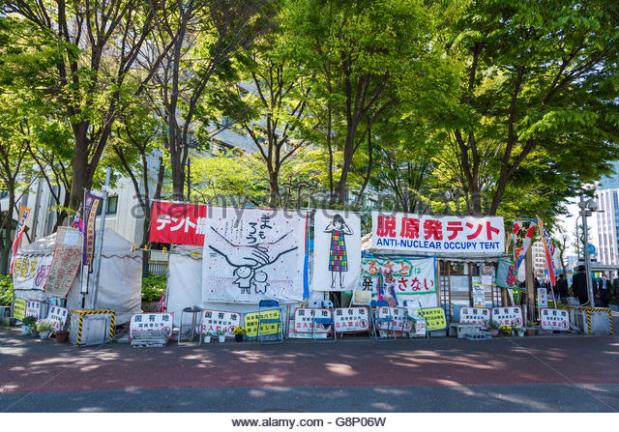
On July 28, Japan’s Supreme Court handed down its ruling in a case filed originally by the national government over tents pitched by anti-nuclear groups outside buildings of the Ministry of Economy, Trade and Industry (METI) in Kasumigaseki, Tokyo. It upheld an earlier order that the groups evacuate and pay for their use of the land.
The court’s petty bench, led by Judge Naoto Ohtani, rejected an appeal made by members of the groups against a lower court ruling. The Tokyo District Court is expected to carry out the forcible removal of the tents upon the request of the government, though members of the groups are expected to resist…….. The ruling includes an order that two defendants of the groups pay about JPY21,000 (USD206 at USD1 = JPY102) per day for use of the land, for a total of nearly JPY40 million (USD392,000) for the five-year period, plus interest. http://www.jaif.or.jp/en/japanese-government-wins-in-supreme-court-tents-of-anti-nuclear-groups-next-to-meti-ministry-building-to-be-forcibly-removed/
Fukushima: A Nuclear War Without A War: The Unspoken Crisis Of Worldwide Nuclear Radiation Fukushima Watch 1 Aug 16 “………Public Health Disaster. Economic Impacts What prevails is a well organized camouflage. The public health disaster in Japan, the contamination of water, agricultural land and the food chain, not to mention the broader economic and social implications, have neither been fully acknowledged nor addressed in a comprehensive and meaningful fashion by the Japanese authorities.
Japan as a nation state has been destroyed. Its landmass and territorial waters are contaminated. Part of the country is uninhabitable. High levels of radiation have been recorded in the Tokyo metropolitan area, which has a population of 39 million (2010) (more than the population of Canada, circa 34 million (2010)) There are indications that the food chain is contaminated throughout Japan:
Radioactive cesium exceeding the legal limit was detected in tea made in a factory in Shizuoka City, more than 300 kilometers away from the Fukushima Daiichi nuclear power plant. Shizuoka Prefecture is one of the most famous tea producing areas in Japan.
A tea distributor in Tokyo reported to the prefecture that it detected high levels of radioactivity in the tea shipped from the city. The prefecture ordered the factory to refrain from shipping out the product. After the accident at the Fukushima nuclear power plant, radioactive contamination of tea leaves and processed tea has been found over a wide area around Tokyo. (See 5 More Companies Detect Radiation In Their Tea Above Legal Limits Over 300 KM From Fukushima, June 15, 2011)
Japan’s industrial and manufacturing base is prostrate. Japan is no longer a leading industrial power. The country’s exports have plummeted. The Tokyo government has announced its first trade deficit since 1980.
While the business media has narrowly centered on the impacts of power outages and energy shortages on the pace of productive activity, the broader issue pertaining to the outright radioactive contamination of the country’s infrastructure and industrial base is a “scientific taboo” (i.e the radiation of industrial plants, machinery and equipment, buildings, roads, etc). A report released in January 2012 points to the nuclear contamination of building materials used in the construction industry, in cluding roads and residential buildings throughout Japan.(See FUKUSHIMA: Radioactive Houses and Roads in Japan. Radioactive Building Materials Sold to over 200 Construction Companies, January 2012)
A “coverup report” by the Ministry of Economy, Trade and Industry (May 2011), entitled “Economic Impact of the Great East Japan Earthquake and Current Status of Recovery“presents “Economic Recovery” as a fait accompli. It also brushes aside the issue of radiation. The impacts of nuclear radiation on the work force and the country’s industrial base are not mentioned. The report states that the distance between Tokyo -Fukushima Dai-ichi is of the order of 230 km (about 144 miles) and that the levels of radiation in Tokyo are lower than in Hong Kong and New York City.(Ministry of Economy, Trade and Industry, Impact of the Great East Japan Earthquake and Current Status of Recovery, p.15). This statement is made without corroborating evidence and in overt contradiction with independent radiation readings in Tokyo (se map below). In recent developments, Sohgo Security Services Co. is launching a lucrative “radiation measurement service targeting households in Tokyo and four surrounding prefectures”.
“A map of citizens’ measured radiation levels shows radioactivity is distributed in a complex pattern reflecting the mountainous terrain and the shifting winds across a broad area of Japan north of Tokyo which is in the center of the of bottom of the map.”
“Radiation limits begin to be exceeded at just above 0.1 microsieverts/ hour blue. Red is about fifty times the civilian radiation limit at 5.0 microsieverts/hour. Because children are much more sensitive than adults, these results are a great concern for parents of young children in potentially affected areas.”
The fundamental question is whether the vast array of industrial goods and components “Made in Japan” — including hi tech components, machinery, electronics, motor vehicles, etc — and exported Worldwide are contaminated? Were this to be the case, the entire East and Southeast Asian industrial base –which depends heavily on Japanese components and industrial technology– would be affected. The potential impacts on international trade would be farreaching. In this regard, in January, Russian officials confiscated irradiated Japanese automobiles and autoparts in the port of Vladivostok for sale in the Russian Federation. Needless to say, incidents of this nature in a global competitive environment, could lead to the demise of the Japanese automobile industry which is already in crisis.
North Korea accuses US of planning nuclear strike, 9 News, 8 Aug 16North Korea has accused Washington of planning a pre-emptive nuclear strike, after the US announced it would deploy its B-1 bomber in the Pacific for the first time in a decade.
The strategic aircraft were to be deployed on Saturday on the US island of Guam, the US military said last month, describing the operation as a routine rotation with the B-52 bomber.
Tensions have been running high since North Korea carried out its fourth nuclear test in January, followed by a barrage of missile launches that this month reached Japanese waters directly for the first time.
Pyongyang accused Washington of “becoming all the more pronounced in their moves to topple down the DPRK by mobilizing all nuclear war hardware”……..
On July 29, the US Air Force said it would upgrade its hardware on Guam, a US territory in the western Pacific, by sending the B-1 for the first time since April 2006.
An entire district in Rajasthan to be powered by solar energy, will end all water woes in the desert state! Rajasthan Electronics and Instrumentation Ltd, the firm currently handling the project has been given the green signal to spend Rs 11.91 crore for the entire project. India.com By Rutu Ladage on August 2, 2016“……..For Rajasthan government, coming up with newer techniques to ensure that the water issues never crop up, Barmer district in Jaiselmer is coming up with a unique solution. While we do have villages and homes in India that boast of solar power and using solar energy to meet their electricity needs, there are hardly any complete districts that boast of running solely on solar power. If the project works out, it will definitely be one of the major firsts in India and set the benchmark for other regions too. The Mukhyamantri Solar Adharit Nalkoop Yojana (MSANY). will provide 70 solar tubewells in Barmer district to help people become reliant on solar energy and use solar power even for agriculture.
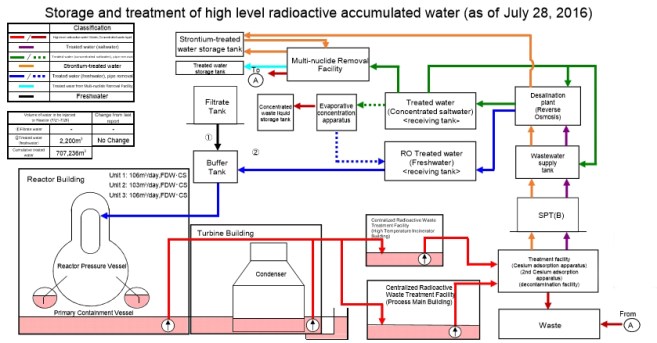
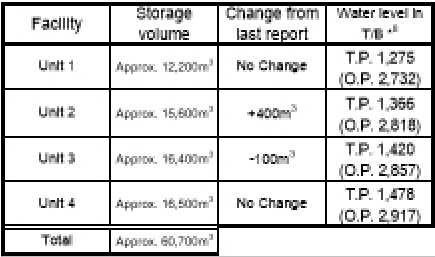
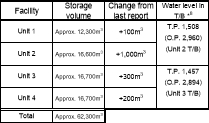
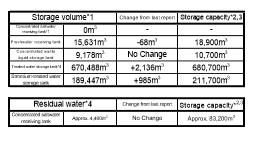
Situation of storing and treatment of accumulated water in the building (actual record) Stored amounts in each unit building (Units 1 to 4 (including condensers and trenches)) and stored and treated amounts, and other related data in the Accumulated Water Storing Facility as of July 28, 2016
Forecast of storing and treatment
(1) Short term forecast
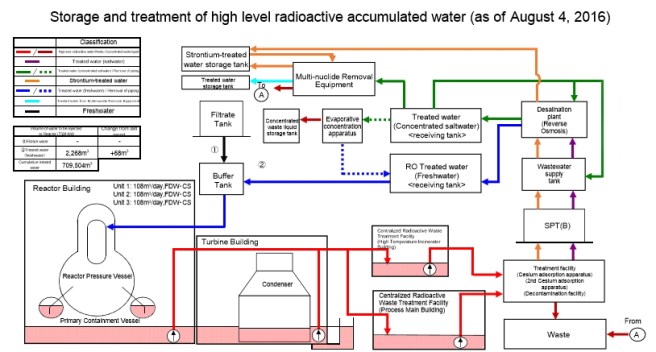
Water transfer is planned so that the levels of the accumulated water in Units 1 and 2 and Units 3 and 4 building will be maintained around at the level of OP. 3,000, based on the stored amount in the Accumulated Water Storing Facilities and the operating situation of the radioactive material treatment equipment. Water is transferred to the Process Main Building and/or High Temperature Incinerator Building as Accumulated Water Storing Facilities. Treatment is implemented considering the state of storage and transfer of Accumulated Water Storing Facilities.
We assume stored amounts in each unit building (Units 1 to 4 (including condenser and trench)), and stored and treated amounts, and other related data in the Accumulated Water Storing 2 Facilities as of August 4, 2016.
(2) Middle term forecast
Regarding accumulated water in Units 1 and 2 buildings and Units 3 and 4 buildings, from the viewpoint of reducing the risks of discharging to the ocean and leaking into the groundwater, it is necessary to keep enough capacity for the accumulated water in the building until its level reaches OP. 4,000 and to keep the accumulated water level lower than the groundwater level. On the other hand, based on the view of limiting inflow of underwater to buildings and reducing the amount of emerged accumulated water, we are planning to transfer accumulated water keeping its level in the building around OP. 3,000 considering water tank capacity. As for accumulated water of the Process Main Building and the High Temperature Incinerator Building, we are planning to treat the accumulated water considering the situation of construction of middle and low level waste water tanks, the operation factor of the radioactive material treatment instruments and duration for maintenance.
We forecast stored amounts in each unit building (Units 1 to 4 (including condensers and trenches)), and storing and treatment situations in the Accumulated Water Storing Facilities for the next 3 months.
Stored amounts in each building and the water storage equipment are forecasted to be unchanged in case transfer and treatment were implemented as scheduled without rain. However, it would be subject to change depending on the operation factor of the radioactive material treatment instruments and so on. Also, the water treated at the radioactive material treatment equipment (fresh water and condensed salt water) can be stored in the middle and low level waste water tanks.
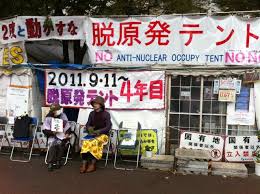
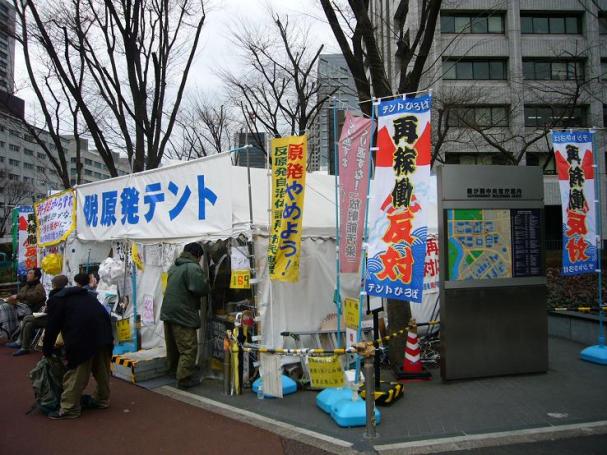
On July 28, Japan’s Supreme Court handed down its ruling in a case filed originally by the national government over tents pitched by anti-nuclear groups outside buildings of the Ministry of Economy, Trade and Industry (METI) in Kasumigaseki, Tokyo. It upheld an earlier order that the groups evacuate and pay for their use of the land.
The court’s petty bench, led by Judge Naoto Ohtani, rejected an appeal made by members of the groups against a lower court ruling. The Tokyo District Court is expected to carry out the forcible removal of the tents upon the request of the government, though members of the groups are expected to resist.
The three tents were erected almost five years ago—in September and October 2011—at the north corner of the premises of METI in a space along the sidewalk. Since then, members of a shadowy coalition of primarily far-left groups have continuously occupied them, displaying signs criticizing national nuclear policy and proclaiming the site a symbol of the anti-nuclear movement.
The groups had argued that setting up the tents fell within the concept of freedom of expression guaranteed by the Constitution, and that the suit by the government was an attempt to interfere with the expression of opinion in violation of that. The Tokyo District Court ruled in the first instance that the government’s filing of the suit was a proper part of managing national property and not unjust, and that it did not interfere with the expression of the same opinions by other means. The Tokyo High Court affirmed that in the second instance.
The ruling includes an order that two defendants of the groups pay about JPY21,000 (USD206 at USD1 = JPY102) per day for use of the land, for a total of nearly JPY40 million (USD392,000) for the five-year period, plus interest.
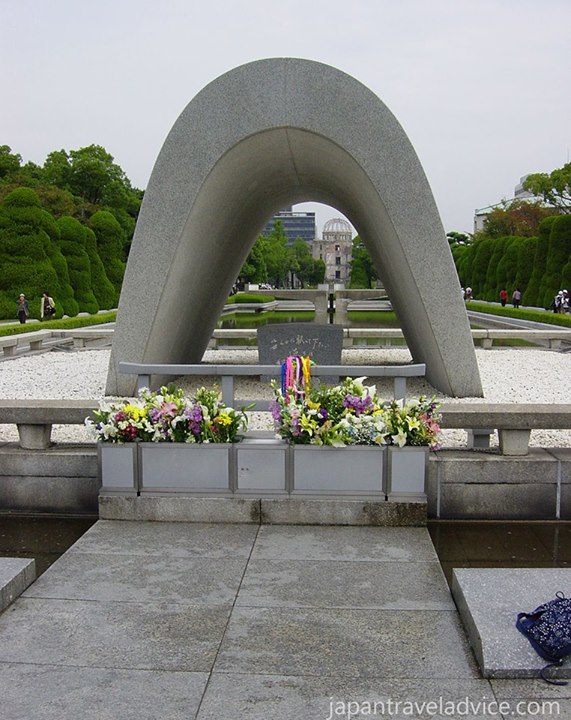
Hiroshima – The following is the full text of the Peace Declaration read Saturday by Hiroshima Mayor Kazumi Matsui at a ceremony to mark the 71st anniversary of the atomic bombing in Hiroshima:
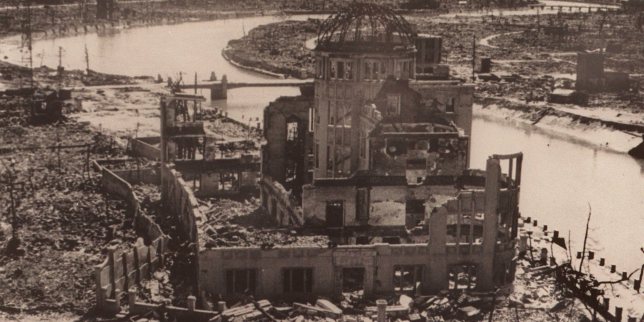
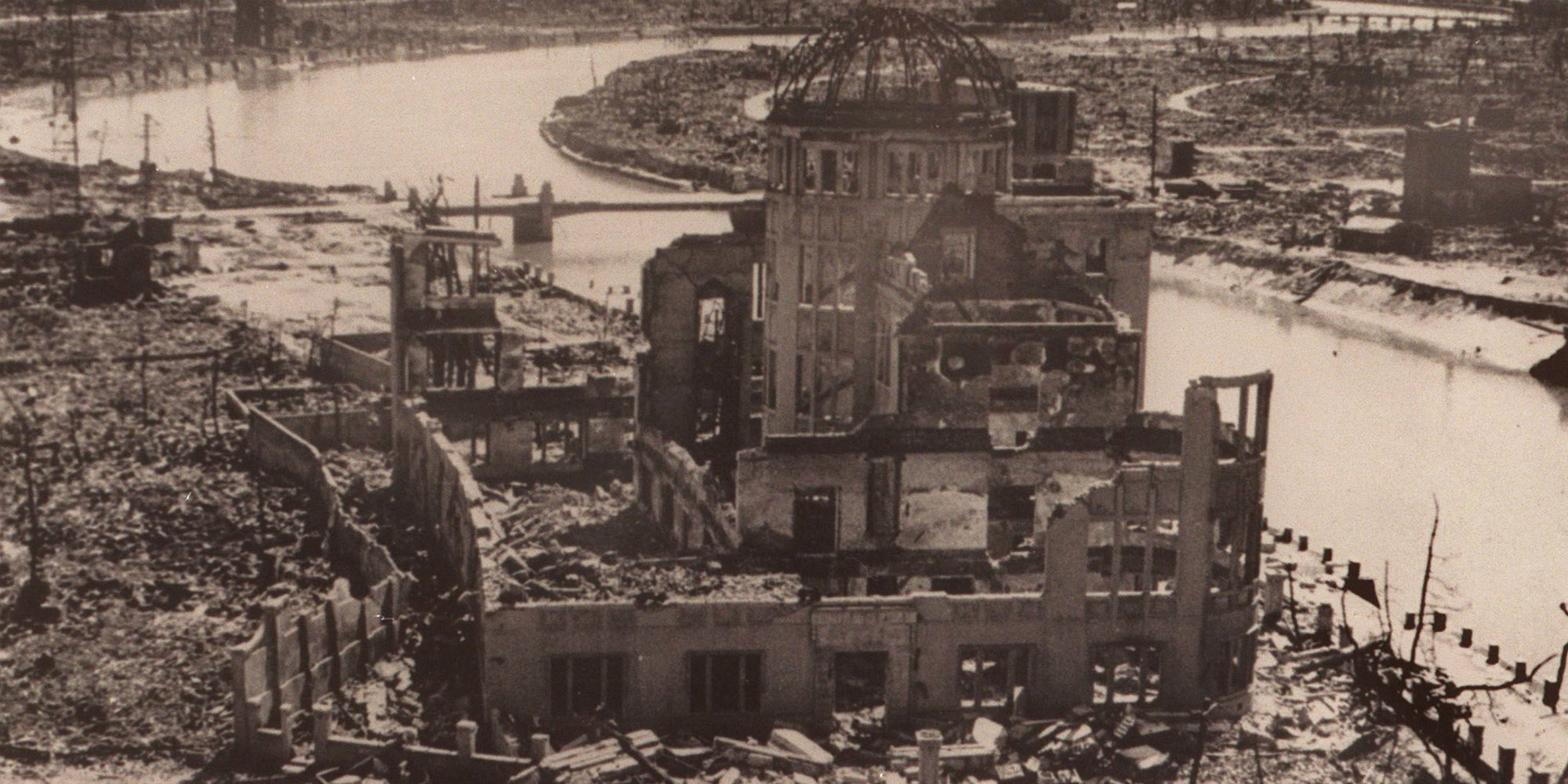
1945, August 6, 8:15 a.m. Slicing through the clear blue sky, a previously unknown “absolute evil” is unleashed on Hiroshima, instantly searing the entire city. Koreans, Chinese, Southeast Asians, American prisoners of war, children, the elderly and other innocent people are slaughtered. By the end of the year, 140,000 are dead.
Those who managed to survive suffered the aftereffects of radiation, encountered discrimination in work and marriage, and still carry deep scars in their minds and bodies. From utter obliteration, Hiroshima was reborn a beautiful city of peace; but familiar scenes from our riversides, patterns of daily life, and cultural traditions nurtured through centuries of history vanished in that “absolute evil,” never to return.
He was a boy of 17. Today he recalls, “Charred corpses blocked the road. An eerie stench filled my nose. A sea of fire spread as far as I could see. Hiroshima was a living hell.” She was a girl of 18. “I was covered in blood. Around me were people with skin flayed from their backs hanging all the way to their feet — crying, screaming, begging for water.”
Seventy-one years later, over 15,000 nuclear weapons remain, individually much more destructive than the one that inflicted Hiroshima’s tragedy, collectively enough to destroy the Earth itself. We now know of numerous accidents and incidents that brought us to the brink of nuclear explosions or war; today we even fear their use by terrorists.
Given this reality, we must heed the hibakusha. The man who described a living hell says, “For the future of humanity, we need to help each other live in peace and happiness with reverence for all life.” The woman who was covered in blood appeals to coming generations, “To make the most of the life we’ve been given, please, everyone, shout loudly that we don’t need nuclear weapons.” If we accept these appeals, we must do far more than we have been doing. We must respect diverse values and strive persistently toward a world where all people are truly “living together.”
When President Obama visited Hiroshima in May, he became the first sitting president of the country that dropped the atomic bomb to do so. Declaring, “…among those nations like my own that hold nuclear stockpiles, we must have the courage to escape the logic of fear, and pursue a world without them,” he expressed acceptance of the hibakusha’s heartfelt plea that “no one else should ever suffer as we have.” Demonstrating to the people of the United States and the world a passion to fight to eliminate all remaining nuclear weapons, the president’s words showed that he was touched by the spirit of Hiroshima, which refuses to accept the “absolute evil.”
Is it not time to honor the spirit of Hiroshima and clear the path toward a world free from that “absolute evil,” that ultimate inhumanity? Is it not time to unify and manifest our passion in action? This year, for the first time ever, the Group of Seven foreign ministers gathered in Hiroshima. Transcending the differences between countries with and without nuclear weapons, their declaration called for political leaders to visit Hiroshima and Nagasaki, for early entry into force of the Comprehensive Nuclear Test Ban Treaty, and fulfillment of the obligation to negotiate nuclear disarmament mandated by the Nuclear Non-Proliferation Treaty. This declaration was unquestionably a step toward unity.
We need to fill our policymakers with the passion to solidify this unity and create a security system based on trust and dialogue. To that end, I once again urge the leaders of all nations to visit the A-bombed cities. As President Obama confirmed in Hiroshima, such visits will surely etch the reality of the atomic bombings in each heart. Along with conveying the pain and suffering of the hibakusha, I am convinced they will elicit manifestations of determination.
The average age of the hibakusha has exceeded 80. Our time to hear their experiences face to face grows short. Looking toward the future, we will need our youth to help convey the words and feelings of the hibakusha. Mayors for Peace, now with over 7,000 city members worldwide, will work regionally, through more than 20 lead cities, and globally, led by Hiroshima and Nagasaki, to promote youth exchange. We will help young people cultivate a shared determination to stand together and initiate concrete action for the abolition of nuclear weapons.
Here in Hiroshima, Prime Minister Abe expressed determination “to realize a world free of nuclear weapons.” I expect him to join with President Obama and display leadership in this endeavor. A nuclear-weapon-free world would manifest the noble pacifism of the Japanese Constitution, and to ensure progress, a legal framework banning nuclear weapons is indispensable. In addition, I demand that the Japanese government expand the “black rain areas” and improve assistance to the hibakusha, whose average age is over 80, and the many others who suffer the mental and physical effects of radiation.
Today, we renew our determination, offer heartfelt consolation to the souls of the A-bomb victims, and pledge to do everything in our power, working with the A-bombed city of Nagasaki and millions around the world, to abolish nuclear weapons and build lasting world peace.
Abe rules out possibility that Japan will possess nuclear weapons
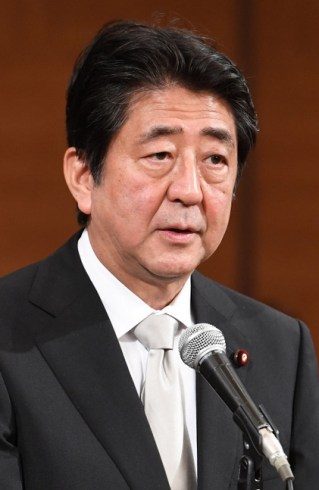
HIROSHIMA — Prime Minister Shinzo Abe ruled out the possibility on Aug. 6 that Japan will arm itself with nuclear weapons in the future.
“There is no way that Japan will either possess nuclear weapons or consider possessing such arms,” Abe told a news conference in Hiroshima.
At a press conference on Aug. 3, newly appointed Defense Minister Tomomi Inada stopped short of denying the possibility that Japan will possess nuclear weapons in the future.
“Under the Constitution, there are no restrictions on the types of weapons that Japan can possess as the minimum necessary,” she said.
Regarding the defense minister’s remarks, Prime Minister Abe said, “Her statement is consistent with the government’s policy. I’d like her to do her best as a member of the Abe Cabinet to achieve a world without nuclear weapons.”
As for constitutional revisions, the prime minister called for rational discussions on the issue. “I hope that the matter will be seriously discussed in the calm environment of the commissions on the Constitution (of both houses of the Diet), and lead to national debate.”
Japanese Prime Minister Shinzo Abe says the country will never possess, or even consider possessing, nuclear weapons.
Abe spoke to reporters after a memorial ceremony for the atomic bombing of Hiroshima on Saturday.
He was asked about remarks by new Defense Minister Tomomi Inada that Japan should not consider the possession of nuclear arms at the moment.
Abe said that Inada’s comment is consistent with the government’s policy.
He said Japan, as the only country to have experienced atomic bombings, firmly upholds its 3 non-nuclear principles.
Abe said, “It is our responsibility to make continuous and determined efforts toward a world without nuclear weapons.”
Abe was also asked about the possibility of the constitution being revised. He said the matter should be discussed in a quiet environment, referring to Diet panels reviewing the constitution. He said lawmakers, regardless of their party affiliation, should express their views in serious discussions, leading to a national debate.
Japanese Prime Minister Shinzo Abe says he is resolved to pursue a nuclear-free world and will do his best to achieve permanent peace.
The prime minister spoke on Saturday at a ceremony in Hiroshima to mark 71 years since the US atomic bombing of the city.
He referred to the visit in May of Barack Obama as the first incumbent US president to come to Hiroshima.
Abe said the leader of the sole nation to have used nuclear weapons saw the reality of the atomic bombing and urged nuclear powers to have the courage to achieve a world without such arms. Abe said he is sure that Obama’s speech gave hope to people around the world.
He said Japan, as the sole nation to have suffered atomic bombing, will adhere to its 3 non-nuclear principles of not having, not making and not bringing in nuclear arms. He said Japan will continue to stress the importance of maintaining and bolstering the framework of the Nuclear Non-Proliferation Treaty.
Abe said he will call for cooperation from both nuclear and non-nuclear powers in an effort to create a nuclear-free world. He added he will urge world leaders and young people to learn about the misery caused by atomic bombing.
He pledged continuing support for Japan’s aging atomic bomb survivors.
Have 70 years of nuclear policy been based on a lie?
The U.S. use of nuclear weapons against Japan during World War II has long been a subject of emotional debate. Initially, few questioned President Truman’s decision to drop two atomic bombs, on Hiroshima and Nagasaki. But, in 1965, historian Gar Alperovitz argued that, although the bombs did force an immediate end to the war, Japan’s leaders had wanted to surrender anyway and likely would have done so before the American invasion planned for Nov. 1. Their use was, therefore, unnecessary. Obviously, if the bombings weren’t necessary to win the war, then bombing Hiroshima and Nagasaki was wrong. In the 48 years since, many others have joined the fray: some echoing Alperovitz and denouncing the bombings, others rejoining hotly that the bombings were moral, necessary, and life-saving.
Both schools of thought, however, assume that the bombing of Hiroshima and Nagasaki with new, more powerful weapons did coerce Japan into surrendering on Aug. 9. They fail to question the utility of the bombing in the first place — to ask, in essence, did it work? The orthodox view is that, yes, of course, it worked. The United States bombed Hiroshima on Aug. 6 and Nagasaki on Aug. 9, when the Japanese finally succumbed to the threat of further nuclear bombardment and surrendered. The support for this narrative runs deep. But there are three major problems with it, and, taken together, they significantly undermine the traditional interpretation of the Japanese surrender.
Timing
The first problem with the traditional interpretation is timing. And it is a serious problem. The traditional interpretation has a simple timeline: The U.S. Army Air Force bombs Hiroshima with a nuclear weapon on Aug. 6, three days later they bomb Nagasaki with another, and on the next day the Japanese signal their intention to surrender.* One can hardly blame American newspapers for running headlines like: “Peace in the Pacific: Our Bomb Did It!”
When the story of Hiroshima is told in most American histories, the day of the bombing — Aug. 6 — serves as the narrative climax. All the elements of the story point forward to that moment: the decision to build a bomb, the secret research at Los Alamos, the first impressive test, and the final culmination at Hiroshima. It is told, in other words, as a story about the Bomb. But you can’t analyze Japan’s decision to surrender objectively in the context of the story of the Bomb. Casting it as “the story of the Bomb” already presumes that the Bomb’s role is central.
Viewed from the Japanese perspective, the most important day in that second week of August wasn’t Aug. 6 but Aug. 9. That was the day that the Supreme Council met — for the first time in the war — to discuss unconditional surrender. The Supreme Council was a group of six top members of the government — a sort of inner cabinet — that effectively ruled Japan in 1945. Japan’s leaders had not seriously considered surrendering prior to that day. Unconditional surrender (what the Allies were demanding) was a bitter pill to swallow. The United States and Great Britain were already convening war crimes trials in Europe. What if they decided to put the emperor — who was believed to be divine — on trial? What if they got rid of the emperor and changed the form of government entirely? Even though the situation was bad in the summer of 1945, the leaders of Japan were not willing to consider giving up their traditions, their beliefs, or their way of life. Until Aug. 9. What could have happened that caused them to so suddenly and decisively change their minds? What made them sit down to seriously discuss surrender for the first time after 14 years of war?
It could not have been Nagasaki. The bombing of Nagasaki occurred in the late morning of Aug. 9, after the Supreme Council had already begun meeting to discuss surrender, and word of the bombing only reached Japan’s leaders in the early afternoon — after the meeting of the Supreme Council had been adjourned in deadlock and the full cabinet had been called to take up the discussion. Based on timing alone, Nagasaki can’t have been what motivated them.
Hiroshima isn’t a very good candidate either. It came 74 hours — more than three days — earlier. What kind of crisis takes three days to unfold? The hallmark of a crisis is a sense of impending disaster and the overwhelming desire to take action now. How could Japan’s leaders have felt that Hiroshima touched off a crisis and yet not meet to talk about the problem for three days?
President John F. Kennedy was sitting up in bed reading the morning papers at about 8:45 a.m. on Oct. 16, 1962, when McGeorge Bundy, his national security advisor, came in to inform him that the Soviet Union was secretly putting nuclear missiles in Cuba. Within two hours and forty-five minutes a special committee had been created, its members selected, contacted, brought to the White House, and were seated around the cabinet table to discuss what should be done.
President Harry Truman was vacationing in Independence, Missouri, on June 25, 1950, when North Korea sent its troops across the 38th parallel, invading South Korea. Secretary of State Acheson called Truman that Saturday morning to give him the news. Within 24 hours, Truman had flown halfway across the United States and was seated at Blair House (the White House was undergoing renovations) with his top military and political advisors talking about what to do.
Even Gen. George Brinton McClellan — the Union commander of the Army of the Potomac in 1863 during the American Civil War, of whom President Lincoln said sadly, “He’s got the slows” — wasted only 12 hours when he was given a captured copy of Gen. Robert E. Lee’s orders for the invasion of Maryland.
These leaders responded — as leaders in any country would — to the imperative call that a crisis creates. They each took decisive steps in a short period of time. How can we square this sort of behavior with the actions of Japan’s leaders? If Hiroshima really touched off a crisis that eventually forced the Japanese to surrender after fighting for 14 years, why did it take them three days to sit down to discuss it?
One might argue that the delay is perfectly logical. Perhaps they only came to realize the importance of the bombing slowly. Perhaps they didn’t know it was a nuclear weapon and when they did realize it and understood the terrible effects such a weapon could have, they naturally concluded they had to surrender. Unfortunately, this explanation doesn’t square with the evidence.
First, Hiroshima’s governor reported to Tokyo on the very day Hiroshima was bombed that about a third of the population had been killed in the attack and that two thirds of the city had been destroyed. This information didn’t change over the next several days. So the outcome — the end result of the bombing — was clear from the beginning. Japan’s leaders knew roughly the outcome of the attack on the first day, yet they still did not act.
Second, the preliminary report prepared by the Army team that investigated the Hiroshima bombing, the one that gave details about what had happened there, was not delivered until Aug. 10. It didn’t reach Tokyo, in other words, until after the decision to surrender had already been taken. Although their verbal report was delivered (to the military) on Aug. 8, the details of the bombing were not available until two days later. The decision to surrender was therefore not based on a deep appreciation of the horror at Hiroshima.
Third, the Japanese military understood, at least in a rough way, what nuclear weapons were. Japan had a nuclear weapons program. Several of the military men mention the fact that it was a nuclear weapon that destroyed Hiroshima in their diaries. Gen. Anami Korechika, minster of war, even went to consult with the head of the Japanese nuclear weapons program on the night of Aug. 7. The idea that Japan’s leaders didn’t know about nuclear weapons doesn’t hold up.
Finally, one other fact about timing creates a striking problem. On Aug. 8, Foreign Minister Togo Shigenori went to Premier Suzuki Kantaro and asked that the Supreme Council be convened to discuss the bombing of Hiroshima, but its members declined. So the crisis didn’t grow day by day until it finally burst into full bloom on Aug. 9. Any explanation of the actions of Japan’s leaders that relies on the “shock” of the bombing of Hiroshima has to account for the fact that they considered a meeting to discuss the bombing on Aug. 8, made a judgment that it was too unimportant, and then suddenly decided to meet to discuss surrender the very next day. Either they succumbed to some sort of group schizophrenia, or some other event was the real motivation to discuss surrender.
Scale
Historically, the use of the Bomb may seem like the most important discrete event of the war. From the contemporary Japanese perspective, however, it might not have been so easy to distinguish the Bomb from other events. It is, after all, difficult to distinguish a single drop of rain in the midst of a hurricane.
In the summer of 1945, the U.S. Army Air Force carried out one of the most intense campaigns of city destruction in the history of the world. Sixty-eight cities in Japan were attacked and all of them were either partially or completely destroyed. An estimated 1.7 million people were made homeless, 300,000 were killed, and 750,000 were wounded. Sixty-six of these raids were carried out with conventional bombs, two with atomic bombs. The destruction caused by conventional attacks was huge. Night after night, all summer long, cities would go up in smoke. In the midst of this cascade of destruction, it would not be surprising if this or that individual attack failed to make much of an impression — even if it was carried out with a remarkable new type of weapon.
A B-29 bomber flying from the Mariana Islands could carry — depending on the location of the target and the altitude of attack — somewhere between 16,000 and 20,000 pounds of bombs. A typical raid consisted of 500 bombers. This means that the typical conventional raid was dropping 4 to 5 kilotons of bombs on each city. (A kiloton is a thousand tons and is the standard measure of the explosive power of a nuclear weapon. The Hiroshima bomb measured 16.5 kilotons, the Nagasaki bomb 20 kilotons.) Given that many bombs spread the destruction evenly (and therefore more effectively), while a single, more powerful bomb wastes much of its power at the center of the explosion — re-bouncing the rubble, as it were — it could be argued that some of the conventional raids approached the destruction of the two atomic bombings.
The first of the conventional raids, a night attack on Tokyo on March 9-10, 1945, remains the single most destructive attack on a city in the history of war. Something like 16 square miles of the city were burned out. An estimated 120,000 Japanese lost their lives — the single highest death toll of any bombing attack on a city.
We often imagine, because of the way the story is told, that the bombing of Hiroshima was far worse. We imagine that the number of people killed was off the charts. But if you graph the number of people killed in all 68 cities bombed in the summer of 1945, you find that Hiroshima was second in terms of civilian deaths. If you chart the number of square miles destroyed, you find that Hiroshima was fourth. If you chart the percentage of the city destroyed, Hiroshima was 17th. Hiroshima was clearly within the parameters of the conventional attacks carried out that summer.
From our perspective, Hiroshima seems singular, extraordinary. But if you put yourself in the shoes of Japan’s leaders in the three weeks leading up to the attack on Hiroshima, the picture is considerably different. If you were one of the key members of Japan’s government in late July and early August, your experience of city bombing would have been something like this: On the morning of July 17, you would have been greeted by reports that during the night four cities had been attacked: Oita, Hiratsuka, Numazu, and Kuwana. Of these, Oita and Hiratsuka were more than 50 percent destroyed. Kuwana was more than 75 percent destroyed and Numazu was hit even more severely, with something like 90 percent of the city burned to the ground.
Three days later you have woken to find that three more cities had been attacked. Fukui was more than 80 percent destroyed. A week later and three more cities have been attacked during the night. Two days later and six more cities were attacked in one night, including Ichinomiya, which was 75 percent destroyed. On Aug. 2, you would have arrived at the office to reports that four more cities have been attacked. And the reports would have included the information that Toyama (roughly the size of Chattanooga, Tennessee in 1945), had been 99.5 percent destroyed. Virtually the entire city had been leveled. Four days later and four more cities have been attacked. On Aug. 6, only one city, Hiroshima, was attacked but reports say that the damage was great and a new type bomb was used. How much would this one new attack have stood out against the background of city destruction that had been going on for weeks?
In the three weeks prior to Hiroshima, 26 cities were attacked by the U.S. Army Air Force. Of these, eight — or almost a third — were as completely or more completely destroyed than Hiroshima (in terms of the percentage of the city destroyed). The fact that Japan had 68 cities destroyed in the summer of 1945 poses a serious challenge for people who want to make the bombing of Hiroshima the cause of Japan’s surrender. The question is: If they surrendered because a city was destroyed, why didn’t they surrender when those other 66 cities were destroyed?
If Japan’s leaders were going to surrender because of Hiroshima and Nagasaki, you would expect to find that they cared about the bombing of cities in general, that the city attacks put pressure on them to surrender. But this doesn’t appear to be so. Two days after the bombing of Tokyo, retired Foreign Minister Shidehara Kijuro expressed a sentiment that was apparently widely held among Japanese high-ranking officials at the time. Shidehara opined that “the people would gradually get used to being bombed daily. In time their unity and resolve would grow stronger.” In a letter to a friend he said it was important for citizens to endure the suffering because “even if hundreds of thousands of noncombatants are killed, injured, or starved, even if millions of buildings are destroyed or burned,” additional time was needed for diplomacy. It is worth remembering that Shidehara was a moderate.
At the highest levels of government — in the Supreme Council — attitudes were apparently the same. Although the Supreme Council discussed the importance of the Soviet Union remaining neutral, they didn’t have a full-dress discussion about the impact of city bombing. In the records that have been preserved, city bombing doesn’t even get mentioned during Supreme Council discussions except on two occasions: once in passing in May 1945 and once during the wide-ranging discussion on the night of Aug. 9. Based on the evidence, it is difficult to make a case that Japan’s leaders thought that city bombing — compared to the other pressing matters involved in running a war — had much significance at all.
Gen. Anami on Aug. 13 remarked that the atomic bombings were no more menacing than the fire-bombing that Japan had endured for months. If Hiroshima and Nagasaki were no worse than the fire bombings, and if Japan’s leaders did not consider them important enough to discuss in depth, how can Hiroshima and Nagasaki have coerced them to surrender?
Strategic significance
If the Japanese were not concerned with city bombing in general or the atomic bombing of Hiroshima in particular, what were they concerned with? The answer
is simple: the Soviet Union.
The Japanese were in a relatively difficult strategic situation. They were nearing the end of a war they were losing. Conditions were bad. The Army, however, was still strong and well-supplied. Nearly 4 million men were under arms and 1.2 million of those were guarding Japan’s home islands.
Even the most hard-line leaders in Japan’s government knew that the war could not go on. The question was not whether to continue, but how to bring the war to a close under the best terms possible. The Allies (the United States, Great Britain, and others — the Soviet Union, remember, was still neutral) were demanding “unconditional surrender.” Japan’s leaders hoped that they might be able to figure out a way to avoid war crimes trials, keep their form of government, and keep some of the territories they’d conquered: Korea, Vietnam, Burma, parts of Malaysia and Indonesia, a large portion of eastern China, and numerous islands in the Pacific.
They had two plans for getting better surrender terms; they had, in other words, two strategic options. The first was diplomatic. Japan had signed a five-year neutrality pact with the Soviets in April of 1941, which would expire in 1946. A group consisting mostly of civilian leaders and led by Foreign Minister Togo Shigenori hoped that Stalin might be convinced to mediate a settlement between the United States and its allies on the one hand, and Japan on the other. Even though this plan was a long shot, it reflected sound strategic thinking. After all, it would be in the Soviet Union’s interest to make sure that the terms of the settlement were not too favorable to the United States: any increase in U.S. influence and power in Asia would mean a decrease in Russian power and influence.
The second plan was military, and most of its proponents, led by the Army Minister Anami Korechika, were military men. They hoped to use Imperial Army ground troops to inflict high casualties on U.S. forces when they invaded. If they succeeded, they felt, they might be able to get the United States to offer better terms. This strategy was also a long shot. The United States seemed deeply committed to unconditional surrender. But since there was, in fact, concern in U.S. military circles that the casualties in an invasion would be prohibitive, the Japanese high command’s strategy was not entirely off the mark.
One way to gauge whether it was the bombing of Hiroshima or the invasion and declaration of war by the Soviet Union that caused Japan’s surrender is to compare the way in which these two events affected the strategic situation. After Hiroshima was bombed on Aug. 6, both options were still alive. It would still have been possible to ask Stalin to mediate (and Takagi’s diary entries from Aug. 8 show that at least some of Japan’s leaders were still thinking about the effort to get Stalin involved). It would also still have been possible to try to fight one last decisive battle and inflict heavy casualties. The destruction of Hiroshima had done nothing to reduce the preparedness of the troops dug in on the beaches of Japan’s home islands. There was now one fewer city behind them, but they were still dug in, they still had ammunition, and their military strength had not been diminished in any important way. Bombing Hiroshima did not foreclose either of Japan’s strategic options.
The impact of the Soviet declaration of war and invasion of Manchuria and Sakhalin Island was quite different, however. Once the Soviet Union had declared war, Stalin could no longer act as a mediator — he was now a belligerent. So the diplomatic option was wiped out by the Soviet move. The effect on the military situation was equally dramatic. Most of Japan’s best troops had been shifted to the southern part of the home islands. Japan’s military had correctly guessed that the likely first target of an American invasion would be the southernmost island of Kyushu. The once proud Kwangtung army in Manchuria, for example, was a shell of its former self because its best units had been shifted away to defend Japan itself. When the Russians invaded Manchuria, they sliced through what had once been an elite army and many Russian units only stopped when they ran out of gas. The Soviet 16th Army — 100,000 strong — launched an invasion of the southern half of Sakhalin Island. Their orders were to mop up Japanese resistance there, and then — within 10 to 14 days — be prepared to invade Hokkaido, the northernmost of Japan’s home islands. The Japanese force tasked with defending Hokkaido, the 5th Area Army, was under strength at two divisions and two brigades, and was in fortified positions on the east side of the island. The Soviet plan of attack called for an invasion of Hokkaido from the west.
It didn’t take a military genius to see that, while it might be possible to fight a decisive battle against one great power invading from one direction, it would not be possible to fight off two great powers attacking from two different directions. The Soviet invasion invalidated the military’s decisive battle strategy, just as it invalidated the diplomatic strategy. At a single stroke, all of Japan’s options evaporated. The Soviet invasion was strategically decisive — it foreclosed both of Japan’s options — while the bombing of Hiroshima (which foreclosed neither) was not.
The Soviet declaration of war also changed the calculation of how much time was left for maneuver. Japanese intelligence was predicting that U.S. forces might not invade for months. Soviet forces, on the other hand, could be in Japan proper in as little as 10 days. The Soviet invasion made a decision on ending the war extremely time sensitive.
And Japan’s leaders had reached this conclusion some months earlier. In a meeting of the Supreme Council in June 1945, they said that Soviet entry into the war “would determine the fate of the Empire.” Army Deputy Chief of Staff Kawabe said, in that same meeting, “The absolute maintenance of peace in our relations with the Soviet Union is imperative for the continuation of the war.”
Japan’s leaders consistently displayed disinterest in the city bombing that was wrecking their cities. And while this may have been wrong when the bombing began in March of 1945, by the time Hiroshima was hit, they were certainly right to see city bombing as an unimportant sideshow, in terms of strategic impact. When Truman famously threatened to visit a “rain of ruin” on Japanese cities if Japan did not surrender, few people in the United States realized that there was very little left to destroy. By Aug. 7, when Truman’s threat was made, only 10 cities larger than 100,000 people remained that had not already been bombed. Once Nagasaki was attacked on Aug. 9, only nine cities were left. Four of those were on the northernmost island of Hokkaido, which was difficult to bomb because of the distance from Tinian Island where American planes were based. Kyoto, the ancient capital of Japan, had been removed from the target list by Secretary of War Henry Stimson because of its religious and symbolic importance. So despite the fearsome sound of Truman’s threat, after Nagasaki was bombed only four major cities remained which could readily have been hit with atomic weapons.
The thoroughness and extent of the U.S. Army Air Force’s campaign of city bombing can be gauged by the fact that they had run through so many of Japan’s cities that they were reduced to bombing “cities” of 30,000 people or fewer. In the modern world, 30,000 is no more than a large town.
Of course it would always have been possible to re-bomb cities that had already been bombed with firebombs. But these cities were, on average, already 50 percent destroyed. Or the United States could have bombed smaller cities with atomic weapons. There were, however, only six smaller cities (with populations between 30,000 and 100,000) which had not already been bombed. Given that Japan had already had major bombing damage done to 68 cities, and had, for the most part, shrugged it off, it is perhaps not surprising that Japan’s leaders were unimpressed with the threat of further bombing. It was not strategically compelling.
A convenient story
Despite the existence of these three powerful objections, the traditional interpretation still retains a strong hold on many people’s thinking, particularly in the United States. There is real resistance to looking at the facts. But perhaps this should not be surprising. It is worth reminding ourselves how emotionally convenient the traditional explanation of Hiroshima is — both for Japan and the United States. Ideas can have persistence because they are true, but unfortunately, they can also persist because they are emotionally satisfying: They fill an important psychic need. For example, at the end of the war the traditional interpretation of Hiroshima helped Japan’s leaders achieve a number of important political aims, both domestic and international.
Put yourself in the shoes of the emperor. You’ve just led your country through a disastrous war. The economy is shattered. Eighty percent of your cities have been bombed and burned. The Army has been pummeled in a string of defeats. The Navy has been decimated and confined to port. Starvation is looming. The war, in short, has been a catastrophe and, worst of all, you’ve been lying to your people about how bad the situation really is. They will be shocked by news of surrender. So which would you rather do? Admit that you failed badly? Issue a statement that says that you miscalculated spectacularly, made repeated mistakes, and did enormous damage to the nation? Or would you rather blame the loss on an amazing scientific breakthrough that no one could have predicted? At a single stroke, blaming the loss of the war on the atomic bomb swept all the mistakes and misjudgments of the war under the rug. The Bomb was the perfect excuse for having lost the war. No need to apportion blame; no court of enquiry need be held. Japan’s leaders were able to claim they had done their best. So, at the most general level the Bomb served to deflect blame from Japan’s leaders.
But attributing Japan’s defeat to the Bomb also served three other specific political purposes. First, it helped to preserve the legitimacy of the emperor. If the war was lost not because of mistakes but because of the enemy’s unexpected miracle weapon, then the institution of the emperor might continue to find support within Japan.
Second, it appealed to international sympathy. Japan had waged war aggressively, and with particular brutality toward conquered peoples. Its behavior was likely to be condemned by other nations. Being able to recast Japan as a victimized nation — one that had been unfairly bombed with a cruel and horrifying instrument of war — would help to offset some of the morally repugnant things Japan’s military had done. Drawing attention to the atomic bombings helped to paint Japan in a more sympathetic light and deflect support for harsh punishment.
Finally, saying that the Bomb won the war would please Japan’s American victors. The American occupation did not officially end in Japan until 1952, and during that time the United States had the power to change or remake Japanese society as they saw fit. During the early days of the occupation, many Japanese officials worried that the Americans intended to abolish the institution of the emperor. And they had another worry. Many of Japan’s top government officials knew that they might face war crimes trials (the war crimes trials against Germany’s leaders were already underway in Europe when Japan surrendered). Japanese historian Asada Sadao has said that in many of the postwar interviews “Japanese officials … were obviously anxious to please their American questioners.” If the Americans wanted to believe that the Bomb won the war, why disappoint them?
Attributing the end of the war to the atomic bomb served Japan’s interests in multiple ways. But it also served U.S. interests. If the Bomb won the war, then the perception of U.S. military power would be enhanced, U.S. diplomatic influence in Asia and around the world would increase, and U.S. security would be strengthened. The $2 billion spent to build it would not have been wasted. If, on the other hand, the Soviet entry into the war was what caused Japan to surrender, then the Soviets could claim that they were able to do in four days what the United States was unable to do in four years, and the perception of Soviet military power and Soviet diplomatic influence would be enhanced. And once the Cold War was underway, asserting that the Soviet entry had been the decisive factor would have been tantamount to giving aid and comfort to the enemy.
It is troubling to consider, given the questions raised here, that the evidence of Hiroshima and Nagasaki is at the heart of everything we think about nuclear weapons. This event is the bedrock of the case for the importance of nuclear weapons. It is crucial to their unique status, the notion that the normal rules do not apply to nuclear weapons. It is an important measure of nuclear threats: Truman’s threat to visit a “rain of ruin” on Japan was the first explicit nuclear threat. It is key to the aura of enormous power that surrounds the weapons and makes them so important in international relations.
But what are we to make of all those conclusions if the traditional story of Hiroshima is called into doubt? Hiroshima is the center, the point from which all other claims and assertions radiate out. Yet the story we have been telling ourselves seems pretty far removed from the facts. What are we to think about nuclear weapons if this enormous first accomplishment — the miracle of Japan’s sudden surrender — turns out to be a myth?
In Japan the Hibakusha are the exposed–exposed to the atomic bombs in Hiroshima and Nagasaki. Now more then ever are the words of the Hibakusha crucial to hear as we contemplate exactly what happens when a nuclear bomb is dropped. Ari’s project documents their testimony. He is in a unique position to do so because his grandfather, Jacob Beser, was the only man in the world to serve as a crewman on both B-29s that dropped the atomic bombs.
In a two-part series, Hibakusha: The Nuclear Family examines the social impact of nuclear technology in Hiroshima, Nagasaki, and Fukushima.
Hiroshima – Today, with some distance of time and perspective, we can think about Hiroshima with a more balanced compassion than a few decades ago. It has become possible to reflect on not only the justification for the first dropping of an atomic bomb on a populated city, but also on how that impacted the many thousands of people caught up in the blast and its aftermath.
It was a bombing American hearts decided was justified — but which minds have largely disconnected from in terms of consequences for humanity. This was evident when the current Republican candidate for President allegedly questioned why we don’t use our nuclear weapons for a third time.
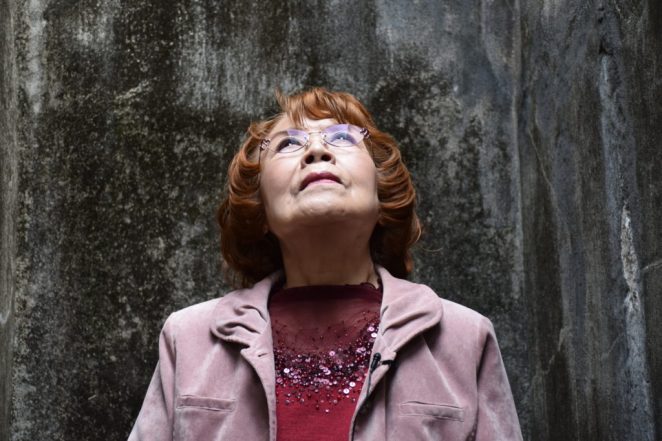
Yoshie Oka returns to the bunker where she survived the atomic bombing of Hiroshima
Next January, either Donald J. Trump or Hillary Rodham Clinton will receive the nuclear football from President Obama. Either one of seemingly the two most controversial people in modern U.S. political history is going be in charge of our nuclear codes, a certain outcome of this election we should be most concerned about.
Seventy-one years ago my grandfather Jacob Beser was flying in the back of a B-29 listening to the radio. He wasn’t listening to Beyonce—He was listening to frequency. He was monitoring a device that was going to end the war. This is what he trained for. This is what he knew and was prepared to die for. If anything went wrong, he was told to eat the device’s frequency code, written on a small piece of paper.
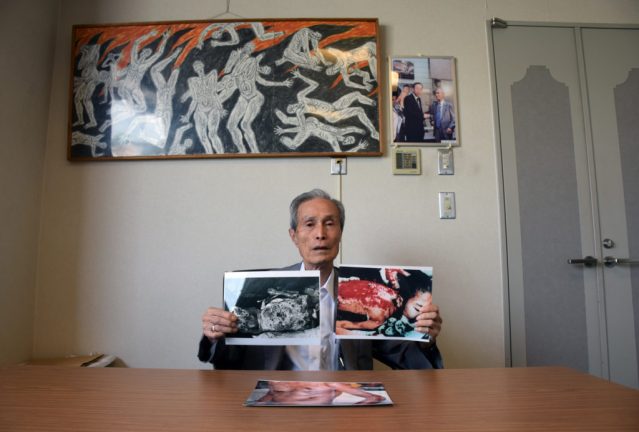
Sumiteru Taniguchi holds up photos of himself immediately after the bombing of Nagasaki. A prominent advocate for nuclear abolition, he was nominated for the 2015 Nobel Peace Prize.
None of that was necessary. He did his job right, and he saw what men were capable of. He saw it twice, over Nagasaki too, and he never expressed guilt about it. But he, like the rest of America, disconnected from the reality of the human suffering 32,000 feet below. He, like the majority of his countrymen, believed in their hearts it was necessary.
When my grandfather looked out the window, he likened the mushroom cloud to sand in the water, the way it billows along the shoreline in the tide. He couldn’t connect with the children in the streets or the people as they packed in train cars on their way to work. He couldn’t connect to the horrors they would experience and live with for the rest of their lives.
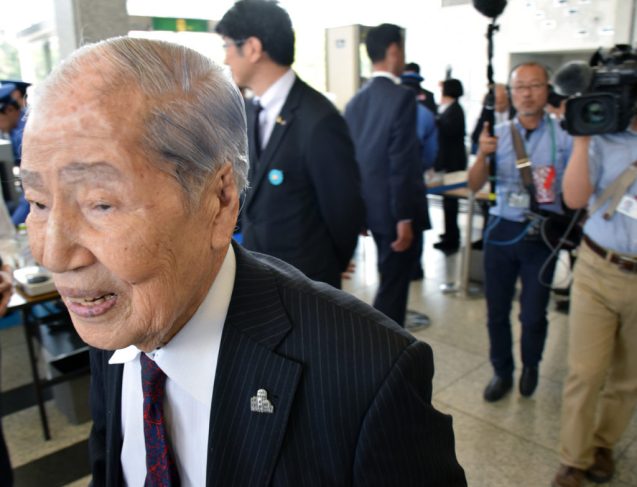
Suano Tsuboi moments before meeting President Obama in Hiroshima during the historic Presidential visit to the city on May 27, 2016.
Can we make those connections, America? Can we stop saying “What about Pearl Harbor” long enough to look at what World War II brought humanity to accomplish? Can we ask ourselves, “What will it take to bring us there again?”
I am not asking for a justification. I am not asking for an apology. I am asking that we listen to the stories of the atomic bomb survivors as a testimony to the evils of nuclear war.
Today I invite you to my Facebook community, Hibakusha: The Nuclear Family, where you can learn about what it was like under the mushroom clouds. I’ve called it a Blogumentary. It is an interactive online documentary that begs you to remember what happened in Hiroshima and Nagasaki. What happened to the people there could happen to any of us. Listen to their words, not as Japanese, and not as Americans, but as people.
Ari M. Beser is the grandson of Lt. Jacob Beser, the only U.S. serviceman aboard both B-29s that dropped atomic bombs on Japan in World War II. He traveled through Japan with the Fulbright-National Geographic Digital Storytelling Fellowship to report on the 70th anniversary of the atomic bombings of Hiroshima and Nagasaki and the fifth anniversary of the Great East Japan earthquake, tsunami, and nuclear meltdowns in Fukushima. Beser’s storytelling gives voice to people directly affected by nuclear technology today, as he works with Japanese and Americans to encourage a message of reconciliation and nuclear disarmament. His new book, The Nuclear Family, focuses on American and Japanese perspectives of the atomic bombings.
71 years ago today, the US Empire murdered 150,000 innocent human beings in Hiroshima to threaten & dominate the entire world.
Our documentary debunks the myths of the official US justification to drop the atomic bombs.
Obama’s high-profile trip to Hiroshima was accompanied by a media storm that gave endless justifications for the US use of the atomic bomb on Japanese civilians. The myths are widely accepted in society, and underpin the notion of American exceptionalism.
Abby Martin interviews Dr. Peter Kuznick, co-author with Director Oliver Stone of the bestselling book and HBO series “The Untold History of the United States,” about the real story behind the use of the atomic bombs—as well as the untold history of Imperial Japan, its role today for the US Empire, and the danger for new war on the horizon.
There is contentious debate among scholars about why Japan surrendered in World War II. Some believe the Aug. 15, 1945, declaration was the result of the atomic bombs dropped on Hiroshima and Nagasaki.
It’s possible that these finally pushed Emperor Hirohito (posthumously called Emperor Showa) to break the deadlock in the Supreme War Council and accept the terms of the Potsdam Declaration for unconditional surrender issued by the Allied leaders on July 26, 1945. In that declaration, there was a promise of “prompt and utter destruction” if the armed forces of Japan didn’t surrender. The use of weapons of mass destruction causing the incineration of large swaths of Hiroshima and Nagasaki in quick succession backed up that threat, highlighting the futility of continuing the war. Emperor Hirohito’s intervention on the side of those favoring capitulation was crucial to winning over those hardliners who didn’t. In this narrative, the dawning of the nuclear age brought peace. It also allowed military leaders to save face, since they could claim that the war was not lost on the battlefield, and agree to surrender to spare the Japanese people from more suffering.
This meant abandoning ketsu-go, the strategy of fighting one last decisive battle intended to inflict so many casualties on a war-weary America that it would relax its demands for unconditional surrender and negotiate a peace. This would, at a minimum, safeguard the Emperor, and potentially preserve the armed forces and shield them from prosecution for war crimes. This strategy was affirmed in June 1945 as the gruesome and bloody Battle of Okinawa was winding down. Reinforcements had been transferred from Manchuria to bolster the defense of Kyushu where the U.S. was expected to attack next.
In February 1945, Joseph Stalin met with Allied leaders in Yalta, promising to attack Japan three months after Germany’s surrender. He kept his promise, and Soviet troops invaded Manchuria in the wee hours of Aug. 9 before the Nagasaki bombing later that day. This came as a shock to Japanese leaders who had been trying throughout July that year to engage the Soviets as brokers in a peace deal with the Allies.
Soviet entry into the war was an alarming development for a military leadership that vowed to keep fighting to save the Emperor. The fate of the czar at the hands of communists, and prospects for a punitive Soviet occupation, influenced the calculus of surrender.
In February 1945, the Japanese military conducted a survey that concluded that Japan could not win the war. But they were not squeamish about the suffering of the Japanese public — more than 60 Japanese cities were subjected to extensive firebombing in 1945, displacing, maiming and killing several hundred thousand civilians. Military leaders could not contemplate the ignominy of surrender, so they compelled their nation to continue fighting a war that was already lost, subjecting the Japanese to horrific suffering that they could have ended far sooner.
Historian Tsuyoshi Hasegawa, in his 2005 book “Racing the Enemy,” provides compelling evidence that the Pacific War ended due to the entry of the Soviets, not the atomic bombings. Having tasted defeat at the hands of the Soviets twice in the late 1930s in Manchurian border clashes, the generals knew that the new front meant further resistance was futile.
Sheldon Garon, a professor of history at Princeton University, takes issue with Hasegawa’s contention that the military was insouciant about Japanese suffering and ready to fight to the last civilian. Recently, Garon gave a talk in Tokyo about an ongoing book project focusing on how the war was lost for Germany and Japan.
He argues that the U.S. was surprised by Japan’s sudden surrender, noting that by Aug. 19, 1945, America would have had three more atomic bombs ready and had six more in production — it did not anticipate a swift end.
According to Garon, the Japanese military was deeply concerned by worsening conditions in Japan because they were undermining the war effort. Authorities, for example, planned the evacuation of a few hundred thousand school children to spare them the urban conflagrations, but were not prepared for the mass exodus of adults who bailed because they knew the military could not protect them. Roads out of Tokyo were clogged with these refugees: 8.5 million fled Japanese cities in the final five months of war, paralyzing transport networks.
This rural-escape survival strategy meant demoralized workers were abandoning factories, compounding existing shortages of war-related production.
According to Garon, these acts of sabotage also meant that an orderly society was no longer obeying orders, responding to accumulating signs of impending defeat. Alas, many of these unlucky refugees fled to smaller cities, and thus were subject to more bombings as America moved onto second-tier targets. The U.S. dropped leaflets warning of impending strikes, and then delivered, stoking fear and undermining faith in the government.
Officials were also demoralized by Germany’s surrender, and the horrific fight to the end that Adolf Hitler insisted on, subjecting his people and cities to a relentless pounding.
Garon observes that the Germans fought like samurai, sacrificing all even when they knew it was for a losing cause. While much is made of Japanese authorities training women and children to resist U.S. invaders with bamboo staves, Garon notes that none ever did so. In contrast, Germany took desperate measures, resorting to full mobilization and deploying these untrained conscripts to battlefields where many died or were injured.
Japan’s diplomats in Europe were shocked by the devastation of Germany and conveyed their concerns about Hitler’s “fighting to the finish” strategy. They advised against emulating the Germans, and thus implicitly counseled surrender for the national interest. But finding an exit with dignity proved elusive.
Garon attributes Japan’s delayed surrender to military intransigence and diplomatic incompetence, a dithering that subjected Japan to needless devastation.
Finally, it was the Soviet entry into the war and the atomic bombings that precipitated a hasty surrender. But it was overdue because the signs of defeat, including a devastating series of setbacks on the home front, had been gathering for some time: endless fire bombings, growing shortages of food due to the U.S. blockade “Operation Starvation,” bereaved families and the subversion of people voting with their feet. There was no appetite for suffering the fate of the Nazis or subjecting the nation to more nightmarish ruination.
As the public — no longer willing to endure — soured on the war, what choice did the Emperor and his advisers have if the Imperial Household was to survive?