Only 10% of population returns to Fukushima town

Monday marks one year since the lifting of an evacuation order for Naraha, Fukushima Prefecture, that was imposed following the accident at Tokyo Electric Power Company Holdings, Inc.’s Fukushima No. 1 nuclear power plant.
However, less than 10 percent of the town’s registered population has returned.
The number of new housing built in the town this year reached 296 in June, 4½ times more than last year’s total. However, among Naraha’s registered population of 7,300, only 681 people had returned to live there as of Friday, according to the municipality.
Residents who have resumed farming, the town’s key industry, are also limited in number.
According to the Naraha government, about a quarter of the households were involved in farming before the accident. However, planting has resumed in only about 20 hectares of rice paddies this year, about 5 percent of the town’s farming area before the accident.
Shuko Watanabe, a 55-year-old cattle breeder in the town, restarted work in July, becoming the first farmer to start breeding for beef among the about 40 farmers who used to be in Naraha.
He breeds five Japanese black cattle while continuing to mainly live in Iwaki, also in the prefecture. Although he only has half the cattle he did before the accident, Watanabe thinks resuming work will encourage others to return to the town.
According to a Reconstruction Agency survey, about 8.4 percent of the 2,000 households that responded said they intend to return early. About 34.7 percent said they will return when certain conditions are met.
Combined with the 7.6 percent of the town’s population that has already returned, about half of the households intend to return.
JCFC steel in troubled French reactor also used in 13 Japanese nuclear power plants

Thirteen Japanese nuclear reactors were constructed with steel made by the same domestic company that produced material used in a French power plant that has come under scrutiny after anomalies were found in the structure of its reactor vessel.
Six utilities used steel from Japan Casting & Forging Corp. (JCFC), they all said in separate statements Friday. The company was identified by Japanese authorities last month as having supplied steel to the Flamanville nuclear plant, developed by Electricite de France SA and Areva SA, where the French safety authority last year found weaker-than-expected steel.
The Nuclear Regulation Authority asked utilities last month to examine reactor parts made by the same companies that supplied the Flamanville facility. Utilities must now evaluate whether their reactor pressure vessels meet national standards and report the results to the regulator by Oct. 31.
“It’s just to be sure,” said an NRA official.
JCFC said it has thrown away steel parts that lead to weaker products, adding that its steels have cleared the safety criteria.
The Japanese facilities affected include Kyushu Electric Power Co.’s Sendai No. 1 and 2 reactors in Kagoshima Prefecture, the company said Friday. The plant was restarted last year and is facing opposition from a new governor who has demanded they be temporarily shut for inspections.
Reactors now in operation don’t need to be shut down, Yoko Kobayashi, an official with the NRA’s planning division, said Friday. The affected utilities are now required to submit manufacturing reports and past evaluation results, she said.
The steel scrutiny is the latest hurdle for the nuclear power industry since the 2011 Fukushima disaster and could hamper the government’s goal of having it account for as much as 22 percent of its energy mix by 2030.
Local court challenges have threatened reactor operations, and even those restarted under new post-Fukushima safety rules have faced a rocky road. Only three of the nation’s 42 operable reactors are online.
Parts made by JCFC met rigorous standards requested by the utilities, and the company will provide support going forward, JCFC official Seigo Otsubo said Friday.
EDF and Areva are conducting additional tests to determine whether the anomalies present a safety issue. The two companies said in April that the submission of their report to French regulators about the Flamanville reactor has been delayed until year-end.
EDF has also determined that steam generator channel heads at 18 French reactors contain anomalies similar to those at Flamanville, Autorite de Surete Nucleaire, the safety regulator, said in June.
According to statements from the utilities, the domestic reactors made with steel from JCFC include: units 2 and 4 at the Fukushima No. 2 power plant run by Tokyo Electric Power Co. Holdings Inc.; unit 2 at the Takahama power plant and units 1 and 2 at the Oi power plant, both run by Kansai Electric Power Co.; reactors 2, 3 and 4 at the Genkai plant and reactors 1 and 2 at the Sendai plant run by Kyushu Electric Power Co.; reactor 2 at the Ikata plant run by Shikoku Electric Power Co.; reactor 1 at the Shika plant managed by Hokuriku Electric Power Co.; and reactor 2 at the aging Tsuruga plant run by the Japan Atomic Energy Agency.
Monju and the nuclear fuel cycle

Media reports that the government is finally weighing whether to pull the plug on the Monju fast-breeder reactor in Tsuruga, Fukui Prefecture, due to the massive cost needed to restart the long-dormant facility, should come as no surprise. Once touted as a “dream reactor” for an energy-scarce country that produces more plutonium than it consumes as fuel, Monju has been a nightmare for national nuclear power policy for the past two decades. The sole prototype reactor for this kind of technology has been in operation a mere 250 days since it first reached criticality in 1994. It has mostly been offline since a 1995 sodium coolant leak and fire. Its government-backed operator has been declared unfit by nuclear power regulators to run the trouble-prone reactor, and the education and science ministry, in charge of the project, has not been able to find a viable solution.
More than ¥1 trillion in taxpayer money has so far been spent on Monju, and maintenance alone costs ¥20 billion a year. Restarting the reactor under the Nuclear Regulation Authority’s new safety standards would cost another several hundred billion yen, including the expense of replacing its long-unused fuel as well as its aging components — though there would still be no guarantee that it would complete its mission of commercializing fast-breeder reactor technology.
The Abe administration may think that writing off the ill-fated costly project, even with the projected ¥300 billion cost of decommissioning the facility over 30 years, will help win more public support for its policy of seeking to reactivate the nation’s conventional reactors — most of which remain idled in the wake of the 2011 meltdowns at Tokyo Electric Power’s Fukushima No. 1 plant — once they’ve cleared the NRA screening. Public concerns over the safety of nuclear energy remain strong after the Fukushima disaster, with media surveys showing a large portion of respondents still opposed putting the idled reactors back online.
If it is going to decide to decommission the Monju reactor, however, the government should also rethink its pursuit of the nuclear fuel cycle — in which spent fuel from nuclear power plants is reprocessed to extract plutonium for reuse as fuel. Monju, which runs on plutonium-uranium mixed oxide (MOX) fuel, has been a core component of the program. As Monju remained dormant for more than 20 years, the government and power companies have shifted the focus of the policy to using MOX fuel at regular nuclear power plants. The No. 3 reactor at Shikoku Electric Power’s Ikata plant in Ehime Prefecture, which resumed operation in August, runs on MOX fuel. The government apparently thinks the Monju program is no longer essential to the policy.
But the nuclear fuel cycle itself has proven elusive, and some say the policy has already collapsed. It is still nowhere in sight when the nuclear fuel reprocessing plant in Rokkasho, Aomori Prefecture — another key component in the program and whose construction began in 1993 — will be ready for operation.
After its scheduled completion in 1997 has been delayed by more than 20 times due to a series of technical glitches and other problems, its construction cost has ballooned three times the original projection to ¥2.2 trillion.
If indeed the Rokkasho facility is completed and starts reprocessing spent fuel from power plants across the country, the Ikata power plant is currently the only one in operation that consumes plutonium-uranium fuel. It’s not clear how many more will be up and running in the years ahead given the slow pace of restarting the idled reactors, and the Rokkasho facility operating without a sufficient number of reactors using MOX fuel would only add to Japan’s stockpile of unused plutonium — which has already hit 48 tons.
If it’s the cost problem that’s finally spelling doom for the Monju project, the government and power companies should also consider the cost-efficiency of the nuclear fuel cycle program, including the extra cost of reprocessing spent fuel into MOX fuel. They should also think about whether the program is compatible with the government’s stated policy — though its commitment may be in doubt — of seeking to reduce Japan’s dependency on nuclear power as an energy source.
Monju has drifted on for years after its future was clearly in doubt. A decision now to terminate the project seems sensible. Such a decision should also prompt the government to stop and consider whether its nuclear fuel cycle still makes sense.
http://www.japantimes.co.jp/opinion/2016/09/04/editorials/monju-nuclear-fuel-cycle/#.V8x28K3KO-c
News Navigator: How far has decontamination progressed in Fukushima?
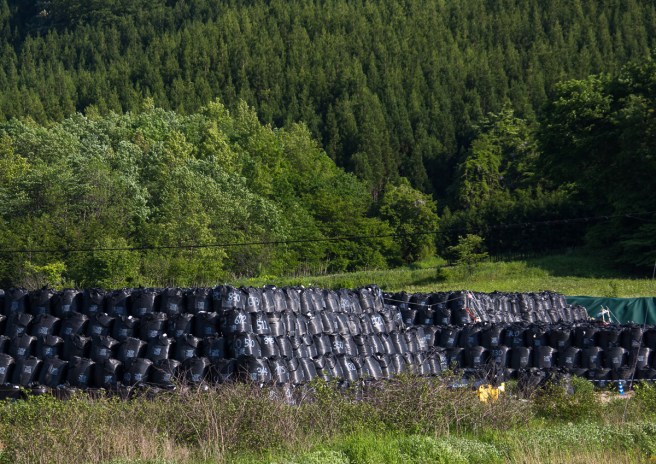
The Mainichi Shimbun answers some common questions readers may have about the decontamination of areas that were heavily exposed to radiation in the nuclear crisis at the Fukushima No. 1 Nuclear Power Plant.
Question: What is the situation right now with the decontamination of areas that were exposed to radioactive materials in the Fukushima nuclear incident, where residents were ordered to evacuate?
Answer: In April 2012, areas that were under evacuation orders were separated into three categories based on annual radiation exposure dosages. Decontamination work has not been carried out in areas of the Fukushima Prefecture towns of Okuma, Futaba, Namie, Tomioka, and the prefectural villages of Iitate and Katsurao and the city of Minamisoma — classified as “difficult-to-return zones” with annual radiation exposure dosages topping 50 millisieverts — save for a few areas that were decontaminated on a trial basis.
Meanwhile, in “restricted residence zones,” where the annual radiation exposure dosage is between 20 and 50 millisieverts, and in “preparing for lifting of evacuation order zones,” which have annual radiation exposure dosages of 20 millisieverts or lower, the government is aiming to have decontamination completed by March 2017.
Q: Why haven’t “difficult-to-return zones” been decontaminated?
A: In addition to the fact that all residents had evacuated, it was determined immediately after the disaster broke out that decontamination efforts would be ineffective because of the high levels of radiation there. However, radiation has the property of decreasing as time passes. Indeed, according to measurements taken by an airplane that was released by the Nuclear Regulation Authority in February this year, radiation levels had gone down significantly. And in some areas, where decontamination was attempted on a trial basis, there was some success.
Q: How much does radiation go down through the decontamination process?
A: According to the Environment Ministry, in a trial decontamination of the Akougi district in Namie, Fukushima Prefecture — designated a “difficult-to-return zone” — radiation levels went down by half. However, a ministry official explains that radiation levels there cannot be brought down to zero because even if the area is decontaminated, radiation seeps in via rain and other means.
Q: What is done with the waste that results from decontamination?
A: The Environment Ministry estimates that 16 million to 22 million cubic meters of radioactively contaminated waste will result from decontamination work. That waste will be stored temporarily in municipalities in Fukushima Prefecture, then transported to interim storage facilities in the prefectural towns of Okuma and Futaba. However, only 5 percent of the entire land area needed for storing radioactive waste had been secured as of late July. (Answers by Hanayo Kuno, Science and Environment News Department)
http://mainichi.jp/english/articles/20160903/p2a/00m/0na/001000c
The end of the line for Japan’s super expensive nuclear reprocessing project?
Monju has drifted on for years after its future was clearly in doubt. A decision now to terminate the project seems sensible. Such a decision should also prompt the government to stop and consider whether its nuclear fuel cycle still makes sense.
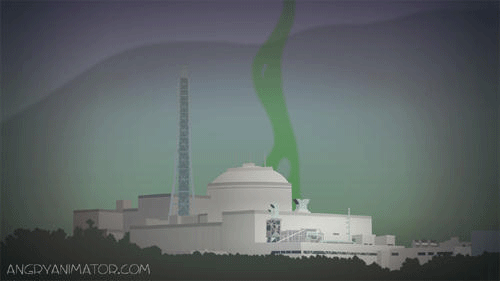
 Monju and the nuclear fuel cycle http://www.japantimes.co.jp/opinion/2016/09/04/editorials/monju-nuclear-fuel-cycle/#.V8yFTFt97Gg Media reports that the government is finally weighing whether to pull the plug on the Monju fast-breeder reactor in Tsuruga, Fukui Prefecture, due to the massive cost needed to restart the long-dormant facility, should come as no surprise. Once touted as a “dream reactor” for an energy-scarce country that produces more plutonium than it consumes as fuel, Monju has been a nightmare for national nuclear power policy for the past two decades.
The sole prototype reactor for this kind of technology has been in operation a mere 250 days since it first reached criticality in 1994. It has mostly been offline since a 1995 sodium coolant leak and fire. Its government-backed operator has been declared unfit by nuclear power regulators to run the trouble-prone reactor, and the education and science ministry, in charge of the project, has not been able to find a viable solution.
More than ¥1 trillion in taxpayer money has so far been spent on Monju, and maintenance alone costs ¥20 billion a year. Restarting the reactor under the Nuclear Regulation Authority’s new safety standards would cost another several hundred billion yen, including the expense of replacing its long-unused fuel as well as its aging components — though there would still be no guarantee that it would complete its mission of commercializing fast-breeder reactor technology.
The Abe administration may think that writing off the ill-fated costly project, even with the projected ¥300 billion cost of decommissioning the facility over 30 years, will help win more public support for its policy of seeking to reactivate the nation’s conventional reactors — most of which remain idled in the wake of the 2011 meltdowns at Tokyo Electric Power’s Fukushima No. 1 plant — once they’ve cleared the NRA screening. Public concerns over the safety of nuclear energy remain strong after the Fukushima disaster, with media surveys showing a large portion of respondents still opposed putting the idled reactors back online.
If it is going to decide to decommission the Monju reactor, however, the government should also rethink its pursuit of the nuclear fuel cycle — in which spent fuel from nuclear power plants is reprocessed to extract plutonium for reuse as fuel. Monju, which runs on plutonium-uranium mixed oxide (MOX) fuel, has been a core component of the program. As Monju remained dormant for more than 20 years, the government and power companies have shifted the focus of the policy to using MOX fuel at regular nuclear power plants. The No. 3 reactor at Shikoku Electric Power’s Ikata plant in Ehime Prefecture, which resumed operation in August, runs on MOX fuel. The government apparently thinks the Monju program is no longer essential to the policy.
But the nuclear fuel cycle itself has proven elusive, and some say the policy has already collapsed. It is still nowhere in sight when the nuclear fuel reprocessing plant in Rokkasho, Aomori Prefecture — another key component in the program and whose construction began in 1993 — will be ready for operation.
After its scheduled completion in 1997 has been delayed by more than 20 times due to a series of technical glitches and other problems, its construction cost has ballooned three times the original projection to ¥2.2 trillion.
If indeed the Rokkasho facility is completed and starts reprocessing spent fuel from power plants across the country, the Ikata power plant is currently the only one in operation that consumes plutonium-uranium fuel. It’s not clear how many more will be up and running in the years ahead given the slow pace of restarting the idled reactors, and the Rokkasho facility operating without a sufficient number of reactors using MOX fuel would only add to Japan’s stockpile of unused plutonium — which has already hit 48 tons.
If it’s the cost problem that’s finally spelling doom for the Monju project, the government and power companies should also consider the cost-efficiency of the nuclear fuel cycle program, including the extra cost of reprocessing spent fuel into MOX fuel. They should also think about whether the program is compatible with the government’s stated policy — though its commitment may be in doubt — of seeking to reduce Japan’s dependency on nuclear power as an energy source.
Monju has drifted on for years after its future was clearly in doubt. A decision now to terminate the project seems sensible. Such a decision should also prompt the government to stop and consider whether its nuclear fuel cycle still makes sense.
USA and China formally ratify Paris climate agreement


 US joins China in ratifying Paris climate agreement in ‘turning point’ for planet , ABC News 4 Sept 16 America and China have formally joined the Paris climate change agreement, with US President Barack Obama hailing the accord as the “moment we finally decided to save our planet”.
The move by the world’s two biggest polluters is a major step forward for the 180-nation deal, which sets ambitious goals for capping global warming and funnelling trillions of dollars to poor countries facing climate catastrophe.
Mr Obama and his Chinese counterpart Xi Jinping handed ratification document to United Nations chief Ban Ki-moon, who said he was now optimistic the agreement will be in force by the end of the year.
Mr Ban described the two leaders as far-sighted, bold and ambitious.
“China and the United States represent nearly 40 per cent of global greenhouse gas emissions,” he said.
“Now by formally joining the Paris agreement your have added powerful momentum to the drive for the agreement to enter into force this year.”
Mr Obama said history would show that the Paris deal would “ultimately prove to be a turning point, the moment we finally decided to save our planet”……..http://www.abc.net.au/news/2016-09-04/us-joins-china-in-ratifying-paris-climate-agreement/7812366
Less than 10% of citizens return to Fukushima town Naraha
Only 10% of population returns to Fukushima town, September 04, 2016 The Yomiuri Shimbun Monday marks one year since the lifting of an evacuation order for Naraha, Fukushima Prefecture, that was imposed following the accident at Tokyo Electric Power Company Holdings, Inc.’s Fukushima No. 1 nuclear power plant.
However, less than 10 percent of the town’s registered population has returned.
The number of new housing built in the town this year reached 296 in June, 4½ times more than last year’s total. However, among Naraha’s registered population of 7,300, only 681 people had returned to live there as of Friday, according to the municipality.
Residents who have resumed farming, the town’s key industry, are also limited in number……http://www.the-japan-news.com/news/article/0003193419
Anti nuclear groups beg Niigata Governor Hirohiko Izumida to run for re-election
 Groups fear no nuclear debate in Niigata governor’s race http://www.asahi.com/ajw/articles/AJ201609040026.html By YUKO MATSUURA/ Staff Writer September 4, 2016 NIIGATA–Anti-nuclear groups are pleading with Niigata Governor Hirohiko Izumida to rescind his decision not to run for re-election, seeing him as the “last bastion” to block the restart of the Kashiwazaki-Kariwa nuclear power plant.
The groups fear that the absence of Izumida in the Oct. 16 Niigata gubernatorial election, whose official campaigning starts on Sept. 29, will cause a dearth in debate among candidates on the safety of the multiple-reactor nuclear plant operated by Tokyo Electric Power Co. in the prefecture.
“Governor (Izumida) is not aware of his value,” said Kunio Ueno, 66, secretary-general of the organizing committee for a gathering of anti-nuclear groups held in Kashiwazaki on Sept. 3.
Eighteen groups, based in and outside Niigata Prefecture, set up the organizing committee for the gathering and demanded the decommissioning of reactors at the plant.
“We will not allow candidates in the gubernatorial election to conceal a point of contention,” their declaration read. “We will make the issue of the nuclear power plant the biggest point of contention.”
Outside the site of the gathering, several citizens groups collected signatures to ask Izumida to run in the election.
On Aug. 30, Izumida, 53, who is in his third term as Niigata governor, announced he will not seek re-election, citing a report in a local newspaper that was not related to the nuclear issue.
The Nuclear Regulation Authority is currently conducting screenings toward the restart of reactors at the Kashiwazaki-Kariwa nuclear power plant.
But Izumida has insisted that the causes of the 2011 disaster at the Fukushima No. 1 nuclear power plant, also operated by TEPCO, must be verified before reactor operations can resume in his prefecture. As of now, only Tamio Mori, 67, mayor of Nagaoka in Niigata Prefecture, has announced he will run in the governor’s race.
On the issue of whether to restart the Kashiwazaki-Kariwa nuclear plant, Mori has only said, “I will strictly examine it based on protecting the security and safety of people in the prefecture.”
About 1,300 people took part in the Sept. 3 gathering.
Sayaka Sakazume, 32, of Niigata city, said: “It will be a problem for me if there are no candidates I can vote for based on my thoughts against the reactor restarts. I want a political situation in which we can choose a candidate.”
China ratifies Paris climate agreement
China has ratified Paris climate agreement, state media says, ABC News 3 Sep 16 China has ratified the Paris agreement on climate change, according to state media, a key move by the world’s biggest polluter that brings the deal a major step closer to coming into force.
The National People’s Congress legislature voted to adopt “the proposal to review and ratify the Paris Agreement”, the official Xinhua news agency said.
The Paris pact calls for capping global warming at well below two degrees Celsius, and 1.5C if possible, compared with pre-industrial levels.
China is responsible for about 25 per cent of global carbon emissions, with the US in second place on about 15 per cent, making their efforts crucial in the fight against warming.
The Paris deal will come into force 30 days after at least 55 countries, accounting for 55 per cent of global greenhouse gas emissions, have ratified it……..http://www.abc.net.au/news/2016-09-03/china-ratifies-paris-climate-agreement3a-xinhua/7811778?section=environment
Evacuation drill held near Ikata nuclear plant
Local residents take part in evacuation drill held near Ikata nuclear plant http://www.japantimes.co.jp/news/2016/09/04/national/local-residents-take-part-evacuation-drill-held-near-ikata-nuclear-plant/#.V8yIJlt97Gg IKATA, EHIME PREF. – The Ehime Prefectural Government on Sunday held an evacuation exercise around Shikoku Electric Power Co.’s Ikata nuclear power plant, the first of its kind since the Aug. 12 restart of the No. 3 reactor at the plant.
Some 400 residents in the town of Ikata joined the exercise to check how to get to Misaki Port from their homes under the scenario a serious accident had happened.
Led by local police cars, participants began appearing at a temporary meeting place near the port some 20 minutes after they started evacuation by sharing rides.
From the meeting place, where candies were delivered as iodine pills by nurses, they rode on buses to the port as instructed by local authorities. All attendees arrived at the port, where maritime evacuation begins, about 50 minutes after the start of the drill.
As the nuclear plant is located at the base of Cape Sada, evacuation operations on both land and marine routes are under consideration. Last November, an exercise was held to take evacuees by ship to Oita Prefecture on the other side of the Seto Inland Sea.
A resident who joined Sunday’s drill said that if there were a landslide caused by heavy rain, it would be difficult to come to the port.
Tepco detects increase in temperature in ice wall in Fukushima
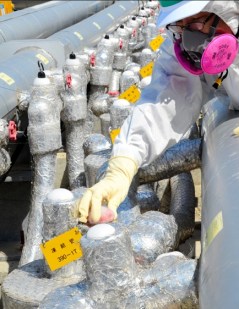 Tokyo Electric Power : Plant operator detects increase in temperature in ice wall in Fukushima
Tokyo, Sept 2 (EFE).- Tepco Electric Power, or TEPCO, the owner of the Fukushima nuclear plant has detected an increase in the temperature of some parts of the underground ice wall that could affect its further construction and the dismantling of the plant.
The temperature rise was caused by intense rainfall in the region where the plant is located due to the typhoons that have been affecting the area since mid-August, a spokesperson of the company told EFE Friday.
The temperature of the wall to the south of reactor No.4 has gone up from minus 5 degrees to 1.8 degrees, according to the measurements carried out by TEPCO on Thursday.
An increase in temperature from minus 1.5 degrees to 1.4 degrees has also been detected east of reactor No.3.
The company is injecting a chemical in both the walls to solidify them, reduce the flow of water and accelerate the freezing process and is discussing other options in case these measures prove ineffective, the spokesperson explained.
Temperatures in these sections are already higher than those in other parts of the ice wall before the storms. However, there are fears some sections of the wall could have thawed with the increase in underground water flow due to the rains.
The company said that this incident could affect the deadlines for the completion of the wall but the construction, which entered the second and second last phase in early June, will continue.
The purpose of the wall is to isolate the ground around the four reactors – affected by the 2011 earthquake and tsunami – to prevent water from natural aquifers flowing into them and coming into contact with the radioactive refrigerant and the contaminated water then finding its way into the Pacific Ocean.
This setback increases pressure on the company, that had barely made progress in bringing down the water still within the reactor basements and had said in July that the ice wall will not be 100 percent effective in blocking the groundwater, thus complicating efforts to dismantle the plant.
Fukushima could host 2020 events

Organizers of the 2020 Tokyo Olympics are working toward staging a baseball and softball game in the 2011 earthquake and tsunami struck Fukushima Prefecture, a source close to the matter said Friday.
Baseball and softball were among the five sports approved last month by the International Olympic Committee to be added to the Tokyo Games program, and the 2020 organizers will look to get approval for the plan from the IOC executive board in December.
The organizers are working to present the idea to IOC president Thomas Bach in October when he visits Japan for a meeting.
Three baseball parks inside the prefecture — all previous hosts of NPB games — are on the shortlist, and organizers are likely to argue accessibility from Tokyo and the possibility of installing fixed seats in the outfield stands as to why the idea is feasible.
The main ballpark for the 2020 Games is set to be Yokohama Stadium, home of the Yokohama BayStars.
Former Olympic minister Toshiaki Endo reiterated on March 11 — the fifth anniversary of the disaster — that the prefecture could host some games in order to demonstrate the revitalization of the Tohoku region, most affected by the disaster.
Fukushima Gov. Masao Uchibori met Yoshiro Mori, the Tokyo 2020 organizing committee president, on Wednesday to request his region be given the opportunity to host the two games in the baseball and softball tournaments’ first round.
http://www.japantimes.co.jp/sports/2016/09/03/olympics/fukushima-host-2020-events/#.V8rqwa3KO-c
Tepco telling California 9th Circ. To Send Sailors’ $1B Fukushima Suit To Japan
TEPCO trying to block the hearing of this case in California under US law.
Watch recording for case: Lindsay Cooper v. Tokyo Electric Power Co., No. 15-56424
http://www.ca9.uscourts.gov/media/view_video.php?pk_vid=0000010155
9th Circ. Told To Send Sailors’ $1B Fukushima Suit To Japan
Law360, Los Angeles (September 1, 2016, 5:47 PM ET) — Tokyo Electric Power Co. urged the Ninth Circuit on Thursday to dismiss a $1 billion putative class action on behalf of 70,000 U.S. sailors allegedly exposed to radiation while responding to the Fukushima nuclear disaster, arguing the claims belong in Japan.
During oral arguments in Pasadena, California, Daniel Collins of Munger Tolles & Olson LLP, representing Tokyo Electric Power Co. Holdings Inc., the owner of the Fukushima nuclear plant, urged a three-judge panel to reverse U.S. District Judge Janis L. Sammartino’s refusal to dismiss the suit….
http://www.law360.com/articles/835597/9th-circ-told-to-send-sailors-1b-fukushima-suit-to-japan
VOX POPULI: A curse that lasts 100,000 years: buried nuclear waste
Homo sapiens sapiens, or anatomically modern humans, emerged on the African continent about 200,000 years ago. They started migrating to various parts of the globe around 60,000 years ago with some eventually reaching the Japanese archipelago.
The Paleolithic era came and went, and rice cultivation began in the Neolithic era.
I started thinking about these prehistoric times after a recent news report mentioned “100,000 years” in connection with radioactive waste that must be disposed of when nuclear reactors are dismantled.
It takes a mind-boggling number of years for nuclear waste, stored deep underground, to decrease in radioactivity to a level that is no longer a health hazard.
With respect to highly radioactive waste such as reactor control rods, the Nuclear Regulation Authority has just set its basic policy, which is that electric power companies will be responsible for the management of such waste for 300 to 400 years, and then the government will take over for the next 100,000 years.
Every precaution must be taken to prevent future humans from accidentally entering sites where the waste is buried and digging the ground. The potential effects of earthquakes and volcanic eruptions on the stored waste also has to be considered.
In determining the extent of responsibility to be shouldered by utilities, it was agreed that it would not be realistic to expect them to manage the storage sites for tens of thousands of years to come.
According to “Hyakunen Tsuzuku Kigyo no Joken” (Conditions necessary for businesses to last 100 years) compiled by Teikoku Databank, a corporate credit research and database service company, there are some, but not many, Japanese companies that have remained in business for more than 400 years.
They include Sumitomo Metal and Mining Co., Yomeishu Seizo Co., and Matsuzakaya, which were founded before or during the Edo Period (1603-1867).
Are Japan’s electric power companies also destined to join their ranks?
But whether it’s 400 years or 100,000 years from now, nobody in our present generation can remain responsible for all those years. I shudder at this “ultrarealistic” reality.
Incidentally, Japan’s first nuclear reactor commenced commercial operation 50 years ago.
Test fishing for flounder begins off Fukushima coast
Flounders surely vacuum well the radionuclides from the ocean floor, and the government-imposed limit of 100 becquerels per kg does no mean no contamination.
There is no such a thing as a low dose when it comes to internal radiation such as the one from ingested contaminated food. Any radioactive contamination may cause harm.
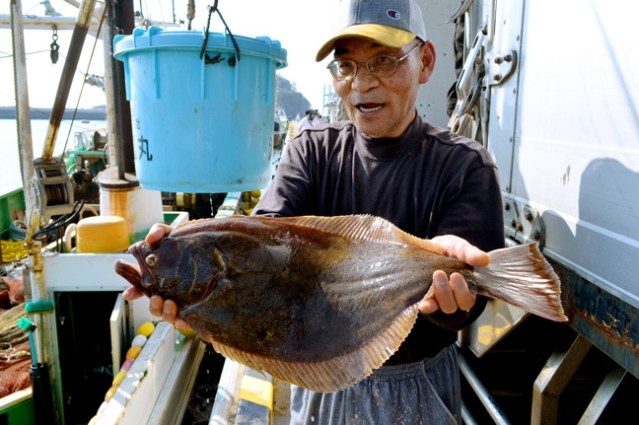
This flounder was caught on Sept. 2 off the coast of Iwaki, Fukushima Prefecture, during the first test fishing for the species since the 2011 disaster at the Fukushima No. 1 nuclear plant.
Test fishing for flounder begins off Fukushima coast
IWAKI, Fukushima Prefecture–Fishermen here caught flounder for sales on Sept. 2 for the first time since the 2011 disaster at the Fukushima No. 1 nuclear plant.
Eleven boats equipped with dragnets left Hisanohama wharf in the morning, and they snared five of the bottom-dwelling flatfish, previously a specialty of Fukushima Prefecture.
“It is a big step (for flounder fishing),” said Akira Egawa, 69, head of the Iwaki city fishery association. “We are going to recover one by one.”
On Aug. 25, 10 kinds of fish, including flounder, were added to the list for “test fishing” off the coast of Fukushima Prefecture. These fish can be caught for the resumption of sales of “safe” fish.
In 2010, 734 tons of flounder were caught in Fukushima Prefecture, the third most in Japan.
The peak season for flounder fishing is around the end of October.
http://www.asahi.com/ajw/articles/AJ201609020065.html
Japan authorizes commercial flounder ‘test-fishing’ off Fukushima
The sales of flounder caught in Fukushima Prefecture might soon resume, with fishermen already “test-fishing” for the first batches of the flatfish. The five-year-long halt in flounder fishing and sales was prompted by the deadly nuclear disaster.
On Friday fishermen caught flounder off the coast of Iwaki, Fukushima Prefecture, during the first test fishing since the 2011 nuclear disaster, Japan’s Asahi Shimbun reports. Flounder along with ten other kinds of fish was added to the list for “test-fishing” last week, meaning it is “safe” for sales.
As many as five flatfish were captured with the help of 11 boats equipped with dragnets.
“It is a big step [for flounder fishing],” said Akira Egawa, head of the Iwaki city fishery association. “We are going to recover one by one.”
Following the nuclear disaster the government issued an outright ban on more than 35 kinds of fish including flounder, angler fish and rockfish which were said to contain high levels of radioactive substances.
The ban has had a huge effect on Fukushima’s fishing industry which has significantly gone down after 2011. Around 5,600 tons of fish were caught off Fukushima coast last year compared to about 38,600 tons before March, 2011.
After March 2011, 50 percent of the fish samples tested for radiation levels exceeded the government-imposed limit of 100 becquerels per kg. However, after April 2015, no fish exceeded that number, according to The Japan Times.
However, after April 2015, no fish exceeded that number, according to The Japan Times.
https://www.rt.com/news/358095-flounder-test-fishing-fukushima/
1 This Month





PLEASE OPPOSE HR 8255 AND S.3639 – bills would accelerate satellite deployment, with no environmental review or safeguards – https://ncstd5li.quorum.us/campaign/169331/
To see nuclear-related stories in greater depth and intensity – go to https://nuclearinformation.wordpress.com
-
Archives
- October 2026 (29)
- September 2026 (339)
- August 2026 (330)
- July 2026 (355)
- June 2026 (287)
- May 2026 (306)
- April 2026 (356)
- March 2026 (251)
- February 2026 (267)
- January 2026 (308)
- December 2025 (358)
- November 2025 (359)
-
Categories
- 1
- 1 NUCLEAR ISSUES
- business and costs
- climate change
- culture and arts
- ENERGY
- environment
- health
- history
- indigenous issues
- Legal
- marketing of nuclear
- media
- opposition to nuclear
- PERSONAL STORIES
- politics
- politics international
- Religion and ethics
- safety
- secrets,lies and civil liberties
- spinbuster
- technology
- Uranium
- wastes
- weapons and war
- Women
- 2 WORLD
- ACTION
- AFRICA
- Atrocities
- AUSTRALIA
- Christina's notes
- Christina's themes
- culture and arts
- Events
- Fuk 2022
- Fuk 2023
- Fukushima 2017
- Fukushima 2018
- fukushima 2019
- Fukushima 2020
- Fukushima 2021
- general
- global warming
- Humour (God we need it)
- Nuclear
- RARE EARTHS
- Reference
- resources – print
- Resources -audiovicual
- Weekly Newsletter
- World
- World Nuclear
- YouTube
-
RSS
Entries RSS
Comments RSS

