- Satellite photos show North Korea leader’s train near compound
-
Kim’s two-week absence fuels speculation about his health Speculation about Kim Jong Un’s health intensified over the weekend after tantalizing — yet unverified — reports about a visit by a Chinese medical team and movements of the North Korean leader’s armored train.
China sent a team including doctors and senior diplomats to advise its neighbor and longtime ally, Reuters reported on Saturday, citing three people familiar with the matter. Meanwhile, a train resembling one long used by North Korean rulers was parked last week near a coastal leadership compound in Wonsan, according to an analysis of satellite imagery released Sunday by the website 38 North. A prominent South Korea adviser also rejected the notion that Kim was ailing or dead…….
Any leadership change in North Korea could increase the threat of instability on China’s border and raise questions about control of the country’s expanding nuclear arsenal. Kim has also been central to U.S. President Donald Trump’s so far unsuccessful efforts to get him to reduce his weapons stockpile. …..
Animals in radiation zones are not doing well

above – Chernobyl bird at right has facial tumour
Not thriving, but failing https://beyondnuclearinternational.org/2018/03/11/not-thriving-but-failing/ https://beyondnuclearinternational.org/2018/03/11/not-thriving-but-failing/ Animals in radiation zones are not doing well, By Linda Pentz Gunter
It started with wolves. The packs around the Chernobyl nuclear plant, which exploded on April 26, 1986, were thriving, said reports. Benefitting from the absence of human predators, and seemingly unaffected by the high radiation levels that still persist in the area, the wolves, they claimed, were doing better than ever.
Appearances, however, can be deceptive. Abundant does not necessarily mean healthy. And that is exactly what evolutionary biologist, Dr. Timothy Mousseau and his team began to find out as, over the years, they traveled to and researched in and around the Chernobyl disaster site in the Ukraine. Then, when a similar nuclear disaster hit in Japan — with the triple explosions and meltdowns at Fukushima Daiichi on March 11, 2011 — Mousseau’s team added that region to its research itinerary.
Mousseau has now spent more than 17 years looking at the effects on wildlife and the ecosystem of the 1986 Chernobyl nuclear disaster. He and his colleagues have also spent the last half dozen years studying how non-human biota is faring in the wake of Fukushima. Ninety articles later, they are able to conclude definitively that animals and plants around Chernobyl and Fukushima are very far indeed from flourishing.
Mousseau’s findings strongly contradicted earlier work including the 2006 Chernobyl Forum report which claimed the Chernobyl zone “has become a wildlife sanctuary,” and a subsequent article published in Current Biology in 2015 that said wildlife was “thriving”around Chernobyl.
“I suppose everyone loves a Cinderella story,” speculated Mousseau, who is based at the University of South Carolina. “They want that happy ending.” But Mousseau felt sure the moment he read the Forum report, which, he noted, “contained few scientific citations,” that the findings “could not possibly be true.
What Mousseau found was not unexpected given the levels of radiation in these areas and what is already known about the medical effects of such long-term exposures. Birds and rodents had a high frequency of tumors.
“Cancers are the first thing we think about,” Mousseau said. “We looked at birds and mice. In areas of higher radiation, the frequency of tumors is higher.” The research team found mainly liver and bladder tumors in voles and tumors on the head, body and wings of the birds studied.
But Mousseau wanted to look beyond cancers, which is what everyone expects to find and what researchers had looked for, but only in humans. There were few wildlife studies, a fact Mousseau found surprising, given nature’s ability to act as a sentinel for likely impending human health impacts.
Mousseau and his fellow researchers found cataracts in birds and rodents. Male birds had a high rate of sterility. And the brains of birds were smaller. All of these are known outcomes from radiation exposure.
“Cataracts in birds is a problem,” Mousseau said. “A death sentence.”
Mental retardation has been found among children exposed to radiation in utero. Mousseau and colleagues discovered the same pattern in the birds they studied. “Birds already have small brains, so a smaller brain size is a definite disadvantage,” he said.
There were also just fewer animals in general. “There were many fewer mammals, birds and insects in areas of higher radiation,” Mousseau said. And they had their hunch as to why.
He and his colleagues extracted sperm from the male birds they caught and were shocked to find that “up to 40% of male birds in the radiologically hottest areas were sterile.”
The birds’ sperm were either deformed or dead. None would be able to reproduce. The discovery, he said, was “not at all surprising. These are the levels of radiation known to influence reproduction. At the same time, there is no safe level of radiation below which there aren’t detectable effects.”
Fewer birds have already been observed in the contaminated areas around Fukushima, said Mousseau. “Although it’s too early to assess the long term impact on abundance and diversity around Fukushima, there are very few butterflies and many birds have declined in the more contaminated areas. If abundance is compressed, biodiversity will follow.”
The consequences of radiation exposure, says Mousseau, “will have a tremendous impact on the quality of life of these animals, and the length of quality of life. It need not necessarily be cancers,” that cause these damages he said. “There is no doubt that the levels of radiation in Chernobyl and Fukushima generate genetic damage.”
Read more about Dr. Timothy Mousseau’s work.
Buildings around Fukushima Daiichi nuclear plant in poor condition, unsafe
Fukushima Daiichi buildings pose safety risks, https://www3.nhk.or.jp/nhkworld/en/news/20200427_24/ Tokyo Electric Power Company plans to draw up safety measures for workers after finding that some of the buildings at the Fukushima Daiichi nuclear plant are in bad condition due to the 2011 accident.TEPCO on Monday reported to the Nuclear Regulation Authority the results of its survey of about 580 buildings in the compound.
The company says the condition of around 10 buildings, including the one that houses the No.4 reactor, have deteriorated due to the tsunami that triggered the accident and subsequent hydrogen explosions.
The NRA argues that the walls or other structures of these buildings could collapse in the event of an earthquake and injure people engaged in decommissioning work.
TEPCO says it will announce by the end of May how and when it will address the problem.
The utility also says it has inspected 340,000 pieces of equipment at the plant, and found that 36,000 of them lack devices that prevent leaks of radioactive materials as well as leak detectors.
North Korea: Expert reveals ‘power struggle’ for ‘control of nuclear weapons and military’
NORTH KOREA’s lack of a formal succession plan for Kim Jong-un could spark a “power struggle” in the region as speculation continues to grow surrounding the supreme leader’s health, according to foreign policy expert Bruce Klingner. Express UK, By SVAR NANAN-SEN, Apr 27, 2020
Bruce Klingner, a senior researcher for Northeast Asia at The Heritage Foundation told Fox News that there could be a power struggle in North Korea regarding who succeeds Kim Jong-un. The Supreme Leader of North Korea has not been seen for over two weeks and his absence has led to speculation over his health and the future of his country.
Mr Klinger said: “As was the case when his father passed away, there is no formal succession plan in the North Korea constitution.
“We don’t know if they have anything planned behind the scenes. So right now, we are all speculating who the next leader might be.
“We are speculating that his sister may be the next leader. In the last couple of years, she has gained power, she has gained authority, we have seen her coming out of the shadows in the last couple of years…….. https://www.express.co.uk/news/world/1274376/North-Korea-Kim-Jong-Un-death-health-successor-nuclear-weapons-military-latest-news
Taiwan environmentalists mark Chernobyl nuclear disaster anniversary, call for renewables not nuclear
Anniversary of Chernobyl sees anti-nuclear appeals. https://www.taipeitimes.com/News/taiwan/archives/2020/04/28/2003735431
Two environmental groups issued online statements over the weekend to mark the 34th anniversary of the Chernobyl nuclear disaster on Sunday and call for the abolition of nuclear power in Taiwan.
The government should bolster safety mechanisms at the nation’s nuclear power plants, safely handle nuclear waste and educate the public on the risks of nuclear energy ahead of a referendum next year on whether to resume work on the mothballed Fourth Nuclear Power Plant, the National Nuclear Abolition Action Platform wrote on Facebook on Saturday.
The Chernobyl nuclear power plant disaster, which was caused by an explosion at the plant’s No. 4 reactor during maintenance, resulted in several thousand deaths, and the area around the plant would remain uninhabitable long into the future, it said.
The anniversary of the 1986 disaster should highlight the dangers of using nuclear power, it added.
Taiwan’s three operating nuclear power plants have been in operation for nearly 40 years, the Taiwan Environmental Protection Union wrote on Facebook on Sunday.
“Can the plants still safely operate, or should they be decommissioned? Policies on the plants are a major compromise between power needs and hopes for decommissioning,” it said.
Some people are concerned that the plants could be contaminating the air or the water supply, it added.
Radioactive waste from the 2011 Fukushima Dai-ichi nuclear power plant disaster in Japan has still not been completely cleaned up, showing that coping with nuclear disasters is beyond human capability, the union said.
The dangers of nuclear power — as evidenced by the atomic bombs used in World War II, and the Chernobyl and Fukushima disasters — should not be overlooked in favor of the economy’s demand for power, it said.
The government should focus its efforts on energy transformation and push for the development of renewable energy, it added.
There is a pressing need to combat climate change, but nuclear power is not a viable alternative, the union said.
“There is a cheaper, faster and safer option to reduce carbon emissions, and that is for the government to put all of its effort into energy efficiency and the development of sustainable energy,” it said.
Kim Jong Un Mystery Grows on Reports of Train, Medical Team
 Kim Jong Un Mystery Grows on Reports of Train, Medical Team, Bloomberg By Kanga Kong and Ros Krasny,
 Where is North Korea’s Kim Jong Un?
Kim Jong-un’s death may lead to brutal power struggle and unknown finger on nuke button, https://www.express.co.uk/news/world/1273890/Kim-Jong-un-dead-North-Korea-nuclear-weapon-news-latest-death-USKIM JONG-UN’S death could spark a power struggle in nuclear-armed North Korea and even an attack on its neighbour in the South, according to an expert on conflict in the Korean peninsula.By GERRARD KAONGAKim Jong-un’s death could result in multiple worst-case scenarios according to Korean expert and senior research fellow Bruce Klingner of think tank The Heritage Foundation. Chinese and Japanese media outlets have claimed the North Korean dictator has died following complications from heart surgery earlier this month. The North Korean state is yet to confirm whether the nation’s leader has died.
While on Fox News Mr Klingner said if the reports of Kim Jong-un’s death were correct the resulting power vacuum would be a cause for international concern.
Mr Klingner warned the death of the leader could result in power struggles, military faction infighting, and even the nation lashing out at its neighbour in the South.
He insisted this was particularly concerning as he said North Korea was a nation with nuclear weapon capabilities.
Mr Klingner said: “There is always a concern when you have a nuclear weapon state if you don’t know who the next leader is.
“It could be a smooth transition or it could be a power struggle where everyone is trying to grab the ring of power. “Then it is a question of who has control over nuclear weapons and the military.”
Mr Klingner also outlined the worst possible scenarios that could occur if Kim Jong-un is confirmed, by North Korea, to be dead.
He continued: “There are a lot of worst-case scenarios.
“Things like a regime collapse and a struggle for power or unknown actions from military factions warring against each other. “There is a concern that there could be an explosion in the sense of North Korea lashing out against its neighbours.
“Or even an implosion with the regime collapse and instability.”
Mr Klingner closed by insisting nations remain concerned similarly to the last death of a North Korean leader.He said: “We were equally concerned during the two previous successions of the father and the grandfather when they passed away.
“The system worked and there was a maintaining of stability so it is more likely the regime will maintain itself.”
There have been conflicting reports regarding the death of North Korean leader Kim Jong-un.
Earliest reports of his death came from the vice director of HKSTV Hong Kong Satellite Television Shijan Xingzou who claimed a very solid source told her the North Korean leader had died.
Japanese weekly magazine Shukan Gendai argued the dictator had not yet died but is currently in a vegetative state and will not recover.
New tsunami estimates for megaquakes off Japan

April 21, 2020
A Japanese government panel says tsunami waves measuring more than 20 meters high could hit northern Japan if a megaquake of magnitude 9 or stronger occurs in one of two deep-sea trenches.
The government panel has been studying the possible scale of an earthquake, and tsunami waves it could trigger, in either a part of the Chishima Trench or the Japan Trench. The targeted area of the Chishima Trench extends from the Kuril Islands to Hokkaido while the area of the Japan Trench extends from Hokkaido to Iwate Prefecture. The study began after the 2011 disaster in northeastern Japan.
The panel’s latest estimate says a quake along the Chishima Trench would have a magnitude of 9.3.
Parts of eastern Hokkaido would be hit by tremors with an intensity of six-plus to seven on the Japanese scale of zero to seven.
A wide area of eastern Hokkaido would see tsunami more than 20 meters high. Waves could reach 27.9 meters in the town of Erimo.
A quake along the Japan Trench would have a magnitude of 9.1. Parts of Aomori and Iwate prefectures could have tremors with an intensity of six-plus.
Tsunami waves would top ten meters in northeastern Japan. Hachinohe City in Aomori Prefectures would be hit by tsunami as high as 26.1 meters, and Miyako City in Iwate Prefecture as high as 29.7 meters. Some areas could be hit by waves higher than those that struck in 2011.
As these areas have had powerful earthquakes in the past, the panel says massive tsunami can strike at any time.
The Cabinet Office plans to estimate the extent of damage and draw up disaster control measures based on these new figures by the end of March next year.
North Korea already has its nuclear arsenal. even if Kim should die.
|
Even if Kim Jong Un dies, he has given North Korea the nuclear arsenal it needed to deter the U.S.
While North Korea is still among the world’s most impoverished nations, living standards are rising for the ruling elite in Pyongyang. Kim has shown he can endure crushing economic sanctions,National Post, Bloomberg News, Jihye Lee and Jon Herskovitz, April 23, 2020 Whatever the state of Kim Jong Un’s health, he has already put North Korea in its strongest position to resist U.S. pressure in decades. Eight years after Kim filled the power vacuum left by the death of his reclusive father, Kim Jong Il, North Korea is more secure and less isolated. The 36-year-old supreme leader has achieved two key marks of legitimacy long sought by his predecessors: a nuclear arsenal that can credibly deter an American attack and a personal relationship with the U.S. president, including three face-to-face meetings with Donald Trump. While North Korea is still among the world’s most impoverished nations, living standards are rising for the ruling elite in Pyongyang. Kim has shown he can endure crushing economic sanctions, illustrated by a United Nations report published Tuesday accusing the regime of widespread evasion. Moreover, the Kim dynasty holds a renewed pledge of strategic support from its ultimate guarantor, China. “The country has pole-vaulted in their nuclear-destruction potential and missile-delivery capabilities compared to capabilities under grandfather or father Kim,” said Soo Kim, a Rand Corp. policy analyst who specializes in Korean peninsula issues. “The specter of a North Korean nuclear attack breeds enough unease in the international community to lean more towards accommodation than confrontation.”…….. North Korea has given up little since Kim’s unprecedented handshake with Trump almost two years ago in Singapore. Besides halting launches of missiles that can reach the U.S. mainland and demolishing some testing facilities, Kim has signed only a vaguely worded pledge to “work toward complete denuclearization of the Korean Peninsula.” …… https://nationalpost.com/news/world/despite-kim-jong-un-health-north-korea-has-little-to-worry-about-u-s-sanctions |
|
|
Tsunami could overtake Fukushima Daiichi’s seawall
Tsunami could overtake Fukushima Daiichi’s seawall, https://www3.nhk.or.jp/nhkworld/en/news/20200422_03/
An estimate by a Japanese government panel suggests that tsunami could overwhelm a new seawall at the Fukushima Daiichi nuclear power plant, if a mega-quake occurs in a deep-sea trench off northeastern Japan.
The panel of experts on Tuesday released its projection of the scale of tsunami that could be triggered by a massive quake along the Japan Trench.
The panel expects that waves as high as 13.7 meters could hit Futaba Town, Fukushima Prefecture, where the plant is located.
That is higher than the 11-meter-high seawall being built on the ocean side of the compound. The wall is one of the anti-tsunami measures taken by Tokyo Electric Power Company as it decommissions the plant.
Other measures include blocking the openings of the reactor buildings and deploying power supply vehicles on higher ground to continue cooling spent nuclear fuel.
TEPCO says it will examine the estimate and consider what measures to take.
- Nearly 1,000 tanks of radioactive wastewater are stored in the compound. The operator says the projected tsunami won’t reach the higher ground where they are located
North Korean leader Kim Jong-Un’s health speculation raises question over nuclear weapons future
|
North Korean leader Kim Jong-Un’s health speculation raises question over nuclear weapons future, 9 news, By CNN, Apr 22, 2020 Confusing and sometimes conflicting reports have emerged about the health of North Korean leader Kim Jong Un.
Those were followed by intense speculation on his whereabouts, his medical condition and the future of the world’s only hereditary communist state.
Initial rumblings began after North Korea’s most important holiday came and went on April 15 without an appearance by Kim, which was unusual.
Then Daily NK, an online publication based in South Korea that focuses on the north, reported that Kim had received a cardiovascular system procedure on April 12 and was being treated in a villa in Hyangsan County.
The reports have also sparked speculation over the security and question of what happens to North Korea’s nuclear weapons in the event of some sort of leadership transition, which is likely of concern in Washington, Seoul and Beijing……..
North Korea’s nuclear weapons are another closely guarded secret inside the country.
Little is known about how many Pyongyang has, how reliable they are, if its missiles and submarines could successfully fire them or even how Kim oversees their command and control apparatus…….
Though North Korea is still technically at war with the South and the United States, many of Pyongyang’s nuclear weapons may be sitting disassembled and “there are probably very few ready systems,” Narang said.
But Narang said he wouldn’t be terribly concerned about the security of North Korea’s nuclear weapons in the event Kim died of natural causes……. https://www.9news.com.au/world/north-korea-kim-jong-un-health-status-confusion-nuclear-weapons-future-usa-south-korea-world-news/6c8663e8-9416-4635-ab90-9036d3e63246
|
|
Japanese government panel warns on risk that tsunami could overwhelm Fukushima nuclear plant in future Japan earthquake
Tsunami could overwhelm Fukushima nuclear plant in future Japan earthquake, government panel says, By Travis Fedschun | Fox News 22 Apr 20, Towering waves could overwhelm the wrecked Fukushima nuclear plant in Japan if another mega-earthquake struck the deep-sea trenches off the country’s Pacific coast, a government panel said Tuesday.The Japanese panel said in a report that if an earthquake of magnitude 9.0 or greater struck in the deep-sea trenches, tsunami waves as high as 44 feet could hit the area around the Fukushima plant.
“A massive earthquake of this class (shown in the simulation) would be difficult to deal with by developing hard infrastructure (such as coast levees),” seismologist Kenji Satake, a University of Tokyo professor and head of the panel said Tuesday. “To save people’s lives, the basic policy would be evacuation.”A future mega-quake in the Japan Trench, which extends off Hokkaido, the northernmost of Japan’s main islands, to Boso Peninsula east of Tokyo, or in the Kuril Trench, which goes from Hokkaido to Russia’s Kuri Island, could yield disastrous results.
Waves as high as 98 feet could strike thThe latest government projection suggests a 36-foot seawall planned by the owner of the wrecked nuclear plant, Tokyo Electric Power Co. (TEPCO) would also be overwhelmed if tsunami waves are unleashed, according to Japanese broadcaster NHK. The panel expected waves of at least 44-feet could strike Futaba Town, where the plant is located.
A magnitude 9.0 earthquake that struck off Japan’s east coast in March 2011 spawned a devastating tsunami that struck the nuclear facility. Three reactors at the Fukushima Dai-ichi plant then had meltdowns, causing radioactive water to leak from the reactors and mix with the groundwater and rainwater at the plant. The water is being treated but is still slightly radioactive and is stored in 1,000 large tanks, which hold 1 million tons of water.e northernmost island of Hokkaido, while other tsunamis may strike in areas along the Sea of Japan, according to Kyodo News.
TEPCO currently stores about 1.2 million tons of radioactive water and only has space to hold up to 1.37 million tons, or until the summer of 2022. The water — leakage of contaminated cooling water from damaged reactors mixed with groundwater — has accumulated since the accident. It is constantly pumped up, treated and stored in tanks, while part of it is recycled as coolant.
The company said Wednesday it’s assessing the new government report…….. https://www.foxnews.com/world/tsunami-fukushina-nuclear-plant-japan-wrecked-future-earthquake-government-report-disaster
Increased tensions between USA and China, as U.S. accuses China of secret nuclear tests
Times 17th April 2020, Relations between China and the United States have plunged to a new low
after the release of a report that suggests Beijing may have conducted
secret nuclear tests, in contravention of arms treaties. Compiled by the US
state department, it says that extensive excavations have been carried out
in the desert of Lop Nur, northwest China, along with the construction of
“explosive containment” chambers. The work coincided with the blocking
of transmissions from sites that monitor levels of radiation and seismic
activity, it added.
Daily Mail 16th April 2020, China accuses the U.S. of ‘confounding black and white’ with a ‘fabricated’
report after State Department warned Beijing might be conducting small
nuclear bomb tests.
https://www.dailymail.co.uk/news/article-8224941/China-accuses-U-S-confounding-black-white-fabricated-nuclear-test-claims.html
A win-win for USA and North Korea? Helping to fight coronavirus
|
Why Helping North Korea Fight Coronavirus Could Lessen the Chance of a Nuclear War https://nationalinterest.org/blog/korea-watch/why-helping-north-korea-fight-coronavirus-could-lessen-chance-nuclear-war-143697
A necessary win-win for Washington and Pyongyang?
by Cynthia Lazaroff Follow @CynthiaLazaroff on Twitter 13 Apr 20, Amidst the existential nightmare unfolding with the coronavirus, comes the news that North Korea has ramped up its missile testing and lost all interest in a dialogue with the United States. At a March meeting with G-7 Foreign Ministers, Secretary of State Pompeo called on all nations to maintain diplomatic and economic pressure on North Korea over its nuclear and ballistic missile programs. Pompeo’s ill-timed call to uphold sanctions even during the global pandemic escalated tensions and triggered Pyongyang’s chilling response: North Korea has become “more zealous for our important planned projects aimed to repay the U.S. with actual horror and unrest for the sufferings it has inflicted upon our people.”
While some may call this mere bluster, Pyongyang’s warning serves as a grim reminder that the existential nuclear threat is not going on lockdown during this pandemic. It is a clear and present danger like COVID-19, invisible but very much alive. And like the virus, it has been ignored for perilously too long. Former U.S. Secretary of Defense William J. Perry has sounded the alarm: “Today, the danger of some sort of a nuclear catastrophe is greater than it was during the Cold War and most people are blissfully unaware of this danger.”
We are now awake to the COVID-19 catastrophe, the enormity of the pain and suffering, the staggering human and economic costs. Worst case projections estimate that COVID-19 deaths could be in the millions globally, with variable forecasts over the past month for America. Estimates show Americans could lose anywhere from 60,000 to 2.2 million or more of their loved ones to the virus because Washington ignored repeated warnings and failed to act before it was too late. This is the price of sleepwalking in the face of this existential threat, which is horrific, but these numbers nonetheless pale in comparison to the estimated tens of millions in North and South Korea, Japan, Guam, Hawaii and beyond who could die in the mass carnage if nuclear weapons were to be launched by Kim or Trump in a moment of anger, accident, miscalculation or mistake.
Existential threats by nature do not discriminate. Like nuclear weapons, COVID-19 attacks human beings indiscriminately, oblivious to race, religion, gender, ideology or country of origin. Like radioactive fallout, the virus does not recognize borders, and like nuclear war, it spares no one—whether rich, poor, Korean, American, sanctioned or unsanctioned.
If Washington doesn’t take emergency measures to stop the spread of COVID-19 in the human population as a whole, America fails to do so at its own peril. Outbreaks in other countries increase the risk of outbreaks around the world. This is why it makes no sense to uphold sanctions that in any way hinder a country’s capacity to combat the virus. U.N. High Commissioner for Human Rights Michelle Bachelet has called for humanitarian exemptions to sanctions because “in a context of global pandemic, impeding medical efforts in one country heightens the risk for all of us.” In other words, what America does to the people of North Korea, Iran, Venezuela, Russia, Cuba and other sanctioned countries, America does to itself.
If Washington doesn’t take emergency measures to stop the spread of COVID-19 in the human population as a whole, America fails to do so at its own peril. Outbreaks in other countries increase the risk of outbreaks around the world. This is why it makes no sense to uphold sanctions that in any way hinder a country’s capacity to combat the virus. U.N. High Commissioner for Human Rights Michelle Bachelet has called for humanitarian exemptions to sanctions because “in a context of global pandemic, impeding medical efforts in one country heightens the risk for all of us.” In other words, what America does to the people of North Korea, Iran, Venezuela, Russia, Cuba and other sanctioned countries, America does to itself.
Guterres calls on Americans further to unite now in solidarity to protect the most vulnerable and susceptible to COVID-19 everywhere—those ravaged by war, women, children, the elderly, homeless and displaced populations, along with those living in the poorest countries with weak health care infrastructures like North Korea. During this global existential crisis, Bachelet and Guterres are inviting Americans to rise to the better angels of our nature, transcend our differences and get our priorities straight: to stop wasting precious time and resources on conflict and war and mobilize as a “human family” to give it everything we’ve got to save lives.
If the United States applies Bachelet and Guterres’ recommendations to North Korea, Washington can make progress on the existential threat of COVID-19 and the existential threat of a nuclear exchange with Pyongyang. America and North Korea can work together to halt the spread of COVID-19, thereby create goodwill and de-escalate tensions. Washington can and should take further steps to reduce tensions and the risk of a nuclear missile launch due to anger, accident, miscalculation or mistake.
Here are five steps the United States should take right now:
Americans wake up every morning to soaring death tolls, the tragic cost of waiting too long to act to contain COVID-19. It is already late—for the United States, for North Korea, for the world. Millions of lives are at stake. The time to act on these existential threats is now. Cynthia Lazaroff is an expert on U.S.-Russia relations, a documentary film producer, and environmental activist. She has been engaged in Track II and 1.5 dialogue for the past forty years and has directed several films on the Soviet Union and nuclear proliferation. You can follow her on Twitter @CynthiaLazaroff. |
|
To help future generations, Fukushima mothers have become radiation scientists
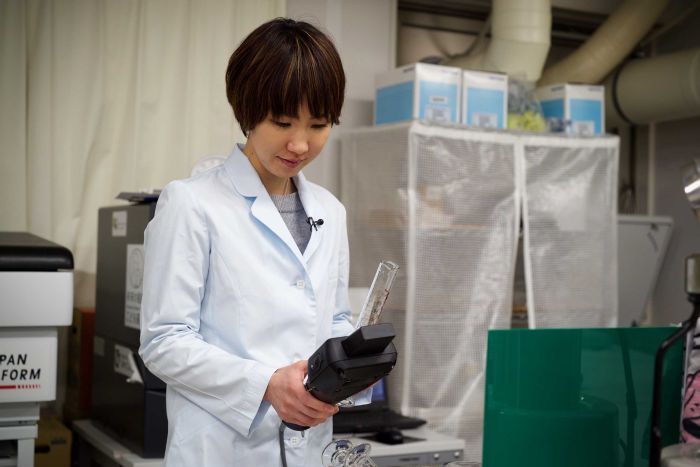
Fukushima mothers record radiation for future generations, Japan Times ,BY YUKA NAKAO, KYODO IWAKI, FUKUSHIMA PREF 10 Apr 20, . – A group of more than 10 mothers set up a citizen-led laboratory to monitor radiation levels in Fukushima communities only months after a massive earthquake and tsunami caused meltdowns at a nuclear power plant in the prefecture nine years ago.Since the foundation of the institute on Nov. 13, 2011, it has been recording and disclosing radiation data on foodstuffs and soil it collected or were brought in by people from different parts of the prefecture, as well as seawater off the Fukushima No. 1 nuclear power plant.
“If the risks of nuclear power had been thoroughly verified by the previous generations, I think the disaster would not have happened,” Kaori Suzuki, 54, an executive of Mothers’ Radiation Lab Fukushima, based in Iwaki, said in a recent interview.
“But since it did occur, what we must do now is record our measurements and changes in the environment so we won’t make the same mistake,” said Suzuki, one of the founding members. “Passing down something that will be useful when major decisions must be made is the only thing we can do.”
The laboratory of 18 staff members, many of them mothers who mostly had no prior experience in measuring radiation, have trained themselves with support from scientists, and they now gauge levels of cesium 134, cesium 137, tritium and strontium 90 with five types of machines.
Samples they have measured include dust in vacuum cleaners, vegetables grown in home gardens, seasonal mushrooms picked in mountains and soil gathered in parks.
They have occasionally detected radiation above safety levels, and reports the lab releases every month on its website have specified which machine is used and other details for each outcome to make their activities as transparent as possible.
Their efforts have made academic contributions as well, with their measuring methods and results published in scientific journals such as Applied Radiation and Isotopes in 2016.
Suzuki said they started the initiative out of desperation to protect their children.
“We had to measure and eat. It was a matter of life and death,” the mother of two said. ….
As time goes by, Tanaka has found that fewer people are discussing radiation effects.
The number of samples brought in by citizens last year was 1,573, up 131 from the year before, but it is showing a decreasing trend overall compared to years before, according to the lab.
“The Olympic Games are coming, and there are fewer media reports on radiation levels than before,” she said.
Officials have dubbed the Tokyo Summer Games the “Reconstruction Olympics,” with the hope of showcasing the country’s recovery from the 2011 catastrophe.
Because of that concept, the starting point of the Japan leg of the torch relay for the Olympics, which were recently put off for a year to the summer of 2021 due to the global coronavirus pandemic, was a soccer training center in Fukushima Prefecture that served as a front-line base in the battle against the nuclear disaster.
Tanaka said logging accurate data and keeping them publicly available are all the more important. “To protect children, having information is essential in deciding what to eat or where to go,” she said, adding that judgments based on correct data will also prevent any discrimination…….
Kimura said she feels that the fears people have toward the new coronavirus are similar to those toward radiation, as they are both invisible.
“Everyone forgets about (radiation) because its effects in 10 or 20 years are uncertain, unlike the new coronavirus that shows pneumonia-like symptoms in a couple of weeks,” she said. “I realized again that people in affected areas like us have been living every day with the same feelings toward the coronavirus pandemic.”
“It’s exhausting,” she said, adding her daughters must have had a hard time as she made them do things differently from their friends, such as wearing masks. “But I felt I was not wrong when my daughter said to me recently, ‘I was being protected by you, mom.’”
In addition to conducting surveys on radiation readings in the environment and food items, the lab in May 2017 opened a clinic with a full-time doctor to provide free medical checkups on internal exposure.
“I think it’s necessary to keep checking children’s health as they grow up, rather than drawing a conclusion saying there won’t be any problem with this level of radiation exposure,” said Misao Fujita, 58, a doctor who is a native of Tochigi Prefecture.
Fujita said the amount of radiation exposure dosage and risks of health damage differ among children even if they live in the same area, depending on such factors as their location and behavior in the days after the nuclear disaster, whether they evacuated and what they eat now.
Those who underwent Fujita’s medical checkups when they were children include a woman who now takes her own child to the clinic, in addition to a number of young decontamination workers.
“The nuclear disaster is something that’s carried on to coming generations. That’s what we have left,” Fujita said. “We must also not forget that about 30,000 people are still unable to return to their hometowns in the prefecture. The disaster isn’t over yet.” https://www.japantimes.co.jp/news/2020/04/10/national/social-issues/fukushima-mothers-record-radiation/#.XpESi_gzbIU
India’s dangerous nuclear triad
|
Why India’s Nuclear Triad Is Such a Dangerous Weapon No joke. National Interest
by Caleb Larson, 10 Apr 20, India’s indigenously developed technology—and a lot of Russian hardware and help—all keep Pakistan and China at bay.
No-First-Use “An NFU policy essentially constitutes a promise, backed by a survivable nuclear arsenal, to only use nuclear weapons in response to a nuclear attack,” explained a Carnegie publication. “The logic is simple and effective: you don’t nuke me, and I won’t nuke you. India and China both have declared no-first-use policies, whereas Pakistan and the United States, among others, do not rule out the first use of nuclear weapons in a conflict.” Despite India’s formidable nuclear arsenal, India had since 2003 maintained it will not use said weapons of mass destruction first, but strictly in a retaliatory manner for deterrence. Triad India maintains a nuclear triad—that is a three-pronged nuclear weapon delivery system that utilizes a diverse array of means for delivering nuclear payload on target. New Delhi has air-launched nuclear missiles, land-based nuclear missiles, and most recently submarine-launched missiles. ……. Armed and Dangerous Over all, India’s nuclear triad is a mix of capabilities—free-falling bombs, long-range and quite sophisticated missiles, and sub-launched missiles of unclear capabilities and likely limited range. Still, India is one of the preeminent nuclear powers in the region, behind China. Look to Russia for more developmental help in the future. https://nationalinterest.org/blog/buzz/why-india%E2%80%99s-nuclear-triad-such-dangerous-weapon-142272 |
|
1 This Month

Protect Sazan Island from the Trump family! https://secure.avaaz.org/campaign/en/protect_sazan_island_from_the_trump_family_loc/?bqFCVab&v=174511&cl=22707147157&_checksum=5e9dde668860e8231c33699735e16a1fbf22ab2cb01da50c999fe8732b9775ef&utm_source=email&utm_medium=blast_email&utm_campaign=174511


Cuba Is Not a Failed State – It Is a Besieged State
PETITION: “Global Appeal to Endorse Palestinian Right of Return of Refugees”
To see nuclear-related stories in greater depth and intensity – go to https://nuclearinformation.wordpress.com
-
Archives
- June 2026 (129)
- May 2026 (306)
- April 2026 (356)
- March 2026 (251)
- February 2026 (268)
- January 2026 (308)
- December 2025 (358)
- November 2025 (359)
- October 2025 (376)
- September 2025 (257)
- August 2025 (319)
- July 2025 (230)
-
Categories
- 1
- 1 NUCLEAR ISSUES
- business and costs
- climate change
- culture and arts
- ENERGY
- environment
- health
- history
- indigenous issues
- Legal
- marketing of nuclear
- media
- opposition to nuclear
- PERSONAL STORIES
- politics
- politics international
- Religion and ethics
- safety
- secrets,lies and civil liberties
- spinbuster
- technology
- Uranium
- wastes
- weapons and war
- Women
- 2 WORLD
- ACTION
- AFRICA
- Atrocities
- AUSTRALIA
- Christina's notes
- Christina's themes
- culture and arts
- Events
- Fuk 2022
- Fuk 2023
- Fukushima 2017
- Fukushima 2018
- fukushima 2019
- Fukushima 2020
- Fukushima 2021
- general
- global warming
- Humour (God we need it)
- Nuclear
- RARE EARTHS
- Reference
- resources – print
- Resources -audiovicual
- Weekly Newsletter
- World
- World Nuclear
- YouTube
-
RSS
Entries RSS
Comments RSS
 nuclear-news