Pakistan’s tactical nuclear weapons, even defensively used, could usher in a larger nuclear war
|
Pakistan’s Tactical Nuclear Weapons Should Terrify You, National Interest, by Kyle Mizokami 10 Apr 20, “…… Unusually among the smaller powers, Islamabad has developed an arsenal of tactical nuclear weapons designed to destroy enemy forces on the battlefield……
Experts believe that Pakistan has between 150 and 180 nuclear bombs. It’s not clear when the country first had an operational, deployable weapon, but by the mid-1990s it had weapons to spare. ….. Tactical nuclear weapons, also called nonstrategic nuclear weapons, are low-yield (ten kilotons or less) nuclear weapons designed for use on the battlefield. Unlike larger, more powerful strategic nuclear weapons, tactical nuclear weapons are meant to destroy military targets on the battlefield. Tactical nuclear weapons are meant to be used against troop formations, headquarters units, supply dumps, and other high-value targets……
Pakistan’s nuclear weapons, particularly tactical nuclear weapons, are seen as an asymmetric means of offsetting India’s advantage in conventional forces. Even if a Pakistani Army offensive into India fails and the Strike Corps counterattacked, tactical nuclear weapons could blunt their spearheads, ideally halting them in their tracks. …..
Pakistan’s tactical nuclear weapons, while intrinsically unsavory, are at least defensive in nature. Unfortunately, given the number of times India and Pakistan have gone to war over the last eighty years, their use is theoretical than those of most countries. The use of nuclear weapons by one side could rapidly escalate to the use of larger, strategic weapons against populated areas by both sides. …… https://nationalinterest.org/blog/buzz/pakistan%E2%80%99s-tactical-nuclear-weapons-should-terrify-you-142937
|
|
|
277,700 Vietnamese support “Appeal of the Hibakusha ” – call to eliminate nuclear weapons
 Over 277,700 signatures collected in Hanoi supporting elimination of nuclear weapons https://en.vietnamplus.vn/over-277700-signatures-collected-in-hanoi-supporting-elimination-of-nuclear-weapons/171278.vnp Over 277,700 signatures collected in Hanoi supporting elimination of nuclear weapons https://en.vietnamplus.vn/over-277700-signatures-collected-in-hanoi-supporting-elimination-of-nuclear-weapons/171278.vnp
Hanoi (VNA) – Over 277,700 signatures have been collected in Hanoi in the first phase of a campaign called “Appeal of the Hibakusha (atomic bomb survivors)”, which calls for the elimination of nuclear weapons. VNA Monday, April 06, 2020
Collected by the Hanoi Union of Friendship Organisations (HUFO), the signatures have been handed over to the Vietnam Peace Committee (VPC), HUFO said on April 6. According to HUFO Vice President Tran Thi Phuong and Hanoi Peace Committee President Tran Thi Ngoc Thanh, the signatures were collected from people at government offices and residential zones as well as at bus stations and public spaces around Hanoi. They expect to gain more signatures from students in the capital during subsequent phases, when local schools and universities re-open after the COVID-19 pandemic ends. VPC Secretary General Dong Huy Vuong spoke highly of HUFO and the Hanoi Peace Committee’s contributions to the campaign./.
|
|
The Carbon Brief Profile: South Korea
 COUNTRY PROFILES 6 April 2020 The Carbon Brief Profile: South Korea, 6 Apr 20,
As part of its series on how key emitters are responding to climate change, Carbon Brief looks at South Korea’s attempts to balance its high-emitting industries with its “green”aspirations.
the nation has drawn criticism for not always matching its green-growth rhetoric with action. Proposed phaseouts of coal and nuclear have been prompted primarily by concerns about air pollution and safety,as opposed to climate.
With an election approaching, many environmental groups joined together to call for more action from the major parties, which they claimed have prepared virtually “no countermeasures” against climate change.
In March, a group of Korean youth activists sued the government over its climate framework, which they deemed insufficient to meet the nation’s Paris Agreement targets.
According to a 2019 study by the Pew Research Centre, South Koreans place climate change highest in their list of potential national threats…….. Recent polling suggests 77% of voters would vote for political parties promising to respond to the threat of climate change in the general election……
This year, nations are expected – though not strictly required – under the Paris Agreement to come forward with updated plans that scale up the ambition of their original target. South Korea has yet to indicate whether it intends to meet this expectation. …….
Finally, South Korea is home to the Green Climate Fund (GCF), a UN body based in the “international business district” of Songdo, near the north-western city of Incheon. The fund is the main mechanism set up for mobilising $100bn every year “by 2020” from richer countries to finance climate mitigation and adaptation in the developing world…….
‘Green growth’ policies
In keeping with South Korea’s rapid industrialisation over the past few decades, the nation’s approach to climate and energy is best summarised by the principle of “green growth”.
Upon the inauguration of President Lee Myung-bak in 2008, he made it clear his overarching philosophy would be based on clean-energy technologies and environmentally friendly development in order to fuel long-term economic growth. In a speech at the time, he said:
“If we make up our minds before others and take action, we will be able to lead green growth and take the initiative in creating a new civilisation.”
This was reflected in the flagship Framework Act on Low Carbon, Green Growth (pdf), which was passed in 2009 and provided the legislative framework for emissions targets and renewable energy expansion, as well as the basis for a carbon trading system.
A five-year plan implemented the same year saw South Korea commit 2% of its GDP through to 2013 to invest in the green economy, which included investing in renewable energy, smart grids and green homes.
According to the World Bank, this focus on green investment is partly credited with the nation’s early recovery from the global financial crisis…….
there are concerns that this system still does not make it attractive enough for private entities to invest in renewables, with insufficient subsidies for solar and wind while coal is still being incentivised .
Another issue with the current Korean system concerns the electricity grid, with renewable energy facilities facing delays in being connected due to inadequate substations.
The government-owned KEPCO controls the grid and has a monopoly on electricity generation. The International Energy Agency (IEA) has identified restructuring of KEPCO as a key recommendation for energy reform.
There are also concerns in South Korea that expanding renewable capacity only benefits foreign companies that already dominate these markets. Earlier this year, the Ministry of Trade, Industry and Energy issued a press release reassuring people that reports of Chinese companies dominating the Korean solar market were “not true”.
Despite all these issues, the SFOC has identified the “biggest problem” facing renewable expansion as conflicts arising with local communities, when trying to construct new renewable facilities in their vicinity.
Conservatives politicians and news outlets, often with a pro-nuclear slant, have been blamed for “tarnishing” the reputation of renewables by stating that solar projects in particular are the cause of “environmental destruction”. According to SFOC:
“As a result, there is an increasing number of local governments autonomously establishing ordinances and rules restricting the sites for solar PV and wind power.”
Nuclear
Around a quarter of South Korea’s electricity comes from its 24 nuclear reactors, placing it “among the world’s most prominent nuclear energy countries”, according to the World Nuclear Association. Its nuclear power output is the fifth largest in the world…….
However, the nation has been shaken by two events that have, ultimately, left the future of South Korea’s
First came the Fukushima nuclear disaster in 2011. Most reactors in South Korea are located close nuclear energy looking highly uncertain.together, often near major population centres, and the accident in neighbouring Japan galvanised anti-nuclear movements across the country who feared a similar event closer to home.
The impact of the disaster on South Korea is reflected in the country’s NDC, which states:
“Given the decreased level of public acceptance following the Fukushima accident, there are now limits to the extent that Korea can make use of nuclear energy, one of the major mitigation measures available to it.”
Next, the industry was hit by a major scandal in which 100 people were indicted for corruption after fake safety certificates were issued at nuclear facilities.
This “mafia-style behaviour”, as one government official put it, led to several reactors being shut down so that cabling could be replaced after it emerged it had received certification through the corrupt operation.
The culmination of this was President Moon and his Democratic Party coming to power in 2017 with a pledge to phase out nuclear energy in South Korea.
While new reactors are still being constructed, Moon said they would not extend the operation of ageing reactors which will be decommissioned in the 2020s and 2030s. This is in line with “deliberative polling” conducted by the government to give a sense of the Korean population’s views on nuclear energy.
Analysis by SFOC found that South Korean public financial institutions have provided around $17bn (£13.7bn) of financial support for coal-power projects since 2008, around half of which was for schemes overseas.The group concludes that without this “easily available financing…such proliferation of coal-fired power plants would not have been possible”.
Another report by Carbon Tracker questions the economic viability of South Korean coal power, identifying the country as having “the highest stranded asset risk in the world” due to market structures which effectively guarantee high returns for coal.
It concludes that South Korea “risks losing the low-carbon technology race” by remaining committed to coal. A newer report from the thinktank says it is already cheaper to invest in new renewables than build new coal in South Korea and it will be cheaper to invest in new renewables than to operate existing coal in 2022. ………
https://www.carbonbrief.org/the-carbon-brief-profile-south-korea
Coronavirus question mark still hangs over Tokyo Olympics in 2021
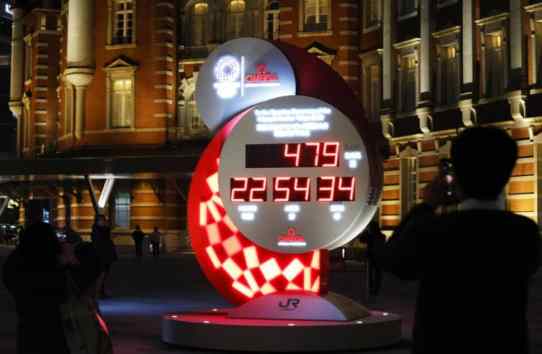 A passerby takes photos of a countdown clock in front of Tokyo Station on Monday showing the adjusted days and time for the start of the postponed Tokyo Olympic Games, which are now set to begin on July 23, 2021.
March 31, 2020
Although this summer’s Tokyo Olympics and Paralympics were postponed by about a year due to the new coronavirus pandemic, the lingering question is whether the global health crisis will be under control by then.
The capital is facing a mounting challenge following the first Olympic postponement in history, with local organizers confronted with the task of reworking the preparations of the last six years.
The International Olympic Committee and the local organizers agreed Monday that the Tokyo Olympics, originally set to open on July 24 this year, will run between July 23 and Aug. 8, 2021, followed by the Paralympics from Aug. 24 to Sept. 5.
The IOC has stressed the importance of holding the Tokyo Games in 2021, with President Thomas Bach saying the sporting event can be a “celebration of humankind after having overcome the unprecedented challenge of the coronavirus.”
However, even as the organizers try to settle one problem after another, ranging from securing venues and lodging for athletes and officials, gathering volunteers and figuring out how to shoulder the additional costs, the key to hosting a successful Tokyo Games is something they cannot control by themselves.
On March 24, Prime Minister Shinzo Abe and Bach agreed to hold the Tokyo Olympics in the summer of 2021 at the latest after they were pressured by athletes to make changes to the schedule to prevent a further spread of the coronavirus and to provide them a chance to prepare fully.
Yoshiro Mori, president of the Tokyo Organising Committee, said at a press conference shortly after the agreement was reached that the virus is their “top concern” but that he expects the situation will change due to medical advancements.
Kazuhiro Tateda, who heads the Japanese Association for Infectious Diseases, says whether infections of COVID-19, the respiratory disease caused by the new coronavirus, could be drastically curtailed by next summer is still unknown, but predicts the pace of the spread will decelerate.
“The new coronavirus has been spreading at a very rapid pace,” Tateda said. “In the next few months, the virus will spread in both the northern and southern hemispheres. If those people who recovered become immune to the virus, we can say that the outbreak will settle down.”
“But we can’t tell what the situation is like in a year,” he said.
Speaking at the press conference with Mori, the organizing committee’s CEO, Toshiro Muto, said a one-year postponement was a “reasonable” decision at a time when no health experts can say for sure when the pandemic will end.
The March 24 decision came just two days before the initial start of the 121-day torch relay in Japan and exactly four months ahead of the opening of the Olympics.
It was also made on the day Tokyo overtook Hokkaido as the region with the most infections.
“If I’m asked whether the coronavirus (situation) settles in the summer of next year, I can’t say that it will be absolutely fine,” Muto said. “But if something like that happens, not only Japan but also the rest of the world will be in a devastating situation. I predict people to come up with new drugs if that’s the case.”
Tateda, a member of the government’s panel of experts, said the organizers made a “rational” choice, but they need to monitor the situation throughout their preparation period and make changes to the schedule if necessary.
Meanwhile, Koji Wada, a professor at the International University of Health and Welfare, says staging the Olympics next summer could be “difficult,” given that the pneumonia-causing virus has spread to all of the world’s seven continents except Antarctica since it broke out in China late last year.
“I think it’s a little too optimistic to assume that many people will become immune to the virus in one year and three months and be able to travel back and forth,” he said in a recent interview.
“Two years might have been better, but barely possible. Even then, there will be cases of infections around the world, and the games will have to go ahead under tough circumstances,” he said.
Wada said staging the Olympics and Paralympics will be different from any other event because a huge number of athletes and spectators from all over the world will gather, and the development of vaccinations and medications will be unlikely in a year.
“It is difficult to place countermeasures against infections to athletes,” he said. “What are they going to do with athletes who come from countries that still have cases of infection? People will suggest putting them under quarantine for about two weeks, but what would happen if that athlete tests positive?”
The European Union’s disease control body released a report on March 25 saying that the summer heat and humidity will be unlikely to prevent the virus from spreading, adding there is no evidence that COVID-19 displays a marked seasonality.
“Based on preliminary analyses of the COVID-19 outbreak in China and other countries, high reproductive numbers were observed not only in dry and cold districts but also in tropical districts with high absolute humidity, such as Guangxi (China) and Singapore,” the European Centre for Disease Prevention and Control said in the report.
Wada warns that holding the Summer Games when the virus situation is not under control will take away from the fairness of the sporting extravaganza.
In particular, it would be difficult for athletes competing in contact sports, such as wrestling and judo.
The Tokyo Games are not the first games to be threatened by global health issues.
The 2010 Vancouver Winter Games were held following the outbreak of swine flu the previous year, while the previous Summer Games in Rio de Janeiro were held amid fears over the mosquito-transmitted Zika virus.
However, Wada said the new virus is not like any other, characterizing it as “nothing we have experienced in recent history.”
“The coronavirus is very difficult compared to other viruses because it spreads through people who do not show symptoms. And since none of us are immune to it, it can spread all over the world,” he said.
Tokyo Olympics and Paralympics: New dates confirmed for 2021
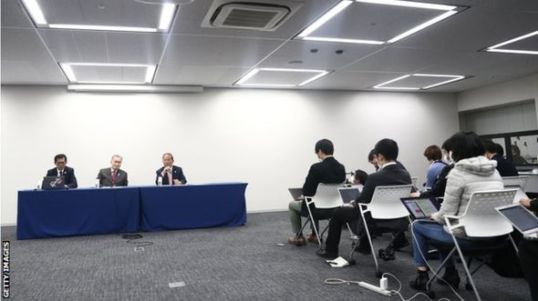 Tokyo 2020 president Yoshiro Mori (centre, at table) made the announcement at a news conference on Monday
30 March 2020
The Tokyo Olympic Games will start on 23 July, 2021 and run to 8 August after being postponed for a year because of the coronavirus pandemic.
The International Olympic Committee’s (IOC) executive board met on Monday to make the decision.
The Olympics will still be called Tokyo 2020 despite taking place in 2021.
The Paralympic Games, originally due to start on 24 August, 2020, will now take place between 24 August and 5 September, 2021.
IOC president Thomas Bach said: “I am confident that, working together with the Tokyo 2020 Organising Committee, the Tokyo Metropolitan Government, the Japanese Government and all our stakeholders, we can master this unprecedented challenge.
“Humankind currently finds itself in a dark tunnel. These Olympic Games Tokyo 2020 can be a light at the end of this tunnel.”
International Paralympic Committee president Andrew Parsons added: “When the Paralympic Games do take place in Tokyo next year, they will be an extra-special display of humanity uniting as one, a global celebration of human resilience and a sensational showcase of sport.
“With the Tokyo 2020 Paralympic Games 512 days away, the priority for all those involved in the Paralympic movement must be to focus on staying safe with their friends and family during this unprecedented and difficult time.”
If that is moved back exactly a year it would clash with the Commonwealth Games in Birmingham which is set to take place between 27 July and 7 August.
“We support the new 2021 dates for the Tokyo 2020 Olympic Games. This gives our athletes the time they need to get back into training and competition,” World Athletics said in a statement.
“Everyone needs to be flexible and compromise and to that end we are now working with the organisers of the World Athletics Championships in Oregon on new dates in 2022.
“We are also in discussions with the Commonwealth Games Federation (CGF) and the European Championships.”
Chief executive of the CGC David Grevemberg said his organisation is “fully committed to hosting a successful Commonwealth Games in Birmingham, England, during 2022”.
He added: “Over the coming days, we will continue to work collaboratively with our international federation partners to ensure the XXII Commonwealth Games maintains its position and stature on the global sporting calendar.”
Olympic organisers hope the delay will allow sufficient time to finish the qualification process which will follow the same mitigation measures planned for 2020.
It has previously been confirmed that all athletes already qualified and quota places already assigned will remain unchanged.
Purchased tickets would be valid for rescheduled events or a refund could be requested when the new dates were set, organisers previously confirmed.
On 24 March, Japan’s Prime Minister Abe Shinzo said the Games would be held in their “complete form” and no later than summer 2021.
Tokyo 2020 organising committee president Yoshiro Mori said he had proposed the 23 July to 8 August timeframe to the IOC, and that Bach had agreed, following consultations with the international sports federations.
“A certain amount of time is required for the selection and qualification of athletes and for their training and preparation, and the consensus was that staging the rescheduled Games during the summer vacation in Japan would be preferable,” Mori said.
“In terms of transport, arranging volunteers and the provision of tickets for those in Japan and overseas, as well as allowing for the Covid-19 situation, we think that it would be better to reschedule the Games to one year later than planned, in the summer of 2021.”
It is the first time in the Olympic Games’ 124-year modern history that they have been delayed, though they were cancelled altogether in 1916 because of World War One and again in 1940 and 1944 for World War Two. Cold War boycotts affected the summer Games in Moscow and Los Angeles in 1980 and 1984 respectively.
BPA “praises speed” of decision
The British Paralympic Association (BPA) has “praised the speed” with which the Tokyo 2020 Games have been rescheduled and hopes it will give athletes the “certainty they need to refocus on achieving their goals”.
Mike Sharrock, chief executive of the BPA, said: “”We recognise many challenges still lie ahead in the battle with the global Covid-19 pandemic and athletes will not be able to return to their training schedules for some time yet.
“The clear priority now is stemming this public health crisis and ensuring people follow the Government advice to stay safe and well.”
Sharrock added he believes Tokyo 2020 “has the potential to be the biggest and best Paralympics in history”.
Nuclear power plant shut down by host of tiny shrimp clogging filters

 Masses of tiny shrimp shut down nuclear power plant in southern China twice in one week, 1 Apr 2020,The Star, By Holly Chik The Power-Generating Units Of A Nuclear Plant In Southern China Were Shut Down Twice Last Week After Its Water Filters Were Blocked By Masses Of Small Shrimp, The Safety Regulator Said.
Big shoals of the tiny acetes – krill-like shrimp that are just a few centimetres long – flooded the seawater diversion channel and circulating water pumping stations of the Yangjiang Nuclear Power Station in Guangdong on March 24, the National Nuclear Safety Administration said in a statement.
They crippled the water pumping stations and caused one of the nuclear plant’s six power-generating units to go into automatic safe shutdown, while the other five units ran at 80 per cent of capacity. The unit that shut down was powered up again the next day after station staff cleared the acetes and cleaned the filters.
But soon after on March 25, the same thing happened, with large shoals of acetes again finding their way into the pumping stations and causing four power-generating units to shut down automatically. The station shut off the other two units for safety reasons. …….
The Hong Kong Nuclear Society also noted that similar incidents had happened before.
“Similar events have occurred at nuclear power plants using seawater as a coolant for their power-generating units [including non-nuclear ones] throughout the world, including China,” said Luk Bing-lam, chairman of the society.
Fukushima Daiichi nuclear power plant’s deadly hazard – highly radioactive sandbags
 Nuclear sandbags too hot to handle, https://www.theaustralian.com.au/world/the-times/nuclear-sandbags-too-hot-to-handle/news-story/87b811443cb8e2881f55e17108872880 By RICHARD LLOYD PARRY, THE TIMES. APRIL 1, 2020
- Japanese engineers trying to dismantle the melted reactors at the Fukushima Daiichi nuclear power plant face a new hazard — radioactive sandbags so deadly that standing next to them for a few minutes could be fatal.
The sandbags were intended to make life easier for the teams dealing with the aftermath of the nuclear disaster in 2011 when three reactors melted after a tsunami destroyed their cooling systems. Twenty-six tonnes of the bags were placed in basements beneath two of the reactors to absorb radioactivity from waste water.
They were stuffed with zeolite, minerals that can absorb caesium. Nine years after the disaster, the submerged sandbags have sucked up so much radiation that they now represent a deadly danger themselves.
Samples of zeolite removed from the bags contain caesium, producing huge amounts of radiation, while the sandbags are giving off up to four sieverts of radiation an hour. Fifteen minutes of exposure to this could cause haemorrhaging. After an hour, half of those exposed would eventually die as a result. The maximum lifetime recommended dose of radiation for humans is less than half a sievert.
Tokyo Electric Power Co (Tepco), which operates the plant, had intended to remove the contaminated water by the end of 2020. The complication caused by the sand means it will take three years longer, the latest delay to the decommissioning.
Tepco managers have admitted that the technology needed to finish the job does not exist and they do not have a full idea of how it will be achieved. Their stated goal of decommissioning by 2051 may be impossible, they said.
One of the biggest problems is the 170 tonnes of irradiated water coming out of the plant every day, much of it natural ground water that flows through the earth towards the sea, picking up radiation on the way. Tepco pumps it out and stores it in huge storage tanks, filtered of some, but not all, of its contaminants — 1.17 million tonnes so far. In two years, the storage space will run out.
The government wants to pour the water away, insisting that the diluting effect of the Pacific will render the radiation harmless, but it is opposed by North and South Korea and the local fishing industry, whose reputation has been ruined by the disaster.
TEPCO’s staggering costs to remove melted nuclear fuel from Fukushima’s crippled reactors
 TEPCO puts cost to remove melted nuclear fuel at over 1 trillion yen, http://www.asahi.com/ajw/articles/13259804, By RINTARO SAKURAI/ Staff Writer, March 31, 2020 Tokyo Electric Power Co. estimates that 1.37 trillion yen ($12.6 billion) will be needed over 12 years to remove melted nuclear fuel from reactors at the crippled Fukushima No. 1 nuclear power plant.TEPCO’s announcement on March 30 covers only two of the three reactors that suffered meltdowns triggered by the 2011 Great East Japan Earthquake and tsunami. TEPCO puts cost to remove melted nuclear fuel at over 1 trillion yen, http://www.asahi.com/ajw/articles/13259804, By RINTARO SAKURAI/ Staff Writer, March 31, 2020 Tokyo Electric Power Co. estimates that 1.37 trillion yen ($12.6 billion) will be needed over 12 years to remove melted nuclear fuel from reactors at the crippled Fukushima No. 1 nuclear power plant.TEPCO’s announcement on March 30 covers only two of the three reactors that suffered meltdowns triggered by the 2011 Great East Japan Earthquake and tsunami.
No estimate was attempted for the cost to prepare for the removal of melted nuclear fuel from the No. 1 reactor. The situation at that reactor is the most difficult among the three reactors, and TEPCO officials are still struggling to come up with a plan for removing the debris from within. The estimate covers the period between fiscal 2020 and fiscal 2031. Of that amount, 350 billion yen will be applied as a special loss to the company’s balance statement for the fiscal year ending March 31, 2020. The utility had already released its plan for decommissioning the three reactors, which foresaw a start to removing melted nuclear fuel from the No. 2 reactor before the end of 2021, while removal would begin for the No. 3 reactor by 2031. In announcing its expected profits for the current fiscal year, TEPCO also outlined its estimated expenses for melted fuel removal over the next 12 years. A total of 330 billion would be needed as preparatory measures, such as further examining the interior of the No. 2 reactor and decontaminating radiation from the area around the three reactors. Another 20 billion yen is expected to be spent for trial removal of melted nuclear fuel from the No. 2 reactor, while 1.02 trillion yen would be required to construct the facilities needed to remove the melted fuel from the No. 2 and No. 3 reactors. The construction cost would be written off as a special loss from TEPCO’s balance statement in the fiscal year when the work takes place. TEPCO forecasts a net profit of 79 billion yen for the current fiscal year, a decrease of 66 percent from fiscal 2019. Sales are expected to decrease by 2.2 percent to 6.199 trillion yen. |
|
Countries may use coronavirus crisis to rein in climate commitments: Japan a case in point
Campaigners attack Japan’s ‘shameful’ climate plans release
Proposals criticised amid fears countries may use coronavirus crisis to rein in commitments, Guardian, Fiona Harvey Environment correspondent 30 Mar 20, Japan has laid out its plans to tackle greenhouse gas emissions under the Paris agreement in the run-up to UN climate talks this year, becoming the first large economy to do so.
But its proposals were criticised by campaigners as grossly inadequate, amid fears the Covid-19 crisis could prompt countries to try to water down their climate commitments.
The UK, which will host the talks, hopes every country will produce renewed targets on curbing emissions and achieving net zero carbon by 2050.
New commitments are needed to achieve the Paris goals of holding temperature rises to no more than 2C, and ideally 1.5C, above pre-industrial levels, as on current national targets the world would far exceed those limits.
Japan’s carbon targets – known as its nationally determined contribution (NDC) in the UN jargon – as announced on Monday morning are almost unchanged from its commitments made in 2015 towards the Paris accord, however.
The country’s target of a 26% reduction in emissions by 2030, based on 2013 levels, is rated as “highly insufficient” by the Climate Action Tracker analysis, meaning that if all targets were at this level, temperature rises would exceed 3C.
The country, the world’s fifth biggest emitter and third biggest economy, is one of the only developed countries still building new coal-fired power stations, although there are signs it may hold back……
Campaigners fear the coronavirus pandemic will be seen by some countries as a way to weaken their commitment to the Paris accord and present less stringent targets instead of the strong cuts needed.
“Japan should not slow down climate actions even amid the Covid-19 global fights, and must revisit and strengthen this plan swiftly in order to be in line with the Paris agreement,” said Kimiko Hirata, the international director of the Kiko Network, a climate group in Japan……
Environmental regulations and climate commitments have come under attack in the context of the coronavirus crisis. Under Donald Trump’s administration in the US, the Environmental Protection Agency has rolled back key regulations including car efficiency standards. In the EU, carmakers wrote to the European commission last week to demand a loosening of requirements on them to cut carbon.
There is still scope for Japan to revise its targets. Other countries have yet to submit their detailed NDCs, but several – including the UK and the EU, and more than 70 smaller economies – made public their intention to reach net zero carbon by 2050, at last year’s UN climate talks in Madrid……. https://www.theguardian.com/environment/2020/mar/30/campaigners-attack-japan-shameful-climate-plans-release
China is Willing to Negotiate on Nuclear Arms, But Not on Trump’s Terms
 China is Willing to Negotiate on Nuclear Arms, But Not on Trump’s Terms, Defense One, BY GREGORY KULACKI, 30 Mar 20
President Trump announced to the world in a March 5 tweet that he would propose “a bold new trilateral arms control initiative with China and Russia.” China immediately rejected the idea the very next day. It would be wrong, however, to infer that Chinese leaders are opposed to nuclear arms control. They are not. They are just not interested in what Trump appears to be offering.
There are good reasons for China to suspect Trump’s motives. He used China as a scapegoat when withdrawing from the Intermediate Nuclear Forces Treaty, for example, and he may be using this vague new initiative to justify allowing the New START Treaty to expire. China was not a party to either agreement. Walking away from treaties with Russia and blaming China for it is unlikely to encourage Chinese leaders to come to the negotiating table.
Trump premised his announcement of this new initiative with a questionable claim that China will “double the size of its nuclear stockpile” before the end of the decade. That sounds ominous, but in fact China has only about 300 warheads and barely enough plutonium to get to 600. Meanwhile, the United States and Russia each possess more than 6,000 warheads. Any new agreement based on parity among the three states would require steep U.S. and Russian cuts even if China did indeed double its arsenal.
China certainly would welcome major U.S. and Russian reductions. But there is no sign either nation is willing to make them. On the contrary, Trump and President Putin have announced ambitious nuclear modernization programs that dwarf China’s. Since neither of the two countries are planning to reduce their arsenals, it is difficult for Chinese leaders to understand what Trump wants to discuss. Neither the president nor his aides have provided a tentative agenda or cited desired outcomes.
Despite Trump’s apparent failure to engage China, if he or his successor wants to bring China to the negotiating table, there is a path to follow. Below are four steps the United States can take to convince Chinese leaders to negotiate on nuclear arms.
Step 1. Pursue International, not Multilateral, Negotiations
There is a marked difference between international and multilateral negotiations, and it matters to China……..
Step 2. Accept Mutual Vulnerability
Accepting mutual vulnerability sounds defeatist. But all it means is that no one can win a nuclear arms race. The United States cannot prevent China from being able to retaliate and deliver some number of nuclear weapons if the United States should ever choose to use nuclear weapons first during a war……
Step 3. Take No-First-Use Seriously
China is serious about not using its nuclear weapons first in an armed conflict. In a statement after its first nuclear test in 1964, the Chinese government declared it will “never at any time and under any circumstances be the first to use nuclear weapons.”…
Step 4. Discuss Limits on Missile Defense
When the United States and the Soviet Union finally realized that no one could win a nuclear arms race, they decided to talk. Negotiators quickly discovered that limiting offense was impossible without limiting defense as well, since an effective way to counter defenses is to build more offensive weapons…..https://www.defenseone.com/ideas/2020/03/china-willing-negotiate-nuclear-arms-not-trumps-terms/164204/
2020 Olympics – Abe’s plan to help the nuclear industry has fallen through
 Abe’s decision to host the Olympics in the first place, and to plan to start the torch relay in Fukushima, as mere pretense that all is well in the prefecture, despite widespread contamination that continues since 2011.
The claim about the necessity of nuclear power makes little sense. Since 2011, the country has been generating only a fraction of the nuclear electricity it used to generate, and yet the lights have not gone off in Japan.
the Abe government seems to be involved in lowering incentives for the development of solar energy, and instead promoting nuclear power.
Efforts by Prime Minister Abe to support the failing and flailing nuclear sector in Japan are indicative of the significant political power wielded by the “nuclear village,” the network of power companies, regulators, bureaucrats and researchers that control nuclear and energy policy. The actions of the nuclear village is one of the factors responsible for the Fukushima accident.

Nuclear flame fizzles in Japan, But leaders still cling to failing nuclear power
Prime Minister Shinzo Abe and the “nuclear village” hoped the Olympics would normalize Japan’s radiological aftermath. But the Fukushima effect has meant zero nuclear exports, leading the government to shore up the nuclear industry at home at the expense of renewables. Beyond Nuclear, By Cassandra Jeffery and M.V. Ramana 29 Mar 20, Last week, International Olympic Committee President Thomas Bach and Japanese Prime Minister Shinzo Abe agreed to delay the 2020 Summer Olympic Games because of the COVID-19 pandemic. However, they will keep the Olympic flame burning in Fukushima Prefecture. The torch relay route was to have begun there, a poor decision, given the meltdown of multiple reactors in Fukushima nine years ago in March 2011. While radiation levels may have declined since 2011, there are still hotspots in the prefecture, including at the sports complex where the torch relay would have begun and along the relay route.
The persistence of this contamination, and the economic fallout of the reactor accidents, should remind us of the hazardous nature of nuclear power. Simultaneously, changes in the economics of alternative sources of energy in the last decade invite us to reconsider how countries, including Japan, should generate electricity in the future….
opposition is evident in Japan too, where opinion polls show overwhelming lack of support for the government’s plans to restart nuclear plants that have been shut down after the Fukushima accidents.
One poll from February 2019 found 56 percent of respondents were opposed to resuming nuclear operations; only 32 percent in favour of resumption. Other polls show significant local opposition, one example coming out of the Miyagi Prefecture, where some local residents have filed an injunction to ban the Miyagi governor from approving a utility plan to restart a nearby reactor.
Even the Japan Atomic Energy Relations Organization, which aims to promote nuclear power, finds that only 17.3 percent of survey respondents prefer nuclear energy, with much larger majorities preferring solar, wind, and hydro power.
The costs of dealing with such accidents are immense. Estimates for the Fukushima disaster range from nearly $200 billion to over $600 billion. Estimates for the costs imposed by the Chernobyl accident amount to nearly $700 billion. In 2013, France’s nuclear safety institute estimated that a similar accident in France could end up costing $580 billion. In Japan, just the cost of bringing old nuclear power plants into compliance with post-Fukushima safety regulations has been estimated at $44.2 billion.
Even in the absence of accidents and additional safety features, nuclear power is already very expensive. For the United States, the Wall Street firm Lazard estimates an average cost of $155 per megawatt hour of nuclear electricity, more than thrice the corresponding estimates of around $40 per megawatt hour each for wind and solar energy. The latter costs have declined by around 70 to 90 percent in the last 10 years.
In the face of the high costs of nuclear power—economic, environmental, and public health—and overwhelming public opposition, it is puzzling that the Japanese government would persist in trying to restart nuclear power plants.
To explain his support for the technology, Prime Minister Shinzo Abe claims that the country cannot do without nuclear power, especially in view of climate change concerns. The claim about the necessity of nuclear power makes little sense. Since 2011, the country has been generating only a fraction of the nuclear electricity it used to generate, and yet the lights have not gone off in Japan.
Further, starting in 2015, Japan’s total greenhouse gas emissions have fallen below the levels in 2011, because of “reduced energy consumption” and the increase in “low-carbon electricity.” The latter, in turn, is because of an increasing fraction of renewable energy in electricity generation, a factor that could play an important role in the future.
Some, including the Global Energy Network Institute and a group of analysts led by Stanford University’s Mark Jacobson, argue that Japan could be 100 percent powered by renewable energy. Regardless of whether Japan reaches that goal, there is little doubt that Japan could be expanding renewable energy, and that increased reliance on renewables makes economic and environmental sense.
Instead, the Abe government seems to be involved in lowering incentives for the development of solar energy, and instead promoting nuclear power. The government has also increased the financial assistance retainer for Tokyo Electric Power Company, the company that operated the Fukushima Daiichi plant from ¥9 trillion to ¥13.5 trillion. This amount is borrowed from banks and the interest costs on this retainer will be paid by Japanese taxpayers.
Efforts by Prime Minister Abe to support the failing and flailing nuclear sector in Japan are indicative of the significant political power wielded by the “nuclear village,” the network of power companies, regulators, bureaucrats and researchers that control nuclear and energy policy. The actions of the nuclear village is one of the factors responsible for the Fukushima accident.
Indeed, the Rebuild Japan Initiative Foundation’s Independent Investigation Commission, traced the accident to, among other things, the presence of “sweetheart relationships and revolving doors that connected the regulatory bodies and electric companies, academics, and other stakeholders in the nuclear community.” Such relationships also exist between institutions involved in energy planning and the nuclear community, which accounts for some of the reluctance on the part of Japan’s energy policy makers to let go of the nuclear dream.
Nuclear sweethearts aside, Prime Minister Abe has another problem; his economic agenda, dubbed “Abenomics” by many, involves exports “of nuclear components and technology, as well as conventional arms” as an important component. So far, despite many trips to various countries by Prime Minister Abe, Japan has yet to export any reactors in the last decade; a project with the most likely client, Turkey, collapsed because of high costs. Because Prime Minister Abe and the nuclear village sees the lack of sales as a problem, they seem to want to shore up the domestic nuclear industry and “prove” that Japan has fully recovered from the 2011 nuclear disaster. But, are the financial costs and the effort worth the risk?
It is not a stretch of the imagination to regard Abe’s decision to host the Olympics in the first place, and to plan to start the torch relay in Fukushima, as mere pretense that all is well in the prefecture, despite widespread contamination that continues since 2011. Restarting nuclear reactors or constructing new ones, should that ever happen, only increases the likelihood of more nuclear accidents in the future and raises the costs of electricity. This is especially irrational when alternative, less risky, sources of electricity have become far cheaper than nuclear energy……..https://wordpress.com/read/feeds/72759838/posts/2643325783
Kansai Electric Power Co’s history of nuclear corruption
 While the depth of the scandal has
  surprised many, stories of collusion and bribery in Fukui towns hosting Kepco’s plants are quite common and date back to the 1970s when the first power plants opened.
Naito, who died in 2018, claimed to have directed illicit cash payments to prime ministers and key politicians in the ruling and opposition parties between 1972 and 1990 in exchange for favorable legislation regarding nuclear power and electricity policies.
A closer look at Kansai Electric and its gift-giving scandal https://www.japantimes.co.jp/news/2020/03/29/business/kansai-electric-gift-giving-scandal/#.XoEN-YgzbIU BY ERIC JOHNSTON, STAFF WRITER OSAKA – Earlier this month, Kansai Electric Power Co. concluded that scores of its employees had received cash and gifts worth hundreds of millions of yen from an influential politician in a Fukui Prefecture town where the utility operates a nuclear power plant. The revelations by Kepco’s investigative panel once again showed the dark side of Japan’s nuclear industry.
What is Kepco?
Kepco is the major utility providing electric power to the Kansai region, including Kyoto, Osaka, Nara, Hyogo, Shiga and Wakayama prefectures. With over 20,000 direct employees and 77 affiliated companies, it is one of Kansai’s largest and most influential corporations economically, but also politically. Kepco executives have long held high leadership positions in local business lobby groups such as the Kansai Economic Federation, which played a leading role in convincing local and national politicians, as well as the appropriate ministries in Tokyo, to approve and fund projects ranging from Kansai Airport to the 2025 Expo. Kepco’s largest shareholder is the city of Osaka, which owned about 7.3 percent of Kepco’s stock as of September 2019.
What’s the role of the Takahama plant?
Fukui Prefecture is home to 11 Kepco nuclear reactors at three plants. One of these is the Takahama plant, which hosts some of Japan’s oldest reactors. The No. 1 and 2 reactors are now over 40 years old but scheduled to be restarted later this year. The No. 3 and 4 reactors, which are 35 and 34 years old, are offline and currently being upgraded to better protect against terrorism threats. But construction is running behind schedule and the exact date of their restart is unclear.
In 2010, just before the Great East Japan Earthquake and the resulting nuclear disaster in Fukushima, nuclear power at Kepco’s three Fukui plants accounted for 51 percent of its electricity sources. That figure sat at 29 percent as of the end of the 2018 fiscal year.
What was the scandal all about? Continue reading
Olympic Torch Relay stopped – another blow to the nuclear propaganda about “Fukushima recovery”

Now Postponed, The Olympic Torch Relay Was To Bring Hope To Ravaged Fukushima, March 26, 2020, Heard on All Things Considered“………….This region was devastated nine years ago when the largest earthquake in Japan’s recorded history triggered a massive tsunami. The giant wave washed away nearly 20,000 people, including thousands in Fukushima. It also hit the Fukushima Daiichi Nuclear Power Station right down the coast, causing a partial meltdown that sent plumes of radioactive particles for miles. The area has been trying to rebuild ever since.
Ueno, a 46-year-old wheat farmer, was supposed to run the torch on Thursday through his hometown of Minamisoma. His current home, down the street from the empty field he’s standing in, is one of the only buildings around. His old houseused to be here too…..
This part of Fukushima, in the area around the Daiichi power plant, is still suffering from high levels of radiation. Only a tiny fraction of the population has returned, most over the age of 60, and many streets still sit empty and deserted, left exactly as they were nine years ago tumbled by the earthquake and rotting. It’s not the same Fukushima that it was before the disaster. … https://www.npr.org/2020/03/26/821402324/now-postponed-the-olympic-torch-relay-was-to-bring-hope-to-ravaged-fukushima
British small nuclear reactors to help Turkey to get nuclear weapons?
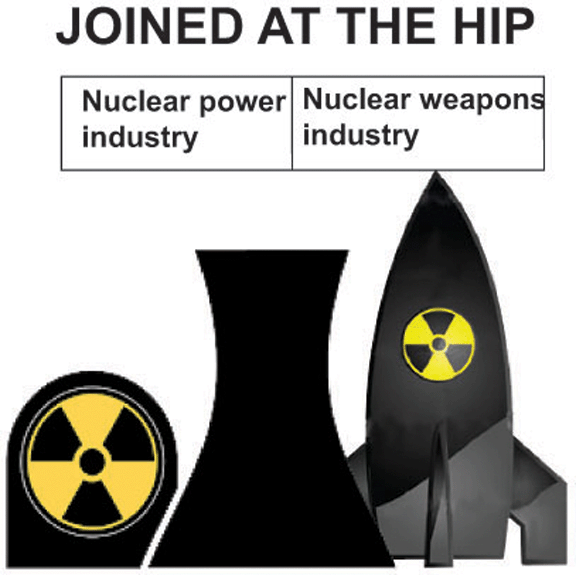 Fears over nuclear Turkey after Rolls Royce reactor deal, Morning Star,
 MARCH 25, 2020 ENGINEERING firm Rolls-Royce has struck a deal with Turkey for the production of nuclear mini-reactors, sparking fears that the British company and its international consortium partners are helping pave the way for Ankara to develop a nuclear bomb…..
the plans have raised fears that Turkey’s authoritarian President Recep Tayyip Erdogan could use the development as a step towards the country becoming a nuclear-armed power.
As previously reported in the Morning Star, Turkey’s secret nuclear programme includes plans to acquire weapons of mass destruction (WMDs), including nuclear missiles.
Writing in a pro-government newspaper in 2017, Mr Karaman said: “We need to consider producing these weapons, rather than purchasing them, without losing any time and with no regard to words of hindrance from the West.”
There are already some 70 US-owned nuclear warheads said to be based at Incirlik airbase near the southern of Adana.
In previous deals with Russia and a Japanese-French consortium, the door was left open for the development of nuclear weapons after Turkey rejected offers to include the provision of uranium and the return of the spent fuel rods used in the reactors.
The development has parallels with the Indian missile capability developed after the testing of plutonium produced in the Canadian-supplied Cirus reactor, which first raised the issue that nuclear technology supplied for peaceful purposes could be diverted to weapons production. https://morningstaronline.co.uk/article/b/fears-over-nuclear-turkey-after-rolls-royce-reactor-deal
12 Fukushima decontamination locations likely to leak radiation, in heavy rain
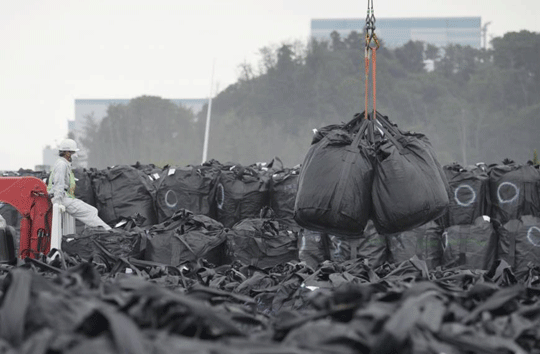
The ministry checked all the sites where the waste is kept after 91 bags were swept into rivers in Fukushima and Tochigi prefectures last year due to downpours caused by Typhoon Hagibis.
Of the 322 locations that are near rivers or in flood-prone areas, 12 sites in Fukushima Prefecture were found to be at risk of having bags of waste swept away or ruptured by mud flows.
The ministry plans to set up fences or move the waste to intermediate storage facilities to reduce the risk by the end of May this year.
Environment Minister Shinjiro Koizumi told reporters on Tuesday his ministry hopes to do the work as soon as possible because of the growing risk of sudden downpours in recent years.
1 This Month

Protect Sazan Island from the Trump family! https://secure.avaaz.org/campaign/en/protect_sazan_island_from_the_trump_family_loc/?bqFCVab&v=174511&cl=22707147157&_checksum=5e9dde668860e8231c33699735e16a1fbf22ab2cb01da50c999fe8732b9775ef&utm_source=email&utm_medium=blast_email&utm_campaign=174511


Cuba Is Not a Failed State – It Is a Besieged State
PETITION: “Global Appeal to Endorse Palestinian Right of Return of Refugees”
To see nuclear-related stories in greater depth and intensity – go to https://nuclearinformation.wordpress.com
-
Archives
- June 2026 (129)
- May 2026 (306)
- April 2026 (356)
- March 2026 (251)
- February 2026 (268)
- January 2026 (308)
- December 2025 (358)
- November 2025 (359)
- October 2025 (376)
- September 2025 (257)
- August 2025 (319)
- July 2025 (230)
-
Categories
- 1
- 1 NUCLEAR ISSUES
- business and costs
- climate change
- culture and arts
- ENERGY
- environment
- health
- history
- indigenous issues
- Legal
- marketing of nuclear
- media
- opposition to nuclear
- PERSONAL STORIES
- politics
- politics international
- Religion and ethics
- safety
- secrets,lies and civil liberties
- spinbuster
- technology
- Uranium
- wastes
- weapons and war
- Women
- 2 WORLD
- ACTION
- AFRICA
- Atrocities
- AUSTRALIA
- Christina's notes
- Christina's themes
- culture and arts
- Events
- Fuk 2022
- Fuk 2023
- Fukushima 2017
- Fukushima 2018
- fukushima 2019
- Fukushima 2020
- Fukushima 2021
- general
- global warming
- Humour (God we need it)
- Nuclear
- RARE EARTHS
- Reference
- resources – print
- Resources -audiovicual
- Weekly Newsletter
- World
- World Nuclear
- YouTube
-
RSS
Entries RSS
Comments RSS
 nuclear-news