Conflict of interest pro nuclear councillor’s nuclear investments
Pro-nuclear energy town councillor’s firm had 700 million yen in nuke plant contracts, Mainichi Daily News, February 7, 2012 TAKAHAMA, Fukui –– A town assembly member here calling for the continuation of nuclear power is also president of a company that has received at least 700 million yen in nuclear-related construction contracts, it has been learned.

Akio Awano, 62, is vice-speaker of the municipal assembly of Takahama, which hosts a Kansai Electric Power Co. nuclear plant. He is also part of a local organization promoting nuclear power plants.
According to the Fukui Prefectural Government and other sources, Awano’s firm, a metal processing company, has around 15 employees and earned about 200 million yen in fiscal 2010. It has an office in the Takahama nuclear plant and has expanded its business on a diet of nuclear plant-related construction. ……. http://mdn.mainichi.jp/mdnnews/news/20120207p2a00m0na023000c.html
TEPCO and Japan’s nuclear lobby under siege from Tokyo’s mayor
Anti-Nuclear Tokyo Mayor Challenges Big Utilities, WSJ, By George Nishiyama, 6 Feb 12, Tokyo’s Setagaya ward is over 260 km away from the Fukushima Daiichi nuclear power plant, a long way from the evacuation area imposed bythe Japanese government after last year’s March 11 disasters….
But Setagaya’s mayor is determined to turn this city ward of 840,000 people, the largest in Tokyo, into the front-runner of a movement that will put an end to Japan’s reliance on atomic power and accelerate the use of renewable energy. Continue reading
Birds and radiation fallout
not sure of the reliability of this one
Bird life badly hit by nuclear fallout in Japan The Irish Times – February 3, 2012, DAVID McNEILL in Tokyo RESEARCHERS WORKING in the irradiated zone around the disabled Fukushima nuclear plant say bird populations there have begun to dwindle, in what may be a chilling harbinger of the impact of radioactive fallout on local life. Continue reading
A rather murderous nuclear weapons cult – Aum Shinrikyo
Aum Shinrikyo In Pursuit Of Nuclear Weapons – Analysis, Eurasia Review by: Muhammad Jawad Hashmi February 2, 2012 Aum Shinrikyo has an apocalyptic belief structure where the world is divided into two opposing forces, good and evil. Shoko Asahara, who is leader of the cult, firmly believes that they will prevail after the apocalypse and are motivated to trigger the apocalypse because their own salvation depends upon fighting the final fight and eliminating the enemy. The prospect of nuclear war shaped Shoko Asahara’s concerns to preach that Aum followers would be the only survivors of a coming Armageddon.
Problem of nuclear regulator in bed with nuclear industry
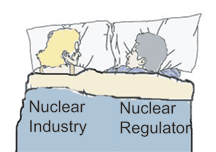
 Nuclear regulatory reform must weed out entrenched interests, Mainichi Daily News, 2 Feb 12, Bills relating to a shift in the nation’s nuclear power policy were approved by the Cabinet on Jan. 31. In addition to the establishment of a new nuclear regulatory agency under the Environment Ministry, the government is aiming to legislate the lifespan of nuclear reactors, and require plant operators to outline specific measures against severe nuclear accidents.
Significant harm has been done by allowing the Nuclear and Industrial Safety Agency (NISA), an administrative body tasked to regulate nuclear power safety, to exist under the umbrella of the Ministry of Economy, Trade and Industry (METI), a major promoter of nuclear power.
Divorcing nuclear regulation from nuclear promotion and centralizing regulatory duties into one agency stands to reason.Changing the agency’s name from the originally proposed “nuclear power safety agency” to “nuclear power regulatory agency” is likewise pertinent, considering the new agency’s nature. Continue reading
End of the line for Japan’s dangerous, super expensive fast breeder nuclear reactor
Japanese parliamentarian and a critic of nuclear power Taro Kono said: ”We spend billions of yen every year just to maintain Monju. It’s crazy. We spend so much money just to keep things not running.”…
critics and nuclear watchdog groups call Monju Japan’s most dangerous reactor, because it uses plutonium fuel and cools its reactor with sodium, which can explode if it comes into contact with water.
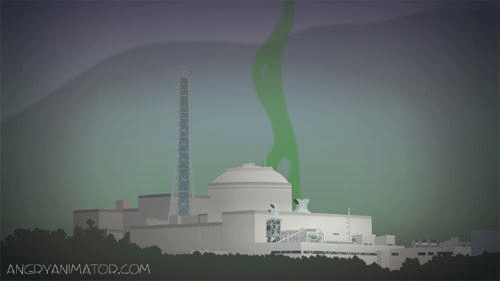
Fast-breeder reactor faces closure, The Age, February 2, 2012 TSURUGA: Japan’s long and expensive pursuit of a super-efficient nuclear reactor is on the brink of failure amid new government concerns about its runaway costs.
The four-decade project to develop a so-called fast-breeder reactor has consumed more than $13 billion in funding, so far producing onlyaccidents, controversies and a single hour of electricity. Continue reading
Radioactivity poses risk in Japan’s tsunami debris
 citizens say they are worried about radioactivity or even say that we should refuse to import this debris. “They worry about their children, they are afraid that radiation levels are too high.”
Radiation experts agree that children are at greatest risk from cancers and genetic defects because they are still growing, are more prone to thyroid cancers, and because they will have more time to develop health defects…..
Radiation fears slow tsunami clear-up, News 24, 1 Feb 12, Tokyo – Giant piles of debris from Japan’s earthquake and tsunami scar the country’s once picturesque northeast coast – and the clear-up is hamstrung by fears the rubbish may be contaminated by radiation. Continue reading
Japan’s government put use by date on nuclear reactors
Japan Cabinet OKs bill to cap nuke reactor life, Macon.com By MARI YAMAGUCHI – Associated PressTOKYO, 1 Feb -12 –– Japan’s Cabinet approved bills Tuesday aimed at bolstering nuclear safety regulations following last year’s Fukushima disaster, including one that would put a 40-year cap on the operational life of nuclear reactors.
The approval came as International Atomic Energy Agency experts generally endorsed “stress test” results at two idled reactors in western Japan, bolstering the Tokyo government’s efforts to restart the facility, though the IAEA team said some safety measures needed clarification.
Japan currently has no legal limit on the operational lifespan of its 54 reactors, many of which will reach the 40-year mark in coming years. One reactor at the Fukushima Dai-ichi plant had been in use 40 years when the tsunami struck last March.
The legislation, which still needs parliamentary approval to take effect, does allow for an extension of up to 20 years.
Critics have blasted that exception as a loophole,…… Critics, ….. say the tests are meaningless because they have no clear criteria, and view the IAEA as biased toward the nuclear industry.
Plebicites – the beginning of the end for nuclear power
To date only three [ plebicites on nuclear power] have been held, [in Japan] in the villages of Maki and Kariwa in Niigata Prefecture, and in Miyama, Mie Prefecture. In all three polls, voters said no to nuclear power.

 NUCLEAR POWER PLEBISCITES Plebicites first step in pulling nuclear plug Japan Times, By ERIC JOHNSTON, 31 Jan 12. Last June more than 90 percent of Italian voters said no to nuclear power in a referendum, while Germany and Switzerland voted to phase out atomic energy in the coming years.
In France, which faces a presidential election this spring, the Socialists and Greens pledged to close 24 reactors by 2025 as public opinion in what was once Europe’s strongest supporter of nuclear plants begins to falter.
In Japan, efforts to collect signatures in support of a national vote on the future of nuclear power began just after the Fukushima disaster struck. But there are also separate attempts to introduce specific plebiscites in Tokyo and in the city of Osaka. Continue reading
Freezing weather causes 8 tons of water leakage at Fukushima nuclear plant
Freezing Fukushima Nuclear Plant Leaks Water TOKYO, Japan, January 30, 2012 (ENS) – The temperature fell to minus 8.7 degrees Celsius on Sunday morning near Japan’s crippled nuclear power plant, causing water pipes and valve seals to rupture, leaking tons of water.
Workers at the Fukushima Daiichi nuclear plant discovered Sunday that the damaged pipes spilled nearly eight tons of water from 14 locations. Two additional water leaks were discovered today, according to plant operator Tokyo Electric Power Company……
http://www.ens-newswire.com/ens/jan2012/2012-01-30-01.html
“Decommissioning” Fukushima nukes to take a very long time
Freezing Fukushima Nuclear Plant Leaks Water TOKYO, Japan, January 30, 2012 (ENS)“…..Decommissioning is expected to take 40 years and require the use of robots and new technologies to remove the melted nuclear fuel, the Japanese government said in December. Continue reading
Climate change policy manipulated by the nuclear lobby
 The threat of climate change gained traction in the global imagination after the end of the Cold War. And as warming worries grew, nuclear power became an anti-emissions trump card in the eyes of many, fueling a reactor building spree.
“Government policy came to incorporate promotion of nuclear power. It was taboo for us to even make an issue of it.”
Nuclear power boosters used climate change to ride to energy supremacy, Mainichi DailyNews, 30 Jan 12 In 1997, in the midst of the international negotiations that would eventually result in the Kyoto Protocol, the Japanese delegation was pondering whether it could realistically accept the protocol’s main point: a commitment to a 6 percent decrease in greenhouse gas emissions from 1990 levels. They were also grappling with what such a commitment would mean for Japan’s energy supplies.
Strangely enough, though the Japanese delegation was grappling with issues of carbon emissions and energy needs, there was not a single representative of the then Environment Agency on hand. Osamu Watanabe, vice minister at the former Ministry of International Trade and Industry at the time of the talks and now president of Japan Petroleum Exploration Co., sums up Japan’s thinking like this:
“Taking nuclear power into account was a prerequisite for accepting the 6 percent reduction. Speaking for the industry ministry, we thought that the more nuclear power we had, the more we could reduce greenhouse gas emissions.”
Meanwhile, at the Environment Agency — which became the Environment Ministry in 2001 — there were many staff who took a more cautious attitude to the promotion of nuclear power. Their skepticism did not, however, often find effective expression.
“The industry ministry put up a lot of resistance to the Environment Agency getting involved in energy policy,” a senior agency official from the time says. “We just couldn’t get a word in.” Continue reading
Records not kept by 5 Japanese nuclear disaster committees
 Five Japan committees keep no disaster records Terra Daily Tokyo (AFP) Jan 27, 2012 Five government teams dealing with Japan’s tsunami and nuclear catastrophes kept no detailed records, an official said Friday, adding to a growing picture of chaos in Tokyo’s disaster response…
Now the government has admitted having no minutes from a further four emergency committees, Continue reading
Problems in assessing radiation in Fukushima school lunches
Radiation testing on school lunches differs, The Yomiuri Shimbun, 30 Jan 12, FUKUSHIMA-–Municipalities are carrying out tests for radioactive substances on ingredients used in school lunches, but parents are worried whether their children are adequately protected as the testsare conducted in various ways. Continue reading
Japan’s nuclear plant stress tests – “flimsy” and unreliable
“I don’t view their evaluation as something that is trustworthy or carries any weight,” “The last time the IAEA inspectors came to Japan, they simply inspected sites and documents and left saying everything was fine. They submitted a flimsy report, and I fear the same will be the case this time.”
 Experts cast doubt on Japan nuclear plant tests, Justin McCurry in Tokyo, guardian.co.uk, 27 January 2012 Japanese government ordered tests on all reactors after Fukushima meltdown, but advisers say they do not prove a plant is safe Advisers to Japan‘s nuclear safety agency have said power plant stress tests do not prove that a nuclear plant is safe, as the country faces the prospect of a summer without a single nuclear reactor in operation. Continue reading
1 This Month





PLEASE OPPOSE HR 8255 AND S.3639 – bills would accelerate satellite deployment, with no environmental review or safeguards – https://ncstd5li.quorum.us/campaign/169331/
To see nuclear-related stories in greater depth and intensity – go to https://nuclearinformation.wordpress.com
-
Archives
- October 2026 (91)
- September 2026 (339)
- August 2026 (330)
- July 2026 (355)
- June 2026 (287)
- May 2026 (306)
- April 2026 (356)
- March 2026 (251)
- February 2026 (267)
- January 2026 (308)
- December 2025 (358)
- November 2025 (359)
-
Categories
- 1
- 1 NUCLEAR ISSUES
- business and costs
- climate change
- culture and arts
- ENERGY
- environment
- health
- history
- indigenous issues
- Legal
- marketing of nuclear
- media
- opposition to nuclear
- PERSONAL STORIES
- politics
- politics international
- Religion and ethics
- safety
- secrets,lies and civil liberties
- spinbuster
- technology
- Uranium
- wastes
- weapons and war
- Women
- 2 WORLD
- ACTION
- AFRICA
- Atrocities
- AUSTRALIA
- Christina's notes
- Christina's themes
- culture and arts
- Events
- Fuk 2022
- Fuk 2023
- Fukushima 2017
- Fukushima 2018
- fukushima 2019
- Fukushima 2020
- Fukushima 2021
- general
- global warming
- Humour (God we need it)
- Nuclear
- RARE EARTHS
- Reference
- resources – print
- Resources -audiovicual
- Weekly Newsletter
- World
- World Nuclear
- YouTube
-
RSS
Entries RSS
Comments RSS

