End of the line for Japan’s dangerous, super expensive fast breeder nuclear reactor
Japanese parliamentarian and a critic of nuclear power Taro Kono said: ”We spend billions of yen every year just to maintain Monju. It’s crazy. We spend so much money just to keep things not running.”…
critics and nuclear watchdog groups call Monju Japan’s most dangerous reactor, because it uses plutonium fuel and cools its reactor with sodium, which can explode if it comes into contact with water.
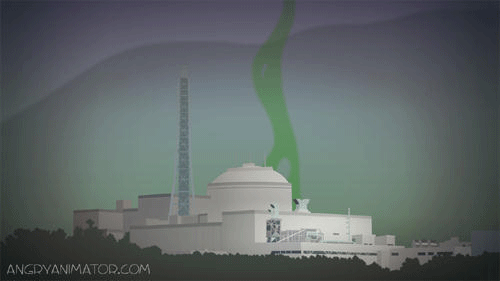
Fast-breeder reactor faces closure, The Age, February 2, 2012 TSURUGA: Japan’s long and expensive pursuit of a super-efficient nuclear reactor is on the brink of failure amid new government concerns about its runaway costs.
The four-decade project to develop a so-called fast-breeder reactor has consumed more than $13 billion in funding, so far producing onlyaccidents, controversies and a single hour of electricity.
The government in December decided on budget cuts for the project and one top nuclear official in November raised the possibility of scrapping the plan.
A move to shut down the project would deliver yet another blow to
Japan’s nuclear program – already reeling from the accident at the
Fukushima Daiichi plant caused by last year’s earthquake and tsunami.
”It was supposed to be the dream reactor, powering Japan for 100 or
200 years,” the director-general of Japan’s fast breeder program at
the Japan Atomic Energy Agency, Satoru Kondo, said. ”I never thought
it would take this long.”
Japan’s only prototype fast-breeder, a 280-megawatt reactor known as
Monju, sits in this coastal town, about 400 kilometres west of Tokyo.
The reactor is idle, and officials say they have no control over
whether it will operate again.
That decision will come from Tokyo, a government with the world’s
highest debt-to-gross-domestic-product ratio is trying to eliminate
wasteful spending. In December officials slashed Monju’s $US275
million ($259.69 million) annual budget by about 20 per cent. They
also removed all money reserved for operation of the reactor this
year.
Japanese parliamentarian and a critic of nuclear power Taro Kono said:
”We spend billions of yen every year just to maintain Monju. It’s
crazy. We spend so much money just to keep things not running.”…
critics and nuclear watchdog groups call Monju Japan’s most dangerous
reactor, because it uses plutonium fuel and cools its reactor with
sodium, which can explode if it comes into contact with water.
Other countries abandoned their fast-breeder development efforts
decades ago because of safety and price concerns, but Japan remained
committed, even after a 1995 fire caused by a sodium leak. That
accident – with an attempted cover-up by the plant’s officials –
caused a 14-year freeze on operations. Three months after the reactor
restarted in May 2010, a three-tonne piece of machinery fell into the
reactor vessel, causing another delay. The device has been removed,
but Monju hasn’t operated since. http://www.theage.com.au/environment/fastbreeder-reactor-faces-closure-20120201-1qtg2.html#ixzz1lGE8RzH3
No comments yet.
1 This Month





PLEASE OPPOSE HR 8255 AND S.3639 – bills would accelerate satellite deployment, with no environmental review or safeguards – https://ncstd5li.quorum.us/campaign/169331/
To see nuclear-related stories in greater depth and intensity – go to https://nuclearinformation.wordpress.com
-
Archives
- October 2026 (91)
- September 2026 (339)
- August 2026 (330)
- July 2026 (355)
- June 2026 (287)
- May 2026 (306)
- April 2026 (356)
- March 2026 (251)
- February 2026 (267)
- January 2026 (308)
- December 2025 (358)
- November 2025 (359)
-
Categories
- 1
- 1 NUCLEAR ISSUES
- business and costs
- climate change
- culture and arts
- ENERGY
- environment
- health
- history
- indigenous issues
- Legal
- marketing of nuclear
- media
- opposition to nuclear
- PERSONAL STORIES
- politics
- politics international
- Religion and ethics
- safety
- secrets,lies and civil liberties
- spinbuster
- technology
- Uranium
- wastes
- weapons and war
- Women
- 2 WORLD
- ACTION
- AFRICA
- Atrocities
- AUSTRALIA
- Christina's notes
- Christina's themes
- culture and arts
- Events
- Fuk 2022
- Fuk 2023
- Fukushima 2017
- Fukushima 2018
- fukushima 2019
- Fukushima 2020
- Fukushima 2021
- general
- global warming
- Humour (God we need it)
- Nuclear
- RARE EARTHS
- Reference
- resources – print
- Resources -audiovicual
- Weekly Newsletter
- World
- World Nuclear
- YouTube
-
RSS
Entries RSS
Comments RSS


Leave a Reply