Exposure of Fukushima residents to radiation
 Fukushima residents exposed to up to 23 millisieverts of radiation Mainichi Daily News, 22 Feb 12, FUKUSHIMA (Kyodo) — The Fukushima Prefecture government said Monday that the residents of three municipalities located near the crippled Fukushima Daiichi nuclear power plant are estimated to have been exposed to up to 23 millisieverts of radiation in the four months after the accident triggered by the March 11 earthquake and tsunami.
“As annual radiation exposure of up to 100 millisieverts poses no specific cancer risks, the estimated radiation is unlikely to cause any adverse health effects,” Fukushima Medical University Vice President Shunichi Yamashita told a press conference. “It is important to reduce future radiation exposure as much as possible.”
While the allowable radiation exposure limit is ordinarily set at 1 millisievert per year, the International Commission on Radiological Protection has recommended an emergency limit of 20 to 100 millisieverts……. “The high-level radioactive contamination indicates that humans should not be allowed to live near the car park,” said Kobe University Professor Tomoya Yamauchi, who conducted a radiation test on the soil.
The crisis at the Fukushima Daiichi plant has resulted in heavy concentrations of radioactive substances at various locations in Minamisoma. The civic group said its discovery indicates that a fact-finding survey is urgently required throughout the city. http://mdn.mainichi.jp/mdnnews/news/20120220p2g00m0dm146000c.html
Continuing radioactive leakage to the ocean from Fukushima nuclear plant
“We’re not over the hump” yet in terms of radioactive contamination of the ocean because of continued leakage from the plant,
Radiation from tsunami disaster detected 400 miles off Japan’s coast, but levels below harmful Washinmgton Post, By Associated Press, February 21 SALT LAKE CITY — Radioactive contamination from the Fukushima power plant disaster has been detected as far as almost 400 miles off Japan in the Pacific Ocean, with water showing readings of up to 1,000 times more than prior levels, scientists reported Tuesday…. Continue reading
Japan’s nuclear crisis resulting in its record trade deficit
Japan’s trade deficit ballons to record high as nuclear crisis pushes up fuel imports Washington Times, By Associated Press, February 19 TOKYO — Japan posted a record high trade deficit in January after its nuclear crisis shut down nearly all the nation’s reactors for tougher checks, sending fuel imports surging. Exports were hurt by a strong yen and weak demand.
The 1.48 trillion yen ($18.7 billion) deficit reported Monday highlights Japan’s increased dependence on imported fuel after the March 11 earthquake and tsunami sent the Fukushima Dai-ichi nuclear plant into multiple meltdowns…. http://www.washingtonpost.com/business/worldbusiness/japans-trade-deficit-ballons-to-record-high-as-nuclear-crisis-pushes-up-fuel-imports/2012/02/19/gIQABX1HOR_story.html
Fukushima in danger of new big earthquakes
 Big quake risk said greater at Fukushima Outcome Magazine, TOKYO, Feb. 14 (UPI) — The risk of strong earthquakes at the Fukushima nuclear plant increased after the magnitude-9 tremor that hit Japan last March, scientists report.
A study using data from more than 6,000 earthquakes shows the March 11, 2011, tremor caused a seismic fault close to the nuclear plant to reactivate, a release from the European Geosciences Union said Tuesday. “There are a few active faults in the nuclear power plant area, and our results show the existence of similar structural anomalies under both the Iwaki and the Fukushima Daiichi areas,” study leader Dapeng Zhao, a geophysics professor at Japan’s Tohoku University, said.
The number of earthquakes in Iwaki increased greatly after the March earthquake, he said. “Given that a large earthquake occurred in Iwaki not long ago, we think it is possible for a similarly strong earthquake to happen in Fukushima,” Zhao said…. http://outcomemag.com/world/2012/02/14/big-quake-risk-said-greater-at-fukushima/
Japan: push for a referendum on nuclear power
 The anti-nuclear side has won all three referendums already held.
Japan group seeks local referendum on nuclear power * Osaka city assembly to decide on nuclear plebiscite
* Osaka mayor anti-nuclear but lukewarm on referendum
* Activists battle apathy a year after Fukushima crisis
By Yoko Kubota TOKYO, Feb 14 (Reuters) – A group of Japanese activists submitted a petition to the western city of Osaka on Tuesday seeking a referendum on scrapping atomic power, a step some hope will boost a campaign that appears to be flagging a year after the Fukushima disaster….. Plebiscites are rare in Japan Continue reading
15 tonnes of water hourly, as Fukushima nuclear reactor hots up again
Fukushima reactor heats up again, ABC News, By Mark Willacy in Fukushima The operator of the Fukushima nuclear plant has begun injecting more water into one of the reactors, after the core temperature rose above Japan’s safety limit.
A gauge inside Fukushima’s reactor number two showed the temperature rising to 82 degrees Celsius over the weekend, its highest level since the reactor was put into a state of cold shutdown two months ago. Operator TEPCO insists there has been no nuclear reaction and that the reactor can be controlled.
Responding to the increase, the operator began injecting 15 tonnes of water an hour into the reactor in a bid to get the temperature down. TEPCO says it has not detected any xenon gas, which is created when a
nuclear reaction has been triggered.
The company suspects that cooling water has not been flowing freely into the the number two reactor, causing the
In Japan thousands rally for “Sayonora to nuclear plants,”
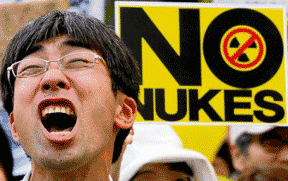 Thousands rally against nuclear power in Japan Business Recorder FEBRUARY 12, 2012 Thousands demonstrated in Tokyo on Saturday against nuclear power generation, 11 months after a massive earthquake and tsunami sparked reactor meltdowns at the Fukushima nuclear power plant.
Kenzaburo Oe, the 1994 Nobel prize winner for literature, told a central rally at Yoyogi Park, “Radioactive waste from nuclear power plants will be borne by generations to come.” Continue reading
Where to put Japan’s 22 metric tons of perhaps radioactive debris?
Radiation concerns keep municipalities from helping with disaster-area debris, Mainichi Daily News, 14 Feb 12, Concerns about radiation are preventing the massive amount of debris left in areas hit by the March 2011 tsunami from being sent to other areas for processing…..
According to the Ministry of the Environment, 22.52 metric tons of debris remained in the three prefectures of Iwate, Miyagi and Fukushima as of Jan. 31. The national government hopes to have debris from Iwate and Miyagi processed in other municipalities, as the amount
is 11 to 19 times the regular amount of waste generated in each of the prefectures in one year…. http://mdn.mainichi.jp/mdnnews/news/20120213p2a00m0na017000c.html
Booming business for Japan’s nuclear companies, as taxpayers foot the radioactive cleanup bill
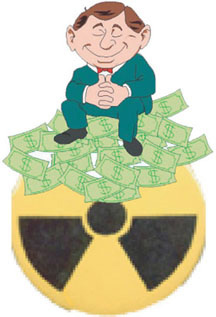 Report From Japanese Nuclear Industry Insiders: Business is Booming, Rocket News 24, February 10, 2012 A lingering topic of the Fukushima incident has been how to go forward. Should nuclear plants in Japan be improved or discontinued.
What have been revealed to reporter Hirotoshi Ito by industry insiders are the massive business deals being prepared behind this important social issue.
According to Ito, what we don’t see occurring is what he calls “backspin business” which is profit made off of situations that undo
previous progress. Key players that once had the now-dubious honor of building a strong, clean, and safe nuclear power infrastructure are making preparations to profit from its damage.
For example, Tokyo Electric Power Company (TEPCO) has long struggled with the task of disposing of nuclear waste. Local residents of all TEPCO’s desired locations have been understandably hesitant to accept tons of radioactive material into their neighborhoods.Luckily for TEPCO the wasteland of the likely to be decommissioned Fukushima Daini (Number 2) Reactor is now the perfect place for them to set-up a decontamination factory….
General contractors are also in line to rake in money. Thanks to their friends at the JAEA, three companies, Kashima, Obayashigumi, and Taiseikensetsu were responsible for building 45 of Japan’s nuclear plants. Now they are looking to JAEA for work decontaminating 12 cities in Fukushima Prefecture. The Japanese government has entrusted JAEA with management of clean-up efforts in the area. If you recall, one of JAEA’s previous incarnations, the PNC, was responsible for the Monju Nuclear Plant accident and cover-up. JAEA has since been bogged down in an expensive effort to restart and maintain that plant for over a decade.
One benefit to regular citizens is the trickle-down revenue local business can make from clean-up crews. Beyond that, the largest
investors in this massive project, the Japanese taxpayers, are taking all the risk and getting no dividends. Meanwhile in the words of one TEPCO employee “after the closing and decontamination, [these companies] will be able to put food on the table for decades.”..
http://en.rocketnews24.com/2012/02/10/report-from-japanese-nuclear-industry-insiders-business-is-booming/
Japanese nuclear corporations clean up financially from radiation clean-up
 Even more disturbing to critics of the decontamination program is the fact that the government awarded the first contracts to three giant construction companies — corporations that have no more expertise in radiation cleanup than anyone else does, but that profited hugely from Japan’s previous embrace of nuclear power.
Japan Starts Nuclear Cleanup, With Little Idea of How By HIROKO TABUCHI, NYT February 10, 2012 IITATE, Japan — As 500 workers in hazmat suits and respirator masks fanned out to decontaminate this village 20 miles from the ravaged Fukushima Daiichi nuclear reactors, their confusion was apparent. “Dig five centimeters or 10 centimeters deep here?” a site supervisor asked his colleagues, pointing to a patch of radioactive topsoil to be removed. He then gestured across the village square toward the community center. “Isn’t that going to be demolished? Shall we decontaminate it or not?”
A day laborer wiping down windows at an abandoned school nearby shrugged at the work crew’s haphazard approach. “We are all amateurs,” he said. “Nobody really knows how to clean up radiation.” Continue reading
Fukushima nuclear disaster is an ongoing emeergency
Harvey Wasserman, 10 Feb 12, … the biggest shock waves this week were caused by Tama University Professor Hiroshi Tasaka, a key advisor to Prime Minister Naoto Kan during the Fukushima disaster.
Warning that Fukushima is “far from over,” Tasaka said official assurances of the complex’s alleged safety were based on “groundless
optimism.” Tasaka cited more than 1500 fuel rods dangerously exposed to the open atmosphere at Unit Four alone. The waste problem has gone nationwide, he said in a newly published book, as “the storage capacities of the spent fuel pools at the nation’s nuclear power
plants are reaching their limits,”
Tasaka’s statements came as a new temperature spike unexpectedly stuck Fukushina Unit Two. For reasons not yet clear, heat releases in excess of 158 degrees Farenheit spewed from the core, prompting Tokyo Electric to pump in more water and boric acid meant to damp down an apparently on-going chain reaction. Prof. Tasaka and others warn that this in turn will contribute to spreading still more radiation into the water table and oceans.
With bitter debate raging in Japan, the US and elsewhere over the killing power of Fukushima’s emissions, the certification of a new US
reactor design may someday be remembered as a bizarre epitaph for the 20th century’s most expensive failed technology.
Without state ratepayers and federal taxpayers being forced to foot the bill, new reactor construction in the US is going nowhere.
And without a final resolution to the on-going horrors at Fukushima, the entire planet, from Tokyo to Alaska to Georgia and beyond, remains at serious radioactive risk.
Japanese monks store radioactive waste near their temple
 Abe said he and the other monks are storing the soil on a hill behind the temple as neither the government nor the nuclear plant operator Tokyo Electric Power (TEPCO) are helping with the clean-up.
“No-one else would take the soil. If there’s nobody to take care of it, the decontamination can’t get going because there’s nowhere to get rid of it,” Abe said.
Japan priest fights invisible demon: radiation Feb 10 (Reuters) – On the snowy fringes of Japan’s  Fukushima city, now notorious as a byword for nuclear crisis, Zen monk Koyu Abe offers prayers for the souls of thousands left dead or missing after the earthquake and tsunami nearly one year ago.
But away from the ceremonial drums and the incense swirling around the Joenji temple altar, Abe has undertaken another task, no less
harrowing — to search out radioactive “hot spots” and clean them up, storing irradiated earth on temple grounds….
Radiation, carried on winds and by snow, spread far beyond the 20 km (12 miles) evacuation zone around the plant, nestling in hot spots across the region and contaminating the ground in what remains a largely agricultural region. Continue reading
5 million signed anti nuclear petition – enough for referenda in 2 Japanese cities
Japanese Anti-Nuclear Campaign Says It Has 5 Million Petition Signatures, VOA, 08 February 2012 Steve Herman | Tokyo A citizen’s group in Japan says it has collectedfive million signatures – halfway to its goal – on a petition calling on the government to permanently shut down all nuclear power plants in the country.
But amid traditional apathy among Japanese toward political movements and longstanding strong ties between power companies and lawmakers in a resource-poor country, anti-nuclear
campaigners are acknowledging an uphill struggle….
Petitioners in Tokyo and Osaka separately say they have collected enough signatures
for referenda in Japan’s two largest cities. But it is unclear if those campaigns will clear all the legal hurdles to get on the ballot. Continue reading
13.5 tons of water hourly in effort to cool Fukushima nuclear reactor No. 2
 Boric acid to prevent recriticality, Japan Times,8 Feb 12, Reactor No. 2 heats up, gets more water Kyodo Workers at the Fukushima No. 1 nuclear plant increased the amount of water injected into reactor 2 on Tuesday to the highest level since the plant achieved cold shutdown in December as concerns grew over rising temperatures at the bottom of the pressure vessel….
Tepco said it increased the amount of injected water, some of which contained boric acid, at 4:24 a.m. Tuesday. Reactor 2 is now being cooled with 13.5 tons of water per hour, up from 10.5 tons. The boric acid is being used to prevent a sustained nuclear chain reaction, or recriticality.
Nuclear disaster minister Goshi Hosono told reporters that Tepco is
making every effort to lower the temperature…. http://www.japantimes.co.jp/text/nn20120207x1.html
It’s getting hotter in Fukushima’s supposedly “cold shutdown” nuclear plant
 Rising temperatures trigger concern at Japan’s Fukushima nuclear plant Telegraph UK 7 Feb 12, Water temperatures at Japan’s damaged Fukushima nuclear power plant have risen more than 20 degrees Celsius over the past week. By Danielle Demetriou in Tokyo 07 Feb 2012 Concerns are growing in relation to conditions at the plant, in northeast Japan, which was declared in a state of cold shutdown in December last year. Continue reading
1 This Month





PLEASE OPPOSE HR 8255 AND S.3639 – bills would accelerate satellite deployment, with no environmental review or safeguards – https://ncstd5li.quorum.us/campaign/169331/
To see nuclear-related stories in greater depth and intensity – go to https://nuclearinformation.wordpress.com
-
Archives
- October 2026 (91)
- September 2026 (339)
- August 2026 (330)
- July 2026 (355)
- June 2026 (287)
- May 2026 (306)
- April 2026 (356)
- March 2026 (251)
- February 2026 (267)
- January 2026 (308)
- December 2025 (358)
- November 2025 (359)
-
Categories
- 1
- 1 NUCLEAR ISSUES
- business and costs
- climate change
- culture and arts
- ENERGY
- environment
- health
- history
- indigenous issues
- Legal
- marketing of nuclear
- media
- opposition to nuclear
- PERSONAL STORIES
- politics
- politics international
- Religion and ethics
- safety
- secrets,lies and civil liberties
- spinbuster
- technology
- Uranium
- wastes
- weapons and war
- Women
- 2 WORLD
- ACTION
- AFRICA
- Atrocities
- AUSTRALIA
- Christina's notes
- Christina's themes
- culture and arts
- Events
- Fuk 2022
- Fuk 2023
- Fukushima 2017
- Fukushima 2018
- fukushima 2019
- Fukushima 2020
- Fukushima 2021
- general
- global warming
- Humour (God we need it)
- Nuclear
- RARE EARTHS
- Reference
- resources – print
- Resources -audiovicual
- Weekly Newsletter
- World
- World Nuclear
- YouTube
-
RSS
Entries RSS
Comments RSS

