Radioactive drinking water risk for 11 million people

 New York nuclear plant threatens drinking water for 11M people, (philstar.com) February 01, 2012 NEW YORK –– The drinking water for more than 11.3 million people could be at risk of radioactive contamination from a leak or accident at the Indian Point Nuclear Plant, located in Buchanan, New York, said a new study released on Tuesday.
According to the report by Environment New York, the state environmental advocacy organization, the drinking water intakes for 11.3 million people in New York, New Jersey, and Connecticut are within 50 miles of Indian Point — the distance the U.S. Nuclear Regulatory Commission uses to measure risk to food and water supplies.
The report also showed that the Indian Point Nuclear Plant threatens drinking water supplies for more than twice as many people compared to any other nuclear facility in the United States.
Environment New York is urging the state to deny the plant relicensing and to move toward a future with no nuclear power and use clean, renewable energy such as wind and solar power. The Indian Point Nuclear Plant, which is 80-minute ride from New York City, has a long history of leaks and accidental releases of radioactive material. One of its nuclear reactors was recently shut down to repair a pump, which was leaking radioactive coolant. http://www.philstar.com/Article.aspx?articleId=773362&publicationSubCategoryId=200
65,000 tons of spent nuclear fuel, and still adding more: no solution in sight!
Nuclear-Waste Overhaul by U.S. Will Take Years, Panel Chief Says February 01, 2012, By Brian Wingfield Feb. 1 (Bloomberg) — The U.S. will need more than a year to create an organization that will oversee federal nuclear- waste policies, according to a co-chairman of the panel that studied the issue for President Barack Obama.
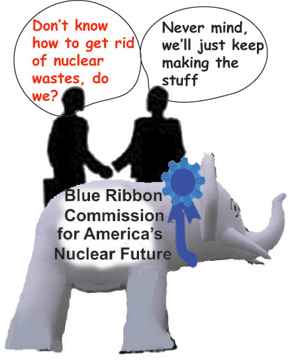
“You’re at least talking a year, maybe two years, maybe more,” to set up the entity, Lee Hamilton, a co-chairman of the Blue Ribbon Commission on America’s Nuclear Future, said today at a House subcommittee hearing in Washington.
Lawmakers are studying a recommendation by the commission to create a government-chartered corporation to oversee nuclear- waste management, taking over from the Energy Department. The corporation would license, build and operate storage and disposal sites, according to the Jan. 26 report..
.. More than 65,000 tons of spent nuclear fuel are stored at about 75 operating and closed U.S. reactor sites, and about 2,000 tons are added a year, according to the commission….
http://www.businessweek.com/news/2012-02-01/nuclear-waste-overhaul-by-u-s-will-take-years-panel-chief-says.html
SMRs – Small Modular nuclear Reactors the latest probably dud design
Small Modular Reactors, the latest ‘rabbit out the nuclear hat’ are generally based on scaled down BWR or PWR technology and illustrate the nuclear industry’s schizophrenic attitude to reactor size.
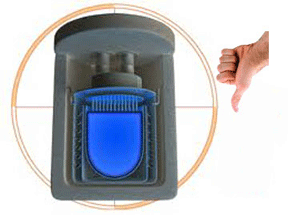 SMRs may turn out to be the latest in a long lineof nuclear designs that looked good on paper, but could not make the transition to commercial technology.
Prospects for Nuclear Power in 2012, Platts, London, 30 January 2012 “……..Technological cul-de-sac If plant life extensions can be achieved in France and the US and Gen III+ does prove a blind alley, it raises the question of what options are open to the nuclear sector. Ten years ago, the industry answer would have been Generation IV designs. Unlike Gen III+, which evolved from existing Pressurised and Boiling Water Reactors, these would be based on radical new technologies. Six technologies were selected by the major nuclear countries as the most promising.
Little regulation of increasing non-medical use of radiation
 Customs and the New York Police Department have deployed unmarked X-ray vans that can drive to a location and look inside vehicles for drugs and explosives.
The FDA has little authority to regulate the use of electronic products emitting radiation. Because security scanners are not classified as medical devices, the agency doesn’t approve them for safety before sale.
the scanners fall under voluntary guidelines set by a nonprofit group made up largely of
manufacturers and agencies that wanted to use the X-ray machines.
 Drive-by X-rays: Security screeners expanding radiation use Michael Grabell, Tucson Sentinel, ProPublica, 2 Feb 12, U.S. law enforcement agencies are exposing people to radiation in more settings and in increasing doses to screen for explosives, weapons and
drugs.
In addition to the controversial airport body scanners, which are now deployed for routine screening, various X-ray devices have proliferated at the border, in prisons and on the streets of New York.
Not only have the machines become more widespread, but some of themexpose people to higher doses of radiation. And agencies have pushed the boundaries of acceptable use by X-raying people covertly, according to government documents and interviews. Continue reading
Problem of nuclear regulator in bed with nuclear industry
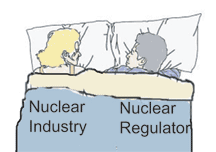
 Nuclear regulatory reform must weed out entrenched interests, Mainichi Daily News, 2 Feb 12, Bills relating to a shift in the nation’s nuclear power policy were approved by the Cabinet on Jan. 31. In addition to the establishment of a new nuclear regulatory agency under the Environment Ministry, the government is aiming to legislate the lifespan of nuclear reactors, and require plant operators to outline specific measures against severe nuclear accidents.
Significant harm has been done by allowing the Nuclear and Industrial Safety Agency (NISA), an administrative body tasked to regulate nuclear power safety, to exist under the umbrella of the Ministry of Economy, Trade and Industry (METI), a major promoter of nuclear power.
Divorcing nuclear regulation from nuclear promotion and centralizing regulatory duties into one agency stands to reason.Changing the agency’s name from the originally proposed “nuclear power safety agency” to “nuclear power regulatory agency” is likewise pertinent, considering the new agency’s nature. Continue reading
End of the line for Japan’s dangerous, super expensive fast breeder nuclear reactor
Japanese parliamentarian and a critic of nuclear power Taro Kono said: ”We spend billions of yen every year just to maintain Monju. It’s crazy. We spend so much money just to keep things not running.”…
critics and nuclear watchdog groups call Monju Japan’s most dangerous reactor, because it uses plutonium fuel and cools its reactor with sodium, which can explode if it comes into contact with water.
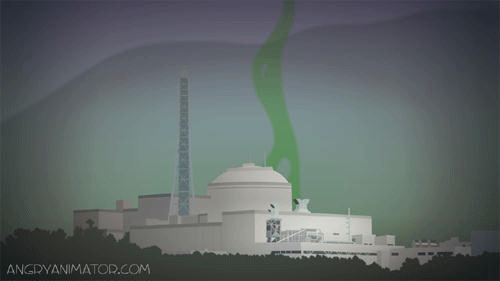
Fast-breeder reactor faces closure, The Age, February 2, 2012 TSURUGA: Japan’s long and expensive pursuit of a super-efficient nuclear reactor is on the brink of failure amid new government concerns about its runaway costs.
The four-decade project to develop a so-called fast-breeder reactor has consumed more than $13 billion in funding, so far producing onlyaccidents, controversies and a single hour of electricity. Continue reading
Nuclear Regulatory Commission’s State of the Art Spin on ionising radiation
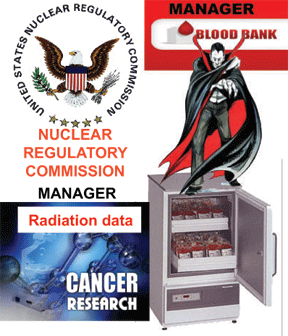 Nuclear accidents pose little risk to health: NRC The study found there was “essentially zero risk” to the public of early fatalities due to radiation exposure following a severe accident.
The long-term risk of dying from cancer due to radiation exposure after an accident was less than one in a billion and less than the U.S. average risk of dying from other causes of cancer, which is about two in one thousand.
The study, called the State-of-the-Art Reactor Consequence Analyses (SOARCA), looked at the radiological health consequences for potential severe accidents at Exelon Corp’s Peach Bottom nuclear plant in Pennsylvania and Dominion’s Surry nuclear plant in Virginia.
USA radioactive leaks from nuclear reactors
the regulations in place for American facilities are actually more lax than one would expect.
the Nuclear Regulatory Commission has repeatedly weakened safety requirements for facilities, regularly allowing antiquated plants to continue operating by making it easier to pass
tests in lieu of actually upgrading the facility.
California nuclear plant shut down over radioactive leaks, RT Question More, 01 February, 2012, A leak at a Southern California nuclear facility that regularly provides power to roughly 1.4 million households has caused the plant to shut down a reactor.
Despite officials insisting that everything will be perfectly alright at the San Onofre nuclear site, this is not the first time as of late that power plants have raised serious questions about their safety in America. Continue reading
Continung talks – U.N. and Iran
UN Nuclear Experts Plan Another Visit to Tehran (includes video) VOA News, 1 Feb 12, The United Nation’s nuclear agency’s chief inspector says he had a “good” visit to Iran and plans to make another trip in the “very near future” to discuss Iran’s controversial nuclear program.
Speaking Wednesday in Vienna after returning from Tehran, Herman Nackaerts said his team of International Atomic Energy Agency experts had three days of “intensive discussions” with Iran about all of its nuclear aims.
The West fears Iran is developing a nuclear weapons capability. Iran says its nuclear ambitions are peaceful. Nackaerts said the IAEA and Iran have “a lot of work” to do, but that
both sides are committed to resolving outstanding issues. He declined to elaborate. ..
http://www.voanews.com/english/news/middle-east/UN-Nuclear-Experts-Plan-Another-Visit-to-Tehran-138498174.html
Complicated nuclear politics in Sweden
Political quarrel about uranium mining, Stockholm News, MATS ÖHLÉN 1 Feb 12, A rather peculiar situation has emerged in the Swedish Riksdag. Despite the fact that the Centre Party is clearly in favour of prohibiting uranium mining in Sweden, it’s about to vote down such a
proposal from the Greens. The reason is that the Centre Party is loyal with its coalition parties in the governing four-party alliance.
The Greens have earlier proposed a prohibition in the Riksdag but was voted down by among else the Centre Party. In a new attempt to get support for the proposal, the Greens have now reformulated their proposal exactly as the Centre Party does in it’s party congress decision in the issue.
After the initial preparation of the issue in the parliamentary Committee of Industry in Trade, it was clear that the Centre Party will vote against the proposal also this time. This according to the chief whip of the Centre Party group in Riksdag Anders W. Jonsson.
“If the Centre Party would vote in favour of the Green’s proposal, it would seriously damage our possibilities to convince our coalition parties in the government offices to present such a proposal”, Jonsson says to public broadcaster Sveriges Radio (SR)…..
Lise Nordin the economic spokesperson for the Greens is very critical towards the Centre Party. “The Centre Party choose power before the environment. Now they have the chance to decide that all threatened areas finally get a closure in this issue. But when it comes to it in the RIksdag, the Centre Party doesn’t stand up for the ideas which it claims to represent”, Lise Nordin says to SR. http://www.stockholmnews.com/more.aspx?NID=8356
1 This Month





PLEASE OPPOSE HR 8255 AND S.3639 – bills would accelerate satellite deployment, with no environmental review or safeguards – https://ncstd5li.quorum.us/campaign/169331/
To see nuclear-related stories in greater depth and intensity – go to https://nuclearinformation.wordpress.com
-
Archives
- October 2026 (91)
- September 2026 (339)
- August 2026 (330)
- July 2026 (355)
- June 2026 (287)
- May 2026 (306)
- April 2026 (356)
- March 2026 (251)
- February 2026 (267)
- January 2026 (308)
- December 2025 (358)
- November 2025 (359)
-
Categories
- 1
- 1 NUCLEAR ISSUES
- business and costs
- climate change
- culture and arts
- ENERGY
- environment
- health
- history
- indigenous issues
- Legal
- marketing of nuclear
- media
- opposition to nuclear
- PERSONAL STORIES
- politics
- politics international
- Religion and ethics
- safety
- secrets,lies and civil liberties
- spinbuster
- technology
- Uranium
- wastes
- weapons and war
- Women
- 2 WORLD
- ACTION
- AFRICA
- Atrocities
- AUSTRALIA
- Christina's notes
- Christina's themes
- culture and arts
- Events
- Fuk 2022
- Fuk 2023
- Fukushima 2017
- Fukushima 2018
- fukushima 2019
- Fukushima 2020
- Fukushima 2021
- general
- global warming
- Humour (God we need it)
- Nuclear
- RARE EARTHS
- Reference
- resources – print
- Resources -audiovicual
- Weekly Newsletter
- World
- World Nuclear
- YouTube
-
RSS
Entries RSS
Comments RSS

