In Japan’s towns, nuclear money silences criticism
“After having received money related to the nuclear power plant like a form of drugs, this region’s capability to nurture its economy independently and actively has declined

 Japanese town’s dependence on nuclear plant hushes criticism, By Yoko Kubota, OHI, Japan Jan 26, 2012 (Reuters) – Japan’s nuclear disaster has eroded trust in utilities and shown residents of the rural, mountainous region of Fukui the risk of radiation, but a dependence on atomic plants for jobs and funds means speaking out against them is taboo. Continue reading
$13 billion taxpayer bailout for Japan’s TEPCO nuclear company
 Japan’s stricken nuclear operator set for $13 billion bailout By Kentaro Hamada and Linda Sieg TOKYO Jan 26, 2012 (Reuters) – Japan is set to launch a $13 billion bail-out of the owner of its stricken Fukushima nuclear power plant after the utility dropped resistance to a public fund injection, sources said on Thursday, as the country debates the future of nuclear power.
The injection of 1 trillion yen ($12.8 billion) in public funds into Tokyo Electric Power Co (9501.T) would effectively nationalize the firm, supplier of power to almost 45 million people, in one of the world’s biggest bailouts outside the banking sector………. It is now resigned to the state rescue, but sources familiar with the matter said it was still dragging its feet over the form of bail-out, with the government proposing that the state-backed Nuclear Damage Liability Facilitation Fund take a two-thirds share, which would let Tokyo make the key decisions. Continue reading
No records kept of Japan’s nuclear disaster crisis response!
 “Perhaps there were some goings on that the participants did not feel comfortable being made public,”
Japan Task Force Kept No Records Of Nuclear Crisis Response, Planet Ark, 25-Jan-12, JAPAN by Yoko Kubota and Shinichi Saoshiro Japan’s energy minister admitted on Tuesday that no records were kept of top level discussions in the critical early days on how to respond to the world’s worst nuclear disaster in 25 years. Continue reading
Japanese govt’s secrecy on nuclear disaster report
 Japan kept silent on worst nuclear crisis, Herald Sun, Tokyo From: AP January 26, 2012 THE Japanese government’s worst-case scenario at the height of the nuclear crisis last year warned that tens of millions of people, including Tokyo residents, might need to leave their homes, according to a report.
But fearing widespread panic, officials kept the report secret. The recent emergence of the 15-page internal document may add to complaints in Japan that the government withheld too much information about the world’s worst nuclear accident since Chernobyl. It also casts doubt about whether the government was sufficiently prepared to cope with what could have been an evacuation of unprecedented scale.
The report was submitted to then-Prime Minister Naoto Kan and his top advisers on March 25, two weeks after the earthquake and tsunami devastated the Fukushima Dai-ichi nuclear power plant, causing three reactors to melt down and generating hydrogen explosions that blew away protective structures…..
After Mr Kan received the report, he and other Japanese officials publicly insisted that there was no need to prepare for wider-scale evacuations.
The government continues to refuse to make the document public. The AP obtained it overnight through a government source, who insisted on anonymity because the document was still categorised as internal……. http://www.heraldsun.com.au/news/breaking-news/japan-kept-silent-on-worst-nuclear-crisis/story-e6frf7jx-1226253974563
A cheaper alternative to rare earths, for electric cars
Toyota Finds Way To Avoid Using Rare Earth: Report, Planet Ark, 24-Jan-12, JAPAN by Chang-Ran Kim and Risa Maeda Toyota Motor Corp has developed a way to make hybrid and electric vehicles without the use of expensive rare earth metals, in which China has a near-monopoly, Japan’s Kyodo News reported.
Toyota, the world’s top producer of fuel-saving hybrid cars such as the Prius, could bring the technology to market in two years if the price of rare earths does not come down, Kyodo said, citing a source familiar with the matter.
A Toyota spokeswoman said the company continues to research ways to reduce rare earth usage and has no time frame yet for commercialization.
Rare earth metals like neodymium and dysprosium are used in the powerful magnets in motors that power hybrid and electric cars, and demand is expected to surge as more of the environmentally friendly cars hit the market.
China produces more than 95 percent of the world’s rare earth metals. Its efforts to limit exports, citing resource depletion and environmental degradation, have alarmed its customers and trading partners and have sent prices soaring.
Japan accounts for a third of global rare earth demand and is aiming to cut consumption, providing subsidies for recycling and investing in new ways to limit their use. http://www.planetark.org/enviro-news/item/64496
Radioactive water leak reported from Fukushima’s No 2 nuclear reactor
Fresh Radioactive Water Leakage Reported at Fukushima Nuke Plant, MOSCOW, January 22 (RIA Novosti) About two liters of radioactive water leaked from the turbine building of the second reactor at the crippled Fukushima Daiichi nuclear plant, Kyodo news agency reported on Sunday.
TEPCO, which operates the nuclear plant, issued a statement on Saturday saying the leak was from a pipe there that transfers highly radioactive water in the basement of the No. 2 reactor’s turbine building to the plant’s waste disposal facility……http://en.ria.ru/world/20120122/170887389.html
TEPCO nuclear company to be nationalised, saved from bankruptcy
TEPCO ‘to be nationalised’ for 10 years, SKY News, January 21, 2012 The operator of Japan’s crippled nuclear power plant will be effectively nationalised for at least 10 years under a plan to provide it with money to fund compensation payouts, a report said Saturday.
The funding from a public body is expected to inject Y1 trillion yen ($A12.48 billion) into Tokyo Electric Power Co. (TEPCO), effectively putting it under state control, Kyodo reported quoting sources close to the matter.
The scheme is expected to be included in a comprehensive business plan to be finalised in March by TEPCO and the fund, named the Nuclear Damage Liability Facilitation Fund, the report said.
Under the plan TEPCO will remain as a listed company, it added.
The funding body will receive money from special government bonds and contributions from other utilities which have nuclear power plants in Japan.
The business plan is aimed at preventing TEPCO from becoming insolvent due to the heavy costs stemming from the world’s worst nuclear accident since the 1986 Chernobyl disaster…..
A government panel has estimated claims from victims affected by the Fukushima crisis could reach 4.5 trillion yen by 2013…..
(TEPCO) will aim to get into the black in the year to March 2014 by raising household electricity charges and reactivate its idle nuclear reactors from early 2013, the news agency added. It is hoped that TEPCO would be able to exit effective state control
as early as in March 2022.
Commenting on the report, TEPCO spokeswoman Megumi Iwashita said: “Nothing has been decided up to date.” http://www.skynews.com.au/businessnews/article.aspx?id=709835&vId=
Continuing radiation fallout danger from Fukushima nuclear disaster
 Radiation used to be a word that evoked serious concern in a lot of people. However, the nuclear industry and its supporters have done a masterful job in allaying public fears about it. They do this in significant part by relying on outdated and highly questionable data collected on Japanese atom bomb survivors, while at the same time ignoring and dismissing inconvenient but much more relevant evidence that shows the actual harmful effects of radiation exposure from nuclear accidents.
neglecting to monitor the fallout will not make it go away. In fact, another enormous problem with radioactive contamination is that it bioaccumulates in the environment, which means it concentrates as it moves up the food chain. (Think of mercury in fish.) Because many radionuclides are so long-lived, this can be a problem for a very long time.

 Fukushima Update: Why We Should (Still) Be Worried Business Insider, Russ Baker, WhoWhatWhy | Jan. 20, 2012, After the catastrophic trifecta of the triple meltdowns at the Fukushima Daiichi nuclear complex in Japan last March—what the Japanese are referring to as their 3/11—you would think the Japanese government would be doing everything in its power to contain the disaster. You would be wrong—dead wrong.
Instead of collecting, isolating, and guarding the millions of tons of radioactive rubble that resulted from the chain reaction of the 9.0 earthquake, the subsequent 45- to 50-foot wall of water that swamped the plant and disabled the cooling systems for the reactors, and the ensuing meltdowns, Japanese Environment Minister Goshi Hosono says that the entire country must share Fukushima’s plight by accepting debris from the disaster……
The enormous volume of waste is much more than the disaster areas can handle. So, in an apparent attempt to return this region to some semblance of normal life, the plan is to spread out the waste to as many communities across the country as will take it. Continue reading
Radioactive gravel in school building in Japan
Radioactive gravel finds way to school, Japan Times, 20 Jan 12, Hunt is on for other shipments from quarry in evacuation zone Kyodo FUKUSHIMA — Radiation-contaminated gravel shipped from a quarry in the evacuation zone around the Fukushima No. 1 nuclear plant found its way to an elementary school building as well as roads and pathways around
houses, sources said Wednesday. The gravel went into concrete that was used to make an elementary school in Nihonmatsu, Fukushima Prefecture, more resistant to earthquakes. The area where the gravel was used had a radiation reading of 0.1 to 0.2 microsieverts per hour.
“We are surprised at the news as we had never expected it. We’d like to make efforts to ensure children’s health by checking the radiation level on a regular basis,” the school’s principal said. Continue reading
Betrayal of Japanese people in government silence on radiation
With no information coming from Tokyo, mayor Tamotsu Baba decided to lead the people of his community further north away from the plant. He did not know it at the time, but that was the very direction the plumes of radiation were also blowing.
For the 20,000 people of Namie – they have lost their homes and many fear for the health of their children.
A system that was designed to protect and warn them has clearly failed.
Japan ‘betrayed citizens’ over radiation danger, ABC News AM By North Asia correspondent Mark Willacy January 20, 2012 Japan has been accused of betraying its own people by giving the American military information about the spread of radiation from Fukushima more than a week before it told the Japanese public.
The mayor of a Japanese community abandoned because of its proximity to the Fukushima nuclear plant has told AM the government’s actions are akin to murder.
An official from Japan’s science ministry, which was in charge of mapping the spread of radiation, has acknowledged to AM that perhaps the public should have been told about the dangers at the same time the US military was informed.
In the hours after the meltdowns at Fukushima, unseen plumes of radiation began to roll over the Japanese landscape. Just a few kilometres from the oozing remains of the nuclear plant the people of Namie village gathered to evacuate. Continue reading
Radioactive cesium in the ocean fish food chain
 Some cesium was found in 16 of these 22 species in November, the last
full month for which data was available.
Cesium was especially prevalent in certain of the species:
– 73 per cent of mackerel tested
– 91 per cent of the halibut
– 92 per cent of the sardines
– 93 per cent of the tuna and eel
– 94 per cent of the cod and anchovies
– 100 per cent of the carp, sea-weed, shark and monkfish
After Fukushima, fish tales, By Alex Roslin, The Montreal Gazette January 14, 2012 “…………evidence has emerged that the impacts of the disaster on the Pacific Ocean are worse than expected.
Since a tsunami and earthquake destroyed the Fukushima Daiichi Nuclear Power Plant last March, radioactive cesium has consistently been found in 60 to 80 per cent of Japanese fishing catches each month tested by Japan’s Fisheries Agency. Continue reading
Protestors denounce Japan’s nuclear watchdog agency
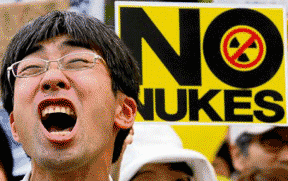 Japan Protesters Block Meeting on Restarting Nuclear Plants WSJ By MITSURU OBE, 18 Jan TOKYO—Protesters denouncing Japan’s nuclear watchdog agency as having a pro-nuclear bias, held up the initial approval of stress-test results for two idled reactors, as police were called in to break up the demonstration.
More than a dozen demonstrators, carrying anti-nuclear signs and shouting, “Shame on you,” disrupted what was to be a closed meeting of government agency representatives, nuclear experts and energy officials gathered to review test results. The Nuclear and Industrial Safety Agency was set to give its preliminary approval for the restart of the two plants ahead of the arrival next week of a mission from the International Atomic Energy Agency.
The protesters called the meeting a sham, and said the majority of the panel members are known to have pro-nuclear views and are merely giving a rubber stamp to reactors.
More than 100 uniformed and plainclothes police officers were called in to end the action. The panel members were escorted out of the meeting room and resumed the session in a different ministry building, where they approved bringing the two plants back online.
The vote represents the first step in a process for restarting plants, which also must get the approval of other nuclear agencies, the Japanese cabinet and local communities……
Inadequate monitoring of Fukushima radiation in ocean
Buesseler has already reported some results from the 15-day cruise last May and June….. ”It implies the groundwater is contaminated or the facility is still leaking radiation.”
”There is no safe level of radiation. They should be making every effort to monitor food.”.
After Fukushima, fish tales, By Alex Roslin, The Montreal Gazette January 14, 2012“.………..evidence has emerged that the impacts of the disaster on the Pacific Ocean are worse than expected.
“People want to know what’s happening with the cesium and how much is in the fish, but we don’t know. It’s frustrating,” said oceanographer Buesseler.
“It’s disconcerting how big of an event Fukushima was and how little data are out there. No one has taken responsibility for studying this in a single agency (in the U.S.), even though we also have reactors on the coast and other events could happen,” he said. Continue reading
USA military were told of radiation data 9 days before Japanese public
Radiation-dispersal data was provided to U.S. before Japanese public, Mainichi Daily News, 17 Jan 12, TOKYO (Kyodo) –– Japan’s science ministry provided data on the dispersal of radioactive materials to U.S. forces a few days after the nuclear crisis erupted at the Fukushima Daiichi power plant, far earlier than the disclosure of the information to the Japanese public, a ministry official said Monday.
The revelation came amid criticism that the government’s delay in releasing data from the System for Prediction of Environmental Emergency Dose Information may have resulted in the unnecessary radiation exposure of people who later evacuated from their homes around the plant.
The data was provided to U.S. forces via the Japanese Foreign Ministry on March 14, three days after a devastating earthquake and tsunami triggered the nuclear crisis, according to Itaru Watanabe, an official of the Science and Technology Policy Bureau of the Ministry of Education, Culture, Sports, Science and Technology.
But it was not until March 23 that the public was officially informed. Watanabe, speaking at a meeting of the nuclear accident investigation panel set up by the Diet, said that the science ministry passed on the data to U.S. forces “to seek support from them” in dealing with the nuclear crisis…..http://mdn.mainichi.jp/mdnnews/news/20120117p2g00m0dm037000c.html
Japan’s media “press club”- subservient to nuclear industry and government
troubling questions whether nuclear power is safe anywhere in this seismically-active archipelago. TEPCO, as on previous occasions, provided incomplete answers, perhaps reflecting valid uncertainties—but also suggesting it is not telling the whole story.
Japan’s nuclear crisis, The meltdown and the media The Economist, Jan 16th 2012, by K.N.C. | TOKYO “…On January 16th, the Fukushima Nuclear Accident Independent Investigation Commission (NAIIC) held its first public hearing. Some 50 members of the public, and around 100 journalists, attended.
…..Japan’s media operate under a “press club” system that can lead to a form of self-censorship. News is doled out in unofficial interactions with the press. This serves many interests. For government and to a lesser extent business, it keeps the media on a tight leash and controls content. For individual journalists, it gives the veneer of exclusive information and inside access. For newspapers, it lessens the chance of being scooped by rivals, so everyone can work under less pressure. Continue reading
1 This Month





PLEASE OPPOSE HR 8255 AND S.3639 – bills would accelerate satellite deployment, with no environmental review or safeguards – https://ncstd5li.quorum.us/campaign/169331/
To see nuclear-related stories in greater depth and intensity – go to https://nuclearinformation.wordpress.com
-
Archives
- October 2026 (91)
- September 2026 (339)
- August 2026 (330)
- July 2026 (355)
- June 2026 (287)
- May 2026 (306)
- April 2026 (356)
- March 2026 (251)
- February 2026 (267)
- January 2026 (308)
- December 2025 (358)
- November 2025 (359)
-
Categories
- 1
- 1 NUCLEAR ISSUES
- business and costs
- climate change
- culture and arts
- ENERGY
- environment
- health
- history
- indigenous issues
- Legal
- marketing of nuclear
- media
- opposition to nuclear
- PERSONAL STORIES
- politics
- politics international
- Religion and ethics
- safety
- secrets,lies and civil liberties
- spinbuster
- technology
- Uranium
- wastes
- weapons and war
- Women
- 2 WORLD
- ACTION
- AFRICA
- Atrocities
- AUSTRALIA
- Christina's notes
- Christina's themes
- culture and arts
- Events
- Fuk 2022
- Fuk 2023
- Fukushima 2017
- Fukushima 2018
- fukushima 2019
- Fukushima 2020
- Fukushima 2021
- general
- global warming
- Humour (God we need it)
- Nuclear
- RARE EARTHS
- Reference
- resources – print
- Resources -audiovicual
- Weekly Newsletter
- World
- World Nuclear
- YouTube
-
RSS
Entries RSS
Comments RSS

