|
Excerpts from ‘Fukushima has an Ongoing Melt-Out’ On March 11, 2011, Pandora’s Box was opened. Japan Times, Commentary by Prof. Christopher Hobson of Waseda University: Apr. 24, 2014: […] many serious challenges lie ahead. There will be more leaks and problems at the No. 1 plant. There will also have to be the controlled release of contaminated water into the ocean. Public support and understanding will be needed through these difficult processes. For this to happen, Tepco needs to begin to rebuild its credibility with the public […] Tepco’s regaining the trust of Japan’s public is just as difficult a task as resolving the technical challenges in decommissioning the plant. The only way this might happen is […] to be more honest and transparent about the problems in Fukushima. |
TEPCO makes $4.3 Billion Profit
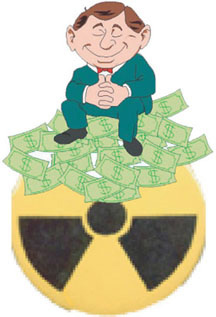
 Fukushima Nuclear Plant Operator Tepco Books $4.3 Billion Profit http://www.thejakartaglobe.com/business/fukushima-nuclear-plant-operator-tepco-books-4-3-billion-profit/ By Agence France-Presse Apr 30, 2014 The operator of Japan’s crippled Fukushima nuclear plant said on Wednesday it booked a $4.3 billion annual net profit owing to an electricity rate hike and a massive government bailout following the 2011 disaster.
Tokyo Electric Power (Tepco) was teetering on the brink as cleanup and
 compensation costs stoked huge losses and threatened to collapse the sprawling utility until Tokyo stepped with a multi-billion dollar rescue.
The company at the center of the worst nuclear accident in a generation said it earned 438.65 billion yen ($4.3 billion) in the fiscal year to March, compared with a net loss of 685.3 billion yen in the same period a year earlier.
Sales rose 11.0 percent to 6.63 trillion yen, it said.
The company’s results got a boost from a rate hike, and helped offset a decline in the amount of electricity Tepco sold owing to warmer-than-usual winter weather, it said.
It also booked a special gain of 1.8 trillion yen based on funds the company received from a government-backed bailout fund as well as asset sales.
But it added that rising fossil fuel costs after Japan switched off its nuclear reactors were pressuring its bottom line.
“The business environment that surrounds us remains very serious,” Tepco president Naomi Hirose told a news conference.
The Fukushima plant’s cooling systems were swamped by the 2011 tsunami, sparking reactor meltdowns and radiation leaks.
Tens of thousands of people were evacuated from around the plant with decommissioning of the site expected to take decades.
Japan’s government pressuring Fukushima evacuees to return: govt wants no criticism of nuclear power
The government has declared that the stipends, which range from a few hundred dollars to more than $1,000, will end next March, when temporary housing will also begin to be closed. Villagers who move back before then will receive a $9,000 bonus from Tepco, adding to the pressure to return
the evacuees will feel increasing pressure to go back from a government that wants to restore the preaccident status quo as much as possible to limit criticism of the powerful nuclear industry.
Forced to Flee Radiation, Fearful Japanese Villagers Are Reluctant to Return NYT, By MARTIN FACKLER APRIL 27, 2014 MIYAKOJI, Japan — Ever since they were forced to evacuate during the accident at the Fukushima Daiichi nuclear plant three years ago, Kim Eunja and her husband have refused to return to their hilltop home amid the majestic mountains of this rural village for fear of radiation.
But now they say they may have no choice. After a nearly $250 million radiation cleanup here, the central government this month declared Miyakoji the first community within a 12-mile evacuation zone around the plant to be reopened to residents. The decision will bring an end to the monthly stipends from the plant’s operator that have allowed Ms. Kim to relocate to an apartment in a city an hour away.
“The government and the media say the radiation has been cleaned up, but it’s all lies,” said Ms. Kim, 55, who is from South Korea, and who with her Japanese husband runs a small Korean restaurant outside Miyakoji. “I want to run away, but I cannot. We have no more money.”
She is not the only one. While the central government and national news media have trumpeted the reopening of Miyakoji as a happy milestone in Japan’s recovery from the devastating March 2011 accident, many residents tell a darker story. They insist their homes remain too dangerous or too damaged to inhabit and that they have not received enough financial compensation to allow them to start anew somewhere else…….
many evacuees have been forced to live in a state of limbo since the accident, unable to leave barracks-like temporary housing, or end their dependency on Tepco for monthly stipends to live in apartments outside the village. Tepco pays the stipends under orders from the government.
Now they feel growing pressure to return whether they want to or not. The government has declared that the stipends, which range from a few hundred dollars to more than $1,000, will end next March, when temporary housing will also begin to be closed. Villagers who move back before then will receive a $9,000 bonus from Tepco, adding to the pressure to return……..
Experts call Miyakoji a forerunner of the problems that will be faced by the 150,000 people displaced by the accident over all, as additional communities are reopened as a result of a $36 billion government-financed cleanup. They say the evacuees will feel increasing pressure to go back from a government that wants to restore the preaccident status quo as much as possible to limit criticism of the powerful nuclear industry.
“This is inhumane and irresponsible,” said Teruhisa Maruyama, a lawyer who leads the Support Group for Victims of the Nuclear Accident, a Tokyo-based legal organization that helps residents seek increased compensation.
Authorities had hoped that Miyakoji could serve as a model for repopulating the evacuated communities. So far, only about a third of residents have returned, and most of them are older villagers who feel they have less to worry about from the long-term cancer risks of radiation……..
“They want to say that everything is back to normal so they can keep their nuclear plants,” said Mr. Mizuochi, 57, who helps his wife at the restaurant. “Failing to compensate us for our losses is a way of pressuring us to go back.” http://www.nytimes.com/2014/04/28/world/asia/forced-to-flee-radiation-fearful-japanese-villagers-are-reluctant-to-return.html?_r=0
Fukushima “Disaster never seen in human history”
Journal: “Fukushima has an Ongoing Melt-Out” — “Is this not the worst possible outcome?” — “Nuclear fuel mixing with groundwater and leaking into sea” — “Disaster never seen in human history and imagined only in movies” — Tokyo Paper: “A situation in which massive accidents occur daily” http://enenews.com/journal-fukushima-has-an-ongoing-melt-out-is-this-not-the-worst-possible-outcome-nuclear-fuel-mixing-with-groundwater-and-leaking-into-sea-disaster-never-seen-in-human-history April 26, 2014

Japan’s Nuclear Decommissioning Institute calls for international help with Fukushima reactors
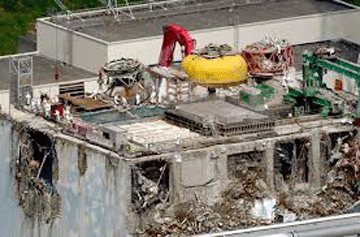 Japan seeking international assistance with Fukushima Daiichi fuel removal http://enformable.com/2014/04/japan-seeking-international-assistance-fukushima-daiichi-fuel-removal/ On Friday, officials from the International Research Institute for Nuclear Decommissioning (IRID) in Japan attending a seminar asked for input from engineers in Japan and across the world on removing melted nuclear fuel from the crippled reactors at the Fukushima Daiichi nuclear power plant.
Tokyo Electric plans to fill the containment vessels with water in order to shield the workers from the high levels of radiation they would be exposed to while retrieving the damaged fuel. The roadmap for decommissioning developed by the utility estimates fuel removal activities could begin by 2020, or later.
At the seminar, IRID officials announced to any engineers interested in giving their input that the plan to fill the containment vessels may not be feasible, as not all leaks may be located or plugged prior to fuel removal.
The announcement infers that the containment vessels may be more damaged than initially estimated by Tokyo Electric. Even if the containment vessels were able of holding the water there are also questions as to whether they would be structurally sound enough to hold the additional weight of the water required for shielding.
Engineers are invited to submit their input on technology that can identify and remove fuel debris in a highly radioactive atmosphere while protecting workers without the aid of shielding by water. The Japanese government will begin accepting proposals in June.
Plutonium and other radioactive trash arrives at Rokkasho
 Spent-fuel waste arrives at Rokkasho http://www.japantimes.co.jp/news/2014/04/22/national/spent-fuel-waste-arrives-at-rokkasho/#.U1hkhFVdWik KYODO AOMORI – A vessel carrying highly radioactive waste arrived Tuesday in the village of Rokkasho, Aomori Prefecture, from Britain, where spent nuclear fuel from Japanese power plants is being reprocessed.
The shipment, made up of 132 stainless steel containers of high-level radioactive waste mixed with glass, is the fourth of its kind to arrive in Japan from the U.K. country. Japan has received 264 of the steel containers since the shipments from Britain began in March 2010.
Japan Nuclear Fuel Ltd., which handles nuclear fuel reprocessing work in Japan, will store the latest batch of nuclear waste at a facility in the village of Rokkasho temporarily.
The latest shipment includes 28 containers each from Chubu Electric Power Co., Kansai Electric Power Co., Shikoku Electric Power Co. and Kyushu Electric Power Co., as well as 20 containers from Chugoku Electric Power Co
VIDEO: former Mayor Katsutaka Idogawa speaks out on the sick children of Fukushima
 VIDEO: Fukushima disaster: Tokyo hides truth as children die, become ill from radiation – ex-mayor RT.com April 21, 2014 The tragedy of the Fukushima nuclear plant disaster took place almost three years ago. Since then, radiation has forced thousands out of their homes and led to the deaths of many. It took great effort to prevent the ultimate meltdown of the plant – but are the after effects completely gone? Tokyo says yes; it also claims the government is doing everything it can for those who suffered in the disaster. However, disturbing facts sometimes rise to the surface. To shed a bit of light on the mystery of the Fukushima aftermath, Sophie Shevardnadze talks to the former mayor of one of the disaster-struck cities. Katsutaka Idogawa is on SophieCo today FULL TRANSCRIPT …………
SS: Your town is moving to a new location, to the neighboring city of Iwaki. Is it safe there? Do you see this as a new start for the people?
KI: I’d like to show you a table with radiation levels around Chernobyl. Radiation levels around Fukushima are four times higher than in Chernobyl, so I think it’s too early for people to come back to Fukushima Prefecture. Here you can see radiation levels in our region, Tohoku. This is ground zero, and the radiation radius is 50-100km, even 200km in fact. Fukushima Prefecture is at the very center. The city of Iwaki, where Futaba citizens moved, is also in Fukushima Prefecture. It is by no means safe, no matter what the government says. Exposing people to the current levels of radiation in Fukushima is a violation of human rights. It’s terrible.
SS: Evacuation advisories are being lifted for some cities in the Fukushima area, but you’re saying that the government is allowing this, despite the danger of radiation?
KI: Fukushima Prefecture has launched the Come Home campaign. In many cases, evacuees are forced to return. Here is a map of Fukushima Prefecture, with areas hit by radiation highlighted in yellow, and you can see that the color covers almost the entire map. Air contamination decreased a little, but soil contamination remains the same. And there are still about two million people living in the prefecture, who have all sorts of medical issues. The authorities claim this has nothing to do with the fallout. I demanded that the authorities substantiate their claim in writing but they ignored my request. There are some terrible things going on in Fukushima. I remember feeling so deeply for the victims of the Chernobyl tragedy that I could barely hold back the tears whenever I heard any reports on it. And now that a similar tragedy happened in Fukushima, the biggest problem is that there is no one to help us. They say it’s safe to go back. But we must not forget the lessons of Chernobyl. We must protect our children. I talked to local authorities in different places in Fukushima, but no one would listen to me. They believe what the government says, while in reality the radiation is still there. This is killing children. They die of heart conditions, asthma, leukemia, thyroiditis…Lots of kids are extremely exhausted after school; others are simply unable to attend PE classes. But the authorities still hide the truth from us, and I don’t know why. Don’t they have children of their own? It hurts so much to know they can’t protect our children……….
SS: The United Nations report on the radiation fallout from Fukushima says no radiation-related deaths or acute diseases have been observed among the workers and general public exposed – so it’s not that dangerous after all? Or is there not enough information available to make proper assessments? What do you think?
KI: This report is completely false. The report was made by a representative of Japan – Professor Hayano. Representing Japan, he lied to the whole world. When I was mayor, I knew many people who died from a heart attack, and then there were many people in Fukushima who died suddenly, even among young people. It’s a real shame that the authorities hide the truth from the whole world, from the UN. We need to admit that actually many people are dying. We are not allowed to say that, but TEPCO employees also are dying. But they keep mum about it……..http://rt.com/shows/sophieco/fukushima-disaster-radiation-children-74
Underground water flow a worry, as ground sinks below Fukushima’s crippled nuclear reactors
Top Nuclear Official: “Ground sinking” beneath Fukushima reactor buildings a concern — Gov’t experts looking closely at risks from changes to flow of underground water http://enenews.com/top-nuclear-official-ground-sinking-beneath-fukushima-reactor-buildings-a-concern-govt-experts-closely-looking-into-risks-from-changes-to-undergroud-water-flow
NHK WORLD, Apr. 21, 2014: Japan’s nuclear regulator and experts are questioning the safety of plans to build frozen walls to […] prevent groundwater from flowing beneath the reactor buildings. […] The government and TEPCO want to start construction in June. […] The NRA invited experts to a meeting last Friday […] NRA Commissioner Toyoshi Fuketa expressed concern about the risk of the ground sinking. […] They said all the risks need to be addressed further. The NRA decided to continue to closely look into the safety of the planned frozen walls.
NHK WORLD, Apr. 21, 2014: Some contamination in the groundwater drawn from near the Fukushima Daiichi nuclear plant is making the area’s fishermen uneasy, as the plant’s operator plans to release it into the sea. Tokyo Electric Power Company has a plan to pump up groundwater and release it into the Pacific Ocean […]
USGS: “More than 80 percent of the identified subsidence in the United States is a consequence of human impact on subsurface water”

See also:
- Asahi: Buildings at Fukushima plant can start floating from too much groundwater — Expert: Blocking groundwater with ice wall may weaken soil and cause buildings to topple (AUDIO)
- AP: Experts warn about ground sinking at Fukushima plant — Tepco Adviser: Reactor building structures likely degraded; “Containment degradation” concerns back in 2011
- Ex-Fukushima Nuclear Worker: Concern about land subsidence at plant due to pumping up groundwater — “I think Tepco knows”
- Expert: Land under Fukushima reactor buildings at risk of turning into liquid — Area near sea could become like mud
- Senior Scientist: Fukushima giant ‘ice wall’ to make crisis worse — Radioactive release into ocean from saltwater intrusion — Side effects ‘not good at all’ (AUDIO)
- BBC: Professor warns underground ice walls could become ‘neutron reflectors’ and cause nuclear chain
Concern over radiation level in foodstuffs from Japan
 Concerned officials now considering ban on Japan food items — Nuclear scientists previously told gov’t to halt all imports after finding high radiation levels — Never implemented due to fear of hurting bilateral relationship http://enenews.com/concerned-officials-now-consideingr-ban-on-japan-food-items-nuclear-scientists-previously-told-govt-to-halt-all-imports-after-finding-high-radiation-levels-never-implemented-due-to-fear-of-hur?utm_source=feedburner&utm_medium=email&utm_campaign=Feed%3A+ENENews+
The Nation,Apr. 18, 2014: Pakistan may ban Japan edible items […] in case if traces of radioactive material are found on them. Federal Minister of Commerce Khurum Dastgeer Khan told the Senate on Thursday, currently the Ministry of National Food Security and Research is tasked to conduct thorough research to determine either the edible items from Japan were infected by radioactive rays or not. […] Senator Suriya Amiruddin who was interested to know whether there is any proposal under consideration of the Government to impose ban on import of edible items from Japan to avoid negative effect of radiation in those items. […] in April 2011, Pakistan Nuclear Regulatory Authority had directed authorities dealing with Cargo arriving directly or indirectly from Japan to screen all types of consignments including edible/non-edible, for radiation. […] The directives were issued from the country’s well-reputed institution Pakistan Nuclear Regulatory Authority […] The PNRA made clearance mandatory for every consignment being imported from Japan. It is worthy of mentioning here that country’s nuclear scientists had advised the federal government three years back to halt all types of goods from Japan to minimize the threat of radiation following the Fukushima Nuclear Crisis in Japan. The scientists had advised the government after they detected high level of Iodine from the consignments imported from Japan. […] in view that the move to ban imports from Japan may hurt bilateral relationship between the two friendly countries, the Pakistani government never imposed ban on import of goods from Japan.
Khurum Dastgeer Khan, Federal Minister of Commerce: “Concerned officials have been advised to investigate the matter relating to import of edible items from Japan following the incident of radioactivity in Japan. It is up to Ministry of Food Security and Research to advise Ministry of Commerce to continue import of edible items from Japan or impose ban on it.”See also: Award-winning project finds seafood sold in Canada with high radiation levels — Many samples well over contamination limit — “Incredible discovery; Something unexpected may be lurking in Canadian waters” — Believes dangerous Fukushima pollution carried across ocean — “I hope people will open their eyes”
Secret deals trapping Turkey into buying Japanese nuclear technology
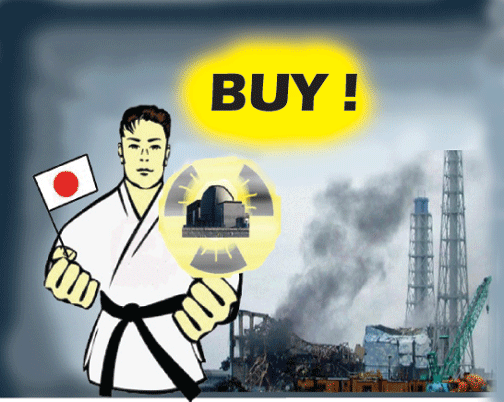 Why would the Western authorities allow a country like Turkey to have nuclear plants?
Because it can trap such a nation under secret deals of the colluding powers, expanding and stabilizing their profit-oriented status quo guaranteed by the magic words “national security”
Japanese Nuclear Plants For Sale http://www.opednews.com/articles/Japanese-Nuclear-Plants-Fo-by-Hiroyuki-Hamada-Fukushima-Meltdown_Government-Industry-Collusion_Government-Transparency_National-Security-140417-354.html?show=votes
By Hiroyuki Hamada 17 April 14 I don’t understand why people are not talking about this but here it goes. Japan has been working hard to export nuclear plants. That’s odd, right? After what happened in Fukushima? I mean who would want it? And if you want it, would you get it from Japan?
Here is an interesting fact. Japan has accumulated at least 4000 nuclear warheads’ worth of plutonium, and in fact, it used to export plutonium to England where it was used to make nuclear weapons (1). And that is actually an enormous feat for a nation with a peace constitution that bans wars as a means of conflict resolution, and for a nation with multiple regulations guarding against exporting weapons, which of course stipulate anything nuclear as a big no. What I’m trying to say is that Japan has been very very dishonest about its nuclear policies. The numbers and the facts, which have become available after the accident, state that the nuclear energy has not been as efficient as what has been claimed, while the safety measures and potential risks have not been the primary concerns. In fact some of us now believe that the primary reason why Japan acquired nuclear energy at the first place was to acquire bomb- making capability, along with the lucrative deals guaranteed by the western nuclear authorities (2).
Last year, one of the Japanese parliament members demanded detailed info regarding the export of the nuclear plant to Vietnam. Many of us were stunned to see the disclosed papers completely filled with black rectangles, the contents were pretty much all censored due to national-security concerns (3).
Now, why would anyone want a nuclear plant from Japan? Continue reading
Japan’s government deceives evacuees to return before radiation readings disclosed
Radiation study on evacuation zones kept undisclosed for 6 months http://www.globalpost.com/dispatch/news/kyodo-news-international/140416/radiation-study-evacuation-zones-kept-undisclosed-6-mo The government kept undisclosed for six months a report on an individual radiation dose study in areas around the crisis-hit Fukushima Daiichi nuclear power plant, including a district recently released from an evacuation order.
The study, covering the city of Tamura and the villages of Kawauchi and Iitate, showed that the radiation level in many areas is still beyond 1 millisievert per year — a level the government is seeking to achieve at contaminated lands in the long term.
The government lifted an evacuation order imposed on the Miyakoji district in Tamura on April 1, but the content of the interim report, compiled in October, was not conveyed to the citizens or the local governments before the action was taken.
The government explained the content to local governments later, while the report was posted on the website of the Ministry of Economy, Trade and Industry on Monday. It also plans to release a final report on Friday. A government team tasked with supporting people affected by the crisis said it did not initially plan to release the interim report but decided to make it public because of the “high attention among residents.”
The team decided to conduct the radiation level study at 43 points in Tamura, Kawauchi and Iitate last July, hoping to address concerns among evacuees seeking to return to their homes.
The study showed that radiation levels measured by individual dosimeters tend to be about 70 percent of those estimated from air dose. Twenty-seven points were also found to be above 1 millisievert per year.
The outcome has raised concerns among the residents that have already returned to their homes.
A 65-year-old man living at his home in the Miyakoji district said, “It was premature to lift the evacuation order. We’ve been deceived.”
The 20-kilometer radius of the Fukushima plant and some areas beyond have been subject to evacuation orders in the wake of the nuclear crisis that began in March 2011.
The Miyakoji district became the first area excluded from the 20-km zone following decontamination and infrastructure restoration efforts.
Japanese government’s double dealing on radiation data
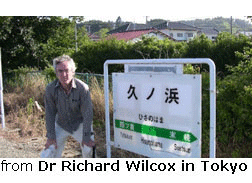 Japan’s Radioactive Potemkin Village: The Government’s Double-Dealing Data, rense.com. By Richard Wilcox, PhD, 4-12-14 I stand to be corrected but what I recently witnessed first hand and face to face in the city of Nihonmatsu can be interpreted as nothing other than scientific fraud and blatant misrepresentation of the facts on the part of the Japanese government regarding gamma radiation levels, leading to the early deaths of tens of thousands of residents . I visited a large nuclear refugee camp in a beautiful location near Nihonmatsu, a modest sized city just outside the evacuation zone of the Fukushima Nuclear Power Plant No. 1 (FNPP#1) disaster site . Continue reading
Deformities in Fukushima plants and insects
 Fairewinds Video: ‘Anomalies’ in plants and animals documented by Fukushima residents, some severely deformed — Scientists: Genetic mutations observed in Fukushima include trees with peculiar distortions, insect abnormalities, tumors in birds, more (PHOTO) http://enenews.com/fairewinds-video-anomalies-in-plants-and-animals-documented-by-fukushima-residents-some-severely-deformed-scientists-genetic-mutations-observed-in-fukushima-include-trees-with-peculiar-disto?utm_source=feedburner&utm_medium=email&utm_campaign=Feed%3A+ENENews+%28Energy+News%29
Fairewinds Energy Education, Apr. 10, 2014 — Chiho Kaneko, member of the Board of Directors of Fairewinds originally from Iwate, Japan (at 11:15 in): It’s not just people who are sicker. I met a home gardener who lives in Kawamata, Fukushima, 30-miles from Fukushima Daiichi. She grows luffas, whose fruit is often dried to make bath sponges. Last year, with some trepidation, she used the seeds saved from the year before. She found flower buds directly growing out of the fruit. Some of her pole beans were abnormally gigantic. Near Fukushima city, another person saw a frog so severely deformed that, at first, it was difficult to tell that it was a frog, save for its hopping. These are true events described by people I met who took notes and photographs of these environmental anomalies.
Asian Perspective Vol. 37, No. 4, Anders Pape Møller and Timothy A. Mousseau, Oct.-Dec. 2013: A careful observer [who visits Chernobyl or Fukushima] will quickly become aware of the peculiar distortions of tree growth, numerous abnormalities in insects, and tumors and cataracts in birds, all caused by genetic mutations induced by exposure to the radiation […] radiation causes damage to DNA molecules (leading to mutations if not repaired) […] We have known for more than eighty years that low-dose radiation has cytotoxic effects and causes mutations. […] we looked at 373 effect sizes from forty-six different studies […] they showed a statistically significant negative effect of radiation […] on mutation, physiology, immunology, and disease. As one would expect, effects were stronger on plants, which are stuck in one place, than on animals that can move around […] As the first scientists in both Chernobyl and Fukushima, we have performed [fifteen] published tests, of organisms ranging from plants and insects to birds and mammals in Chernobyl, that support the hypothesis that low-dose radiation disrupts development, and all fifteen studies show a higher degree of asymmetry in the more contaminated plots. […] we have assembled effect sizes from all published studies of mutation rates from Chernobyl, in total 151 estimates of mutations in forty-five studies of thirty-three species ranging from bacteria and plants to insects, birds, and mammals, including humans [The] findings are robust in showing a general, strong overall mean effect size of radiation on mutation rates. […] Mutations accumulate with time and across generations, so we may only be seeing the first stages of the negative public health consequences […] for humans.
Personal account from Tokyo, of government’s duplicity in radiation readings
Japan’s Radioactive Potemkin Village: The Government’s Double-Dealing Data, rense.com. By Richard Wilcox, PhD, 4-12-14 “…….Can You Trust The Government?
According to the Japanese government official website, the Nuclear Regulation Authority , gamma radiation in Tokyo is just 0.034 microsieverts per hour (mcr sv pr hr) . This reading is taken 22 meters above the ground, in Shinjuku, a main hub of urban Tokyo. As luck would have it, I live not far from there and took a reading out my window several stories up in my apartment building and it regularly reads 0.13 mcr sv pr hr. According to the government chart, an estimated reading of 0.061 mcr sv pr hr is given for one meter above ground level. I measured one meter above ground where I live and the reading was 0.12 mcr sv pr hr.
What accounts for the noticeable discrepancy? Could it be the equipment or the location of measurement? The government chart gives an average reading for the ENTIRE CITY OF TOKYO, of 0.061, as if that is remotely accurate. I believe the government and authorities use two main tactics:
1. The place measurement monitoring devices high above the ground where it won’t read the worst radiation which naturally settles on the ground or in ditches;
2. They scrub and decontaminate the area in the immediate vicinity of the monitoring device in order to create a lower reading.
It could also be that tampering with the way devices are calibrated in order to get lower readings, or manipulating published data could occur, but I have no personal proof of these speculations.
Much of the problem with radiation science promoted by the nuclear establishment and their minions is that they limit the factors involved in their methodology and avoid the precautionary principle when drawing conclusions. In other words: don’t worry, be happy (even if your mitochondrial DNA is being damaged).
After the Fukushima accident I personally measured my kid’s school grounds. My readings were consistently higher what was reported by the school who simply measured above the ground in order to avoid the worst radiation.
When I was in the midwest in the US in March, I took outdoor readings above and on the ground that measured between 0.08 to 0.13 mcr sv pr hr. We now live in a manmade radioactively contaminated world due to above ground nuclear tests, nuclear power plant emissions, and nuclear accidents, in addition to natural background radiation from the sun or soil.
What I have witnessed first hand in Nihonmatsu is scientific fraud and misrepresentation of the facts. This is verified by my own dosimeter readings, and by the testimony of both Mr. Honda, the head of the temporary housing facility, and the experienced construction and decontamination worker who I talked with…..”
* Richard Wilcox is a Tokyo-based teacher and writer who holds a Ph.D. in environmental studies and is a regular contributor to the world’s leading website exposing the Fukushima nuclear disaster, Rense.com. He is also a contributor to Activist Post. His radio interviews and articles are archived at http://wilcoxrb99.wordpress.com and he can be reached by email for radio or internet podcast interviews to discuss the Fukushima crisis at wilcoxrb2013@gmail.com. http://www.rense.com/general96/jpsradioctv.html
69% of Japanese want nuclear power to be phased out
 Japan’s Profound Ambivalence Over Nuclear Energy , TIME, Per Liljas, 14 April 14 Prime Minister Shinzo Abe has unveiled a pro-nuclear blueprint for the country’s energy future around the three-year mark of the disaster at Fukushima, a move that most Japanese appear to disagree with, even those who returned to Fukushima to rebuild their lives ……On a national level, too, there is a lack of consensus. Produce from Fukushima, even from villages unconnected to the disaster, does not inspire confidence among consumers despite official O.K.s. And nobody can agree on the future of Japan’s nuclear-energy sector…….“They want to restart the reactors because of money, but it’s irresponsible, Japan is too unsafe to have nuclear power,” says activist Kaori Echigo, before taking to a podium in front of the parliament building in Tokyo and leading a crowd in the chanting of anti-nuclear slogans. The crowd at these gatherings, which have been held weekly since the disaster, has dwindled to a few hundred. But the last time a reactor was restarted, in 2012, thousands came onto the streets—as they are likely to do again if Abe goes ahead with his plan.
A poll by the Tokyo Shimbun newspaper last month found that 69% of respondents wanted nuclear power to be phased out. That number could rise even higher if Japan makes it through another summer without blackouts…….Spread out through the village are fields covered with black plastic bags, each one filled with contaminated topsoil that has been collected from the surroundings. Watanabe says she feels life is coming back to Tamura when she sees children in the streets, but then remembers that they are only allowed half an hour’s outdoor playtime per day because of radiation fears.
“I don’t want my grandchildren to grow up here,” she says. “I don’t know which health problems they may get.” Even that old saw about marrying somebody from Tamura means nothing now. “I want my grandchildren to get married” Watanabe adds, “and I don’t know which suitors would ever come here.” http://time.com/59096/fukushima-nuclear-daiichi-japan-tamura/
Likely political and economic damage to Abe’s government as result of pro nuclear decision
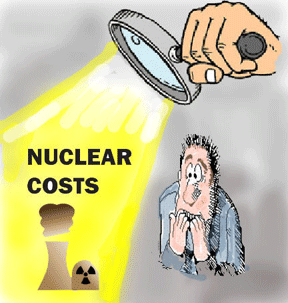 Tokyo’s decision on nuclear power plants ‘may backfire’
It could cost PM Abe politically and set back his economic policies: analysts Business Times BY ANTHONY ROWLEY, 14 April 14, IN TOKYO JAPANESE Prime Minister Shinzo Abe has entered a high-stakes gamble with the decision announced last Friday to restore nuclear power to the nation’s menu of electricity generation sources in the wake of the Fukushima nuclear meltdown three years ago.
The controversial decision goes against the non-nuclear policy adopted by the Democratic Party of Japan government before Mr Abe’s Liberal Democratic Party returned to power at the end of 2012 and could backfire in a number of ways, analysts say.
With polls showing a significant proportion of Japanese remaining opposed to the restart of the nation’s 50 or so nuclear reactors that have been idled since the Fukushima disaster, the political price of restoring nuclear power could be high for Mr Abe, some claim.
At the same time, there could be economic consequences such as setting back the policy being pursued by the Bank of Japan (BOJ) under pressure from Mr Abe to replace deflation with annual inflation of 2 per cent. So far much of the progress towards this target has been driven by “imported inflation” in fuel costs…..(subscribers only) http://www.businesstimes.com.sg/premium/world/tokyos-decision-nuclear-power-plants-may-backfire-20140414
1 This Month





PLEASE OPPOSE HR 8255 AND S.3639 – bills would accelerate satellite deployment, with no environmental review or safeguards – https://ncstd5li.quorum.us/campaign/169331/
To see nuclear-related stories in greater depth and intensity – go to https://nuclearinformation.wordpress.com
-
Archives
- October 2026 (58)
- September 2026 (339)
- August 2026 (330)
- July 2026 (355)
- June 2026 (287)
- May 2026 (306)
- April 2026 (356)
- March 2026 (251)
- February 2026 (267)
- January 2026 (308)
- December 2025 (358)
- November 2025 (359)
-
Categories
- 1
- 1 NUCLEAR ISSUES
- business and costs
- climate change
- culture and arts
- ENERGY
- environment
- health
- history
- indigenous issues
- Legal
- marketing of nuclear
- media
- opposition to nuclear
- PERSONAL STORIES
- politics
- politics international
- Religion and ethics
- safety
- secrets,lies and civil liberties
- spinbuster
- technology
- Uranium
- wastes
- weapons and war
- Women
- 2 WORLD
- ACTION
- AFRICA
- Atrocities
- AUSTRALIA
- Christina's notes
- Christina's themes
- culture and arts
- Events
- Fuk 2022
- Fuk 2023
- Fukushima 2017
- Fukushima 2018
- fukushima 2019
- Fukushima 2020
- Fukushima 2021
- general
- global warming
- Humour (God we need it)
- Nuclear
- RARE EARTHS
- Reference
- resources – print
- Resources -audiovicual
- Weekly Newsletter
- World
- World Nuclear
- YouTube
-
RSS
Entries RSS
Comments RSS


