Nose bleeding attacks prevalent in some people exposed to Fukushima nuclear radiation
 Press Conference by Former Official: I’m bleeding from nose every day, many in Fukushima have similar symptoms — Author: My nose bled for days, it wouldn’t stop; Staff had same problem… Do people want me to lie? I can only write truth — Gov’t: The nosebleeds aren’t caused by nuclear crisis (PHOTO) http://enenews.com/press-conference-former-official-nose-bleeds-every-day-many-others-fukushima-developed-similar-symptoms-govt-nosebleeds-caused-nuclear-crisis-author-bleeding-nose-days-wouldnt-stop-others-same-s?utm_source=feedburner&utm_medium=email&utm_campaign=Feed%3A+ENENews+%28Energy+News%29
Jiji Press, May 10, 2014: Environment Minister Nobuteru Ishihara has criticized a manga story for linking nosebleeds to exposure to radiation […] He underscored the importance of keeping unfounded rumors in check [and] that doctors with special knowledge have denied a causal relationship between exposure to radiation after the nuclear accident and nosebleeds.
Mainichi, May 10, 2014: Katsutaka Idogawa, 67, [Futaba’s] former mayor […] is featured in the popular comic series “Oishinbo.” […] Idogawa says his nose bleeds regularly and that there are many others in Fukushima who have developed similar symptoms. […] Idogawa told a news conference on May 9 in Tokyo […] his nose bleeds every day, especially in the mornings. “There is no way I would retract my comments in the manga,” Idogawa said. Responding to Environment Minister Nobuteru Ishihara […] Idogawa commented, “The minister has no business with my physical condition.”
Author Tetsu Kariya interview, translated by Toshi Nakamura, Jan. 13, 2014: […] after I got back [from Fukushima] and was having dinner, I suddenly started bleeding from my nose, and it wouldn’t stop. I thought, “what on Earth?” I’ve rarely ever had a nosebleed so it was quite a shock. After that, I had nosebleeds at night for days after. But when I went to the hospital, they said “there’s currently no medical connection between nosebleeds and radiation” and they severed a capillary in my nose membrane with a laser. Also, after I went, I felt a great deal of fatigue. The staff who went with me and the chief of Futaba-machi suffered from nosebleeds and fatigue. They say the radiation levels are low so there’s no harm, but I wonder about that.
Statement from Tetsu Kariya summarized by Yoshihiro Kaneda, May 7, 2014: It is possible that those who have supported me would walk away from me. I don’t understand why people criticize the truth which I have collected data in Fukushima 2 years and I write it as it is. Do people want to close my eyes against the truth and write something good lies for somebody or other? […] I can only write the truth. I hate self-deceiving. Today’s Japanese society is surrounded by the atmosphere of hating inconvenient truth and desiring lies of feeling good.
Japan’s authorities don’t like it, but Manga art pushes on with anti-nuclear story
Manga pushes ahead with antinuclear storyline, Japan Newsw, May 13, 2014 Jiji Press Japanese gourmet manga “Oishinbo” went further down its antinuclear path in the most recent serialized chapter released on Monday, after sparking controversy with the previous chapter on fallout from the nuclear accident at Tokyo Electric Power Co.’s Fukushima No. 1 nuclear power plant.
In the latest episode in Shogakukan Inc.’s Big Comic Spirits magazine, characters warned against living in Fukushima Prefecture.
The previous chapter of Oishinbo, published on April 28, drew criticism for linking nosebleeds—including one suffered by the manga’s lead character—to radiation from the northeastern Japan power station where a triple reactor meltdown occurred shortly after the March 2011 earthquake and tsunami.
At a news conference Monday, Chief Cabinet Secretary Yoshihide Suga said experts deny any causal relationship between nosebleeds and exposure to radiation following the accident. Environment Minister Nobuteru Ishihara made a similar remark on Friday…….
In the latest story, the real former Futaba Mayor Katsutaka Idogawa returns as a character who says that many locals suffer from symptoms such as nosebleeds and fatigue “because they were exposed to radiation.”
In the manga, Idogawa also criticizes the responses from TEPCO and the central government to the worst nuclear accident in Japan’s history. Futaba is one of two municipalities that host the Fukushima No. 1 plant.
Another character in the newest chapter says that Idogawa made his remarks after giving thorough thought to the issue and based on his own experience, explaining that the remarks “are immune from any lie or falsehood and are weighty.”
“You simply can’t decontaminate a wide area in Fukushima and make it a place where people can live again,” a character portraying Takeru Arakida, associate professor at Fukushima University, says in the manga. “This is the truth of Fukushima,” another character responds.The latest episode drew backlash from Fukushima Prefecture and other local governments concerned……..http://the-japan-news.com/news/article/0001274657
Japan’s govt not happy about Manga art depicting radiation effects of Fukushima nuclear disaster
Manga story about radiation criticized Japan News, Jiji Press, 10 May 14 Environment Minister Nobuteru Ishihara has criticized a manga story for linking nosebleeds to exposure to radiation at Tokyo Electric Power Co.’s stricken Fukushima No. 1 nuclear plant.
“I cannot understand the intention behind the story or what the author wants to say,” Ishihara said at a news conference. He underscored the importance of keeping unfounded rumors in check…….
Ishihara also said Friday that doctors with special knowledge have denied a causal relationship between exposure to radiation after the nuclear accident and nosebleeds.
The Environment Ministry is conducting research on the human health effects of radioactive substances released from the plant…….http://the-japan-news.com/news/article/0001269114
Fukushima reactors molten fuel cores – where are they? Robots might find them
 Robots To Investigate Fukushima N-reactors http://www.bernama.com.my/bernama/v7/wn/newsworld.php?id=1036936 TOKYO, May 9 (Bernama) — Tokyo Electric Power Co. (TEPCO) plans to use robots for investigating the inside of reactor containment vessels at its stricken Fukushima No. 1 nuclear power plant.
The investigation is expected to take place as early as in the fiscal second half that begins in October, sources were quoted as saying by Japan’s Jiji Press news agency.
Internal conditions of the containment vessels at the plant’s No. 1 to 3 reactors remain unknown.
If the robots — made by Hitachi Ltd. and others — are able to identify where melted nuclear fuel is located, this would lead to progress in work to decommission the plant damaged in the March 2011 earthquake and tsunami.
But it is unclear how much information can be obtained by the robots due to high radiation levels and steams inside the vessels.
TEPCO said the investigation is aimed at assessing temperatures and radiation levels inside the vessels.
The government plans to start removing melted fuel in 2020.
Fukushima groundwater radioactive contamination getting worse, but not properly measured
 Ongoing Impact of Wastewater from Fukushima Nuclear Power Station Ongoing Impact of Wastewater from Fukushima Nuclear Power StationHydro International, By Shunji Murai Professor Emeritus, University of Tokyo, Japan08/05/2014 Three years on from the Great East Japan Earthquake and Tsunami of 11 March 2011, air contamination is decreasing and is now concentrated in a limited area. Land contamination has also decreased through decontamination processes. However, despite all the efforts by Tokyo Electric Power Company (TEPCO) and the Japanese government, water contamination in surface and ground water is getting worse, simply because there are no effective countermeasures. ……. Even though the wastewater issue is taken seriously by Japanese people as well as people worldwide, the real status of the effect of the contamination is still unknown because neutral third-party organisations have no access to within a 20km radius of Fukushima NPS. The author has tried to make clear what the status of the wastewater issue is by using various sources including a Fishermen Union’s report, which appears to be more reliable than the government report or the report by TEPCO. http://www.hydro-international.com/news/id6913-Ongoing_Impact_of_Wastewater_from_Fukushima_Nuclear_Power_Station.html |
New research shows that TEPCO underestimated radioactive cesium released from Fukushima
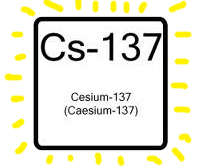 Radioactive cesium levels at Fukushima higher than TEPCO claims, Voice of Russia, 6 May 14 A new study conducted by Japanese researchers revealed that cumulative amount of radioactive cesium at the disaster-hit Fukushima nuclear power plant is nearly 1,5 times higher than previous estimates of the Tokyo Electric Power Co. (TEPCO), RIA Novosti reports. According to the research, between 17.500 and 20.500 terabecquerels of radioactive cesium-137 was released into the atmosphere from the Fukushima reactors against less than 13.600 terabecquerels declared by the plant operator TEPCO.
Earlier in April Japan’s Ministry of Economy, Trade and Industry issued a report that showed significant drop of radiation levels in areas surrounding Fukushima to under 20 millisieverts per year. These figures, however, exceed the long-term target of Japanese government of 1 millisievert per year.
………..: http://voiceofrussia.com/news/2014_05_09/Radioactive-cesium-levels-at-Fukushima-higher-than-TEPCO-claims-0913/
Japan’s shock as Manga art depicts the reality of Fukushima radiation and health
Japanese Manga Stirs Up Fukushima Nuclear Controversy http://kotaku.com/japanese-manga-stirs-up-fukushima-nuclear-controversy-1573381718 (Manga pictures on original article) 8 May 14 A famous Japanese food manga takes on the “truth about Fukushima.”
The Japanese manga, Oishinbo (美味しんぼ) is a long-running food manga that has been ongoing since 1983. In his latest chapter that was recently published in the magazine Big Comic Spirits, author Tetsu Kariya depicted the manga protagonist, Shiro Yamaoka, as he returned from a visit to the nuclear-disaster-suffering prefecture when he suddenly has a random nosebleed.After the incident, there is a discussion with another character who says that he, too, has suffered from such unexplained nosebleeds and fatigue, finishing with the comment, “There are a lot of people in Fukushima who suffer from the same symptoms. They just don’t talk about it.”
This depiction managed to stir up the hornet’s nest. According to Japanese news site Ebisoku, soon after the magazine hit the racks, the publisher, Shogakukan, was flooded with complaints and criticism that the manga was showing Fukushima in an exaggerated negative light.
The town of Futaba-machi wrote an official complaint, stating that there was no truth to the claim that “lots of people suffer from nosebleeds and other symptoms” and that the manga was damaging the image of Fukushima that they were trying hard to rebuild. The complaint notes that ever since the manga came out, there have been cancellations of visits and product orders and that Fukushima residents were afraid that the manga was cultivating discrimination against the prefecture and its residents.
Shogakukan has responded, saying that the depictions in the manga are based on real-world coverage by the author and that the manga had been published respecting the author’s expression.
The latest chapter of the manga seems based on personal experience by Kariya that he noted in an interview with Nichigo Press earlier this year. In the interview, Kariya talked of how the damage from the 2011 earthquake and subsequent nuclear disaster was much worse than he had imagined.
In response to the negative criticism against his manga, Kariya stated that while he expected some backlash, the extent of the response has surprised him. In a statement covered byNetarika, Kariya warned that there are still 2 more chapters to come and that he plans on writing harsher things. “People who are in an uproar about a nosebleed might go berserk.” Kariya stated. However, Kariya remains firm in his stance, saying that people are trying to sugar-coat the disaster with euphemisms and falsely positive language to hide the truth – something he hates more than anything else.
The author of Oishinbo recognizes that a lot of people will not like what he has to say, however, he maintains his position and has said that he will release his rebuttal after the last chapter is published.
Two ex-PMs launch Japan Assembly for Nuclear Free Renewable Energy
Japan’s ex-PMs team up for anti-nuclear drive, Channel News Asia, 8 May 14 Two former Japanese prime ministers — Morihiro Hosokawa and Junichiro Koizumi — have teamed up to increase the pressure on incumbent Prime Minister Shinzo Abe to stop the resumption of nuclear power in the country. TOKYO: Two former Japanese prime ministers — Morihiro Hosokawa and Junichiro Koizumi — have teamed up to increase the pressure on incumbent Prime Minister Shinzo Abe to stop the resumption of nuclear power in the country.
A new organisation, called the “Japan Assembly for Nuclear Free Renewable Energy”, has been launched with the main objective of calling for a nuclear free Japan, and promoting the development and use of renewable energy — and it has been getting a lot of media attention………Heading the group is Mr Hosokawa, who recently ran for Tokyo governor on an anti-nuclear platform.
He was backed by another former Prime Minister Junichiro Koizumi, who also plays an important role in the organisation.

“First, we are against the restart of Japan’s nuclear reactors. We want to transfer nuclear power to natural energy, build an economy that can capitalise on it and build a society where we do not have to worry about radiation,” he said.
Mr Koizumi said: “All nuclear plants have stopped, not only for 3 months, or 6 months, but for almost a year. Has Japan been unable to survive without nuclear power? We have prevailed.
“People may say I am a person of the past. But I will, with the generation of the future, work towards creating a country without nuclear power.”
Joining them in the anti-nuclear drive is a long list of celebrities, including actors, authors, people from the music industry and local authorities……the group said it plans to hold regular meetings and forums, to generate momentum and pressure the government to stop the generation of nuclear energy in Japan.
First lawsuit against TEPCO by a worker exposed to radiation
 Fukushima worker sues TEPCO for exposure to radiation http://ajw.asahi.com/article/0311disaster/fukushima/AJ201405080045 A worker at the Fukushima No. 1 nuclear power plant who was exposed to high levels of radiation in the early days of the disaster is seeking compensation from plant operator Tokyo Electric Power Co. and other parties.
It is the first such lawsuit by a Fukushima worker, according to the man’s lawyers. Their client’s identity was withheld.
“I wish (the utility) had informed us of possible risks in advance,” the 48-year-old man said at a news conference in Tokyo on May 7. “I want (TEPCO) to create safer conditions for workers because the decommissioning of the reactors will not finish anytime soon.”
Arguing that he was unnecessarily exposed to high levels of radiation due to slipshod instructions from TEPCO, the man is seeking 11 million yen ($107,000) in compensation. The lawsuit was filed at the Iwaki branch of the Fukushima District Court.
Just 13 days after the Great East Japan Earthquake on March 11, 2011, the man was among the six workers from TEPCO’s original contractor and its subcontractor who entered the basement of the No. 3 reactor turbine building, which had been flooded by tsunami, to install cables.
Three of the workers waded through contaminated water up to their ankles and were exposed to up to 180 millisieverts of radiation. They were later hospitalized.
According to the man’s complaint and other documents, he did not enter the radioactive water, but worked near a puddle of contaminated water for 90 minutes. He estimated that he received a radiation dose of at least 20 millisieverts at that time. The man argued that TEPCO should have been aware of the risks of working in the basement because it had previously discovered highly contaminated water around the No. 1 reactor on March 18. The man insists that the utility, however, told the six workers that the basement was safe to work in.
“That is a breach of responsibility to ensure safety,” the man said. “(The utility) put us in a position of being exposed to high doses of radiation unnecessarily.”
So far, the man has suffered no health issues.
“After carefully examining the contents of the demand and his arguments, we will sincerely respond to the claim,” TEPCO said in a statement issued the same day.
Large earthquake felt across wide area of Japan
Tokyo hit by worst quake since 3/11 — Felt throughout more than half of Japan prefectures — Expert: “People should take precautions for next several days” — AP: ‘Unusual’ quakes shake Alaska http://enenews.com/tokyo-hit-by-worst-quake-since-311-felt-throughout-moe-than-half-of-japans-prefectures-expert-people-should-take-precautions-for-next-several-days-ap-unusual-quakes-hit-alaska?utm_source=feedburner&utm_medium=email&utm_campaign=Feed%3A+ENENews+%28Energy+News%29
Yomiuri Shimbun, , May 5, 2014: The quake, which struck at about 5:18 a.m., measured lower 5 on the Japanese seismic intensity scale of 7 in Chiyoda Ward, Tokyo […] the strongest seismic intensity level measured in central Tokyo since the Great East Japan Earthquake of 2011. […] Yohei Hasegawa, a Japan Meteorological Agency official in charge of monitoring earthquakes and tsunami, said at a news conference: “The earthquake is believed to have occurred inside the Pacific plate and it doesn’t seem to be related to an earthquake that could occur directly beneath Tokyo, which would have a different mechanism. It is unlikely to be followed by active aftershocks, but people should take precautions for the next several days.”
AP, , May 4, 2014: It was the strongest earthquake since the 9.0 quake in March 2011. […] The quake was felt across a wide area of Japan […] There were no reports of damage or other abnormalities from the Fukushima Dai-Ichi nuclear plant […] Reuters reported a magnitude 6.6 earthquake struck in the Pacific Ocean […] a second earthquake of magnitude 6.1 about 10 minutes later, further south. […] On Saturday, a series of small earthquakes and aftershocks has rattled northern Alaska. […] the earthquakes are unusual, because the region isn’t a seismically active part of Alaska.
Standart News, May 5, 2014: jolts were felt in 26 out of 47 prefectures of Japan.
Japanese nuclear utilities call for tax-payer support as they post losses
 Japanese utilities post losses, seek state support Star Online 2 May 14 TOKYO: Japan’s nuclear-reliant utilities reported losses for the third straight year and warned of further electricity rate hikes to pay for surging fuel imports as they face an uncertain outlook for restarting idled reactors.
Six of Japan’s nine big regional power companies, all of which own reactors, reported a combined net loss of US$3.3bil as they face the rising fuel costs and also spend billions of US dollars to upgrade nuclear facilities to meet new regulatory standards. “We can no longer deny the possibility that we will not be able to restart a nuclear plant for some time,” Kansai Electric Power president Makoto Yagi told an earnings briefing, adding that another electricity rate hike might become inevitable. It raised rates by 9.75% last May.
Kansai Electric, Japan’s second-largest utility by revenue which supplies nearly one-fifth of the nation’s electricity, reported a 97.4 billion yen (US$950mil) net loss for the fiscal year that ended on March 31, its third consecutive year of losses.
Kyushu Electric Power and Hokkaido Electric Power said on Wednesday they would request financial support from the government-affiliated Development Bank of Japan, asking it to buy 150 billion yen in preferred shares in the two utilities.
Kyushu Electric serves Japan’s southern main island which is home to several auto and chip plants, while Hokkaido Electric serves the northern-most island.
The three consecutive years of net losses for utilities will make it difficult for them to secure further private-sector loans under standard Japanese banking practices, pushing firms like Kyushu and Hokkaido to seek public support……..Even in the most optimistic scenario, analysts and industry watchers say Japan may only be able to restart one-third of its reactors, while 17 are unlikely ever to come back online due to their age, location or proximity to suspected active fault lines. — Reuters http://www.thestar.com.my/Business/Business-News/2014/05/02/Japanese-utilities-post-losses-seek-state-support/
Fukushima’s children thyroid cancer and justifiable anxiety over radiation
 Thyroid cancer cases rise near Fukushima as schoolchildren flee radiation http://www.naturalnews.com/044938_thyroid_cancer_Fukushima_schoolchildren.html
Thursday, May 01, 2014 by: Jonathan Benson, staff writer (NaturalNews) Disillusioned by the government’s questionable position on radiation dangers throughout the region, many Japanese families living in and around the Fukushima prefecture where a large nuclear power station sustained three full meltdowns back in 2011 are deciding to send their children away to greener, safer pastures.
Associated Press (AP) reporter Yuri Kageyama reports that many families living within the so-called “no-go zone,” which covers a six-mile radius surrounding the plant, are not so sure that their children are safe there. At least 33 children throughout the region have been diagnosed with thyroid cancer since the Fukushima disaster, and many more are suffering from other symptoms possibly caused by radiation.
This is why Yukie Hashimoto and her husband decided to send their 12-year-old daughter 200 miles away to a resort town in central Japan. Concerned that the girl might eventually develop symptoms from perpetual exposure to low-dose radiation, the Hashimotos decided to take advantage of an offer by the town’s mayor to take in, educate and care for young Fukushima refugees.
“The low-dose radiation is continuing,” stated Hashimoto to reporters about the decision. “There is no precedent. We don’t know what effect that will have on our children.”
Local leader says radiation levels four times higher around Fukushima than after Chernobyl
And the Hashimotos aren’t alone. The families of at least seven other children near Fukushima have reportedly decided to do the same thing to protect their children from long-term harm. This comes as local leader Katsutaka Idogawa, former mayor of Futaba, a town near Fukushima, recently issued a warning about radiation levels near Fukushima being four times higher than they were near Chernobyl.
“It is by no means safe, no matter what the government says,” he is quoted saying to RT.com.
Many residents in the area feel the same way, having expressed concerns about the validity of government reassurances that radiation levels are too low to be harmful. If recent radiation readings are any indication, it is clear that things are hardly as rosy as the world is being led to believe.
“I didn’t really believe things are as safe as the government is telling us,” Hashimoto said to AP reporters. “We made our decision with her future, 10 years and 20 years later, in mind.”
Thyroid-cancer-surgeon-turned-mayor to care for refugee children
In Matsumoto, the ski town where their daughter and a handful of others have now been sent, the children will receive an education and be cared for by local families. If complications should arise from earlier radiation exposure, the children will have access to the town’s mayor, a medical doctor who previously performed more than 100 thyroid cancer surgeries following Chernobyl.
“If my fears turn out to be unfounded, nothing would be better news,” stated Akira Sugenoya, the mayor in question, to the AP last fall when he first announced taking in refugee children living near Fukushima. “But if they become reality, then there is little time before it’s too late.”
For the Hashimotos, not everyone in the family is necessarily on board with this precautionary measure. The young girl’s older brother and grandmother both think her relocation is extreme, and she herself is worried about her leaving her six-year-old brother behind, since he is too young to be accepted into the program. But at the end of the day, her parents are certain that the decision is sound.
“The bottom line is: No one knows for sure,” stated Hiroshi Ueki, a former Fukushima resident who moved with his wife and two children to Matsumoto to lead the project. “What we do know is that the cases of cancer are up, and so naturally we are worried.”
Fukushima’s ‘safety’ ice wall will not work according to PRO NUCLEAR Dale Klein and Barbara Judge
Nuclear expert doubts ice wall will solve Fukushima plant leaks http://www.japantimes.co.jp/news/2014/05/02/national/nuclear-expert-doubts-ice-wall-will-solve-fukushima-plant-leaks/#.U2QRuIFdWik
KYODO An international nuclear expert expressed skepticism Thursday over Tokyo Electric Power Co.’s plan to set up an ice wall to ultimately stop radioactive water from further increasing at the troubled Fukushima No. 1 nuclear complex.

“I’m not convinced that the freeze wall is the best option,” former U.S. Nuclear Regulatory Commission Chairman Dale Klein, who heads a supervisory panel tasked with overseeing the plant operator’s nuclear safety efforts, said in an interview with Kyodo News.
“What I’m concerned about is unintended consequences,” Klein said.
“Where does that water go and what are the consequences of that? I think they need more testing and more analysis,” he said.
Former British Atomic Energy Authority Chairwoman Barbara Judge, who was also present at the interview in Tokyo and is part of the panel, said there is a need to assess during summer whether the ice wall method would be effective. The remarks by the two overseas experts came at a time when concerns over the plan are being raised by Japan’s Nuclear Regulation Authority and engineering experts. Their opinions may cast a shadow on Tepco’s plan to begin operating the ice wall by the end of next March.
“No one has built a freeze wall this long for this period of time. Typically, you build a freeze wall for a few months,” Klein said.
Faced with a string of problems including radioactive water leaks at the Fukushima plant, Tepco is attempting to freeze 1.5 kilometers of soil around the basement areas of the Nos. 1 to 4 reactor buildings.
The ice wall is envisioned to block groundwater from seeping into the reactor buildings’ basement areas and mixing with highly toxic water used to cool the plant’s three crippled reactors.
“I am much in favor of the bypass system,” Klein said, referring to the groundwater bypass system in which Tepco pumps groundwater at the Fukushima plant to direct it into the sea to reduce the amount of water seeping into the reactor buildings.
“The freeze wall is expensive,” he said, urging Tepco and the government to look at the cost of building one and whether the plan is making the “best use of limited resources.” “I would encourage them to get international advice a little bit more,” Klein said about Tepco, in terms of its decontamination work and future plans to scrap the plant.
Klein also urged the company to work with and share information with relevant authorities in the United States and Britain given that those nations are experienced in water management and decontamination efforts at former military or weapons-related sites.
Tomioka a radioactive dead town in Fukushima Prefecture
AP: “This town is dead”… Locals feel Fukushima plant could explode any minute; Yearly ‘safe’ radiation levels exceeded “in a matter of a few hours” — TV: “Fukushima evacuees complain of health problems”; Nearly 70% of households affected http://enenews.com/ap-this-town-is-dead-we-feel-fukushima-plant-could-explode-any-minute-says-evacuee-yearly-safe-radiation-levels-exceeded-in-a-matter-of-a-few-hours-tv-evacuees-complain-of-health?utm_source=feedburner&utm_medium=email&utm_campaign=Feed%3A+ENENews+%28Energy+News%29
NHK WORLD,, Apr. 30, 2014: Fukushima evacuees complain of health problems […] nearly 70 percent of households that evacuated after the March 2011 disaster have members who complain of health problems. The prefecture polled more than 62,800 evacuee households. About one-third responded. [68%] said one or more of their members complain of health problems such as lack of sleep or depression.
AP,, Apr. 30, 2014: […] It’s difficult to imagine ever living again in Tomioka, a ghost town about 10 kilometres from the former Fukushima Dai-chi nuclear plant. […] The streets were abandoned […] The neighbourhood was eerily quiet except for the chirping of the nightingales. […] The long-term goal is to bring annual exposure down to one millisievert […] considered the safe level before the disaster, but the government is lifting evacuation orders at higher levels.
It says it will monitor the health and exposure of people who move back to such areas. In the yellow restricted zone […] a visitor exceeds one millisievert in a matter of a few hours. […] “The prime minister says the accident is under control, but we feel the thing could explode the next minute,” said Michiko Onuki, who ran a ceramic and craft shop out of their Tomioka home. “We would have to live in fear of radiation. This town is dead.” […] “I can survive anywhere, although I had a plan for my life that was destroyed from its very roots,” said [Tomioka city assemblyman Seijun] Ando, tears welling up in his eyes. […]
Japan’s Prime Minister Abe hastens sale of nuclear power plant to UK
 Abe’s visit spurs signing of deal to build nuclear plant Ft.com, By Kiran Stacey and Guy Chazan 2 May 14, Britain’s nuclear power industry was given a boost on Thursday as one of Japan’s largest companies took a step closer to building a £10bn nuclear power plant in the north-west.
Toshiba, the engineering and technology company, signed an agreement giving it the right to build at Sellafield, in west Cumbria, during a visit by Shinzo Abe, Japanese prime minister, to London, in an effort to boost trade and investment between the two countries.

The land option agreement for the new nuclear site will involve total payments by Toshiba and its partners to Britain’s Nuclear Decommissioning Authority of over £200m by the time the option is exercised, the energy department said……….
The NuGen consortium, a joint venture between Toshiba/Westinghouse and France’s GDF Suez, owns a site near Sellafield in west Cumbria that has been earmarked for three new reactors. …….
The leaders of the two countries also agreed to launch negotiations on sharing supplies and transport services between their militaries, as well as accelerating a plan to jointly develop military equipment.
Mr Abe’s willingness to discuss military co-operation is a sign of his efforts to make Japan a more significant player on the world stage, something he refers to as making a “greater contribution to peace”.
But while officials in both countries welcomed the deal as a sign of healthy trading ties, the warm words mask deeper Japanese unease about Britain’s role in Europe. Mr Abe used his visit to Downing Street to press home the urgency of signing a trade agreement between Japan and the EU, something he wants to achieve by 2015……….http://www.ft.com/intl/cms/s/0/6fa6824e-d144-11e3-bdbb-00144feabdc0.html#axzz30asoDSeZ
1 This Month





PLEASE OPPOSE HR 8255 AND S.3639 – bills would accelerate satellite deployment, with no environmental review or safeguards – https://ncstd5li.quorum.us/campaign/169331/
To see nuclear-related stories in greater depth and intensity – go to https://nuclearinformation.wordpress.com
-
Archives
- October 2026 (58)
- September 2026 (339)
- August 2026 (330)
- July 2026 (355)
- June 2026 (287)
- May 2026 (306)
- April 2026 (356)
- March 2026 (251)
- February 2026 (267)
- January 2026 (308)
- December 2025 (358)
- November 2025 (359)
-
Categories
- 1
- 1 NUCLEAR ISSUES
- business and costs
- climate change
- culture and arts
- ENERGY
- environment
- health
- history
- indigenous issues
- Legal
- marketing of nuclear
- media
- opposition to nuclear
- PERSONAL STORIES
- politics
- politics international
- Religion and ethics
- safety
- secrets,lies and civil liberties
- spinbuster
- technology
- Uranium
- wastes
- weapons and war
- Women
- 2 WORLD
- ACTION
- AFRICA
- Atrocities
- AUSTRALIA
- Christina's notes
- Christina's themes
- culture and arts
- Events
- Fuk 2022
- Fuk 2023
- Fukushima 2017
- Fukushima 2018
- fukushima 2019
- Fukushima 2020
- Fukushima 2021
- general
- global warming
- Humour (God we need it)
- Nuclear
- RARE EARTHS
- Reference
- resources – print
- Resources -audiovicual
- Weekly Newsletter
- World
- World Nuclear
- YouTube
-
RSS
Entries RSS
Comments RSS

