Tatsuya Murakami, influential ex-mayor leads community opposition to Japan’s nuclear power push

 Ex-mayor of nation’s nuclear birthplace comes out swinging against atomic power Japan Times, BY KEIJI HIRANO, 13 April 14, KYODO THE FORMER MAYOR OF A VILLAGE THAT HAD A PIONEERING ROLE IN THE NATION’S NUCLEAR DEVELOPMENT EXPRESSED HIS OPPOSITION SUNDAY TO THE COUNTRY CONTINUING TO LOOK TO NUCLEAR POWER AS AN ENERGY SOURCE.
“It has been said that a local community can enjoy benefits by hosting a nuclear power plant, but it is just an illusion,” Tatsuya Murakami, who served as mayor of Tokaimura, Ibaraki Prefecture, for 16 years until his retirement last September, told a public gathering in Tokyo.
Around one-third of the village’s general account budget was from nuclear facilities located there while he was mayor, “but the ‘nuclear money’ has made our industrial structure disproportionately depend on nuclear-related businesses,” he said. “As a result, we have failed to cultivate other businesses.”
The village’s shipment of manufactured goods stands at only ¥30 billion, compared with that of Myoko, Niigata Prefecture, with a population almost the same as Tokaimura’s, at ¥140 billion, according to Murakami.
“The nuclear operators are just like lords of the community, and people seek cozy ties with them. To criticize the lords is taboo,” Murakami said as he talked about the situation in the village where nation’s first research reactor achieved criticality in 1957.
His comments came after the government of Prime Minister Shinzo Abe decided Friday on a national energy policy that supports the use of nuclear power now and in the future, retracting a nuclear phaseout goal introduced by the previous Democratic Party of Japan-led government in the wake of the 2011 Fukushima nuclear disaster.
Murakami has served as a co-representative of the Mayors for a Nuclear Free Japan, which comprises around 90 former and incumbent mayors supporting the nuclear phaseout policy. Incumbent mayors include those of major cities, such as Sapporo, Aomori and Nagoya………
Six months after retiring, Murakami now gives lectures several times a month around the nation to encourage people to raise their voices against nuclear power.
“I had been thinking about how to reconstruct our village in the wake of the nation’s first criticality accident in 1999,” which killed two workers at a nuclear fuel processor and exposed hundreds of residents to radiation, he said. “We were thrust into notoriety — Tokaimura was contaminated with radiation and the villagers were not being chosen as marital partners.
“I believe now that a local municipality should break away from the old mindset focusing only on economic development,” he said. “Rather, we need to create a sustainable society, taking good care of the environment as well as ourselves.”http://www.japantimes.co.jp/news/2014/04/13/national/ex-mayor-of-nations-nuclear-birthplace-comes-out-swinging-against-atomic-power/
Japan’s return to nuclear power will not be easy or soon
Japan reverses its withdrawal from nuclear power, DW 13 April 14 The Japanese government has decided not to phase out nuclear power. But a fast turnaround in energy policy is also not possible, even if only a third of the nuclear reactors will be restarted again. Japan’s conservative government has drawn different conclusions from the Fukushima disaster than did the German government, which chose to phase out nuclear power. Its new energy plan, which Shinzo Abe’s Liberal Democratic Party (LDP) cabinet approved on Friday (11.04.2014), calls nuclear power the country’s most important power source…….
But the nuclear power plants will have to meet tighter safety requirements. The government wants to allow the operation of power plants classified as safe by the reformed Nuclear Supervisory Authority. The first two reactors could gain approval before summer.
A majority of Japanese oppose nuclear power, according to polls. But this has had no effect on any elections since the Fukushima disaster. With the new energy plan the government satisfies the wish of the economy to use nuclear power as reliable energy source.
The new policy also allows the construction of new nuclear reactors. The government will determine the necessary amount of nuclear power, the paper says. But analysts doubt that it is possible to push through the construction of new reactors. They would have to be build at places where nuclear power plants already exist due to public reluctance.
The energy market is to be liberalized by the end of the decade and that could make the construction of new reactors too expensive. And the future of the decommissioned reactors also looks bleak.
Since last summer the eight electricity suppliers asked the Nuclear Supervisory Authority for permission to restart only 17 of the 48 reactors. Another 14 reactors are heavily disputed politically. There is widespread public rejection of any attempt by operator Tepco to restart Fukushima 2. The Hamaoka nuclear complex with three reactors is located in a heavily populated area in an earthquake zone. The remaining 17 reactors won’t ever go in operation again because security retrofitting won’t pay off due their age……..http://www.dw.de/japan-reverses-its-withdrawal-from-nuclear-power/a-17563405
Fukushima: Sending People Back To The Death Zone
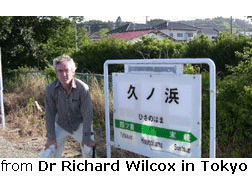 Japan’s Radioactive Potemkin Village: The Government’s Double-Dealing Data, rense.com. By Richard Wilcox, PhD, 4-12-14 “…..Sending People Back To The Death Zone
Japan has coordinated its big push to force residents back into the Death Zone with the cheerful news from the UN that there is “no increase in Fukushima cancer rates” due to radiation (20). While some residents are homesick and want to return, many are wary of returning due to radiation dangers (21).
The excellent website Simply Info summarizes the gist of a recent UN report which fallaciously claims there will be no cancers from Fukushima:
“UNSCEAR uses the fact that cancer can not be traced back to an origin to explain away any potential cancers from the Fukushima disaster. This tactic is well known among the tobacco and asbestos industries.
The source of the data used by UNSCEAR is primarily the IAEA, TEPCO and the Japanese government. Anyone who has been following events in Fukushima knows none of these sources are considered unbiased or accurate. Much dispute about the validity of the data from these entities exists. All of the data from other sources is ignored by UNSCEAR” (22).
A number of studies question the safety of both low and high radiation levels as well as the validity of the UN’s risk assessment model (23; 24; 25; 26; 27; 28).
Irrefutable proof of harm to living organisms from radiation are shown in studies that have already found innumerable forms of damage to wildlife in both Chernobyl, over a quarter a century ago, and in Fukushima today (29; 30). Birds of a feather in the nuclear age drop dead together …..”
* Richard Wilcox is a Tokyo-based teacher and writer who holds a Ph.D. in environmental studies and is a regular contributor to the world’s leading website exposing the Fukushima nuclear disaster, Rense.com. He is also a contributor to Activist Post. His radio interviews and articles are archived athttp://wilcoxrb99.wordpress.com and he can be reached by email for radio or internet podcast interviews to discuss the Fukushima crisis at wilcoxrb2013@gmail.com.
http://www.rense.com/general96/jpsradioctv.html
‘.
* Richard Wilcox is a Tokyo-based teacher and writer who holds a Ph.D. in environmental studies and is a regular contributor to the world’s leading website exposing the Fukushima nuclear disaster, Rense.com. He is also a contributor to Activist Post. His radio interviews and articles are archived at http://wilcoxrb99.wordpress.com and he can be reached by email for radio or internet podcast interviews to discuss the Fukushima crisis at wilcoxrb2013@gmail.com.
Japan Government malfeasance regarding the nuclear crisis is criminal
Japan’s Radioactive Potemkin Village: The Government’s Double-Dealing Data, rense.com. By Richard Wilcox, PhD, 4-12-14 “……..Plume Of Doom
Government malfeasance regarding the nuclear crisis is beyond the pale, criminal, diabolically evil, in fact. Was it stupidity, bureaucratic intransigence or an intentional plan to genocide the population that kept the government from protecting people at the time of the accident?
As scholar Kyle Cleveland notes in an important research paper which covers “Radiation Plume Politics and the SPEEDI disaster”:
“Despite having elaborate evacuation plans that previously had been coordinated with TEPCO, Baba Tomatsu, the mayor of Namie, initially learned of the nuclear disaster by watching it on TV and was bitterly resentful of the lack of consideration that put his village at risk: There was no coordination with the Japanese Government. Nothing. Baba Tomatsu: ‘They didn’t tell us where to evacuate. Nothing. Namie machi did everything by ourselves. And, disappointingly, because we didn’t hear anything from the government no advisories we used anything that we had—school buses and such—to move people out of the area. People’s cars were destroyed by the tsunami so we placed those people in those buses. At that time, the people who had ways to evacuate had already evacuated, to Miyagi, or Yamagata prefecture. So the 21,000 population were all scattered like a bee’s hive. Because we had no information we were unwittingly evacuating to an area where the radiation level was high so I’m very worried about the people’s health. I feel pain in my heart but also rage over the poor actions of the government… It’s not nice language but I still think it was an act of murder. What were they thinking when it came to the people’s dignity and lives? I doubt that they even thought about our existence’ ” (.
Many people have fled Fukushima specifically to protect their children’s health . Of course, Fukushima prefecture was not the only place to be doused with radiation. One researcher found that highly radioactive hot particles emitted from the accident landed 300 miles from the FNPP#1 and that people not only in Japan, but even in North America were breathing these particles into their lungs for a month after the accident …….”
* Richard Wilcox is a Tokyo-based teacher and writer who holds a Ph.D. in environmental studies and is a regular contributor to the world’s leading website exposing the Fukushima nuclear disaster, Rense.com. He is also a contributor to Activist Post. His radio interviews and articles are archived at http://wilcoxrb99.wordpress.com and he can be reached by email for radio or internet podcast interviews to discuss the Fukushima crisis at wilcoxrb2013@gmail.com. http://www.rense.com/general96/jpsradioctv.html
Chiho Takahashi: a volunteer reflects on the Fukushima nuclear tragedy
Japan’s Radioactive Potemkin Village: The Government’s Double-Dealing Data, rense.com. By Richard Wilcox, PhD, 4-12-14 A Volunteer Speaks
“………My colleague, Chiho Takahashi, a student at Tsuda College, recently wrote of her experiences as a volunteer to support the folks at the Adachi temporary housing facility:
“In November of 2012, I went to the Adachi temporary housing in Nihonmatsu for the first time. Almost all of the children that participated in our event were shorter than me, my height is 148 cm. But as I visited periodically during the next year and a half I noticed the children growing in height. In that way I could measure the passage of time and see that the victims’ lives were not “temporary” at all but taking place over a long period.
Children who were first grade students of elementary school became third grade students. Children who were first grade students of junior high school became high schoolers. I asked myself, ‘do you think that it is a temporary life?’ I could not think so.
In February of 2013 I had an experience where an elderly man let me into his house at the Adachi temporary housing. He lives in the house all alone. I went up his steps into his small quarters. There are four rooms in the house: kitchen, living room, bed room and bath. He showed me into the living room where there was akotatsu (Japanese foot warmer) and suggested that I warm myself in the kotatsu because it was very cold that day. We talked for about 30 minutes in afternoon and he told me about his children and grandchildren but he rarely sees them because they live in Tokyo and Miyagi prefectures. He was proud that he had done forestry and farming work using his big truck before he was forced to move to Nihonmatsu from Namie town because of the 3.11. disaster. Since then, he has lost everything and has nothing to do every day but drink in broad daylight. There were some bottles of rice wine and potato liquor on the table in the living room.
When I was heard his sad story I could only say to him that ‘that’s too bad.’ Although I felt I was not useful to him I tell people this story to people in Tokyo so they will know what a hard life it is in the temporary housing of Nihonmatsu.
I want many people to know the experience which I saw and heard and felt in Tohoku. I can’t carry out expensive projects like government, but I have always felt that I should try to do important things with my precious friends even if they might seem ‘small.’ In this way, maybe I can inspire more people from Tokyo to assist the refugees of the Tohoku and Fukushima disasters, even if it is just one person at a time. Our small volunteer made the singular effort to go to Nihonmatsu to assist the temporary housing residents, so too if each person made a small but sincere effort it might create a larger effect.”
* Richard Wilcox is a Tokyo-based teacher and writer who holds a Ph.D. in environmental studies and is a regular contributor to the world’s leading website exposing the Fukushima nuclear disaster, Rense.com. He is also a contributor to Activist Post. His radio interviews and articles are archived athttp://wilcoxrb99.wordpress.com and he can be reached by email for radio or internet podcast interviews to discuss the Fukushima crisisat wilcoxrb2013@gmail.com. http://www.rense.com/general96/jpsradioctv.html
Dwindling group of Hiroshima survivors bear witness to the nuclear horror
Hiroshima survivors offer peace and hope for nuclear disarmament April 13, 2014 SMH, Daniel Flitton The two young brothers looked into the bright blue sky and waved happily at the shiny plane flying far above.
Their sister, Emiko Okada, eight years old at the time, remembers an intense flash of light and her mother suddenly rushing into the yard to the children, bleeding from where shards of glass had lodged in her head.
Next came the fire – and people running, hair standing on end, white bones exposed, skin and flesh burning. People were vomiting, not just blood but black ooze from their nose and mouth.
Mito Kosei, in his mother’s womb at the time of the atomic attack, guides tourists around the memorial peace park in Hiroshima.
This was the day the A-bomb fell on Hiroshima.
Ms Okada is one of a dwindling group of survivors from that morning in 1945, determined never to let the terrible human cost of nuclear war be forgotten, even after they are gone.
”Frightening is not the world I can use, it was something much worse,” she said via a translator, still upset by the memory.
Emiko Okada who as an eight-year-old survived the atomic attack on Hiroshima.
Stories from the survivors, known in Japan as hibakusha, were told to foreign ministers of a 12-nation group, including Australia, gathered in Hiroshima at the weekend to kickstart global talks on nuclear disarmament.
Survivors’ stories are being preserved in an online archive by the Tokyo Metropolitan University………http://www.smh.com.au/world/hiroshima-survivors-offer-peace-and-hope-for-nuclear-disarmament-20140412-36k3t.html
Against public opinion Japanese government goes for nuclear power
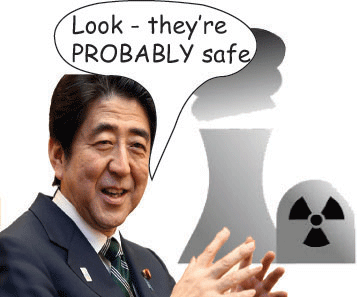 Japanese govt. abandons nuclear-free future in face of public opposition RT.com: April 11, 2014 The Japanese government has overturned its predecessor’s energy plan that would see all of the country’s nuclear power plants closed by 2030. The move – which has been opposed by the public – has been forced by spiraling energy costs.
Approved by the Liberal Democratic Party, which was not in power in 2011 when the Fukushima nuclear accident occurred, nuclear power has been described in the 20-year-plan as an “important baseload power source” – meaning its steady output will be fundamentally relied on for steady electricity generation.
“We aim to opt for an energy supply system which is realistic, pragmatic and well balanced,” Trade and Industry Minister Toshimitsu Motegi told the media on Friday.
Motegi said that the exact role of nuclear power in the energy mix would be decided once the state of its beleaguered energy industry would become clear in three or four years, but stressed that nuclear energy offered “security”.
A March survey showed that 59 percent of Japanese opposed the re-start of nuclear reactors, and only 12 percent had “no” or “minimal concerns” about the potential for another serious nuclear accident in Japan.
All 48 of Japan’s nuclear reactors are currently offline.
The government has ordered energy companies to spend over $16 billion upgrading its outdated and seismically vulnerable facilities to avoid a repeat of the worst nuclear accident since the Chernobyl accident in 1986.
This comes on top of the projected $100 billion cost of clearing-up the pollution and radioactive remains of the damaged Fukushima facility itself. …….
he reintroduction of nuclear may be too costly to solve the country’s energy shortfall.
Reuters recently compiled a report saying that it would make no economic sense to revive two-thirds of the country’s plants under the current stringent operating criteria.
“I think it is unavoidable that the Japanese utilities will write off most of their nuclear ‘assets’ and move on. Given the slim realistic prospects for a major nuclear share, the challenge will be flexibility and the whole baseload concept flies out of the window,” Mycle Schneider, a Paris-based energy consultant told the news agency.
The government’s energy plan also reserves a bigger role for renewable sources, which it says will double from the current 10 percent of the overall energy mix in the next sixteen years.
While green energy has widespread public support, this may be another plan that will require extra subsidy from government coffers flushed out by the 2011 natural disaster and the subsequent attempts to rectify previous mismanagement of the energy industry. http://rt.com/news/japan-nuclear-plan-fukushima-992/
Terrorism risk ignored, as Japan plans to produce plutonium
Japan reaffirms its plan to produce plutonium, Center for Public Integrity
The Abe government’s new energy plan calls for completing the Rokkasho plutonium fuel factory despite U.S. concern it poses terrorism risks By Douglas BirchemailJake Adelstein 12 April 14
Just weeks after Japan pledged to return hundreds of pounds of plutonium to the United States for disposal, the Japanese government on April 11 formally endorsed the completion of a factory designed to produce as much as eight tons of the nuclear explosive annually.
The plant is among the key elements of a long-range energy plan approved by Prime Minister Shinzo Abe’s cabinet, reversing the previous government’s efforts to phase out nuclear power in the wake of the March 2011 Fukushima disaster. The move is generally viewed in Japan as unpopular with the public but has been welcomed by Japan’s utilities, which are struggling with massive debts.
 The mammoth plant in the village of Rokkasho, scheduled to be completed in October, is meant to extract plutonium from spent commercial reactor fuel so it can be used in fresh fuel to be burned in the country’s reactors. “With safety first in mind always, Japan will promote…the completion of Rokkasho,” the energy plan states.
Publicly, the Obama administration has said little about Rokkasho, located on the Pacific Coast about 1,000 miles north of Tokyo. But privately, U.S. officials and experts say they are worried that Japan’s operation of the $22 billion facility – in the wake of the country’s closure of most of its nuclear power plants — will add unnecessarily to its existing stockpile of 44 tons of plutonium, some of which is stored in Japan and some in Europe.
U.S. officials have complained to their Japanese counterparts that the plant lacks an adequate security force, making it a potential target for terrorists. They have also urged Japan to subject the plants’ workers to stringent background checks, a move the Japanese see as being at odds with privacy traditions. U.S. experts also have expressed concern that the plant’s operation will encourage other countries, including South Korea, to constructsimilar plutonium factories.
Japan’s stockpile of plutonium today ranks fifth in the world, behind four nuclear-weapons states. The Chinese government in recent weeks has repeatedly expressed concern about Japan’s plans to produce plutonium “far exceeding its normal needs.”
Tokyo’s decision to proceed follows a joint announcement on March 24 by Abe and President Obama and Abe, at the Nuclear Security Summit in the Netherlands, that Japan would return hundreds of pounds of plutonium and weapons-grade uranium it received under the U.S. Atoms for Peace program in the 1960s and 1970s.
The two leaders said the transfer would further “our mutual goal” of keeping global stocks of nuclear explosive materials to a minimum, to keep them out of the hands of terrorists.
But critics say Rokkasho’s operation would violate that goal……..
Many communities in Japan are dependent on a stream of payments by the federal government to promote the siting of nuclear power plants, but a few have recently expressed concerns about the burning of plutonium-laced reactor fuels.
In early April, the city of Hakodate sued to halt work on a reactor that would be the first to burn such fuel. Hakodate’s Mayor Toshiki Kudo told reporters in Tokyo Thursday that the government and utility had ignored a plea from the municipality to suspend work on the Ohma plant and made “a unilateral announcement that it would go ahead with construction.”
Kudo called the plant “a terrorist target,” and said it could pose a greater safety risk than reactors fueled in other ways.
Angela Erika Kubo contributed to this article from Tokyo. http://www.publicintegrity.org/2014/04/11/14582/japan-reaffirms-its-plan-produce-plutonium
Fukushima Renewable Energy Institute opened
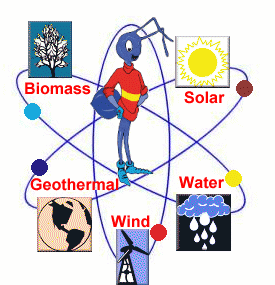 Fukushima embracing renewable energy research http://japandailypress.com/fukushima-embracing-renewable-energy-research-1047080/ Apr 10, 2014 John Hofilena Fukushima, the area in Japan which felt the brunt of what is now one of the world’s worst nuclear crisis since Chernobyl, is now hopefully turning over a new leaf amidst the struggle to rebuild and start the process of renewing that which was destroyed by the Great East Japan Earthquake and tsunami. It is now giving renewable energy a chance. On April 1, Japan’s National Institute of Advanced Industrial Science and Technology has just launched a renewable energy research and development center in Koriyama, Fukushima Prefecture.
The Fukushima Renewable Energy Institute, as it is called, opens three years after the Fukushima nuclear power plant suffered catastrophic meltdowns after the massive earthquake and tsunami that hit east Japan in March 2011. Much of Japan took a negative view of nuclear power starting from that time, and it is a testament to that negativity that 48 of Japan’s commercial nuclear reactors are offline at the moment. In the meantime, renewable energy sources such as solar and wind power have been in vogue in Japan. All of Japan’s renewable power sources are supplemental to fossil fuel-driven thermal energy at this point, but the situation may start to change.
Fukushima’s new R&D center will be at the center of a major project to develop the world’s most advanced energy technologies and make renewable energy Japan’s primary power source. Aside from the two new buildings, a solar power and wind power generation facilities also sit within the site. Major Japanese technology companies such as Hitachi, Sharp and Panasonic have jumped into the project and will conduct R&D at the center. The goal of the center is to develop state-of-the-art renewable technologies for implementation in various areas of the country. These new technologies will include new solar power innovations that improve energy conversion efficiency and a wind power generation system using laser lights — all of it exciting for Japan if all goes according to plan.
Japan’s energy efficiency success
 How Japan Replaced Half Its Nuclear Capacity With Efficiency https://www.greentechmedia.com/articles/read/how-japan-replaced-half-its-nuclear-capacity-with-efficiency
Is new coal really necessary in Japan? Lauri Myllyvirta and Justin Guay April 10, 2014 After the Tohoku earthquake in March 2011, Japan was in a seemingly impossible situation. A tremendous amount of conventional generation capacity, including the entire nuclear fleet, was unavailable, and the country faced the risk of power cuts during summer consumption peaks.
But miraculously, or seemingly so, in just a few short weeks Japan managed to avert the rolling power cuts that many believed inevitable. Even more impressive, the Japanese have turned these emergency measures into lasting solutions.
So how’d they do it without forcing people back to the Stone Age? Japan overcame this daunting task by tapping the cheapest and most widely available source of energy: energy efficiency and conservation. Much of the electricity savings were initially driven by a popular movement known as “Setsuden” (“saving electricity”). This movement emerged to encourage people and companies to conserve energy and prevent rolling power cuts. Simple measures such as increasing temperatures in homes and offices, “thinning” lighting by removing some of the bulbs and tubes, shutting down big screens and cutting exterior lighting enabled Japan to dramatically reduce power demand almost overnight (albeit at the cost of a small amount of personal comfort).
In addition to these measures, the dress code in offices was eased to reduce the need for AC, while commercial facilities were audited to identify potential savings.
These temporary measures have proven to have long-term impact. Continue reading
After a nuclear catastrophe, radiation victims become “unpersons”
 When life becomes a shadow – after nuclear catastrophe, Ecologist Robert Jacobs 8th April 2014 Those caught up in nuclear disasters suffer many times over, writes Robert Jacobs. Ill-health and early death aside, they are also cut off from their former communities, identities and family life, and the victims of social and medical discrimination. Radiation makes people invisible. We know that exposure to radiation can be deleterious to one’s health; can cause sickness or even death when received in high doses.
But it does more. People who have been exposed to radiation, or even those who suspect that they have been exposed to radiation that never experience radiation related illnesses may find that their lives are forever changed – that they have assumed a kind of second class citizenship.
They may find that their relationship to their families, to their communities, to their hometowns, to their traditional diets and even traditional knowledge systems have become broken. They often spend the remainder of their lives wishing that they could go back, that things would become normal.
Unpersons
They slowly realize that they have become expendable and that their government and even their society is no longer invested in their wellbeing.
As a historian of the social and cultural aspects of nuclear technologies I have spent years working in radiation-affected communities around the world.
Many of these people have experienced exposure to radiation from nuclear weapon testing, from nuclear weapon production, from nuclear power plant accidents, from nuclear power production or storage, or, like the people in the community that I live, in Hiroshima, from being subjected to direct nuclear attack.
 For the last five years I have been working with Dr. Mick Broderick of Murdoch University in Perth, Australia on the Global Hibakusha Project. We have been working in radiation-affected communities all around the world. In our research we have found a powerful continuity to the experience of radiation exposure across a broad range of cultures, geographies, and populations.
Fukushima – the victims’ future is all too predictable
About half way between beginning this study and this present moment the nuclear disaster at Fukushima Daiichi happened here in Japan.
One of the most distressing things (among so many) since this crisis began is to hear so many people, often people in positions of political power and influence say that the future for those affected by the nuclear disaster is uncertain.
I wish that it were so, but there is actually a deep historical precedence that suggests that the future for the people of Tohoku is predictable.
In this short article I will outline some continuities to the experiences of radiation-affected people. Most of the following is also true for people who merely suspect that they have been exposed to radiation, even if they never suffer any health effects.
Many have already become a part of the experiences of those affected by the Fukushima disaster. There are, of course, many differences and specificities to each community, but there is also much continuity…….. http://www.theecologist.org/blogs_and_comments/Blogs/2351503/when_life_becomes_a_shadow_after_nuclear_catastrophe.html
Fukushima insects have significant and unprecedented deformities
PHOTOS: Study finds deformities “significantly higher” in Fukushima insects — “To my knowledge, such deformations haven’t been reported” in species before — Lower body split in half, 2 tail-like appendages — 1,000% higher death rate in young than other Japan area — Urgent investigations called for, 8 April 14 http://enenews.com/photos-study-finds-deformities-significantly-higher-in-sample-of-fukushima-insects-to-my-knowledge-such-deformations-have-not-previously-been-reported-in-species-lower-body-split-in-ha?utm_source=feedburner&utm_medium=email&utm_campaign=Feed%3A+ENENews+%28Energy+News%29

Cancer rates nearly four times higher than world average near Fukushima
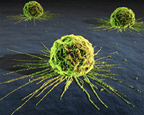 Japanese physicians link spike in cancer to Fukushima radiation http://www.naturalnews.com/044619_Fukushima_radiation_cancer_Japanese_physician.html, April 06, 2014 by: Ethan A. Huff, staff writer Cancer rates in many areas of Japan are on the rise following the global catastrophe at the Fukushima Daiichi nuclear power facility back in March 2011. And some Japanese doctors now caring for all those radiation refugees who were shipped out from areas surrounding the nuclear plant after it exploded say fallout from the disaster is likely to blame for this massive uptick in disease.
The German media group Deutsche Welle (DW) reports that many radiation refugees are having to watch as their family members and pets suffer gruesome fates at the hands of what appears to be radiation poisoning. One elderly woman told reporters that her dog lost all the hair around his neck, his skin turned black, and he eventually died, all signs that suggest a link to radiation.
Many people are also suffering, as evidenced by tests revealing an increase in thyroid damage among folks who lived in close proximity to the plant. One local doctor from Namie, a town located about 5.6 miles (9 km) from the Fukushima plant, has been examining patients ever since the disaster and is convinced that Fukushima radiation is causing a major public health crisis.
“Children and young people are particularly vulnerable to the uptake in radioactive iodine in their thyroid,” says Dr. Shunji Sekine, a retired physician with a medical practice in the city of Nihonmatsu, which is currently housing some 230 relocated families who evacuated other areas following the Fukushima disaster, as quoted by DW.
“Although comprehensive studies are missing, I see a connection between nuclear accidents and the occurrence of cancer,” adds the specialist in both thyroid and breast cancer, noting that he has observed a significant increase in both conditions following the nuclear catastrophe.
Cancer rates nearly four times higher than world average near Fukushima Cancer rates have been rising all across the region, in fact, with the latest data showing that 13 out of every 100,000 inhabitants, including many young children, are coming down with some form of cancer. Based on world averages for cancer, this represents a cancer rate that is nearly four times higher than the norm.
“According to official figures, 33 cancer cases have been identified in about a quarter of a million children and teenagers since the beginning of February,” reads the DW report. “This translates into 13 cases for every 100,000 inhabitants, a figure almost four times higher than the world average for all age groups.”
Forced evacuations exposed people to more radiation; Japanese government knew all along
The Japanese government has, perhaps not surprisingly, continued to downplay the severity of the situation, advising “further investigations” in order to avoid pinning the rise in disease on Fukushima. But the phenomenon almost exactly matches what occurred following the Chernobyl disaster, as well as the uptick in cancer rates following the dropping of atomic bombs on Hiroshima and Nagasaki by the U.S. during World War II.
Many of the people being diagnosed with radiation-associated diseases were also forced to trek through areas during their evacuation that had become poisoned by radioactive particles that drifted from the stricken plant. According to Dr. Sekine, who out of the kindness of his own heart is now allowing victims in his area to use a full-body screening machine to test for radiation poisoning annually, the forced relocation of these folks by the Japanese government actually exposed them to more radiation.
“Only four days after the explosion of the nuclear reactor, orders were given to evacuate the town of Tsushima in the northwest,” adds DW. “This led to the refugees being transported through the invisible radioactive cloud, resulting in even more exposure to contamination than if they had stayed at home.”
“Officials in Tokyo knew this from their computer models. But they remained silent, as they feared a widespread panic.”
Japan’s nuclear energy policy dangerously adrift
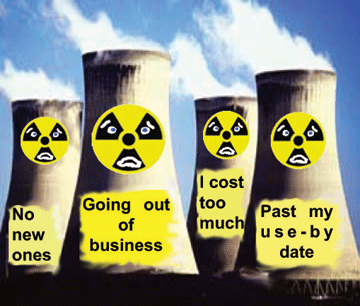 In the Wake of Fukushima: Japan’s Nuclear Energy Policy Impasse 60% of Japan’s 48 viable nuclear reactors,are not as yet being considered for application to the Nuclear Regulation Agency (NRA) for restart By Andrew Dewit Global Research, April 07, 2014
Asia-Pacific Journal Japan’s energy policy regime appears dangerously adrift in the context of accelerating climate change. The core problem is agency. On the one hand, Japanese PM Abe Shinzo and the nuclear village appear obsessed with nuclear power restarts and 20th century paradigms of the power economy. On the other hand, Japan’s anti-nuclear civil society lacks the political vehicle to force a combined nuclear pullout plus drastic reduction of greenhouse gas emissions. Some anti-nuclear forces do not yet understand the urgent need to reduce emissions, and are content to burn coal, despite of the patent threat of climate change. This is precisely what Japan has done in the wake of 3.11. The Abe cabinet is focused on getting restarts and a nuclear-based energy plan. Yet the scope for restarts is surprisingly limited and – incredible in this era of multiple crises and revolutions – the draft new energy plan lacks concrete numbers.1 The country needs better leadership on smart growth, in the context of what McKinsey specialists refer to as a “resource revolution”2 and MIT economists depict as “the second machine age.”3
Nuclear Is Probably No Longer Baseload
All of Japan’s 48 viable nuclear reactors are at present offline, and have been since September of 2013. The Abe cabinet is keen to restart as many of these as possible. But regulatory rules, public opinion and other factors constitute significant barriers to achieving even a third of Japan’s pre-Fukushima 30% reliance on nuclear power. That will mean nuclear will no longer be a “baseload” source of electricity, capable of supplying a reliable load to the grid at all times.
Indeed, an Asahi Shimbun survey of the utilities themselves indicates that fully 60% of Japan’s 48 viable nuclear reactors, meaning 30 reactors, are not as yet being considered for application to the Nuclear Regulation Agency (NRA) for restart. And of these 30 reactors, it appears that at least 13 are write-offs due to age, proximity to a seismic fault, and other factors that render them incapable of satisfying the new safety standards of the NRA.4 For that reason, at present there are only 17 reactors for which restart applications have been filed.
Of these, it appears – even to Japanese supporters of nuclear power – that perhaps only 8 will finally get approval and be restarted. Highly regarded energy specialist Tom O’Sullivan, of Mathyos Japan, concludes this on the basis of a survey of “various established Japanese policy institutes that are close to Japan’s industrial interests.” O’Sullivan notes that “[t]his level of restarts would only amount to 56 TWh of power output or 6% of Japan’s total power requirements and thus may not constitute a baseload power supply.”5
Reuters conducted its own analysis, using a broader set of questionnaires and interviews of over a dozen experts, along with input from the 10 firms that operate nuclear capacity. One suspects these operators painted as optimistic a picture of their restart prospects as possible. Even so, the result of this survey led Reuters’ expert journalists, Mari Saito, Aaron Sheldrick and Kentaro Hamada, to conclude that at best there will be 14 nuclear restarts at some point in time. They add that there is great uncertainty about the remaining 34 nuclear reactors. Their conclusion is that nuclear energy “will eventually make up less than 10 percent of Japan’s power supply.”6
Part of the reason nuclear appears not likely to recover its status as base-load power are the NRA’s new safety rules, in tandem with maintenance schedules and other factors that make a very shrunken fleet unreliable. But another large reason for this likely outcome is the stubbornness of the opposition to nuclear power………. http://www.globalresearch.ca/in-the-wake-of-fukushima-japans-energy-policy-impasse/5376899?utm_source=rss&utm_medium=rss&utm_campaign=in-the-wake-of-fukushima-japans-energy-policy-impasse
US gov’t shredded documents for 4 days while drawing up plans to evacuate Japan
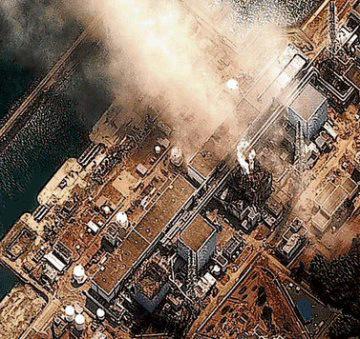 Fukushima Disaster: Professor, “Level of radiation was far worse than Navy officers anticipated”, Conservatve Read, US gov’t shredded documents for 4 days while drawing up plans to evacuate Japan — “Somebody was obviously very worried”
Jeff Kingston of Temple Univ., Apr. 4, 2014: Kyle Cleveland, my colleague […] recently published a report […] a critical, but nuanced picture of a crisis that was closer to careening out of control than is generally acknowledged. […] Naval officers […] discovered the level of radiation was far worse than they anticipated. Radiation gauges on the [USS Reagan] measured levels of radiation at 100 nautical miles off the coast that were 30 times greater than normal. [Sailors report] significant health problems due to exposure to radiation […] Cleveland finds that there was considerable disagreement between various U.S. agencies about the severity of the risk […]
Given that the U.S. government expanded the exclusionary zone in Fukushima to 80 km and developed contingency plans for a massive evacuation while shredding of documents continued for four days at the U.S. Embassy and military bases in Japan, somebody was obviously very worried. […] Some of his insider sources tell him that the crisis was actually far worse than anyone acknowledged at the time and that information was withheld to prevent a panic.
Cleveland concludes that Japan’s nuclear reactors should not be restarted……… http://conservativeread.com/fukushima-disaster-professor-level-of-radiation-was-far-worse-than-navy-officers-anticipated/
1 This Month





PLEASE OPPOSE HR 8255 AND S.3639 – bills would accelerate satellite deployment, with no environmental review or safeguards – https://ncstd5li.quorum.us/campaign/169331/
To see nuclear-related stories in greater depth and intensity – go to https://nuclearinformation.wordpress.com
-
Archives
- October 2026 (58)
- September 2026 (339)
- August 2026 (330)
- July 2026 (355)
- June 2026 (287)
- May 2026 (306)
- April 2026 (356)
- March 2026 (251)
- February 2026 (267)
- January 2026 (308)
- December 2025 (358)
- November 2025 (359)
-
Categories
- 1
- 1 NUCLEAR ISSUES
- business and costs
- climate change
- culture and arts
- ENERGY
- environment
- health
- history
- indigenous issues
- Legal
- marketing of nuclear
- media
- opposition to nuclear
- PERSONAL STORIES
- politics
- politics international
- Religion and ethics
- safety
- secrets,lies and civil liberties
- spinbuster
- technology
- Uranium
- wastes
- weapons and war
- Women
- 2 WORLD
- ACTION
- AFRICA
- Atrocities
- AUSTRALIA
- Christina's notes
- Christina's themes
- culture and arts
- Events
- Fuk 2022
- Fuk 2023
- Fukushima 2017
- Fukushima 2018
- fukushima 2019
- Fukushima 2020
- Fukushima 2021
- general
- global warming
- Humour (God we need it)
- Nuclear
- RARE EARTHS
- Reference
- resources – print
- Resources -audiovicual
- Weekly Newsletter
- World
- World Nuclear
- YouTube
-
RSS
Entries RSS
Comments RSS

