Health Situation in Fukushima – Arnie Gundersen
Excerpt 1
Arnie Gundersen: “I’ve been reflecting a lot over the last week and a half about what the trip meant to me personally and what I learned… The first thing is [the people are] terribly concerned about their country and concerned about their children… The second thing is the inhumanity of the Japanese government, the Japanese utilities and the Japanese banks toward their own population. I’m just appalled at how the power structure in Japan is ignoring what its people want and basically ramming nukes down the throat of their population… I think [the media sources in Japan] still feel pressure under that State Secrets Act. Nobody wants to push too hard against [Prime Minister Shinzo Abe’s] administration. As a matter of fact, one of Abe’s prime key ministers came out and said twice now that if… the media doesn’t say what the administration wants them to say, they’re going to pull their licenses.”
Excerpt 2
Arnie Gundersen: “The one thing I learned when I was in the resettlement communities [of people evacuated due to the Fukushima nuclear crisis] is that they’ve all been told that there will be no resettlement communities by the time the Olympics start. The plan is to move people back into their homes in the contaminated areas, or to move them somewhere else in Japan to permanent homes”… (Maggie Gundersen, founded of Fairewinds Energy Education:) “I was devastated when I saw some of the pictures that you took in Japan… these temporary housings just look like military barracks on bare pavement… And now to hide the radiation, extensive radiation, that’s there and re-depositing in the already cleaned areas from snowmelt, flooding, and rain — and to say it’s okay and send everyone back is a death sentence to all these families and children and grandchildren.”
Excerpt 3
Arnie Gundersen: Yeah, let me get back to the first thing I said about the inhumanity toward their own people. We had doctors tell us when they treated somebody for radiation illness, if they put radiation illness on the hospital forms, the government refused to pay. So doctors were literally going out of business because they were doing their job and treating people. But the other thing I learned on the last day of the trip was that there’s a huge spike in the death rates within Fukushima Prefecture for young children compared to what it was in previous years. But that story has been stifled by the Japanese medical and government agencies. Nobody’s publishing the data that the Japanese have been publishing for years leading up to the disaster. So where are the death data on Fukushima Prefecture? And the answer is it hasn’t been published because the Japanese government doesn’t want it out there. When you control the medical community, the epidemiological data that you need to prove a case is really, really difficult. I think Fairewinds did a good job in the time we were over there getting sample data with a group of scientists that may affect the way the world looks at the disaster. But the other half of that is, you’ve got to get the doctors on board to report honestly what they’re seeing. And the medical community is even more under the thumb of the Abe regime than is the press. It’s very depressing.” … (Maggie Gundersen:) “I want to let you know that Arnie and other scientists are working on some really significant studies from samples that scientists have taken in Japan… Fairewinds will be participating in a report that will be issued on this and we will keep you up to date. It takes time to do this testing, but as soon as it’s ready, it will be publicized.”
http://www.fairewinds.org/podcast//put-on-a-happy-face-japan-speaking-tour-series-no-4-1
Court rejects appeal to halt operations of Sendai reactors

Lawyers hold up signs describing the April 6 ruling by the Miyazaki branch of the Fukuoka High Court as being unjust.
MIYAZAKI–A high court here rejected an appeal by Kyushu residents seeking to shut down the only two nuclear reactors operating in Japan, ruling that it is impossible to secure absolute safety with nuclear energy.
Presiding Judge Tomoichiro Nishikawa of the Miyazaki branch of the Fukuoka High Court said April 6 that current science and technology standards cannot reach a level of safety in which no radioactive materials are emitted regardless of the severity of the accident at a nuclear plant.
“A judgment has to be made based on the standard of what level of danger a society would be willing to live with,” Nishikawa said.
The court did not set any danger level, but it did rule that there was no convincing reason to issue a temporary injunction against the operations of the No. 1 and No. 2 reactors of the Sendai plant run by Kyushu Electric Power Co. in Satsuma-Sendai, Kagoshima Prefecture, in southern Japan.
The plaintiffs argued that the Nuclear Regulation Authority’s new safety standards, established after the disaster unfolded at the Fukushima No. 1 nuclear plant in 2011, underestimated possible damage to the plant caused by a powerful earthquake.
Nishikawa dismissed the argument, saying the standards “were at an extremely high level of rationality because it was needed to secure safety.”
Nishikawa, however, did describe as “irrational” the NRA’s assessment of volcanic eruption risk near the Sendai nuclear plant. That assessment was preconditioned on predicting the timing and scale of volcanic activity that would cause extensive damage to a wide area.
But the judge added that there was no basis for believing that such an eruption might occur while the plant was in operation. He concluded that “a political decision” would have to be made about whether to consider the risks related to such eruptions.
The plaintiffs, from the three Kyushu prefectures of Kagoshima, Kumamoto and Miyazaki, are considering appealing the latest ruling to the Supreme Court.
Kyushu Electric Power issued a statement on April 6 that said the ruling acknowledged the company’s past arguments that safety of the plant had been secured.
Setting a standard for an acceptable danger level could untangle the differing court decisions on the operations of nuclear reactors.
In March, for example, the Otsu District Court raised doubts about the NRA’s safety standards and ordered an injunction against two reactors at the Takahama nuclear plant in Fukui Prefecture in central Japan.
The lawsuit for an injunction against the Sendai plant was filed with the Kagoshima District Court in May 2014.
The district court rejected the plaintiffs’ request in April 2015. A few months later, in August, the No. 1 reactor at the Sendai plant became the first in Japan to resume operations under the new safety standards. The No. 2 reactor was restarted in October.
A major point of contention in the lawsuit was Kyushu Electric Power’s estimate of the largest possible quake that could hit the Sendai plant.
The plaintiffs argued that the utility’s figure, based on an average of past quakes, was defective because it underestimated the potential of possible future quakes. The residents also said their rights would be violated if a major accident occurred at the Sendai plant.
Kyushu Electric Power countered that its estimate was based on the new safety standards that reflected the latest knowledge about earthquakes.
The company said there was no specific danger of a major accident at the plant because the anti-quake measures implemented were sufficient.
The plaintiffs had also cited problems with the evacuation plans for the Sendai plant that could endanger their human rights.
But Nishikawa pointed to the approval given by the Nuclear Emergency Preparedness Commission to the evacuation plan, which was described as specific and rational because it laid out measures according to distance from the nuclear plant.
http://www.asahi.com/ajw/articles/AJ201604060045.html
Freezing of soil near Fukushima plant going well, says TEPCO

Rainwater is discharged from newly constructed drainage outlets into the plant’s harbor during a media tour at the Fukushima No. 1 nuclear power plant on April 4.
The freezing of soil around the Fukushima No. 1 nuclear power plant to block the flow of groundwater is proceeding “largely smoothly,” the plant operator said April 4.
Tokyo Electric Power Co. started making a frozen underground wall in late March around the No. 1 to No. 4 reactors at the plant, which suffered a triple meltdown triggered by the March 2011 earthquake and tsunami.
The final part of the construction process to freeze the soil was unveiled to the media for the first time April 4 during a visit to the site by Yosuke Takagi, state minister of the economy.
To build the frozen soil wall to prevent groundwater flowing into the four reactor buildings and becoming contaminated with radioactive substances, the utility inserted 1,568 pipes to a depth of 30 meters and 1 meter apart.
The company is now circulating liquid with a temperature of minus 30 degrees through the pipes to first freeze the soil on the side of the sea so as not to drastically change the groundwater level at the plant.
As of April 4, the soil temperature had dropped to minus 4 to 6 degrees at some locations, according to TEPCO.
“While we need to keep making efforts to control the temperature deliberately, we can say that the project is proceeding largely smoothly so far,” the company spokesman said.
The utility also unveiled new drainage outlets for the K drainage channel to discharge water into the plant’s harbor and block it from being released into the outer ocean.
The construction of the new outlets was completed March 28. Radiation-contaminated rainwater coming through the K drainage channel had previously often flown into the outer ocean when it rained.
GroundTruth Films: Fukushima Diary
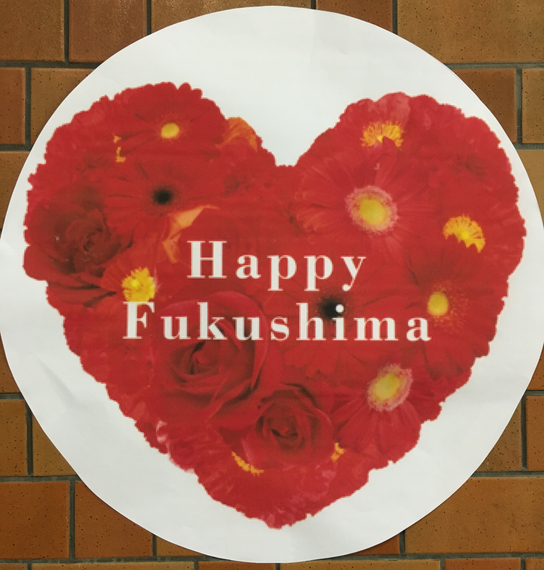
Signs covering Fukushima Station are a distraction from the fact that 100,000 people are still displaced in the Prefecture.
Burn clothes: Wear ‘em, toss ‘em. That’s the spirit in which Beth Balaban and I packed for our final filming trip to Fukushima for Son of Saichi. We also brought burn pillows, burn shoes, burn socks, burn slippers, burn blow up mattresses… Safe to say, nothing in our suitcases is coming home with us.
On our previous three trips we’ve stayed outside the evacuated contamination zone, traveling in and out for brief periods daily. This time we’re staying inside Yamakiya, a village evacuated after the earthquake, tsunami and nuclear power plant meltdown five years ago. And even though radiation levels here aren’t of the sci-fi-turn-your-skin-neon-green variety, scientists we’ve talked to admit that even after being part of the nation’s $10 billion clean-up effort, it’s still not a place they’d want to live.
Yamakiya’s evacuation didn’t come right away after the March 2011 disaster. It came a few months later when prevailing winds and seasonal rainfall took a toxic road trip, traveling like the Shinkansen over hills and valleys, and along Rte. 114 past the home of Hidekazu Ouichi, a lifelong farmer and son of Saichi, a Hiroshima survivor.
We’re here now because Hidekazu got word from the government late last year that he could – finally – move back home April 1st. But when he picked us up from the Fukushima train station, we found out the government has changed its mind again about lifting the evacuation orders. No, they now say, he can’t move back until September.
He’s moving back anyway. Another 31 families are, too. (Most former residents are rejecting any offer to live here.)
On the 30-minute drive to Yamakiya, I realize I’m more worried about what’s measured in pixels and decibels than becquerels or microsieverts. There’s a television screen embedded in the dashboard of Hidekazu’s new Toyota, and Japan’s national obsession – cute, quirky mascots – are on full display. Eyes on the road, Hidekazu!

Now that he’s home, Hidekazu finds it hard to break his lifelong habits and those of his ancestors. The family farm has always been land to live off, always a place of sustenance, and it’s difficult for him to see it any other way.
That’s why we’re not surprised when he opens the freezer to show us feet from a wild boar he and his friends caught in the backyard. A ghost town for the past five years, this area became overrun with wild animals – especially boar which Hidekazu says have gotten so used to gallivanting around town that “they roam freely inside abandoned houses, and come right up like a dog and wag their tails at you.”

The boar pre-freezer.
The bad news is that wild boar – tasty as their feet might be – eat mushrooms which are among the most contaminated plants in Yamakiya’s forest. Cesium builds up inside the body of boars because of it. When Hidekazu tested this boar to see just how radiated it was, he measured 12,000 becquerels. (One becquerel is defined as the decay of one atom of a radioisotope per second. So if your Geiger counter detects the radiation of one decay coming from a sample – say, a boar – in one second, then that sample has one becquerel of radiation.) 12,000 becquerels is astronomically higher than the 500 allowed by the government.

Crew member and animator Christian Schlaeffer puts his Geiger counter to the frozen boar feet.
Hidekazu offered to cook the feet up for us for dinner. We politely declined.
Oh, who am I kidding? We told him he was crazy and there wasn’t a chance in hell we’d eat it, and neither should he! But if our previous trips have told us anything, it’s that Hidekazu will eventually convince us to eat or drink something that will surprise us and amuse him. I suspect it’s just a matter of time before the killer bee liquor comes out of the cabinet.
http://www.huffingtonpost.com/beth-murphy/groundtruth-films-fukushi_b_9605966.html
150 Fukushima No. 1 workers who got maximum radiation dose at start of crisis can now return to plant
Some 150 people who worked at the crippled Fukushima No. 1 nuclear power plant whose cumulative radiation dose exceeded 100 millisieverts will be able to return to the facility starting April 1.
By law, nuclear plant operators are required to record and manage the radiation exposure of each worker over a five-year term to ensure their dosage doesn’t exceed safe limits.
According to Tokyo Electric Power Co., 150 Tepco workers and 24 subcontractor workers who dealt with the meltdown disaster that occurred right after the March 11, 2011, earthquake and tsunami were exposed to radiation exceeding the limit. As of March 1, 129 of the Tepco employees were still working at the utility. They were moved to other divisions based on the government directive.
Since the five-year term for the workers ended in March, Tepco said it hopes experienced hands will return to engage in the decommissioning of the plant to contribute to safety at the site.
But Tepco said it will not push them to return and said those who wish to go back will be managed under a new exposure regime designed to limit a worker’s lifetime radiation dosage to 1,000 millisieverts in line with recommendations made by the International Commission on Radiological Protection.
Last year, the Ministry of Health, Labor and Welfare created the new regime, which requires nuclear plant operators to set individual limits for workers based on their age and past exposure to radiation.
In total denial of the low-dose internal irradiation effects
Another marvelous spin propaganda article minimizing the dangers of the radiation in Fukushima, from the Asahi Shimbun.
If you watch that press conference from the beginning to the end, you may have different impression about their work. They do not pay any attention to the effect of the low-dose internal irradiation. Such omission being very convenient to promote the fallacy that life in Fukushima is very safe.
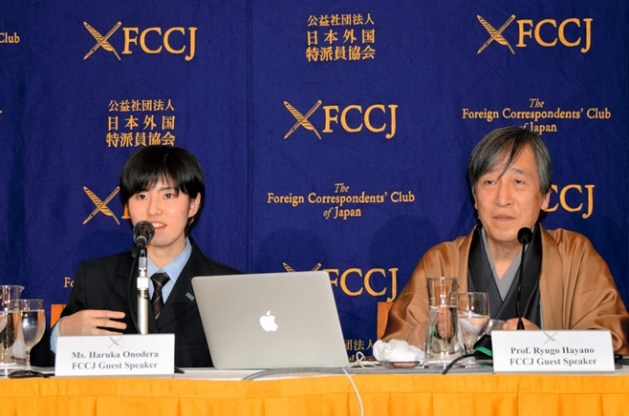
Haruka Onodera, a third-year student at Fukushima High School, holds a news conference with University of Tokyo professor Ryugo Hayano at the Foreign Correspondents’ Club of Japan in Tokyo on Feb. 8.
Fukushima students reach out to tell truth about radiation
Struck by ignorance about the 2011 nuclear disaster, high school science club members in Fukushima Prefecture enlisted the help of fellow students around Japan and abroad for a comparative study on radiation doses.
The results surprised even those living in the prefecture that hosts the Fukushima No. 1 nuclear power plant.
“The individual doses (of external radiation exposure in high school students) were almost equal inside and outside of Fukushima Prefecture, and in European areas,” Haruka Onodera, 18, said in English at the Foreign Correspondents’ Club of Japan (FCCJ) in Tokyo on Feb. 8.
A German correspondent asked her, “Would you declare Fukushima now safe?”
“Actually, we didn’t measure the doses in people living in the contaminated areas, so we can’t say all of Fukushima is safe,” Onodera answered, often pausing in thought in the middle of her words and phrases. “But I hope we will send (personal dosimeters) to contaminated areas and help do risk management for people living there in the future.”
Onodera, a third-year student of Fukushima High School and member of the physics and radiation division of the school’s Super Science Club, also showed explanatory slides at the FCCJ news conference titled, “Fukushima and radiation monitoring. The goal of the project is to show the realities of Fukushima Prefecture to the rest of the world.
The club’s physics and radiation division started the project in summer 2014. It involved 216 high school students and teachers in Japan and abroad carrying personal dosimeters for two weeks.
Six high schools in Fukushima Prefecture–Fukushima, Adachi, Aizu Gakuho, Iwaki, Asaka and Tamura–and another six located elsewhere in Japan–including in Gifu, Kanagawa, Nara and Hyogo prefectures–were involved in the project.
They were joined by 14 high schools from France, Poland and Belarus.
According to the measurements taken by the students, the annual radiation doses in Fukushima Prefecture ranged between 0.63 and 0.97 millisievert. For elsewhere in Japan, the range was from 0.55 to 0.87 millisievert, while in Europe, the annual doses were between 0.51 and 1.1 millisieverts.
The similar levels of external doses are believed to be partly attributable to the lower level of natural background radiation in Fukushima Prefecture compared with that in western Japan. That finding came from an analysis of a database on the radioactive content of soil in areas surrounding the different high schools across Japan.
Onodera, who was seated next to Ryugo Hayano, a professor of physics with the University of Tokyo, at the FCCJ news conference, had also presented the study results last year to a workshop of high school students in France and a conference on Fukushima foodstuffs held on the sidelines of an international food exposition in Italy.
Two second-year students of the Super Science Club–Minori Saito, 17, and Yuya Fujiwara, 17–gave a talk at a workshop organized in Date, Fukushima Prefecture, by the International Commission on Radiological Protection late last year.
First- and second-year students who are members of the club, joined by eight high school students from France, visited peach farmers and shiitake mushroom growers in Fukushima Prefecture in summer last year. It was part of a program for studying the current state of Fukushima from diverse views.
The students wanted to address global audiences after they were shocked by how little was known about the actual state of Fukushima Prefecture.
“Can humans live in Fukushima?” a French high school student asked the Fukushima students over Skype as part of an international exchange program in 2014.
That prompted the Japanese students to determine the actual situation on their own, and compare it with circumstances elsewhere in Japan and abroad. Hayano advised them to undertake the endeavor when he visited Fukushima High School to give a talk.
The findings of the study were surprising. Most of the Fukushima students expected the doses in Fukushima would be the highest, even by a large margin.
The students also studied how behavior affected the dose levels.
The Fukushima High School students were being exposed to lower radiation levels when they were at school than when they were at home. They believe the school’s concrete buildings provided a more effective shield from radiation sources than the wooden houses did.
By contrast, students attending Ena High School in Gifu Prefecture were exposed to more radiation when they were at school, where granite, containing radiation sources, is used in the buildings.
Their analysis results were published in November in a British scientific journal on radiological protection. Onodera was involved in writing the research paper.
“The experience has brought home to me how important it is to address reality objectively and scientifically,” she said.
Onodera said she was growing more interested in basic sciences and dreams of doing research on molecular biology at university.
“We hope to solicit help from people in evacuation zones within Fukushima Prefecture, and from high schools in countries we have yet to address, in further broadening our study,” said Takashi Hara, a teacher and adviser to the science club’s physics and radiation division.
‘Ice Wall’ Is Japan’s Last-Ditch Effort To Contain Fukushima Radiation
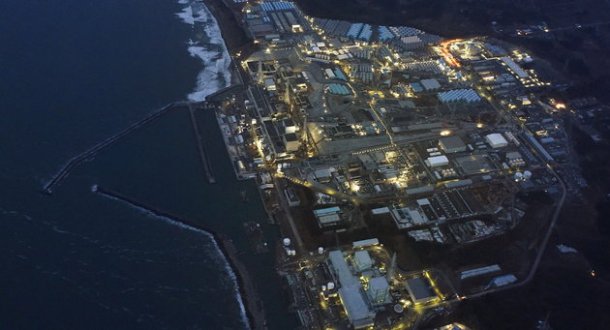
Tokyo Electric Power Co.’s (TEPCO) tsunami-crippled Fukushima Daiichi nuclear power plant is illuminated for decommissioning operation in the dusk in Okuma town, Fukushima prefecture, Japan, in this aerial view photo taken by Kyodo March 10, 2016, a day before the five-year anniversary of the March 11, 2011 earthquake and tsunami disaster.
• The nearly mile-long structure consists of underground pipes designed to form a frozen barrier around the crippled reactors.
• The $312 million system was completed last month, more than a year behind schedule.
• Nearly 800,000 tons of radioactive water are already being stored onsite.
Japanese authorities have activated a large subterranean “ice wall” in a desperate attempt to stop radiation that’s been leaking from the Fukushima Daiichi nuclear power plant for five years.
The wall consists of a series of underground refrigeration pipes meant to form a frozen soil barrier around the four reactors that were crippled during the 2011 Tohoku earthquake and tsunami.
Construction of the $312 million government-funded structure was completed last month, more than a year behind schedule, the Associated Press reports. The nearly mile-long barrier is intended to block groundwater from entering the facility and becoming contaminated.
Tokyo Electric Power Co., or TEPCO, which owns the plant, activated the system Thursday, a day after obtaining approval from Japan’s Nuclear Regulation Authority.
In a video detailing the ice wall’s design, TEPCO said the technology has been successfully used to prevent water intrusion during the construction of tunnels, but this is the first time it has been used to block water from entering a nuclear facility.
“We will create an impermeable barrier,” the company said, “by freezing the soil itself all the way down to the bedrock that exists below the plant. When groundwater flowing downhill reaches this frozen barrier it will flow around the reactor buildings, reaching the sea just as it always has, but without contacting the contaminated water within the reactor buildings.”
TEPCO says the ice wall will be activated in stages over the next several months and is one of several measures the company is taking to reduce the amount of water being contaminated on the site.
Nearly 800,000 tons of radioactive water are already being stored in more than 1,000 industrial tanks at the nuclear plant, according to the AP.
While hopes are high that the ice wall will prove successful in stopping additional radioactive water from seeping into the Pacific Ocean, Shunichi Tanaka, chairman of the Nuclear Regulation Authority, urged caution.
“It would be best to think that natural phenomena don’t work the way you would expect,” he told reporters Wednesday, according to the AP report.
The activation of the ice wall comes just weeks after a TEPCO official reported that robots designed to access the dangerous interior of the plant and seek out the melted fuel rods were “dying” from the high levels of radiation.
The video below details how the ice wall is expected to work.
Telling the Story of Fukushima
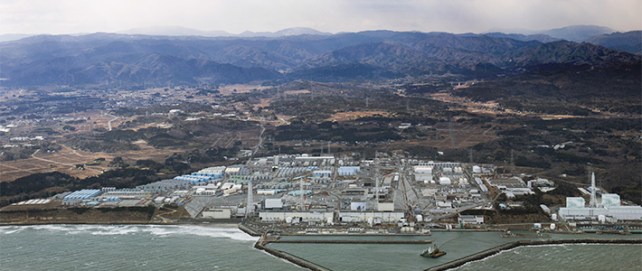
Different Approaches to Remembering 3/11 at the Prefecture’s Museums
Five years after the March 11 earthquake and tsunami touched off a triple meltdown at the Fukushima Daiichi nuclear power plant, the disaster is no longer just a current event—it is also a part of Japan’s history. But how should that history be told? Government and civil society groups have different answers, and they are starting to emerge in a battle of museums.
A Tale of Two Museums
In a flurry of caption writing and message tweaking, Fukushima prefectural government officials are currently putting the finishing touches on a major new exhibit about the disaster at the Fukushima Daiichi Nuclear Power Station. Starting this summer, the exhibit will be permanently displayed at the ¥20 billion Fukushima Prefectural Center for Environmental Creation in the town of Miharu. Plans are in the works to send every fifth-grade student in the prefecture on a field trip to view it. The goal, according to the organizers, is to “address the worries and concerns of Fukushima residents, further understanding of radiation and environmental problems, and deepen awareness of environmental recovery.”
Some 40 kilometers away, in a small post-and-beam hall in the city of Shirakawa, a group of local citizens are planning a very different kind of exhibit. Their displays focus on the ways in which the government exacerbated the disaster and disregarded the rights of Fukushima residents in its aftermath. They will be exhibited at the Nuclear Disaster Information Center, which was built in 2013 using ¥30 million yen in donations from the public, with the goal of ensuring Fukushima and its lessons are not forgotten.
These two projects represent divergent understandings of how the Fukushima nuclear disaster should be remembered. Given their vastly unequal resources and reach, they also raise questions about the appropriate role of government in memorializing the disaster that rocked Japan and the world five years ago.
“People who have suffered from the Fukushima disaster have doubts about whether a public facility like the Center for Environmental Creation can truly communicate the lessons of an accident for which the national and prefectural governments bear partial responsibility,” says Gotō Shinobu, an associate professor at Fukushima University, who is involved in planning the alternative exhibit in Shirakawa.
A Familiar Story
The quiet battle over historical interpretation that is playing out in Fukushima has a precedent in the seaside city of Minamata, Kumamoto Prefecture, the site of one of the most devastating industrial disasters in world history. Thousands of people living in the area were killed or severely sickened by mercury after Chisso Corporation dumped industrial waste from its chemical plant into the bay over the course of several decades, contaminating fish and shellfish and poisoning the people who ate them. Fifty years later, public and private museums in the area are still telling different versions of that history.
One version can be found at the Minamata Disease Municipal Museum, which was established in 1993 with the goal of “handing down the lessons and experiences of Minamata Disease,” according to its mission statement. Videos and panels in the ¥6 billion facility relate the history and science of the disaster, and victims are on hand to share their personal experiences. But Endō Kunio, a board member and employee of the nonprofit victims’ support organization Sōshisha, says the museum fails to communicate the disaster’s true lessons. “Simply lining up events does not equate to history,” he says. “The facts of what happened are there, but the museum doesn’t say much about their meaning.”
Since 1988, Sōshisha has run its own museum, which displays fishing gear, protest flags, and other artifacts in a converted mushroom-cultivation shed. Among its founding principles is the goal of recording the struggles of the victims and the culpability of government and industry. “Our starting point is the perspective that Minamata Disease resulted from criminal activities on the part of Chisso Corporation and the national government,” says Endō. That perspective has shaped the low-budget museum into a symbol of resistance against the sanitization of painful historical events.
Fukushima Fault Lines
The divide in Fukushima falls along similar lines. The exhibit at the prefectural center will include a timeline of events since the meltdowns, a “radiation lab” explaining the science of radiation and measures to reduce exposure, and a large display on efforts to increase renewable energy and sustainability in the prefecture, according to an overview released last year. Although the exhibit advocates for a “Fukushima that does not depend on nuclear power,” reporting by the Tokyo Shimbun has pointed out that its planning board included several members with close ties to the nuclear industry.
In 2014, shortly after planning began, a citizen’s group with antinuclear leanings called the Fukushima Action Project sent a letter to the prefectural authorities expressing concern over the exhibit. The group requested, among other things, that the center not minimize the health risks of radiation. Since then, FAP representatives have met eight times with prefectural officials to discuss the content of the exhibits. According to meeting transcripts posted on the group’s website, they expressed concerns this January that the exhibit still does not adequately address the severe and ongoing water pollution caused by the disaster or the huge amounts of radioactive waste generated by the cleanup.
Fukushima prefectural officials, meanwhile, note that the exhibit does not touch on government or industry culpability, the fact that radiation exposure limits were raised after the disaster, or the pollution and waste problems because “these issues are not pertinent to the goals of the exhibit.” The facility’s goal, they explain, is “supporting educational activities related to radiation and the environment”; in response to public concerns about the exhibit, they state only that the exhibit content was determined by a panel of experts.
Nagamine Takafumi, the director of the Nuclear Disaster Information Center, is also deeply skeptical about the public museum. “We believe the goal of the Fukushima Prefectural Center for Environmental Creation is to create a myth of radiation safety,” he said. He and his colleagues are currently planning two permanent exhibits for their center. One, designed by Fukushima University’s Gotō, will compare global teaching materials on nuclear power and highlight the Ministry of Education’s pronuclear bias before the disaster. The other will examine the failure of all but a few municipalities in Fukushima to distribute potassium iodide pills immediately after the accident, which would have lowered residents’ risk of developing thyroid cancer.
A Third Perspective
Another private, but less politically driven, museum operates from an outbuilding at an abandoned school in the village of Kawauchi, about 25 kilometers inland from the nuclear plant. Called the Kangaeru Shirōkan, which translates roughly to “a museum for feeling, thinking, and understanding,” the free facility displays protective bodysuits, radiation meters, photographs, town newsletters, and other artifacts of the meltdown.
The museum was founded in 2012 by Nishimaki Hiroshi, a local journalist who moved to the area from Saitama Prefecture nine years ago. He says that in the months following the disaster, he wanted to do something constructive, but felt immobilized by the scale and complexity of the meltdown’s aftermath. When novelist and longtime friend Taguchi Randy suggested he open a museum, he acted on the idea.
The displays include scant explanatory text, and Nishimaki is rarely on site to act as a guide. His says his goal is simply to present the reality as locals have experienced it so that it will not be forgotten. “The government does bear some responsibility for what happened, but I don’t think of the displays as a way to attack them,” he says. Still, he has avoided government funding in order to maintain complete freedom in what he exhibits.
An Inevitable but Unequal Divide
It is hardly surprising that views of environmental catastrophe differ in private and public museums. Government actors partially responsible for a disaster are unlikely to be objective in planning a museum to memorialize it, and civic organizations that include disaster victims are equally unlikely to put aside their own experiences when interpreting the same events. In the case of the Fukushima disaster, divergent views on nuclear power further shape the messages presented in museums.
Public and private projects of historical interpretation can in this sense complement one another. Yet there is little chance the majority of the public will be exposed to both perspectives. As Gotō points out, the budget of the public museum is over 600 times that of the private one he is involved with, and visits to the private museum are not a part of any official school curriculum.
Last year, national and local officials met to discuss another large, government-funded museum focused on the nuclear disaster, this one planned to open on the prefecture’s coast some time in the coming decade. Although they haven’t asked, Minamata’s Endō has a piece of advice for them.
“It is all-important that the story of what happened be told by the people who live in that place,” he says. “When government officials and civil society groups interpret for them, it becomes something different.”
Contaminated water, fuel extraction stand in way of decommissioning Fukushima plant
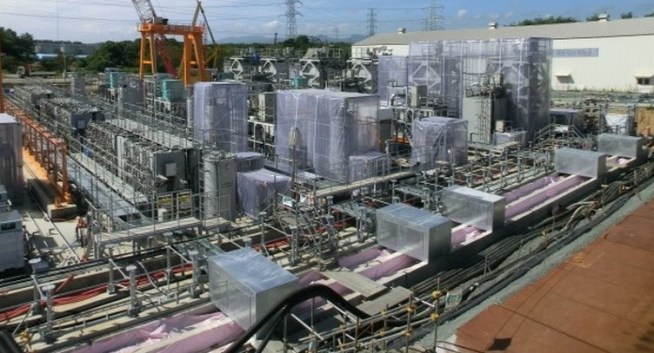
The Advanced Liquid Processing System (ALPS) is seen in September, 2012
With about five years having passed since the start of the Fukushima No. 1 Nuclear Power Plant disaster, nuclear workers still lack a method of treating the around 1,000 tanks of contaminated water stored on site, and the start of work to remove melted nuclear fuel from the plant remains at least five years away.
“Until the contaminated water issue is solved, decommissioning of the reactors remains far off. We have to stop the water,” says Tetsuo Ito, professor of nuclear energy safety engineering at the Kinki University Atomic Energy Research Institute. Akira Ono, chief of the Fukushima plant, says, “We’re still at step one” of the decommissioning process, which is estimated to take until 2041 to 2051.
Tokyo Electric Power Co. (TEPCO), the plant’s owner, is treating the contaminated water with its Advanced Liquid Processing System (ALPS), which can remove 62 varieties of radioactive material. However, ALPS cannot remove radioactive tritium, and because of this the treated water is stored in tanks. Tritium is extremely difficult to separate from water, because even if one of the hydrogen atoms in a water molecule is replaced by tritium, the chemical properties such as the boiling point barely change.
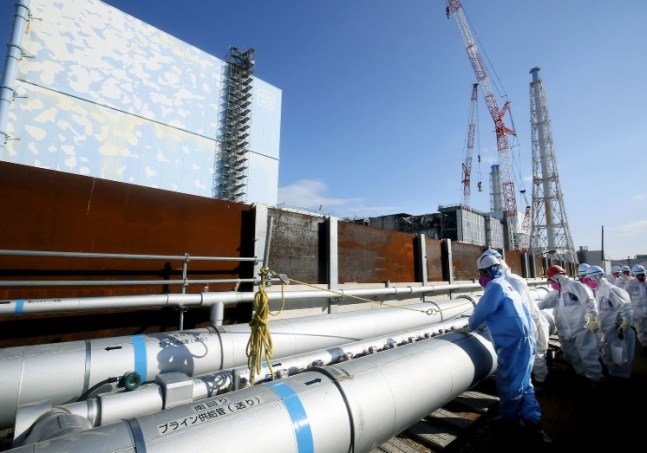
Pipes for an underground frozen wall to block contaminated water leakages are seen on the landward side of the Fukushima No. 1 Nuclear Power Plant, on Feb. 23, 2016.
The International Atomic Energy Agency (IAEA) has advised that tritium-containing water be released into the ocean, because its effect on the human body is very limited. Tritium-containing water is created even during the normal operation of a nuclear power plant, and it is released into the ocean in accordance with waste-disposal standards. However, there is local opposition to doing this at the Fukushima plant because of worries about its effects on the reputation of the local fishing industry, and no decision has been made on what to do with the water.
Tritium has a half-life of 12.3 years, so storing the water until the radiation naturally lessens is another option, but there is the risk of leaks during that time if the tanks’ conditions deteriorate.
As for decommissioning the plant reactors, at the end of 2011 the national government put together a roadmap that estimated the decommission work would take 30 to 40 years. To decommission the No. 1 through 3 reactors at the plant, 1,573 units of spent fuel will have to be removed from the spent fuel pools of these reactors, and 1,496 units’ worth of fuel that melted from the reactors will have to be removed. Safe removal of the melted fuel represents the largest problem.
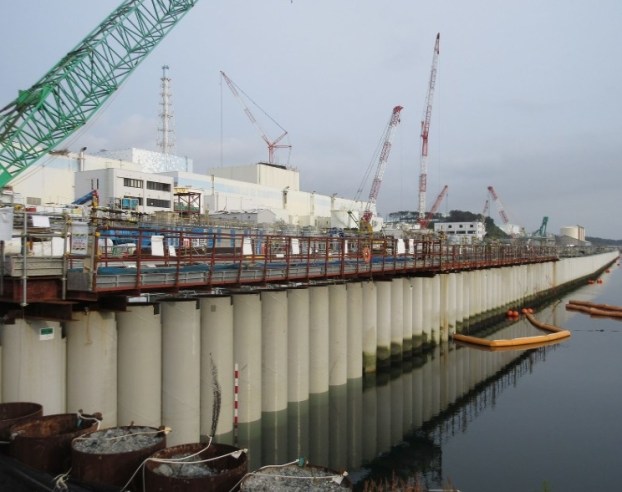
A wall constructed on the seaward side of the Fukushima No. 1 Nuclear Power Plant to prevent leakages is seen on Sept. 24, 2015.
The national government and TEPCO intend to decide on a plan for the fuel’s extraction in the first half of fiscal 2018, and start extraction efforts at one of the reactors within the year 2021. Toyoshi Fuketa, a member of the Nuclear Regulation Authority (NRA), argues that nuclear fuel that is too difficult to take out should be stored on-site, saying, “There is the option of just removing as much (of the melted fuel) as possible, and hardening the rest (to seal off its radiation).”
The cost for decommissioning the reactors is already estimated at 2 trillion yen, and this could grow if the decommissioning schedule is delayed.
While the No. 1 through 3 reactors at the plant were shut down at the time of the Great East Japan Earthquake on March 11, 2011, they lost all power due to the proceeding tsunami and, with no way to cool the nuclear reactors, they experienced a meltdown. The tsunami measured at up to 15.5 meters, and emergency underground power supplies were flooded and failed to function.
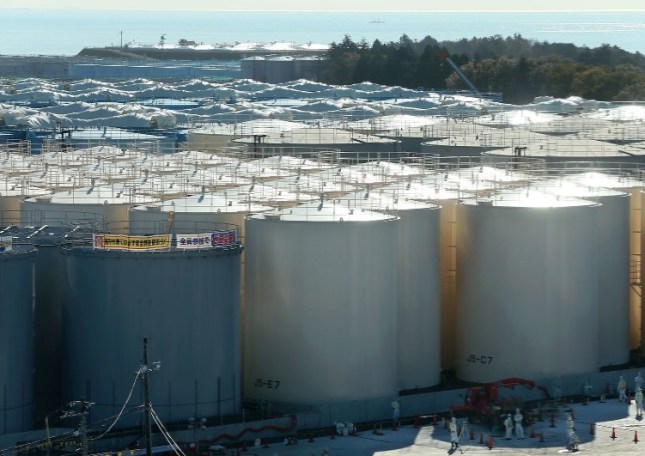
Tanks for holding contaminated water are seen on the grounds of the Fukushima No. 1 Nuclear Power Plant, on Nov. 5, 2015
The No. 1 reactor was equipped with a cooling system called Reactor Core Isolation Cooling (IC), but this didn’t activate, and on March 12 at 3:36 p.m. the No. 1 reactor suffered a hydrogen explosion. Then, on March 14 at 11:01 a.m. the No. 3 reactor also experienced a hydrogen explosion. The No. 4 reactor was already offline at the time of the disaster for a regular inspection, but hydrogen from the adjacent No. 3 reactor leaked in, and it suffered a hydrogen explosion as well at 6:14 a.m. on March 15. The No. 2 reactor was not hit by a hydrogen explosion, but among the No. 1 through 3 reactors it is thought to have leaked the most radiation. The disaster is rated a 7 on the International Nuclear Event Scale, the same as the Chernobyl disaster.
Masao Yoshida, the late chief of the Fukushima plant who headed up the frontline disaster-response efforts, testified to a government panel investigating the disaster, “We (who were on-site) imagined it as the destruction of eastern Japan. I really thought we were dead.”
Four reports on the disaster were put together, from the national government, the Diet, TEPCO and elsewhere in the private sector. They differ on points such as why the IC in the No. 1 reactor did not activate. The Diet probe raised the possibility that the IC system’s piping was damaged in the earthquake, but the national government’s investigative panel denied that earthquake damage was the cause. Due to the high radiation levels in the reactor buildings, there has not yet been an on-site investigation to better understand what happened.
http://mainichi.jp/english/articles/20160403/p2a/00m/0na/010000c
Plutonium from Japan to be disposed of underground in New Mexico
U.S.-bound plutonium that has recently been shipped out of Japan will be disposed of at a nuclear waste repository in New Mexico after being processed for “inertion” at the Savannah River Site atomic facility in South Carolina, according to an official of the National Nuclear Security Administration.
“The plutonium will be diluted into a less sensitive form at the SRS and then transported to the Waste Isolation Pilot Plant (WIPP) for permanent disposal deep underground,” said Ross Matzkin-Bridger in charge of the operation at the NNSA, a nuclear wing of the Department of Energy.
“The dilution process involves mixing the plutonium with inert materials that reduce the concentration of plutonium and make it practically impossible to ever purify again,” he told Kyodo News in a recent phone interview.
The official made the remarks ahead of the latest Nuclear Security Summit, sponsored by President Barack Obama, which began Thursday in Washington.
The fourth such meeting of world leaders is focused on how to secure weapons-usable nuclear materials all over the globe. The summit started after Obama’s 2009 speech in Prague, in which he called for “a world without nuclear weapons” and for which he was awarded a Nobel Peace Prize later that year.
At the previous summit in the Netherlands in March 2014, Prime Minister Shinzo Abe agreed to return plutonium and highly enriched uranium upon request from the Obama administration, which is seeking to strengthen control of nuclear materials.
The removal of 331 kilograms of plutonium and hundreds of kilograms of HEU from the Fast Critical Assembly, a research facility located in the village of Tokai, Ibaraki Prefecture, was completed before the Nuclear Security Summit kicked off.
Japan received the plutonium and HEU fuels from the United States, Britain and France from the late 1960s to early 1970s for research purposes in the name of “Atoms for Peace.”
The nuclear fuel delivery, however, has generated controversy in South Carolina since it was reported that it was en route to the U.S. government-run SRS facility in the state.
South Carolina is “at risk of becoming a permanent dumping ground for nuclear materials,” Gov. Nikki Haley said in a recent letter to Energy Secretary Ernest Moniz, calling for the freight to be stopped or rerouted.
The final disposal at the WIPP, as described by Matzkin-Bridger, may defuse these local concerns in South Carolina.
The WIPP is a repository — about 660 meters underground — for permanently storing nuclear waste created by the U.S. government’s nuclear weapons program.
“The Department of Energy has signed a Record of Decision to implement our preferred option to prepare 6 metric tons of surplus plutonium from the SRS for permanent disposal at the WIPP near Carlsbad, New Mexico,” Matzkin-Bridger explained. “This includes all foreign plutonium that we bring to the United States under our nonproliferation programs.”
The HEU from Japan’s FCA will be “down-blended” to low enriched uranium at the Y-12 National Security Complex in Oak Ridge, Tennessee, according to the official. In the future, LEU will be used for research purpose at research reactors both in the U.S. and Japan, possibly including the FCA.
“This project was accomplished on an accelerated timeline well ahead of schedule, thanks to the hard work and strong cooperation from both sides,” said a U.S.-Japan joint statement released Friday on the sidelines of the Nuclear Security Summit.
“It furthers our mutual goal of minimizing stocks of HEU and separated plutonium,” the document added, emphasizing the importance of the operation in strengthening nuclear security.
In the statement, the Japanese government made a new pledge to remove and transfer HEU fuels from the Kyoto University Critical Assembly (KUCA), another Japanese research institute, to the United States for down-blending and “permanent threat reduction.”
“If the KUCA’s HEU reactor is successfully converted to a LEU unit, it will have a significant meaning for other reactors in the U.S. and European nations, which are pursuing to convert reactors for LEU,” Hironobu Unesaki, a professor at Kyoto University, said. “The KUCA could provide academic outputs for future LEU conversion process worldwide.”
Officials and specialists in both nations have praised the bilateral cooperation, which aims to reduce the threat of nuclear terrorism through securing sensitive materials.
However, the materials recently transferred from Japan are only the tip of the iceberg. Currently, Japanese utilities possess over 47 metric tons of separated plutonium, which is equivalent to about 6,000 nuclear bombs.
At the last Nuclear Security Summit two years ago, Abe restated the nation’s international promise not to possess any plutonium that it has no use for. But the country’s stockpile of the nuclear material has since slightly increased.
A recent court injunction to suspend the operation of two plutonium-consuming reactors in Fukui Prefecture has made a solution for the plutonium problem more elusive.
http://www.japantimes.co.jp/news/2016/04/02/national/politics-diplomacy/plutonium-japan-disposed-underground-new-mexico/#.Vv80Iiraw3k.facebook
Fukushima Daiichi Contaminated Waste to Be Recycled into Construction Materials
Japan to Recycle Waste Collected during Fukushima Decontamination
TOKYO – The Japanese government announced Wednesday it will recycle the material collected during the decontamination of the Fukushima nuclear plant for construction purposes if radiation levels are found to be sufficiently low.
The government plans to store the waste collected from the radiation-affected region and use it as construction material in places outside the prefecture in northeastern Japan, within 30 years, reported state broadcaster NHK.
According to the country’s environment ministry, residue showing less than 8,000 becquerel per kg could be used in future to pave roads, build anti-tsunami walls and in other public works.
Over 90 percent of the material, accumulated since the 2011 disaster, could be re-used if the contaminated elements are removed, according to the authorities, who are, however, yet to develop the technology to separate waste with high radiation levels.
Currently, Fukushima authorities store the radioactive waste at two depots close to the plant, which can store up to 30 million tons.
The waste will remain at these storage sites for the next 30 years, to be later transferred to a definitive storage place, whose location remains to be determined, and to be used in public works if cleared of high radiation levels.
The Fukushima crisis has been the worst nuclear accident in history after the 1986 Chernobyl disaster in Ukraine.
The nuclear plant, which suffered a meltdown in the aftermath of the earthquake and subsequent tsunami that struck the country on March 11, 2011, is now being dismantled, a task that will take at least four decades to complete.
http://www.laht.com/article.asp?ArticleId=2408901&CategoryId=12395
Multiple rivers in Fukushima Prefecture have radioactive sediments

 Radioactive sediment found in Fukushima rivers Zee News , April 1, 2016 – Tokyo: Japanese researchers have detected relatively high levels of radioactive substancesin sediment in multiple rivers running through Fukushima prefecture, the media reported on Friday. The prefectural government in January surveyed the density of radioactive materials in soil and other sediment that has accumulated on the bottoms and banks of 72 rivers in the prefecture, public broadcaster NHK reported…..
The researchers found up to 54,500 becquerels per kg of radioactive substances in the Maeda river in Futaba town, where the plant is situated, and 39,600 becquerels in the Hiru river in Fukushima city. They also detected more than 10,000 becquerels at five other locations in four municipalities…….
The prefectural government plans to study restricting access to rivers with high concentrations of radioactive materials.
It also plans to urge the central government to remove contaminated soil and other sediment. http://zeenews.india.com/news/world/radioactive-sediment-found-in-fukushima-rivers_1871348.html
Manga convey realities of living in Tohoku disaster areas
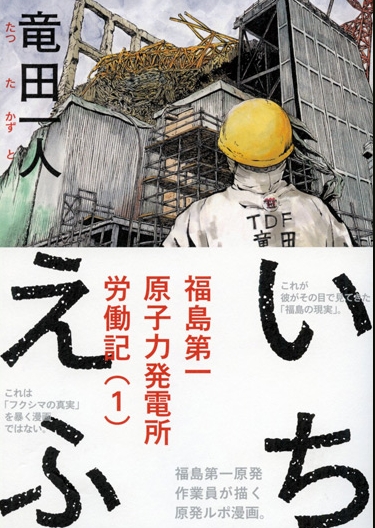
Although words of praise poured in for Kazuto Tatsuta’s manga about the Fukushima nuclear disaster, some comments said he was a spy for Tokyo Electric Power Co.
The artist, who went to great lengths to show the true situation around TEPCO’s Fukushima No. 1 nuclear plant, scoffed at the notion.
“As for nuclear power generation, I have never taken stances of ‘promotion,’ ‘opposition’ or ‘neutral.’ I just wanted to convey the changes of the place (at the nuclear plant) in real time,” he said.
His manga series, “Ichiefu Fukushima Daiichi Genshiryoku Hatsudensho Rodoki” (1F; Records of labor at Fukushima No. 1 nuclear power plant), was one of several that started after the triple disaster struck five years ago.
Some of them initially offered messages of encouragement to the disaster victims. But they gradually changed to depict the realities of the situation in the northeastern Tohoku region and the disaster victims’ extraordinary experiences.
Tatsuta’s series, carried in the weekly magazine Morning, was based around the sites of demolition work at the nuclear plant.
He was working at a company of an acquaintance near Tokyo when the Great East Japan Earthquake struck on March 11, 2011. Tatsuta looked for a job in areas affected by the disaster, and ended up working at a rest station of the nuclear plant as an employee of the sixth-layer subcontractor in June 2012.
In 2013, Tatsuta started “Ichiefu” to show the daily lives of workers at the plant.
His work drew much attention and acclaim. But some said the artist was underestimating the dangers of nuclear power generation. The series ended in October 2015.
Yoko Hano depicted the daily post-disaster lives of a different group–senior high school students in Fukushima Prefecture.
She started the serialized manga “Hajimari no Haru” (Spring as a beginning) because she also wanted to convey the truth. The comic is currently carried under the title of “Happy End?” in the Monthly Afternoon magazine.
Hano, who is from Nishigo in Fukushima Prefecture, now lives in Shirakawa, also in the prefecture.
“From the time immediately after the outbreak of the disaster, I saw false information from the media that was slipshod in confirming facts,” she said. “A person in my neighborhood was cornered by the situation caused by the disaster and committed suicide. I thought that unless accurate information is offered, our local communities will be destroyed.”
The protagonists in her manga learn about agriculture. They vow to reconstruct their hometowns and start taking action despite being shaken by nuclear accident.
“Here (in Fukushima Prefecture), there are many themes I should tackle throughout my life. I think that people who are making a living with jobs related to expression and speech should migrate to Fukushima,” Hano said.
In the serialized manga “Gogai! Iwate Chaguchagu Shinbunsha” (Extra edition! Iwate Chaguchagu newspaper company), the protagonist is a female reporter with a local newspaper in Iwate Prefecture.
Its creator, Aruto Asuka, who lives in Ichinoseki in the prefecture, began to carry the manga in the comic magazine Be Love, published twice a month, in 2009. Initially, it focused on the people, seasonal traditions and industries of the prefecture.
Then, the Great East Japan Earthquake and tsunami struck in 2011.
The manga now features the reality of the prefecture that was hit hard by the disaster.
Ichinoseki, an inland area, escaped serious damage. However, “that produced big conflicted feelings in my mind,” Asuka recalled.
In a special edition titled “Sanriku no Umi” (Sea of Sanriku), which was carried in the third volume of the book version of the manga, the protagonist visits the coastal district of Koishihama in Ofunato, Iwate Prefecture, for news coverage, and meets a young fisherman and his wife again.
The wife is pregnant but hesitant to give birth because of her feelings for a relative who lost her child and other family members in the disaster.
“I also have feelings of guilt about the fact that I am alive without suffering from any damage,” Asuka said. “I will not forget the various feelings of people (in the affected areas).”
http://www.asahi.com/ajw/articles/AJ201604010061.html
Tainted Fukushima towns stuck in time as decon crews plug away
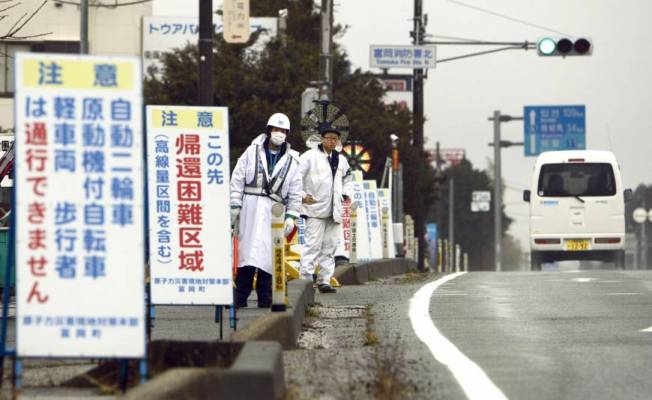
Police and security officers keep watch along National Route 6 leading to the off-limits zone in Tomioka, Fukushima Prefecture, on March 9
FUKUSHIMA – Five years after the nuclear disaster triggered by the huge earthquake and tsunami, reconstruction has made little progress in parts of Fukushima Prefecture. A Kyodo News reporter drove National Route 6 northward to the crippled Fukushima No. 1 nuclear plant to witness the lingering effects of the calamity.
In the town of Hirono, in the southeast, many shops and buildings remain empty. North of Hirono is the town of Naraha, most of which lies within the 20-km-radius hot zone around Tokyo Electric Power Co.’s radiation-leaking power plant.
The nuclear disaster forced Hirono to move its operations to other municipalities in the prefecture, while Naraha was designated an evacuation zone.
Now the towns have a radiation level below 1 millisievert per year — a level the government is trying to achieve in other areas via decontamination — and residence restrictions and evacuation orders have been lifted, with Hirono’s town office returning to its original place.
However, many residents are reluctant to go back to their homes. So far only 48 percent of Hirono’s population and 6 percent of Naraha’s have returned.
Yet hotels and other lodgings were busy accommodating out-of-prefecture workers seeking decontamination and construction work. All 275 rooms at a hotel in Hirono built for the reconstruction support scheme three years ago are “almost fully reserved for the next month,” the front desk clerk said.
A worker in his 50s who came from Tokyo to oversee decontamination work said he earns more than ¥16,000 ($145) per day. Another man staying at the hotel said he was on a three-week contract and received ¥25,000 a day. Their lodging was paid for by their employers.
At night, there was only one pub open in Hirono.
“The shopping area is deserted, although schools have resumed,” said a woman who works there. Still, the pub was full, mainly with visitors not from Fukushima.
In Tomioka, parts of which are still designated as in the “difficult to return” zone, most retail buildings on both sides of the main road have been abandoned and are decaying. Bags of contaminated soil sit piled up near the shore — now a huge makeshift storage site.
In a similar zone in the town of Okuma, which co-hosts the plant, three men in white protective suits were conducting decontamination in a field under a cloud of dust.
Nearby, a large boar suddenly crossed the road.
Soon after the nuclear disaster struck five years ago, untended cows and dogs were seen wandering around looking for food, but now boars are a frequent site, local people say.
In a residential part of Okuma, quake-damaged roads have been fixed but houses are being left as they are. The only sounds are chirping birds and the wind.
At a railway station, radiation over 10 microsieverts per hour is detected just above a covered drain. Although radiation in the “difficult to return” zones in Okuma and neighboring Futaba — the two towns hosting the nuclear plant — is much lower than it was immediately after the meltdowns, there are many hot spots measuring over 5 microsieverts — dozens of times higher than the government’s goal.
A Futaba resident who was showing the area to foreign journalists said, “The word ‘reconstruction’ has no relevance to this town.”
In Minamisoma — farther north of the Fukushima No. 1 complex — some areas are still designated as restricted residential zones.
“The number of jobs, such as decontamination work, has increased, but most of them are taken by people coming from outside the prefecture. We can hardly say this place has been enlivened again,” said Masayoshi Kariura, a Catholic priest.
“The pileup of contaminated soil that is clearly visible is weighing heavily on the residents,” he said.
1 This Month




PLEASE OPPOSE HR 8255 AND S.3639 – bills would accelerate satellite deployment, with no environmental review or safeguards – https://ncstd5li.quorum.us/campaign/169331/
To see nuclear-related stories in greater depth and intensity – go to https://nuclearinformation.wordpress.com
-
Archives
- September 2026 (330)
- August 2026 (330)
- July 2026 (355)
- June 2026 (287)
- May 2026 (306)
- April 2026 (356)
- March 2026 (251)
- February 2026 (267)
- January 2026 (308)
- December 2025 (358)
- November 2025 (359)
- October 2025 (375)
-
Categories
- 1
- 1 NUCLEAR ISSUES
- business and costs
- climate change
- culture and arts
- ENERGY
- environment
- health
- history
- indigenous issues
- Legal
- marketing of nuclear
- media
- opposition to nuclear
- PERSONAL STORIES
- politics
- politics international
- Religion and ethics
- safety
- secrets,lies and civil liberties
- spinbuster
- technology
- Uranium
- wastes
- weapons and war
- Women
- 2 WORLD
- ACTION
- AFRICA
- Atrocities
- AUSTRALIA
- Christina's notes
- Christina's themes
- culture and arts
- Events
- Fuk 2022
- Fuk 2023
- Fukushima 2017
- Fukushima 2018
- fukushima 2019
- Fukushima 2020
- Fukushima 2021
- general
- global warming
- Humour (God we need it)
- Nuclear
- RARE EARTHS
- Reference
- resources – print
- Resources -audiovicual
- Weekly Newsletter
- World
- World Nuclear
- YouTube
-
RSS
Entries RSS
Comments RSS

