The nuke biz is going down like dominoes. Hitachi announces a nearly $6.2 billion loss on its U.S. uranium enrichment joint effort with GE.

Electronics giant Hitachi Ltd. is set to lose tens of billions of yen this fiscal year due to the withdrawal from a project to develop a new method of uranium enrichment by a joint venture in the United States.
The loss, forecast by Hitachi on Feb. 1, was disclosed shortly after Toshiba Corp. made a similar announcement last month of deficits brought on by its nuclear power business.
Hitachi is expected to report a 70 billion yen ($620 million) non-operating loss by the time books are closed for fiscal 2016 at the end of March, said Mitsuaki Nishiyama, a senior vice president of the Tokyo-based conglomerate, in a news conference on the company’s performance through the third quarter.
The deficit is largely attributed to the joint venture GE Hitachi Nuclear Energy Inc. withdrawing from the uranium enrichment project. Due to this decision, Hitachi no longer expects any profits from the North Carolina-based company, of which it owns 40 percent and the rest by General Electric.
After allocating the losses, the value of Hitachi’s share of the joint venture comes to only about 11 billion yen.
Despite the gloomy news, Nishiyama said that “there are no more large deficit risks.”
Hitachi and GE were expecting more nuclear power plants to be built when they launched the joint fuel enrichment business, but orders have been sluggish across the globe, forcing the project to be shelved.
Nevertheless, Hitachi will be sticking with its nuclear power business. The company said that it plans to proceed with its project to build a plant in Britain by ensuring costs are thoroughly managed.
http://www.asahi.com/ajw/articles/AJ201702020042.html
February 3, 2017
Posted by dunrenard |
Japan | Hitachi, Loss, nuclear |
3 Comments
The writing is on the wall. Ban uranium mining now: “Tepco’s termination of the contract would affect about 9.3 million pounds of uranium deliveries through 2028, worth about $1.3 billion in revenue.”
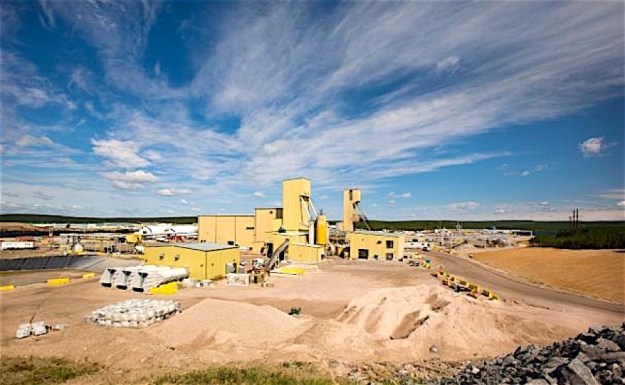
Cigar Lake, in northern Saskatchewan, Canada, is the world’s highest-grade uranium mine.
Uranium miner Cameco (TSX:CCO; NYSE:CCJ) is weighing its options after a key Japanese customer attempted to cancel its contract, which would mean $1.3 billion in lost revenue for the Canadian company.
Tokyo Electric Power Company Holdings (TEPCO), the operator of Japan’s wrecked Fukushima nuclear plant, issued a termination notice for a uranium supply contract on Jan. 24 and, earlier this week, it said it would not accept a delivery that was scheduled for Feb.1.
Such contract cancellation would affect about 9.3 million pounds of uranium deliveries through 2028, including about 855,000 pounds annually in 2017, 2018 and 2019, Cameco said.
Shares collapsed on the news. They were trading down 12.5% to Cdn$14.50 in Toronto at 1:00 pm, and 13.3% down in New York to $11.06 at 1:26 pm ET.
Cameco said the Japanese power company has cited forces beyond its control — specifically government regulations arising from the 2011 Fukushima nuclear accident — that have prevented the operation of its nuclear plants.
The Canadian firm insisted that there’s no basis for terminating the contract and considers TEPCO to be in default. It said it will pursue its rights — including binding arbitration.
“We are surprised and disappointed that TEPCO is seeking to terminate its contract given all the past productive discussions we have had to date,” Cameco’s president and CEO Tim Gitzel said in the statement.
The company noted it has sufficient financial capacity to manage any loss of revenue in 2017 as a result of the dispute.
Including income coming from TEPCO, Cameco expects 2017 earnings will range between $2.1 billion to $2.2 billion. More information on the uranium miner’s financial position will be released next week.
http://www.mining.com/cameco-to-lose-1-3bn-as-japans-tepco-cancels-uranium-contract/
February 3, 2017
Posted by dunrenard |
Japan | Cameco, Tepco, Uranium supply |
1 Comment
Hitachi to take a 70 billion yen hit after U.S nuclear project fails, Asahi Shimbun By SATOSHI SEII/ Staff Writer February 2, 2017 Electronics giant Hitachi Ltd. is set to lose tens of billions of yen this fiscal year due to the withdrawal from a project to develop a new method of uranium enrichment by a joint venture in the United States.
The loss, forecast by Hitachi on Feb. 1, was disclosed shortly after Toshiba Corp. made a similar announcement last month of deficits brought on by its nuclear power business.
Hitachi is expected to report a 70 billion yen ($620 million) non-operating loss by the time books are closed for fiscal 2016 at the end of March, said Mitsuaki Nishiyama, a senior vice president of the Tokyo-based conglomerate, in a news conference on the company’s performance through the third quarter.
The deficit is largely attributed to the joint venture GE Hitachi Nuclear Energy Inc. withdrawing from the uranium enrichment project. Due to this decision, Hitachi no longer expects any profits from the North Carolina-based company, of which it owns 40 percent and the rest by General Electric.
After allocating the losses, the value of Hitachi’s share of the joint venture comes to only about 11 billion yen……
Hitachi and GE were expecting more nuclear power plants to be built when they launched the joint fuel enrichment business, but orders have been sluggish across the globe, forcing the project to be shelved……http://www.asahi.com/ajw/articles/AJ201702020042.html
February 3, 2017
Posted by Christina Macpherson |
business and costs, Japan |
Leave a comment
Cameco to contest Tepco’s termination of supply contract
Cameco announced today that Tokyo Electric Power Company Holdings (Tepco) has issued a termination notice for a uranium supply contract with Cameco Inc that it does not accept. “Cameco Inc sees no basis for terminating the contract, considers Tepco to be in default, and will pursue all its legal rights and remedies,” the Saskatchewan, Canada-based uranium producer said.
The Japanese utility confirmed yesterday it would not accept a uranium delivery scheduled for 1 February and would not withdraw the contract termination notice it provided to Cameco on 24 January, according to Cameco’s statement. Tepco alleges that an event of ‘force majeure’ has occurred because it has been unable to operate its nuclear generating plants for 18 consecutive months due to government regulations arising from the Fukushima nuclear accident in March 2011.
“We are surprised and disappointed that Tepco is seeking to terminate its contract given all the past productive discussions we have had to date,” said Tim Gitzel, president and CEO of Cameco. “For the past six years we have worked in good faith with Tepco to restructure this contract, and would continue to do so if there was any basis for a commercial resolution. During the past week we tried to engage Tepco to obtain clarification given conflicting information we had received previously from them and only received confirmation of their intent to terminate the contract yesterday.”
Cameco will “vigorously pursue” remedies to recover value for its shareholders and other stakeholders, Gitzel added.
Under the contract, Tepco has already received and paid for 2.2 million pounds of uranium since 2014. The termination would affect about 9.3 million pounds of uranium deliveries through 2028, worth about $1.3 billion in revenue to Cameco, including about $126 million in each of 2017, 2018 and 2019 based on 855,000 pounds of deliveries in each of those years. In 2017, Cameco’s consolidated revenue, including the Tepco volume, is expected to range between $2.1 billion to $2.2 billion.
Cameco said it will be “moving expeditiously” to enforce its rights under the uranium supply contract to recover losses arising from Tepco’s actions.
“As with any commercial dispute, it will take some time for a resolution to be achieved, particularly if it proceeds all the way to arbitration,” Cameco said.
The company, which is scheduled to release its annual results after markets close on 9 February, said it has “sufficient financial capacity” to manage any loss of revenue in 2017 as a result of the dispute.
A spokesman for Tepco said: “We have terminated the uranium concentrate supply agreement with Cameco by giving written notice to Cameco in accordance with the terms and conditions of the agreement. We are aware that Cameco is showing their objection to our assertion of termination. However, our notice complies with the agreement and we will take appropriate action.”
http://www.freep.com/story/news/2017/02/01/trump–nuclear-waste-lake-huron/97346178
Tepco scraps uranium supply contract with Canada’s Cameco
Feb 1 Canadian uranium producer Cameco Corp said on Wednesday that Tokyo Electric Power (Tepco) , the operator of Japan’s wrecked Fukushima nuclear plant, had scrapped its uranium supply contract with the company.
Shares of Cameco slid 12.2 percent to C$14.55 in early trading on Wednesday.
The company, one of the world’s largest uranium producers, said it considered Tepco’s move to terminate the contract unfair and that it would pursue legal action.
Cameco said Tepco cited a force majeure for ending the contract as it had been unable to operate its nuclear plants for 18 straight months due to Japanese regulations arising from the 2011 Fukushima nuclear accident.
The company said it was notified of the contract termination by Tepco last week.
Tepco’s termination of the contract would affect about 9.3 million pounds of uranium deliveries through 2028, worth about C$1.3 billion ($995.41 million) in revenue to Cameco, the Saskatoon, Canada-based company said.
Cameco’s earnings before interest, taxes, depreciation and amortization could take a 10-15 percent hit in the near-term as a result of the Tepco dispute, said Edward Sterck, an analyst at BMO Capital Markets.
Tepco’s move comes amid a fall in demand for uranium that is largely a result of the Fukushima nuclear plant meltdown, which led to shutdowns of all of Japan’s nuclear reactors.
Some reactors have since come back online, but global inventories of the radioactive metal remain high.
Cameco warned late last year that the uranium market would remain depressed until Japan’s nuclear reactors were restarted and excess supply was depleted.
Cameco also said it expected 2017 revenue of C$2.1 billion to C$2.2 billion, inclusive of Tepco’s volume, adding that it could withstand any potential loss of revenue this year from the dispute.
http://www.reuters.com/article/cameco-contract-tep-hldg-idUSL4N1FM35I
February 1, 2017
Posted by dunrenard |
Japan | Cameco, Tepco, Uranium supply |
Leave a comment

Ryuichi Yoneyama, governor of Niigata Prefecture, poses for a photograph in Tokyo on Jan. 23.
The man blocking the world’s largest nuclear plant says he grew opposed to atomic energy the same way some people fall in love.
Previously an advocate for nuclear power, Ryuichi Yoneyama campaigned against the restart of the facility as part of his successful gubernatorial race last year in Niigata Prefecture.
He attributes his political U-turn to the “unresolved” 2011 disaster at the Fukushima No. 1 nuclear power plant and the lack of preparedness at the larger facility in his own prefecture, both owned by Tokyo Electric Power Company Holdings Inc.
“Changing my opinion wasn’t an instant realization,” Yoneyama said in an interview. “It was gradual. As people say, you don’t know the exact moment you’ve fallen in love.”
Yoneyama won’t support the restart of the Kashiwazaki-Kariwa plant in Niigata Prefecture until an investigation is complete into the chain of events that resulted in the triple meltdown at Fukushima No. 1, which he visited Wednesday. While utilities don’t need approval from local authorities to restart plants, power companies are tradition-bound not to move ahead until they get their consent.
Yoneyama, a 49-year-old doctor and native of Niigata, is one of the highest-profile local opponents pitted against a political establishment led by Prime Minister Shinzo Abe. The establishment sees nuclear power as crucial for the country’s long-term energy security and environmental goals.
Regulations and public opinion are keeping nearly all of Japan’s atomic stations shut almost six years after the meltdowns at Fukushima, where the search has barely begun for fuel that burned through to the bottom of the reactors.
“If the local governor remains firmly opposed to the restart, it will be very difficult for the reactors to come back online,” said James Taverner, an analyst at IHS Markit Ltd. “In addition to the local government, building the support and trust of local residents is key.”
A Kyodo News poll on the day of Yoneyama’s October election showed about 64 percent of Niigata voters opposed the restart of Kashiwazaki-Kariwa, known popularly as KK. The restart of the facility was one of the key issues in the race to replace Gov. Hirohiko Izumida, who was famous for his tough stance against Tepco. He unexpectedly announced in August that he wouldn’t seek a fourth term.
To the residents of the prefecture, Yoneyama was the candidate who would make nuclear safety a priority, while his main opponent gave off the vibe that he was a member of the reactor restarts camp, the former governor said by email.
In last year’s gubernatorial race in Kagoshima Prefecture, where Kyushu Electric Power Co. operates the Sendai nuclear plant, a three-term incumbent was defeated by an opponent campaigning to temporarily close the reactors. A district court last year barred Kansai Electric Power Co. from running two reactors at its Takahama station in Fukui Prefecture only weeks after they’d been turned back on.
Yoneyama supported bringing back online Japan’s reactors during his unsuccessful bid in 2012 for a seat in the Lower House. The country was being forced to spend more on fossil fuel imports after the disaster, so restarting the plants was needed to help the economy recover, he said at the time.
Though Yoneyama’s position switch helped secure his first electoral victory after four failed campaigns for the Diet, nuclear opponents see him driven by more than political opportunism.
“I had my reservations about Yoneyama,” said Takehiko Igarashi, an official at the Niigata division of the anti-nuclear group Nakusou Genpatsu. “But after he was vetted and endorsed by the Japanese Communist Party and other smaller parties that have an anti-nuclear slant, I knew that I could trust him.”
Tepco and Abe’s government see restarting KK as one way for Japan’s biggest utility to boost profits and help manage its nearly ¥16 trillion ($139 billion) share of the Fukushima cleanup. Resuming reactors 6 and 7 will boost annual profits by as much as ¥240 billion, the utility has said.
The economic argument, however, is beginning to hold less sway, with Yoneyama saying the benefits to the local economy are “overstated.” While the prefecture risks missing out on ¥1.1 billion a year in government support without the restarts, that represents a small slice of the prefecture’s budget, which tops ¥1 trillion, according to Yoneyama.
Abe, a strong backer of nuclear power, leads a government aiming for nuclear to account for as much as 22 percent of the energy mix by 2030, compared with a little more than 1 percent now.
While restart opponents like Yoneyama demand the government guarantee the safety of the reactors, they’ve also criticized the evacuation and emergency response plans as inadequate.
In his first meeting with Tepco executives since taking office, Yoneyama earlier this month told Chairman Fumio Sudo and President Naomi Hirose that he won’t support KK’s restart until a new evacuation plan is drawn up using the results of a Fukushima investigation. Tepco will fully cooperate with the probe and stay in communication with the governor, the company said in response to a request for comment.
“Once I realized that the Fukushima disaster couldn’t be easily resolved, of course my opinion changed,” Yoneyama said. “If another accident occurs, overseas tourism will become a distant dream. Even Japanese may flee the country.”
http://www.japantimes.co.jp/news/2017/02/01/national/niigata-governor-ryuichi-yoneyama-stands-firm-against-restart-of-kashiwazaki-kariwa-plant/#.WJHSePLraM9
February 1, 2017
Posted by dunrenard |
Japan | antinuclear, Kashiwazaki-Kariwa NPP, Niigata Governor |
Leave a comment

 Trust banks preparing to sue Toshiba – report http://www.channelnomics.com/channelnomics-us/news/3003570/trust-banks-preparing-to-sue-toshiba-report Vendor also preparing to sell part of its memory business, Scharon Harding, 30 Jan 17, Toshiba may be hit with lawsuits from Japanese trust banks that could total over 1 billion yen ($8.8 million) over the accounting scandal it endured in 2015, Reuters reports.
According to the report, Mitsubishi UFJ Trust and Banking Corp. said today it is getting ready to sue the Japanese vendor in the name of its clients’ pension funds after revelations the vendor had been exaggerating profits caused share prices to drop.
Reuters added that Sumitomo Mitsui Trust Bank Ltd and Mizuho Trust & Banking Co. are organizing “similar” lawsuits, according to anonymous sources.
News of the potential lawsuits comes three days after Toshiba announced plans to sell parts of its memory business, including its SSD business, by 31 Marcch. The move is an attempt to minimize damage from an upcoming writedown for its U.S. nuclear business that could reach billions, according to CNBC.
Toshiba is already facing a pile of cases in relation to findings that the company’s bookkeeping practices led to the overstating of profits by over 170 billion yen (about $1.4 billion) by 45 institutional investors for 16.7 billion yen ($146 million) and 15 Japanese entities totaling 15.3 billion yen ($134 million), Reuters said.
February 1, 2017
Posted by Christina Macpherson |
business and costs, Japan, Legal |
Leave a comment
 Japan’s ‘Unresolved’ Disaster Sways Former Advocate of Nuclear Power, Bloomberg by Stephen Stapczynski and Emi Urabe, January 30, 2017,
The man blocking the world’s largest nuclear plant says he grew opposed to atomic energy the same way some people fall in love.
Previously an advocate for nuclear power in Japan, Ryuichi Yoneyama campaigned against the restart of the facility as part of his successful gubernatorial race last year in Niigata. He attributes his political U-turn to the “unresolved” 2011 Fukushima Dai-Ichi disaster and the lack of preparedness at the larger facility in his own prefecture, both owned by Tokyo Electric Power Co. Holdings Inc.
“Changing my opinion wasn’t an instant realization,” Yoneyama said in an interview. “It was gradual. As people say, you don’t know the exact moment you’ve fallen in love.”
Yoneyama won’t support the restart of the Kashiwazaki-Kariwa plant in Niigata until an investigation is complete into the chain of events that resulted in the triple meltdown at Fukushima, which he plans to visit Wednesday. While utilities don’t need approval of local authorities to restart plants, Japanese power companies are tradition-bound not to move ahead until they get their consent……
In last year’s gubernatorial race for the southern prefecture of Kagoshima, where Kyushu Electric Power Co. operates the Sendai nuclear plant, a three-term incumbent was defeated by an opponent campaigning to temporarily close the reactors. A district court last year barred Kansai Electric Power Co. from running two reactors at its Takahama station in western Japan only weeks after they’d been turned back on……….
Tokyo Electric and Abe’s government see restarting KK as one way for Japan’s biggest utility to boost profits and help manage its nearly 16 trillion yen ($139 billion) share of the Fukushima cleanup. Resuming reactors No. 6 and No. 7 will boost annual profits by as much as 240 billion, the utility has said.
The economic argument, however, is beginning to hold less sway, with Yoneyama saying the benefits to the local economy are ‘overstated.’ While the prefecture risks missing out on 1.1 billion yen a year in government support without the restart, that represents a small slice of the prefecture’s budget, which tops 1 trillion yen, according to Yoneyama……..
“Once I realized that the Fukushima disaster couldn’t be easily resolved, of course my opinion changed,” Yoneyama said. “If another accident occurs, overseas tourism will become a distant dream. Even Japanese may flee the country.” https://www.bloomberg.com/news/articles/2017-01-29/japan-s-unresolved-disaster-sways-symbol-of-nuclear-opposition
February 1, 2017
Posted by Christina Macpherson |
Japan, politics |
1 Comment
Toshiba Corporation (aka Westinghouse) is withdrawing from the nuclear power construction business… Captains of Toshiba and Westinghouse are abandoning their nuclear Titanic sunk on economic iceberg!!!!!
Toshiba Corp. will cease taking orders related to the building of nuclear power stations, sources said Saturday, in a move that would effectively mark its withdrawal from the nuclear plant construction business.
The news comes amid reports Toshiba’s chairman may resign over the massive write-down that has doomed the company’s U.S. nuclear business.
The multinational conglomerate said Friday it will review its nuclear operations and spin off its chip business to raise funds in a bid to cover an expected asset impairment loss of up to ¥700 billion ($6.08 billion).
After Toshiba ceases taking new orders, it will focus on maintenance and decommissioning operations, according to the sources.
The company will continue work on four nuclear plants under construction in the United States that are expected to be completed by 2020.
The Japanese industrial conglomerate may announce company chairman Shigenori Shiga’s resignation as soon as Feb. 14, when it reports its April-December financial results, the sources also said.
Shiga once served as president of the U.S. nuclear unit, Westinghouse Electric Co., which Toshiba has said could face a multibillion-dollar loss due to cost overruns from delays in plant projects.
The post of Toshiba chairman is expected to remain vacant after Shiga’s resignation.
Westinghouse Chairman Danny Roderick is also set to step down, the sources said, but Toshiba President Satoshi Tsunakawa is likely to stay on.
Shiga, Roderick and Tsunakawa took their current posts last June as Toshiba reshuffled its management following an accounting scandal that surfaced in 2015.
Shiga was the vice president in charge of the power systems business when Westinghouse acquired CB&I Stone & Webster in late 2015. CB&I Stone & Webster is the U.S. nuclear plant construction firm at the heart of Toshiba’s massive write-down problem.
http://www.japantimes.co.jp/news/2017/01/28/business/corporate-business/toshiba-chairman-resign-struggling-u-s-nuclear-business#.WIycNpKdlmA
Toshiba to sell part of chip business, puts overseas nuclear ops under review
Toshiba Corp (6502.T) said it will sell a minority stake in its memory chip business as it urgently seeks funds to offset an imminent multi-billion dollar writedown, adding that its overseas nuclear division – the cause of its woes – was now under review.
The drastic measures are set to be just some of the tough choices the Japanese conglomerate will have to take as proceeds from the sale are likely to only cover part of a charge that domestic media has put at $6 billion.
Still battered by a 2015 accounting scandal, Toshiba was plunged back into crisis when it emerged late last year that it had to account for huge cost overruns at a U.S. power plant construction business recently acquired by its Westinghouse division.
Describing the nuclear division as no longer a central business focus for the firm, Chief Executive Satoshi Tsunakawa said Toshiba will review Westinghouse’s role in new projects and whether it will embark on new power plant construction. The division will also now fall under direct CEO supervision.
Tsunakawa added Toshiba was looking to sell less than 20 percent of its memory chip business – the world’s biggest NAND flash memory producer after Samsung Electronics (005930.KS) – which comprises the bulk of the conglomerate’s operating profit.
The firm is rushing to complete the sale by the end of the financial year in March as failure to do so will likely mean that shareholder equity – just $3 billion in the wake of the accounting scandal – would be wiped out by the charge.
Sources have said Toshiba aims to raise more than 200 billion yen ($1.7 billion) from the sale and potential investors include private equity firms, business partner Western Digital Corp (WDC.O) and the government-backed Development Bank of Japan.
It is also selling other assets although it ruled out the sales of any of its infrastructure businesses – which include water treatment, railway and elevator firms.
“We’ve been raising funds through sales of stock holdings, real estate and other assets,” Tsunakawa told a news conference without disclosing the amount, adding that various measures were being considered to boost the firm’s capital base by March.
Toshiba also said it may eventually list the memory chip business.
http://mobile.reuters.com/article/idUSKBN15A2IT
January 29, 2017
Posted by dunrenard |
Japan | Nuclear Plant Construction, Toshiba |
Leave a comment
No one is fit for nuclear.
Not those who believed that they were nor those who still believe that they are.
Let’s all ban this deadly industry from our planet earth!

According to a well-known joke about the national traits of Europeans, it is heaven if the chefs are French, the engineers are German and the bankers are Swiss and it is hell if the chefs are British, the engineers are French and the bankers are Italian.”
As for the Japanese? They appear not suited to a particular field — nuclear energy. And that is no joke. The development of nuclear technology as part of national policy and by private nuclear businesses has repeatedly experienced failure, causing problems to numerous people and wasting a massive amount of money.
Mutsu, Japan’s first and only nuclear-powered ship which was launched in the early 1970s, suffered a radiation leakage and was decommissioned in 1992 after having only four experimental runs.
The government decided late last year to decommission the prototype fast-breeder reactor Monju in Fukui Prefecture, which has hardly been in operation for more than 20 years following a fire triggered by a sodium leak broke out at the facility in 1995.
Construction work on a spent nuclear fuel reprocessing plant in Rokkasho, Aomori Prefecture, got underway in 1993, but its completion was postponed 23 times and there are no prospects that it will be put in operation in the foreseeable future.
Roughly 5 trillion yen has so far been spent on nuclear projects in Japan.
In March 2011, a serious accident occurred at Tokyo Electric Power Co.’s Fukushima No. 1 Nuclear Power Plant after the complex was hit by a massive tsunami triggered by the Great East Japan Earthquake. Over 80,000 residents from areas near the atomic power station are still living outside the affected areas as evacuees. The costs of dealing with the nuclear crisis have already surpassed 20 trillion yen.
Meanwhile, Toshiba Corp. has added a new page to the negative history of Japan’s nuclear development.
In 2006, Toshiba acquired Westinghouse Electric Co., a U.S. nuclear plant company, for over 600 billion yen. The deal was criticized as too costly, but Toshiba wanted to control the world nuclear power market. Toshiba’s president at the time was upbeat about the takeover saying, “We’ll conduct business aggressively.”
Nevertheless, Toshiba will likely suffer nearly 1 trillion yen in losses from the deal because the electronics giant failed to find hidden problems involving its U.S. nuclear power unit. The world nuclear power market has shrunk since the outbreak of the Fukushima nuclear crisis. Following revelations that it had padded its profits through accounting irregularities, Toshiba downsized its workforce by more than 10,000 people, but its rehabilitation efforts are still insufficient. Its financial difficulties have even put the company’s survival in jeopardy.
Physicist and technology commentator Kiyoshi Sakurai, who is well versed in technical problems and accidents involving nuclear plants, warned in a past Mainichi Shimbun interview, “Only a handful of those concerned with a certain project loudly underscore the significance of the project. These people could self-righteously go too far without understanding the project’s objectivity or necessity.”
His remarks remind the public of a past silly war (World War II).
More sadly, it is feared that Japanese people traumatized by the atomic bombing tend to stick to the peaceful use of atomic energy and have lost the capacity for calm and rational judgment.
After reviewing the above, one can see that Japanese people are unfit for nuclear energy development projects. (By Hideaki Nakamura, Editorial Writer)
http://mainichi.jp/english/articles/20170125/p2a/00m/0na/006000c
January 25, 2017
Posted by dunrenard |
Japan | Ban, nuclear |
Leave a comment
 Toshiba to unveil extent of U.S. nuclear business writedown on February 14 , Reuters 24 Feb 17 Japan’s Toshiba Corp (6502.T) said it will unveil the extent of the writedown on its U.S. nuclear business on Feb. 14 when it reports its results for the quarter ended Dec. 31.
The laptops-to-engineering conglomerate, still recovering from a $1.3 billion accounting scandal two years ago, shocked investors in December by announcing major cost overruns at the U.S. nuclear business it bought in 2015. …….
Last week, media reported the troubled Japanese firm may unveil a writedown of as much as 700 billion yen ($6.18 billion) for its nuclear business……… rating agency Standard and Poor’s downgraded Toshiba’s debt to CCC+, or vulnerable to nonpayment, from B, and put the company’s credit watch on negative. http://www.reuters.com/article/us-toshiba-accounting-writedown-idUSKBN1580QV
January 25, 2017
Posted by Christina Macpherson |
business and costs, Japan |
Leave a comment
The R3 and R4 of the Genkai nuclear power plant, Pref. Saga, have met the new safety standards of the NRA. Restart announced at the end of summer.
As of today: Have met the safety standards, 10 reactors in 5 nuclear plant namely also Sendai R1, R2 – Takahama R1 to R4 – Mihama R3 – Ikata R3.
Two reactors have now been restarted: Sendai 1 and Ikata 3 (using MOX).

The Nuclear Regulation Authority formally decided Wednesday on the screening document certifying that the Nos. 3 and 4 reactors at Kyushu Electric Power Co.’s Genkai nuclear power plant in Saga Prefecture satisfied the country’s safety standards for their restart.
The latest decision made at an NRA regular meeting brings to 10 the number of reactors, at five nuclear power plants, that have satisfied the regulator’s new safety standards, introduced after the nuclear disaster at Tokyo Electric Power Company Holdings Inc.’s Fukushima No. 1 nuclear power plant in 2011. The two Genkai reactors are scheduled to be back online sometime in or after summer this year.
The Kyushu power company applied for a safety screening on those reactors in July 2013. At that time, the company anticipated an earthquake with an acceleration of up to 540 gal at the Genkai plant followed by tsunami of up to 3 meters high. However, the NRA deemed the simulation as “too optimistic” and the figures were raised to an acceleration of 620 gal with 4-meter-high tsunami.
In November last year, the NRA approved a draft document as the two reactors complied with the new standards. The NRA then solicited public opinions and received 4,200 comments, including concerns over possible earthquakes, but concluded that there was no problem with compliance.
With the formal decision being made on the Genkai plant, the focus for the restart has moved to an approval of a construction plan that maps out the specifications of related equipment for safe operation as well as whether it can obtain the consent of local governments for the restart.
So far, nuclear reactors that have passed the NRA’s screenings under the new standards are the Nos. 1 and 2 reactors at Kyushu’s Sendai power plant in Kagoshima Prefecture, the Nos. 1 to 4 reactors at Kansai Electric Power Co.’s Takahama plant and KEPCO’s No. 3 reactor at Mihama plant, both in Fukui Prefecture, and the No. 3 reactor at Shikoku Electric Power Co.’s Ikata plant in Ehime Prefecture. Currently, two reactors — Sendai plant’s No. 1 and Ikata’s No. 3 — are online.
http://www.the-japan-news.com/news/article/0003466628
January 24, 2017
Posted by dunrenard |
Japan | NRA, nuclear plants, Restarts, Safety Screenings |
Leave a comment
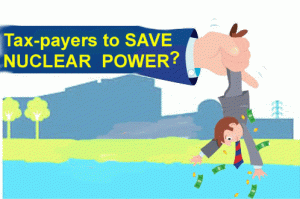 Toshiba faces pressure to secure funding for UK nuclear project, Ft.com by: Andrew Ward and Jim Pickard in London, 22 Jan 17 Toshiba is facing pressure to secure investment from a South Korean energy group and the UK government to keep afloat a multibillion-pound British nuclear power project as the Japanese conglomerate struggles with mounting financial difficulties.
Korea Electric Power Corporation (Kepco) has been in talks for months to join the NuGen consortium planning a nuclear plant at Moorside in Cumbria alongside Toshiba and Engie of France. The need for new partners has been increased by huge writedowns on Toshiba’s nuclear business in the US, which has left the group scrambling to shore up its balance sheet. As well as Korean capital, Toshiba is angling for UK government investment in the Cumbrian project after Theresa May’s administration recently signalled its willingness to put public money into new nuclear plants. This would represent a reversal of longstanding UK policy not to expose taxpayers’ money to the heavy expense and high risks involved in building nuclear reactors.
A Whitehall official said it was “premature” to talk about government involvement in financing Moorside but several other people involved in the process or briefed on the matter said the option of public investment was on the table. But these people said a more immediate step to keep the scheme on track was the proposal for Toshiba to sell part of its 60 per cent stake in NuGen to Kepco, the utility majority-owned by the South Korean government. “Talks have been moving slowly but the financial difficulties facing Toshiba will hopefully focus minds on getting a deal done,” said one person close to the talks.
It emerged last month that the UK and Japanese governments were in talks about potential joint support for a new nuclear plant planned by Hitachi, another Japanese conglomerate, at Wylfa in Anglesey. One senior nuclear industry figure said these discussions also extended to potential government financing for Moorside. Shares in Toshiba have fallen by 44 per cent since the group warned last month that it would have to make writedowns of “several billion dollars” related to the $229m acquisition last year of Stone & Webster, the US nuclear construction company, by Toshiba’s US nuclear technology unit, Westinghouse……..
Public investment in new nuclear plants would be a striking illustration of Mrs May’s determination to intervene more heavily in industrial strategy, a policy she was expected to set out in a discussion paper on Monday. The UK Department for Business, Energy and Industrial Strategy said: “We are working closely with a number of developers on proposed new nuclear projects in the UK, as they develop their plans.”
https://www.ft.com/content/c0b01308-e0aa-11e6-8405-9e5580d6e5fb
January 23, 2017
Posted by Christina Macpherson |
business and costs, Japan, politics, UK |
Leave a comment
 Analysis – As nuclear loss grows, Toshiba needs chip investors, soon Reuters By Makiko Yamazaki and Kentaro Hamada 22 JAN 17 TOKYO
With mounting writedowns from its nuclear business, Japan’s Toshiba Corp (6502.T) is looking to sell part of its core semiconductors business, a world No.2 in the flash memory chips used in smartphones.
But its rush to plug a hole in its U.S. nuclear business that Japanese media now estimate at as much as $6 billion may complicate any asset sale.
Toshiba, which warned last month of multi-billion dollar charges for U.S. nuclear project cost overruns, wants to boost its capital base by the end of the financial year in March.
Failure to offset the nuclear hit could wipe out already thin shareholder equity and push the company into negative net worth – jeopardising its role in public infrastructure projects and its place on the Tokyo Stock Exchange’s ‘first section’, for larger companies.
Following a 2015 accounting scandal, the conglomerate is barred from raising fresh funding on equity markets. Selling assets, though, could help it win broader financial support from its main banks.
Toshiba could sell 20-30 percent of its chip business, according to media reports.
The business, worth more than $10 billion, is the world’s second largest after Samsung Electronics (005930.KS) in flash memory chips – and it’s Toshiba’s most profitable.
Operating profit is forecast at 130 billion yen (913.35 million pounds) for the year to end-March, accounting for the bulk of overall group profit, forecast at 180 billion yen. Those forecasts were made before its December warning of the U.S. nuclear charges.
People with knowledge of the matter said Toshiba has begun preparations to sell a minority stake in its chip business. One person said non-disclosure agreement forms have been sent to some private equity funds……..
As Toshiba has ruled out ceding control of the chips business, it may also seek state help, as other troubled Japanese technology companies have done in previous restructurings, the sources said.
Another person familiar with the matter said the state-run Development Bank of Japan is among several funds Toshiba may approach for possible investment in its chip business, though the bank could be put off by the size of investment needed.
(Reporting by Makiko Yamazaki and Kentaro Hamada; Writing by Miyoung Kim; Editing by Ian Geoghegan) http://uk.reuters.com/article/uk-toshiba-accounting-semiconductors-ana-idUKKBN156009
January 23, 2017
Posted by Christina Macpherson |
business and costs, Japan |
Leave a comment
Analysis – As nuclear loss grows, Toshiba needs chip investors, soon Reuters By Makiko Yamazaki and Kentaro Hamada 22 JAN 17 TOKYO With mounting writedowns from its nuclear business, Japan’s Toshiba Corp (6502.T) is looking to sell part of its core semiconductors business, a world No.2 in the flash memory chips used in smartphones.
But its rush to plug a hole in its U.S. nuclear business that Japanese media now estimate at as much as $6 billion may complicate any asset sale.
Toshiba, which warned last month of multi-billion dollar charges for U.S. nuclear project cost overruns, wants to boost its capital base by the end of the financial year in March.
Failure to offset the nuclear hit could wipe out already thin shareholder equity and push the company into negative net worth – jeopardising its role in public infrastructure projects and its place on the Tokyo Stock Exchange’s ‘first section’, for larger companies.
Following a 2015 accounting scandal, the conglomerate is barred from raising fresh funding on equity markets. Selling assets, though, could help it win broader financial support from its main banks.
Toshiba could sell 20-30 percent of its chip business, according to media reports.
The business, worth more than $10 billion, is the world’s second largest after Samsung Electronics (005930.KS) in flash memory chips – and it’s Toshiba’s most profitable.
Operating profit is forecast at 130 billion yen (913.35 million pounds) for the year to end-March, accounting for the bulk of overall group profit, forecast at 180 billion yen. Those forecasts were made before its December warning of the U.S. nuclear charges.
People with knowledge of the matter said Toshiba has begun preparations to sell a minority stake in its chip business. One person said non-disclosure agreement forms have been sent to some private equity funds……..
As Toshiba has ruled out ceding control of the chips business, it may also seek state help, as other troubled Japanese technology companies have done in previous restructurings, the sources said.
Another person familiar with the matter said the state-run Development Bank of Japan is among several funds Toshiba may approach for possible investment in its chip business, though the bank could be put off by the size of investment needed.
(Reporting by Makiko Yamazaki and Kentaro Hamada; Writing by Miyoung Kim; Editing by Ian Geoghegan) http://uk.reuters.com/article/uk-toshiba-accounting-semiconductors-ana-idUKKBN156009
January 23, 2017
Posted by Christina Macpherson |
business and costs, Japan |
Leave a comment
Large crane collapses at Takahama nuclear plant
A large crane has toppled onto a building storing nuclear fuel at the Takahama nuclear power plant in Fukui Prefecture, central Japan. Part of the building’s roof was damaged. There were no reported injuries.
Workers at the plant found on Friday night that the crane had half-collapsed onto the building next to the containment vessel of the No.2 reactor.
The crane is about 110 meters long. It buckled where it hit the edge of the roof and is lying across another building.
Officials at Kansai Electric Power Company say no one was injured. They confirmed damage to a facility collecting rainwater on the roof, but say they have detected no change to radiation levels in the surrounding area.
The Secretariat of the Nuclear Regulation Authority says its inspectors have confirmed the falling crane caused wall panels inside the building to move. Workers are checking the building’s functions to prevent radioactive materials from leaking.
Kansai Electric officials say they believe strong winds likely toppled the crane. They are investigating whether there was any problem in its installation.
Weather officials had warned of strong winds in the prefecture at the time.
The Takahama plant’s operational chief, Masakazu Takashima, has apologized for the accident.
The Nuclear Regulation Authority in June last year approved the operation of the plant’s No.1 and No.2 reactors beyond the basic limit of 40 years.
The crane was reportedly being used for construction work on the containment vessel as part of safety measures for the operation extension.
https://www3.nhk.or.jp/nhkworld/en/news/20170121_17/

A crane is seen collapsed over a reactor auxiliary building and another structure at the Takahama Nuclear Power Plant in Takahama, Fukui Prefecture, on Jan. 21, 2017. The No. 2 reactor is seen at top.
Crane falls on Takahama nuke plant buildings amid storm warning
TAKAHAMA, Fukui — A large crane fell on a reactor auxiliary building and a fuel handling building at the No. 2 reactor of the Takahama Nuclear Power Plant in Fukui Prefecture on the night of Jan. 20, damaging part of their roofs, Kansai Electric Power Co. said.
There were no injuries in the incident, nor were there any leakages of radiation to the outside environment, the power company said. A storm warning had been issued in the prefecture, with strong winds at a speed of about 15 meters per second (54 kilometers per hour) observed near the plant at the time of the incident, which occurred at around 9:50 p.m.
The 112.75-meter mobile crane, as well as three other similar cranes, was installed for work to refurbish plant facilities in accordance with the new safety standards introduced in the wake of the Fukushima No. 1 Nuclear Power Plant disaster. The collapsed crane was intended for work to install a new dome above the No. 2 reactor’s containment vessel. After the incident, the framework of the collapsed crane was seen bent along the buildings on which it fell, and the metal rails on the edges of the roofs of the two affected buildings were damaged.
According to Kansai Electric Power Co., a worker at the plant’s central control room heard a loud sound and checked to find one of the four cranes collapsed. When a Kansai Electric employee visually checked the inside of the fuel handling building, where 259 nuclear fuel rods are stored in a pool, there were no objects that had fallen upon them. The utility said there were no effects from the accident on the fuel pool or the fuel rods.
“We are sorry for causing concern,” said Masakazu Takashima, a senior official at the Takahama plant at a press conference, suggesting that work involving large cranes would be suspended at the plant for the time being. With regards to the strong winds in the area at the time, he said, “We thought it would be all right after calculating the effects from the wind. However, we hadn’t taken wind direction into consideration.” Takashima said the cause of the incident had yet to be identified.
The Nuclear Regulation Authority (NRA) in June last year granted permission to extend the operation of the plant’s No. 1 and No. 2 reactors, making them the country’s first reactors to be allowed to operate beyond 40 years.
According to the NRA, the management methods for protecting nuclear plant facilities are provided for by each plant’s safety code. Nuclear safety inspectors stationed at each plant monitor to see if work is in progress as specified by the safety code and conduct safety inspections four times a year. While no work was underway at the time of the crane collapse as it was during the night time, the NRA will investigate if work and equipment were properly managed in accordance with the rules as a storm warning had been issued in the prefecture at the time.
“We will check if the series of work involving the cranes had been properly managed to the effect that it wouldn’t affect nuclear reactor facilities,” said an NRA official.
http://mainichi.jp/english/articles/20170121/p2a/00m/0na/007000c

Workers on Saturday examine a crane that collapsed onto a building that houses spent nuclear fuel at the Takahama nuclear power plant in Fukui Prefecture
Crane falls on building with spent nuclear fuel at Takahama plant
FUKUI – A crane collapsed Friday night at the Takahama nuclear power station in Fukui Prefecture, damaging a building housing spent fuel, the plant operator said Saturday.
No one was injured in the accident at around 9:50 p.m. near the No. 2 reactor building and nothing fell into the spent fuel pool, according to the operator, Kansai Electric Power Co.
The crane also damaged the roof of an adjacent building.
A wind warning was in effect in the area, and strong winds were blowing at the time, according to the utility.
The 112-meter crane had been used to prepare for safety-enhancement work in which a concrete dome will be placed over the No. 2 reactor building. Work was not being undertaken at the time of accident.
An official apologized for the accident at a news conference at the plant, saying the utility would re-examine the risk of crane accidents amid strong winds and investigate the cause of the incident.
There are 59 fuel assemblies in the pool, including spent ones, according to Kansai Electric.
The No. 2 reactor is one of two aging reactors at the plant, in operation for over 40 years. Safety-enhancement work for the facility is expected for completion in 2020.
In June last year, nuclear regulators approved the utility’s plan to extend the operation of the Nos. 1 and 2 reactors beyond the government-mandated 40-year service period. It was the first such approval given under new safety regulation introduced following the 2011 Fukushima nuclear accident.
The plant has two newer reactors. All four reactors are currently offline.
http://www.japantimes.co.jp/news/2017/01/21/national/crane-falls-building-spent-nuclear-fuel-takahama-plant/#.WIM6nX3raM9
January 21, 2017
Posted by dunrenard |
Japan | Accident, Takahama NPP |
Leave a comment