Manga convey realities of living in Tohoku disaster areas
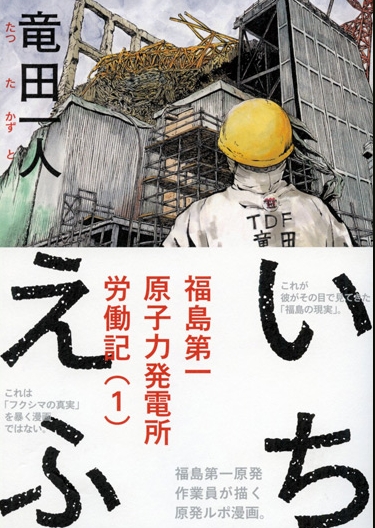
Although words of praise poured in for Kazuto Tatsuta’s manga about the Fukushima nuclear disaster, some comments said he was a spy for Tokyo Electric Power Co.
The artist, who went to great lengths to show the true situation around TEPCO’s Fukushima No. 1 nuclear plant, scoffed at the notion.
“As for nuclear power generation, I have never taken stances of ‘promotion,’ ‘opposition’ or ‘neutral.’ I just wanted to convey the changes of the place (at the nuclear plant) in real time,” he said.
His manga series, “Ichiefu Fukushima Daiichi Genshiryoku Hatsudensho Rodoki” (1F; Records of labor at Fukushima No. 1 nuclear power plant), was one of several that started after the triple disaster struck five years ago.
Some of them initially offered messages of encouragement to the disaster victims. But they gradually changed to depict the realities of the situation in the northeastern Tohoku region and the disaster victims’ extraordinary experiences.
Tatsuta’s series, carried in the weekly magazine Morning, was based around the sites of demolition work at the nuclear plant.
He was working at a company of an acquaintance near Tokyo when the Great East Japan Earthquake struck on March 11, 2011. Tatsuta looked for a job in areas affected by the disaster, and ended up working at a rest station of the nuclear plant as an employee of the sixth-layer subcontractor in June 2012.
In 2013, Tatsuta started “Ichiefu” to show the daily lives of workers at the plant.
His work drew much attention and acclaim. But some said the artist was underestimating the dangers of nuclear power generation. The series ended in October 2015.
Yoko Hano depicted the daily post-disaster lives of a different group–senior high school students in Fukushima Prefecture.
She started the serialized manga “Hajimari no Haru” (Spring as a beginning) because she also wanted to convey the truth. The comic is currently carried under the title of “Happy End?” in the Monthly Afternoon magazine.
Hano, who is from Nishigo in Fukushima Prefecture, now lives in Shirakawa, also in the prefecture.
“From the time immediately after the outbreak of the disaster, I saw false information from the media that was slipshod in confirming facts,” she said. “A person in my neighborhood was cornered by the situation caused by the disaster and committed suicide. I thought that unless accurate information is offered, our local communities will be destroyed.”
The protagonists in her manga learn about agriculture. They vow to reconstruct their hometowns and start taking action despite being shaken by nuclear accident.
“Here (in Fukushima Prefecture), there are many themes I should tackle throughout my life. I think that people who are making a living with jobs related to expression and speech should migrate to Fukushima,” Hano said.
In the serialized manga “Gogai! Iwate Chaguchagu Shinbunsha” (Extra edition! Iwate Chaguchagu newspaper company), the protagonist is a female reporter with a local newspaper in Iwate Prefecture.
Its creator, Aruto Asuka, who lives in Ichinoseki in the prefecture, began to carry the manga in the comic magazine Be Love, published twice a month, in 2009. Initially, it focused on the people, seasonal traditions and industries of the prefecture.
Then, the Great East Japan Earthquake and tsunami struck in 2011.
The manga now features the reality of the prefecture that was hit hard by the disaster.
Ichinoseki, an inland area, escaped serious damage. However, “that produced big conflicted feelings in my mind,” Asuka recalled.
In a special edition titled “Sanriku no Umi” (Sea of Sanriku), which was carried in the third volume of the book version of the manga, the protagonist visits the coastal district of Koishihama in Ofunato, Iwate Prefecture, for news coverage, and meets a young fisherman and his wife again.
The wife is pregnant but hesitant to give birth because of her feelings for a relative who lost her child and other family members in the disaster.
“I also have feelings of guilt about the fact that I am alive without suffering from any damage,” Asuka said. “I will not forget the various feelings of people (in the affected areas).”
http://www.asahi.com/ajw/articles/AJ201604010061.html
Tainted Fukushima towns stuck in time as decon crews plug away
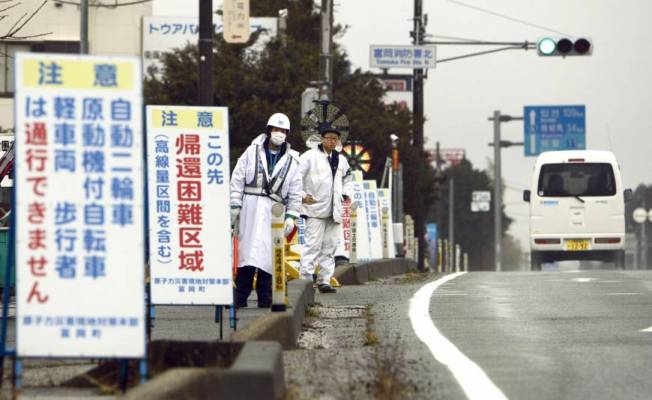
Police and security officers keep watch along National Route 6 leading to the off-limits zone in Tomioka, Fukushima Prefecture, on March 9
FUKUSHIMA – Five years after the nuclear disaster triggered by the huge earthquake and tsunami, reconstruction has made little progress in parts of Fukushima Prefecture. A Kyodo News reporter drove National Route 6 northward to the crippled Fukushima No. 1 nuclear plant to witness the lingering effects of the calamity.
In the town of Hirono, in the southeast, many shops and buildings remain empty. North of Hirono is the town of Naraha, most of which lies within the 20-km-radius hot zone around Tokyo Electric Power Co.’s radiation-leaking power plant.
The nuclear disaster forced Hirono to move its operations to other municipalities in the prefecture, while Naraha was designated an evacuation zone.
Now the towns have a radiation level below 1 millisievert per year — a level the government is trying to achieve in other areas via decontamination — and residence restrictions and evacuation orders have been lifted, with Hirono’s town office returning to its original place.
However, many residents are reluctant to go back to their homes. So far only 48 percent of Hirono’s population and 6 percent of Naraha’s have returned.
Yet hotels and other lodgings were busy accommodating out-of-prefecture workers seeking decontamination and construction work. All 275 rooms at a hotel in Hirono built for the reconstruction support scheme three years ago are “almost fully reserved for the next month,” the front desk clerk said.
A worker in his 50s who came from Tokyo to oversee decontamination work said he earns more than ¥16,000 ($145) per day. Another man staying at the hotel said he was on a three-week contract and received ¥25,000 a day. Their lodging was paid for by their employers.
At night, there was only one pub open in Hirono.
“The shopping area is deserted, although schools have resumed,” said a woman who works there. Still, the pub was full, mainly with visitors not from Fukushima.
In Tomioka, parts of which are still designated as in the “difficult to return” zone, most retail buildings on both sides of the main road have been abandoned and are decaying. Bags of contaminated soil sit piled up near the shore — now a huge makeshift storage site.
In a similar zone in the town of Okuma, which co-hosts the plant, three men in white protective suits were conducting decontamination in a field under a cloud of dust.
Nearby, a large boar suddenly crossed the road.
Soon after the nuclear disaster struck five years ago, untended cows and dogs were seen wandering around looking for food, but now boars are a frequent site, local people say.
In a residential part of Okuma, quake-damaged roads have been fixed but houses are being left as they are. The only sounds are chirping birds and the wind.
At a railway station, radiation over 10 microsieverts per hour is detected just above a covered drain. Although radiation in the “difficult to return” zones in Okuma and neighboring Futaba — the two towns hosting the nuclear plant — is much lower than it was immediately after the meltdowns, there are many hot spots measuring over 5 microsieverts — dozens of times higher than the government’s goal.
A Futaba resident who was showing the area to foreign journalists said, “The word ‘reconstruction’ has no relevance to this town.”
In Minamisoma — farther north of the Fukushima No. 1 complex — some areas are still designated as restricted residential zones.
“The number of jobs, such as decontamination work, has increased, but most of them are taken by people coming from outside the prefecture. We can hardly say this place has been enlivened again,” said Masayoshi Kariura, a Catholic priest.
“The pileup of contaminated soil that is clearly visible is weighing heavily on the residents,” he said.
Radioactive sediment found in Fukushima rivers
Tokyo: Japanese researchers have detected relatively high levels of radioactive substances in sediment in multiple rivers running through Fukushima prefecture, the media reported on Friday.
The prefectural government in January surveyed the density of radioactive materials in soil and other sediment that has accumulated on the bottoms and banks of 72 rivers in the prefecture, public broadcaster NHK reported.
The study came in response to the 2011 nuclear accident at the Fukushima Daiichi power plant.
The researchers found up to 54,500 becquerels per kg of radioactive substances in the Maeda river in Futaba town, where the plant is situated, and 39,600 becquerels in the Hiru river in Fukushima city. They also detected more than 10,000 becquerels at five other locations in four municipalities.
The prefectural government plans to study restricting access to rivers with high concentrations of radioactive materials.
It also plans to urge the central government to remove contaminated soil and other sediment.
http://www.thejapannews.net/index.php/sid/242732285

Past References
Overview of active cesium contamination of freshwater fish in Fukushima and Eastern Japan
- Received: 13 March 2012
- Accepted: 05 April 2013
- Published online: 29 April 2013
Abstract
This paper focuses on an overview of radioactive cesium 137 (quasi-Cs137 included Cs134) contamination of freshwater fish in Fukushima and eastern Japan based on the data published by the Fisheries Agency of the Japanese Government in 2011. In the area north and west of the Fukushima Nuclear plant, freshwater fish have been highly contaminated. For example, the mean of active cesium (quasi-Cs137) contamination of Ayu (Plecoglossus altivelis) is 2,657 Bq/kg at Mano River, 20–40 km north-west from the plant. Bioaccumulation is observed in the Agano river basin in Aizu sub-region, 70–150 km west from the plant. The active cesium (quasi-Cs137) contamination of carnivorous Salmondae is around 2 times higher than herbivorous Ayu. The extent of active cesium (quasi-Cs137) contamination of Ayu is observed in the entire eastern Japan. The some level of the contamination is recognized even in Shizuoka prefecture, 400 km south-west from the plant.
Introduction
The serious accidents of the Fukushima Nuclear Power Plant have been contaminating a vast area in eastern Japan1, home of 60 million people. Consumption of freshwater fish is an important part of the aquatic pathway for the transfer of radionuclides to the freshwater ecosystem creatures including humans2. Therefore the contamination of freshwater fish of aquatic bioaccumulation is an important problem3,4. In the case of the Chernobyl Accident, the transfer of radionuclides to fish has been studied in European countries5,6,7. Most attention was focused on Belarus, the Russian Federation and Ukraine, because of the higher contamination of water bodies in these areas8,9. However, in the case of Fukushima, there is little information about freshwater ecosystem contamination in 2011. Therefore, this paper focuses on an overview of active cesium 137 (quasi-Cs137) contaminations of freshwater fish in Fukushima and eastern Japan based on 2011 data published by the Fisheries Agency of the Japanese Government10.
Results
Highest contaminated area in fukushima prefecture
Fukushima Prefecture is located in the northeastern part of the Main Island of Japan (Fig. 1). It is divided into three sub-regions by its mountainous topography, i.e., Hamadori, Nakadori and Aizu (from east to west). Hamadori is the coastal region facing the Pacific Ocean and separated from Nakadori (central basin) by the Abukuma Highlands. The westernmost Aizu is mountainous with the Aizu Basin in the center. There still is a rich natural environment maintained throughout the prefecture with three national parks, one quasi-national park and eleven prefectural parks present. The mountain ranges form headwaters and basins of many rivers such as the Abukuma River and the Aga River. The Abukuma Highlands is designated as one of the prefectural parks and rich in endemic wildlife including the indigenous forest green tree frog (Rhacophorus arboreus) and salamanders (Hynobius lichenatus, Hynobius nigrescens). There the Ayu (Plecoglossidae: Plecoglossus altivelis altivelis), Salmon (Salmonidae: Oncorhynchus masou, Salvelinus leucomaenis) and carp (Cyprinidae: Tribolodon hakonensis, Cyprinus carpio, Carassius.sp) are very popular freshwater fish for fishing and angling.

Blue is water system: Aga river basin is west area of Fukushima, Abkuma river basin is center of Fukushima. Green is mountain chain or highland where heights is more 1,000 m. Yellow is high contaminated area by nuclear accidents.
The Fukushima Nuclear Power Plant is located in Hamadori. Due to the topography with the Pacific Ocean in the east and the Abukuma Highlands in the west, the areas in the north to the west of the plant are highly contaminated. Such areas include Iidate Village and Date City. The Mano River which flows through Iidate Village in the upstream and Minami-souma City. Two months after the accident, the Ministry of Land, Infrastructure and Transport surveyed the Mano River11. The survey results of the contamination level of the bottom soil are Cs134: 6,900 Bq/kg and Cs137: 7,800 Bq/kg in Mano River of Minamisouma city at Majima bridge on 29/5/2011. While the area downstream and the Abukuma River in Date City found higher contamination. Two months after the accident, the Ministry of Environment surveyed the Abukuma River of Date city. The survey results of the contamination level of the bottom soil are Cs134: 11,000 Bq/kg and Cs137: 12,000 Bq/kg in Abukuma River of Date city at Taisho bridge on 24/5/2011.
The contamination level of radioactive cesium (quasi-Cs137) of the Ayu, annual and herbivorous species, captured in these rivers or their tributaries between May and September 2011 was measured. The cesium bioaccumulation of those captured in the Mano River was mean 2,657 Bq/kg (n = 3, median 2,900 Bq/kg, range 1,770–3,300 Bq/kg) and the Abukuma River at Date city was mean 1,770 Bq/kg, (n = 11, median 1,170 Bq/kg, range 650–2,080 Bq/kg ).
The bioaccumulations of Aga river basin (West Fukushima)
The Aga River Basin encompasses the entire Aizu region in west Fukushima. The river water flows through from the Aizu region to the Sea of Japan. As it lies over 70 km to the west of the nuclear power plant and both the Abukuma Highlands and Oou montain chain are in between, the Cs137 contamination level here was lower than Mano river and the Abukuma river basin. Two months after the accident, Fukushima prefecture surveyed the Agano River (Aga river Basin) of Aizu and South Aizu region12. The survey results of the contamination level of bottom soil were Cs134: 29 Bq/kg and Cs137: 33 Bq/kg in Agano River of Aizu region at Miyako bridge on 27/5/2011, Cs134: 29 Bq/kg and Cs137: 34 Bq/kg in Agano river of Minami-Aizu region at Tajima bridge on 27/5/2011.
In the aga river basin, the bioaccumulation of fish are well recognized. Fig. 2 shows the quasi-Cs137 contamination and bioaccumulation levels of three fish families captured in the basin, i.e., Plecoglossidae (Plecoglossus altivelis n = 18), Cyprinidae (Tribolodon hakonensis n = 25, Cyprinus carpio n = 5, Carassius sp. n = 11)and Salmonidae(Oncorhynchus masou n = 12, Salvelinus leucomaenis n = 13) between April and December 2011. Since p-value = 0.008 ≤ 0.05 of Kruskal-Wallis Test, at the p = 0.05 level of significance, there exists enough evidence to conclude that there is a difference among the three families based on the active cesium contamination level. The median of herbivorous Plecoglossidae shows the lowest level among the three families (n = 18, mean 50.64 Bq/kg, median = 46.00 Bq/kg, range 12.00–90.00 Bq/kg). Then the median of omnivorous Cyprinidae shows about 1.6 times (n = 41, mean 79.80 Bq/kg, median 72.00 Bq/kg, range 15.00–210.00 Bq/kg) and the mean of carnivorous Salmonidae about 1.9 times higher (n = 25, mean 96.24 Bq/kg, median 89.00 Bq/kg, 17–200 Bq/kg) than Plecoglossidae.

The box plots indicate inter-quartile ranges of these data. Bars are into the each box indicate the each median.
The widespread contamination in eastern Japan
To the south west of Fukushima prefecture, there lies the Kanto region which as well as containing the metropolitan prefecture of Tokyo also comprises Ibaraki prefecture, Tochigi prefecture, Gunma prefecture, Saitama prefecture, and Chiba prefecture. In the area, there is the Tone river basin that is the one of biggest river basins (16,840 km2) in Japan. Therefore, there are not only many source points of water springs and many rivers and streams but also high density water network systems of irrigation canals and urban water systems. Freshwater fish inhabit all types of water systems. As a result, the level of freshwater contamination can be taken as an index of the environmental contamination of the freshwater ecosystem. The isogram map (Fig. 3) shows an average of quasi-Cs137 for each prefecture about contamination levels of the Ayu (Plecoglossus) captured in between May and September 2011.
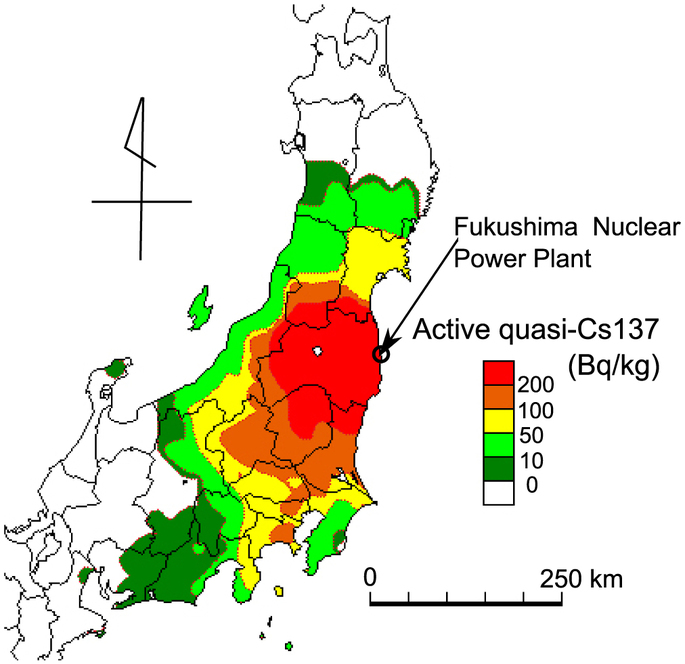
Each isogram center points are each prefecture’s capital city.
The relation between distance from power plant and contamination level
We found a relation between the distance from the power plant and the quasi-Cs137 contamination level of freshwater fish. According to the result of inverse regression analysis about quasi-Cs137 contamination levels related to the distance from the nuclear power plants of each prefectural capital city, the equation is: Y = 27339.82−1 × −75.13 (Y = Cesium, X = The Distance from the plants to each prefecture’s capital city, Signif F = 0.009 < 0.05, Adjusted R Square 0.50). In areas within a radius of 100 km from the nuclear plant, active cesium contamination levels of the Ayu are more than 200 Bq/kg. In those between a radius of 100 km and 200 km, it is around 60–200 Bq/kg. In those between a radius of 200 km and 300 km in which Tokyo is included, it is 20–60 Bq/kg. Therefore, it is estimated that contamination of freshwater fish is extended to all prefectures in eastern Japan. The contamination is recognized as far as Shizuoka prefecture, 400 km south-west from the plant.
Discussion
The Japanese freshwater system is very high density as developed rice water paddy field, irrigation canal, urban water-system network. Therefore, we have to think that the contamination of freshwater fish is widespread not only in river basins but also all over the ground included all types of water-systems, for example, agricultural and urban water systems. The isogram map shows the contamination tendency quite well. The contamination levels of the freshwater fish provide insufficient data and the knowledge of the path about bioaccumulation. So, we will have to survey a more wide spread area and monitor bioaccumulation in each species level.
In this paper we show the relation between distance and contamination levels by inverse regression analysis. The results indicate the effects of quasi radioactive cesium 137 by the Fukushima accident look like less serious than those of the Chernobyl accident. However, contamination levels are possibly higher than the Chernobyl as the cesium is concentrated by the water systems in limitation region. Water paddy field look like shallow pond saved mud included cesium 137. Moreover, the cesium137 will distribute and concentrate by high density irrigation canal and urban water-system. For example, the highly contaminated Taisho river bottom soil Cs134: 4,335 Bq/kg, Cs137: 5,456 Bq/kg was found at 1/11/2011 at Kitakashiwa bridge of Kashiwa city in Tokyo metropolitan area, 200 km south-west from the plant13. Therefore we must carefully and continuously monitor the contamination to the freshwater ecosystem and human health.
Methods
Data 2011 of radioactive cesium of freshwater fish was analyzed by each local government according to the emergency food survey manual of radioactive substance14. The purpose of this manual is they avoid feeding high contaminated food it was defined by food security of emergency condition. Therefore, it is not aimed at collecting accurate data. As a result, this data did not distinguish between cesium137 and cesium134. Therefore, the analysis of this paper calculated by quasi-Cs137 included Cs134. They used germanium semiconductor machine when they measured the radioactive cesium contamination of freshwater fish. The measure time is from 10 minute to 1 hour. The calibration is only Cs137 in per week. The range of radioactive cesium applied only Cs137 regression equation. The result, when the case included Cs134 is relatively much, the numerical value become over estimation. The sample of freshwater fish was collected by each prefectural government by emergency policy of food security. In the survey, the fish sample collected 5–10 kg in one survey station. The measure is using wet condition fish. Ayu and small fish was measured hole body, while big fish measured the part of food portion.
References
1.
Monitoring information of environmental radioactivity level, MEXT and DOE Airborne Monitoring, Ministry of Education, Culture, Sports, Science & Technology in Japan, http://radioactivity.mext.go.jp/en/list/203/list-1.html (2013).
2.
Joanna, B. et al. Radiocesium in Fish from the Savannah River and Steel Creek: Potential Food Chain Exposure to the Public. Risk Analysis Vol. 21, No.3, 545–559 (2001).
3.
McCreedy, C. D., Jagoe, C. H., Glickman, L. T. & Brisbin Jr, I. L. Bioaccumulation of cesium-137 in yellow bullhead catfish (Ameiurus natalis) in habiting an abandoned nuclear reactor reservoir. Environmental Toxicology and Chemistry 16, 328–335 (1997).
4.
Rowan, J. R. & Rasmussen, J. B. Bioaccumulation of radiocesium by fish: The influence of physicochemical factors and trophic structure. Canadian Journal of Fisheries and Aquatic Science 51, 2388–2410 (1994).
5.
Hakanson, L., Anderson, T. & Nilsson, A. Caesium-137 in perch in Swedish lakes after Chernobyl-present situation, relationships and trends. Environmental Pollution 58, 195–212 (1989).
6.
Ugedal, O., Forseth, T., Jonsson, B. & Njastad, O. Sources of variation in radiocesium levels between individual fish from a Chernobyl contaminated Norwegian lake. Journal of Applied Ecology 32, 352–361 (1995).
7.
Elliott, J. M. et al. Sources of variation in post-Chernobyl radiocesium in fish from two Cumbrian lakes (north-west England). Journal of Applied Ecology 29, 108–119 (1992).
8.
Long-Term Observation of Radioactivity Contamination in Fish around Chernobyl. RYABOV I N Vol 79, 112–122 (2002).
9.
Environmental consequences of the Chernobyl accident and their remediation : twenty years of experience report of the Chernobyl Forum Expert Group ‘Environment’. Vienna: International Atomic Energy Agency (2006).
10.
Results of the inspection on radioactivity materials in fisheries products, Fisheries Agency, http://www.jfa.maff.go.jp/e/inspection/index.html. (2012).
11.
Urgent radionuclides monitoring report in public water system area of Fukushima prefecture (in Japanese), Ministry of Environment, http://www.env.go.jp/water/suiiki/urgent/result201106.pdf. (2011).
12.
Urgent environmental radionuclides monitoring report in public water system area of Fukushima prefecture at 4/6/2011(in Japanese), Fukushima Prefecture, http://www.pref.fukushima.jp/j/koukyouyousuiikimonitaring.pdf. (2011).
13.
Final report of the highly contamination spot in Kashiwa city (in Japanese), Ministry of Environment, http://www.env.go.jp/press/press.php?serial=14647. (2012).
14.
The survey manual “Guide: Emergency Preparedness for Nuclear Facilities”, Nuclear Safety Commission, June, 1980-final revised in 2010. (2010).
Sources :
- Received: 13 March 2012
- Published online: 29 April 2013
Overview of active cesium contamination of freshwater fish in Fukushima and Eastern Japan
http://www.nature.com/articles/srep01742
- Received: 21 November 2013
- Published online: 16 January 2014
Initial flux of sediment-associated radiocesium to the ocean from the largest river impacted by Fukushima Daiichi Nuclear Power Plant
http://www.nature.com/articles/srep03714
- Received: 15 May 2014
- Published online: 12 February 2015
Future projection of radiocesium flux to the ocean from the largest river impacted by Fukushima Daiichi Nuclear Power Plant
http://www.nature.com/articles/srep08408
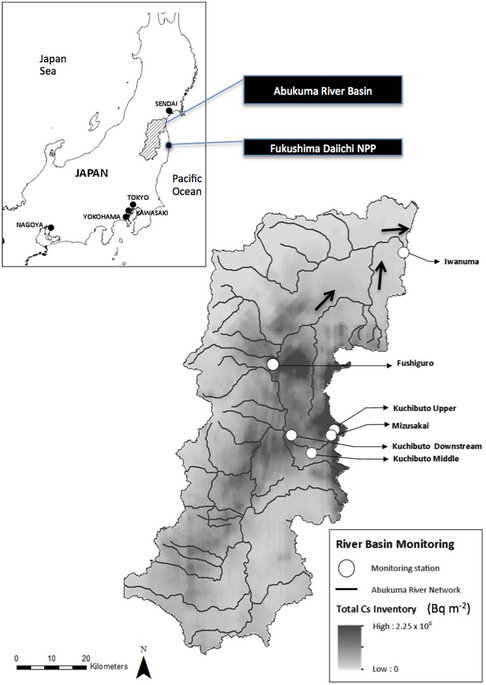
Map of the Abukuma river basin showing monitoring locations and the total radiocesium inventory
Ice wall at Fukushima plant switched on, but will it work?
by MARI YAMAGUCHI Mar. 31, 2016
TOKYO (AP) — The operator of Japan’s destroyed Fukushima nuclear plant switched on a giant refrigeration system on Thursday to create an unprecedented underground ice wall around its damaged reactors. Radioactive water has been flowing from the reactors, and other methods have failed to fully control it. The decontamination and decommissioning of the plant, damaged by a massive earthquake and tsunami in 2011, hinge of the success of the wall.
Q. WHAT IS AN ICE WALL?
A. Engineers installed 1,550 underground refrigeration pipes designed to create a 1.5-kilometer (0.9-mile) barrier of frozen soil around four damaged reactor buildings and their turbines to control groundwater flowing into the area and prevent radioactive water from seeping out. The pipes are 30 meters (100 feet) deep, the equivalent of a 10-story building. Engineers say coolant in the pipes will freeze the surrounding soil to minus 30 degrees Celsius (minus 22 Fahrenheit), creating the wall over several months.
Q. WHY IS AN ICE WALL NEEDED?
A. The cores of three of the damaged reactors melted during the accident and must be cooled constantly with water to keep them from overheating again. The cooling water becomes radioactive and leaks out through damaged areas into the building basements, where it mixes with groundwater, increasing the volume of contaminated water. Nearly 800,000 tons of radioactive water have been pumped out, treated and stored in 1,000 tanks that now occupy virtually every corner of the Fukushima plant, interfering with its decontamination and decommissioning and adding to the risk of further leaks of water into the nearby ocean.
Q. ARE THERE RISKS?
A. Construction officials say the coolant is environmentally safe. There were doubts that the huge refrigeration system could effectively freeze the soil while groundwater continues to flow in the area. The operator, Tokyo Electric Power Co., says results from a test of part of the wall last summer were mixed but suggest the system has sufficient capability. Experts are also concerned that an ice wall cannot be adjusted quickly in an emergency situation, such as a sudden increase in the flow of contaminated water, because it takes several weeks to freeze or melt. Electrical costs for running the refrigeration system could be steep. TEPCO says the wall, once formed, can remain frozen for up to two months in the event of a power failure.
Q. WHO MADE THE ICE WALL?
A. The 35 billion yen ($312 million) project was funded by the government and built by Kajima Corp., which has used similar technology in smaller projects such as subway construction. The wall was delayed by technical uncertainties and was finished last month, a year behind schedule.
Tepco starts freezing soil around Fukushima plant reactors
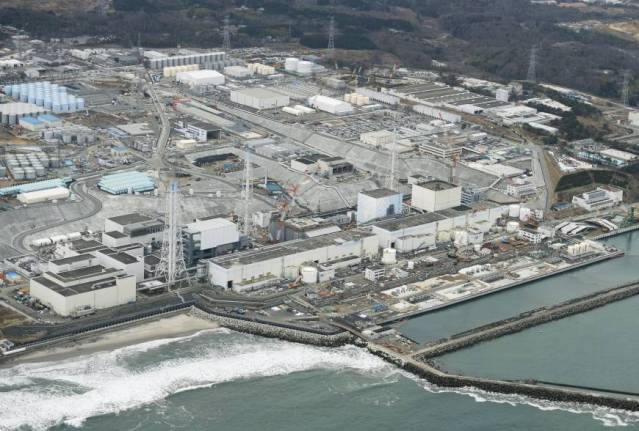
Tokyo Electric Power Co. said Thursday it has started freezing soil around damaged nuclear reactor buildings at the disaster-hit Fukushima plant, aiming to reduce the flow of groundwater into the highly contaminated facilities.
The Nuclear Regulation Authority on Wednesday gave Tepco permission to create a coolant-filled ice wall and start freezing soil on the east sea-facing side of the plant followed by 95 percent of the west side facing the mountains.
The work is expected to take more than three months to complete.
The plant was crippled by a massive earthquake and tsunami in March 2011.
In June 2014, Tepco installing equipment needed to establish the ice wall around the No. 1 to No. 4 reactors.
The work was completed in February, with the government funding some ¥35 billion ($309 million) of the project.
The utility plans to seek permission to extend the wall to cover the entire west side as well as the south and north sides of the plant after collecting data.
The 1.5-kilometer-long and 30-meter-deep wall is designed to stem a massive flow of groundwater from entering the basements of the reactor buildings and mixing with leaked toxic water.
The complete freezing is expected to take eight months if all goes smoothly.
Chief Cabinet Secretary Yoshihide Suga said the government “hopes the ice wall will stem the flow of groundwater into the facilities at an early date.”
Tepco and the government initially aimed to complete freezing the entire wall by the end of fiscal 2015, but the schedule was delayed due to prolonged discussions on safety measures.
The wall is expected to reduce the amount of groundwater flowing into the facilities every day to about 50 tons from more than 100 tons currently.
Still, the effectiveness of the ice wall, which would be the world’s largest ground freezing project, remains unclear.
The NRA warned earlier that if the groundwater level within the wall is reduced excessively by stemming the flow from outside, highly contaminated water within the buildings could seep out.
Tepco said it will stop the freezing work or inject water into wells around the reactor buildings if the groundwater level inside the wall is likely to become too low.
Increased Strontium in Sardines since Fukushima Accident?

Dogs fed sardines show high Strontium levels
by Dr. Peter Dobias, DVM
Why you might want to cut out small fish from your dog’s diet
I have had two dog patients with severely elevated levels of the element strontium. The interesting part is that these two dogs were fed a high amount of sardines and I highly suspect that strontium is coming from this source.
Strontium acts in the body the same way as calcium and deposits in bones. Sardines and other small fish are eaten whole with the bones and that is why they are more likely a source of this toxic element.
The reason why I am concerned is that the radioactive isotope strontium 90 is a toxic carcinogen and it has been released in Japan’s Fukushima disaster.
Here is an example of the results:

As a veterinarian, I source from almost three decades of experience, but still I like to see the proof. Hair testing for minerals and toxic elements has been really helpful because it is highly accurate and shows what is happening in different groups of dogs.
In the course of many years of testing, I have learned that dogs who eat fish-based foods have elevated mercury levels and sardines appear to be the cause of increased strontium. Since the Fukushima nuclear accident strontium is continuously being released into the oceans and not much is being done to inform the general public.
Sadly, I have noticed that dogs who have epilepsy have higher than average levels of strontium and mercury, which made me recommend against feeding fish and sardines to dogs, despite their nutritional benefits. Fish is not what it used to be.
http://peterdobias.com/blogs/blog/11014105-dogs-fed-sardines-show-high-strontium-levels
NRA approves TEPCO’s plan to freeze underground walls of soil at Fukushima plant

NRA approves TEPCO’s plan to freeze underground walls of soil at Fukushima plant
The Nuclear Regulation Authority (NRA) decided on March 30 to approve Tokyo Electric Power Co. (TEPCO)’s plan to gradually freeze underground walls of soil around the crippled Fukushima No. 1 nuclear plant, starting with shields on the ocean side.
With the NRA’s approval, TEPCO, the operator of the crippled Fukushima nuclear complex, is to begin work as early as March 31 to freeze the walls built around the buildings of reactors Nos. 1 through 4 at the plant. The walls are designed to prevent underground water from flowing into the reactor buildings. But such a large-scale “wall of ice” has not been introduced anywhere in the world and it is unclear how much underground water the frozen shields will be able to prevent from flowing into the crippled nuclear complex.
Under the project to build the frozen soil walls, coolant chilled to a temperature of minus 30 degrees Celsius is to circulate through 1,568 pipes that are driven into the ground to a depth of around 30 meters, to create a “wall of ice.” The project is aimed at preventing underground water from entering the reactor buildings and reducing the amount of contaminated water being generated. If the project goes as planned, work to freeze the walls is expected to be completed in about eight months. TEPCO estimates that the walls will help the utility reduce the inflow of underground water to several dozen tons per day from the current 150 to 200 tons.
TEPCO is to gradually freeze the walls, starting with the one (about 690 meters) on the ocean side first, while leaving seven sections (a total of about 45 meters) on the mountain side unfrozen. TEPCO had initially planned to freeze all of the walls at once. But if the levels of underground water around the reactor buildings drop drastically, contaminated water remaining in the reactor buildings could flow out. So the NRA called for the gradual freezing of the walls. TEPCO then accepted the NRA’s suggestion.
The frozen-soil wall project is considered to be a key measure to deal with contaminated water along with the so-called “subdrain” project designed to reduce the amount of water being contaminated by removing underground water from wells around the reactor buildings. TEPCO started inserting pipes into the ground in June 2014 and completed its preparations to begin freezing the walls in February this year.
http://mainichi.jp/english/articles/20160330/p2a/00m/0na/012000c
TEPCO given OK on freezing soil at Fukushima plant
The Nuclear Regulation Authority gave the go-ahead to Tokyo Electric Power Co.’s plan to freeze the soil around the reactors at the crippled Fukushima No. 1 nuclear power plant from the seaside on March 30.
The aim of the frozen soil wall is to block the flow of groundwater into the reactor buildings to prevent it from becoming contaminated with radioactive substances.
The utility has already inserted 1,568 pipes to a depth of 30 meters in the ground around the No. 1 to No. 4 reactor buildings. The plan is to circulate liquid with a temperature of minus 30 degrees through the pipes to freeze the surrounding soil.
TEPCO’s plan is to first freeze the entire wall on the seaside and about half of the wall on the mountain side.
The effects of completing the frozen wall on the seaside are expected to show after about six weeks with water being prevented from flowing through. Then, the frozen portions on the mountain side will be gradually increased. When 95 percent of the wall is frozen, TEPCO will suspend the freeze, leaving cracks in seven places to allow some water through.
The utility predicts that with 95 percent of the entire soil wall frozen, about half of the groundwater will be blocked.
To freeze the entire wall on the mountain side, TEPCO will have to gain further approval from the NRA.
Initially, the electric power company planned to freeze soil only on the mountain side. However, the NRA pointed out that if groundwater is totally blocked from the mountain side, the level of water within the frozen soil near the reactors could become too low and with nothing outside to stop it, highly contaminated water inside the reactor buildings could more rapidly flow out.
Because of that, TEPCO decided in February that it will freeze the soil mainly from the seaside and collect data on the level of groundwater and, after that, it will freeze the entire wall.
“It is important to collect sufficient data in a continuous manner and implement the freezing while keeping watch,” said NRA chairman Shunichi Tanaka.
The plan to create the frozen soil wall was developed by an economy ministry committee in May 2013 as an important part of measures to decrease the volume of contaminated water. The work to insert pipes into the ground was completed in February.
http://ajw.asahi.com/article/behind_news/social_affairs/AJ201603300074
Prosecutors innocent TEPCO over radioactive water leakage into the ocean
The court said there is no evidence that proves that radioactive water flew out of the Fukushima nuclear power plant to the ocean. I hope this would finally convince those who haven’t been convinced that the state of Japan denies truth and violates peoples lives. Its time to get rid of Abe et al.
Prosecutors drop TEPCO case over radioactive water leakage
FUKUSHIMA–The Fukushima District Public Prosecutor’s Office announced on March 29 that it will not prosecute Tokyo Electric Power Co. or its executives for violating an environmental pollution law.
The decision came two and a half years after a group of plaintiffs, including residents of Fukushima Prefecture, filed a criminal complaint against TEPCO, operator of the crippled Fukushima No. 1 nuclear power plant, and its 32 current and former executives.
The group sought to bring charges against the utility and its executives for allowing radioactive contaminated water to be discharged into the sea.
In its decision, the prosecutors said there was “insufficient” evidence to press charges against TEPCO and some of its executives, including Naomi Hirose, company president. The remaining executives, the prosecutors said, “had no authority or responsibility to set measures to avoid the leakage in the first place,” therefore, the accusation has “no grounds.”
“The Fukushima police investigated the case for almost two years. It is extremely disappointing,” said Ruiko Muto, 62, the head of the plaintiff’s group, at a news conference in Tokyo on March 29. “We wanted them to look into the case further. We can’t accept this decision.”
The group is planning to appeal to the Committee for the Inquest of Prosecution. The group will meet with its lawyers on March 30 and decide on whether it will pursue further action.
http://ajw.asahi.com/article/0311disaster/fukushima/AJ201603300068
Charges ruled out for Tepco figures over Fukushima No. 1 radioactive water spillage into sea
FUKUSHIMA – Public prosecutors decided on Tuesday not to indict Tokyo Electric Power Co. President Naomi Hirose and other current and former executives of the utility over radioactive water leaks from the crippled Fukushima No. 1 nuclear power plant into the ocean.
Sufficient evidence was not found, the Fukushima District Public Prosecutor’s Office said.
In September 2013, a civic group filed a criminal complaint against 32 current and former Tepco executives, including Hirose and Tsunehisa Katsumata, former chairman of the operator of the northeastern nuclear power plant, saying tainted water leaked from storage tanks into the ocean due to their failure to take preventive measures.
Through its investigation, the Fukushima Prefectural Police concluded that some 300 tons of stored radioactive water had flowed into the sea as of July 2013 because Tepco executives neglected to monitor the tanks or take leak-prevention measures, and sent the case to the prosecutors last October.
The prosecutors said there was no evidence supporting the allegation that the leaked tainted water was carried into the sea by groundwater at the plant, which suffered meltdowns following the massive earthquake and tsunami in March 2011.
The group said it will ask for a prosecution inquest panel’s investigation.
Look At The Millions Of Bags Of Radioactive Dirt That Japan Has No Plan For

Five years after the meltdowns at the Fukushima Daiichi nuclear plant, Japan still faces another four decades or more of cleanup. One of many problems is what to do with the massive amount of contaminated soil from the site—which is now in a growing pile of bags stacked on former farms in Fukushima.
A new photo series from Japan-based photographer James Whitlow Delano documents the sprawl of nuclear waste.
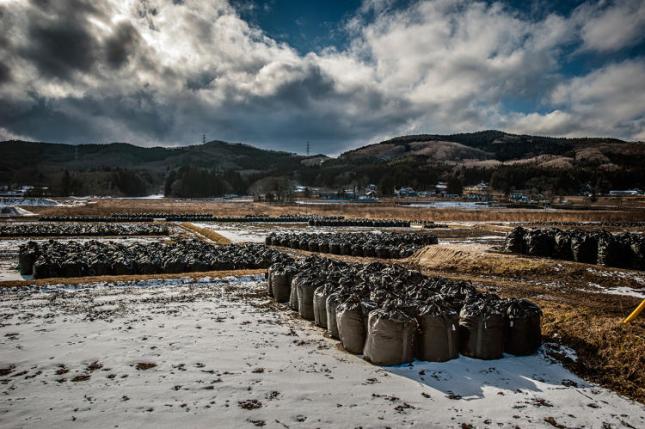
As of 2015, the government reported that there were more than 9 million bags in the prefecture. Some of it will be moved inside the no-entry zone next to the nuclear plant, which is so radioactive that the government has given up on decontamination for the moment. But Japan is also sending radioactive waste to other parts of the country.
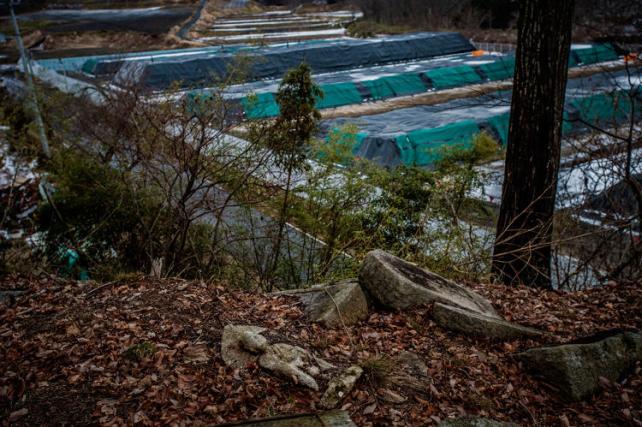
“The Japanese government decided early on in the decontamination process that all prefectures in Japan should share the burden of storing radioactive waste with Fukushima Prefecture,” says Delano, who has been photographing the disaster since it happened in 2011. “This resulted in firm pushback by communities in other prefectures that are adjacent to sites that were selected.”
They have reason to be concerned: In September of 2015, when there were floods in Nikko, Japan, hundreds of bags of radioactive soil were washed into the local river.
Even in Fukushima itself, in villages where many residents may not be able to return for a decade or more, no one wants a radioactive dump next to their former homes. The dumps are supposed to be temporary and moved in 30 years, but people are skeptical that will happen. “They feel like the presence of the site will be like the last nail in the coffin for their communities,” he says. “So, no one wants this contaminated soil.”
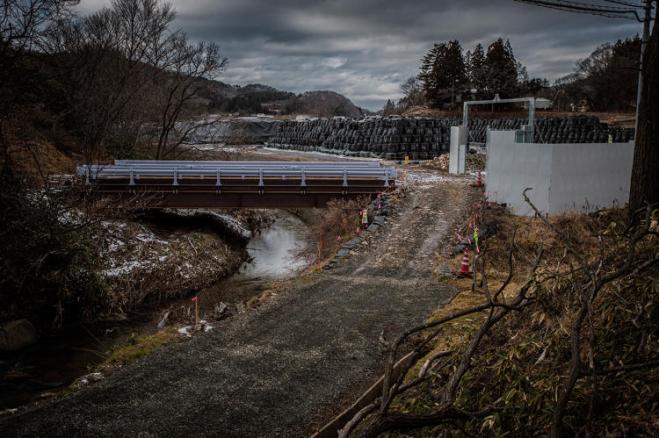
In some areas, a few people have started moving back. “When I used to sneak inside the old 20-kilometer-radius nuclear no-entry zone, I would enter a neighborhood in Minami Soma that was half inside the zone and half outside and hop the barrier to document the absence of humanity,” says Delano. “About one and a half years after the earthquake and tsunami, the no-entry zone was readjusted to reflect the actual radiation levels, instead of being an arbitrary 20-kilometer radius. That meant that the whole neighborhood would be decontaminated and prepared for families to return, if they wanted to do so.”
Some resident returned, but now the fields next to the neighborhood are being cleared for a dump filled with bags of contaminated soil. “People fear the presence of this soil and the dust that every breeze will carry into their neighbor,” he says. “It creates fear and doubt. Many families, especially those with young children, are not returning to this region of Fukushima Prefecture.”

Delano was reluctant to spend much time in the area himself, and carried a Geiger counter and wore a mask while he worked. “I always do my work and get out,” he says. “For example, one hot spot I found in 2012 would expose you to the equivalent of an additional year of natural radiation exposure within 24 hours, if you were to sit there. For obvious reasons, I did not linger there.”
For him, the disaster was personal—he’s lived in Japan for two decades and has Japanese family. Even in Tokyo, the food supply has been affected, and foods are now labeled with the prefecture where they were grown. “You can be careful, but once you go to a restaurant or buy a bento box lunch, all bets are off,” he says.
He also wanted to show how much the area—which was once a peaceful, Vermont-like region of farms—has changed. “It is some of the most beautiful country in Japan,” he says. “This natural beauty only reinforces the sense of loss.”
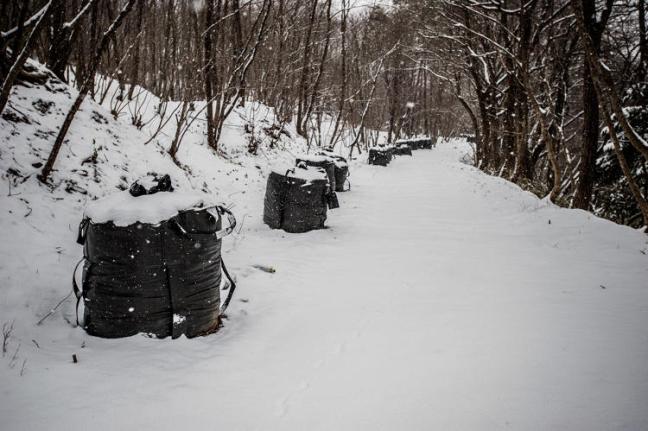
Fukushima: Where mountains and forests cannot be decontaminated

In the background, workers in Iitate village go about their daily routine of removing the layer of irradiated topsoil, which are then placed in stacks of black bags
FUKUSHIMA, JAPAN – Up to 20,000 workers have been toiling to decontaminate towns and villages to clear the way for evacuated residents to return following the Fukushima nuclear plant disaster.
In head-to-toe protective gear, their primary task is removing by shovel and machinery topsoil contaminated with radioactive caesium, which leaked from the crippled power station when a tsunami swamped it five years ago.
The soil is put into plastic flexible container bags and transported by truck to isolated temporary storage sites, where they are surrounded with bags of clean soil to “seal” off emitted radiation. The interim facilities will receive some 22 million cubic m of soil from 43 cities, towns and villages across Fukushima prefecture. It will be put there for 30 years.
Soil under trees, in roadside ditches and places such as drain spouts get particular attention. This is where the radioactive pollutants tend to concentrate after being washed off roofs and pavements by rain and snow.

Once considered among the most beautiful villages in Japan, the farmlands of Iitate are now dotted with black bags – called ‘flexible container bags’ – holding contaminated soil.
The cleanup process also includes brushing and wiping rust or stains from roofs, removing sediment, washing roadside ditches and removing leaves from under trees.
But there remains a sizeable area where decontamination was suspended due to high radiation levels, including Futaba district, where the power plant is located.
The disaster also contaminated vast amounts of paddy straw and grass with radioactive material. This has led to plans for facilities for “designated waste”, which from Fukushima alone accounts for around 140,000 tonnes. It is now temporarily stored on farmland and at waste incineration plants.
The radiation reality will last for years to come.
“While it is possible to decontaminate residential areas, the same cannot be done with mountains and forests. You can’t remove all the trees. But radioactive matter has contaminated trunks and leaves, and when rain falls, these particles return to the ground,” said Ms Emiko Fujioka, secretary-general of non-profit group Fukushima Beacon.
Environment Ministry presents contaminated waste disposal plan for Fukushima

Environment Minister Tamayo Marukawa speaks at the beginning of a meeting on interim storage facilities in the city of Fukushima, on March 27, 2016.
FUKUSHIMA — The Ministry of the Environment announced on March 27 that the government expects to acquire up to 70 percent of land for interim storage facilities for waste contaminated with radioactive materials emanating from the Fukushima nuclear crisis and bring up to 40 percent of contaminated soil into such facilities by the end of fiscal 2020.
The ministry has a rough road ahead, however, since as of March 25 it had only acquired about 1.3 percent of the land needed to build storage facilities straddling the Fukushima Prefecture towns of Okuma and Futaba, and it also faces serious challenges in negotiations with landowners.
On a total of 1,600 hectares of land, the interim storage facilities will be equipped with disposal sites for contaminated soil and other materials, as well as incinerators to reduce the volume of contaminated waste derived from decontamination work around the Fukushima No. 1 Nuclear Power Plant. Delivering of the waste began in March 2015 as a pilot project and it will be stored at the site up to 30 years.
The Environment Ministry presented the projection at a meeting held in the city of Fukushima on March 27. It announced the plan to secure 640-1,150 hectares, or 40-70 percent of the areas for the interim storage sites, by the end of fiscal 2020. A ministry official explained how it calculated the figures, saying that the ministry has already contacted 1,240 landowners by visiting their homes and “there is a feeling” that they will cooperate with the ministry’s plan.
Up to 28 million cubic meters of waste contaminated with radiation that is currently stored across Fukushima Prefecture is planned to be brought to the storage sites, and the ministry expects to deliver 5 million to 12.5 million cubic meters of that to the facilities by the end of fiscal 2020. Environment Minister Tamayo Marukawa told a March 27 news conference in the city of Fukushima that the ministry plans to remove contaminated soil stored at schools and residential areas first, adding, “We’ve allowed a wide range in the projected figures (as negotiations with landowners are underway).”
Meanwhile, Toshitsuna Watanabe, mayor of the town of Okuma where an interim storage facility is planned to be built, expressed appreciation for the figures presented by the ministry to some extent, saying, “Though it appears to be a rough projection, I recognize that they at least presented the target figures.” He added, “With no goals presented before this, local residents were beginning to suspect the central government’s willingness (to put efforts in the storage project). We hope the ministry undertakes the task to reach those targets.”
A 61-year-old landowner who has evacuated from Okuma to the Fukushima Prefecture city of Iwaki questioned the ministry’s plan, saying that 40-70 percent of land acquisition in five years is “too slow.”
“I have decided to sell the land, but the government hasn’t yet shown me the amount of compensation payment,” the man said.
The village of Iitate, currently under radiation evacuation orders, is working toward the lifting of the evacuation orders by the end of March 2017, excluding areas that are designated as “difficult-to-return” zones with high levels of radiation. Iitate Mayor Norio Kanno says, “According to the ministry’s plan, contaminated waste might not be removed (from the village) for five more years. There are piles of bags filled with contaminated soil and they are preventing disaster recovery efforts,” adding, “I want the ministry to speed up the land acquisition process.”
http://mainichi.jp/english/articles/20160328/p2a/00m/0na/011000c
Fukushima evacuee Hiroshi Ueno does not want to return to his old house
FUKUSHIMA, JAPAN – Having settled into a new life with his family outside Fukushima prefecture, Mr Hiroshi Ueno has no intention of returning home.
The 51-year-old, who was a florist in Minamisoma city – around 30km north of the Fukushima No. 1 nuclear plant – now handles data management at a support centre for other evacuees.
His son was 18 and about to start his first job when disaster struck on March 11, 2011. The extended family of 10, including Mr Ueno’s elderly parents and his sister’s family, decided to evacuate the very next day.
At that time, there was no official word from the Japanese government for mass evacuation but many residents feared the worst – a meltdown from the nuclear plant.
“Most of us left our houses without even tidying up our homes which were damaged by the earthquake,” Mr Ueno told The Straits Times.
“No one knew what would happen next.”
They packed only the bare essentials into their car and began their journey as evacuees. Over the next five days, they drove from one place to another before finally arriving at Yonezawa city where they now live. Their former home in Minamisoma had become a no-go zone.
It was only a year later that Mr Ueno and his wife were allowed a brief visit back to retrieve their important documents and other belongings.
“Wearing protective suits, we got on a bus with others who were from the same area,” he said. They were allowed to stay for only two hours and had to wear dosimeters to keep track of radiation levels.
Five years on, he would rather not return home.
“There are many issues like housing, compensation and security that have yet to be fully resolved.”
Damaged and worn out, the house will soon be demolished for redevelopment. But Mr Ueno will not be returning.
“Even looking at it is painful,” he added. “But for my parents, the house is full of memories… it is something that they couldn’t bear to let go of.”
Fukushima evacuee Miyuki Satou returns to ground zero – only to serve up piping hot bowls of ramen
FUKUSHIMA, JAPAN – It was about 2pm on a chilly Tuesday but there were no customers in Ms Miyuki Satou’s makeshift shop next to the Naraha town hall office, where she serves up piping hot bowls of ramen and udon.
The town was evacuated in the aftermath of the triple Tohoku disaster in 2011.
Although Naraha was the first town located entirely within a 20km radius of the crippled Fukushima No. 1 power plant to have its evacuation order lifted in September last year, people have been slow to return. Only 976 of its population of 7,700 have come home – mostly the elderly.
One key reason for this is that families have already rebuilt their lives and bought new homes elsewhere, including Ms Satou’s.
The 51-year-old was a former resident of the coastal town bordering the Pacific Ocean, but now lives with her two daughters who have full-time jobs in the neighbouring Iwaki city.
But her ties with Naraha have led her back to run a food business – one of only two eateries there. Both close at 3pm.
Every day she has about 70 customers – mostly workers tasked with rebuilding the town where black bags of contaminated soil still remain a common sight, or former residents who have come back to visit.
She estimates only 10 per cent of her customers are residents who have moved back home.
“There is really no demand and so there is no point opening late,” she said. “Naraha used to be a much livelier town before the disaster, but now it just feels very lonely.”
It makes no sense for young families to return, when it is more convenient to live near their new workplaces or schools, she added.
But despite the nuclear disaster having changed her life, she offered a moderate take on the use of nuclear power.
Prime Minister Shinzo Abe’s administration has said that Japan “cannot do without nuclear power” and has set a target to have nuclear power make up as much as 22 per cent of the country’s energy needs. Recent attempts to restart reactors elsewhere in the country – halted over public safety concerns following the 2011 disaster – have become entangled in a web of lawsuits.
The use of nuclear energy has split popular opinion in Japan. Ms Satou acknowledged it was a difficult question.
“It is an industry that can create a lot of jobs,” she said. “It will of course be better to use other forms of energy but I don’t think we have found one yet.”
High radiation keeps Fukushima evacuee Mitsue Masukura away from home
FUKUSHIMA, JAPAN – Retiree Mitsue Masukura, 63, who used to live in the coastal town of Namie, knows she will not be returning home anytime soon.
The Japanese government’s target is to declare all areas around the crippled Fukushima No. 1 power plant livable by March next year (2017), except for three towns. Namie is one of the three. Certain parts of the town remain off limits because decontamination works have been suspended given the high radiation dosages.
Residents like Ms Masukura, a former fishmonger, are already allowed to return for only short periods during the day. They are not allowed to stay overnight.
Not that she has any plans to return.
She said: “Even if we move home, there will hardly be any amenities because many of the former merchants have moved out and started new businesses elsewhere.
“Besides, people still do not really feel safe about returning to a town so badly affected by the nuclear fallout.”
Despite official assurances of the contrary, her unwillingness to trust the authorities stems from a case of ‘once bitten, twice shy’.
In the immediate aftermath of the March 11, 2011, disaster, there was poor communication of the situation, and conflicting instructions, which led to a lot of speculation, she said.
“We didn’t know who said what or where we should go,” she said.
As a result, her family of five moved five times from town to town, ryokan (a traditional Japanese inn) to ryokan, before settling in their current temporary living quarters in Fukushima city. Each unit is smaller than the size of a one-room flat in Singapore. Her family used to live together under one roof, but now stay next door to one another across three units.
She looks forward to the family buying a house and moving to Minamisoma next year, after her grand-daughter graduates from senior high school.
When asked how she felt about not being able to return home to Namie, she said: “It’s been already five years since we left. There are all these memories of the past, which will continue to live on in the mind.”
Fukushima Special Report: When is it safe to go home?
FUKUSHIMA, JAPAN – For 72-year-old Mr Nobuyoshi Ito, home is an isolated village with only 40 other residents. Once considered among the most beautiful villages in Japan, Iitate is today a shell of its former self before a nuclear disaster five years ago.
Most of the homes, left behind by around 6,000 residents, are empty. Farmers have been replaced with masked workers tasked with filling up black bags of contaminated soil. Only parts of the village, about an hour’s drive inland from the crippled Fukushima No 1 power plant, have been deemed safe for visitors, and they cannot stay overnight.
But that has not stopped Mr Ito, a former IT engineer-turned-farmer, from returning and staying in open defiance to study the effects of the radioactive plume that hit after the nuclear plant on the east coast of the main island Honshu was destroyed by a tsunami.
“When the government asked us to evacuate … I asked if there would be criminal charges if I continued to live here,” he said. “They said no.”
“I am a test subject, making use of the environment,” added Mr Ito, now a lobbyist opposing nuclear energy. He carries a hand-held meter to record the radiation he is exposed to daily, at his own expense.
Readings in Iitate now can range between 1.1 and 1.9 microsieverts per hour, according to government monitoring posts, which is more than 10 times those in places such as Tokyo, 250km south, where readings are around the globally accepted norm of 0.1 microsieverts per hour. This translates to a benchmark for safe radiation absorption of 1 millisievert (1,000 microsieverts) per year, although the International Atomic Energy Agency and others say anything up to 20 millisieverts per year poses no immediate danger to human health.
Mr Ito spends most of his time in the village but once a month drives three hours to Niigata prefecture on the west coast where some of his grandchildren live.
But many others from Iitate have had to evacuate to cramped temporary housing – smaller than a one-room flat in Singapore.
It is a bitter pill to swallow, said Mr Ito. “For older people like me, a slight exposure to radiation is all right, compared to the stress of living in temporary housing,” he said.
On the wall in his office is a 2011 calendar, which he has not taken down because “the female model is cute”. But it is a sombre reminder of the lives that were lost or upended at 2.46pm local time on March 11 when a 9.0-magnitude earthquake triggered a 10m wall of water that ravaged the northeastern coast of Japan and caused meltdowns in three reactors at the Fukushima plant. It was the world’s worst nuclear accident since the Chernobyl disaster in 1986.
Some 16,000 people died, most by drowning, 2,500 are still missing, and another 100,000 evacuees have not returned home. About 60 per cent of them still live within Fukushima prefecture. After the disaster, residents within a 20km radius of the No. 1 nuclear plant were evacuated, and some areas 30km away such as Iitate were cleared because of high radiation levels.
The health consequences of the leaking radiation are still unclear but more than 300,000 people aged below 18 have been screened for thyroid cancer. About 150 have tested positive, although some attribute this to more rigorous testing rather than the direct impact of radiation.
Last October, Japan confirmed the first case of radiation-linked cancer for a former Fukushima nuclear plant worker. Among evacuees, factors like stress, poor diet and a lack of exercise have also taken a toll.
Japan is halfway through a 10-year reconstruction master plan. Some 26.3 trillion yen (S$319 billion) has been budgeted since 2011 and another 6.5 trillion yen was approved this month to speed up the construction of public housing for evacuees, and for other projects such as medical care and infrastructure.
Decontamination process
Japan Ministry of Environment official Hitoshi Aoki said the government expects to lift evacuation orders by March next year in all but three areas – Namie, Futaba and Ookuma – where decontamination efforts have been suspended because of high air dose radiation. It has not yet been decided when these areas, which are closer to the plant, will be cleaned up.
The cleanup process involves removing topsoil, since cesium – a radioactive byproduct of the Fukushima meltdown – falls to the ground when it rains or snows, said Mr Aoki.
The disaster forced all of Japan’s dozens of reactors offline in the face of public worries over safety but Prime Minister Shinzo Abe said this month that Japan “cannot do without nuclear power”.
This has split public opinion and most of the country’s reactors remain shut down.
Population drain
Iitate village is expected to be one of the areas to reopen next March.
But contamination, and a general mistrust of the Government for not being upfront or transparent about the extent of the nuclear disaster in the immediate aftermath, are among reasons former Iitate residents like Mr Hideji Suzuki, 78, are reluctant to return home.
Once a farmer, he now lives with his wife in temporary housing quarters an hour by car from their old house.
“We can’t go back to Iitate anymore, even if we want to,” he said.
Residents like him will not be able to return to their former lifestyles and jobs in the mountains – which cannot be decontaminated easily – even if they moved back.
The disaster has accelerated a demographic shift away from affected cities within Fukushima prefecture.
Minamisoma city, 30km north of the plant where lower radiation levels have allowed evacuated residents to return, has seen “rapid aging”, said city official Mr Tokio Hayama. Offices have reopened but the working population – over the age of 15 and below 65 – has yet to recover.
“We need to dispel the fear of radiation, which has become a major factor that prevents their return,” said Mr Hayama.
The disaster has also split families, like Mr Yasuhiro Abe’s. The 52-year-old moved his wife and 14-year-old daughter to Kyoto, concerned about their health in the wake of the nuclear fallout.
But he stayed behind in Fukushima City – 90km from the power plant and unaffected by the exclusion order – to continue running a movie theatre he has worked at for almost 30 years.
“As far as possible, we want to raise our child in a place with lower radiation levels,” he said. “When she comes of age, she can choose whether to come back.”
Former residents have been slow to return to the seaside town of Naraha also, which was the first within the exclusion zone to have the evacuation order lifted in September last year. Many families have already rebuilt their lives elsewhere and in the six months since, only 976 of the town’s 7,700 original inhabitants have come home – mostly the elderly.
Former residents like Ms Shinoda Tomoko, 78, have chosen to move out – and move on with their lives. She now lives 60km south of the Fukushima plant in Iwaki city with her children and grandchildren who have new jobs and are attending new schools.
But retiree Tomiko Igari, 69, intends to buck the trend. On one of her regular trips back to Naraha, she said she will return in October this year, after the lease on the flat where she now lives runs out.
Her home is just across the road from a vast field that is still full of black bags with contaminated soil.
“My only hope is that when I come home, all of that will be gone,” she said. “It’s really an ugly reminder of the accident.”
http://www.straitstimes.com/asia/east-asia/fukushima-special-report-when-is-it-safe-to-go-home
1 This Month



26 September – International Day for the Total Elimination of Nuclear Weapons


PLEASE OPPOSE HR 8255 AND S.3639 – bills would accelerate satellite deployment, with no environmental review or safeguards – https://ncstd5li.quorum.us/campaign/169331/
To see nuclear-related stories in greater depth and intensity – go to https://nuclearinformation.wordpress.com
-
Archives
- September 2026 (219)
- August 2026 (330)
- July 2026 (355)
- June 2026 (287)
- May 2026 (306)
- April 2026 (356)
- March 2026 (251)
- February 2026 (267)
- January 2026 (308)
- December 2025 (358)
- November 2025 (359)
- October 2025 (375)
-
Categories
- 1
- 1 NUCLEAR ISSUES
- business and costs
- climate change
- culture and arts
- ENERGY
- environment
- health
- history
- indigenous issues
- Legal
- marketing of nuclear
- media
- opposition to nuclear
- PERSONAL STORIES
- politics
- politics international
- Religion and ethics
- safety
- secrets,lies and civil liberties
- spinbuster
- technology
- Uranium
- wastes
- weapons and war
- Women
- 2 WORLD
- ACTION
- AFRICA
- Atrocities
- AUSTRALIA
- Christina's notes
- Christina's themes
- culture and arts
- Events
- Fuk 2022
- Fuk 2023
- Fukushima 2017
- Fukushima 2018
- fukushima 2019
- Fukushima 2020
- Fukushima 2021
- general
- global warming
- Humour (God we need it)
- Nuclear
- RARE EARTHS
- Reference
- resources – print
- Resources -audiovicual
- Weekly Newsletter
- World
- World Nuclear
- YouTube
-
RSS
Entries RSS
Comments RSS
 nuclear-news