0,353 µSv/hour on a Fukushima Train
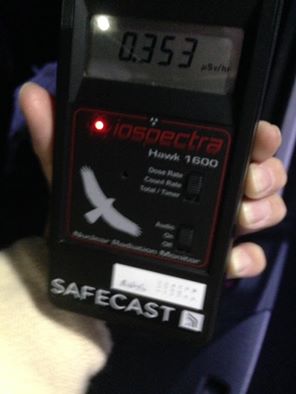
This is taken on a train in Nihonmatsu, Fukushima. Nihonmatsu is located in a straight line or air distance at 52.75 km west of Okuma (Fukushima Daiichi).
On a running train, inside of a train, radiation is measured already at 0,353 µSv/hour, you can imagine how much more outside of the train, on the ground.
PM Abe’s government forces the population to return despite the obvious contamination, and people are getting fed up with the given continuous lies.
Credit to Kuniko Yamanoi for that information and photo.
Protest at Japanese Embassy in Paris Against Fukushima Evacuees Forced Return and the 2020 Tokyo Olympics

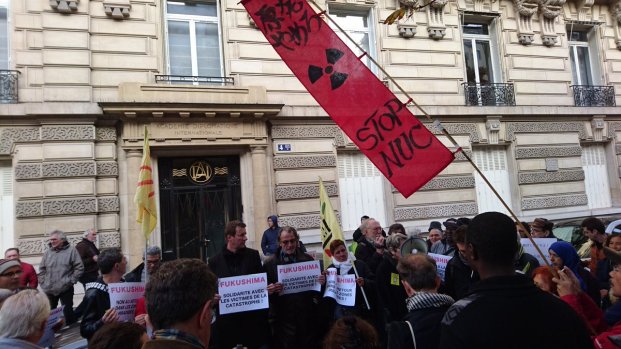
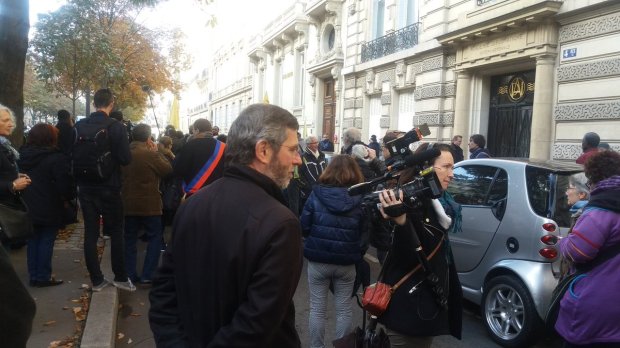
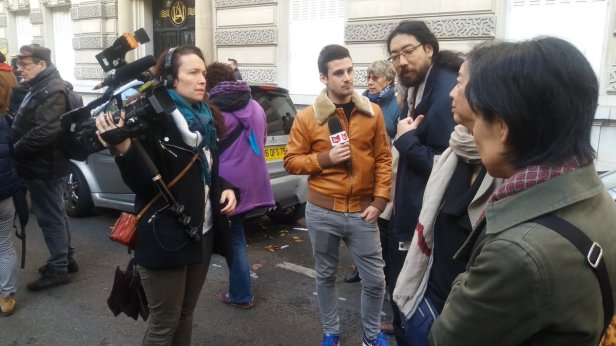
Today October 22, 2016, in Paris, the French Green Ecology Party (EELV), Green Peace France and Réseau Sortir du Nucléaire, joined together to organize a Fukushima protest in front of the Japanese Embassy.
They denounced the Fukushima evacuees forced return by the Japanese government, and insisted that no one should be compelled to live in irradiated town with high level of radiation. That it is plainly criminal on the part of the Japanese Government.
Since Eastern Japan and Tokyo included, have been contaminated by the now five years and a half ongoing nuclear catastrophe at Tepco’s Fukushima Daiichi nuclear plant, a catastrophe yet neither under control nor resolved, the 2020 Olympics should be relocated somewhere else.
Some officials of the French Green Ecology Party (EELV) and personalities of Green Peace France and Réseau Sortir du Nucléaire attended the protest. Among those were also present Yannick Jadot and Michele Rivasi, both Europe Ecology deputies at the European Parliament, one of the two to be the French Ecology Party presidential candidate at the coming French presidential election in 2017. Were also present members of the Japanese community.
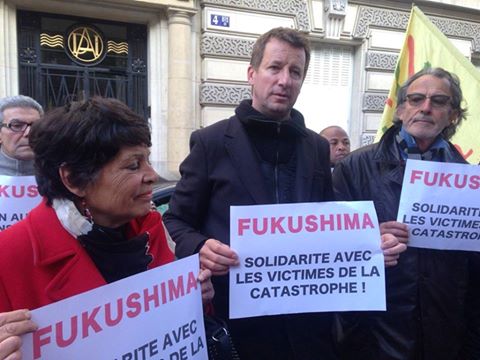
Michele Rivasi and Yannick Jadot
Impact of the Fukushima Accident on Marine Life, Five Years Later
Five years ago, the largest single release of human-made radioactive discharge to the marine environment resulted from an accident at the Fukushima Daiichi Nuclear Power Plant in Japan. Approximately 80 percent of the fallout happened over the Pacific Ocean. A new study explores the environmental consequences in the marine environment of the accident. It outlines the status of current research about the impact of the fallout on plant and animal life and what remains to be done as the radioactivity continues to spread.
https://www.sciencedaily.com/releases/2016/10/161018141309.htm
Containment Repair Research for Fukushima Unit 2 Ongoing
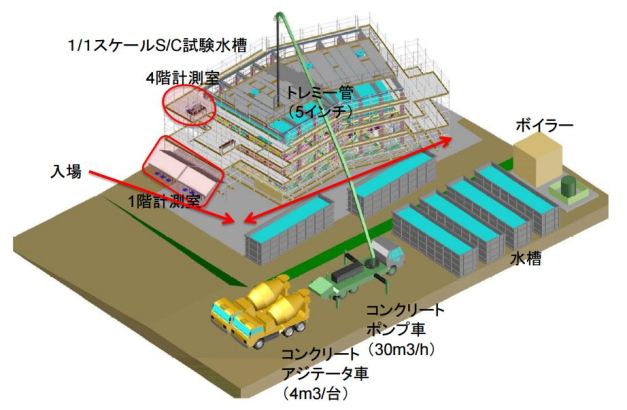
IRID announced the details of the ongoing research for repairing the unit 2 suppression chamber.
Based on their previous investigations IRID has determined that there could be a hole or series of holes of around 50mm in the unit 2 suppression chamber.
The research work is to determine if filling with concrete that structure could work. The proposed plan would use a concrete pump truck with a 5 inch diameter flexible hose to inject concrete into the suppression chamber.
Initial work took place at the Ando Hazama Technical Research Institute (Tsukuba City, Ibaraki Prefecture) on October 15th.
It seems they succeeded in layering the concrete mixture, sinking properly in the bottom of the suppression chamber tube. A 28 day pressure test will be conducted to assure the concrete properly plugs the leak.
Future work may be conducted at the new decommissioning research center at Naraha.
Source IRID :
<添付資料1:1/1スケールS/C試験に関する現場状況・概要図>
http://irid.or.jp/wp-content/uploads/2016/10/20161018_001.pdf
<添付資料2:コンクリート打設進捗に伴う時経列事象・解説図>
http://irid.or.jp/wp-content/uploads/2016/10/20161018_002.pdf
Residents Who Fled Fukushima Meltdown Fear Return to Ghost Town
Japan seeks to lure evacuees back to town near nuclear plant
Abe looks to win support for restarting mothballed reactors
Weed-engulfed buildings and shuttered businesses paint an eerie picture of a coastal Japanese town abandoned after a monstrous earthquake and tsunami triggered meltdowns in the Fukushima nuclear plant.
Namie, one of the communities hardest hit by the 2011 disaster, had 21,000 residents before they fled radiation spewing from the reactors eight kilometers (five miles) away. Prime Minister Shinzo Abe is now looking to repopulate the town as early as next year, a symbolic step toward recovery that might also help soften opposition to his government’s plan to restart Japan’s mostly mothballed nuclear industry.
“The national and local governments are trying to send us back,” said Yasuo Fujita, 64, a sushi chef who lives alongside hundreds of other Fukushima evacuees in a modern high rise in Tokyo more than 200 kilometers away. “We do want to return — we were born and raised there. But can we make a living? Can we live next to the radioactive waste?”

The main street in Namie, Fukushima
So far few evacuees are making plans to go back even as clean-up costs top $30 billion and Abe’s government restores infrastructure. That reluctance mirrors a national skepticism toward nuclear power that threatens to erode the prime minister’s positive approval ratings, particularly in areas with atomic reactors.
Mothballed Reactors
Officials in his government are calling for nuclear power to account for as much as 22 percent of Japan’s electricity supply by 2030, nearly the same percentage as before the Fukushima meltdown, in part to help meet climate goals. Only two of the nation’s 42 operable nuclear plants are currently running, leaving the country even more heavily reliant on imports of oil and gas.
A poll published by the Asahi newspaper this week found 57 percent of respondents were opposed to restarting nuclear reactors, compared with 29 percent in favor. One of Abe’s ministers lost his seat in Fukushima in an upper house election in July, and the government suffered another setback when an anti-nuclear candidate won Sunday’s election for governor of Niigata prefecture, home to the world’s largest nuclear plant.
Some 726 square kilometers — roughly the size of New York City — of Fukushima prefecture remain under evacuation orders, divided by level of radioactivity. While the government is looking to reopen part of Namie next year, most of the town is designated as “difficult to return to” and won’t be ready for people to move back until at least 2022.
“We must make the area attractive, so that people want to return there,” Reconstruction Minister Masahiro Imamura said this week. “I want to do everything I can to make it easy to go back.”

Workers are cleaning by scraping up soil, moss and leaves from contaminated surfaces and sealing them in containers. Still, the operation has skipped most of the prefecture’s hilly areas, leading to fears that rain will simply wash more contamination down into residential zones. Decommissioning of the stricken plant itself is set to take as many as 40 years.
The bill for cleaning up the environment is ballooning, with the government estimating the cost through March 2018 at $3.3 trillion yen ($32 billion). That’s weighing on Tokyo Electric Power Co. Holdings Inc., which is already struggling to avoid default over decommissioning costs.
“They are spending money in the name of returning things to how they were” without having had a proper debate on whether this is actually possible, said Yutaka Okada, senior researcher at Mizuho Research Institute in Tokyo. “Was it really right to spend this enormous amount of money?”
Namie officials, operating from temporary premises 100 kilometers away in the city of Nihonmatsu, are plowing ahead with preparations. A middle school in the town is scheduled for remodeling to add facilities for elementary pupils — even though they expect only about 20 children to attend. Similar efforts in nearby communities have had limited success.
Only 18 percent of former Namie residents surveyed by the government last year said they wanted to return, compared with 48 percent who did not. The remainder were undecided.
Staying Put
Fujita, the sushi chef, has joined the ranks of those starting afresh elsewhere. He opened a seafood restaurant near his temporary home last year, and is buying an apartment in the area. In a sign the move will be permanent, he even plans to squeeze the Buddhist altar commemorating his Fukushima ancestors into his Tokyo home.

For those that do return, finding work will be a headache in a town that was heavily dependent on the plant for jobs and money.
Haruka Hoshi, 27, was working inside the nuclear facility when the earthquake struck, and she fled with just her handbag. Months later she married another former employee at the plant, and they built a house down the coast in the city of Iwaki, where they live with their three-year-old son. They have no plans to return.
“It would be difficult to recreate the life we had before,” she said. “The government wants to show it’s achieved something, to say: ‘Fukushima’s all right, there was a terrible incident, but people are able to return after five years.’ That goal doesn’t correspond with the reality.”
Study: Possible water problem at storage sites in Fukushima
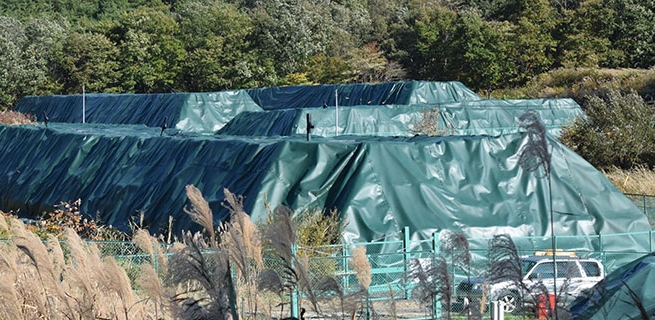
It might be difficult to measure radiation levels in water at this temporary storage site for contaminated soil in Fukushima Prefecture.
Bags of radiation-contaminated soil could be sinking into the ground at temporary storage sites in Fukushima Prefecture, allowing water to accumulate within instead of flowing to outside tanks for testing, the Board of Audit said.
No confirmation has been made that the ground at the sites is actually sinking or if contaminated water has pooled inside. But Board of Audit officials are asking the Environment Ministry to consider additional safety measures if signs indicate that this is actually occurring.
The board’s study focused on 34 of the 106 temporary storage sites that the Environment Ministry set up for soil removed through decontamination work after the disaster in March 2011 unfolded at the Fukushima No. 1 nuclear power plant.
Construction of the storage sites started in 2012, and the transfer of contaminated soil to these facilities was completed in 2015.
The temporary storage sites were designed to have a slight mound on the ground in the center to allow water from the bags to flow down into surrounding collection tanks for periodic measurements of radiation levels.
Internal Environment Ministry guidelines called for this setup at storage sites containing bags that are not waterproof.
The Board of Audit studied 34 temporary storage sites where the bags are not waterproof. These bags were piled five deep or higher at those sites.
The study showed that at 31 of the sites, the weight of the bags may have not only flattened the mound in the center, but it also could have created an indent in the ground where the leaking water could accumulate.
If the water does not flow to the tanks, it will be difficult to determine the radiation levels.
The study also noted that the foundations at the sites were soft to begin with and may be unable to support the bags of soil. The sinking phenomenon could worsen as time passes.
The Environment Ministry played down the risk of the water contaminating areas around the storage facilities.
“Even if the ground has sunk, the structure is designed so water does not leak outside the site,” a ministry official said. “Eventually, the water should collect in the tanks. We will make every effort to oversee the sites as well as use waterproof bags as much as possible.”
A total of 4.16 billion yen ($40 million) was spent to construct the 31 temporary storage sites.
The Environment Ministry designed the temporary storage sites under the precondition they would be used for only three years and then removed. For that reason, measures were not taken to strengthen the foundations to prevent the ground from sinking, even if soft farmland was chosen for a site.
The plan is to eventually return the land where the temporary storage sites have been built to its original state and return it to the landowners
However, the Board of Audit’s study adds another concern for residents, many of whom had opposed construction of the temporary storage sites in their neighborhoods.
Toshio Sato, 68, has evacuated to Fukushima city from his home in Iitate village, where four of the possible problem storage sites are located.
“There are some people who want to resume growing rice once they return home,” Sato said. “If water is accumulating, there is the possibility it could unexpectedly overflow into surrounding areas. The concerns just seem to emerge one after another.”
The government plans to lift the evacuation order for a large part of Iitate in March 2017.
Testing of Seawater Off Fukushima Daiichi
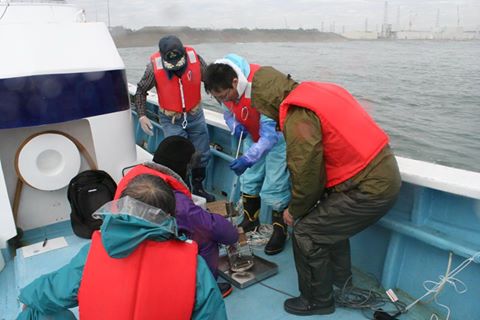
Results of seawater testing off the Fukushima Daiichi Nuclear Plant by Tarachine, the Mother’s Radiation Lab & Clinic of Iwaki, Fukushima
Item measured: Cesium 137 (method by treatment with phosphomolybdic acid)
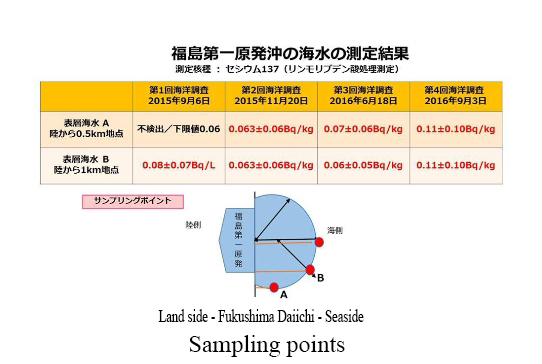

https://www.actbeyondtrust.org/campaign/pledge/tarachine/jp/
Another Chernobyl or Fukushima risk plausible: Experts
The “flawed and woefully incomplete” public data from the nuclear industry is leading to an over-confident attitude to risk, the researchers warned.
The study, which put fresh pressure on the nuclear industry to be more transparent with data on incidents, also called for a fundamental rethink of how accidents are rated, arguing that the current method (the discrete seven-point International Nuclear Event Scale or INES) is highly imprecise, poorly defined, and often inconsistent.
For example, the Fukushima accident and the Chernobyl accident are rated 7 — the maximum severity level — on the INES scale.
However, Fukushima alone would need a score of between 10 and 11 to represent the true magnitude of consequences, the researchers said.
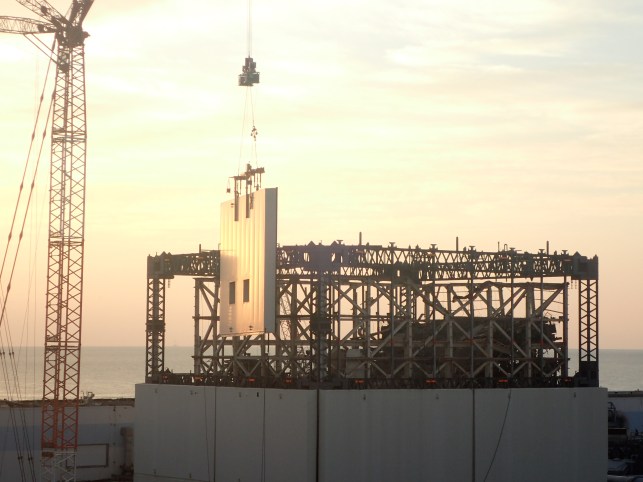
Catastrophic nuclear accidents like Chernobyl disaster in the US that took place in 1986 and the more recent Japan’s Fukushima disasters in 2011 may not be relics of the past. But the risk of such disasters are still more likely to occur once or twice per century, a study has warned.
The study found that while nuclear accidents have substantially decreased in frequency, this has been accomplished by the suppression of moderate-to-large events.
The researchers estimated that Fukushima and Chernobyl-scale disasters are still more likely than not once or twice per century, and that accidents like 1979 meltdown at Three Mile Island in the US are more likely than not to occur every 10-20 years.
For the study, a team of international risk experts analysed more than 200 nuclear accidents — the biggest-ever analysis of nuclear accidents — which provided a grim assessment of the risk estimated by the nuclear industry.
The “flawed and woefully incomplete” public data from the nuclear industry is leading to an over-confident attitude to risk, the researchers warned.
“We have found that the risk level for nuclear power is extremely high,” said lead author Spencer Wheatley, Professor at ETH Zurich in Switzerland.
“The next nuclear accident may be much sooner or more severe than the public realises,” added Benjamin Sovacool, Professor at the University of Sussex in Britain.
Further, the standard methodology used by the International Atomic Energy Agency to predict accidents and incidents — particularly when focusing on consequences of extreme events — is also problematic, the researchers said.
The study, which put fresh pressure on the nuclear industry to be more transparent with data on incidents, also called for a fundamental rethink of how accidents are rated, arguing that the current method (the discrete seven-point International Nuclear Event Scale or INES) is highly imprecise, poorly defined, and often inconsistent.
For example, the Fukushima accident and the Chernobyl accident are rated 7 — the maximum severity level — on the INES scale. However, Fukushima alone would need a score of between 10 and 11 to represent the true magnitude of consequences, the researchers said.
To remove a possibility of such disasters would likely require enormous changes to the current fleet of reactors, which is predominantly second-generation technology, Wheatley noted.
But, “even if we introduce new nuclear technology, as long as older facilities remain operational — likely, given recent trends to extend permits and relicense existing reactors — their risks, and the aggregate risk of operating the global nuclear fleet, remain,” Sovacool said.
The results were published in the journals Energy Research & Social Scienceand Risk Analysis
Mother’s Radiation Lab & Clinic in Iwaki, Fukushima
A radiation measuring center organized and run by independent citizens, after being lied, betrayed and abandoned by the Japanese Government.
About them :
http://www.iwakisokuteishitu.com/english/aboutus.html
Here is the page of Tarachine in English with donation information using PayPal.
Iwaki Radiation Measuring Center NPO “Tarachine”
http://www.iwakisokuteishitu.com/english/e-donations.html
And some of their participating actions:
Fukushima Children Fund
https://dunrenard.wordpress.com/2016/09/25/fukushima-children-fund/
East Japan Soil Measurement Project of Minna no Data, Dec.2015 to Sept. 2016
Fukushima Apples Are Very Hot In Cocktails
Here is another propaganda article on Forbes from James Conca, the highest paid pro-nuke shill, wanting us to believe that Fukushima Apples are dynamite in cocktails.
They are certainly not dynamite, but surely hot!

Fukushima Apples Are Dynamite In Cocktails
The 42nd World Cocktail Championships, which kicked off in Tokyo this week, is an unusual event to discuss a nuclear disaster. But that is exactly what Yoshikazu Suda, a bartender in Tokyo’s Ginza district who hails from Fukushima, is doing.
And his demonstration of solidarity with farmers and the people of Fukushima is in the form of some very cool drinks.
Bartenders and mixologists from over from 53 countries will gather in Tokyo to take part in the drink-creating championships. But the International Bartenders Association is no ordinary group. Founded in 1951, the IBA represents the National Bartender Guilds in 64 countries around the world. Over 500 bartenders and mixologists will gather at the event, which is being held in Japan for the first time in 20 years.
The International Bartenders Association is committed to responsible drinking and dispelling myths about alcohol. But this World Cocktail Championship will dispel a completely different type of myth – that Fukushima food is contaminated by radiation. It certainly is not.
During the contest at Tokyo’s Imperial Hotel, several varieties of fruit will be used, but only Fukushima-grown apples will be used in the fruit-cutting event, specifically apples grown by Fukushima farmer Chusaku Anzai.
Five years ago, a magnitude 9 earthquake on the Tohoku Fault off the east coast of Japan sent a 50-foot tsunami crashing into the coast with almost no warning, flooding over 500 square miles of land, killing almost 20,000 people and destroying a million homes and businesses.
Tokyo 2020: Japan earthquake and nuclear disaster site could host Olympic events
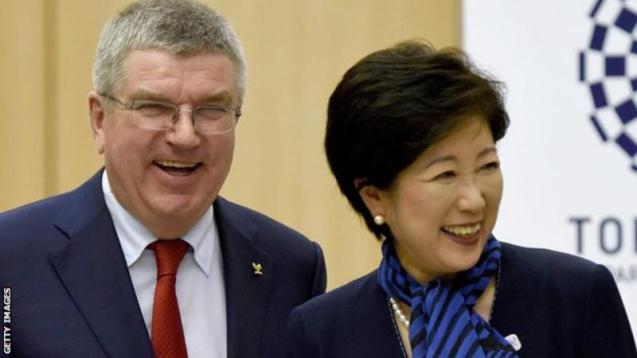
IOC president Thomas Bach is holding talks with Tokyo Governor Yuriko Koike in the city
Tokyo 2020: Japan earthquake and nuclear disaster site could host Olympic events
Tokyo 2020 Olympic events could be held in part of Japan hit by the 2011 Fukushima earthquake, tsunami and nuclear disaster in a bid to cut costs.
Rowing canoe/kayak sprint events and baseball/softball are among sports that could be moved 400km north of Tokyo.
The International Olympic Committee is holding talks with organisers after a review showed costs could exceed £23bn ($28bn) – four times the estimate.
But IOC president Thomas Bach said “we have to respect” athletes.
“The athletes are the heart and soul of the Olympic Games,” Bach emphasised.
The IOC began four-party discussions with the city government, Tokyo organisers and Japan’s central government on Tuesday in a bid to reduce spending on the Games.
The proposal to move some sports to the north-eastern area of Japan devastated by the earthquake was made in a review of expenses commissioned by Tokyo Governor Yuriko Koike.
The review recommends moving some sports from planned new venues to existing ones.
Several events have already been moved outside of Tokyo, with cycling now due to take place 200km from the village in the Shizuoka district.
Bach said he was confident cost reductions could be made, but suggested Tokyo should try to stay close to its original bid proposal of keeping the majority of venues within 8km of the athlete’s village in the city’s downtown.
He said moving events to the earthquake-hit area was one of several cost-cutting options being discussed, and that it could “contribute to the regeneration” of the region.
The most expensive Games to date are the London Games at £12bn and the Sochi 2014 Winter Games in Russia which cost £17.7bn.
The Rio Olympic Games cost £9.7bn, coming in 51% over budget despite cuts to ceremonies, venues and staff.
According to a recent study, no Games since 1960 has come in under budget.
http://www.bbc.com/sport/olympics/37703005
Bach: Events could be held in northeast Japan
The head of the International Olympic Committee has suggested holding some events of the 2020 Tokyo Games in areas of northeastern Japan that were devastated by the earthquake and tsunami of 2011.
IOC President Thomas Bach, now visiting Japan, met Prime Minister Shinzo Abe in Tokyo on Wednesday.
Bach told Abe the IOC is thinking of holding some Olympic events in the disaster zone to contribute to revival efforts. He said this could show the world how the areas have recovered. Abe welcomed the idea.
Abe also promised the government’s participation in talks to cut costs for the games.
Bach had proposed 4-way talks by the Tokyo Metropolitan Government, the IOC, Tokyo 2020 organizers and Japan’s government.
Reporters later asked Bach if baseball and softball will be held in Fukushima City. Bach said it’s an option under consideration. He added that since the sports are very popular in Japan, having the country’s team play in the disaster zone would send a strong message.
Fukushima Governor to Pitch Local Attractions in U.S.
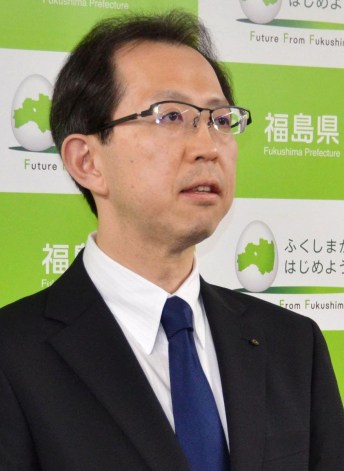
Washington, Oct. 18 (Jiji Press)–Visiting Fukushima Governor Masao Uchibori said Tuesday that he will pitch in the United States specialties and attractions of the northeastern Japan prefecture, such as sake and hot springs.
At a press conference, Uchibori said he wants many people to visit the prefecture from the United States and take first-hand looks at the current situation there.
If such visitors disseminate information about the prefecture in their own words, that will be a significant step toward reconstruction, he added.
Fukushima was hit hard by the March 2011 nuclear reactor meltdown at the Fukushima No. 1 power plant of Tokyo Electric Power Company Holdings Inc. following a massive earthquake and subsequent tsunami.
The evacuation area due to radioactive contamination caused by the nuclear disaster now accounts for only 5 pct of the prefecture’s land area and people live normal lives in the remaining 95 pct, Uchibori explained.
Fukushima Rice Mixed With Other Rices

From June 1, 2016
In the “7-Eleven” minimarkets in Japan, Fukushima rice is mixed with the other rices, to lower the contamination measuring and to facilitate its selling .
Minimarkets are open 24 hours a day, 7 days a week.We do not know about the other minimarkets.
Written information of origins:
1, Seven-Eleven rice 2 kg (2014 production)
Iijima rice Co., Ltd. (Koriyama, Fukushima Prefecture)
Expiration date 27.5.17
2, blend
Fukushima Prefecture Koshihikari
Fukushima Prefecture shine
Seven-Eleven US 5 Kg
Iijima rice Co., Ltd. (Koriyama, Fukushima Prefecture)
Expiration date 26.12.17
3, blend
Fukushima Prefecture Koshihikari
Akita Prefecture Akitakomachi
http://iijima88.com/smarts/index/1/
Knowing that we decided to measure ourselves the rice.
Pre-treatment of the sample

We stopped for a while trhe electric furnace.
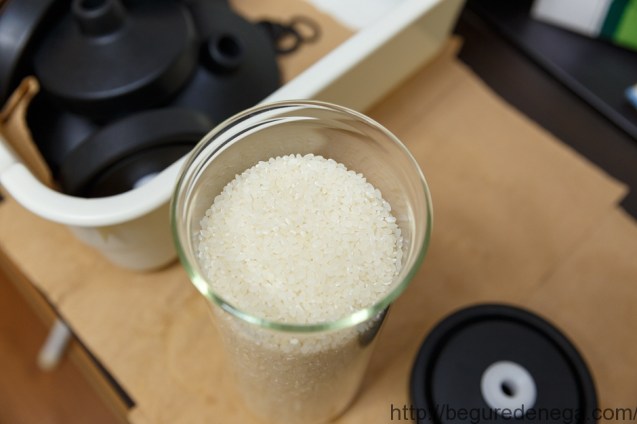
First it is lyophilized (freeze-dried).

By freezing the sample.

During 43hours.
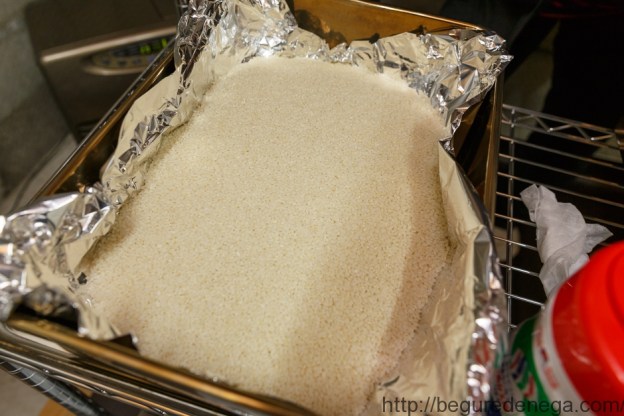
Water removal at high level by lyophilization.
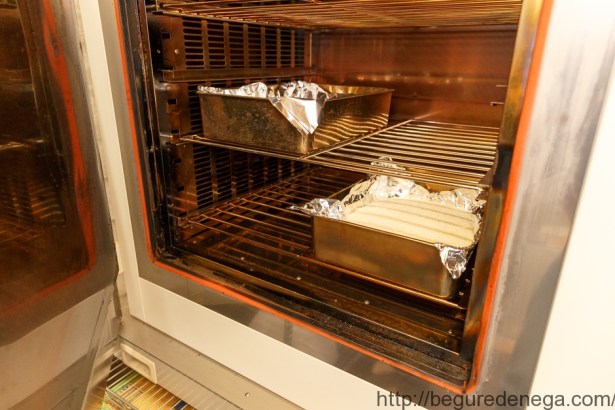
Then into the electric furnace.
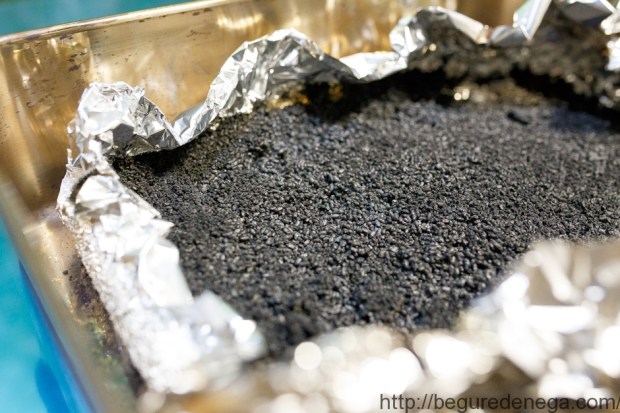
It is processed for 4 days at then 180-370 ℃.
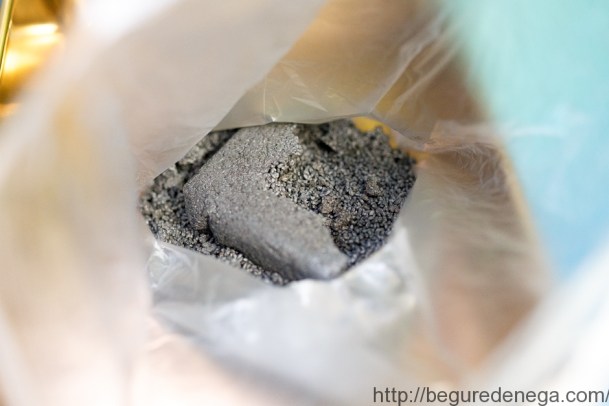
A 7kg sample was reduced to about 550g.
After this sample was crushed, we gave it to be measured with a germanium semiconductor detector at the University of Tokyo.
The results are … to be worried about.
Measurement results

Both types of radioactive cesium have been detected: 134Cs and 137Cs. Proving that convenience stores are selling the inexpensive rice from the disaster area.
High-school Students Continuously Put at Risk for Propaganda Use
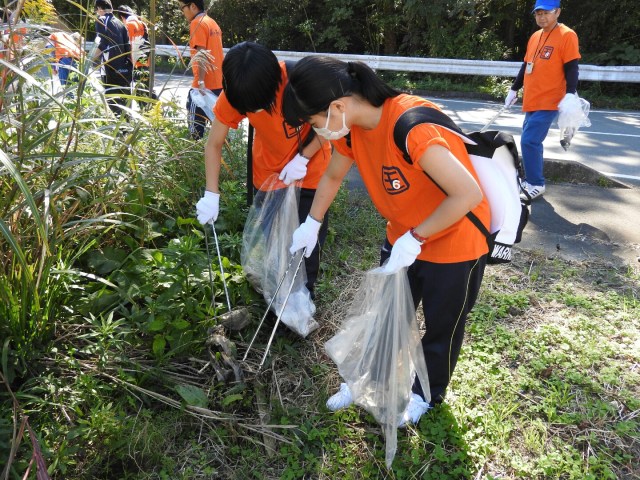
National route 6 which runs only a few km parallel to the coast where stands what is left of Daiichi Nuclear power plant, high-school students are cleaning up radiation.
14 high school students were picking up trash. 0.7μSv / h radiation measured by some citizens’ group at some of the places. With dust being blown, many high school students were walking still without a mask.
The criticism that it could endanger the children, was ignored by Yumiko Nishimoto, president of the NPO “Happy load net” which organized that acttion, answering “we are living here every day.” .
Clean-up activities with an eye to the torch relay of the Tokyo Olympics. The priority is the “reconstruction”, and the health of children is secondary, completely neglected.
The NPO responsible for such insanity argues that it helps them studying about radiation, that they do that every year.
Children are continuously being used to help the propaganda that everything is back to normal. But it’s a lie and it is borderline criminal. Shame on you Japan.
http://taminokoeshimbun.blog.fc2.com/blog-entry-61.html
Tokyo governor visits alternative site in Miyagi Prefecture for 2020 Games’ rowing and canoe sprint
We are many to think that it is shocking, disgusting and very sad that after over5 & a half years they are still putting their greed above the health of those people who would participate and go to watch these games, not to mention their own people. They should have relinquished as soon as they knew that the Fukushima Daiichi nuclear disaster had contaminated a good third of the country.

Tokyo Gov. Yuriko Koike (left front) and Miyagi Gov. Yoshihiro Murai (left back) wave to the press as they inspect the Naganuma rowing course in the city of Tome, Miyagi Prefecture, on Saturday.
Tokyo Gov. Yuriko Koike on Saturday visited a boat race course in Miyagi Prefecture, a facility emerging as an alternative venue for the rowing and canoe sprint events at the 2020 Tokyo Olympic games.
“Based on this visit, I will start considering venues,” Koike told reporters after inspecting facilities at the Naganuma rowing course in the city of Tome, more than 400 kilometers from Tokyo. Miyagi is one of the prefectures in northeastern Japan hit hardest by the March 2011 earthquake and tsunami.
Games organizers and the International Rowing Federation had already approved the Sea Forest Waterway venue to be constructed on Tokyo Bay, but a metropolitan government cost review panel recommended last month that plan be reconsidered.
The Tokyo Olympic and Paralympic organizing committee has raised concerns that costs could top ¥35.1 billion ($337 million) even if the rowing and canoe sprint events were held at the Naganuma rowing course. But Miyagi Prefecture Gov. Yoshihiro Murai argued Saturday in a television appearance that the overall cost is “estimated at around ¥15 to ¥20 billion.”
On the TV program, Murai also emphasized that most of the costs will be for “permanent facilities” after the Olympic Games, and that the prefectural government would shoulder the cost to remove temporary housing.
Last Wednesday, Murai visited Koike in Tokyo to convey his wish to hold the rowing and canoe events in Miyagi to show the world the recovery Japan has made since the 2011 quake and tsunami disaster.
Koike had told Murai that the Naganuma boat course was an option and she would “make a comprehensive decision” after visiting the site.
The organizing committee, however, has questioned the feasibility of holding those events at the Miyagi site, raising what they said are “nine problems,” including transportation, infrastructure and costs.
Saitama Gov. Kiyoshi Ueda has also said his prefecture is ready to host the rowing and canoe sprint events at Saiko Doman Green Park in the city of Toda.
1 This Month
10 March A LIVE WEBINAR THE REAL EFFECTS OF NUCLEAR POWER
What the Industry Isn’t Telling Us
1:00 PM Mountain, 2 pm Central, 3 pm Eastern. Live on the Keepers of the Water Facebook page



18 March Webinar @ 1 PM EST: An Assessment of SMR Projects: The Case of Canada
register for the zoom:
https://us02web.zoom.us/webinar/register/WN_o8BIIOUvQ2ONJR1nta65DQ#/registration


of the week – STOP SMALL MODULAR REACTORS IN CANADA
To see nuclear-related stories in greater depth and intensity – go to https://nuclearinformation.wordpress.com
-
Archives
- March 2026 (109)
- February 2026 (268)
- January 2026 (308)
- December 2025 (358)
- November 2025 (359)
- October 2025 (376)
- September 2025 (258)
- August 2025 (319)
- July 2025 (230)
- June 2025 (348)
- May 2025 (261)
- April 2025 (305)
-
Categories
- 1
- 1 NUCLEAR ISSUES
- business and costs
- climate change
- culture and arts
- ENERGY
- environment
- health
- history
- indigenous issues
- Legal
- marketing of nuclear
- media
- opposition to nuclear
- PERSONAL STORIES
- politics
- politics international
- Religion and ethics
- safety
- secrets,lies and civil liberties
- spinbuster
- technology
- Uranium
- wastes
- weapons and war
- Women
- 2 WORLD
- ACTION
- AFRICA
- Atrocities
- AUSTRALIA
- Christina's notes
- Christina's themes
- culture and arts
- Events
- Fuk 2022
- Fuk 2023
- Fukushima 2017
- Fukushima 2018
- fukushima 2019
- Fukushima 2020
- Fukushima 2021
- general
- global warming
- Humour (God we need it)
- Nuclear
- RARE EARTHS
- Reference
- resources – print
- Resources -audiovicual
- Weekly Newsletter
- World
- World Nuclear
- YouTube
-
RSS
Entries RSS
Comments RSS
 nuclear-news