Fukushima museum receives pro-nuclear signs for safekeeping
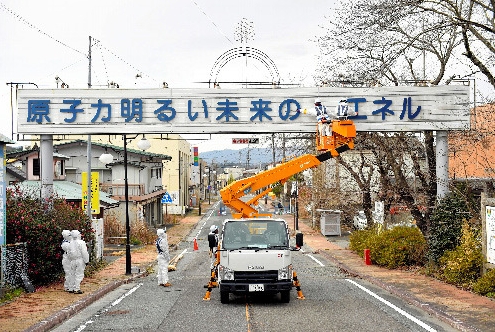
Workers in protective gear remove the banner lauding nuclear energy in Futaba, Fukushima Prefecture, in December.
AIZUWAKAMATSU, Fukushima Prefecture—Pro-nuclear propaganda signs that became the ironic symbol of a town evacuated in the 2011 Fukushima nuclear disaster have been moved to a museum’s storage ahead of their possible public display as a warning from history.
The Fukushima Museum in this city took over care of the signs this month on behalf of the town government of Futaba, which co-hosts the crippled Fukushima No. 1 nuclear power plant.
The most well-known of the banners, which residents campaigned to save, reads: “Genshiryoku–Akarui Mirai no Energy” (Nuclear power is the energy of a bright future).
Yuji Onuma, a 40-year-old former resident of Futaba who now lives in Kogawa, Ibaraki Prefecture, came up with the slogan as a sixth grader at a Futaba school. The town hall adopted it to promote nuclear energy.
Onuma, who fled the town amid the triple meltdown, said the move to the museum is welcome in terms of keeping them in good condition.
“But I am hoping that they will be shown to the public as soon as possible,” he said.
The signboards were removed between December and March along with other panels of slogans promoting nuclear energy in the town. The town government cited the danger of the tall steel structures collapsing because of old age.
They had been kept in a barn wrapped in blankets until the prefectural museum came forward with the offer of storage space early this month.
“The signboards will be kept from deteriorating at the museum where the temperature and humidity can be easily adjusted,” a Futaba official said of the transfer to the museum.
The town hall had initially sought to remove and dispose of the prominent signs, saying they were nearly 25 years old and may fall off at any time.
But after the town announced the decision to do so in March 2015, Onuma and other like-minded people scrambled to start a petition to call for their preservation as historically important items.
“The signs should be stored and exhibited as a ‘negative legacy’,” said Onuma, who recalled that he had once been proud of co-hosting a nuclear power station as he believed it would lead the town to a promising future.
But after the disaster, he decided he was wrong and switched to the solar power generation business in Kogawa.
In the end, the town government agreed to preserve them after they were removed from the original site.
A Futaba official said the signs could be featured at a facility to pass down the records of and lessons learned from the powerful quake, tsunami and the nuclear disaster which the prefectural government is planning to construct.
Massive underestimation of Cost to scrap Fukushima nuclear plant Japanese officials admit
 Cost to scrap Fukushima nuclear plant massively underestimated, Japanese officials admit A revised figure expected by the end of the year could be more than double the current price tag SCMP, 25 October, 2016, The cost of cleaning up Tokyo Electric Power’s wreckedFukushima Daiichi nuclear plant may rise to several billion dollars a year, from less than US$800 million now, Japan’s industry ministry said on Tuesday.
The increased cost projections appeared in ministry documents prepared for a panel tasked with devising a viable financial plan for the utility company known as Tepco, which is struggling to cope with rising costs at its Fukushima plant nearly six years after the world’s worst nuclear disaster since Chernobyl.
Japan’s Minister of the Economy, Trade and Industry, Hiroshige Seko, told reporters after the panel meeting, its second, that the government will provide a firmer estimate for annual decommissioning costs for the nuclear plant by the end of the year,
Surging decommissioning costs are being addressed by the panel but it is also looking into options including a break up of Tepco, which is under state control after an earthquake and tsunami sparked meltdowns at the Fukushima reactors in March 2011……..
The meltdowns of three reactors released radiation over a wide area, contaminating water, food and air, and forcing more than 160,000 people to evacuate.
Dismantling the reactors is expected to take about 40 years, but Tepco is still struggling to contain radioactive water from the plant and has said it can’t predict the eventual total costs of the clean-up and decommissioning. http://www.scmp.com/news/asia/east-asia/article/2039929/cost-scrap-fukushima-nuclear-plant-massively-underestimated
EDITORIAL: Cost estimate needed first to decommission Fukushima plant
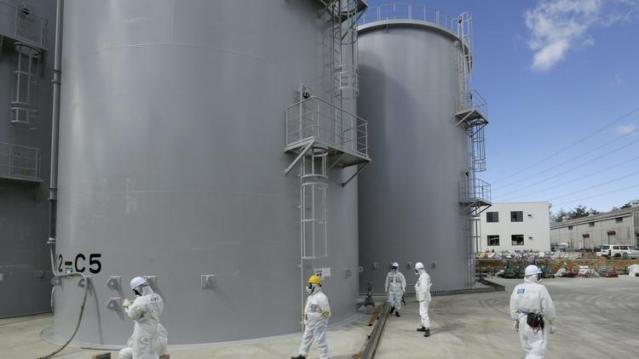
An industry ministry panel of experts is tackling two key questions concerning the decommissioning of the crippled Fukushima No. 1 nuclear power plant.
One is how much money will be needed to decommission the plant’s reactors, three of which melted down. The other is who should foot the bill and how.
However, there are some serious flaws in the way the expert panel is working on these knotty questions, which could lead to a huge financial burden on the public.
First of all, the panel’s meetings are not open to the public. The main points of the discussions are published later, but many details, including who made specific remarks, are omitted.
The fate of Tokyo Electric Power Co., which operates the Fukushima plant and is responsible for its decommissioning, will be largely determined by whether it can restart its Kashiwazaki-Kariwa nuclear power plant in Niigata Prefecture.
Panel members include many business leaders who have been promoting nuclear power generation.
The outcome of the recent Niigata gubernatorial election underscored the strong opposition of local residents against TEPCO’s plan to bring the plant back online.
The panel’s lineup raises concerns that its discussions may be based on the assumption that the Kashiwazaki-Kariwa nuclear plant will eventually be restarted, despite the situation in the prefecture.
Another troubling fact is that the government has yet to announce any estimate of the total decommissioning cost.
In the panel’s first meeting, some members urged the government to swiftly present an estimate of the cost. In the second meeting, however, the Ministry of Economy, Trade and Industry only said that annual spending could grow to several hundreds of billions of yen from about 80 billion yen ($703 million) spent now.
The ministry says a specific estimate of the total cost will be announced as early as the end of the year, along with a plan for management reforms at TEPCO and a package of related measures the government will take.
But this timetable doesn’t make sense. Pinning down the overall decommissioning cost should be the starting point for the panel’s discussions.
With the conditions of the melted nuclear fuel remaining unclear, it is certainly difficult to accurately estimate the cost.
Still, an estimate should first be shown to ensure substantive debate on whether the method used for the work is appropriate and whether there are ways to curb the cost.
As for financing, the panel has supported the proposal that TEPCO should secure the necessary funds on its own through management reform over other options, such as the utility’s liquidation involving debt forgiveness by its creditors, tax financing by the government and a continuation of the current state control of TEPCO.
In an apparent attempt to stress the importance of TEPCO’s own efforts to save itself, the panel has also recommended that the Kashiwazaki-Kariwa nuclear plant should be spun off from TEPCO and integrated with the nuclear power business of another utility.
There is no disputing that TEPCO should push through thorough management reforms to prevent the public from shouldering part of the cost through tax financing or hikes in electricity rates.
The question, however, is whether the embattled utility’s own efforts will be enough to cover the entire decommissioning cost, expected to reach several trillions of yen.
If a plan based on the company’s own efforts fails and disrupts the decommissioning process, the reconstruction of disaster-hit areas in Fukushima Prefecture could be seriously delayed.
It is vital for the panel to win broad public support for its proposals on the national challenge of decommissioning the Fukushima No. 1 nuclear power plant.
This requires careful, exhaustive and reasonable debate, open to the public, on the cost and the financing method.
http://www.asahi.com/ajw/articles/AJ201610270028.html
Men Over 30 Whole-Body Counter Examination increasing at Iwaki city Mothers Radiation Lab
Since 2014 the number of men over 30 years old having whole body counter examination(Radioactivity measurement of the whole body) is increasing at the Tarachine Mothers Radiation Lab in Iwaki city, Fukushima,. Most of them are decontamination workers.
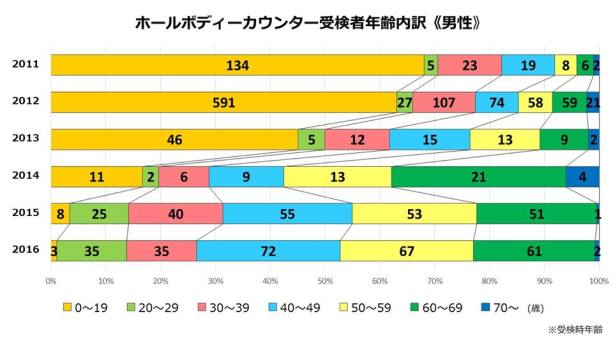
Whole-body counter men examinees breakdown by age.
Paper sludge that polluted sea cleans up soil in Fukushima
Another one after so many others. Always nice to read so as to reduce the anxiety of the Fukushima people who have to live with that contamination.
But does it truly works? Or is it just another soothing story cooked by the ETHOS project whose only intent is to make people stay put in the contaminated areas, the costs of evacuation being too high…

A heap of sludge produced in papermaking
FUJI, Shizuoka Prefecture–Charcoal from paper mill sludge that once polluted the ocean here southwest of Tokyo could be used to restore contaminated land near the crippled Fukushima No. 1 nuclear power plant.
An experiment in 2011 showed that the charcoal is effective in reducing radioactive substances in soil and preventing the absorption of cesium by plants, said research leader Ai Van Tran.
Tran, 68, a doctor in agricultural science, was conducting the research for the Corelex Group that includes Corelex Shin-ei Mfg. Co., which has the largest share of recycled toilet paper in Japan.
“We would be delighted if our byproduct, which was once a source of environmental pollution, is useful in decontamination. It will also contribute to reducing the waste from papermaking, so it is killing two birds with one stone,” said Satoshi Kurosaki, the president of the Corelex Shin-ei.
In making recycled paper, about 30 percent of the raw material remains as sludge. In 2002, the Corelex Group developed “blacklite,” a type of activated carbon produced by burning paper sludge. It has a variety of useful properties such as soil conditioning, deodorizing, underfloor humidity control, melting snow and more.
The company produces blacklite from the paper sludge generated at a paper mill in Hokkaido, and it is used at golf courses and farms on the island.
After the radioactive fallout from the accident at the Fukushima No. 1 nuclear plant contaminated a vast area, the team, led by Tran, suggested conducting a trial to use the absorbent property of blacklite to decontaminate the soil.
Between May and October 2011, the company rented about 1,000 square meters of rice fields in Iitate, Fukushima Prefecture. It is one of the most heavily contaminated areas. The team grew rice in soil containing blacklite, and compared the amount of radioactivity in the rice with crops grown on soil with no blacklite.
The result was clear.
The rice harvested from the paddies that contained blacklite had just one-35th of the amount of radioactive cesium that was found in the rice grown on untreated soil. The cesium concentration in the treated soil was about half that in the untreated soil.
Also, the rice in the paddies with blacklite showed much better growth than the other crop.
As the ingredients of blacklite is industrial waste, it only costs about 500 yen ($4.80) for a 30-liter bag.
The enormous amount of soil removed from the surface of the ground in Fukushima Prefecture in the decontamination effort has been bagged and piled up at a temporary storage site. It is waiting to be transferred to an interim storage facility, which is still under construction.
It is expected to take a significant amount of time to process this soil and concerns have been raised over radiation leakage in the meantime.
Tran, who is originally from Vietnam, and his team have acquired the patent for a new method to contain radiation by mixing contaminated soil with blacklite and then sealing it in a tank made of concrete.
It is believed that the soil is gradually decontaminated when an ion exchange process occurs between the mineral in blacklite and the radioactive cesium in the soil.
Tran’s paper on his team’s experiments attracted attention in the United States, and he has been invited to speak at an international conference on nuclear chemistry scheduled for December in Texas.
The research is still in its early stages, but the Corelex Group has contacted the economy ministry to ask whether blacklite can be used in the decontamination project in Fukushima in the future.
http://www.asahi.com/ajw/articles/AJ201610260012.html
German Owned Biomass Plants Burning Radioactive Wood For Electricity in Fukushima
Japan to burn irradiated wood to create electricity, releasing gases to the environment AGAIN! Safe disposal?
“Germany’s Federal Office for Radiation Protection declined to comment on the process of burning radioactive waste in Fukushima. Entrade’s biomass units will be located about 50 kilometers (31 miles) from the Tepco reactors, said Uhlig.”
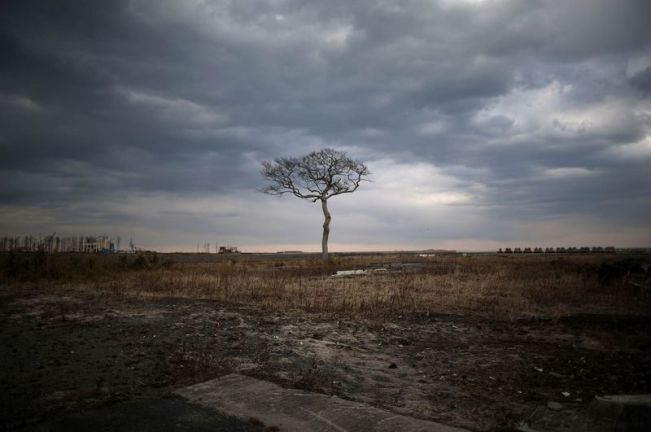
A lone tree inside exclusion zone, close to the devastated Fukushima Daiichi Nuclear plant in February 2016.
Radioactive Fukushima Wood Becomes Power in German Machine
- Entrade contracts 20 megawatts of power sales to Fukushima
- Lighty radiated wood turned to power in 400 biomass plants
Japan is turning to a small German company to generate power from timber irradiated by the Fukushima Dai-Ichi nuclear meltdowns.
Closely held Entrade Energiesysteme AG will sell electricity from 400 of its container-sized biomass-to-power machines set up in Fukushima Prefecture, said the Dusseldorf-based company’s Chief Executive Officer Julien Uhlig. The devices will generate 20 megawatts of power by next year and function like a “biological battery” that kicks in when the sun descends on the the region’s solar panels, he said.
Selling green power with Entrade’s mobile units could support Japanese attempts to repopulate a region that’s struggled to restore normality after the March 2011 earthquake and tsunami killed 18,000 people while also triggering the Fukushima nuclear meltdown that dislocated 160,000 others. The prefecture aims to generate 100 percent of its power from renewable energy by 2040.

Entrade’s so-called E4 plants, four of which fit inside a 40-foot (12-meter) container, can reduce the mass of lightly irradiated wood waste by 99.5 percent, according to Uhlig. Shrinking the volume of waste could help Japanese authorities who need to reduce the volume of contaminated materials. Workers around Fukushima have been cleaning by scraping up soil, moss and leaves from contaminated surfaces and sealing them in containers.
“Burning won’t destroy radiation but we can shrink detritus to ash and create a lot of clean power at the same time,” said Uhlig, a former German government employee, in a phone call from Tokyo on Oct. 21. “There’s a lot of excitement about this project but I also detected a high degree of reluctance in Fukushima to talk about radiation.”
Ballooning Costs
The decommissioning of Tokyo Electric Power Co. Holdings Inc.’s stricken plant is set to take as long as four decades and the government estimates environmental clean-up costs may balloon to $3.3 trillion yen ($31.5 billion) through March 2018.
Prime Minister Shinzo Abe said in March that Japan cannot forgo nuclear power. His government wants about a fifth of Japan’s power generated by nuclear by 2030, compared with almost 30 percent before three reactors melted down at the Fukushima plant.
Currently, just two of the nation’s 42 operable nuclear reactors are running, which has translated into higher costs for imported fossil fuels as well as more greenhouse gas emissions.
Germany’s Federal Office for Radiation Protection declined to comment on the process of burning radioactive waste in Fukushima. Entrade’s biomass units will be located about 50 kilometers (31 miles) from the Tepco reactors, said Uhlig.
Like Muesli
Entrade’s biomass plants, which rely partly on technology developed by Germany’s Fraunhofer Institute, are “compactors” of lightly irradiated waste, said Uhlig. The “all in the box” technology is attractive to environmentally-conscious clients who have a steady stream of bio waste but don’t want to invest in a plant, he said.
Uhlig’s company is cooperating with London’s Gatwick Airport to turn food waste from airlines into power. Royal Bank of Scotland financed another project supplying power from 200 units to an industrial estate near Liverpool, U.K.
Entrade has experimented with 130 types of biofuel since beginning operation in 2009. The company claims its plants convert biomass to power with 85 percent efficiency.
“It’s a bit like mixing muesli, taking what’s available from clients or the locality and blending it,” said Uhlig.
Entrade is moving its headquarters to Los Angeles to generate investment capital and help meet demand in the U.S. and Caribbean, he said. The company has 250 units in California and can hardly keep up with demand, Uhlig said.
Costs are ballooning for dismantling Japan’s Fukushima nuclear plant
“The government has estimated that decontaminating the areas around the Fukushima plant, including removing radiated topsoil, buildings and trees, will cost at least 2.5 trillion yen ($24 billion).
But experts have been warning that such estimates may be too optimistic.”
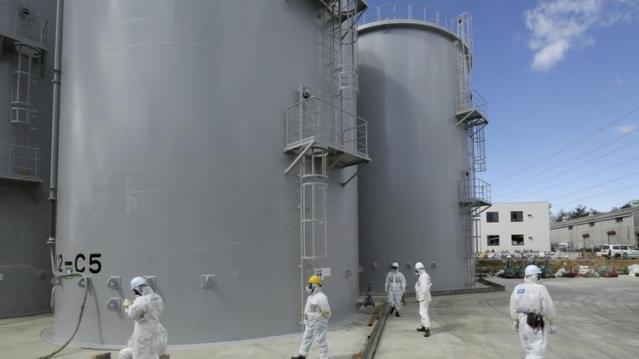
Workers check storage tanks of radiation-contaminated water at tsunami-crippled Tokyo Electric Power Co.’s Fukushima Daiichi Nuclear Power Plant in Okuma, Fukushima Prefecture, northern Japan, on March 24, 2015.
Japan’s estimate of dismantling the Fukushima nuclear plant is ballooning far beyond the utility’s estimate of 2 trillion yen ($19 billion).
A government study released Tuesday found decommissioning the Fukushima Dai-ichi plant already has cost 80 billion yen ($770 million) over the last three years.
The plant suffered multiple reactor meltdowns due to damage from the March 2011 earthquake and tsunami.
The ministry overseeing nuclear power said the decommissioning costs will continue at several hundreds of billions of yen (billions of dollars) a year.
Tokyo Electric Power Co., the utility that operated and is now decommissioning Fukushima Dai-ichi, has said decommissioning will take several decades.
Even if it were to take 30 years at an estimated annual cost at 300 billion yen ($3 billion), both conservative projections, the cost would be nearly 1 billion yen or $100 billion.
TEPCO spokesman Shinichi Nakakuki declined comment on the government projection, but he acknowledged TEPCO was still trying to determine what exactly the decommissioning effort might involve.
“It is difficult to calculate the entire cost for the decommissioning,” he said, adding that the 2 trillion yen figure had so far taken into account the effort to remove the nuclear debris, taking the example of Three Mile Island in the U.S., as well as costs and equipment needed to keep the reactors stable.
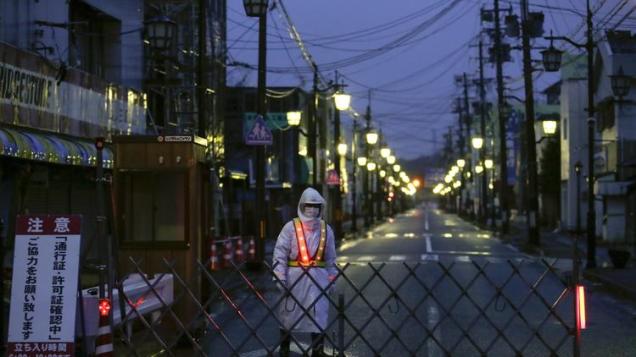
A security guard stands guard on one of the totally empty main streets in Namie, a town north of Tokyo Electric Power Company’s Fukushima Daiichi Nuclear Power Plant, Fukushima Prefecture, northern Japan, 09 March 2016.
The study did not distinguish between costs borne by the government and borne by TEPCO, which received a government bailout.
Japan has been struggling to clean up parts of the no-go zone to put the worst nuclear catastrophe since Chernobyl behind it.
The government has estimated that decontaminating the areas around the Fukushima plant, including removing radiated topsoil, buildings and trees, will cost at least 2.5 trillion yen ($24 billion).
But experts have been warning that such estimates may be too optimistic. The nuclear disaster in Fukushima displaced about 150,000 people.
http://www.chicagotribune.com/news/nationworld/ct-fukushima-nuclear-plant-20161025-story.html
Miyagi Prefecture to Request Municipalities to Dispose by Incineration the 8,000 Becquerels Below Contaminated Waste
The radioactive waste generated by the TEPCO Fukushima Daiichi nuclear power plant accident will be disposed in accordance to the contaminated waste standard disposal methods of the country. All to be incinerated in the Miyagi Prefecture existing waste treatment facilities.
First of all, they plan to have incineration tests beginning next year, testing incineration in various municipalities facilities, collecting data during approximately 6 months so as to confirm the safety of the concentration in the incinerated ash. Intending to embark on full-scale incineration from the middle of next year, 2017.
The Miyagi Prefecture summarizes its disposal policy : because the procedure for the disposal of contaminated waste above 8000 becquerels takes a long time, we decided to proceed with the disposal of substandard contaminated waste first.
As a specific method, contaminated waste will be burned while mixed with general waste so as not to exceed again radioactive concentration criteria. In addition, some municipalities which stored large volumes of contaminated waste and may not be able to handle it fully on their own, will get help from other municipalities facilities for disposal.
Next month, the Miyagi Prefecture will open the municipal mayors conference, during which it will the municipalities cooperation.
http://www3.nhk.or.jp/news/html/20161024/k10010741491000.html

Cost to scrap Fukushima nuclear plant massively underestimated, Japanese officials admit

The cost of cleaning up Tokyo Electric Power’s wrecked Fukushima Daiichi nuclear plant may rise to several billion dollars a year, from less than US$800 million now, Japan’s industry ministry said on Tuesday.
The increased cost projections appeared in ministry documents prepared for a panel tasked with devising a viable financial plan for the utility company known as Tepco, which is struggling to cope with rising costs at its Fukushima plant nearly six years after the world’s worst nuclear disaster since Chernobyl.
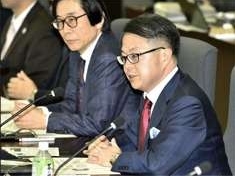
Japan’s Minister of the Economy, Trade and Industry, Hiroshige Seko, told reporters after the panel meeting, its second, that the government will provide a firmer estimate for annual decommissioning costs for the nuclear plant by the end of the year,
Surging decommissioning costs are being addressed by the panel but it is also looking into options including a break up of Tepco, which is under state control after an earthquake and tsunami sparked meltdowns at the Fukushima reactors in March 2011.
“A combination among nuclear operators is one possibility,” Yojiro Hatakeyama, a director at the industry ministry overseeing the electricity and gas industries, told reporters.
He did not elaborate on the government’s estimate for annual decommissioning costs after repeated questioning from reporters.
Experts say any move to merge atomic operations is likely to meet strong resistance from Japan’s other nuclear operators.
Japan has 10 nuclear operators and all have been hit by the political fallout from the disaster, which has undermined public faith in atomic energy. All but two of Japan’s 42 reactors are in shutdown mode.
Tepco shares were up 1 per cent by 0509 GMT, while the general market and other operators also gained.
The briefing material for the panel said the clean-up may require several hundred billion yen, or several billion US dollars, of funds every year, compared with 80 billion yen (US$766 million) now.
And these estimates are likely to surge when the company and the government decide how to extract melted uranium fuel debris at the plant in 2018 or 2019, a person with direct knowledge of discussions on restructuring Tepco said earlier this month.
The meltdowns of three reactors released radiation over a wide area, contaminating water, food and air, and forcing more than 160,000 people to evacuate.
Dismantling the reactors is expected to take about 40 years, but Tepco is still struggling to contain radioactive water from the plant and has said it can’t predict the eventual total costs of the clean-up and decommissioning.
Tepco wants the government to consider introducing rules to avoid having to book a single huge exceptional loss as soon as cost estimates for decommissioning become clearer, a person familiar with the situation said earlier.
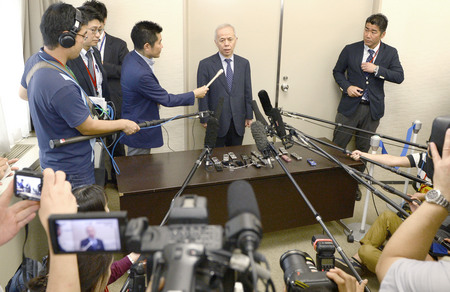
Untrained Staff Did Radioactive Cleanup Work in Fukushima
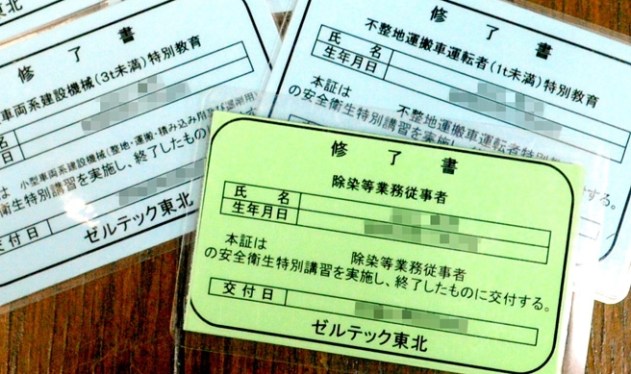
Certificates of training in radioactive decontamination work were issued by a company in Nihonmatsu, Fukushima Prefecture, to workers who had received no such training.
NIHONMATSU, Fukushima Prefecture–A company has admitted to not giving the required special training to workers before dispatching them to carry out decontamination work in radiation-hit Fukushima city.
A subcontractor called “Zerutech Tohoku” issued at least 100 bogus certificates to its workers showing they had completed the training, when, in fact, they had done nothing, according to the Fukushima Labor Standards Inspection Office.
The office had warned the subcontractor, which is based in Nihonmatsu and decontaminates parts of nearby Fukushima city, which was affected by the 2011 nuclear disaster, that it should give special training to workers to prepare them for the task.
The Ministry of Health, Labor and Welfare requires decontamination operators be given at least 5.5 hours of special training to each individual in accordance with the Industrial Safety and Health Law.
The training includes a lecture on potential health hazards and how to operate decontamination equipment as their job involves handling soil polluted by radioactive materials.
The 52-year-old representative of the company admitted wrongdoing in an interview with The Asahi Shimbun.
“We had to hire a large number of workers over a short period of time since we received a contract involving a vast swath of land,” he said of the false certificates, of which between 100 and 150 have been discovered.
In addition, the company, a fourth-tier subcontractor, issued seven other kinds of certificates needed to operate an aerial vehicle or chain saw, which were required to land the cleanup contract.
For issuing false certificates, offenders could be imprisoned for up to six months or fined 500,000 yen ($4,800).
But the law has been criticized for having numerous loopholes.
One is that there is not test of workers’ knowledge after they have received the training.
The operators are also not required to register the certificates with municipal authorities.
And it is not specified what qualifications are required for the person who conducts the training.
The Labor Standards office, a regional arm of the health ministry, has been inspecting the company for breaches of the law and regulations on decontamination work since Oct. 19.
The Zerutech Tohoku representative founded the company in March last year.
Radioactive contaminant levels can’t be read at 31 Fukushima temp waste sites

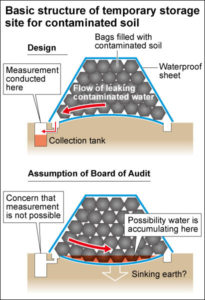
FUKUSHIMA — It may be impossible to measure the radioactive contaminant concentrations of water leeching from soil and other waste produced by the Fukushima nuclear disaster cleanup at 31 temporary waste storage sites in Fukushima Prefecture due to a planning flaw, a Board of Audit inspection has found.
The cleanup waste is put in bags, put in piles and covered with a waterproof tarp at the temporary disposal sites. These piles are built atop a low convex mound of earth, which is also covered with a tarp and is supposed to funnel the water leeching out of the waste into underground tanks. Contaminant concentration measurements are then taken from these tanks.
However, though many temporary disposal sites have been built on soft ground such as agricultural land, apparently no provisions were made for land subsidence — the earth being pushed down by the pressure of the waste bags — during planning.
The Board of Audit chose 34 of the 106 disposal sites in the prefecture for inspection. The 34 sites were spread across five municipalities, had waste piles five to six bags (or about 5 meters) high, and had been established in the four years up to fiscal 2015. Of these, the earth beneath the waste stack had subsided — going from convex to concave — at 31 sites, meaning contaminated water was also not flowing into the storage tanks. It is possible the water is collecting in the tarps.
There are 15 such sites in the Fukushima Prefecture town of Kawamata, five in the town of Namie, four each in the city of Tamura and the village of Iitate, and three in the town of Naraha. The subsidence of the earth bases hasn’t been confirmed, but the Board of Audit has pointed out that if contaminated water is pooling in the tarps, it could impact future operations to move the waste to a mid-term storage site. It has also called on the Environment Ministry, which operates the sites, to take necessary measures to rectify the problem.
The ministry told the Mainichi Shimbun, “The stacks are designed so that contaminated water won’t escape even if the land underneath subsides, and no harm has been done by the treatment of the water. The waste bags themselves have been replaced with waterproof versions, but we would still like to consider ways to reinforce the ground (under the piles), such as by using sand in the middle.”
http://mainichi.jp/english/articles/20161024/p2a/00m/0na/017000c
At UN Seminar, Fukushima Governor Appealed that Fukushima is Safe.

On October 19, 2016, Governor Masao Uchibori, the Fukushima prefecture governor, took part in a seminar at the United Nations headquarters in New York, a seminar about the reconstruction of Eastern Japan from the 2011 earthquake.
He declared that though there were rumors saying that many people can’t live anymore in Fukushima since the nuclear accident in March 2011, it was not fact. The evacuation zone was only 5 % of the Fukushima prefecture. He also emphasized that life in Fukushima was back in the same way as it was before the 2011 earthquake in 95 % of the prefecture.
The Fukushima Decontamination, Waste Storage, Processing and Recycling Utopia
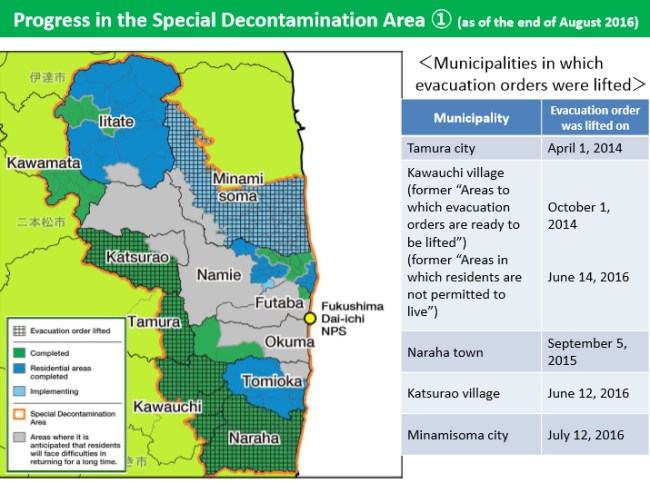
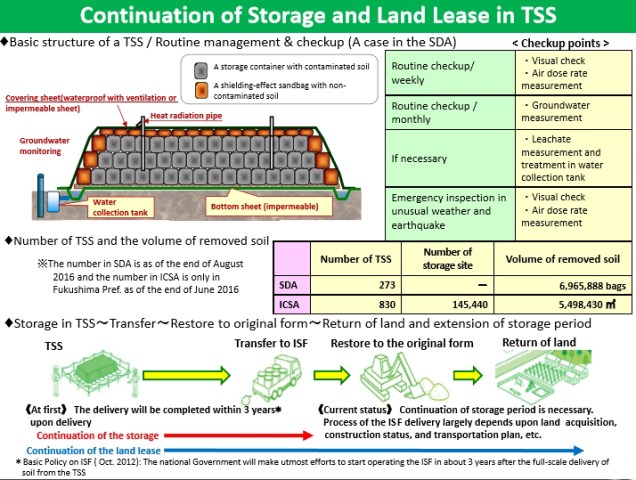
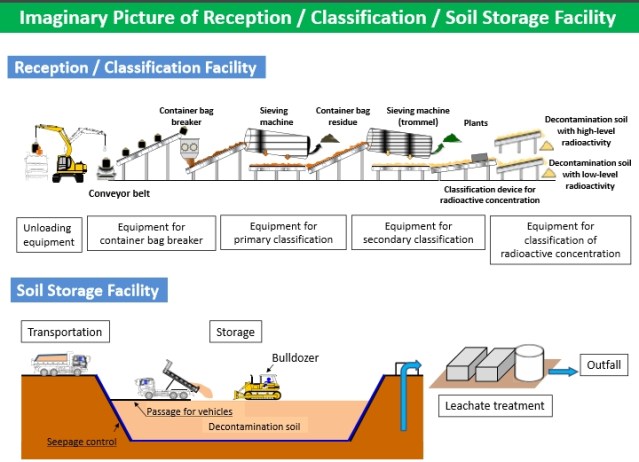
In Fukushima Prefecture, large quantities of contaminated soil and waste have been generated from decontamination activities. Currently, it is difficult to clarify methods of final disposal of such soil and waste. Until final disposal becomes available, it is necessary to establish an Interim Storage Facility (ISF) in order to manage and store soil and waste safely.
The only solution proposed is a storage facility of 16 km2 around the Fukushima plant for a period of 30 years. After that, time will tell, because the problems are endless.
The following materials generated in Fukushima Prefecture will be stored in the ISF.
1. Soil and waste (such as fallen leaves and branches) generated from decontamination activities, which have been stored at the Temporary Storage Sites.
2. Incineration ash with radioactive concentration more than 100,000 Bq/kg.
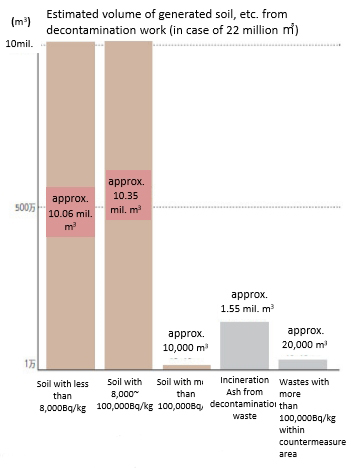
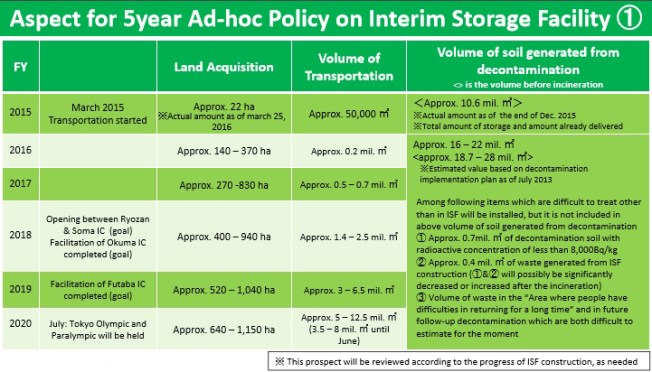
It is estimated that generated soil from decontamination will be approx. 16 ~22 mil. m3 after the volume reduction incineration, estimated value based on the decontamination implementation plan of July 2013. (Ref: approximately 13~18 times as much as the volume of Tokyo Dome (1.24 mil. m3) .
Transportation to Stock Yards
In order to confirm safe and secure delivery towards the transportation of a large amount of decontamination soil, MOE implemented the transportation approx. 1,000m3 each from 43 municipalities in Fukushima Prefecture from 2015-2016.
Actual achievement in 2016 as of July 30, 2016
Stored volume: 13,384m3 (58,766m3 in total)
Stock yards in Okuma: 4,883m3; stock yards in Futaba: 8,501m3
* Calculated on the assumption that the volume of a large bag is 1m3
Total number of trucks used: 2,279 (9,808 in total)
Stock yards in Okuma: 815 trucks; stock yards in Futaba:1,464 trucks
To construct facilities, it will need comprehensive area and 2/3 will be assumed to be used for facilitation. The possible volume for installation is to be 10,000m3/ha and 140,000m3/5ha for a storage facility, and will be installed from TSS to ISF sequentially.
Approximate period from contract with operators to ISF operation: 3months for TSS, 6months for delivery & classification, 12months for storage, 18months for incineration.
On the premise that infrastructure construction on roads for Okuma and Futaba IC would proceed as planned, the maximum volume of possible transportation is estimated: 2millions m3 /y before the operation of both IC, 4millions m3/y after Okuma IC & before Futaba IC, 6 millions m3/y after the both ICs operation.
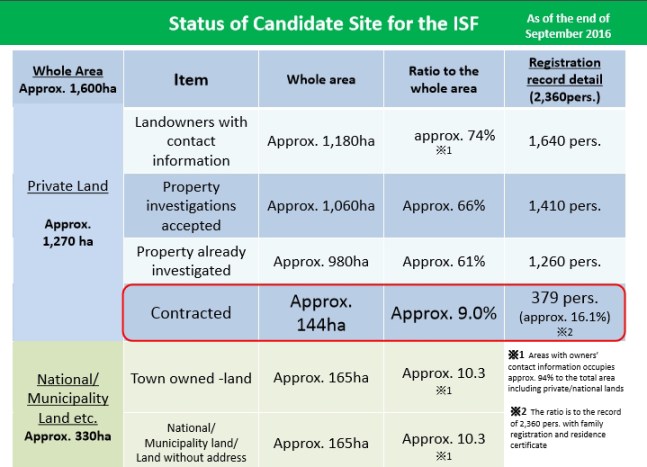
Landowners are still reluctant to sell their land to put the waste. In late September 2016, according to the official data of the Ministry of Environment, only 379 owners out of 2360 had signed a contract. This represents an area of 144 ha, or about 9% of the total project.
The town of Okuma, is almost entirely classified as “difficult to return”zone, therefore it intends to offer all its municipal land to put the waste. This represents 95 hectares, or about 10% of land considered in the town. This includes schools, the Fureai Park with some sports grounds … The town has not yet decided whether it would sell or would lease its land.
Meanwhile, it is an abandoned village:
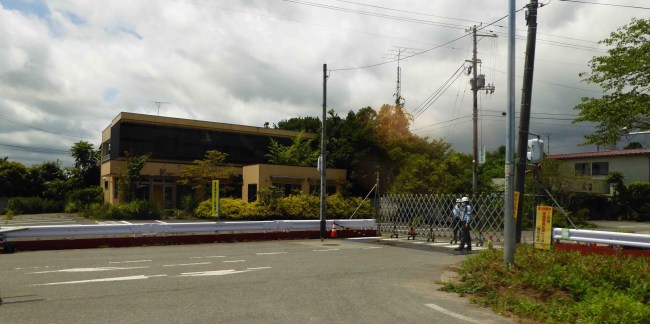
The Joban railway line was partially destroyed by the tsunami, as here in Tomioka:
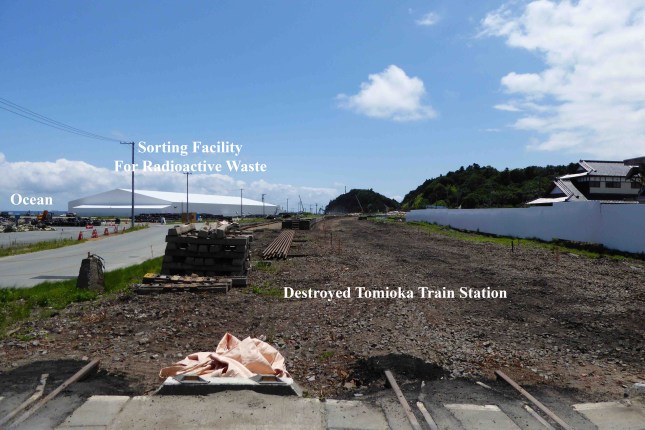
Destroyed Tomioka train station and sorting facility for radioactive waste
Some parts have reopened, but not in the most contaminated areas; between Tatsuta and Namie. Japan Railway wants to fully reopen the railway before 2020, avoiding the coast. Decontamination should produce 300,000 m3 of radioactive waste. The radioactive waste bags are along the railway, but they will need to be take them away. The Environment Ministry is negotiating with landowners owning the land beside the railway, but this is not enough because few responded favorably. So it’s a game of musical chairs that is planned: use the lands where some waste is right now after they’ll freed by the transfer of the waste to the storage center located around the Fukushima Dai-ichi.
Meanwhile, the waste is piling up everywhere:
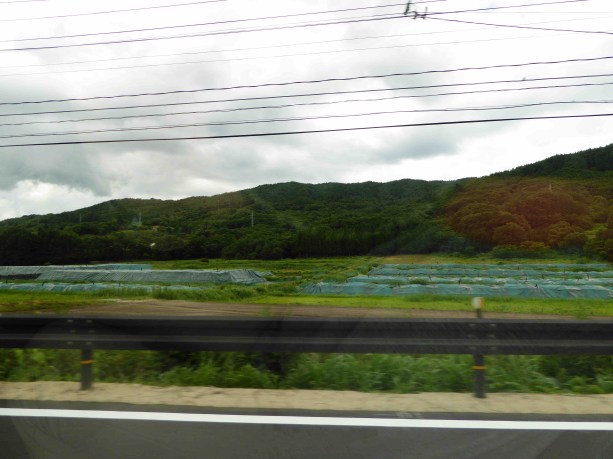
Radioactive waste in Iitate
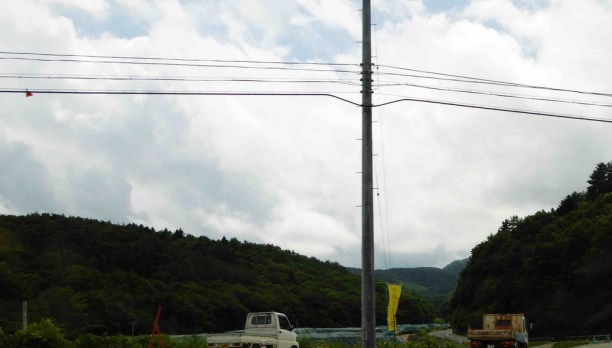
Valley of radioactive waste in Iitate mura
This storage was not expected to last as long, which is not without causing problems because the bags do not hold. Here in Tomioka, weeds grow back:
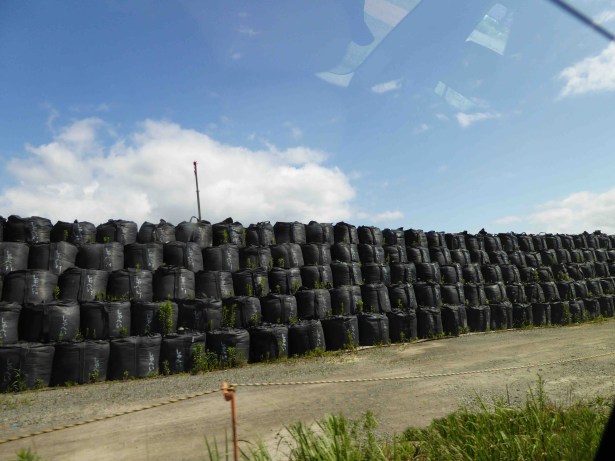
The equivalent of the Court of Accounts of Japan went to inspect some of these sites and found other problems, according to the Asahi. Those who receive contaminated soil, are elevated in the center so that the water flows over the edges where it can be harvested and controlled because the bags are not waterproof. There are up to 5 levels. With time and the weight of waste, a hollow that may appear in the center, and contaminated water accumulates there. Monitoring is difficult or impossible. See diagram of Asahi:
It is not normal that the Nuclear Regulatory Authority, the NRA does not control these storage sites for radioactive waste.
Regarding the waste from the decommissioning of nuclear power plants, the NRA wants to bury the most contaminated within 70 meters for 100 000 years. This is essentially reactor control rods. Utilities would bear responsibility for 300 to 400 years. They have not yet found where to have the sites … Read Asahi for more. http://www.asahi.com/ajw/articles/AJ201609020034.html
The government relies on the radioactive decay for these wastes to pass below the 8000 Bq / kg to be downgraded and utilized …
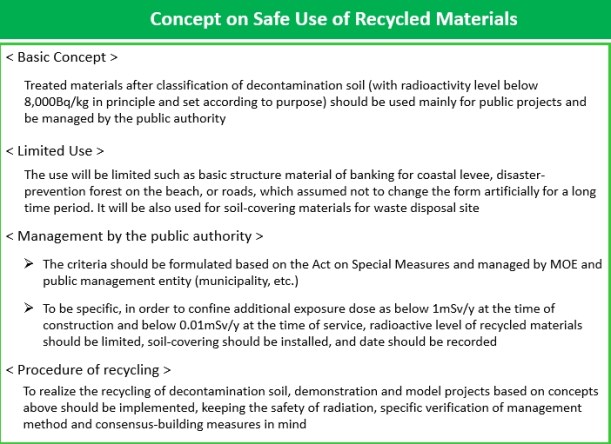
http://josen.env.go.jp/en/pdf/progressseet_progress_on_cleanup_efforts.pdf
Drone Inspection of Fukushima Units 1 & 2 Vent Tower

TEPCO reported on October 20th they used drones to measure radioactivity at the reactors 1 and 2 vent tower.
Vent towers are quite unstable during earthquakes and are highly contaminated, they are therefore not easy to dismantle, even with robot
When they sent a drone into the vent tower, they found out that a bar prevented the drone to go in lower than 10-20 m below.
It’s pretty amazing that Tepco did not know that this bar was there and that they can not give its position more precisely.
TEPCO only provided two pictures online with a laconic comment. No results of their radioactivity measuring was given. Transparency is progressing …
http://www.tepco.co.jp/en/nu/fukushima-np/handouts/2016/images/handouts_161020_02-e.pdf
Not willing to Lie, the Chairman of the Fukushima Thyroid Examination Assessment Subcommittee Resigned
Of course this news was not released in the Japanese national main media nor in the Fukushima local media, it was only released in the Hokkaido Shimbun, a local media from the northern island Hokkaido.
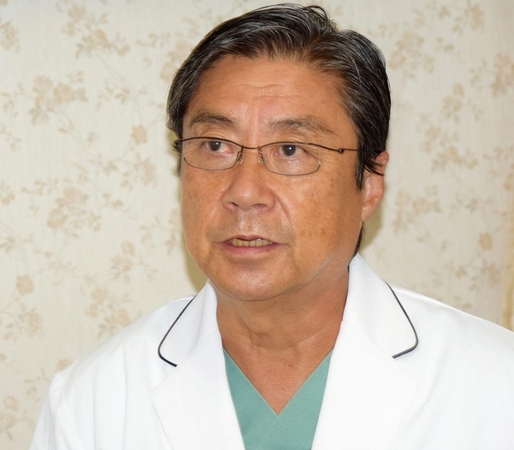
Dr. Kazuo Shimizu
Dr. Kazuo Shimizu, Chairman of the Thyroid Examination Assessment Subcommittee and member of the Oversight Committee for the Fukushima Health Management Survey, a thyroid surgeon and Honorary Director at Kanaji Hospital, and Professor Emeritus at Nippon Medical School, and former chair of the board of the Japanese Society of Thyroid Surgery, submitted his resignation as Chairman of the Thyroid Examination Assessment Subcommittee.
As Chairman of the Thyroid Examination Assessment Subcommittee, he does not personally agree with the interim report conclusion that “it is unlikely that the effects of radiation” caused the high incidence of thyroid cancer found in the Fukushima Prefecture. Not agreeing with the drawn conclusions of the interim report and as Chairman not free to have a personal opinion, nor to express it, he decided to resign.
Dr. Kazuo Shimizu is a doctor, a leading authority in endoscopic surgery of the thyroid gland. Within the Fukushima population, 380,000 children below 18 years old at the time of the Fukushima Daiichi nuclear plant accident in March 2011 have been examined. 174 people have been so far diagnosed with thyroid cancer or suspected thyroid cancer.
Dr. Kazuo Shimizu says that such high incidence of thyroid cancer, from his long clinical experience, is unnatural. That frequency is a fact, which should not be explained, nor discarded by just the “It is unlikely that the effects of radiation.” caused that high incidence conclusion.
In the former Soviet Union after the 1986 Chernobyl nuclear accident, thyroid cancer was frequent in children due the released iodine-131.
http://headlines.yahoo.co.jp/hl?a=20161021-00010003-doshin-soci
However, it is not that surprising. When Oshidori Mako interviewing Dr. Kazuo Shimizu in May 2015 asked « Is it really overdiagnosis that is going on? », Dr. Kazuo Shimizu answered :“I am not in a position to be able to say, ‘It is not due to overdiagnosis.’ As chair of the Subcommittee, I cannot validate opinions of either side. It is hard for me. I would have been able to voice my opinions more clearly if I hadn’t been elected chair of the Subcommittee.”
http://fukushimavoice-eng2.blogspot.fr/2015/08/oshidori-mako-interviews-experts.html
1 This Month

Website of the Week

New book – https://www.amazon.com/dp/1923372157?utm_source=substack&utm_medium=email
Now until to February 10, 2026 Radioactive waste storage in France: the debate is finally open! How to participate?
-
Archives
- January 2026 (106)
- December 2025 (358)
- November 2025 (359)
- October 2025 (377)
- September 2025 (258)
- August 2025 (319)
- July 2025 (230)
- June 2025 (348)
- May 2025 (261)
- April 2025 (305)
- March 2025 (319)
- February 2025 (234)
-
Categories
- 1
- 1 NUCLEAR ISSUES
- business and costs
- climate change
- culture and arts
- ENERGY
- environment
- health
- history
- indigenous issues
- Legal
- marketing of nuclear
- media
- opposition to nuclear
- PERSONAL STORIES
- politics
- politics international
- Religion and ethics
- safety
- secrets,lies and civil liberties
- spinbuster
- technology
- Uranium
- wastes
- weapons and war
- Women
- 2 WORLD
- ACTION
- AFRICA
- Atrocities
- AUSTRALIA
- Christina's notes
- Christina's themes
- culture and arts
- Events
- Fuk 2022
- Fuk 2023
- Fukushima 2017
- Fukushima 2018
- fukushima 2019
- Fukushima 2020
- Fukushima 2021
- general
- global warming
- Humour (God we need it)
- Nuclear
- RARE EARTHS
- Reference
- resources – print
- Resources -audiovicual
- Weekly Newsletter
- World
- World Nuclear
- YouTube
-
RSS
Entries RSS
Comments RSS
 nuclear-news