Sizewell C: the Unanswered Questions

Alison Downes, https://stopsizewellc.org/sizewell-c-the-unanswered-questions/
8 June 2026: On the day the Public Accounts Committee begins scrutiny of Sizewell C, [1] and almost a year to the day that the government’s announcement of its £14.2bn investment paved the way for a Final Investment Decision, Stop Sizewell C is publishing a report “Sizewell C – The Unanswered Questions”. This highlights what is known, what it is impossible to know, and what the government continues to keep secret about Sizewell C. It is a story of secrecy, obfuscation and deception and contains a number of recommendations. [2]
Read here: Sizewell C, the Unanswered Questions, 8 June 2026
Stop Sizewell C said: “Over the last decade, efforts to uncover Sizewell C’s expected cost and schedule have been met by obfuscation, secrecy and outright deception. [3] While the National Audit Office published some details that the government wanted to keep secret, [4] we now demand much greater transparency; the Sizewell C Full Business Case and Strategy and Delivery Plan must be published – unredacted – immediately.
“With households on the hook for Sizewell C, we need assurances that the government has a prepared exit strategy for when the project – which according to the NAO is already based on “big assumptions” and “significant uncertainty” [5] – goes wrong. The government’s inability to back out of HS2 shows where this project might be heading, but with Sizewell C’s “novel” financing, it would be immoral to force households to continue paying for something that might never work properly, while investors laugh all the way to the bank.
“In the cost of living crisis, consumers must be protected now and into the future from the risks of building nuclear projects. As well as assurances of increased scrutiny and Ministerial accountability for Sizewell C, we call for a commitment that RAB will never be used again for future nuclear projects. Unless investors suddenly rediscover an appetite for risk – unlikely given the free ride provided by Sizewell C’s RAB – abandoning nuclear or switching to full state funding would seem to be the only alternatives.
“We look forward to the outcomes of the Public Accounts Committee’s enquiry into Sizewell C and hope the Committee calls out the government for failing to come clean about this deeply flawed project.”
Notes
1. The Public Accounts Committee is taking oral evidence on Sizewell C at 1pm today, 8 June with senior officials and Nigel Cann https://committees.parliament.uk/work/9713/sizewell-c/
2. See Appendix below. Some of our recommendations echo those by the National Audit Office in its report on Sizewell C.
3. Our report includes examples such as:
The government claimed not to “recognise” a cost of Sizewell C put at “close to £40bn” by the Financial Times in January 2025, when in July the project “baseline” was given as £38bn and HMG’s “central cost estimate” as £40.5bn.- Ministers are keeping the target completion date secret, saying only “mid to late 2030s”, but the NAO revealed the project baseline date as July 2039.
- Sizewell C revised its May 2020 cost estimate of £20bn a few months later, including removing allowances for in risk contingencies, but told the Planning Inspectorate in January 2021 the estimated cost “remains the same”.
- Officials gaslit Stop Sizewell C in a conversation about the project costing over £30bn.
4. Stop Sizewell C has repeatedly called for publication of the Sizewell C Full Business Case (FBC) but the government decided to only publish a summary. The NAO had sight of the FBC in preparing its report, but the FBC itself is still unpublished.
5. NAO’s press statement says: “This novel approach [RAB financing] has costs and relies on big assumptions” and “DESNZ’s modelling of [Sizewell C’s] benefits shows they will not outweigh the costs to consumers until after 2060. They are also subject to significant uncertainty.”
Appendix: Our recommendations.
I. GREATER TRANSPARENCY
- We call for the immediate unredacted publication of Sizewell C’s Strategy and Delivery Plan that contains clear and accessible information about cost, schedule and project milestones to enable the public to understand project progress. Annual updates to Parliament should spell out the following:
- Average and total costs for domestic and business users to date.
- Total capital accessed by the project to date.
- Updated construction cost compared to project baseline, LRT and HRT.
- Transparency about the whole life cost of the project from inception, through construction, operation and decommissioning. The cost of risk shouldered by HMG should also be included.
- If the Strategy and Delivery Plan cannot be published at this time the government should make a statement explaining why and commit to a publishing date.
- We call for the immediate – unredacted – publication of Sizewell C’s Full Business Case, as accessed by the National Audit Office.
- Terms agreed with EDF for use of its technology should be placed in the public domain.
II. EVIDENCE OF AN EXIT STRATEGY
While Stop Sizewell C is already convinced that Sizewell C cannot provide value for money or energy security, we believe the case for Sizewell C will weaken further over time as project milestones are missed, technological challenges emerge, and other sources of energy generation become cheaper. Given the financial burden on consumers, we seek assurances that the government would pursue an exit strategy rather than commit further funds to an expensive, unreliable energy source that would add to the UK’s stockpile of nuclear waste. The lack of an exit strategy must surely be a fundamental learning from HS2 – and Hinkley Point C.
- DESNZ should publish a process and timetable for regular reviews of the FBC, including ongoing assessments of internal or external developments on the economic viability of the project. These updates should be made public.
- These updates should transparently communicate the cost of continuing Sizewell C compared to the cost of abandoning the project, and what and when a government exit strategy would be pursued, to save consumer money being wasted.
III. PROVIDE CONSUMERS WITH ASSURANCES OF SCRUTINY AND PROTECTION
- We echo the NAO’s call for close, ongoing scrutiny by Ministers and independent watchdogs of consumer risk. The government must provide clarity on how this scrutiny will be undertaken, and demonstrate that DESNZ is resourced with the right skills and expertise to ensure full oversight. The government should undertake an early review of Sizewell C’s governance and assign specific Ministerial accountability for the project.
- The government should make a commitment not to use RAB for future nuclear power developments, especially GW nuclear projects. Full state funding would seem inevitable.
- The policy decision to “recycle” the government’s profit from Sizewell C’s RAB during construction (and operation, assuming the government kept its share) to help reduce consumer contributions towards Sizewell C should be legislated, to reduce the likelihood that future governments would rescind this arrangement and force consumers to pay even more for Sizewell C. (See point 3.)
- DESNZ should provide more detailed information to show how private sector expertise will be garnered from investors, and the basis of their belief that this will deliver savings for the benefit of consumers and that would justify use of the RAB.
- With investor returns during construction considered “high” by the NAO, we call on Ofgem to use all its powers to limit the profits investors would receive during operation, and not be swayed by investor claims that returns should reflect their “higher risk” * – when in fact consumers are bearing significant risk.
*Comments made by Centrica in a video presentation, https://www.centrica.com/investors/centrica-as-an-investment/investing-for-value-at-sizewell-c/
Department for Energy Security and Net Zero (DESNZ) defends Sizewell C funding which puts risk on taxpayer.

Representatives of the Department for Energy Security and Net Zero (DESNZ)
have defended the government’s funding model for Sizewell C, which places
risk on taxpayers rather than private investors.
Under the agreed final
investment decision (FID), private investors won’t have to pump more
equity into the nuclear project even if construction costs spiral.
At an oral evidence session of the Public Accounts Committee (PAC) on Monday (8
June), DESNZ civil servants were grilled about the findings of a recently
published report by the National Audit Office (NAO) into the delivery of
the 3.2GW nuclear plant, which concluded that private investors are reaping
“high” rewards from the project.
Utility Week 8th June 2026,
https://utilityweek.co.uk/desnz-defends-sizewell-c-funding-which-puts-risk-on-taxpayer/
Lawrence Wilkerson: Israel Bet Everything on War With Iran-and Lost
Speaking with political analyst Glenn Diesen, Wilkerson contends that despite years of military escalation, sanctions, and regional conflict, Israel has failed to achieve its central objective: weakening Iran’s influence across the Middle East. Instead, he argues, the war has strengthened regional opposition, intensified global criticism of Israel’s actions in Gaza, and exposed growing cracks in America’s support for endless military intervention.
At the center of Wilkerson’s analysis is a point often ignored in Western discussions: the conflict ultimately revolves around Palestine.
“The Palestinians are still dying every day,” Wilkerson noted, arguing that military campaigns against Iran, Lebanon, and Gaza have failed to address the root political crisis driving instability throughout the region.
Highlights
• “All Iran has to do is not lose.” Wilkerson argues that Israel and the United States require a decisive victory while Iran simply needs to survive and endure.
• Palestine remains the core issue. According to Wilkerson, efforts to shift attention toward Iran, Hezbollah, or other regional actors obscure the unresolved question of Palestinian statehood.
• Growing public opposition. Wilkerson points to rising global criticism of Israel’s actions and increasing skepticism among Americans about continued military involvement abroad.
• A deeper U.S.-Israel integration. He warns that proposed legislation would further embed Israel within the U.S. military and defense establishment while reducing public oversight and accountability.
• A changing world order. Wilkerson argues that conflicts in the Middle East and Ukraine are unfolding alongside a broader shift in global power away from Western dominance and toward emerging Eurasian economic and political networks.
For Wilkerson, the danger is not simply another regional war. It is the possibility that Washington continues doubling down on military solutions while ignoring the political realities that have fueled conflict for generations. The result, he warns, could leave both Israel and the United States increasingly isolated in a rapidly changing world.
Spiralling costs, fish discos and vast radioactive waste. Is nuclear really the solution to Britain’s energy problem?

an “unsolved environmental problem for future generations… a heavy burden to lay on our children and their children’s, children.” Porritt is aghast: “This is a truly extraordinary development – confirming that the UK still has NO idea what to do about its legacy nuclear waste.” And there is, of course, a huge cost involved, firstly with decommissioning a nuclear reactor and then storing the waste.
an “unsolved environmental problem for future generations… a heavy burden to lay on our children and their children’s, children.” Porritt is aghast: “This is a truly extraordinary development – confirming that the UK still has NO idea what to do about its legacy n
In an increasingly energy-hungry Britain, is nuclear the best way to meet soaring demand without burning fossil fuels? Fergus Collins investigates the benefits and risks
Fergus Collins, BBC CountryFile, June 8, 2026
“…………………………………….. The UK currently has nine operational nuclear reactors at five plants, with four more due to come online in the 2030s – two at Hinkley Point C in Somerset and two planned at Sizewell C in Suffolk – demonstrating Government commitment to this energy source (devolved Scotland has no nuclear plans).
“Nuclear will play a central role in meeting the UK’s future energy needs as we deliver our net zero target,” says the current minister for nuclear Lord Patrick Vallance. “As set out in our clean power mission, while our future electricity system will be dominated by renewables, we still need firm, low-carbon power to ensure the system is stable, secure and affordable. Nuclear provides that essential backbone – delivering clean power for millions of homes while underpinning a safe, resilient and cheaper system for the decades ahead.”
Not everyone is convinced, especially those concerned about safety issues; the shadows of the Chernobyl and Fukushima nuclear disasters, in 1986 and 2011 respectively, still dog the industry. Nuclear power creates vast amounts of potentially lethal radioactive waste, which must be contained and stored securely for thousands of years. Then there are questions of cost. Nuclear reactors are massive infrastructure projects and hugely expensive, not least because of the requirements of mitigating safety risks. Is it worth the investment – or could we power the UK through other means?
………………………………………………………………..The two new nuclear power stations at Hinkley Point and Sizewell are being built by EDF, France’s state-owned energy company. EDF manages eight nuclear sites in the UK – seven Advanced Gas-cooled Reactor (AGR) sites and one Pressurised Water Reactor (PWR). It says it’s driving the transition towards “an Electric Britain
………………………………….Who opposes nuclear power?
Some of the strongest voices against nuclear power in the UK come from groups protesting against the new reactors at Hinkley and Sizewell. Former science teacher Allan Jeffrey has been voicing concerns for over 40 years as part of campaign group Stop Hinkley, which works closely with TASC (Together Against Sizewell C). He doesn’t mince words: “Nuclear power stations are toxic radioactive waste factories” and argues that nuclear is “neither clean nor green” saying “large amounts of greenhouse gasses are produced in the nuclear fuel cycle from uranium mining and fuel processing to the building of power stations and waste storage sites and decommissioning old reactors.”
Jeffrey dismisses the idea that nuclear is more ethical than the gas or coal supplies the UK buys from unstable or openly hostile foreign states. “Uranium is not a renewable fuel,” he says, “and is mined in countries such as Australia, Canada, Niger and Kazakhstan. The miners frequently get lung cancer from the Radon gas, and much environmental pollution is left locally by the mining tailings and river water pollution.”
Jeffrey also points at the cost of nuclear: “Nuclear reactors take too long to build and pay back their greenhouse gas emissions.” He has a point with Hinkley Point C, which has been a building site since being approved by the Conservative Government in 2016.
Stop Hinkley and TASC are supported by statistics from CND (Campaign for Nuclear Disarmament) and many prominent anti-nuclear voices, including the environmentalist and friend of King Charles, Jonathan Porritt. In a recent blog post he claimed: “The Treasury’s financial modelling for the new power station at Sizewell C (seen by the Financial Times) gives a range of roughly £80 billion to £100 billion, far higher than the official estimate of £47 billion from the DESNZ – which in itself was already nearly double the original cost of £20 billion!”
DESNZ argues that there will be a big saving with Sizewell C because it is a replica of Hinkley and will be “built at a cost of £38bn in 2024 real terms. This would represent around 20% saving on the capital cost of the project compared with Hinkley C”.
What are the wildlife costs of nuclear power?
One very public reason for rising costs – and one the press have leapt on – is mitigation measures to prevent deaths of wildlife, especially fish. Nuclear power stations are located on the coast so they can draw seawater to cool the reactors. But they also suck in large numbers of fish; the Environment Agency has estimated 4.6 million per year at Hinkley, a figure EDF strongly contests.
EDF says it has spent £700 million in mitigation measures, including sonic fish deterrents developed with Swansea University. These use ultrasound to drive fish from the water intakes and have been dubbed ‘fish discos’ in the press.
That said, the Government’s own review, led by Sir John Fingleton, found that Britain was the most expensive place in the world to build nuclear facilities due largely to a “fragmented” regulatory system that had led to “conservative and costly decisions not proportionate to the actual risk being managed”.
However, Matt Browne, head of public affairs at The Wildlife Trusts, disputes EDF’s claims. “The developers of Hinkley C continue to misrepresent the impact that the nuclear plant will have on nature… This is highly misleading and allows EDF to pretend that £700 million is being spent to protect nature, when the real figure is closer to £50 million. It also misrepresents the number of fish affected by the proposed plant.”
Browne goes on to say: “On the basis of these false claims, the Government is now considering progressing recommendations which will lead to nature protections being severely compromised.”……………………………….
What happens to nuclear waste?
One area where there is a gap in the Government and EDF’s positive messaging – and one that tallies with Stop Hinkley and Porritt’s deeper fears – is just how and where to store nuclear waste.
Even after it’s no longer useful for generating heat, it continues to emit radiation, which breaks molecular bonds and causes severe damage to cell tissues in all organisms, leading to cancers and other severe health issues. And, as it breaks down very slowly, the waste emits this harmful radiation for tens of thousands of years.
The ONR says “Nuclear waste is primarily transferred to specialised, secure and regulated facilities for storage pending long-term disposal. Current Government policy is that UK higher activity radioactive waste will be managed in the long-term through geological disposal facilities (GDF)”.
GDF means burying the waste in deep subterranean vaults and leaving it alone till its radiation cools.
For Allan Jeffrey, this is simply an “unsolved environmental problem for future generations… a heavy burden to lay on our children and their children’s, children.” Porritt is aghast: “This is a truly extraordinary development – confirming that the UK still has NO idea what to do about its legacy nuclear waste.” And there is, of course, a huge cost involved, firstly with decommissioning a nuclear reactor and then storing the waste.
Currently, most high-level nuclear waste is being stored at Sellafield. Once at the forefront of the UK’s nuclear programme, Sellafield stopped generating electricity in 2003 and is now in the process of being decommissioned. As well as dealing with Sellafield’s own waste – spent fuel rods and other debris stored in silos and artificial ponds – it holds waste from other plants.
High level waste usually occurs in liquid form, a byproduct of processing spent fuel. This is mixed with crushed glass in a furnace and the molten product is poured into steel cannisters where it cools and solidifies, making it stable and safe for storage. But it is temporary storage only and Sellafield is almost full. Communities in Cumbria and Lincolnshire have been identified as potential nuclear waste sites.
…………The decommissioning of Sellafield is a massive project that may take over 100 years, with spiralling costs – but that’s a blink of an eye in terms of nuclear radiation.
………………………..Such gigantic periods of time, when all current decision makers and hundreds of generations of their descendants will be long dead, are hard to comprehend. Opponents of nuclear, such as Stop Hinkley and TASC, urge policymakers not to take the risk and to invest instead in renewables such as wind, solar and hydro power. In 2025, wind provided approximately 30% of the UK’s electricity needs compared to just 11–17% provided by nuclear. The UN’s International Energy Agency predicts renewables will generate 90% of all new power in the coming years. And yet you’ll find protest groups opposing almost every new wind or solar farm with the same vigour as those who are anti-nuclear……………..https://www.countryfile.com/environment/spiralling-costs-fish-discos-and-vast-radioactive-waste-is-nuclear-really-the-solution-to-britain-s-energy-problem
Visual data reveals extent of systematic Israeli white phosphorus attacks on south Lebanon: Report
These shells are designed to release 116 burning felt wedges that can be detonated high in the air and drift over a radius of up to 250 meters, causing widespread fires on the ground.
Lebanon’s Ministry of Environment has formally accused the Israeli military of committing ‘an act of ecocide,’ resulting in an estimated $25 billion in damages
The humanitarian risks of these munitions are devastating because white phosphorus causes horrific, deep-tissue burns that can reach the bone and may reignite if exposed to oxygen after treatment.
News Desk, JUN 7, 2026, https://thecradle.co/articles/visual-data-reveals-extent-of-systematic-israeli-white-phosphorus-attacks-on-south-lebanon-report
A report by The New York Times (NYT) published on 6 June gathers thorough documentation that the Israeli military has repeatedly deployed white phosphorus over populated areas in southern Lebanon during its ongoing war and invasion of the country.
Visual evidence collected by NYT, including verified social media footage and news coverage, shows distinctive smoke trails and airbursts over cities like Nabatieh and Tyre, as well as smaller towns like Qlayaa, Khiam, and Yohmor, with incidents documented as recently as May 2026.
While the Israeli military maintains that its use of these munitions is intended for smoke screens and complies with international law, human rights experts assert that deploying such an indiscriminate incendiary substance in civilian-heavy areas violates the laws of war.
The body of evidence gathered by numerous international observers and human rights groups is extensive and corroborates these findings.
Amnesty International’s Crisis Evidence Lab and Human Rights Watch (HRW) have verified dozens of videos and photos showing the airbursting of US-made M825A1 artillery shells.
These shells are designed to release 116 burning felt wedges that can be detonated high in the air and drift over a radius of up to 250 meters, causing widespread fires on the ground.
In Yohmor, HRW geolocated eight images from March 2026 showing these munitions exploding over residential neighborhoods, directly resulting in fires in homes and vehicles.
Similar evidence from Dhayra in October 2023 includes testimony from residents and doctors who treated nine civilians for suffocation and respiratory damage caused by the “garlic-like” smoke.
Independent researchers have now documented over 200 uses of the substance in Lebanon since October 2023, which the Lebanese government reports have caused more than 600 fires.
This pattern of use extends far beyond recent events in Lebanon; Israel has a long history of deploying white phosphorus in the region, including during the 1982 and 2006 wars in Lebanon, extensively in Gaza in 2009, and throughout its ongoing genocidal campaign since 2023.
Amnesty International documented the use of white phosphorus artillery shells in densely populated civilian areas in Gaza shortly after the launch of the war on 7 October, 2023; this deployment directly violated a 2013 pledge by the Israeli military to phase out the use of the incendiary substance in populated areas.
The humanitarian risks of these munitions are devastating because white phosphorus causes horrific, deep-tissue burns that can reach the bone and may reignite if exposed to oxygen after treatment.
Beyond the immediate physical trauma, the substance poses long-term environmental hazards by contaminating soil and water, necessitating specialized cleanup operations before farmers can safely return to their land.
Due to the indiscriminate nature of these illegal weapons, rights groups continue to call for an immediate halt to their use in residential areas.
Lebanon’s Ministry of Environment formally accused the Israeli military of committing “an act of ecocide,” back in April 2026, citing a National Council for Scientific Research report that details $25 billion in damages, including the destruction of thousands of hectares of forest and orchards alongside extreme phosphorus soil contamination in strikes conducted between 2023 and 2024.
Russian drone hits nuclear fuel site near Chernobyl.
A Russian drone hit a storage site for spent nuclear fuel near the
Chernobyl power plant on Sunday, the latest in a series of incidents that
have raised fears of a nuclear incident as the Ukraine war drags on.
Ukraine’s state nuclear company Energoatom said the drone hit the reception
area of a heavily secured facility overnight, triggering a fire that was
quickly extinguished. No casualties were recorded while radiation levels
remained “within normal limits”, the company said. “Russia
deliberately struck this particular nuclear infrastructure facility,”
Ukraine’s President Volodymyr Zelenskyy said on X.
The new attack comes as
Zelenskyy was set to meet in London UK Prime Minister Sir Keir Starmer,
German Chancellor Friedrich Merz and French President Emmanuel Macron, as
the European leaders seek to spearhead a new effort to revive peace
negotiations with Russia.
FT 7th June 2026 https://www.ft.com/content/3c109ff1-e1cd-42c9-86b2-5e5bfb4671e5
Thousands March in Albania After PM Says Pristine Land ‘Belongs’ to Kushner-Backed Group
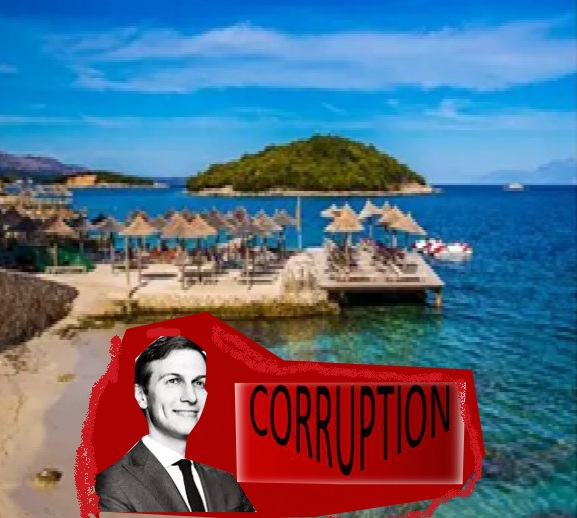
“One week later, we are still here, stronger than yesterday,” said one group opposing a proposed luxury resort project supported by Jared Kushner.
Jake Johnson, Jun 08, 2026, https://www.commondreams.org/news/jared-kushner-albania-resort
Albanians took to the streets in droves for the eighth consecutive day on Sunday to protest a proposed $1.6 billion luxury resort complex backed by US President Donald Trump’s son-in-law, Jared Kushner, one of several investors in the project, which opponents say is both corrupt and disastrous for wetlands and wildlife.
“One week later, we are still here, stronger than yesterday,” said the Albanian Ornithological Society, a leading critic of the proposed development. “Millions around the world are united in one voice for nature, for justice, and for the protection of what belongs to everyone, standing for every protected area in Albania.”
Albanian Prime Minister Edi Rama has vocally defended the project amid mounting public backlash, saying in a recent interview that the land marked for development “belongs to the investors,” not the Albanian people.
Rama also criticized the thousands of people who have turned out to protest the luxury hotel project as well as international media coverage of the demonstrations, saying that “there is no chance” that “the projects in Albania will be defined by street protests.”
Demonstrators, many raising pink flamingo cutouts to decry the project’s expected impacts on the vulnerable bird and other wildlife, have demanded cancellation of the resort project and Rama’s resignation, accusing him of steamrolling environmental concerns to bolster the country’s tourism industry and curry favor with the Trump administration. Kushner currently works for the administration as a “special peace envoy.”“We are stronger than your bulldozers,” chanted demonstrators over the weekend.
“They know that luxury tourism means holidays in your own country become a privilege for the few,” Ypi added. “With no unions to speak of and a labor movement that only appears in communist-era footage of May Day parades, work conditions are so exploitative that only those from countries even more desperate are willing to take the jobs that arise.”
As The New York Times reported last year, Rama heads the government committee that gave “Kushner and his business partners the right to move ahead with accelerated negotiations to build the luxury resort on a 111-acre section of the 2.2-square-mile island of Sazan that will be connected by ferry to the mainland.”
“Mr. Kushner’s Affinity Partners, a private equity company backed with about $4.6 billion in money mostly from Saudi Arabia and other Middle East sovereign wealth funds, is pursuing the Albania project along with Asher Abehsera, a real estate executive that Mr. Kushner has previously teamed up with to build projects in Brooklyn, New York,” the Times added.
Lea Ypi, an Albanian academic, wrote in an op-ed for The Guardian on Monday that “Albanians know that real-estate speculation without state support means ordinary citizens will struggle to buy a flat or pay the rent.”
“They know that luxury tourism means holidays in your own country become a privilege for the few,” Ypi added. “With no unions to speak of and a labor movement that only appears in communist-era footage of May Day parades, work conditions are so exploitative that only those from countries even more desperate are willing to take the jobs that arise.”
𝐍𝐄𝐓𝐀𝐍𝐘𝐀𝐇𝐔’𝐒 𝐆𝐀𝐌𝐁𝐋𝐄 𝐖𝐈𝐓𝐇 𝐀𝐌𝐄𝐑𝐈𝐂𝐀𝐍 𝐈𝐍𝐓𝐄𝐑𝐄𝐒𝐓𝐒 𝐀𝐍𝐃 𝐒𝐎𝐋𝐃𝐈𝐄𝐑𝐒 𝐈𝐍 𝐓𝐇𝐄 𝐌𝐈𝐃𝐃𝐋𝐄 𝐄𝐀𝐒𝐓

DD Geopolitics Protagonist HQ and Ibrahim Majed, Jun 09, 2026
The fragile calm that had prevailed across much of the Middle East since April, excluding the ongoing Israeli war on Lebanon, unraveled within hours, exposing a strategic reality Washington has long sought to avoid.
What began as a localized escalation rapidly evolved into a broader geo-economic crisis with consequences extending far beyond the battlefield.
At the center of the crisis lies a structural imbalance within the U.S.-Israeli relationship.
While Washington remains Israel’s principal military, diplomatic, and economic backer, recent events have highlighted the extent to which regional escalations can impose costs on the United States regardless of American preferences.
The result is a dynamic in which decisions made in Tel Aviv increasingly shape the strategic environment that Washington must manage.
𝐓𝐡𝐞 𝐄𝐬𝐜𝐚𝐥𝐚𝐭𝐢𝐨𝐧 𝐓𝐫𝐢𝐠𝐠𝐞𝐫
he latest escalation stemmed from Israel’s continued military operations in Lebanon, including renewed strikes on the southern suburbs of Beirut, despite mounting regional warnings and Iran’s explicit signaling that further escalation in Lebanese territory would cross a red line.
These actions effectively collapsed the fragile de-escalation framework that had begun to take shape in recent months.
Yet the strategic significance of the crisis did not stem solely from direct military exchanges.
The conflict quickly expanded through an asymmetric front.
Yemen’s Ansarallah movement announced a comprehensive blockade targeting Israeli-linked maritime traffic through the Bab al-Mandab Strait, transforming what might have remained a localized confrontation into a wider geo-economic challenge.
The implications were immediate.
One of the world’s most critical maritime chokepoints suddenly became a theater of strategic pressure.
Energy markets reacted rapidly, with oil prices surging as traders assessed the risks posed to global shipping routes and regional stability.
What began as a military confrontation was now exerting pressure on the economic infrastructure that underpins global commerce.
𝐓𝐡𝐞 𝐂𝐥𝐚𝐬𝐡 𝐨𝐟 𝐏𝐨𝐥𝐢𝐭𝐢𝐜𝐚𝐥 𝐓𝐢𝐦𝐞𝐥𝐢𝐧𝐞𝐬
The military escalation unfolded against the backdrop of a growing political divergence between U.S. President Donald Trump and Israeli Prime Minister Benjamin Netanyahu.
Hours before the strikes, Trump projected confidence that Washington remained firmly in control of events.
According to reports surrounding a high-level phone conversation, the American president conveyed the impression that he retained decisive influence over Israeli decision-making and could prevent a broader confrontation.
The subsequent Israeli strikes conveyed a different message.
Regardless of Washington’s preferences, events on the ground proceeded according to Israeli calculations.
The operation demonstrated the limits of American influence at a moment when the White House was attempting to contain regional tensions and preserve diplomatic channels.
More importantly, it reinforced a perception increasingly shared across the region: while the United States remains the dominant external power, its ability to dictate the behavior of key allies is not unlimited.
𝐓𝐫𝐮𝐦𝐩’𝐬 𝐄𝐥𝐞𝐜𝐭𝐨𝐫𝐚𝐥 𝐍𝐢𝐠𝐡𝐭𝐦𝐚𝐫𝐞
For the White House, the timing could hardly be worse.
The administration entered 2026 seeking to reduce regional tensions, stabilize energy markets, and avoid another Middle Eastern crisis capable of dominating domestic political discourse ahead of the Midterm Elections.
Escalation threatens all three objectives simultaneously…………………………………………………………………….
𝐍𝐞𝐭𝐚𝐧𝐲𝐚𝐡𝐮’𝐬 𝐒𝐮𝐫𝐯𝐢𝐯𝐚𝐥 𝐓𝐢𝐦𝐞𝐥𝐢𝐧𝐞
Netanyahu, however, is operating according to a very different political timetable.
His government faces mounting domestic pressures, including declining public support, growing political fragmentation, large-scale protests, and unresolved disputes surrounding the conscription of the Ultra-Orthodox community.
Current political trends suggest that a return to normal political conditions could expose the governing coalition to severe electoral risks…………………………………………..
𝐓𝐡𝐞 𝐒𝐭𝐫𝐮𝐜𝐭𝐮𝐫𝐚𝐥 𝐓𝐫𝐚𝐩
The deeper problem for Washington is that its options remain constrained.
Despite occasional public disagreements, successive American administrations have found it politically difficult to impose meaningful costs on Israel during periods of confrontation.
Congressional support, entrenched institutional relationships, domestic political considerations, and long-standing strategic commitments collectively limit the range of coercive tools available to the White House.
As a result, American policymakers frequently find themselves attempting to contain the consequences of decisions they neither initiated nor fully control.
This dynamic creates a strategic trap.
The United States absorbs the diplomatic costs of regional instability, bears responsibility for protecting maritime trade routes, manages the economic consequences of energy market disruptions, and remains expected to provide security guarantees throughout the region.
Yet its ability to shape the behavior that generates those costs remains constrained by political realities at home.
𝐓𝐡𝐞 𝐒𝐭𝐫𝐚𝐭𝐞𝐠𝐢𝐜 𝐂𝐨𝐬𝐭
The deeper danger for Washington extends far beyond the immediate crisis.
What has emerged is a growing divergence between Israeli domestic political imperatives and broader American strategic objectives………………………………………………………….
Ultimately, the central question is no longer whether the United States can continue supporting Israel.
Rather, it is whether American policymakers can reconcile unconditional strategic commitments with a regional reality in which their own interests are increasingly exposed to decisions made by an ally pursuing a very different political agenda.
If the current trajectory continues, the greatest challenge to Washington’s Middle East strategy may not emerge from its adversaries, but from the widening gap between American interests and the actions of the partner it remains committed to defending. https://ddgeopolitics.substack.com/p/75a?utm_source=post-email-title&publication_id=1769298&post_id=201184525&utm_campaign=email-post-title&isFreemail=true&r=1ise1&triedRedirect=true&utm_medium=email
‘The Humiliation Just Compounds’: Trump Tells Netanyahu Not to Bomb Iran, Then Israel Strikes Anyway

US President Donald Trump “appears unwilling to spend the political capital necessary to rein in Netanyahu—beyond angry phone calls and tough public statements,” said one analyst.
Jake Johnson, Jun 08, 2026, https://www.commondreams.org/news/trump-netanyahu-iran-2677009860
The Israeli military bombed Iran on Monday shortly after US President Donald Trump urged Israeli Prime Minister Benjamin Netanyahu not to respond to an Iranian missile barrage, which came in retaliation for Israel’s earlier bombing of Beirut.
“I am going to call Bibi right now and tell him not to retaliate,” Trump told Axios on Sunday, noting that the Iranian strikes did not appear to cause any injuries. “Each of them had their fun. Israel had its strike, and Iran had its strike. We don’t need another one.”
Iran’s missile attack on Israel was the first since a tenuous ceasefire agreement took effect in early April, and the exchange intensified concerns of a return to full-blown regional war. Iran’s Foreign Ministry said the Sunday strikes were a defensive response to the Israeli military’s bombing of southern Beirut as well as “Israel’s persistent breaches of the April ceasefire, including its collaboration with the US military in attacks on Iranian ships and targets in southern Iran over the past two weeks.”
The Israel Defense Forces vowed to “continue to operate all across Lebanon” and said it would not “allow fire toward Israel.”
Esmail Baghaei, a spokesperson for Iran’s Foreign Ministry, said during a press conference on Monday that despite Trump’s public comments, “no one in the region believes” that Israel attacked Lebanon or Iran “without prior coordination and cooperation with the United States.”
“The United States bears responsibility as a party to the April 8 ceasefire understanding,” said Baghaei. “Whatever happens in the region, whether the US itself violates the ceasefire by attacking Iranian commercial ships or targeting southern parts of the country, or whether violations are carried out through the Zionist regime in Lebanon with US complicity, the direct responsibility of the United States is clear, and the consequences of any escalation will also fall on Washington.”
Trump told the Financial Times following Iran’s missile attack on Israel that he did not believe it would undercut the prospects of a diplomatic agreement. The US president also said Netanyahu would have no choice but to accept any agreement the Trump administration reaches with Iran, declaring: “I call the shots. I call all the shots. [Netanyahu] doesn’t call the shots.”
But critics of Trump’s illegal and costly war of choice in Iran, which he launched in coordination with Israel in late February, said Netanyahu’s swift defiance of the president’s call for restraint underscored how disastrous the conflict has been for the US.
“This war has been humiliating for Trump and American power generally,” US Sen. Chris Murphy (D-Conn.) wrote on social media. “And when Trump announces he is going to call Netanyahu and tell him not to retaliate, and within hours Netanyahu retaliates, the humiliation just compounds.”
Trita Parsi, executive vice president of the Quincy Institute for Responsible Statecraft, wrote in a blog post following the Israeli attack on Iran that Trump “appears unwilling to spend the political capital necessary to rein in Netanyahu—beyond angry phone calls and tough public statements—unless he knows that he has a deal with Iran.”
“From Trump’s perspective, it is only worth doing if an agreement with Iran is already secured. In short, Trump is willing to restrain Israel to preserve a deal, but not to obtain one. Iran, however, wants evidence that Trump can restrain Israel before agreeing to a deal,” Parsi wrote. “As a result, the most likely scenario is another round of Iranian and Israeli strikes, with Trump declining to meaningfully constrain Israel.”
The National Iranian American Council noted that Iran’s leadership “has already threatened a broader and more destructive campaign” in response to Israel’s strikes.
“The coming 24 to 72 hours will likely determine whether this becomes a contained crisis or the beginning of a new phase in the regional conflict,” the group added.
Protect Sazan Island from the Trump family!

To Albanian Prime Minister Edi Rama:“Do not let Sazan Island and the Vjosa–Narta landscape become the playground of billionaires. One of the last pristine sites in the Mediterranean should be protected, and ordinary Albanians should benefit from its natural beauty, not the ultra-rich!”
A few days ago, when locals went out for a walk along the pristine beach on Albania’s southern coast, they found large, barbed-wire-topped fences blocking their path. Heavy machinery was already tearing into the sand.
When citizens stood up to the private guards, they were violently dragged away. That’s when the protests erupted.
Nature is for everyone to enjoy, not a luxury commodity to be sold off to the highest bidder. And right now, Albanians are fighting for that right alone against one of the richest families in the world, the Trumps.
Let’s join their calls and help them deliver a massive victory for nature. When we hit 500,000 signatures, we’ll make sure Prime Minister Edi Rama sees it and demands a total halt to the project.
Mediterranean wildlife at risk
The 10,000-room luxury resort is going to be built within the Vjosa–Narta Protected Landscape, a critical habitat for more than 70 endangered species and over 200 bird species, including flamingos and Dalmatian pelicans. Its waters are among the last refuges for the endangered Mediterranean monk seal and an important nesting ground for loggerhead sea turtles.
How To Create A Custom News Feed on X Free From Algorithm Manipulation
Caitlin Johnstone, Jun 09, 2026
Today the Twitter algorithm served me up a bunch of Zionist tweets from accounts I’ve never followed, right at the top of my “For You” feed. Elon and company decided on my behalf that this is the kind of information I need to be consuming, so they’ve taken it upon themselves to shove it down my throat without my permission.
As Silicon Valley algorithm manipulation gets more and more aggressive in force-feeding us the official narrative of the day, we have to get a bit clever in making sure we see the information our rulers don’t want us to see. I like to use Twitter Lists for this, because for all its flaws Twitter is still where the journalists hang out and remains a great place for staying on top of the news if you can figure out how to cut through all the bullshit.
Lists are great if you have a limited number of go-to accounts you want to make sure you see, rather than relying on the worthless algorithm in the “For You” tab or seeing every single tweet by every single person you follow in the “Following” tab. You can create your own list and fill it up with all the reporters, analysts and commentators you enjoy, and it will show you their posts in chronological order.
Here’s how you make one:………………………………………………………………………………………………………………………………………………https://mail.google.com/mail/u/0/?tab=rm&ogbl#inbox/WhctKLcDzmtkrNPHkMhmvXzcCltJLvWSdFrbNHcsbszWWhdQbVgMlQXfVZtWcnXdVdVRDTQ
UK Navy nuclear submarine fleet stuck in dock while awaiting maintenance
The UK’s Navy’s entire available fleet of nuclear attack submarines is stuck in
port, leaving Britain vulnerable to Vladimir Putin’s underwater fleet. All
five of the UK’s Astute-class hunter-killer boats are awaiting maintenance
and repairs. A sixth, which was commissioned into the fleet, is not yet
ready to deploy. Naval commanders have said the situation makes the UK look
“toothless” in the eyes of Russia, which has ramped up naval activity
around British waters by a third in the past year. Cdr Ryan Ramsey, a
former nuclear submarine captain, said the lack of available attack boats
was a “serious wake-up call” for Britain.
Telegraph 7th June 2026, https://www.telegraph.co.uk/news/2026/06/07/navy-fleet-out-of-service-maintenance-russia-lord-west/
-
Archives
- October 2026 (112)
- September 2026 (339)
- August 2026 (330)
- July 2026 (355)
- June 2026 (287)
- May 2026 (306)
- April 2026 (356)
- March 2026 (251)
- February 2026 (267)
- January 2026 (308)
- December 2025 (358)
- November 2025 (359)
-
Categories
- 1
- 1 NUCLEAR ISSUES
- business and costs
- climate change
- culture and arts
- ENERGY
- environment
- health
- history
- indigenous issues
- Legal
- marketing of nuclear
- media
- opposition to nuclear
- PERSONAL STORIES
- politics
- politics international
- Religion and ethics
- safety
- secrets,lies and civil liberties
- spinbuster
- technology
- Uranium
- wastes
- weapons and war
- Women
- 2 WORLD
- ACTION
- AFRICA
- Atrocities
- AUSTRALIA
- Christina's notes
- Christina's themes
- culture and arts
- Events
- Fuk 2022
- Fuk 2023
- Fukushima 2017
- Fukushima 2018
- fukushima 2019
- Fukushima 2020
- Fukushima 2021
- general
- global warming
- Humour (God we need it)
- Nuclear
- RARE EARTHS
- Reference
- resources – print
- Resources -audiovicual
- Weekly Newsletter
- World
- World Nuclear
- YouTube
-
RSS
Entries RSS
Comments RSS

